WA – Kalgoorlie-Esperance
Apprentice, Trainee and Juniors
Audit Program Interim Report
2011
May 2012
A report by the Fair Work Ombudsman under the Fair Work Act 2009. Date of Publication – May 2012
Summary
During 2011 the Fair Work Ombudsman (FWO) conducted a compliance audit in the Kalgoorlie-Esperance region, focusing on the entitlements of apprentice, trainee and junior workers.
Recognising the vulnerability of many of these employees, the Fair Work Ombudsman wanted to ensure they were receiving their correct entitlements.
Many apprentices, trainees and juniors in the region are employed in the building and construction, metal trades, child care and hairdressing industries. We therefore decided that the audit program would include employers from among these industries. Initially, we had also identified the
hospitality and electrical trades industries as being suited to this audit program. However, we recognised during the course of the campaign that it would not be feasible, in the timeframes given, to include these last two industries.
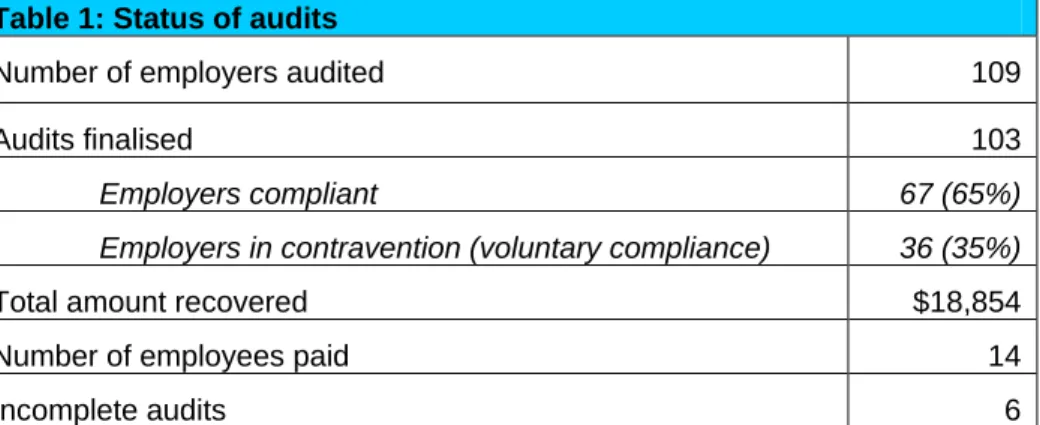
To date we have finalised 103 audits in the metal trade, child care, building and construction and hairdressing industries. Of the 103 finalised audits we have found 67 (65%) employers to be compliant and 36 (35%) to be non-compliant. Six matters remain opened due to ongoing investigations.
Whilst the majority of contraventions identified related to employers not meeting their record keeping and payslip obligations, we also identified instances of underpayments which resulted in us recovering $18 854 for 14 vulnerable employees.
Further findings and information regarding this audit program are detailed below.
Background
The FWO considers apprentices, trainees and juniors to be vulnerable workers. Often these workers are unclear of their entitlements and may not be confident to approach their employers to raise workplace concerns. The FWO therefore considered there would be value in undertaking a compliance program in the Kalgoorlie-Esperance region designed to ensure these employees, across selected industries, were receiving their correct entitlements.
The selected industries included childcare, hairdressing, metal trades, building and construction, hospitality and electrical.
Audit aim & objectives
The aim of the program was to conduct a compliance assessment across several selected industries in the Kalgoorlie-Esperance regions to ensure apprentices, trainees and young people are receiving their correct employee entitlements. The objectives of the program were to:
• assess compliance with rates of pay
• assess compliance with record keeping obligations
• educate employers on modern awards and obligations under the Fair Work Act and
Regulations 2009
• educate employers on the role and functions of the FWO
Stakeholder involvement
Between December 2010 and January 2011 we notified the following stakeholders of the audit program;
• The Chamber of Commerce and Industry WA (CCIWA) • Small Business Centre Goldfields
• CCI Apprenticeship Solutions • Department of Training
We undertook a number of joint educational initiatives with some of the stakeholders, including assisting the CCIWA and Apprenticeships Australia to develop and update their workplace relations information, which they provided to apprentices and their employers.
In conjunction with the Small Business Centre Goldfields, we facilitated a forum on ‘Engaging Apprentices and Trainees’. The forum, which was held in February 2011 coincided with a peak period for the commencement of new apprentices and trainees. The forum was also supported by the Department of Commerce – Labour Relations, CCI Apprenticeship Solutions and the
Department of Training and each of these organisations provided presentations on their role in regards to employing apprentices or trainees.
Given our engagement with these associations and the educational initiatives undertaken, we are confident that although we did not include entities from the hospitality and electrical trades
industries in our audit phase, many would have benefitted from both our educational activities and materials.
Method
Using data obtained from the Department of Education, Employment and Workplace Relations (DEEWR) we identified suitable businesses for audit within the selected industry sectors. We then issued these employers with a notification letter advising that they had been selected for an assessment and the requirement to forward us their apprentices, trainees and junior employees’ records for assessment.
The letters were sent out in phases, with the first industry sector to receive notification letters being child care centres.
If we did not receive an employer’s records in the required time frame, we made further contact with the employer by phone and further explained the requirement to forward us the specified documents.
Upon receipt of the records we assessed them ensuring employees were receiving their correct hourly rates of pay and the employer was maintaining time and wage records and issuing pay slips.
Where we found employers to be compliant we notified them of the outcome of their audit in writing and closed the file.
Where we identified potential contraventions we contacted the employer, to discuss the issue and in some cases requested further documentation. Once the contravention was confirmed we detailed our findings in a letter to the employer and asked the employer to voluntarily rectify the contraventions. Employers with monetary contraventions were required to back pay employees who had been underpaid.
Results
The findings contained within this report are covering the metal trades, child care, building and construction and hairdressing sectors.
Table 1: Status of audits
Number of employers audited 109
Audits finalised 103
Employers compliant 67 (65%)
Employers in contravention (voluntary compliance) 36 (35%)
Total amount recovered $18,854
Number of employees paid 14
Incomplete audits 6
As at 2 March 2012 we had completed a total of 103 audits, of which we found 67 (65%) employers to be compliant and 36 (35%) employers to be in contravention of their employer obligations. As a result of the audit program we were able to recover $18 854 for 14 underpaid employees, however this figure is likely to increase as there are six matters which remain opened due to ongoing investigations.
The non-compliant employers were found to have a total of 47 contraventions. The three most prevalent contravention types were those relating to time/wage records (38%), payslips (21%) and wages (19%).
Table 2 below shows the results by industry sector and the fact that the compliance rate varied amongst the different industry groups.
Although the number of employers audited within the building and construction industry was small (5), we found a compliance rate of 20% to be considerably low.
Table 2: Audit results by industry
Metal Trades
Childcare
Hair and Beauty
2 2 (100%) Audits Finalised 81 5 15 Compliance Rate 55 (68%) 1 (20%) 9 (60%) Contravention Rate 26 (32%) 4 (80%) 6 (40%) 0 - Ongoing Investigations 6 - -
Building and
Construction
Metal Trades Industry
The metal trades industry is covered by the Manufacturing and Associated Industries and Occupations Award 2010.
This industry is well represented in the region, employs a number of apprentices and trainees and therefore the majority of our audits were conducted amongst businesses from this industry. Of the 81 audits finalised within this industry we found a 55 (68%) employers to be compliant. The 26 non-compliant employers were found to have a combined total of 36 contraventions. The majority of the contraventions related to record-keeping (15) and payslip (9) contraventions.
We also identified underpayments which related to wages, allowances, leave loading and overtime. In total we recovered $1505.70 for 3 underpaid employees.
We found the majority of employers were paying their apprentices, juniors and trainees a flat rate of pay significantly higher than that of the base rate of pay prescribed in the Modern Award. In most cases this higher rate of pay was sufficient to cover all other entitlements prescribed by the Modern Award such as loadings, penalties etc. However sometimes as a result of this practice the employees were underpaid and consequently the employer was found to be in contravention. Due to the prominence of this practice, we delivered a presentation to advise employers of the potential risk of underpayments occurring if employers do not review the amount they paid their staff against the rates of pay the employee would be entitled to under the Modern Award.
Overall the majority of the contraventions which were identified within this industry related to payslip and record keeping requirements where employees were not financially disadvantaged
Child Care Industry
The child care industry is covered by the Children’s Services Award 2010 (Modern Award).
Six of the 15 employers we audited were found to be in contravention and 3 of these had monetary contraventions which resulted in $1607.67 being recovered for 5 employees. These contraventions related to the underpayment of hourly rates of pay and allowances.
We found that most of the employers we audited were unfamiliar with the Modern Award and the junior transitional rates between the Modern Award and the Pre-Modern Award. As the Pre-Modern Award provided similar rates of pay as the Modern Award, we did not identify significant
underpayments. However we provided additional information to these employers to assist them to better understand their obligations.
Building and Construction Industry
The building and construction industry is covered by the Building and Construction General On-site Award 2010.
Although we targeted 17 entities in the building and construction sector we only found 5 that engaged apprentices, juniors or trainees and consequently were suitable for audit.
The 5 employers we audited appeared to have limited knowledge of the applicable award with 4 of the 5 employers found to have monetary contraventions and one to have a payslip
contravention.
A total of $15 741.40 was recovered for 6 employees within this industry with one employer found to have underpaid 3 employees in excess of $14 000.
Hair and Beauty Industry
The hair and beauty industry is covered by Hair and Beauty Industry Award 2010.
Many of the hair and beauty businesses in the Kalgoorlie-Esperance region were either not within the FWO’s jurisdiction or not hiring apprentices and/or juniors. Only two hairdressing businesses were suitable for audit and both employers were found to be compliant.
Other Findings
In addition to the industry findings above, we identified a number of regional common trends and issues.
In the Kalgoorlie region we found the majority of employers paying their staff above the minimum entitlements prescribed by the relevant Modern Award. The underpayments we identified were mainly as a result of employers paying a high flat hourly rate, which depending on the hours worked, could result in employees being financially disadvantaged.
We also found that several employers were not familiar with the requirements of Individual Flexibility Arrangements (IFAs) provided in Modern Awards. We therefore took the opportunity to provide these employers with information about IFAs, while also inviting them to attend the presentation we offered to employers in the region, which among other issues, addressed the requirements of IFAs.
In the Esperance region, we found many of the employers to be familiar with their obligations. However we found that some employers had not increased the rates of pay in line with the Federal minimum wage setting decision of July 2011 and consequently had underpaid their employees. Of interest, it was generally first year apprentices that were being underpaid.
We also found that although most employers maintained records and issued payslips, we found instances where some of the records and payslips did not contain all the information required to be recorded as per the Regulations. For example, payslips which did not detail the business’
Australian Business Number or the employee’s superannuation fund details.
Conclusion
Overall we were pleased to find a reasonable level of compliance amongst the businesses audited with the exception of those in the construction and building industry. Further it was encouraging that where we did find contraventions, many were of a technical or non-monetary nature. We did not find any employers deliberately not complying with their obligations. One recommendation we make however, is that employers regularly review their rates of pay so as to ensure they are not underpaying their staff.
Having established a good working relationship with several industry stakeholders in the region, we look forward to continuing this relationship into the future. The work we undertook in collaboration with the stakeholders was valuable in educating employers and employees about the roles and functions of the various apprenticeship and trainee organisations as well as the FWO.
© Commonwealth of Australia 2012
This work is copyright. You may download, display, print and reproduce this material in unaltered form only (retaining this notice) for your personal, non-commercial use or use within your organisation. Apart from any use as permitted under the Copyright Act 1968, all other rights are reserved. Requests and enquiries concerning reproduction and rights should be