CASINO GAMING (Table Games)
Contents
A. Introduction B. Background
C. Current Casino Policies D. Current Situation Assessment E. Landscape of Other Provinces
F. Summary of Findings – Public Views and Stakeholder Consultations G. Primary Issues and Recommendations
A. Introduction
Casino gaming (table games) is a form of charitable gaming in the province. Casino events may only be held when the Alberta Gaming and Liquor Commission, under provisions of the Gaming and Liquor Act and policies of the Commission Board, issues a casino event licence to an eligible charitable or religious organization.
The licence authorizes the organization to hold a casino event at a permanent, licensed casino facility or during a special occasion event, such as a major exhibition. The licensed organization is required to provide volunteers for various key positions during the casino event and to use the proceeds it earns for approvedcharitable or religious purposes.
This section discusses the background to casino gaming in the province. It provides key
information related to current casino policies and an assessment of the current situation regarding casino gaming, including a discussion of the First Nations gaming policy that allows for on-reserve casinos, announced by the government in January 2001. As well, the casino policies of other provinces are provided for comparison.
Highlights of some key views and perspectives of Albertans and those of stakeholders regarding casinos are also provided.
This section concludes with recommendations to address primary issues that were identified during the Gaming Licensing Policy Review.
B. Background
Casinos in Alberta
Casino gaming (table games) is a form of charitable gaming. It is governed by the Criminal Code (Canada), Gaming and Liquor Act (Alberta), Gaming and Liquor Regulation (Alberta), and the policies of the Board as contained in Casino Licence Terms & Conditions and Operating Guidelines and Casino Terms & Conditions and Operating Guidelines.
In Alberta, casino gaming typically includes both table games and slot machines and is held in a facility licensed by the Alberta Gaming and Liquor Commission. In this section, casino gaming refers to the table game activities offered in casinos. For a detailed discussion about electronic gaming devices, see the separate section “Slot Machines.”
The casino facility may only operate under a casino event licence issued by the Commission to an eligible charitable or religious organization. The charitable or religious organization is required to provide volunteers for various key financial positions during the casino event and earns proceeds from the table games at the casino event. The proceeds must be used for approved charitable or religious purposes. Charitable volunteers have no direct role or involvement in the operation of slot machines during the charitable casino event.
This charitable model of casino gaming in Alberta is distinctfrom the casino model of a number of other provinces, in which casino gaming is conducted and managed by government through a crown agency and net revenues are allocated at the discretion of the government. In Alberta, licensed charitable groups conduct and manage table games at casino events.
Casino Table Games and Slot Machines
There is an important distinction to be made between the conduct and management of casino table games and that of slot machines in casino facilities.
Charities are licensed specifically to conduct and manage the table games in Alberta casinos. This is possible through provisions of the Criminal Code, which authorizes the provincial government to issue licenses to charitable and religious organizations to conduct and manage specified types of lottery schemes as long as the proceeds are used for charitable or religious purposes.
Under Alberta’s Gaming and Liquor Act, a casino event (or the operation of the casino) occurs under a licence issued by the Commission to a charitable or religious group. The group earns net proceeds from the table games and also receives a commission from the slot machines. The casino facility licensee receives a fee for providing space and services.
Under the Criminal Code, only a provincial government may conduct and manage electronic gaming devices such as slot machines. The Gaming and Liquor Act authorizes the Commission to fulfill that role on behalf of the province. In that regard the Commission enters into an agreement with casino facility licensees to provide various services to operate slot machines during licensed casino events. The licensed charitable groups have no direct role or function
regarding the operation of slot machines, but are paid a commission for allowing the province to operate slot machines during their licensed casino event. Further details are provided in the separate section “Slot Machines.”
In 2000-01, almost 2,700 casino event licences were issued. Casino table games generated gross revenues of approximately $610 million and returned $499 million in prizes to players. Charities received $34.3 million from casino gaming. An additional $52.4 million in net revenues from slot machines was provided to charities that held casino events, for a combined total of $86.8 million. Charities paid $77 million in expenses to casino facility operators, casino advisors, trustees and others for their services related to table games.
Types of Table Games
Following are the types of table games currently permitted in casinos in the province:
• Blackjack (Lucky Sevens, Multiple Action Blackjack, and Hole Card Blackjack)
• Mini Baccarat
• Poker (Seven Card Stud, Texas Hold’em, Omaha Hold’em, High/Low Split and Bad Beat Poker Pots)
• Pai Gow Poker
• Other Table Games (Red Dog, Super Pan Nine, Casino War)
• Roulette
• Sic Bo
• Approved Wheels of Fortune
• Caribbean Poker (Caribbean Stud Poker and Caribbean Draw Poker)
• Let It Ride
• Wild Jackpot Poker
• Tile Pai Gow
• Hand-Held Mini-Baccarat
• Craps
Types of Casino Licences
There are two types of casino licences: (1) the casino event licence and (2) the casino facility licence.
The casino event licence is issued to a charitable or religious organization, or to an agricultural fair or exhibition, which authorizes the holding of casino table games for a specified period of time in a licensed casino facility. The licensed charity is required to provide volunteers for various positions during the casino event. The eligibility criteria for a charitable gaming event licence are described in theappendix “Gaming Revenues, Disbursements and Use of Proceeds.” The fee for a casino eventlicence is calculated by multiplying the number of gaming tables by $15, and multiplying that amount by the number of casino days authorized under the licence. Poker tables are excluded from the calculation.
A casino facility licence is issued to a person or affiliated group of persons or a company that meets the requirements of the Gaming and Liquor Act and the Gaming and Liquor Regulation
and is approved by the Board. The casino facility licensee must provide space and services to licensed charities holding a casino event that meet the standards and requirements outlined in
Casino Terms & Conditions and Operating Guidelines.
Evolution of Casinos in Alberta
Agricultural fairs and major exhibitions in the province played a pivotal and pioneering role in casino gaming. The province’s first casino opened at Edmonton’s Klondike Days annual fair in 1967 and was operated by a non-profit group. The casino was opened for one week and held at the Silver Slipper Saloon on the Edmonton Exhibition grounds.
The Calgary Stampede opened the Frontier Casino on the Stampede grounds during its summer exhibition in 1969.
In 1970, the Criminal Code was amended, transferring the authority to license and operate lottery schemes from the federal government to provinces. At this time, both the Calgary Stampede and Edmonton Northlands operated up to three casinos per year.
1970s - Charitable System of Gaming
The charitable system of casino gaming was developed in the mid seventies. In 1974, 158 casino event licences were issued in the province. The total drop (money spent to buy chips) in that year was $4.4 million.
The first non-profit casino venue was established by the Kinsmen Club in Edmonton in 1975. At about the same time Edmonton Northlands and Calgary Stampede agreed to hold one casino per year in exchange for having the exclusive right to operate casinos during the time of their 10 day summer fairs.
Starting in 1976, the licensing system was based on: casinos being an alternative fundraising activity by eligible community organizations, which were required to be accountable for the use of proceeds and the conduct and management of casino gaming being the responsibility of the charity. These formed the key elements of the charitable gaming model for casinos in the province.
From June 1, 1976 to December 31, 1980, three casino licences were issued per week in Calgary and Edmonton. Only one public casino could be held at a time in any city.
1980s - Permanent Charitable Casinos
The province’s first permanent, privately-operated charitable casino opened in Calgary in 1980 and the second was established in Edmonton in 1981.
Beginning in 1981, the licensing authority held random draws once every two months to
determine the dates when an eligible charity could hold a casino event. They involved drawing a casino date from one envelope and drawing a charity name for that date from another envelope to
match the two. The names of the charities were placed in the random draw on a first come first served basis to hold a casino in the next available two month period.
In 1985, the Criminal Code was amended, granting authority to the provinces to conduct and manage mechanical and electronic gaming devices. It would be more than 10 years before the province would introduce slot machines to casinos.
In 1987, charities were given the option to pool revenues from casino events. In 1988 the number of allowable casinos per week was increased to eight from four. The number of blackjack tables permitted in casinos was increased. The betting limit was increased to $50. Starting in October, 1988, casino draws were held every six months on a first come first served basis.
In 1989, casino draws were held quarterly.
1990s - Growth of Casino Gaming
In July 1990, charities were permitted to enter into pre-signed agreements with facility operators to hold a casino event in the operator’s facility. Mini Baccarat was permitted in casinos in 1990. In 1995, the Lotteries Review Committee conducted public hearings, seeking input into various issues on future directions for lotteries and gaming in the province. One of the issues dealt with how casinos should operate in the future. It made various recommendations in this regard (see “Current Casino Policies” in this section). In 1995 the number of permanent casino facilities increased to 11 full-time casinos and three that operated on weekends.
In July 1995, the Alberta Gaming and Liquor Commission amalgamated all liquor and gaming regulatory, enforcement and marketing agencies, including the Alberta Gaming Commission, the Gaming Control Branch, Alberta Lotteries and Gaming and the Alberta Liquor Control Board. In July 1996, the Alberta Gaming and Liquor Commission would be formally established in the
Gaming and Liquor Act (Alberta).
In September 1995, poker was introduced to casinos.
Between 1985 and 1995 new casino facilities were opening and, due to the resulting increase in facility fees charged by operators, the charitable groups’ share of proceeds decreased. Various changes were made to casino policies in 1996 to address the decrease in the charities’ proceeds. In January 1996, up to nine licences were issued per week in Edmonton and Calgary. The number of licences was increased to 12 per week in the two cities starting July 1, 1996. Slot machines were first introduced into summer fair casinos and then, beginning in 1996, installed into permanent casino facilities and racing entertainment facilities.
Facility Fee Fixed to a Maximum Percentage of Net Revenue
Two changes were made on July 1, 1996, to address the issue of charities losing money during casino events.* The operating expense fee which had to be paid before a charity could earn any casino proceeds was removed. In its place casino operators were limited to a fixed fee that could not exceed a maximum percentage of the net proceeds (after prizes). In addition the pooling of casino proceeds was made mandatory at all casino facilities in the province to even out the disparity in net revenues between different casino events at the same casino facility. This averaging of revenues guaranteed charities would earn proceeds from a casino event rather than experience a loss as had occurred previously.
The Commission began to license casino facilities in 1996, under the province’s new Gaming and Liquor Act and Gaming and Liquor Regulation.
First Nations’ Interest in Gaming
First Nations beganto express interest in operating casinos to fund economic development in the 1990s. The Native Gaming Committee, comprised of government MLAs,submitted its reportto thegovernment with recommendations in April 1996. To assure the viability of casinos as a source of revenue for non-profit organizations, the committee recommended a maximum of four First Nations casinos be licensed on reserves, or contiguous to the reserve and that First Nations casinos be subject to the same rules, regulations and legislation as other charitable casino gaming initiatives.
Casino Gaming Transformed
Various developments helped to begin the transformation of the province’s casinos from basic gambling rooms to more elegant destinations that were expanded to allow space for slot machines. Among them were the relocation of the Palace Casino in August 1996 and the opening of Baccarat Casino in October 1996 and Casino Calgary in May 1997.
On July 28, 1997, the casino operating guidelines allowed the maximum number of slot machines in casino facilities to be doubled, the hours for table games to be extended by one hour to a maximum of 14 and for liquor to be served on the casino gaming floor. The Silver Dollar Casino in Calgary was designated to serve rural communities around Calgary.
Beginning on October 1, 1997, casinos could operate on Sundays.
*
Such losses were experienced for various reasons. Among them, the building of new casino facilities resulted in an increase in the facility fee cost. Charities were required to pay the facility fee cost before they could earn any proceeds from casino events. To protect themselves from the possibility of losing money they could buy “no loss insurance.” In addition, the level of net revenues earned from casino to casino was based on the luck of the draw. For example, the amount earned would be influenced, among other factors, by when the event occurred. In the larger centres since only one casino event was held on Monday or Tuesday, charities typically earned more in revenue than casinos held other days when more casino licences
Effective April 1, 1998, revenue from slot machines was pooled on a city-wide basis, affecting the cities with more than one casino facility (that is, Edmonton with four casino facilities, Calgary with five, Red Deer with two and Lethbridge with two). Previously the revenue was pooled by facility.
The Alberta Lotteries and Gaming Summit ’98 was held in Medicine Hat in April 1998. The government accepted or accepted in principle all of the summit recommendations, including the recommendation the charitable model for operating casinos and bingo be maintained.
In December 1998, casinos were permitted to operate poker rooms during extended hours, beyond those of the rest of the casino, as long as the room could be accessed by a separate outside entrance during the extended hours. The policy change was aimed at discouraging illegal poker rooms from operating in the province, in particular in Edmonton and Calgary.
Casino operators have expanded their facilities since 1997 to accommodate additional slot machines and attract additional slot players. The incremental sales generated through slot machines would help to make expansion and renovation viable. Those facilities that performed renovations and invested in decor and ambience experienced higher increases in sales while those that did not experienced declines in sales.
On May 25, 1999, the provincial government established the Ministry of Gaming, the first in Canada.
In the summer of 1999, the Cash Casino in Lethbridge closed.
Craps was legalized by an amendment to the Criminal Code in 1999. In that year various casino facilities in the province began offering this dice game to their customers.
The Gaming Licensing Policy Review was announced in December 1999. The Minister of Gaming requested, pending the outcome of the review, the Commission suspend consideration of requests to license or approve new casinos, casino expansions or re-locations, new games and new gaming environments.
Proceeds to charities from casino slot machines was $52.4 million in 2000-01, exceeding for the first time the proceeds from casino table games. Slot revenue had increased dramatically since 1995-96 when casino slot machines were introduced and generated $166,000 in proceeds to charities.
2000s - First Nations Gaming Policy
The government announced the First Nations Gaming Policy in January 2001, which will allow for on-reserve casinos. The specific terms and conditions for on-reserve casinos, to be developed as part of the Gaming Licensing Policy Review, are to be consistent with those for other casinos in the province with the exception that First Nations charity workers will be paid for their participation and the casino event licensee can be one umbrella charity.
C. Current Casino Policies
Criminal Code Requirements
In Canada, the Criminal Code (Canada) establishes the legal foundation for gaming activities. All gambling that occurs in any province or territory must meet the requirements of the Criminal Code.
Casino table games are considered a “lottery scheme.” These table games would be illegal if it were not for provisions of Section 207(1)(b) of the Criminal Code which state it is lawful
…for a charitable or religious organization, pursuant to a licence issued by the Lieutenant Governor in Council of a province or by such other person or authority in the province as may be specified by the Lieutenant Governor in Council thereof, to conduct and manage a lottery scheme in that province if the proceeds from the lottery scheme are used for a charitable or religious object or purpose;…
Section 207(2) of the Criminal Code allows a provincial authority to prescribe terms and conditions relating to the conduct, management and operation of licensed lottery schemes.
Gaming and Liquor Act (Alberta)
In Alberta, casinos are administered and regulated under the provisions of the Gaming and Liquor Act (Alberta) and the Gaming and Liquor Regulation (Alberta).
The Gaming and Liquor Act grants authority to the Commission to issue casino licences and to impose conditions on those licences subject to the authorization of the Lieutenant Governor in Council (s. 35). The act also authorizes the Lieutenant Governor in Council to make regulations respecting conditions and eligibility requirements that must be met before a licence is issued or a person is registered (s. 126).
Gaming and Liquor Regulation (Alberta)
The Gaming and Liquor Regulation establishes the casino licence, which “authorizes a casino” (s. 19(d)).
Under section 20 of the regulation, only charitable or religious organizations are eligible for a casino licence and must satisfy the Board of the Commission the proceeds from the gaming activity will be used for a charitable or religious object or purpose approved by the Board. The regulation also establishes the following class of registration of gaming worker:
“casino worker: authorizes a person to perform a function specified in the registration at a casino;…” (s. 25(a)).
A “gaming worker” is a person paid to assist a gaming licensee in the conduct or management of a gaming activity (s. 24).
The regulation also establishes the casino facility licence. That licence “…authorizes the operation of a facility in which a casino may be conducted” (s. 22(b)). Section 23(1)(3) of the regulation provides that: “A casino facility licence may only be issued to an individual, partnership or corporation.”
The regulation also requires anyone who deals in gaming supplies must be registered with the Commission (s. 27).
Casino Policies
The province’s casino policies are contained in two documents:
• Casino Licence Terms & Conditions and Operating Guidelines - A set of policies for charities holding casino events indicating the requirements under a casino event licence.
• Casino Terms & Conditions and Operating Guidelines - A detailed set of policies mainly for casino facility operators. It covers among other subjects casino operational requirements, facility standards and requirements, security standards, permitted games, rules of play, etc.
Lotteries Review Committee
A number of current casino policies were adopted in response to recommendations of the Lotteries Review Committee in 1995. The committee specifically recommended the following, many of which were to be adopted:
• That the number of charitable casino event licences in Edmonton and Calgary be increased to 12 from eight due to demand.
• That operating hours for casinos should be extended to allow for 13 consecutive hours, within the hours of 11 a.m. to 2 a.m.
• That casino VLT revenues should go to non-profit organizations (note:slot machines were not yet introduced to casinos; VLTs were located in separate lounges of
casinos).
• That casino revenues should be pooled over a three-month period so that non-profit groups can share in the revenues.
• That 15% of net VLT revenues in casinos should be shared by non-profit groups and the casino operator as follows: 2/3 to the former, 1/3 to the latter as a management fee. The remaining revenue would continue to go to the province to be reallocated according to the funding formula as suggested.
• That smaller groups share one licence to avoid issuing casino licences to organizations that intentionally split for the purpose of obtaining more than one licence during the year.
• That large-scale, Vegas-style casinos should not be allowed anywhere in Alberta and casinos must be government regulated and retain their non-profit status.
Casino Policies Revised
In response to the Lotteries Review Committee, the number of casino event licences were increased to 12 from eight per week in Edmonton and Calgary starting July 1, 1996. The intent was to reduce the length of the wait list to hold a casino event. Operating hours were extended to a maximum of 13 consecutive hours within the hours of 11 a.m. to 2 a.m. (and currently is a maximum of 14 hours).
Slot machines were introduced into casino facilities in early 1996 and a portion of the net
revenues generated by them were allocated to licensed charities. The pooling of table revenue by facility was established in July 1996.
Groups applying for licences were reviewed as to their relationship with other groups that may be related or which belong to the same umbrella group and casino events were allocated
accordingly. This was aimed in part at preventing the issuing of casino events licences to groups that divide for the purpose of obtaining additional casino event licences.
Casinos continue to be strictly regulated and controlled by the province.
Native Gaming Committee
In April 1996, the Native Gaming Committee, comprised of government MLAs and chaired by Judy Gordon - MLA Lacombe Stettler, issued its findings and recommendations, including those relating to First Nations gaming. Among them was a recommendation to allow for up to four First Nations casinos on or contiguous to reserves. The government endorsed the committee’s report and recommendations in June 1996.
From 1996 to 2001, a number of First Nations expressed interest in establishing an on-reserve casino. First Nations and the Commission have held discussions on gaming, including sessions to clarify the requirements for casinos under the province’s charitable model.
In January 2001, the government formally announced a First Nations gaming policy. The policy takes into account the changes that have occurred in gaming in the province over the past five years.
Key Casino Policies
Following is a summary of the current key casino policies regarding the casino event licence and the casino facility licence. The casino event licensee (charity) provides volunteers who are responsible for cash and financial controls. The casino facility licensee (operator) provides gaming expertise and facilities and is responsible for the game chips. During the operation of a casino, players exchange cash for chips and vice versa. At the completion of a two-day event, the charity’s cash is reconciled to the operator’s chips and any discrepancies noted. This balancing and separation of responsibility provides financial integrity and control.
Casino Event Licensee Requirements
A casino event may only occur in the province when a casino event licence has been issued by the Commission to an eligible charitable or religious organization. Generally, casino events last two days and are held in a permanent licensed casino facility. In some cases, a casino event licence may also be issued to eligible charitable organizations that intend to operate a relatively small number of table or “wheel” games in an unlicensed facility, such as a small agricultural fair or rural community hall.
A casino event licensee enters into a contractual agreement with the operator of a casino facility in which it wishes to conduct its casino event. A charitable organization may select the casino facility in which to hold its events. In this regard, the charity is limited based on the designated region within which they may hold casino events. For example, only charities based in
Edmonton, a designated region for purposes of casino gaming, may hold a casino event at a casino facility in the city, subject to availability.
There are various requirements for volunteers of the licensed charity. The licensed charity must appoint volunteers to fill the following positions during its casino event:
• General Manager and Alternate General Manager - Responsible for all aspects of the casino, including designated staff are in place, witnesses interim and final pull of drop boxes, all key financial transactions and security.
• Banker - Supervises the cash cage and is directly accountable to the General Manager; is responsible for Cashiers and Chip Runners.
• Cashier - Receives and counts opening cash fill and required forms from the Banker; documents transactions with the banker and maintains security of chips and cash; ensures all player cash-outs over $200 are witnessed by any of the General Manager, Banker, Financial Controls Supervisor or Advisor; at the end of a shift accounts for all chips and cash for which they were responsible.
• Chip Runner - Participates in games opening or transfers opening chip fills from Banker to games as requested; at final close of games each day witnesses chip count, completes Closing Game Inventory of Chips.
• Count Room Supervisor - Directly accountable to the General Manager for supervision of count room procedures including count room staff.
• Counter - Empties drop boxes, shows everyone present that they are empty; assists sorting of cash or chips as needed; counts sorted cash or chips.
• Sorter - Sorts cash or chips into denominations; gives all other drop box contents to Count Room Supervisor; witnesses count by Counter.
• Amalgamator - Receives cash or chips from sorter; amalgamates all cash or chips in count room by denomination and bundles cash; assists count room supervisor to summarize cash and chips at the end of each drop.
The charities pay facility operators a fixed fee for space and services, to a maximumof 50% of net proceeds earned in Edmonton and Calgary casinos, 35% in St. Albert and 25% in other locations.
Licensed charities must pool net casino proceeds (and/or losses) with all charities licensed in the same casino facility within the same pooling period.
Net casino proceeds from all facilities operated by the same casino facility licensee in a city are pooled within the same pooling period. The pooling period is the same as the quarterly draw period. Quarters are January-March, April-June, July-September, and October-December. Pooling guarantees charities a return from holding a casino event. It is a fair system of dividing net revenue regardless of the days on which a charity’s casino event may be held. As well, any losses incurred are included in the pool with the end result that all charities earn money from holding a casino event.
The facility licensee, with the Commission’s approval, is required to select a trustee and establishes a casino pooling trust agreement to be used for the casino facility. All licensed charities are required to sign an agreement with the trustee and submit a copy of the master agreement to the Commission for approval before the pooling period begins.
Slot machine proceeds are pooled by city during the same quarterly periods and divided as follows: charity commission - 15%, casino facility operator commission - 15%, and Alberta Lottery Fund -70%.
Licensed charities are required to provide a series of reports to the Commission within seven daysafter the casino eventis completed. Any discrepancies must be reported.
For a detailed discussion about eligibility requirements andthe allowable uses of proceeds from charitable gaming, refer to the appendix “Gaming Revenues, Disbursements and Use of
Proceeds.”
Casino Facility Operator Requirements
During a casino event the casino facility licensee must provide to the licensed charity the following:
• use of the casino facility, all the required casino gaming equipment, operating floats, chip inventory, registered gaming workers, playing cards, surveillance equipment, armoured car service, insurance and marketing and promotions.
Each casino facility licensee must provide the charity licensed to hold a casino event in the facility with a Casino Facility and Service Agreement. That agreement must establish fixed fees or charges for the operation of the casino. The operator is entitled either to the fixed fees or a percentage of the gross casino proceeds, whichever is less. The revenue sharing formulas of net gaming proceeds are as follows:
• 50% of net proceeds for Edmonton and Calgary casinos, up to the fixed fee for the facility;
• 65% of net proceeds for the St. Albert casino, up to the fixed fee for the facility; and
• 75% of net proceeds for other casinos, up to the fixed fee for the facility. The facility operator and event licensee are jointly responsible for any losses incurred in proportion to the revenue sharing formula.
Casinos are allowed to operate table games a maximum of 14 consecutive hours, within the hours of 10:00 a.m. to 2:00 a.m. Slot machines may be operated for up to 17 consecutive hours within the hours of 10:00 a.m. to 3:00 a.m. Casinos held at agricultural fairs and exhibitions may operate a maximum of 16 consecutive hours. Casinos are allowed to operate seven days a week and must be closed on Christmas Day.
Poker rooms may operate beyond regular casino hours. The intent is to discourage illegal clubs from operating in the same city as the casino. Poker rooms must havea separate entrance to the room from the outside so patrons do not have to enter through the main casino gaming floor. Those under 18 years of age are not permitted to be in a casino facility or to work as casino volunteers.
Facility Requirements
Prior to receiving a casino facility licence, the proposed facility is required to meet various community standards. For example, it must not have a negative impact on other existing gaming facilities (that is, put the charities using the facilities in a high risk financial situation). The facility may not be located within the same building envelope as an existing casino facility. The applicant for a casino facility licence is required to undergo extensive background checks, including criminal record checks. The applicant must bear the costs associated with the background checks.
The applicant must ensure the proposed facility is always in compliance with all municipal, provincial and federal legislation and obtains all the necessary permits, licences and authorizations.
The Casino Terms & Conditions and Operating Guidelines specify the areas, rooms or equipment that are required in a casino facility. They include, among others: a gaming floor, main cash cage, slot machine cash cage, count room, security desk, monitor room and security equipment.
The sizes of the areas or rooms is based on whether the facility offers 16 or more table games or fewer than that amount. For example, the gaming floor size with 16 or more tables must be a minimum of 20,000 square feet (1,858 square metres), with less than 16 tables 7,500 square feet (697 square metres).
If liquor is served all the necessary liquor licence requirements must be met.
Signs and documents must be posted. Those include the casino facility licence, casino event licence, house rules poster, gaming irregularities poster, problem gambling poster, a “No Minors Allowed” sign, among others.
Each facility must have the specified security equipment including a closed-circuit television system. Various procedures are outlined if cheating at play or other illegal activity is observed or suspected.
Casino facility operators provide paid staff for most of the following gaming positions: a) games manager
b) pit supervisor c) pit boss d) dealer
e) cash cage advisor f) count room advisor g) financial control supervisor h) slot machine manager
i) slot machine operator, including slot machine attendant and cashier j) security guard
k) monitor room personnel and l) casino manager
All the positions above except f) and g) are employees of the casino. The cash cage advisor and count room advisor are independent advisorsand hired by the charity conducting the casino event to assist in the event. The financial control supervisor position is an optional position offered by the casino facility licensee, one thatwould be filled by a casino employee to serve as a casino advisor to a licensed charity instead of an independent advisor. Most casinos do not have a financial control supervisor position.
Gaming workers hired by the facility operator must pass a criminal record check and be registered by the Commission. The registration of a gaming worker must be kept current. Various policies are provided for the conduct and appearance of gaming workers and the duties of each position. Operating procedures are provided for the cash cage and count room. The casino terms and conditions apply to the gaming floor layout, games mix, table set up, betting procedures, betting limits and games floor. The terms and conditions include the rules of play for each of the table games permitted in the casino.
The casino terms and conditions also specify the requirements on the casino gaming floor for slot machines, including the maximum number of slot machines that may be provided based on a space allotment per machine. Casino facility licensees may only operate slot machines under a casino gaming retailer agreement with the Commission. Refer to the section “Slot Machines.”
D. Current Situation Assessment
Permanent Casino Facilities
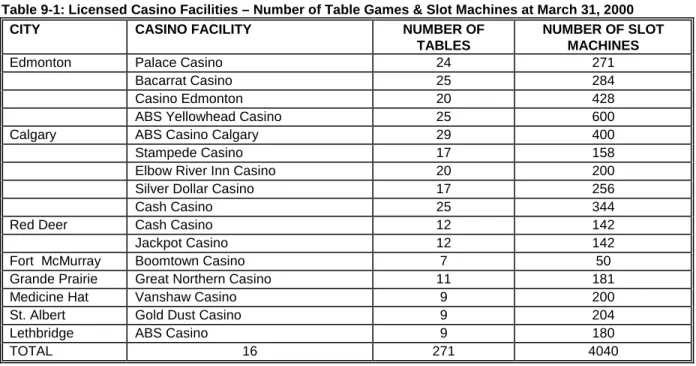
There are 16 permanent charitable casino facilities throughout the province. Nine are located in Edmonton and Calgary and seven are regional casino operations (the Silver Dollar Casino in Calgaryserves rural charities).
The locations and names of the province’s permanent casino facilities, and their respective number of table games and slot machines as of March 31, 2001, are listed in the following table: Table 9-1: Licensed Casino Facilities – Number of Table Games & Slot Machines at March 31, 2000
CITY CASINO FACILITY NUMBER OF
TABLES
NUMBER OF SLOT MACHINES
Edmonton Palace Casino 24 271 Bacarrat Casino 25 284 Casino Edmonton 20 428 ABS Yellowhead Casino 25 600 Calgary ABS Casino Calgary 29 400 Stampede Casino 17 158 Elbow River Inn Casino 20 200 Silver Dollar Casino 17 256 Cash Casino 25 344 Red Deer Cash Casino 12 142 Jackpot Casino 12 142 Fort McMurray Boomtown Casino 7 50 Grande Prairie Great Northern Casino 11 181 Medicine Hat Vanshaw Casino 9 200 St. Albert Gold Dust Casino 9 204 Lethbridge ABS Casino 9 180 TOTAL 16 271 4040
Summer Fair Program
The Board of the Commission each year authorizes casinos as part of the summer fair program. In 1999-2000 the Board authorized casino events at seven summer fairs as follows: Calgary Exhibition and Stampede, Edmonton Northlands, Lethbridge and District Exhibition, Medicine Hat Exhibition and Stampede, Westerner Exposition Association (Red Deer), Camrose Regional Exhibition and Agricultural Society and T’suu Tina First Nation PowWow Days.
The summer fairs offered table games and a number also offered slot machines at their casino events. Edmonton Northlands, Calgary Stampede and Camrose Regional exhibitions offer table games as well as slot machines. The major exhibitions in Red Deer, Medicine Hat and
Lethbridge were licensed to hold their summer fair casinos at the existing permanent casino facilities in those centres. None of them have table games at their summer fair site. Only slots were operated during the T’suu Tina First Nation PowWow Days.
Permanent Facilities: Casino Licences Issued by Community
In all cases, except for the Red Deer casinos, there is a balance between the number of casino event licences issued in a municipality at any one time and the number of permanent casino facility operations found there.
For example:
• In Calgary, 35 two-day casino event licences are issued biweekly. That equals 70 days of operation over 14 calendar days, providing five casinos with adequate licences to operate seven days per week.
• Seven two-day licences are issued biweekly in Grande Prairie, Ft. McMurray, Medicine Hat and Lethbridge, providing each casino with seven days of operation per week.
In Red Deer two casinos compete for charities’ licences on weekdays so that one operator remains open while the other must remain closed or “dark.” Additional weekend licences are issued so both operators can remain open on weekends. Over a 14 day cycle there are six days where both casinos are open: Friday-Saturday during the first week and Thursday-Friday-Saturday-Sunday during the following week.
The Commission controls the number of casino facilities in each municipality through the rate at which it issues licences. For example, the Commission issues 35 casino licences biweekly in Calgary. If the Commission were to issue 42 casino licences biweekly, an additional casino facility would be required.
Designated Casino Regions
A charity is required to hold casino events within a casino facility that falls within its designated region in the province. For example, only charities based in Edmonton and Calgary may access casino events in those cities or “regions.” A licensee in a rural location may only conduct events in the nearest regional casino facility to that location. It must be a facility other than one located in Edmonton or Calgary (an exception is the Silver Dollar Casino in Calgary, which serves charities in rural communities around Calgary).
Wait Times to Hold Casino Events
The wait time for a charity to hold a casino event at a permanent casino after it has obtained a casino event licence from the Commission varies by community based on the level of demand for event licences. The wait time in most communities is considerably longer than one year as shown in the following table:
Table 9-2: Approximate Waiting Period to Hold Casino Events, by City
CITY WAITING PERIOD
Edmonton 22 months Calgary 18 months Red Deer 20 months Lethbridge 22 months St. Albert 29 months Medicine Hat 6 months Fort McMurray 12 months Grande Praire 16 months
The approximate wait time for rural charities around the City of Calgary, which conduct their casino events at the Silver Dollar Casino in Calgary, is 20 months.
Revenues Increase as Casino Gaming Environments Enhanced
The gaming environment within permanent casino facilities throughout the province has improved over the past few years, providing a higher-quality gaming-entertainment experience. As a result, the facility standards for casino gaming in general in the province have risen. The Commission continues to examine casino facility standards to ensure the integrity of gaming activities is maintained and to meet player expectations.Among recent improvements, the Great Northern Casino in Grande Prairie moved to a new location and the Medicine Hat casino renovated its existing space in 1999-2000. The ABS Casino in Edmonton closed one of its locations and opened its new Yellowhead casino facility in August 2000.
The Palace Casino also expanded and renovated to provide an improved environment for its customers. Based on customer demand, Casino Edmonton expanded its facility to accommodate additional slot machines, as did the Cash Casino facilities in both Red Deer and Calgary.
In September 1999, ABS Casino Calgary was authorized to expand its gaming floor to accommodate additional slot machines.
The casino in Fort McMurray moved to a downtown location on May 17, 2000, and began operating under the new name Boomtown Casino.
As casino facilities were improved and with the introduction of slot machines, the revenues from table games have increased. As more slot machines were allocated to casinos each year over the past five years, due to demand and performance, the revenue from slot machines has also steadily increased.
Casino operators and other interested parties continue to express interest in expansion, whether as renovations to their facilities, relocation or new casino facilities.
Revenue and Proceeds from Casino Events
In 2000-01, casinos generated $610 million in gross revenue from table games, an increase in gross revenue of 101% since 1995-96. As stated previously, that growth is attributed to the improvements made in casino facilities over the past few years.
As noted in the table that follows, the number of casino event licences increased by 178% over 10 years, to almost 2,700 licences in 2000-01 from the 954 issued in 1990. The proceeds to charities increased by 364% over the same period, to $86.8 million from $18.7 million. The total levels of charitable proceeds fluctuated from 1990 to 1995-96, but then increased in each
consecutive year over the last four years shown in the table.
Graph 9-1: Breakdown of Casino Revenue
0 200,000 400,000 600,000 800,000 1990 1991 1992 93-94 94-95 95-96 96-97 97-98 98-99 99-00 00-01 ($000s ) Prizes Charity Proceeds Expenses
Year Gross Casino
Revenue ($000) Prizes ($000) Expenses ($000)
Slot Proceeds Charity Proceeds
($000)
Licences Avg. Charity Proceeds per Licence 00-01 610,365 499,011 77,012 52,413 86,755 2,695 $32,191 99-00 594,127 493,056 61,890 37,440 76,621 2,695 $28,431 98-99 549,654 460,496 54,981 24,258 58,435 2,534 $23,060 97-98 476,712 392,997 50,725 10,975 43,965 2,291 $19,190 96-97 354,598 293,753 35,672 2,680 27,853 1,769 $15,745 95-96 303,948 251,724 34,572 166 17,818 1,418 $12,566 94-95 294,070 243,751 30,715 - 19,604 1,222 $16,043 93-941 297,634 245,158 29,497 - 22,979 1,192 $19,278 1992 243,287 196,705 25,668 - 20,914 1,041 $20,090 1991 224,312 181,428 23,629 - 19,256 997 $19,314 1990 192,257 153,114 20,442 - 18,700 954 $19,602 1
The 1992-93 fiscal year was not included, due to the overlap between the 1992 calendar year and the 1993-94 fiscal year. In addition, the variations in the figures reported for 1993 as compared to 1993-1993-94 were relatively small.
The average proceeds per licence fluctuated in the past 10 years. This is attributed to increasing expenses each year as gross revenues also increased. The highest average proceeds per licence over the past 10 years in the province was $32,191 earned in 2000-01 when 2,695 licences were issued. That compares to average proceeds of $19,602 per licence earned in 1990 when only 954 licences were issued, or about one-third of the number issued in 2000-01.
Proceeds by Commission Category of Licences
The Commission’s charitable gaming licence category that has benefited most from casino licences in 1999-2000 is sports, which accounted for 24.5% of all casino licences and 20.9% of proceeds, as indicated in the table that follows.
The categories that followed in terms of licences obtained and proceeds generated as a
percentage of the total were: education, social action, service and arts. Each of these categories generated an amount greater than 10% of total proceeds, while each of theother categories generated less than 10%.
Graph 9-2: Casino Proceeds and Licences
$5,000 $15,000 $25,000 $35,000 1990 1991 1992 93-94 94-95 95-96 96-97 97-98 98-99 99-00 00-01 P roc eeds 0 1000 2000 3000 Li cenc es Avg. Charity Proceeds per Licence Licences
Charitable Category Gross Casino Revenue
($000)
Licences % Licences Charity Proceeds
($000)
%Total Proceeds Avg. Proceeds per Licence Agriculture 16,322 81 3.0% 1,190 1.6% $14,691 Arts 60,240 258 9.6% 7,839 10.2% $30,384 Community 55,709 190 7.1% 6,879 9.0% $36,205 Education 81,847 328 12.2% 10,539 13.8% $32,131 Foundation 9,064 35 1.3% 1,178 1.5% $33,657 Medicine/Health 18,270 80 3.0% 2,387 3.1% $29,838 Multiculturalism 58,147 190 7.1% 7,109 9.3% $37,416 Other 5,657 18 0.7% 626 0.8% $34,778 Recreation 14,329 73 2.7% 1,981 2.6% $27,137 Religious 11,875 38 1.4% 1,471 1.9% $38,711 Senior Citizens 11,431 54 2.0% 1,516 2.0% $28,074 Service 57,764 357 13.2% 8,234 10.7% $23,064 Social Action 64,722 281 10.4% 8,343 10.9% $29,690 Sports 120,015 660 24.5% 16,017 20.9% $24,268 Youth 8,735 52 1.9% 1,312 1.7% $25,231 TOTAL 594,127 2,695 100.0% 76,621 100.0% $28,431
The highest average proceeds per licence were generated in the following categories: religious, followed by multiculturalism, community groups, other (those that do not fit into any of the other 14 categories), foundation, education, arts and medicine/health. The average proceeds per licence in the rest of the categories were less than the provincial average per licence.
Pooling of Casino Proceeds
Due to extreme fluctuations in the daily casino hold, charities’ proceeds are averaged through pooling.
Casino table proceeds are pooled by casino facility for 90 days. As table profits are pooled by casino facility the more successful casinos offer a higher pooled average. Charities in urban locations with more than one casino have the option of choosing the casino facility in which to conduct their licensed casino event. The table drop in the regional casinos outside Edmonton and Calgary is substantially less than the table drop in the two major centres.
Charities holding casinos receive a portion of the net revenue from slot machines generated during their casino events. When the slot machine portion of revenue from casino events is included in the total, charities earned a total of $76.6 million from casinos in 1999-2000.
The casino pool payouts per quarter vary from urban to rural locations, and among casinos in those locations. In 1999-2000 charities in Calgary earned from $21,000 to $60,000 in proceeds for holding a two-day casino event. The comparable figures for Edmonton ranged from $38,000 to $55,000 and those for regional casinos ranged from $2,800 to $19,800.
First Nations On-Reserve Casinos
In January 2001, the government announced a First Nations gaming policy that allows for reserve casinos. The policy formally responds to the interest of First Nations to provide on-reserve gaming.
The First Nations gaming policy must be taken into account when any consideration is given to the expansion of casino gaming or facilities in the province.
Under the policy on-reserve casinos will be required to follow the terms and conditions established for all other charitable casinos in the province. For example, the division of table game revenue would be determined on a casino by casino basis, consistent with the existing casino policy.
Specific conditions that apply to on-reserve casinos include the following:
• The net sales from slot machines will be divided as follows:
• 15% to the licensed charity;
• 15% commission to the casino facility operator;
• 30% to Alberta Lottery Fund for traditional initiatives, and
• 40% to Alberta Lottery Fund and specifically allocated to a First Nations Development Fund. The development fund will be available
to all Alberta First Nations to support economic, social and community development projects, including addictions programs, education, health and infrastructure.
That is, 30% of the net sales would be commissions divided equally between the charity and facility and 70% would go to the Alberta Lottery Fund, the same division of net slot revenue that currently exists among charitable casinos in the province.
• The host First Nation will be designated as the charity, through a registered not-for-profit society; and
• The host First Nation (as casino licensee and charity) and the casino operator must be clearly separate and distinct entities.
For the purposes of the First Nations Gaming Policy, a host First Nation is a First Nation with an operating casino licensed by the Province of Alberta and is located on an Indian reserve set apart prior to January 1, 2001, or on a reserve set apart after that date which is contiguous to an existing reserve and to which the Province of Alberta has consented.
E. Landscape of other Provinces
Where commercial casinos are permitted in other provinces, they are conducted and managed by the provincial government or its agent. Ontario operates its commercial casinos through a provincial crown corporation. In B.C. a portion of the proceeds from the commercial casinos are available to charities by applications through its Direct Access Program administered by the B.C. Gaming Commission. Smaller charitable casinos are being established in rural locations in Ontario.
A few provinces allow only Monte Carlo style casinos (typically blackjack tables and wheels of fortune) under licence to charities and do not have commercial casinos.
Participation in Casinos Growing in Canada
According to Statistics Canada, the largest generators of gaming revenues across the country are casinos. Since 1996, when Statistics Canada first examined the gambling industry, the growth in casino gaming has continued to outstrip that in most other industries. They exceeded revenues from VLTs in 1997 and ticket lotteries in 1998. Between 1992 and 1997, GDP in the gambling industry increased by 125% compared with just 14% in all other industries (Statistics Canada 2000, Update on Gambling).
The report also noted participation among players from 1996 to 1998 increased in casinos, as well as slot machines and VLTs, to 20% from 17% during those years. Meanwhile, participation across Canada decreased for all other gaming activities, including government ticket lotteries (to 77% from 86%); non-government lotteries, raffles and other games of chance (to 34% from 39%), and bingo (to 10% from 12%).
A number of other provinces have authorized casinos. As noted in the table that follows, each province has its own distinct model of casino gaming. In Alberta, charitable and religious organizations conduct and manage casino events. In a number of other provinces the provincial governments or their agents conduct and manage casinos rather than charitable or religious organizations.
Table 9-3: Landscape of Casino Gaming in Other Provinces – at March 31, 2000
JURISDICTION NUMBER OF CASINOS / SLOTS
DIVISION OF REVENUE COMMENTS
British Columbia
Conducted & Managed by British Columbia Lottery Corporation – a crown corporation.
:
Regulated by
Gaming Policy Secretariat :
BC Gov’t guarantees $125 million to charities each year (indexed annually at the rate of the Vancouver price index). June 1999 – end to gaming expansion announced. 2 destination casinos 18 Casinos 16 community casinos 523 destination 2,399 Slots 1,875 community 13 Poker tables 368 Table games 6 destination casinos approved in principle prior to gaming freeze in 1999; one is scheduled to open in Spring 2001.
25% slot win to operator Slots
75% to BCLC
40% table win to operator Table Games
60% to BCLC
Up to an additional 3% of table and slot win can go to the casino service provider for facility development based on an approved plan being in place.
Win = money the casino service provider receives from wagers, minus the winnings paid out.
Minimum age: 19 Alcohol prohibited at community casinos. Maximum 300 slots; 30 table games; plus an additional 4 poker tables per casino.
Host municipalities receive 10% of net revenues from community casinos and 1/6 of net revenue from destination casinos. Slot: $230.5 million 1999-2000 Net Win Table: $214.7 million
Alberta
Conducted & Managed by: Licensed charitable organizations. Slots conducted and managed by Alberta Gaming and Liquor Commission. Regulated by: AGLC 16 charitable casinos 16 Casinos 0 commercial casinos 3,430 Slots 353 Table Games 15% operator Slots 15% charity 70% AB Lottery Fund Table Games
EDM and CGY: Minimum 50% net proceeds to charity. : St. Albert: minimum 35% Regional: minimum 25% Minimum age: 18 Casino events only held under license to eligible charitable organizations. AGLC issues licences to private casino facility operators to provide space and services.
Slot*: $240.6 million 1999-2000 Revenue Table*: $101.1 million *Slot net sales; table hold (wagers less prizes)
JURISDICTION NUMBER OF CASINOS / SLOTS
DIVISION OF REVENUE COMMENTS
Saskatchewan
Conducted & Managed by Saskatchewan Gaming Corporation – a crown corporation owns the slots at Casino Regina and operates the casino.
:
Saskatchewan Indian Gaming Authority (SIGA) conducts and manages First Nations casino operations under contract with SLGA (who own slots).
Regulated by:
Saskatchewan Liquor and Gaming Authority.
1 commercial casino 7 Casinos
4 First Nations casinos 1 Full-time exhibition casino
1 Part-time exhibition casino (open 4 days/week year round). 620 Casino Regina 1240 Slots 620 First Nations 41 Casino Regina 196 Table Games 71 First Nations 84 exhibition 50% SK Gen. Revenue Commercial
25% First Nations Fund 25% Associated Entities Fund
37.5% SK Gen. Revenue First Nations
37.5% First Nations Fund 25% Associated Entities Fund (if off-reserve) or Community Development Corporations (on reserve). VLTs Exhibition 15% siteholder 85% SK Government 100% siteholder Table games Minimum age: 19
Current government policy - no expansion of
electronic gaming. No slots at exhibition casinos - only VLTs. Siteholders for exhibition casinos are exhibition associations.
Figures not available until June 2001.
1999-2000 Revenue
Manitoba
Conducted & Managed by Manitoba Lottery
Corporation – a crown corporation.
:
Regulated by
Manitoba Gaming Control Commission : 2 commercial 2 Casinos 1,231 Slots 64 Table Games 100% MLC Minimum age: 18 Crystal Casino was consolidated with Club Regent ad McPhillips Street Station casinos in July 1999.
$147.2 million 1999-2000 Revenue
Ontario
Conducted & Managed by Ontario Lottery and Gaming Commission – a crown corporation.
:
Regulated by Alcohol and Gaming Commission of Ontario
:
June 2000 – OLGC chair announces 3-year freeze on gaming expansion. 3 commercial 8 Casinos 5 charity 8,078 Commercial 8,978 Slots 900* Charity 356 Commercial Table Games 80* Charity 100% OLGC* Commercial Casinos *Net profits from Casino Rama are shared by 134 ON First Nations groups.
Charities receive 100% of net proceeds.
Charity Casinos
Host local gov’t receives 5% gross slot revenue.
Minimum age: 18 1999-00 Gaming Revenue Commercial casinos $2.0 billion : Slot: $1.5 billion Table: $511 million Charity casinos $65.3 million* : *Only two of five charity casinos operated for entire Fiscal 2000.
Betting Limits
Commercial: $10,000 : Charity: $100
JURISDICTION NUMBER OF CASINOS / SLOTS
DIVISION OF REVENUE COMMENTS
Quebec
Conducted & Managed by Loto-Quebec – a crown corporation.
:
Regulated by
RACJ (Re’gie de alcools de courses et de jeux) : 3 Commercial 3 Casinos 3,000 Casino de Montreal; 1,410 Casino de Hull 5,185 Slots 775 Casino de Charlevoix. 118 C de M 194 Table Games 55 C de H 21 C de C
100% Loto-Quebec Minimum age: 18 1999-2000 Revenue $454.1 million C de M $683.5 million: $194.0 million C de H $35.4 million C de C Nova Scotia
Conducted & Managed by Nova Scotia Gaming Corporation – a crown corporation.
:
Operated by: Metropolitan Entertainment Group. Regulated by: Nova Scotia Alcohol and Gaming Authority. 2 commercial 2 Casinos 650 Halifax Casino 1000 Slots 350 Sydney Casino 39 Halifax Casino 52 Table Games 13 Sydney Casino 100% NS Gaming Corp. $81.3 million: 1999-2000 Revenue $54.4 Halifax $26.9 Sydney New Brunswick
Conducted & Managed by Licensed charitable organizations. : Regulated by Lotteries Commission of NB :
Trade Practices & Licensing Branch Licensed by: Department of Public Safety No commercial casinos. No permanent casino facilities. No slots.
Single and series charitable event licenses.
100% net proceeds to charity.
April 2000 – responsibility for licensing and
enforcement transferred from Revenue Division of Finance Department the newly formed Department of Public Safety.
Responsibility of policy remains with Lotteries Commission of NB.
Newfoundland & Lab
Conducted & Managed by Licensed charitable organizations.
:
Regulated & Licensed by: Licensing Branch Department of Public Safety No commercial casinos. No permanent casino facilities. No slots.
Single and series charitable event licences.
100% net proceeds to charity.
JURISDICTION NUMBER OF CASINOS / SLOTS
DIVISION OF REVENUE COMMENTS
Prince Edward Island
Conducted & Managed by Licensed charitable organizations.
:
Regulated & Licensed by Consumer Services Section
: Office o/t Attorney General
No commercial casinos. No permanent casino facilities.
No slots.
Single and series charitable event licences.
100% net proceeds to charity.
Yukon
Conducted & Managed by Licensed charitable and religious organizations.
:
Regulated & Licensed by Licensing Branch Department of Justice : No commercial licences. No permanent casinos facilities. 100% net proceeds to charity. Minimum age: 19. Maximum event length is three days.
Northwest Territories
Conducted & Managed by Licensed charitable organizations.
:
Regulated & Licensed by Licensing Branch
: Municipal and Community Affairs
No commercial licences. No permanent casinos facilities.
No slots.
Expense limit: minimum 25% of gross proceeds.
Minimum age: 16 – can be set higher at licensee request.
Maximum event length is three days.
Nunavut
Conducted & Managed by Licensed charitable organizations.
:
Regulated & Licensed by Consumer Affairs. : No commercial licences. No permanent casinos facilities. No slots.
F. Summary of Findings – Public Views and Stakeholder
Consultations
Stakeholder Consultations
The Gaming Licensing Policy Review process included obtaining the views and perspectives of the Alberta public, including both players and non-players, and stakeholders. This summary of findings presents a snapshot of those views and perspectives focusing on casino gaming. The review process also included a review of gaming-related literature gathered from jurisdictions around the world. A few key sources are described here.
The findings are divided as follows:
• Public - The views and attitudes of adult Albertans about gaming activities in the province.
• Stakeholders - The views and perspectives of stakeholders. Stakeholders are either directly involved in the gaming industry, or indirectly involved through the services they provide or through some related experience or interest. Most stakeholders have knowledge of at least some of the gaming licensing policies currently in effect. Others will be fully aware of those licensing policies, in particular as they may apply to the gaming activity with which they are directly involved.
• Landscape- The perspectives related to casinos in other countries.
Public
In May 2000, during the gaming licensing policy review, the views and perspectives of adult Albertans were sought through public opinion research.
The research shows Albertans tend to view casino table games and slot machine gaming as a harder form of gambling. More than half of Albertans also believe that it is up to each individual to control his or her own gambling.
More than half of the public indicated they are not well informed about where casino proceeds go. Only about 28% said they were somewhat or well informed. About half of respondents believe proceeds go to government (even though all casino table game proceeds go to charitable groups).
The top four areas identified by respondents as deserving of gaming proceeds in general were charities (34.9%), health care (29.1%), education and schools (23.2%) and community organizations (20.9%). Other areas each received less than 15% support.
Well more than half of respondents felt casino proceeds go to a good cause. More than half of respondents indicated their main source of information about where proceeds go is the
newspaper.
Most respondents would like the availability of casino table games to remain the same (67%). A smaller percentage would like to see the availability reduced (30%). There was little demand (4%) expressed from the public for an increased availability of casino table games.
Respondents indicated clearly players should be able to play slots at resort casinos (93.9%), or local casino (92.4%). A majority also indicated they should be able to play them in a gaming room in a hotel (65.2%) and First Nation casino on reserve land (68.2%).
Among respondents, about 6% bet on table games in the last year, 13% played slot machines and the rest indicated they did not participate in casino gaming activities.
Among players, the average amount spent over the last month (when the public opinion research was undertaken) was $152.45 for slot machines and $222.53 for table games.
The preferred places to play slots, if the activity were to be available in all the following locations, would be the local casino (84.4%), resort casino (70.9%), gaming room in a hotel (57.8%) and bars and lounges (54.6%). In addition, 42.2% said they would play slots at a First Nations casino on reserve land and 32.1% would play them at race tracks.
Of players, close to half indicated they would play slots and a little more than one-third indicated they would probably play them when visiting a casino.
Graph 9-3: Knowledge of the Use of Casino Proceeds (Albertans 18+)
0% 25% 50% 75% 100%
Charities Workers Public
% Very Well or Somewhat Well Informed
Graph 9-4: Desired Availibility of Casino Gaming (Albertans 18+)
0% 25% 50% 75% 100% Charities Workers Public % of Respondents More Available Same Less Available
The ideal features in a gaming facility for respondents are security and a clean, modern environment. Other features that also rated highly were spacious surroundings, convenient parking, easily identifiable staff and non-smoking sections.
Stakeholders
Consultation with stakeholders occurred during the Gaming Licensing Policy Review. During September and October 2000, facilitated interviews and discussions occurred with stakeholder groups throughout Alberta. In addition, representative telephone surveys were conducted involving more than 600 representatives of charitable organizations. Also surveyed for their views were 300 industry workers involved with bingo and casino gaming.
Stakeholders generally hold the province’s charitable gaming model in high regard. Casinos are one part of the model in which charities benefit directly from the revenue generated by activities they are licensed to conduct. Stakeholders have clearly expressed the need to maintain that model so charities may continue to benefit directly from revenues they generate from gaming activities. There is an increasing demand by charities to hold casino events.
Integrity of gaming is of common interest. Stakeholders feel the Commission has been
professional and acts with integrity and the gaming industry is well regulated. None called into question the Commission’s own integrity, even though the stakeholders may be opposed to some policy decisions of the Commission.
Stakeholders generally desire a level playing field where everyone knows the rules and there is fair opportunity to participate. Many wanted the same rules that currently exist for charitable casinos to also apply to First Nations on-reserve casino facilities that may be built in the future . There is a wide range of knowledge among stakeholdersabout where the proceeds from gaming go and how they are used. Some are well informed and others less so. Many want to see more money spent informing people about how proceeds are used, a view that is consistent with that of most Albertans.
A number of stakeholders identified the issue of how the Commission determines which groups are eligible for a casino gaming event licence, especially since the demand for such licences is intense and the proceeds from a two-day event continue to increase. A few wondered whether the rules are fair, and if all charitable groups were considered.
Few suggestions were made to improve rules and regulations. Many stakeholders expressed an interest in providing more input in the development of gaming policies.
As to social responsibility, some stakeholders feel the Commission (and the media) overstates the problems associated with gambling and should allow the marketplace to determine growth. Other stakeholders feel the Commission understates the problem and should further restrict gaming activities.
Industry Stakeholders
Most charities believe access to gambling is well controlled and regulated and rules have been consistently enforced. A minority believe more types of gambling should be permitted in the province.
Charities felt a better job could be done to communicate the benefits of gaming. Communicating with the gaming industry could also be improved upon.
The views of gaming workers in casinos and bingo, for the most part, reflected similar views to those of charitable groups as discussed above.
A representative of a gaming industry association wanted the First Nations gaming policy, specifically the disbursement of proceeds from First Nations on-reserve casinos, to be on a level playing field with existing casinos and the process of disbursements of funds be transparent and accountable. The association felt accessibility to games such as keno would be better in age-controlled facilities like casinos or liquor lounges. The group supported an open, competitive request for proposals process for establishing new casinos.
Casino operators wanted the same rules to apply to everyone, including First Nations casinos. A major concern expressed by the operators is a need for a game plan for the industry to move forward.
Based on the current number of casino facilities in the province, the casino industry operators believe the casino market in Alberta has reached 80% of its potential. They also believe there is more opportunity for growth in Calgary than in Edmonton.
Other gaming retailers or licensees felt casinos were receiving undue attention. VLT retailers, for example, wanted to be treated in the same way as casinos, that is, to be allowed to grow or expand.
Bingo stakeholders felt there was unfair competition from casinos, from video lottery terminals (VLTs) and slot machines approved by the Commission. They desired a plan for gaming development rather than what they perceive as an ad hoc approach with bingo. They feel they compete for the same player, citing nickel slot machine players as bingo players. To compete they feel there is a need to introduce electronic bingo, keno and slot machines in bingo halls. At the same time, both bingo and horse racing representatives want to see a better differentiation of gaming products being offered, to distinguish among them. For example, it was felt racing entertainment centres should have exclusivity to the electronic horse race games, which also are found in casinos.
Representatives of the horse racing industry felt that the Commission favours casinos, some VLT operators and charities at the expense of those experiencing declining attendance, such as bingo and horse racing.
Another stakeholder felt casinos were no longer being driven by charities as once they were, but by a few companies motivated by profit.