In this report, Hanover Research presents a brief literature review of regional career-technical education (CTE) models and describes CTE implementation in 10 states identified as most similar to California: Texas, Illinois, Florida, New York, Georgia, Tennessee, Michigan, Virginia, Indiana, and Ohio.
Education Models
Prepared for the California County Superintendents
Educational Services Association
T
ABLE OF
C
ONTENTS
Executive Summary and Key Findings ... 5
INTRODUCTION ... 5
KEY FINDINGS ... 5
Section I: Literature Review ... 7
OVERVIEW ... 7
CAREER ACADEMIES... 11
CTE IN TRADITIONAL HIGH SCHOOLS ... 12
POSTSECONDARY PARTNERSHIPS ... 14
INDUSTRY PARTNERSHIPS ... 15
CALIFORNIA EDUCATION CODE ... 16
Section II: State Models... 19
Methodology ... 19
TEXAS ... 20
State Priorities ... 20
Funding and Performance ... 20
Delivery Systems ... 22
Career Clusters and Programs of Study ... 23
Postsecondary Partnerships ... 24
ILLINOIS... 24
State Priorities ... 24
Funding and Performance ... 25
Delivery Systems ... 26
Career Clusters and Programs of Study ... 27
Postsecondary Partnerships ... 27
FLORIDA ... 28
State Priorities ... 28
Funding and Performance ... 29
Delivery Systems ... 30
Career Clusters and Programs of Study ... 31
NEW YORK ... 32
State Priorities ... 32
Funding and Performance ... 32
Delivery Systems ... 33
Career Clusters and Programs of Study ... 34
Postsecondary Partnerships ... 35
GEORGIA ... 35
State Priorities ... 35
Funding and Performance ... 35
Delivery Systems ... 37
Career Clusters and Programs of Study ... 37
Postsecondary Partnerships ... 38
TENNESSEE ... 38
State Priorities ... 38
Funding and Performance ... 39
Delivery Systems ... 40
Career Clusters and Programs of Study ... 40
Postsecondary Partnerships ... 41
MICHIGAN ... 41
State Priorities ... 41
Funding and Performance ... 42
Delivery Systems ... 43
Career Clusters and Programs of Study ... 44
Postsecondary Partnerships ... 44
VIRGINIA ... 45
State Priorities ... 45
Funding and Performance ... 45
Delivery Systems ... 47
Career Clusters and Programs of Study ... 47
Postsecondary Partnerships ... 48
INDIANA ... 48
State Priorities ... 48
Delivery Systems ... 50
Career Clusters and Programs of Study ... 50
Postsecondary Partnerships ... 51
OHIO ... 52
State Priorities ... 52
Funding and Performance ... 53
Delivery Systems ... 54
Career Clusters and Programs of Study ... 55
Postsecondary Partnerships ... 55
Appendix ... 57
CORE INDICATOR DEFINITIONS ... 57
CALIFORNIA STATISTICS ... 58
E
XECUTIVE
S
UMMARY AND
K
EY
F
INDINGS
I
NTRODUCTIONIn this report, Hanover Research aims to inform the California County Superintendents Educational Services Association (CCSESA) as the Association prepares to make recommendations to state policymakers regarding regional career-technical education (CTE) models. This report proceeds in two sections:
Section I: Literature Review provides an overview of career-technical education (CTE) and describes four widely implemented CTE delivery systems, including career academies, CTE opportunities in traditional high schools, postsecondary partnerships, and industry partnerships. This section concludes with a brief description of CTE-related legislation in California.
Section II: State Models describes CTE in 10 states Hanover Research identified as most similar to California: Texas, Illinois, Florida, New York, Georgia, Tennessee, Michigan, Virginia, Indiana, and Ohio. To the extent possible, these profiles describe CTE funding and performance with regard to state priorities; core indicators; CTE delivery systems; career clusters and programs of study; and postsecondary partnerships.K
EYF
INDINGS
Large states employ multiple strategies to deliver career-technical education. The largest states profiled in this report have implemented multiple strategies to support CTE, including career academies, early college high schools, dual enrollment programs, and efforts to support CTE in traditional high schools, such as opportunities to award core academic credit for CTE coursework. Local agencies appear to retain at least some control over the specific CTE implementation models and programs of study available to students.
A majority of the states profiled offer CTE career clusters aligned with the National Career Clusters Framework. The Framework establishes 16 Career Clusters such as Agriculture, Food, and Natural Resources; Education and Training; Health Science; and Marketing. Several states modify the Framework to meet local needs by offering additional career clusters.
Many state legislatures have prioritized CTE. Although some states have struggled to maintain funding levels for secondary and postsecondary CTE, many state legislatures have enacted laws that increase access to CTE or that aim to improve graduation rates for students who pursue CTE pathways. These laws strengthen postsecondary partnerships, increase the number of CTE courses that count toward core graduation requirements, and improve opportunities for students to earn industry-recognized certifications.
Effective career-technical education models share several characteristics. Strategies that blend academics and CTE permit students more opportunities to engage in career development and demonstrate the connection between school and the “real world.” Innovative delivery models that increase student engagement and allow students to develop meaningful relationships with mentors also may improve student outcomes. CTE models that include partnerships with postsecondary institutions expose students to college-level work and begin students down a path toward future training.
Profiled states use several strategies to align secondary CTE with postsecondary programs. Two common methods of coordinating secondary and postsecondary CTE include Early College High Schools and dual enrollment programs. Both approaches enable students to earn high school and college credits simultaneously. Articulation agreements with postsecondary institutions also facilitate student transitions.
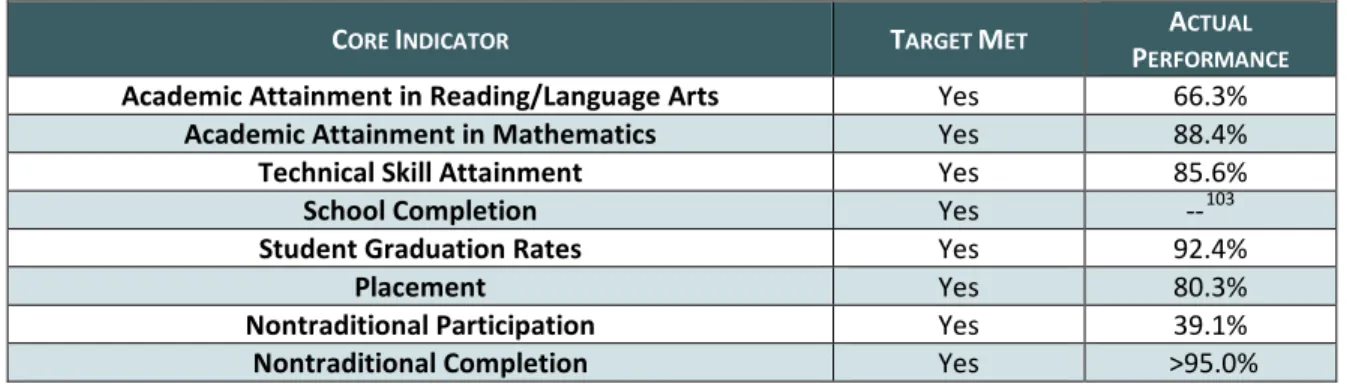
Core indicators included in the Consolidated Annual Reports required by the Perkins Career and Technical Education Act of 2006 represent the metrics most often used to gauge the performance of CTE in individual states. The core indicators include:o Academic Attainment in Reading/Language Arts o Academic Attainment in Mathematics
o Technical Skill Attainment o School Completion o Student Graduation Rates o Placement
o Nontraditional Participation o Nontraditional Completion
S
ECTION
I:
L
ITERATURE
R
EVIEW
This section provides an overview of career-technical education (CTE) and describes four widely implemented CTE delivery systems, including career academies, CTE opportunities in traditional high schools, postsecondary partnerships, and industry partnerships. This section concludes with a brief description of CTE-related legislation in California.
O
VERVIEWThe Perkins Career and Technical Education Act of 2006 (Perkins Act), which allocates funding for CTE to the states on the condition that they maintain at least one CTE program of study, has driven much of the innovation in CTE in recent years.1 Programs of study are comprehensive course sequences, including both secondary and postsecondary study, that carry students toward an appropriate, career-oriented achievement such as an industry credential or associate’s or bachelor’s degree.2 States typically develop these programs of study in one of three ways:
At the state level with voluntary local use;
At the state level with mandatory local use; or
At the local level with state approval.3As of 2012, around one-quarter of states allowed voluntary local use of state-developed programs of study, and more than half of states conferred state approval on locally developed programs of study. The remaining states have mandated use of state-developed programs of study at the local level.4
The White House sought to further enhance the country’s career and technical education programs though reauthorization of the Perkins Act in 2012. The administration’s proposed blueprint to transform career and technical education hinged on four core principles designed to “usher in a new era of rigorous, relevant, and results-driven” CTE programs, including:
Alignment: CTE programs should effectively align their offerings to “equip students with 21st-century skills and prepare them for in-demand occupations in high growth industry sectors.”
1 “Career, Technical, and Adult Education: Fiscal Year 2015 Request.” Department of Education, p. 11.
http://www2.ed.gov/about/overview/budget/budget15/justifications/o-ctae.pdf
2 Ibid.
3 Taken verbatim from: “A Look Inside: A Synopsis of CTE Trends – Focus: Career Clusters and Programs of Study.”
National Association of State Directors of Career Technical Education, September 2012, p. 2. http://www.careertech.org/sites/default/files/SynopsisofCTETrends-CareerClusters-2012.pdf
Collaboration: “Strong collaborations among secondary and postsecondary institutions, employers, and industry partners” are essential to CTE programs’ success.
Accountability: Programs should be held accountable for improving student outcomes and should implement consistent and clear metrics of student success.
Innovation: Model programs should demonstrate increased focus on creating innovative programs in alignment with state policies and practices.5To achieve these goals, the Office of Vocational and Adult Education (OVAE) has collaborated with major national associations and individual states to create a design framework for effective CTE programs of study. The Office has identified 10 components that work collectively to support successful career and technical education programs, detailed in Figure 1.1.
Figure 1.1: Components of Effective CTE Programs
COMPONENT OF SUCCESS EVIDENCE OF EFFECTIVE IMPLEMENTATION
Local policies supporting CTE development and
implementation
Policies should include provisions for state and local funding for resources, including professional development and dedicated staff time, along with formal procedures for the design, implementation, and continuous monitoring of the program. Policy language also should ensure CTE opportunities for any secondary student and require secondary students to develop an individual graduation or career plan.
Partnerships among education, business, and other community
stakeholders
Partnerships should be based on clearly written agreements elaborating the roles and responsibilities of each partner. Ongoing analyses of economic and workforce trends should be performed to identify statewide (or regional) programs of study to be created, expanded, or discontinued. Successful partnerships should link to existing initiatives that promote workforce and economic development.
Professional development opportunities for teachers, administrators, and faculty
These opportunities should support both vertical alignment from high school through postsecondary education and horizontal alignment between the career and technical curriculum and traditional instruction. Professional development programs also should ensure that faculty have adequate content knowledge to effectively deliver the curriculum.
Systems and strategies to gather data on student outcomes and program
components
Data systems are critical to the ongoing success of any CTE program and should include valid and reliable data on student outcomes, administrative record matching of student education and employment data, and systems to collect real-time data to evaluate and improve the program’s effectiveness.
Implementation of college and career readiness standards
These standards define what students are expected to know and be able to do to enter and advance in college and/or careers and comprise the foundation of a program of study. These standards should incorporate essential knowledge and skills (i.e., academic skills, communication, and problem solving), which students must master regardless of their chosen career area.
Course pathways between secondary and postsecondary
classes
Pathways should map out the recommended academic and technical courses in each program of study to ensure that students may transfer to postsecondary education without duplicating classes or requiring remedial coursework.
5 “Investing in America’s Future: A Blueprint for Transforming Career and Technical Education.” U.S. Department of
Education, April 2012, p. 2. http://www2.ed.gov/about/offices/list/ovae/pi/cte/transforming-career-technical-education.pdf
COMPONENT OF SUCCESS EVIDENCE OF EFFECTIVE IMPLEMENTATION
Credit transfer agreements
Agreements should allow students to earn postsecondary credit and enable them to seamlessly transfer credits to an institution without completing additional paperwork or petitioning for credit. The system should provide a systematic process for students to transfer credit to any two- or four-year institution in the state.
Guidance counseling and academic advisement services
To successfully aid students in their academic decisions, counseling systems should offer resources for students to identify their strengths and career interests and choose an appropriate course of study. Counseling services should provide tools to help students learn about postsecondary education and career options and assist students and parents with the logistics of applying for college.
Innovative teaching and learning strategies
These strategies aim to integrate CTE and academic material in unique and effective ways. Successful strategies employ contextualized work-based, project-based, and problem-based learning approaches and are jointly led by interdisciplinary teaching teams of academic and career and technical teachers. Programs should incorporate team-building, critical thinking, problem-solving, and communication skills, such as through the use of career and technical student organization (CTSO) activities.
Technical skills assessments These assessments evaluate students’ technical skill levels and should be given at multiple points of the CTE program. Evaluation procedures should include performance-based assessments to the greatest extent possible.
Source: U.S. Department of Education6
The National Dropout Prevention Center/Network (NDPC/N) lists CTE among 15 strategies “that have the most positive impact on the dropout rate,” but the NDPC/N makes fewer stipulations about the types of CTE that have the greatest impact on student learning.7 NDPC/N praises multiple delivery models but generally notes the value of reducing the divide between academic and career skills.8
Nationwide, many states have made efforts to blend CTE and academic pursuits to encourage participation in CTE. Indeed, one major obstacle to student participation in CTE is that state graduation requirements often require students to fulfill academic requirements that do not allow time for the completion of CTE courses (which are often classified as electives). For this reason, some states have adjusted graduation requirements to permit students to receive core academic credit for CTE courses that meet certain standards.9 To reward CTE participation, several states offer special distinctions to high school graduates who engage in a substantial amount of CTE coursework; these distinctions include CTE diplomas, standard diplomas with a CTE distinction, and CTE certificates.10
6 “Career and Technical Programs of Study: A Design Framework.” U.S. Department of Education, pp. 2-5.
http://cte.ed.gov/file/POS_Framework_Unpacking_1-20-10.pdf
7 “Effective Strategies for Dropout Prevention.” National Dropout Prevention Center/Network.
http://www.dropoutprevention.org/effective-strategies#CTE
8 “Career and Technology Education (CTE).” National Dropout Prevention Center/Network.
http://www.dropoutprevention.org/effective-strategies/career-and-technology-education-cte
9 See: [1] “State Graduation Requirements.” Illinois State Board of Education, November 2012, p. 5.
http://www.isbe.net/news/pdf/grad_require.pdf
[2] “Professional Development for CTE Courses for Mathematics or Science Credit.” Texas Education Agency, August 6, 2012. http://www.tea.state.tx.us/index4.aspx?id=2147508147
10 Ultsch, A. and C. Imperatore. “State Policies Encourage CTE and Career Readiness.” Association for Career and
Technical Education, June 3, 2013.
Overall, efforts to encourage CTE have shown success. In fall 2013, the Association for Career and Technical Education (ACTE) and the National Research Center for College & University Admissions (NRCCUA) conducted a national survey of over 51,000 high school students to ask about students’ experience with CTE. One-third of survey respondents indicated that they had an opportunity to earn college credit, a certification, or a degree due to participation in CTE, and two-thirds of survey respondents agreed that the skills they were learning in CTE courses would “help them to get jobs in the future.”11
States have the opportunity to achieve the positive outcomes of CTE through a number of delivery systems. Most importantly, CTE programs should employ the mechanisms that promote graduation rates. According to ACTE, CTE programs support graduation rates in the following ways:
By preparing [students] for the postsecondary education and training that will be critical to future economic successes;
By increasing student engagement;
By building positive relationships; and
By providing innovative delivery methods.12Regardless of delivery model, most credit-bearing CTE opportunities operate within the National Career Clusters Framework, which includes 16 Career Clusters and at least 79 Career Pathways, not including additional locally developed pathways.13 The recognized career clusters include:
Agriculture, Food, and Natural Resources
Architecture and Construction
Arts, A/V Technology and Communications
Business Management and Administration
Education and Training
Finance
Government and Public Administration
Health Science
Hospitality and Tourism11 “CTE Works! 2014 Results from a National Survey.” Association for Career and Technical Education, p. 3.
https://www.acteonline.org/uploadedFiles/Assets_and_Documents/Global/files/CTE_Info/Research/2014_NRCC UA_ACTE_Research_Report_Final.pdf
12 Slightly adapted from: “Issue Brief: Career and Technical Education’s Role in Dropout Prevention and Recovery.”
Association for Career and Technical Education, June 2007, p. 1. Available from: “What is CTE?” Association for Career and Technical Education. https://www.acteonline.org/general.aspx?id=120#.VAhjf02Yboo
13 “Career Clusters.” National Association of State Directors of Career Technical Education Consortium.
Human Services
Information Technology
Law, Public Safety, Corrections, and Security
Manufacturing
Marketing
Science, Technology, Engineering, and Mathematics
Transportation, Distribution, and Logistics14C
AREERA
CADEMIESCareer academies are school-within-school programs in high schools that offer curricula based around a specific career path or theme. By providing students with employment experience through school-employer partnerships, career academies help at-risk students prepare for post-graduation employment.15 Initially geared primarily toward students at high risk of dropout, career academies have since broadened their focus to include other students as well.16
Most career academies have similar features in that they:
Operate as “small learning communities” (SLCs) to create a more supportive, personalized learning environment;
Combine academic and career/technical curricula around a career theme to enrich teaching and learning; and
Establish partnerships with local employers to provide career awareness and work-based learning opportunities for students.17Career themes used in these academies can include healthcare, finance, technology, communications, public service, or business, among others. Career-related courses are typically taught by a core set of instructors within the academy, while relationships between the academy and local employers can provide students with access to mentors, internship opportunities, and real-world experience in their chosen fields.18
The small learning communities emphasized in career academies create a strong sense of support among students and teachers, and research has found that students in career academies in fact do “receive more personal attention and support from teachers,
14 Ibid.
15 “What Works Clearinghouse – Career Academies.” What Works Clearinghouse, p. 1.
http://ies.ed.gov/ncee/wwc/pdf/intervention_reports/WWC_Career_Academies_100506.pdf
16 Stern, D., C. Dayton, and M. Raby. “Career Academies: A Proven Strategy to Prepare High School Students for
College and Careers.” Career Academy Support Network and University of California at Berkeley, February 2010, pp. 5-6. http://files.eric.ed.gov/fulltext/ED524061.pdf
17 Ibid.
compared to non-academy students”19 Close relationships with educators, in particular, can be a critical factor in preventing dropouts and increasing graduation rates.20
In the largest study of career academies to date, the MDRC, an independent research organization, showed that participation in a career academy may have a slightly positive impact on a variety of academic outcomes, including attendance, earned credits, grade point average, and graduation rates.21 Perhaps most notably, the MDRC study showed that high-risk students who participated in career academies completed a core academic curriculum at double the rate of their peers, with a 32 percent completion rate among academy students compared to 16 percent for the non-academy comparison group.22
The one study that met the evidentiary standards of the What Works Clearinghouse (WWC), an independent reviewer of educational practices, showed that career academies have “a positive and statistically significant effect on dropping out.”23 The study also showed that by graduation, academy students had earned more credits than had non-academy students.24
CTE
INT
RADITIONALH
IGHS
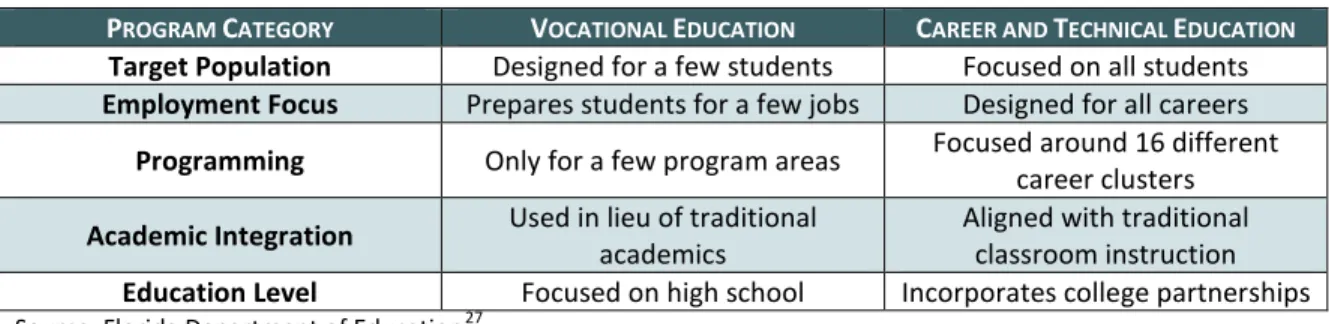
CHOOLSWhile high schools devoted to CTE offer unique opportunities to improve student engagement, traditional high schools may offer students a similar outlet to explore various career paths. Within traditional high school settings, CTE programs are frequently organized into career clusters focusing on a variety of subject areas, particularly those in high economic demand, such as healthcare, advanced manufacturing, and technology.25 With these recent changes, the technical education system, “once stereotyped as a dumping ground for those less academically-inclined […] has been transforming itself to a system that offers rigorous, relevant, real-world instruction with positive outcomes and impact on student achievement.”26 Figure 1.2 compares the facets of modern CTE programs with those of preexisting vocational education programs.
19 Stern et al., Op. cit.
20 Jerald, C. “Keeping kids in school: What research says about preventing dropouts.” The Center for Public Education.
April 5, 2007. http://www.centerforpubliceducation.org/Main-Menu/Staffingstudents/Keeping-kids-in-school-At-a-glance/Keeping-kids-in-school-Preventing-dropouts.html
21 Brand, B. “High School Career Academies: A 40-Year Proven Model for Improving College and Career Readiness.”
National Career Academy Coalition, November 2009, p. 4.
http://www.aypf.org/documents/092409CareerAcademiesPolicyPaper.pdf
22 Ibid.
23 “What Works Clearinghouse – Career Academies,” Op. cit., p. 2. 24 Ibid., p. 10.
25 “Investing in America’s Future: A Blueprint for Transforming Career and Technical Education,” Op. cit., p. 1. 26 “Already At the Top: CTE Programs Show Positive Impact on Student Achievement.” National Association of State
Directors of Career Technical Education Consortium, May, 2010, p. 1.
Figure 1.2: Features of Vocational and Career and Technical Education
PROGRAM CATEGORY VOCATIONAL EDUCATION CAREER AND TECHNICAL EDUCATION
Target Population Designed for a few students Focused on all students
Employment Focus Prepares students for a few jobs Designed for all careers
Programming Only for a few program areas Focused around 16 different career clusters
Academic Integration Used in lieu of traditional academics Aligned with traditional classroom instruction Education Level Focused on high school Incorporates college partnerships
Source: Florida Department of Education27
The ratio of academic to CTE courses often varies according to a state’s graduation requirements or predetermined course sequences established for specific career pathways. Research suggests that the balance of academic and CTE coursework ultimately should emphasize core academic coursework, however. A 2005 report of the National Research Center for Career and Technical Education at the University of Minnesota found that, among students who entered high school on time or at a younger than normal age, a blend of CTE and academic coursework had a positive impact on graduation rates, “but only up to a point.”28 Concentration in CTE “to the exclusion of adequate academic course taking” was found to increase the risk of dropout.29 The study ultimately recommended that students take one CTE course for every two academic courses.30
Career guidance programs allow traditional high schools to enhance CTE to offer some of the benefits found in career academies and comprehensive high schools. As an integrated part of a school’s counseling program, career development can help students in a variety of ways. Findings from the University of Massachusetts Amherst’s Center for School Counseling Outcome Research and Evaluation (CSCORE), which has conducted several studies of high school counseling practices, illustrate these benefits. CSCORE’s research in Nebraska and Utah finds that counseling programs that incorporate “a strong career development component” – for instance, by structuring students’ schedules based on specific career goals – are positively related to “beneficial student outcomes including improved attendance, lower disciplinary rates, higher Perkins program completion rates, and increased scores on state achievement tests.”31
27 Adapted from: “Best Practices in Career and Technical Education: the School District of Palm Beach County Model.”
Florida Department of Education, December 9, 2009, p. 8.
http://www.palmbeach.k12.fl.us/agenda/Wednesday,%20December%2009,%202009%20Spec%20Mtgs%20and% 20Workshops%20re%20%20Academics/4073728B-4CA2-4D7A-90B5-2765C9D0F73B.pdf
28 Plank, S., S. DeLuca, A. Estacion. “Dropping Out of High School and the Place of Career and Technical Education: A
Survival Analysis of Surviving High School.” National Research Center for Career and Technical Education, October 2005, p. 25. http://www.nrccte.org/sites/default/files/publication-files/droppingout-plank.pdf
29 Ibid. 30 Ibid., p. 26.
31 Carey, J.C. and K.M. Harrington. “The Impact of School Counseling on Student Educational Outcomes in High
Schools: What Can We Learn about Effectiveness from Statewide Evaluations of School Counseling Practice in Nebraska and Utah?” Center for School Counseling Outcome Research and Evaluation, 2010, pp. 3-4. http://www.umass.edu/schoolcounseling/uploads/Research-Brief-8.2.pdf
The College Board similarly has emphasized the need for well-integrated counseling services at the secondary level. In “Eight Components of College and Career Readiness Counseling,” the College Board outlines “a comprehensive, systemic approach for school counselors’ use to inspire all students to, and prepare them for, college success and opportunity – especially students from underrepresented populations.”32 While the components are geared toward both college and career readiness, they emphasize the benefits of an integrated approach that incorporates and encourages exploration of both career and postsecondary academic options during the high school years.33
Finally, some traditional high schools offer students the opportunity to complete CTE coursework at district-run centers focused solely on CTE. In districts supported by CTE centers, students typically complete core academic coursework on their home campus.34
P
OSTSECONDARYP
ARTNERSHIPSPartnerships between secondary schools and postsecondary institutions have long been the basis for initiatives aimed at building seamless pathways for students to journey from secondary education to higher education and into the workforce.35 Dual enrollment programs, through which high school students may earn college credit at no cost, are among the most widely implemented approaches to CTE that require support from postsecondary institutions. The structure of dual enrollment programs varies widely, and courses may be held “during the school day, evenings, weekends, on or off campus, as a regular college course, or specially adapted to the high school’s objectives.”36
The National Alliance of Concurrent Enrollment Partnerships has established standards to guide the implementation of dual enrollment programs. The standards have earned broad support, particularly in the West and Midwest, although they have not been adopted by California.37 The standards address five key aspects of dual enrollment programs: curriculum, faculty, students, assessment, and program evaluation.38
Like dual enrollment programs established in traditional high schools, early college high schools offer students the opportunity to “simultaneously earn high school and
32 “Eight Components of College and Career Readiness Counseling,” 2010, p. 2. The College Board National Office for
School Counselor Advocacy.
http://media.collegeboard.com/digitalServices/pdf/nosca/11b_4416_8_Components_WEB_111107.pdf
33 Ibid.
34 See: [1] “About Us.” Frisco Independent School District. http://schools.friscoisd.org/spc/cte
[2] “Capital Region Career & Technical School.” Capital Region Board of Cooperative Educational Services. http://www.capitalregionboces.org/CareerTech/aboutusfaq.cfm
35 Greenberg, A.R. “School-College Partnerships: Conceptual Models, Programs, and Issues.” ERIC Clearinghouse on
Higher Education, 1992. http://files.eric.ed.gov/fulltext/ED347956.pdf
36 Allen, D. “Dual Enrollment: A Comprehensive Literature Review & Bibliography.” City University of New York,
August 2010, p. 1. http://www.cuny.edu/academics/evaluation/library/DE_LitReview_August2010.pdf
37 “NACEP in State Policy.” National Alliance of Concurrent Enrollment Partnerships.
http://www.nacep.org/research-policy/legislation-policy/
38 “Standards.” National Alliance of Concurrent Enrollment Partnerships.
postsecondary credit for the same course while being exposed to the demands of college-level work.”39 These schools are founded “on the principle that academic rigor, combined with the opportunity to save time and money, is a powerful motivator for students to work hard and meet serious intellectual challenges.”40 While the exact structure of early college high schools varies from state to state and school to school, all early college high schools should share the following characteristics:
Students have the opportunity to earn an Associate’s degree or up to two years of transferable college credit while in high school.
Mastery and competence are rewarded with enrollment in college-level courses and the opportunity to earn two years of college credit for free.
The years to a postsecondary degree are compressed.
The middle grades are included in the school, or there is outreach to middle-grade students to promote academic preparation and awareness of the early college high school option.
Schools provide academic and social supports that help students succeed in a challenging course of study.
Learning takes place in small learning environments that demand rigorous, high-quality work and provide extensive support.
The physical transition between high school and college is eliminated—and with it the need to apply for college and for financial aid during the last year of high school. After graduation many students continue to pursue a credential at the partner college.41I
NDUSTRYP
ARTNERSHIPSNationwide, industry leaders support districts and schools implementing CTE in a number of ways, often by serving as guest speakers, providing guidance on the development of career-oriented curricula, and offering job shadowing, mentoring, mock interviews, and field trips.42 Work-based learning programs, which range from single-day job shadowing opportunities to formalized credit-bearing opportunities, provide unique ways for students to engage directly with workers and leaders in the community. A WestEd report that examined opportunities for work-based learning in California recommended combining work-based learning with other approaches that support college and career readiness, including:
39 “Dual Enrollment/Early College High Schools.” National High School Center.
http://www.centerii.org/handbook/Resources/4_A_h_Dual_enrollment_early_college_hs.pdf
40 “Overview & FAQ.” Early College Designs. http://www.earlycolleges.org/overview.html#basics1 41 Taken verbatim from: Ibid.
42 Jackson, N.M. “Joining Hands: CTE Programs Partner With Employers for Success.” Techniques, January 2014, p. 19.
Challenging academics: A core academic component of college-preparatory instruction in essential subjects, including English, math, science, social studies, foreign language, and visual and performing arts.
Technical skills and knowledge: A demanding technical component, emphasizing the practical application of academic learning and preparing youth for high-skill, high-wage employment.
Work-based learning: A work-based learning component that offers opportunities to learn through real-world experiences, such as internships, apprenticeships and school-based enterprises.
Support services: Supplemental services, such as counseling and additional instruction in reading, writing, and mathematics.43C
ALIFORNIAE
DUCATIONC
ODEThe California education code includes multiple pieces of state legislation relevant to CTE.44 In particular, the education code includes rules that pertain to each of the following:
Collection of CTE-related data (§8006-8008)
Entities permitted to offer CTE with the supervision of local school districts (§52336-52336.5)
Contracts between school districts and external CTE providers, such as private businesses and trade and technical schools (§8090-8093)
District-level CTE advisory committees, which are appointed by each district’s governing board and must include representatives of multiple stakeholder groups (§8070)
Apprenticeship programs, including school attendance requirements, instructional time, and cost allocation (§8150-8155)
Determination of the need for a greater number of cosmetology programs (§8080-8083)
Administration of the Career Technical Education Facilities Program, which provides funding to local education agencies to construct or renovate CTE facilities (§17078.70-17078.73)
Administration of regional occupation centers, which permit students, graduates, and out-of-school youth to enroll in CTE training programs regardless of their county of residence (§52300-52334.5)
Administration of regional career guidance centers (§52340-52346)4543 Taken verbatim from: Darche, S., N. Nayar, and K.R. Bracco. “Work Based Learning in California: Opportunities and
Models for Expansion,” WestEd, 2009, p. 4. http://www.wested.org/online_pubs/workbasedlearning.pdf
44 “California Education Code.” California Legislative Council.
http://www.leginfo.ca.gov/cgi-bin/calawquery?codesection=edc
The education code discusses regional occupation centers at length. In general terms, these entities:
Enable a broader curriculum in technical subjects to be offered, avoid unnecessary duplication of courses and expensive training equipment, and provide a flexibility in operation which will facilitate rapid program adjustments and meeting changing training needs as they arise;
May achieve great flexibility of planning, scope and operation by the conduct of these programs in a variety of physical facilities at various training locations; and
Provide career technical and occupational instruction related to the attainment of skills so that trainees are prepared for gainful employment in the area for which training was provided, or are upgraded so they have the higher level skills required because of new and changing technologies or so that they are prepared for enrollment in more advanced training programs.46Likewise, regional career guidance centers “increase the effectiveness of career development programs through the dissemination and implementation of the products, processes, and guidelines established by the California career guidance project.”47 By law, career guidance centers operate in San Diego County and Los Angeles County.48
The state legislature also grants power to the California Department of Education (CDE) to establish CTE standards for public schools. The current standards, adopted in 2005, establish learning goals for 58 career pathways associated with 15 industry sectors, including:
Agriculture and Natural Resources
Arts, Media, and Entertainment
Building and Construction Trades
Business and Finance
Education, Child Development, and Family Services
Energy, Environment, and Utilities
Engineering and Architecture
Fashion and Interior Design
Health Science and Medical Technology
Hospitality, Tourism, and Recreation
Information and Communication Technologies
Manufacturing and Product Development
Marketing Sales and Service
Public Services
Transportation49
46 Text adapted from: Education Code Section 52300-52334-.5. California Legislative Council.
http://www.leginfo.ca.gov/cgi-bin/displaycode?section=edc&group=52001-53000&file=52300-52334.5
47 §52340-52346. California Education Code.
http://www.leginfo.ca.gov/cgi-bin/displaycode?section=edc&group=52001-53000&file=52340-52346
48 Ibid.
49 “CTE Model Curriculum Standards.” California Department of Education.
For each industry sector, CDE provides a description, knowledge and performance anchor standards (which are common standards established across industry sectors), pathway standards, and a matrix “that displays where natural, obvious academic alignment occurs.”50
50 “California Career Technical Education Model Curriculum Standards.” California Department of Education, January
S
ECTION
II
:
S
TATE
M
ODELS
This subsection describes CTE in 10 states Hanover Research identified as most similar to California: Texas, Illinois, Florida, New York, Georgia, Tennessee, Michigan, Virginia, Indiana, and Ohio. To the extent possible, these profiles describe CTE funding and performance with regard to state priorities; core indicators; CTE delivery systems; career clusters and programs of study; and postsecondary partnerships.
M
ETHODOLOGYHanover Research identified a set of prospective peer states on the basis of student population size and composition. Specifically, we calculated the overall difference between California and each of the 50 states and the District of Columbia across the following variables, weighted as indicated:
Total public school enrollment (elementary and secondary) (weight = 1/2)
Percentage of the public school student population eligible for free or reduced-price lunches (weight = 1/6)
Percentage of the student population enrolled in CTE (weight = 1/6)
Percentage of the postsecondary student population enrolled in public or private not-for-profit two-year or less-than-two-year institutions (weight = 1/6)After calculating the overall difference scores, we ranked states based on similarity to California (i.e., from most to least similar). Then, to ensure that prospective peer states serve a sufficiently-similar number of students, we eliminated several states near the top of the rankings with total public school enrollments less than 15 percent of the size of California’s public school population. These states included: Kentucky (11 percent), New Mexico (5.4 percent), Maryland (13.8 percent), Hawaii (2.9 percent), and Missouri (14.8 percent).
Please note that these profiles also aim to describe the outcomes of state CTE initiatives. The Perkins Act requires all states to report to the federal government on the performance of their CTE programs by submitting a Consolidated Annual Report (CAR).51 The CAR narrative reports and the core indicator reports each state submits to the U.S. Department of Education are publicly available (the most recent available corresponds to 2011-2012) and provide comparable information regarding the efficacy of the CTE programs in each peer state. The Appendix contains the U.S. Department of Education’s recommendations for measuring each core indicator.
51 “State Profiles: CTE Program Performance Data.” Association for Career and Technical Education.
T
EXASS
TATEP
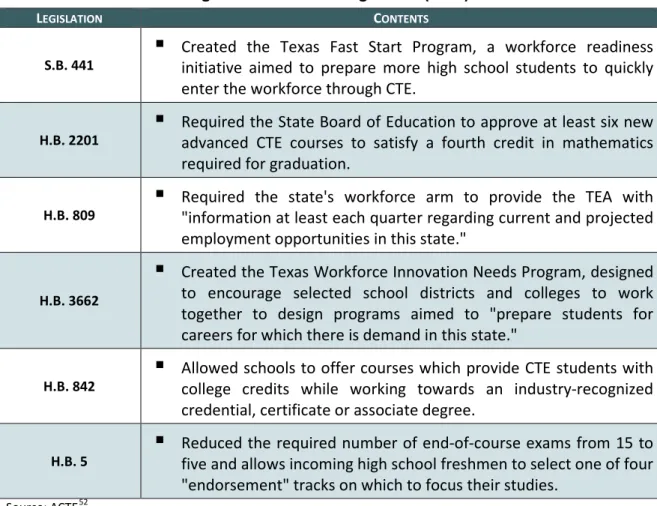
RIORITIESIn 2013, Governor Rick Perry signed a number of initiatives related to secondary-level CTE, as shown in Figure 2.1. These laws support development of high school-to-workforce pathways, increase of CTE courses that satisfy graduation requirements, expansion of postsecondary learning opportunities, and introduction of career-related endorsements for various academic paths.
Figure 2.1: Texas CTE Legislation (2013)
LEGISLATION CONTENTS
S.B. 441
Created the Texas Fast Start Program, a workforce readiness initiative aimed to prepare more high school students to quicklyenter the workforce through CTE.
H.B. 2201
Required the State Board of Education to approve at least six new advanced CTE courses to satisfy a fourth credit in mathematicsrequired for graduation.
H.B. 809
Required the state's workforce arm to provide the TEA with "information at least each quarter regarding current and projectedemployment opportunities in this state."
H.B. 3662
Created the Texas Workforce Innovation Needs Program, designed to encourage selected school districts and colleges to work together to design programs aimed to "prepare students for careers for which there is demand in this state."H.B. 842
Allowed schools to offer courses which provide CTE students with college credits while working towards an industry-recognizedcredential, certificate or associate degree.
H.B. 5
Reduced the required number of end-of-course exams from 15 to five and allows incoming high school freshmen to select one of four"endorsement" tracks on which to focus their studies.
Source: ACTE52
F
UNDING ANDP
ERFORMANCETexas, home to the second-largest school system in the nation, serves a diverse student body and engages a substantial proportion of the student population in CTE. Furthermore, nearly half of the population pursuing postsecondary study has enrolled in a public or private two-year or less-than-two-year institution. In the 2014 fiscal year, the state received over $90 million in Perkins funding, 70 percent of which was distributed on the secondary level. The most recently available data regarding other sources of funding indicates that
local funding sources have remained constant while state funding for postsecondary CTE has declined.
Texas does not represent an isolated case in terms of declining state funding for postsecondary CTE. In 2011-2012, state funding for postsecondary CTE declined in 38 percent of states.53 Figure 2.2 describes student demographics and funding trends for the state.
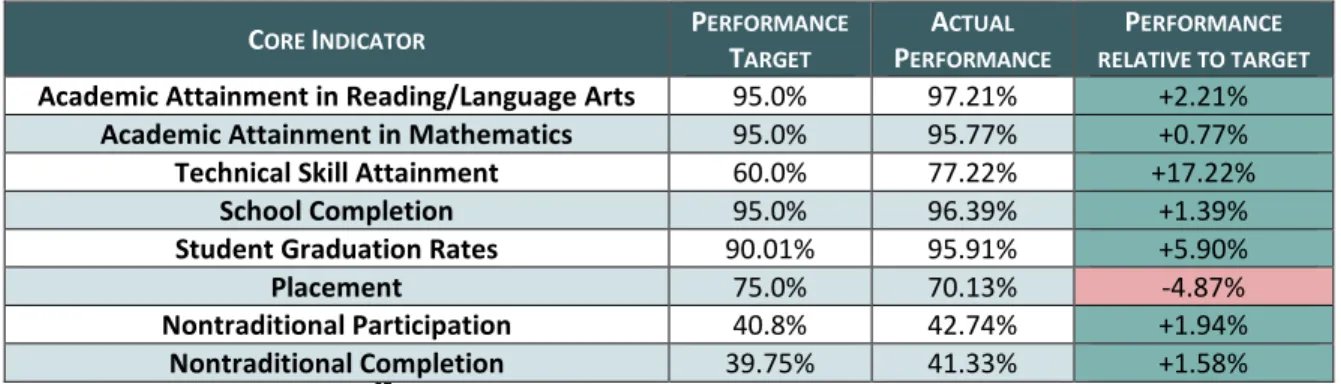
In 2011-2012, the most recent year for which performance indicator data are available, Texas met performance targets associated with seven of the eight indicators that the Perkins Act requires states to track. With regard to technical skill attainment, the state exceeded the target goal by a substantial margin. The state initially set a goal of 60 percent of CTE concentrators who take an industry-aligned assessment to earn a passing score; by the end of the academic year, over 77 percent of CTE students who took an industry-aligned assessment earned a passing score.
53 “A Look Inside: A Synopsis of CTE Trends – Focus: Funding.” National Association of State Directors of Career
Technical Education, February 2013, p. 2. http://careertech.org/sites/default/files/SynopsisofCTETrends-Funding-2012.pdf
54 [1] Elementary/Secondary Information System. National Center for Education Statistics.
http://nces.ed.gov/ccd/elsi/expressTables.aspx
[2] Integrated Postsecondary Education Data System. National Center for Education Statistics. http://nces.ed.gov/ipeds/datacenter/
[3] “Generate Enrollment (CTE Participants) Report.” U.S. Department of Education, Office of Career, Technical and Adult Education. http://cte.ed.gov/accountability/reports/report_enroll_2005a.cfm?p=4&e=p
55 “CTE in Your State: Texas.” National Association of State Directors of CareerTechnical Education Consortium.
http://www.careertech.org/cte-your-state
Figure 2.2: Texas Demographics, Funding Levels, and Funding Trends
TEXAS DEMOGRAPHICS,2011-2012
Public school enrollment 5,000,193
Free or reduced-price lunch eligibility (%) 51.1%
CTE enrollment (%) 21.5%
Postsecondary students enrolled in public or private not-for-profit
two year or less-than-two year institutions (%)* 44.7%
PERKINS FUNDING,FY2014
Total Perkins funds received $92,014,058
Percentage distributed to secondary 70%
Percentage distributed to postsecondary 30%
NON-PERKINS FUNDING,2011-2012
State secondary funding Maintained
State postsecondary funding Decreased
Local secondary funding Maintained
Local postsecondary funding Maintained
*Fall 2012
Sources: National Center for Education Statistics and U.S. Department of Education54
The state fell short with regard to placement, defined as the percentage of CTE students who achieve enrollment in postsecondary education or advanced training, military enlistment, or employment by “the second quarter following the program year in which they left secondary education.” Slightly over 70 percent of CTE students achieved one of the previously mentioned placements, a placement rate 4.87 percentage points below the performance target of 75 percent. Figure 2.3 describes state performance for each core indicator.
Figure 2.3: Texas Core Indicator Performance (2010-2011)56
CORE INDICATOR PERFORMANCE T
ARGET
ACTUAL
PERFORMANCE
PERFORMANCE
RELATIVE TO TARGET
Academic Attainment in Reading/Language Arts 95.0% 97.21% +2.21%
Academic Attainment in Mathematics 95.0% 95.77% +0.77%
Technical Skill Attainment 60.0% 77.22% +17.22%
School Completion 95.0% 96.39% +1.39%
Student Graduation Rates 90.01% 95.91% +5.90%
Placement 75.0% 70.13% -4.87%
Nontraditional Participation 40.8% 42.74% +1.94%
Nontraditional Completion 39.75% 41.33% +1.58%
Source: Texas Education Agency57
D
ELIVERYS
YSTEMSTexas primarily relies on comprehensive high schools to deliver CTE. The state’s comprehensive high schools include:
Magnet schools, which offer specialized curriculum that fully integrates core academic instruction with specific career training;
Career academies within comprehensive high schools, which are small, personalized learning communities that contextualize academic instruction with specific career training; and
Stand-alone career academies, which are career academies that function independent of a comprehensive high school.58The College & Career Academy Support Network (CCASN) lists 52 career academies that operate in the state.59 Some CTE courses offered by public schools in the state carry mathematics or science credits, and teachers for those courses are required to attend state-sponsored training. These courses include:
56 The most recently available CAR report for Texas provides data from the 2010-2011 academic year, rather than
from the 2011-2012 academic year.
57 “Texas Consolidated Annual Report for Fiscal Year 2011-2012 under the Carl D. Perkins Career and Technical
Education Improvement Act of 2006.” Texas Education Agency, December 2012, pp. 12-14. http://cte.ed.gov/Docs/CARNarrative/TX_narrative_2011-2012.pdf
58 Taken verbatim from: “State Profiles.” Association for Career and Technical Education.
https://www.acteonline.org/stateprofiles/
59 “Academies Nationwide.” College &Career Academy Support Network.
Advanced Animal Science
Advanced Biotechnology
Advanced Plant and Soil Science
Engineering Mathematics
Engineering Design and Problem Solving
Food Science
Forensic Science
Mathematical Applications in Agriculture, Food, and Natural Resources
Statistics and Risk Management60The state’s stand-alone career academies “are generally defined as a separate school or school within a school with an educational program that is based on one or more occupational themes.”61 Thus, within this structure, stand-alone career academies would operate as independent schools under the purview of district administration. For example, Texas Science, Technology, Engineering, and Mathematics (T-STEM) academies operate as independent high schools “focusing on improving instruction and academic performance in science and mathematics-related subjects and increasing the number of students who study and enter STEM careers.”62 Initially, all T-STEM academies were funded through a grant administered by the Texas Education Agency or a private partner engaged in the Texas High School Project. As of the 2011-2012 academic year, campuses relying on local or other sources of funding may implement the T-STEM Academy model and, upon approval, become eligible for state-funded professional development and technical assistance.63
C
AREERC
LUSTERS ANDP
ROGRAMS OFS
TUDYCTE in Texas is largely guided by the AchieveTexas College and Career Initiative, which relies on the National Career Clusters Framework to structure CTE around the 16 career clusters.64 Texas administrative code requires districts to offer programs of study from at least three CTE clusters or contract with other organizations or institutions to ensure student access to CTE.65
In total, public schools in the state offer over 120 programs of study across the 16 career clusters.66 Each program of study includes an academic core curriculum (four courses each in English language arts, mathematics, science, and social studies) “that is enhanced with relevant CTE career-related courses.”67 The choice to implement any one career cluster or associated program of study is made locally by school boards, superintendents, or
60 “Professional Development for CTE Courses for Mathematics or Science Credit,” Op. cit.
61 Patterson, C. “Career and Technology Education: Many Paths, Equal Rigor and One Destination for Texas High
Schools.” Texas Institute for Education Reform, September 2008, p. 11.
http://www.senate.state.tx.us/75r/senate/commit/c530/handouts08/1020-Andrew-Erben.pdf
62 “Texas Science, Technology, Engineering and Mathematics Initiative.” Texas Education Agency.
http://www.tea.state.tx.us/index3.aspx?id=4470
63 Ibid.
64 “What is the AchieveTexas College and Career Initiative?” AchieveTexas. http://www.achievetexas.org/ 65 “Frequently Asked Questions and Answers about AchieveTexas.” AchieveTexas.
http://www.achievetexas.org/Questions1.htm
66 “CTE in Your State,” Op. cit. 67 “State Profiles,” Op. cit.
committees, or other decision-making structures that operate within a community.68 Programs are ultimately approved by the state education agency.69
P
OSTSECONDARYP
ARTNERSHIPSAll Texas school districts are required to provide students with the opportunity to earn at least 12 college credits through dual enrollment or Advanced Placement (or an equivalent program).70 Additional funding for dual enrollment is available through the Advanced Technical Credit Grant Program, which provides funding for students pursuing dual enrollment to earn CTE credits.71
Jobs for the Future (JFF), a nonprofit organization that advocates for workforce development, lists 46 early college high schools that operate in the state.72 High schools also may award college credits to CTE students working toward an industry-recognized credential, certificate, or associate’s degree. 73
I
LLINOISS
TATEP
RIORITIESIn 2012, Illinois joined the Pathways to Prosperity initiative—a six-state coalition “that aims to increase the number of high school graduates who attain a postsecondary credential with value in the labor market while also leaving open the prospect of further education.”74 To that end, the state legislature has invested in the construction of a culinary arts training facility, eliminated certification obstacles for educators seeking a license with a CTE endorsement, and permitted AP coursework in computer science to substitute for part of the graduation requirement in mathematics.75 With the support of the Pathways to Prosperity network, the state will continue to pursue innovative approaches to growing the number of CTE-credentialed graduates.76
68 “Frequently Asked Questions and Answers about AchieveTexas,” Op. cit. 69 “State Profiles,” Op. cit.
70 Ibid.
71 “Request for Application # 701-12-104 2012–2013 Advanced Technical Credit Grant Program.” Texas Education
Agency, May 7, 2012.
http://www.tea.state.tx.us/index4.aspx?id=2147506546&ekfxmen_noscript=1&ekfxmensel=e9f6cb525_620_634
72 “Reinventing High Schools for Postsecondary Success.” Jobs for the Future.
http://www.jff.org/initiatives/early-college-designs/schools
73 “State Profiles,” Op. cit.
74 “Illinois Will Create New ‘Pathways to Prosperity’ for High School Students.” Illinois State Board of Education, June
19, 2012. http://www.isbe.net/news/2012/jun19a.htm
75 “State Profiles,” Op. cit.
F
UNDING ANDP
ERFORMANCEIllinois serves a population of over 2 million students, nearly half of whom are eligible for free or reduced-price lunches, and a large community college population. In 2014, the state received over $40 million in Perkins funding, of which 60 percent was allocated to secondary education (Figure 2.4).
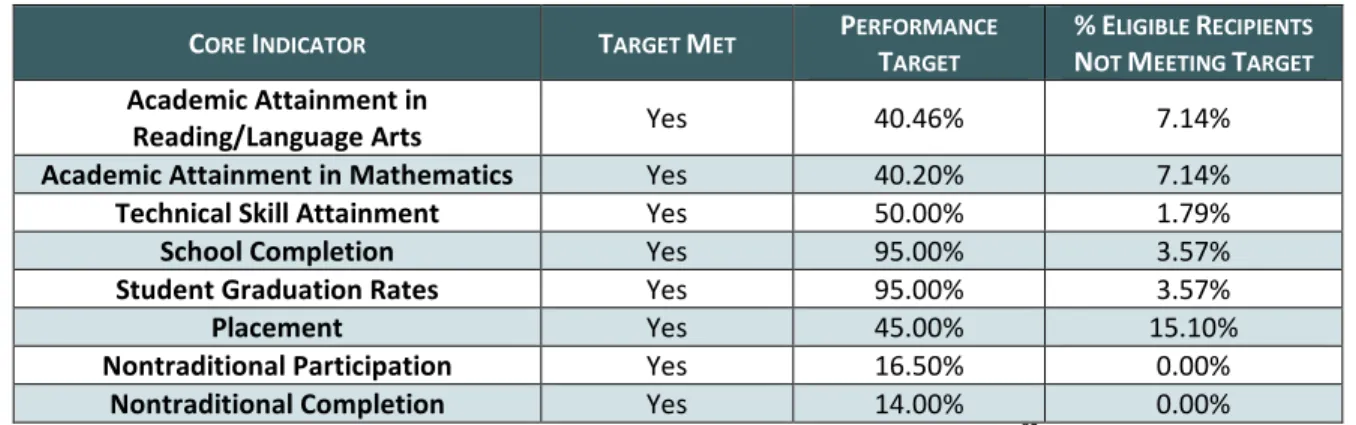
Illinois reports the proportion of eligible recipients for Perkins funding that meet established performance targets. Eligible recipients may include local education agencies, CTE schools, educational service agencies, consortia, and postsecondary institutions.79According to the most recently available Illinois CAR report, the state “met at least 90 percent of all of the required postsecondary and secondary state Annual Adjusted Levels of Performance.”80 Although the state met performance targets for each indicator, not all eligible recipients in the state met the performance target benchmark. Figure 2.5 lists the proportion of eligible recipients who did not meet at least 90 percent of the performance benchmark.81
77 [1] Elementary/Secondary Information System, Op. cit.
[2] Integrated Postsecondary Education Data System, Op. cit. [3] “Generate Enrollment (CTE Participants) Report,” Op. cit.
78 “CTE in Your State,” Op. cit.
79 Section 3(14). Carl D. Perkins Vocational and Technical Education Act.
http://www.gpo.gov/fdsys/pkg/BILLS-109s250enr/pdf/BILLS-109s250enr.pdf
80 “Part B: Narrative Performance Information.” Illinois State Board of Education,” December 2012, p. 14.
http://cte.ed.gov/Docs/CARNarrative/IL_narrative_2011-2012.pdf
81 Ibid., p. 15.
Figure 2.4: Illinois Demographics and Funding Levels
ILLINOIS DEMOGRAPHICS,2011-2012
Public school enrollment 2,073,721
Free or reduced-price lunch eligibility (%) 48.9%
CTE enrollment (%) 14.5%
Postsecondary students enrolled in public or private not-for-profit
two-year or less-than-two-year institutions(%)* 40.6%
PERKINS FUNDING,FY2014
Total Perkins funds received $40,519,069
Percentage distributed to secondary 60.0%
Percentage distributed to postsecondary 40.0%
NON-PERKINS FUNDING,2011-2012
State secondary funding --
State postsecondary funding --
Local secondary funding --
Local postsecondary funding --
*Fall 2012 --Data unavailable
Sources: National Center for Education Statistics and U.S. Department of Education77 National Association of State Directors of CareerTechnical Education Consortium78
Figure 2.5: Illinois Core Indicator Performance (2011-2012)
CORE INDICATOR TARGET MET PERFORMANCE
TARGET
%ELIGIBLE RECIPIENTS
NOT MEETING TARGET
Academic Attainment in
Reading/Language Arts Yes 40.46% 7.14% Academic Attainment in Mathematics Yes 40.20% 7.14%
Technical Skill Attainment Yes 50.00% 1.79%
School Completion Yes 95.00% 3.57%
Student Graduation Rates Yes 95.00% 3.57%
Placement Yes 45.00% 15.10%
Nontraditional Participation Yes 16.50% 0.00%
Nontraditional Completion Yes 14.00% 0.00%
Sources: National Association of State Directors of CareerTechnical Education Consortium82
Illinois State Board of Education83
D
ELIVERYS
YSTEMSIllinois supports multiple CTE delivery systems, including:
Comprehensive high schools;
CTE-focused secondary schools, which are schools that focus secondary academics around specific careers; and
Area career centers, which provide supplementary career training to area high school students and adult learners.84CCASN lists 27 career academies operated in the state.85 All high schools may award core academic credit to students who complete a CTE course that addresses “at least 50 percent of the content of the required course or graduation requirement for which it is substituted.”86 To support blended academic and CTE coursework, Illinois participates in the Southern Regional Education Board’s (SREB) High Schools That Work initiative, which supports high schools in combining “challenging academic courses and modern Career and Technical Education courses to raise the achievement of high school students.”87
As of March 2014, 24 area career or vocational centers operate in Illinois.88 Area career and vocational centers are associated with specific school districts, and all students training in these centers must register through the school district in which they reside.89 In addition, all
82 “CTE in Your State,“ Op. cit.
83 “Part B: Narrative Performance Information.” Illinois State Board of Education, Op. cit. 84 Taken verbatim from: “State Profiles,” Op. cit.
85 “Academies Nationwide,” Op. cit. 86 “State Graduation Requirements,” Op. cit.
87 “High Schools That Work.” Illinois State Board of Education. http://www.isbe.state.il.us/career/html/hstw.htm 88 “Area Career Centers (AAC) and Area Vocational Centers (AVC).” Illinois State Board of Education, March 2014.
http://www.isbe.net/career/pdf/il-acc-avc.pdf
89 “SDLC Meeting.” Illinois State Board of Education, April 2012, p. 15.
area career centers are part of regional Education for Employment (EFE) systems.90 These operate as regional CTE delivery systems that function within the same regulations that apply to public schools under the guidance of a governing board led by local superintendents.91
C
AREERC
LUSTERS ANDP
ROGRAMS OFS
TUDYIllinois relies on the National Career Clusters Framework to support CTE in five career areas: business, marketing, and computer education; technology and engineering education; family and consumer sciences; health sciences technology; and agricultural education.92 Programs of study, which may be developed locally, must begin by Grade 9 and last through at least two years of higher education.93 The state also operates a grant-funded continuous improvement initiative, Pathways to Results, designed to improve career education and programs of study. Specifically, the initiative aims to:
Develop and refine programs of study and supporting processes to improve the career pathways that lead students to employment.
Develop and implement an inquiry-based, equity-guided process to improve programs and enhance access and equitable outcomes for diverse learners.
Improve transition outcomes for underserved students, including groups of students who are racially and ethnically diverse, low income, low literacy, and first-generation college.
Improve access of local teams to data and tools to support continuous improvement and student outcomes.94P
OSTSECONDARYP
ARTNERSHIPSArticulation agreements implemented by Illinois’ Education for Employment Regional Delivery Systems, local high schools, and postsecondary institutions “assist with facilitating program alignment; student transition, shared facilities, equipment and staff; and cooperative program planning and evaluation.”95 JFF lists eight early college high schools that operate in the state.96
In addition to the partnerships listed above, the Illinois State Board of Education has partnered with the University of Illinois and the Illinois Department of Commerce and
90 “2013 Career and Technical Education Report.” Illinois State Board of Education, February 24, 2014, p. 4.
http://www.isbe.net/reports/cte_ed_rpt13.pdf
91 “Welcome Back!” Education for Employment System #330. http://www.efe330.org/ 92 Career Cluster Framework. Illinois Community College Board.
http://iccbdbsrv.iccb.org/programsofstudy/images/ClusterModel.jpg
93 “State Profiles,” Op. cit.
94 Taken verbatim from: “Pathways to Results.” University of Illinois College of Education, May 22, 2014.
http://occrl.illinois.edu/files/profiles/Pathways%20Profile.pdf
95 “State Profiles,” Op. cit.
Economic Opportunity to form a state chapter of Project Lead the Way, a national initiative that promotes a STEM curriculum in K-12 settings.97
F
LORIDAS
TATEP
RIORITIESFlorida prioritizes CTE funding for districts that serve students below the poverty line. The state-to-local funding formula for secondary CTE programs allocates funding in the following proportions:
Thirty percent allocated to local educational agencies (LEAs) based on the number of 5- to 17-year olds who reside in the school district.
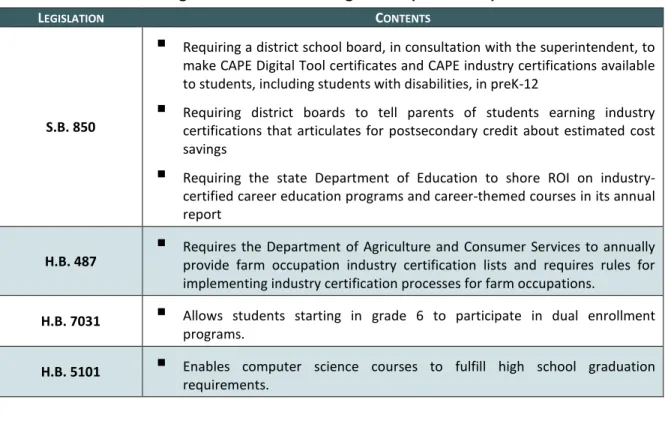
Seventy percent allocated to LEAs based on the number of 5 to 17-year olds in districts below the poverty line, based on data collected under ESEA.98Between 2013 and 2014, the state legislature passed multiple laws pertaining to CTE, as described in Figure 2.6. These laws strengthen opportunities for students to earn industry certifications, expand dual enrollment, increase the number of CTE courses that can fulfill graduation requirements, and broaden CTE instruction.
Figure 2.6: Florida CTE Legislation (2013-2014)
LEGISLATION CONTENTS
S.B. 850
Requiring a district school board, in consultation with the superintendent, to make CAPE Digital Tool certificates and CAPE industry certifications available to students, including students with disabilities, in preK-12
Requiring district boards to tell parents of students earning industry certifications that articulates for postsecondary credit about estimated cost savings
Requiring the state Department of Education to shore ROI on industry-certified career education programs and career-themed courses in its annual reportH.B. 487
Requires the Department of Agriculture and Consumer Services to annually provide farm occupation industry certification lists and requires rules forimplementing industry certification processes for farm occupations.
H.B. 7031
Allows students starting in grade 6 to participate in dual enrollmentprograms.
H.B. 5101
Enables computer science courses to fulfill high school graduationrequirements.
97 [1] Home page. Illinois Project Lead the Way. http://www.pltw.uillinois.edu/
[2] Home page. Project Lead the Way. https://www.pltw.org/
98 Taken nearly verbatim from: “Implementation Guide (2013-2014 Edition).” Florida Department of Education, p. 13.