
Text 1 ABSTRACT pdf
71
0
0
Full text
(2) PROBLEM-BASED LEARNING AND WRITING PROCESS COMBINATION IN TEACHING WRITING. By: KHAIRUN NISA. A Thesis Submitted in a partial fulfillment of The requirements for S-2 Degree. MASTER IN ENGLISH LANGUAGE TEACHING STUDY PROGRAM LANGUAGE AND ARTS EDUCATION DEPARTMENT TEACHER TRAINING AND EDUCATION FACULTY LAMPUNG UNIVERSITY BANDAR LAMPUNG 2017.
(3) ABSTRACT PROBLEM-BASED LEARNING AND WRITING PROCESS COMBINATION IN TEACHING WRITING By Khairun Nisa This study was aimed at finding out whether PBL and writing process combination in EFL writing classroom affect the students’ writing achievement or not, the correlation between the students’ perception towards the implementation of PBL and writing process combination in EFL writing class and students’ writing achievement and how the process is. The study involved 31 Pre- Intermediate writing students of Lampung University. To collect the data, the researcher administered several instruments. They were writing tests, distributed questionnaire, and did observation by making field note. Then, the data were analyzed both quantitatively and qualitatively.. The results showed that PBL and writing process combination affected the students writing achievement after getting treatment for four meetings. Then, for students’ perception toward the implementation of Problem-Based Learning showed that more than 80% agreed with the statement which described that PBL helped the students in generating their idea to start their writing. Besides, there is a correlation between students’ perception toward PBL in writing process and writing achievement. The result shows that the analysis of correlation (r) is 0.465. Next, for the process, the researcher found that PBL was easier for the students to write since they have got ideas from their friends. This related to the next point of PBL, which is knowledge construction. The students made a discussion about the problems that might be arise from the topic given by the teacher. By this step, the students got ideas to construct their writing in a group or individually..
(4)
(5)
(6)
(7) CURRICULUM VITAE Khairun Nisa was born on October 3rd, 1992 in Bandar Lampung. She is the youngest daughter of the four children from a happy couple, Sudirman Husin and Nurhawati. She started her education at elementary school of SDN 3 Labuhan Ratu Bandar Lampung in 1998 and graduated in 2004. In the same year, she entered junior high school of SMP Negeri 8 Bandar Lampung and graduated in 2007. She continued her study at SMA Yayasan Pembina Unila Bandar Lampung and finished in 2010. In 2015, she is graduated from S-1 of English Education Study Program, Language and Art Education Department, FKIP, University of Lampung. She continued her study in the same year to Master Program of English Education at Lampung University..
(8) DEDICATION This script is fully dedicated to: My beloved parents: Sudirman Husin and Nurhawati My beloved siblings: Eska P. Ulpa., Dwi Sujana EN., Uswatun Hasanah My beloved brother in law: M. Mona Adha and Rahamat Prayogi My beloved sister in law: Zeni Ocsa Jamarta My beloved niece: Nabilah Almahira Adha and Nadiya Azahra Prayogi My beloved Almamater, UNILA.
(9) MOTTO As for those who believe and do good works, we suffer not the reward of one whose work is goodly to be lost. (QS. Al-Kahf: 30).
(10) ACKNOWLEDGEMENTS Praise merely for Allah SWT, The Most Gracious and The Most Merciful, who always gives me all the best in this life. This script entitled: Problem-Based Learning and Writing Process Combination in Teaching Writing presented to fulfill one of the requirements in accomplishing the S-2 Degree at the Department of Language and Arts of Teacher Training and Education Faculty, University of Lampung. This script could never come to existence without any support, encouragement and guidance from several dedicated people. In this occasion I would like to express my deepest gratitude to: 1.. Prof. Dr. Patuan Raja, M.Pd., as my first advisor, for his patience, invaluable guidance, ideas, revision, and who has been willing to spend his time to assist me in accomplishing this script.. 2.. Hery Yufrizal, M.A., Ph.D., as my second advisor, for his guidance, criticism and revision in the writing process during the completion of this script.. 3.. Dr. Flora, M.Pd., as my examiner as well as the Chief of Master Program of English Education, for her encouragement, suggestion, and guidance for the betterment of this script.. 4.. Prof. Ag. Bambang Setiyadi, M.A., Ph.D. as my second examiner for his encouragements, contributions, and suggestions. 5.. Dr. Mulyanto Widodo, M.Pd., as the Chair Person of Language and Arts Department.. 6.. Dr. H. Muhammad Fuad, M.Hum., as the Dean of Teacher Training and Edu- cation Faculty of Lampung University.. 7.. My lecturers and administrative staff of Lampung and Arts Department.. 8.. Dr. Ari Nurweni, M.A., as the Head of English Department Study Program for giving me a chance to conduct and manage the time of this research.. 9.. Prof. Dr. Cucu Sutarsyah, M.A. as the Lecturer, for their guidance and support during the research and students of Pre-Intermediate Writing in Lampung University for their participation..
(11) 10. My beloved family, my mother, Nurhawati and my father, Sudirman Husin, for keeping my motivation, spirit and encouraging me to struggle when I wanted to give up. My beloved siblings, brother in law and my sis- ter: Eska P.Ulpa, Dwi Sujana E.N., Uswatun Hasanah, for always caring, motivating and understanding me. My beloved niece: Nabilah Almahira Adha and Nadiya Azahra Prayogi, for her cuteness to console me when I was not mood for finsihing this script. 11. My close friends, Lia Annisa Mahdalena, Nandita Wana Putri, Mardhotila, Aulia Afifah Junaidi, Fadlan Satria, Putri Sari Dewi, Robi Septiadi, Triyadi Isworo, and Lasti Puspita Rini for help, care, support and motivation. 12. And all my friends in the 3rd batch of Master Program of English Education Lampung University for supporting and encouraging me. Last but not least, I hope this script will give a positive contribution to education development and be useful to the readers and for the further researchers.. Bandar Lampung, 07 Juni 2017 The writer,. Khairun Nisa.
(12) CONTENTS Page ABSTRACT................................................................................................... CURRICULUM VITAE............................................................................... DEDICATION............................................................................................... MOTTO......................................................................................................... ACKNOWLEDGEMENTS......................................................................... CONTENTS................................................................................................... TABLES......................................................................................................... GRAPHS........................................................................................................ APPENDICES............................................................................................... i ii iii iv v vii ix x xi. I. Introduction 1.1.Background……………………………………………………………….. 1.2.Research Questions………………………………………………………... 1.3.Objectives…………………………………………………………………. 1.4.Uses……………………………………………………………………….. 1.5.Definition of Terms………………………………………………………… 1.6.Scope............................................................................................................... 1 5 6 7 7 8. II. Literature Review 2.1. Writing………………………………………………………………...... 9 2.2. Teaching Writing………………………………………………….......... 11 2.3. Process Approach in Teaching Writing....................................................... 13 2.4. Problem-Based learning.............………………………………………..... 16 2.5. Problem-Based Learning Process………………………………………... 17 2.6. PBL in Language Teaching........................................................................ 19 2.7. PBL in Teaching Writing............................................................................. 21 2.8. Procedure PBL in Teaching Writing……………………………………… 24 2.9. Advantages and Disadvantages PBL in Teaching Writing …..…............... 29 2.10.Perception in Language Learning.............................................................. 31 2.11.Perception toward PBL in Teaching Writing............................................. 32.
(13) 2.12.Theoretical Assumption.............................................................................. 33 2.13.Hypotheses.................................................................................................. 34 III. Research Methods 3.1.Design……………………………………………………………………… 36 3.2.Data Source…....…………………………………………………………… 37 3.3.Instruments ……………………………………………………………...... 37 3.4.Validity and Reliability…..……………………………………………….. 42 3.5.Data Collecting Technique........................................................................... 45 3.6.Data Analysis……………………………………………………………… 46 3.7.Hypothesis Testing……………………………………………………....... 47 IV. Result and Discussion 4.1. The Implementation of PBL and Writing Process ……….…………......... 49 4.2. Result……..……………………………………….……………………... 51 4.2.1. Students’ Writing Achievement……………………………………….. 51 4.2.1.1. The Result of Students’ Writing Achievement in General………..…. 52 4.2.1.2. Hypothesis Testing…...………………………………………………. 57 4.2.1.3. The Result of Students’ Writing Achievement in Each Aspect………. 57 4.2.1.4. Hypothesis Testing for Each Aspect………………………………….. 65 4.2.2. The Students’ Perception toward the Implementation of PBL and Writing Process in Teaching Writing...………………………………... 69 4.2.3. The Correlation between Students’ Perception toward the Implementation of PBL and Writing Process in Teaching Writing.…... 73 4.2.4. The Process of Implementing the Experiment…………………….…... 74 4.3 Discussion …………………………………………………….………. 83 4.3.1. Students’ Writing Achievement…………………………………...…... 83 4.3.2. The Students’ Perception toward the Implementation of PBL and Writing Process in Teaching Writing...…………………….…………... 88 4.3.3. The Correlation between Students’ Perception toward the Implementation of PBL and Writing Process in Teaching Writing........ 91 4.3.4. The Process of Implementing the Experiment……………….………… 92 V. Conclusion and Suggestion 5.1. Conclusion……………………………………………………………...... 95 5.2. Suggestion................................................................................................... 96 Reference…………………………………………………………………………. 97 Appendix………………………………………………………...……….………. 101.
(14) TABLES Table 2.1 Table 3.1 Table 3.2 Table 3.3 Table 3.4 Table 3.5 Table 4.1 Table 4.2 Table 4.2 Table 4.3 Table 4.4 Table 4.3 Table 4.4 Table 4.5 Table 4.6 Table 4.7 Table 4.8 Table 4.9 Table 4.10 Table 4.11 Table 4.12 Table 4.13 Table 4.14 Table 4.15 Table 4.16 Table 4.17 Table 4.18 Table 4.19 Table 4.20. PBL and Writing Process Combination ........................................ Scoring Rubric for Writing test ..................................................... Specification of the Questionnaire for Students’ Perception ........ Reliability of Questionnaire .......................................................... Reliability of Pre-test (Writing Test) ............................................ Reliability of Posttest (Writing Test) ............................................ The Statistic Table of Writing Pre-test Score................................ Distribution Frequency of Students’ Writing Pre-test Score ........ The Statistic Table of Generic Feature Aspect in the Pre-test ...... The Statistic Table of Writing Posttest Score ............................... Distribution Frequency of Students’ Writing Posttest Score ........ The Statistic Table of Textual Language Aspect in the Pretest ........................................................................................... The Statistic Table of Syntactical Language Aspect in the Pre-test........................................................................................... T-test Result of Pre-test and Posttest............................................. The Statistic Table of Generic Feature Aspect in the Pre-test........................................................................................... The Statistic Table of Textual Language Aspect in the Pretest 58 The Statistic Table of Syntactical Language Aspect in the Pre-test........................................................................................... The Statistic Table of Spelling Aspect in the Pre-test................... The Statistic Table of Generic Feature Aspect in the Posttest .......................................................................................... The Statistic Table of Textual Language Aspect in the Posttest .......................................................................................... The Statistic Table of Syntactical Language Aspect in the Posttest .......................................................................................... The Statistic Table of Spelling Aspect in the Posttest .................. T-test of Generic Feature............................................................... T-test of Textual Language ........................................................... T-test of Syntactical Language...................................................... T-test of Spelling........................................................................... The Improvement from Pre-test to Posttest in Each Aspect ......... The Percentage of Each Item in Questionnaire ............................. The Mean Score of Each Indicator in Questionnaire ..................... 22 39 42 44 44 44 53 53 53 55 55 54 54 57 58. 58 59 58 58 58 59 63 64 65 66 68 70 71.
(15) Table 4.21 The Correlation between Students’ Perception and Students’ Writing Achievement .................................................................... 73 Table 4.22 The Process of Implementing PBL in Writing Process (Lesson Plan 1).............................................................................. 79 Table 4.23 The Process of Implementing PBL in Writing Process (Lesson Plan 2).............................................................................. 81.
(16) GRAPHS Graph 4.1 The improvement of Average Score from Pre-test to Posttest...... 56 Graph 4.2 The Average Students’ Writing Test for Each Aspect in Pretest 59 Graph 4.3 The Average Students’ Writing Test for Each Aspect in Posttest .......................................................................................... 62 Graph 4.4 The Improvement of Students’ Writing in Each Aspect from Pre-test to Posttest ......................................................................... 68.
(17) APPENDICES Appendix 1 Writing Test (Pre-test)................................................................ Appendix 2 Writing Test (Posttest) ............................................................... Appendix 3 Lesson Plan 1 ............................................................................. Appendix 4 Lesson Plan 2 ............................................................................. Appendix 5 Questionnaire (Students’ Perception)......................................... Appendix 6 Field Note................................................................................... Appendix 7 Students’ Pre-test Score by Rater 1............................................ Appendix 8 Students’ Pre-test Score by Rater 2............................................ Appendix 9 The Result of Students’ Pre-test Score...................................... Appendix 10 Students’ Posttest Score by Rater 1............................................ Appendix 11 Students’ Posttest Score by Rater 2............................................ Appendix 12 The Result of Students’ Posttest Score....................................... Appendix 13 The Analysis of Questionnaire (Mean Score) ............................ Appendix 14 The Analysis of Each Item in Questionnaire.............................. Appendix 15 Students Writing Pre-test............................................................ Appendix 16 Students Writing Posttest ........................................................... Appendix 17 Students’ Perception................................................................... Appendix 18 Surat Izin Penelitian ................................................................... Appendix 19 Surat Keterangan setelah Penelitian ............................................ 102 103 104 107 109 111 116 117 118 119 120 121 122 123 125 135 144 148 149.
(18) 1. I.. INTRODUCTION. This chapter discusses some points relate to the research. They are background, research questions, objective, definition of terms, and scope of this research.. 1.1 Background Writing is a language skill which is difficult to acquire. It is supported by the statement from Tribble that in communication there are certain conventions which are. generally. associated. with. communication. purpose. (1996).. The. communication purpose has many activities in which learners arrange from graphic symbols to words form, and put the words in order and link them together in a certain way to produce a logical sequence of sentences. Learning to write a good writing is not easy. Especially for English as a foreign language (EFL) learners, it is possible for the students to find some barriers in writing. As a consequence, writing becomes one of difficult skills to master for EFL learners. In relation to the latest condition of current problem faced by EFL learner’s difficulty in mastering English, writing skill is considered challenging due to the fact that writing needs complex cognitive and physical activities to produce and combine letters as well as demonstrate certain aspects of linguistics which involve word, spelling, sentence structure, and many more. Besides, there are double problems for EFL learners since the learners have to struggle on the acquisition of.
(19) 2 grammar, syntatic structure, vocabulary, rhetorical structure and the idiom of new language (Nik et al, 2010).. In addition, there are some difficulties in writing, not only in using appropriate vocabulary choice, sentence, and paragraph organization to generate and organize ideas, but also in turning such idea into readable text. Therefore, the writing becomes a complicated activity since it requires many aspects such as content, organization, vocabulary, language use, and mechanics. The writing complexity appears when students start to write. They do not know what they should write at first whereas the students are expected to be able to present their ideas well in the written form. Besides, Grenville ( 2001) also says that the trouble appears when the students think up the attention-grabbing first sentence and the really interesting stuff as well as when the students’ mind is a blank as the paper they are starting at. Besides, most of students tend to memorize and imitate. They fail to intergrate their ideas into their writings.. According to National Writing Project (2003), the complexity of writing causes teaching writing is very challenging task for English teachers in education field. Besides, this complexity may affect the students’ attidue on writing. Considering the problems encountered by students, Harmer (2004) states that one of the greatest enemies of successful teaching is students boredom. This makes the teachers should find the appropriate methods and methodological beliefs to lead the teaching practice. In addition, if there are appropriate methods, it will be possible to change the students’ atttitude in writing, that writing can be an interesting, easy and enjoyable activity..
(20) 3 Problem Based Learning is defined as a pedagogical strategy, which uses realworld situations as the basis to development of content, knowledge, and problem solving skill. Ideally in the PBL classroom, the instructor guides, probes, and support students’ initiatives, rather than lectures, directs, or provides easy solutions. (Duch et al, 2001). PBL will encourage students to work at the higher levels of analysis, synthesis and evaluation based on Bloom’s cognitive levels, whereas common textbook problems leave the students working at the two, or possibly three, lowest levels (Larsson, 2001). PBL also trains the students’ problem solving skill that they can carry with them throughout their lifetimes (Weissinger, 2004). Further, problem-based learning also provides teachers with a variety of current issues which are more relevant and engaging for these future teachers to help them view their chosen field as a true profession (Levin, 2001).. Given the definition of this learning method, it can be seen that PBL has its own benefits for teaching. Jiriyasin (2011) found that PBL could give positive effect on students’ oral performance. Besides, Lin (2015) conducted the similar research on elementary context. It was found that PBL could foster the students’ ability to learn and use the vocabulary in context. Leong and Patrick (2009) also conducted a research that seeks the power of PBL. They found that students are generally enthusiastic and interested in PBL assignment. Affandi (2015) examined project based learning and problem based learning. The result showed that problem based learning could foster students’ writing skills, which were trained by vocabulary and knowledge develop. However, in PBL, there is no specific process to help the students in editing and revising their writing to have the better final writing..
(21) 4 From these statements, the researcher has conducted pre research to find whether those problems also existed in Lampung University students or not. After interviewing some students of English Department in Lampung University, it shows that mostly the students get difficulty in writing skill. It is hard for the them to develop their writing. Making simple sentences has already their daily activity but when they need to develop their sentences into one paragraph or more, they find some difficulties. First, it is hard for them to develop their idea into a paragraph. Sometimes, they get no idea to write even to start writing. This is probably because they work individually so that they do not have a place to discuss. Second, they are lack of vocabulary. In general, writing becomes one of the way to improve our vocabulary since as a writer people need more words to make a longer paragraph but in traditional class, it seems that students get less input of new vocabulary. Third, they feel hard in explaining the detail to make a good paragraph. When they get the topic, they feel confuse in making the idea into detail. They tend to write a simple paragraph, which is not more than five sentences. This is because in writing there are some aspects that the students need to consider.. According to the statements above, therefore, it is needed to develop teaching writing in the classroom. Since writing is a process activity, Gabrielatos stated (2001) that in order to be able to select and use appropriate procedures and materials, as well as assess their students’ needs and progress, teacher need to be clear regarding to desirable outcome of writing program and the process involved in good writing. Considering this, both PBL and Process writing have their own.
(22) 5 strength and weaknesses, in PBL, there is lack of activity to improves the students’ writing since PBL more general in leading students to generate idea in writing while process writing can provide more activity in writing to make the students able to edit and revise their writing into a good writing.. From the problems that have found in pre research before, it is essential to apply both PBL and process writing to solve them since there are some stages in PBL which can help the students to generate idea and also there are some stages in writing process that can make the students improve their writing. Problem Based Learning has been proposed by various experts as one of the ways in Teaching English, which provides an interesting topic to be discussed and solved by the students in the classroom activity for writing. Besides, writing process can lead the students to edit their writing from the feedback and revise it until they produce better final writing.. Departing from the consideration above, this study is conducted to explore the implementation of PBL and writing process combination to teaching writing at university students.. 1.2 Research Questions Based on the explanation before in the background, this study would answer the following research questions:. 1. Does the use of PBL and writing process combination in EFL writing class affect the students’ writing achievement?.
(23) 6 2. What are the students’ perception toward the implementation of PBL and writing process combination in EFL writing class? 3. Is there any correlation between students’ perception toward the implementation of PBL and writing process in writing class and students’ writing achievement? 4. How do the teaching-learning activities proceed when PBL and writing process combination is implemented in EFL writing classroom?. Those are the research questions that the researcher would like to find the answer by conducting this study.. 1.3 Objectives Related to the background stated before, the researcher tried to formulate the objectives as follows:. 1. To find out whether PBL and writing process combination affect the students writing achievement or not. 2. To describe the students’ perception towards the implementation of PBL and writing process combination in EFL writing class. 3. To find out the correlation between the students’ perception towards the implementation of PBL and writing process combination in EFL writing class and students’ writing achievement. 4. To describe the teaching-learning writing activities when PBL and writing process combination is implemented in EFL writing classroom..
(24) 7 1.4 Uses This research would be hopefully useful both theoretically and practically:. 1. Theoretically, this research will be useful for supporting the theory about Problem-Based Learning (PBL) and writing process on students’ writing achievement. 2. Practically, this research will be useful for the teacher to implement Problem-Based Learning (PBL) and writing process in one time to give the effective teaching-learning writing activities.. These are what the researcher hopes by conducting this research.. 1.5 Definition of Terms In order to avoid misunderstanding, some terms used in this research are defined as follows: a. Writing is a skill in which we express ideas, feelings and thoughts, which arranged in words, sentences and paragraph inwritten form. b. Writing Achievement is related to the students’ ability in composing written text. In this reseearch, it refers to students’ argumentative writing achievement. c. Problem Based Learning (PBL) is a teaching method which provides an interesting topic to be discussed and solved by the students in the classroom activity and for writing class, PBL will be in planning stage of writing process by using real-world situations as the basis to develop students’ writing in content, knowledge, and problem solving skill..
(25) 8 d. Writing process is a process of writing in leading the students to do some steps to have better final writing. e. Students’ perception is a belief or opinion of the students to give response to the result of something.. 1.6 Scope This study was delimited in describing Problem-Based Learning and writing process in teaching writing. In this case, the researcher as the teacher in this study used argumentative writing to get the data. Furthermore, the study was confined to get the responses of the students’ perception which have been taught PBL and writing process combination in EFL writing classroom.. Those are the explaination of some points relate to the research. They are background, research questions, objective, definition of terms, and scope of this research. The research that will be conducted is based on the explanation in this chapter..
(26) 9. II. LITERATURE REVIEW. This chapter deals with the theoretical concept of writing, teaching writing, process approach in teaching writing, Problem-Based Learning, Problem-Based Learning process, Problem-Based Learning in language teaching, Problem-Based Learning in teaching writing, procedure PBL in teaching writing, the advantages and disadvantages of PBL in teaching writing, perception in language learning, perception toward PBL in teaching writing, theoretical assumption,. and. hypotheses.. 1.1 Writing Writing is related to the ability to put the graphic system such as letter, words, and sentences of a language being used in written communication to help readers understand certain message or information. Writing is a process of communication that uses conventional graphic system to convey a message to readers. Hyland (2003) defines writing as a product constructed from the writer’s command of grammatical and lexical knowledge, and writing development is considered to be the result of imitating and manipulating models provided by the teacher. Besides, writing is a means for learning because on a general basis,.
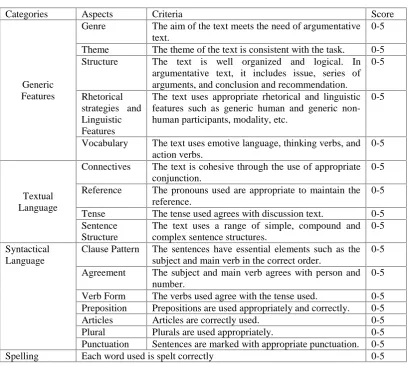
(27) 10 eriting can teach critical thinking by helping students organize, summarize, integrate, and synthesize diverse elements into a coherent whole. Moreover, there are some principles of writing in order to write. They include what to say, how to sequence what to say and how to express what we say. Referring to the statement, it can be said that in writing, students must be able to express their idea and describe it in sequence and communicative way. In addition, Richard and Reynandya (2002) also state that writing is a complex, recursive, and creative process that is very similar in its general outlines for first and second language writers; learning to write requires the development of an efficient and effective composing process, writing is seen as involving a complex relation between writer, reader, and text. In short, it is concluded that writing is a way to produce language that comes from our thought in writen form. By using writing, we can share our idea, feeling or anything that exist in our mind to the others. A successful language learner in writing is determined from several aspects. Based on Heaton (1991), there are five general components of main area in writing, they are language use, mechanical skills, treatment of content, stylistic skills, and judgement skills. In other hand, Knapp & Watkins (2005), states that there are four categories for assessing all of kinds the text, namely generic features, textual language, syntactical language and spelling. The first category is generic features which deals with the macro-level features of text. It consists of some criteria, namely genre, theme, structure, rhetorical and language features, and vocabulary. The.
(28) 11 second category is textual language. This category covers several criteria, such as connectives, reference, tense, and sentence structure. The third category is sytactical language. Criteria in this group are related to writer’s competence in control of the syntax of English sentences. The last one is spelling where the spelling should be correct and consistent.. Krashen also discusses the research and theories on writing and their applications to pedagogy. Krashen suggests that good writers consider writing a process, have low affective filters, are aware of their audience (i.e., use reader-based prose), and concentrate (at least initially) on content rather than accuracy. Krashen argues that concerns for grammar should only appear at the final stage of the composing process – editing. Krashen calls for two important pedagogical techniques: 1) increased reading for the acquisition of written language and 2) writing practice in order to develop a process approach to writing.. In this study the researcher uses theory of Knapp & Watkins (2005) as the basis in scoring students’ writing. there are four categories for assessing all of kinds the text, namely generic features, textual language, syntactical language and spelling.. 1.2 Teaching Writing Teaching writing is to teach students how to express the idea or imagination in written form. In order to be successful in writing, in which the material presented is revelant to their needs, interest, capacities, and ages until they are able to make composition with view or even no errors. In other words, it is clear that the.
(29) 12 teacher should guide the students to writer or how to express the ideas in written form. In practicing their writing, they have to follow the steps to make their writing more effective.. In relation to teaching writing, Harmer (1984) pointed out that there is certain particular consideration that needs to be taken account, such as sentence organization, paragraph arrangement, and coherence. Teaching writing requires the elements of writing including grammar, sentence organization, vocabulary, and mechanics. It can be said that teaching writing should guide students not only to write sentence but also to organize their ideas into written form. Another important thing to consider is that the students should exercise themselves to practice their writing in order to be accustomed to write an effective writing. In practicing their writing, they have to follow the steps to make their writing more effective. Crimmon (1983) highlighted that there were three stages of the writing process: 1. Planning is a series of strategies designed to find and produce information in writing. 2. Drafting is a series of strategies designed to organize and develop a sustained period of writing and encourage one to gather information on those subjects from different perspective. 3. Revising is a series of strategies designed to re-examine and re-evaluate the choices that will create a piece of writing. In addition, Pearsal and Cunningham quoted by Affandi (2015) also devided the process of writing into three steps:.
(30) 13 1. Discovery is a process when the writer thinks about occasion, purpose, the audience, and the topic. 2. Composing is a process of planning what the writer is going to write and revise. 3. Editing is the process when the writer checks for the standard English, the appropriate format, and the accuracy. In brief, it can be concluded that basically, teaching writing is aimed at helping students to organize and develop their ideas well since the students have a plan about the ideas that will be expressed in written form before they come to the actual writing. Thus, the teacher can focus on those three things.. 2.3 Process Approach in Teaching Writing A Cognitive Process Theory of Writing is as a model that the theory of process writing has sprung from. The model was further developed and updated by Hayes and Flower in 1980. It is rather complex containing many components. Therefore it is only the model's central ideas that are brought forward in this text. In Weigle (2002), Hayes and Flower in a quotation: "This approach emerged from researchers’ study of the steps that accomplished writers engage in as they write: planning and organizing ideas, translating ideas into text and reviewing and reading, editing" (1980). Those steps are one of the useful model that can be implemented in teaching writing. Besides, Weigle writes that Hayes-Flower model, is the individual parts of writing engage rather than the task environment. Individual aspects of writing involve “interactions among four components: working memory, motivation and affect,.
(31) 14 cognitive processes and long-term memory" (2002). Cushing Weigle’s claim that the Hayes-Flower model of process writing is based on first-language writing that it has important implication for second language as well (2002).. In order to explain process writing as a method for teaching writing in a more concrete and operative way, it is suitable to present some schemes for how to structure process writing. Moreover, a general structure with pre-writing, drafting and revising, leading to a final product is true for the process of writing. Graham (2003) writes that process writing is time consuming due to the focus on the various stages of text production (drafting and rewriting) cited in Ahlsen (2007). Furthermore, he writes about the importance of feedback regarding process writing since it takes a lot of time and effort and so it is only fair that the student’s writing is responded to suitably.. Writing is a process with 4 stages namely planning, drafting, revising and editing (Seow; 2002) in Richard and Renandya (2002), or planning, drafting, editing and final draft based on Harmer (2004). Planning which is also sometimes called as pre-writing is the stage where writing learners are encouraged to write by jotting ideas and collecting information necessary as through brainstorming, clustering, making WH-questions and the like. When planning, writers have to think about three main issues (Harmer, 2004).. In the first place they have to consider the purpose of their writing since this will influence not only the type of text they wish to produce, but also the language they use, and the information they choose to include. Secondly, writers have to.
(32) 15 think of the audience they are writing for, since this will influence not only the shape of the writing but also the choice of language –whether it is formal or informal in tone for example. Thirdly, writers have to consider the content structure of the piece – that is how best to sequence the facts, ideas or arguments which they have decided to include. Drafting is the stage where writer puts ideas and information he wishes to share on paper. This is usually done on the assumption that it will be amended later. The focus is usually more on the fluency of ideas rather than the accuracy of grammar and spelling.. The next stage is revising (Seow: 2002) or editing (Harmer: 2004). Seow suggests that revising occurs when writer looks back at the work by putting feedbacks given in the responding stage. The writer will also measure the effectiveness of the communication to the target audience. Harmer also suggests that what he means by editing is reflecting and revising.. The last stage is editing or final version in which the writer produces the final version. Checking grammar and spelling accuracies, punctuations, and word choices usually becomes the main task to be done at this stage. Though there are four stages but as a matter of fact elements writing process as mentioned above are not linear, but rather recursive in the sense that a writer plans, drafts, edits/revises and then re-plans, re-drafts, re-edits before finally has the final work. Seow describes this process from Process Activated to Process terminated, while Harmer describes it as the Process Wheel..
(33) 16 2.4 Problem-Based Learning There are many definitions of PBL proposed by some experts. Finucane et al (1998) define PBL as an educational approach that underline the students independent learning and promote deeper rather than superficial learning, by allowing learners to play an active role in solving problems which mirror real world problems. It is also defined as a pedagogical strategy which uses real-world situations as the basis to the development of content, knowledge, and problemsolving skill (Mayo et al, 1993). Based on these theories, this study tends to the definition of PBL from Mayo et al (1993) since this study concern to make the students use their knowledge in solving the problem as the pre-activity in writing.. There are some previous research which have proved the effectiveness of this method in some subjects. Mergendoller, Maxwell, and Yolanda (2006) compared PBL and traditional instructional approach in developing high school students’ microeconomics knowledge and examine whether PBL was differentially effective with students demonstrating different levels of four aptitudes; verbal ability, interest in economics, preference for group work, and problem solving efficacy. They found that there was a statistically significant difference in the learning of macroeconomic concepts between students in the PBL and traditional classes. Students with different characteristics perform differently within PBL and lecture–discussion classes.. Besides, Harsari (2012) investigated whether PBL could improve students achievement in Mathematics better than teaching Mathematics through direct method. The research showed that teaching learning process by using PBL could.
(34) 17 improve students’ achievement in Mathematics better than teaching through direct method.. 2.5 Problem-Based Learning Process It is a pedagogical strategy for posing contextualized, real world situations, and providing resources, instruction, and guidance to learners as they develop content knowledge and problem- solving skills (Mayo, Donnelly, Nash, & Schwartz ,1993). The ability to solve problems is more than just accumulating knowledge; it is the development of cognitive strategies that help students analyze illstructured situations to produce meaningful solutions. The illustration of PBL process as follows:. Here are five strategies of implementing Problem-Based Learning: 1. Problem as a study 2. Problem as an exploritory understanding 3. Problem as an example 4. Problem as a part of process.
(35) 18 5. Problem as stimulus authentic activity According to the Central Queensland University of Australia (2002) ProblemBased Learning (PBL) encourages students to take responsibility for their own learning. On their webpage, dedicated to provide their students information on this learning methodology, they point out that the PBL process follows the following format: •. A PBL activity would involve students meeting as a small groups to discuss a particular problem situation that has no easy or straight forward answer.. •. The problem situations they face will be authentic and are likely to occur in real life.. •. The group would use their own knowledge and experience when discussing the problem and. •. From here the group would come up with a number of idea that are likely to explain. •. treat it as if they were personally asked to solve it.. and solve the problem situation.. Once these hypotheses have been established the group then negotiates an area of. exploration for each member and retires independently to carry out. the research.. •. After sufficient time has elapsed to allow the research to be completed the group will meet. again to discuss the problem in light of the information. discovered by the group members..
(36) 19 •. Now the group will make a conclusions as to nature of the problem and the best fit solution,. •. given the information known.. Finally, the group makes a presentation to explain their idea of the solution and its. consequences.. The historical origins of Problem-Based Learning date back to the early 1970s at the Medical School of McMaster University in Canada though its intellectual beginnings are far older (Rhem, 1998).. 2.6 Problem-Based Learning in Language Teaching According to Maurer & Neuhold (2012), PBL as the constructivist respond to traditional learning theories is based upon three main preconditions for successful and learning process, they are; 1) It is student-centered, 2) Follows an active process of knowledge construction, and 3) It is colaborative. These are explored in the following paragraph.. The first principle is learning as student-centered and active process. Studentcentered implies that PBL implementation should be dominated with the roles of students rather than the teacher in the classroom. The priciple supports the belief of constructivist that knowledge is gained when someone interects. Maurer & Neuhold (2012) divide this principle into two features; prosess and content. In terms of process, students are actively in charge for their own learning processes while in content students are the center of identifying their learning objectives and defining their learning goals..
(37) 20 In addition, this principles is also related to the principle of self-directed learning. It implies that learners play an active role in planning, monitoring and evaluating the learning process (Dolmans et al, 2005). Through self-regulated, learners should be trained to realize their initial knowledge and should be stimulated to regulate or direct their learning process from a cognitive perspective.. The second principle is learning as constructed and contextual process. This principle departs from the definition proposed by Wilkerson & Gijselaers (1996) that the students must be able to determine on their own what to learn and what resources, guided by the facilitator or tutor. Maurer & Neuhold (2012) The student-centered element of PBL in this regard implies that students by solving “real” problems experience the relevance of the topic at hand and are therefore more engaged and eager to learn than if a professor defines the relevance of the topic at hand for them while they become passive recipients that might just consider the topic from this perspective because they were told to do so. This principle is also in line that in PBL should be constructive process and it also has to pay attention to the contextual process.. The third principle is learning as a collaborative prosess. The preceding paragraphs have explored that PBL is highly related to group work and collaborative process based upon the defitions. As the process of learning, discussion with peers might allow students’ to develop knowlegde. Dolmans et al (2005) mentioned that learners should be involved actively and should be stimulated towards activation of prior knowledge, elaborations and deep learning because this leads to deeper and richer understanding and better use of.
(38) 21 knowledge. This principle shares the idea with constructivism where constructivism posits that understandings comes from interactions with the environment, cognitive conflict stimulates learning, and knowledge occurs when students negotiate social situations and evaluate individual understanding (SavinBaden & Major, 2004).. From the previous research of PBL in language teaching, Jiriyasin (2011) found that PBL can give positive effect on students’ oral performance. Lin (2015) conducted the similar research on elementary context. It was found that PBL can foster the students’ ability to learn and use the vocabulary in context. Besides, Leong and Patrick (2009) conducted a research that tried to find the power of PBL. They found that students are generally enthusiastic and interested in PBL assignment.. To support students’ perspective, teachers also rated the satisfaction level on students’ learning progress and performance high. It can be pointed out the obvious values gained in this case study were communication skills, including both oral and written, and both in their target language and native language (language benefit).. 2.7 PBL in Teaching Writing From the basic principles of PBL, PBL as the constructivist respond to traditional learning theories is based upon three main preconditions for successful and learning process, they are; 1) It is student-centered, 2) Follows an active process of knowledge construction, and 3) It is collaborative (Maurer & Neuhold,2012), it.
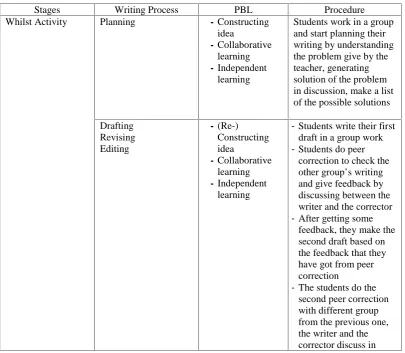
(39) 22 implies that learners play an active role in planning, monitoring and evaluating the learning process (Dolmans et al, 2005).. In the other hand, teaching writing is like guide the students to follow the process of writing. In this research, the researcher try to put PBL in writing process to complete the stage of planning in writing process by having discussion about a problem given by the teacher which is as constructing idea in PBL process. To combine those two things, the researcher will use 4 stages of wwriting process based on Seow (2002) and theory of Maurer & Neuhold (2012) for PBL process which is mentioned in the table of PBL and writing process combination below.. Table 2.1. PBL and Process Writing Combination Stages Whilst Activity. Writing Process Planning. PBL - Constructing idea - Collaborative learning - Independent learning. Procedure Students work in a group and start planning their writing by understanding the problem give by the teacher, generating solution of the problem in discussion, make a list of the possible solutions. Drafting Revising Editing. - (Re-) Constructing idea - Collaborative learning - Independent learning. - Students write their first draft in a group work - Students do peer correction to check the other group’s writing and give feedback by discussing between the writer and the corrector - After getting some feedback, they make the second draft based on the feedback that they have got from peer correction - The students do the second peer correction with different group from the previous one, the writer and the corrector discuss in.
(40) 23 giving feedback - They revise their writing by considering the feedback from the other group - The teacher will give some feedback for the structure of the text to each group before they present their writing in front of the class - The students present in a group about their writing and stick their final draft in front of the class. This means that by applying PBL students play their own role in planning, monitoring and evaluating their learning process. It can be seen from teaching learning process of writing. By using PBL, PBL can make the students arrange their own writing by starting from the problem that teacher has given. The second principle is learning as constructed and contextual process. This principle departs from the definition proposed by Wilkerson & Gijselaers (1996) that PBL is a teaching learning process which demands students to actively develop knowledge. From this principles, this probably can easier the students generate idea to write it in a paragraph.. In addition, Coffin (2013) described how PBL principles are used as the fundamental basis of restructuring English as a foreign language (EFL) writing course, called Writing3, at a Thai university. The study also examined students’ and teachers’ perceptions as related to their learning experiences. The results showed that both teachers and students highly appreciate PBL process because it has helped them in discovering their learning potential and gaining values and benefits from concrete to abstract elements as learners. Students expressed that their motivation, knowledge and skills have tremendously improved..
(41) 24 2.8 Procedure PBL in Teaching Writing There have been many experts presenting their ideas on the steps in conducting problem-based learning. Barron et al. enumerate four important principles in the implementation of PBL instruction: (a) defining learning appropriate goals that lead to deep understanding, (b) providing scaffolds that support students learning, (c) ensuring opportunities for formative self-assessment and revision, and (d) developing social structures that promote participation (Barron et al., 1998).. In addition, Ommudsen (2001) listed the stages of problem-based learning using the abbreviation DENT which stands for define, explore, narrow, and test. First, teacher ought to define the problem carefully. It covers what problems are to determine and whether or not such problem have components. Secondly, exploration for suitable solution is needed. It explores the ideas that many contribute to solutions and what concept might apply in the problem. The third phase is narrowing the choice. After developing hypothesis from the previous stage, this stage is to sort and rank them. The last stage is testing the solution. Should the solution be eliminated, students need to begin it from the first cycle.. Furthermore Boud and Feletti (1997) present the process of problem-based instruction as follows: 1. Students are presented with a problem (case, research paper, videotape, etc). Students work in permanent groups organize their ideas and previous knowledge related to the problem and attempt to define the broad nature of the problem..
(42) 25 2. Throughout discussion, students pose questions called “learning issues” the delineate aspects of the problem that they do not understand. These learning issues are recorded by the group and help generate and focus discussion. Students are continually encouraged to define what they know and more importantly what they do not know. 3. Students rank, in order of importance, the learning issues generated in the session. They decide which questions will be followed up by the whole group and which issues can be assigned to individuals, who later teach the rest of the group. Students and instructor also discuss what resources will be needed to research the learning issues and where they could be found. 4. When students reconvene, they explore the previous learning issues, integrating their new knowledge into the context of the problem. Students are also encouraged to summarize their knowledge and connect new concepts to old ones. They continue to define new learning issues as they progress through the problem. Students soon see that learning is an ongoing process and that there will always be learning issues to be explored. Based on the explanation from Boud and Feletti (1997), there are four steps in the process of PBL that guide the students to get new knowledge by discussing and solving the problems.. Another similar procedure of PBL is also proposed by Trekles (2012). He posits the stages of conducting PBL which includes three steps; problem generation, problem presentation, and reflection and debriefing. During the first phase, students are exposed to authentic scenario, which requires real-world problem.
(43) 26 (Savery & Duffy, 1994). It is suggested that problem should be multidisciplinary problem and open-ended so it can enhance the students’ potential better. The second stage is problem presentation. During this stage, students were given a chance to analyze the problem. They ought to answer questions related to problem such as what happened, and how did it happen and what details led them to think this way. Through these questions, they have to collect information as the answer they must use this information in order to create a feasible solution in response to the problem. The third stage is reflection and debriefing. This stage covers the process when students comment on the other students’ work. Near the end of the lesson, all students will come together as a class to briefly discuss their thoughts on the writing prompt, the virtual world, and what they enjoyed or did not enjoy about learning experience (Trekles, 2012).. Moreover, Tan (2004) proposed an illustration of the process of PBL which covers problem presentation, problem triggers inquiry, PBL stage and solution, presentation and evaluation. The first step, which is problem presentation, relates to the introduction of the problem to the students. The later stage is problem trigger inquiry where the students initiate the process of searching solution. After that, the PBL main stage can be carried out. That is initial analysis of problem, generation of learning issue, iterations of independent and collaborative problem solving and integration of knowledge, and integration of new knowledge. The last stage as proposed by Tan (2004) is presentation the solution and evaluation.. Summing up several experts’ statement, PBL procedure includes introduction to problem. Then, followed by the attempt to answer the problem through carefully.
(44) 27 research for the solution. After that process is end up with a presentation or debriefing from the solution. As many experts have delineated the process of PBL. This study adopts the stages proposed by Boud & Felleti (1997) which said that the process includes introduction to problem, discussion and posing a question, setting the priority and explore and integrate the new knowledge.. By adapting the stages proposed by Boud and Felleti (1997), the researcher will use the procedures of writing argumentative using PBL as follows:. Pre Activity Ask the students about the current problem faced in the society Ask the students if they have any idea about the solution of that problem Main Activity Divide the students into some groups Play a video about the hot issue currently Ask the students what the video is about Ask the students to discuss with their group about the possible solutions of the problem and make a list of it Give an argumentative text to each group which is about the solution of the problem in the video before Ask them to find the solution in the text Ask them to identify the text by looking at the aims of the text and linguistic feature of the text Point some parts of text which show the linguistic feature of argumentative text.
(45) 28 Ask the students to discuss with their group to make their own argumentative paragraph based on the solution that they have listed before Exchange their writing to the other group and ask them to give feedback to the argumentative paragraph from the other group Ask the students to revise their group’s writing based on the feedback Do the second peer correction by exchanging their writing to the other group which is different from the first one and give feedback to their friends’ writing Revise their writing by considering the feedback from their friends Present their final draft in front of the class and stick their group’s writing in front of the class Post Activity Review the material Explain the activity in the next meeting. This is a part of the procedure in impelemnting PBL and writing process. Afetr working in a group writing, the students have time to work individually in writing their paragraph. For the complete one, lesson plan is also provided in the appendix which shows the more complete procedure for group writing and individual writing in the implementation of the treatment. In the procedure of implementing this treatment, the teacher will be as a controller and in the beginning of the meeting, the researcher will make sure that the students are in a right track by giving some correction for the students’ activity such as their writing and their comment in giving feedback..
(46) 29 The researcher will conduct the research for. six meetings. There are four. meetings for giving treatments by using PBL in teaching writing and two meetings for giving pre-test in the beginning and posttest in the last meeting.. 2.9 Advantages and Disadvantages PBL in Teaching Writing From applying this method in some previous research, there are some advantages and disadvantage which have found in language teaching learning prosess through Problem-Based Laerning.. 1. Advantages Duch et al (2001) state that PBL addresses directly many of the recommended and desirable outcomes pf an undergraduate education: specifically, the ability to do the following: 1. Think critically and be able to analyze and solve complex, real-word problems; This benefit apparently can make the students become critic in finding the solution of the real problem so that they are be able to write the argumentative paragraph contextually. 2. Find, evaluate, and use appropriate learning resources; By using the appropriate learning resources, this perhaps can help the students generate their idea in writing. 3. Work cooperatively in teams. and small groups; This also helps the. students to share their idea and also to create better writing by providing.
(47) 30 cooperative learning. So that after discussing the idea, they can solve their own problem in writing and make a better writing to present. 4. Demonstrate versatile and effective communication skills, both verbal and written; 5. Use content knowledge and intellectual skills acquired at the university to become continual learners; All these benefits are gained through the sets of process in the PBL implementation and also can relate it to teaching writing.. 2. Disadvantages Despite its benefits, PBL also has challenges in its implementation. These challenges occur as the process of implementing PBL requires a number of complex processes. Thus, it is very possible that during this process, some problems might be encounteres. Dolmans et al (2005) enumerate the problem that might exist which can degrade the benefits of PBL. First, the problem used in the class might be too well-structured. It underlines that criteria selecting the problem should be paid attention. It is due to when the problem is considered too easy for the students; they are not challenged to construct knowledge actively. The second problem is in PBL implementatioin related to the tutors. PBL cannot run well if the tutor are too directive.. Teachers who implement PBL should be well-informed related to their role in the classroom because dominant tutors in the group hamper the learning process, but the quiet or passive tutors who are probably trying not to teach also hamper the.
(48) 31 learning process (Dolmans et al, 2005). Based on the experts say about the disadvantages of PBL, it seems that this method will get some difficulties to be applied in teaching writing. Tutor need to be active although students become the main role of the learning process. Tutor should prepare the apropriate material for teaching writing which is not confusing and understandable.. 2.10 Perception in Language Learning Richards (2001) states that students are in a good position to assess the effectiveness of teaching, although the extent to which they are able to do so depends on the type of feedback instrument they are given. Although students are often critical, they usually have a good sense of whether a teacher prepares his or her lesson, teaches relevant content, provides lesson that are engaging, relevant, and at an appropriate level of difficulty. Students’ perceptions are the beliefs or opinions that students have as a result of realising or noticing something, especially something that is perhaps not obvious to other people, for example: teachers, parents, or outsiders. They are the result of direct experiences in the educational context. Based on the previous research of Jiriyasin (2011) the subjects’ opinions towards learning with a PBL approach were constructive. They felt that learning by this instructional method was enjoyable and interesting as the way the class was conducted challenged them to think, explore for more information, and share their ideas with the peers. They reported that their English discussion skills were better..
(49) 32 2.11 Perception towards PBL in Teaching Writing There are some previous research which have conducted a research of PBL. After conducting the research, it showed students’ perception of PBL in teaching writing. Affandi (2015) found that most of the students feel enjoy solving the problem which is selected by the teacher to be used in learning process of writing argumentative paragraph. Besides, the other previous research is from Coffin (2013) who found that by implementing PBL in this context was quite. successful in terms of enhancing the learning experiences of both students and teachers positively and effectively.. Despite gained benefits, it is also acknowledged that PBL process has brought frustration and more hard work to both students and teachers. The experience of assisting the whole process of PBL implementation in this case has confirmed that PBL with a suitable modification for each local context is viable alternative educational strategy to transform a passive learning environment into an active learning environment.. According to Maurer & Neuhold (2012), PBL as the constructivist respond to traditional learning theories is based upon three main preconditions for successful and learning process, they are; 1) It is student-centered, 2) Follows an active process of knowledge construction, and 3) It is colaborative.. In this study, the reseracher tries to find students’ perception by distributing questionnaire to the students which consists of 15 statements based on the.
(50) 33. three conditions of PBL related to the theory of Maurer and Neuhold (2012) in teaching learning process of writing argumentative paragraph.. 2.12 Theoretical Assumption From the theories and explanation before, it can be assumed that Problem Based Learning can build a challanging activity for the students. Since this research focuses on writing ability, the researcher combine PBL and writing process which the role of PBL much concern on the planning in the writing process. By using PBL this makes the students feel excited in learning because PBL give the real problem to be discussed. Then, the implementation of PBL in writing process can improve sudents achievement also because PBL can make first step of writing become stronger since PBL give a guidence for the students to generate their idea in their writing in writing process so that both PBL and writing process combination give different role in composing their writing where PBL give a triger to the students in generating their idea then writing process will make the students have a better writing by doing drafting, revising and editing.. Through the stages implemented by using PBL inwriting process, the students give possitive response that can support the students in their writing achievement. Besides, since PBL provides real problem, this can also make the students to be able to solve their own problem in the real life. Moreover, writing is a process which consists of some steps that the students do independently either in a group or individual. By combining these two, PBL and writing process, the steps will.
(51) 34 complete each other. Therefore, the implementation of this combination, the researcher believes that can give a good effect to students’ writing achievement.. 2.13 Hypotheses The following hypotheses are proposed in order to answer the research questions. From the theory and some previous research before, the researcher proposed some hypotheses as follows: 1. The use of PBL and writing process combination in EFL writing classroom affects the students’ writing achievement. 2. Students’ perception agreed that PBL and writing process improve students’ writing achievement. 3. There is a correlation between the students’ perception towards the implementation of PBL and writing process combination in EFL writing class and students’ writing achievement. 4. PBL and writing process combination can complete each other procedures that can make the students involve and enjoy the learning process since PBL guide the students genereate their idea to write in writing process to have a good writing. There are several hypotheses that the researcher prove through this study.. This research conducted by concerning some points that have been discussed in this chapter. They are the theoretical concept of writing, teaching writing, process approach in teaching writing, Problem-Based Learning, Problem-Based Learning.
(52) 35 process, Problem-Based Learning in language teaching, Problem-Based Learning in teaching writing, procedure PBL in teaching writing, the advantages and disadvantages of PBL in teaching writing, perception in language learning, perception toward PBL in teaching writing, theoretical assumption, hypotheses.. and.
(53) III. METHODS This chapter discusses a set of methodology of this study. It starts with design, data source, instruments, validity and reliability, data collecting technique, data analysis, and hypothesis testing.. 3.1 Design Since this study was aimed at describing the teaching-learning writing activities when PBL and writing process combination was implemented in EFL writing classroom, finding out the effects of applying PBL and writing process combination of EFL students’ writing skill, and describing the students’ attitude towards the implementation of PBL and writing process combination in EFL writing classroom, this study used a mixed method research.. The researcher collected both the quantitative and qualitative data simultaneously during the study. The collection of qualitative data during the experiment was to understand how the participants were going through the process, whereas the quantitative data assessed the impact of the treatment on the outcomes. The qualitative data was in terms of observation data collection. Meanwhile, quantitative data was dealing with test scores and responses to questionnaire. The following was research design to answer the first research question:.
(54) 37 T1 X T2 Notes: T1 X T2. : Pre-test : PBL & Writing Process combination : Posttest. 3.2 Data Source The population of this research was third semester of university students. The sample of this research would be one class as the experimental groups with. The subject of this research was English department students batch 2014. This study was conducted in university level because the objective in this study was to minimize the students’ problem of generating idea. Since university students have already had the basic knowledge, especially in English Department students, the use of this approach combination would be appropriate.. 3.3 Instruments There were three instruments that would be used in this research. They were observation, writing test and questionnaire.. a. Observation In this study, the observation was used to answer the first research question. The researcher did observation in teaching-learning process based on Maurer & Neuhold (2012) who stated PBL as the constructivist respond to traditional learning theories is based upon three main preconditions for successful and learning process, they are; 1) It is student-centered, 2) Follows an active process of knowledge construction, and 3) It is collaborative and writing process, which.
(55) 38 consisted of some steps like planning, drafting, editing and final draft (Harmer; 2004).. b. Writing test In this research, writing test was used to know the students’ writing achievement. There were two tests, pretest and post-test, which are both the same. In the pretest and posttest the students would be asked to write their argument or make an argumentative paragraph. Scoring criteria will be used to assess the students’ argumentative writing. Considering the validity of assessment, in determining the scoring rubric, the teachers should concern what skills or abilities are being measured. In the composition literature, there were three main types of rating scales, namely primary trait scales, holistic scales, and analytic scales (Mashori, 2007).. Considering the aim of the study which was to find out impact of applying PBL on students’ writing achievement, the analytic scales was chosen. Analytic scales measure several aspects of writing rather than single-judgment of students’ writing. According to Hunter et al. (1996), analytic scoring involves evaluating students’ work by breaking it down into its constituent elements or attributes and assigning a proportion of the available marks to teach.. In this study, the writing scoring rubric assessment used was adapted from the rubric of Knapp & Watkins (2005). The scoring rubric of writing was designed based on the generic, structural, and grammatical features of discussion text. This scoring system has 17 criteria which are categorized into four aspects, namely.
Figure

Related documents
The Visual Basic based hooks in the CRM application use the eQuality Connect COM client to pass customer name and account balance to the eQuality Connect server via CORBA. –
In terms of outcome data, although information on pregnancy losses may be captured, the level of detail regarding congenital anomalies in the offspring can be limited, and this
Tree 8: Basic Time Step Pricing Model Leveraged Underlying 28 Tree 9: Basic Time Step Pricing Model Leveraged American Call Option 28 Tree 10: Basic Time Step Pricing
The Museums and Online Archives Collaboration‟s Digital Asset Management Database (DAMD) is designed to facilitate exporting surrogate media metadata in standards-based
The facility to enter and store all data items required for management of the school, including information to monitor and support pupils, manage staff, manage school assets
In the present study, the effects of processing conditions such as pH, reducing agent and storage time on yields and purity of glycinin (11S) were evaluated in the fractionation
Marchand, “Diffuse pleural mesothelioma and asbestos exposure in the North Western Cape Province,” British Journal of Industrial Medicine , vol. Hammond, “Relation between exposure
