Journal of Chemical and Pharmaceutical Research, 2013, 5(9):575-583
Research Article
CODEN(USA) : JCPRC5
ISSN : 0975-7384
A comparison study of three nonlinear multivariate data analysis methods in
smartongue: Kernel PCA, LLE and Sammon Mapping
Shiyi Tian, Min Chen, Weichun Pan, Shaoping Deng
Food Sensory Science Laboratory of Zhejiang Gongshang University, Food Safety Key Lab of
Zhejiang Province, Zhejiang Gongshang University, Hangzhou, PR China
_____________________________________________________________________________________________
ABSTRACT
Smartongue is a voltammetric electronic tongue, based on a non-specific sensors array and one special voltammetry, so called multi-frequency large amplitude pulse voltammetry (MLAPV), which made its responding signals have much overlapping information. Three non-linear multivariate data analysis methods, Kernel principal component analysis (Kernel PCA), Locally linear Embedding (LLE) and Sammon mapping, were used to dig the information from the collecting data of Smartongue. One linear data analysis method, normal principal component analysis (PCA) and the discrimination index (DI value) were applied as the reference method and as the quantitative indicator to evaluate the discrimination ability. The results indicated that three non-linear data processing methods exhibited much more feasible and efficient than PCA in Smartongue. Sammon mapping is the most suitable non-linear method to process data in Smartongue. It was able to extract the useful information from the raw data and to classify three bitter solutions, six artificial green tea products and five milk powder solutions by means of the storage time well. Sammon mapping will be a very promising data processing technique for voltammetry electronic tongue.
Keywords: Smartongue; Kernel principal component analysis (Kernel PCA); Locally Linear Embedding (LLE); Sammon mapping
_____________________________________________________________________________________________
INTRODUCTION
______________________________________________________________________________
analysis method is more suitable for this task. Unfortunately, so far there are only a few available non-linear multivariate data analysis methods for data process in electronic tongue [11].
In this paper, we compared the feasibility and efficiency of three non-linear multivariate data analysis methods, Kernel PCA with three kernel functions [12], Local Linear Embedding (LLE) [13] and Sammon mapping [14], in dealing with the data measured by a voltammetric electronic tongue, Smartongue. This device developed by our lab bases on multi-frequency large amplitude pulse voltammetry (MLAPV), the potential applied and current responding technology which will produce lots of non-linear information of analyzed solutions. The results show that all three non-linear multivariate data analysis methods have better discrimination ability than PCA does. Furthermore Sammon mapping is the best among all three above mentioned methods.
EXPERIMENTAL SECTION
Samples Preparations and Measurements
Bitter solutions: Solutions of three bitter taste substances, caffeine (Sigma), acetaminophen (Sigma) and urea (Sigma), with analytical grade at 0.01 mol·L-1 were prepared respectively to evaluate the discrimination ability of Smartongue with three non-linear data process methods. Due to weak signal, the charging current and faradic current, generated by the multi-frequency large amplitude pulse voltammetry (MLAPV), bitter taste substance usually was not easily identified by Smartongue with normal PCA.
Green tea: One type of green tea, Longjing Tea, purchased from Lianhua Supermarket, Hangzhou, China, was used as the reference sample. In order to assess the ability of our device, the inferior green tea was produced by roasting the Longjing Tea in 120 ◦C for 5 min. Six green tea samples with the various mass ratios of Longjin Tea to inferior one were prepared to evaluate the discrimination ability of three non-linear multivariate data analysis methods (Table 1). In order to prepare tea solutions, 5 g of each sample had been brewed for 5 min in 250 mL deionized water (Milipore) at 85 ◦C with stirring. Then the tea-leave was taken away from solutions by the filter. All clear solutions were cooled down by ice-bath to 22 ◦C. 15 mL of the each solution was analyzed immediately after temperature got the setting point. Each sample equally divided into six pieces. Each piece was measured one time by Samrtongue.
The milk powder: One milk powder, Guangming milk powder, purchased from Lianhua Supermarket, Hangzhou, China, was used as the third sample for evaluation of the classification ability of three non-linear multivariate data analysis methods. In milk powder measurements, 25 g of Guangming milk powder was kept stirring in 250mL of deionized water (Millipore) at 40 ◦C until all powder was dissolved. Then the solution was stored in the refrigerator (Haier Co.) at 4 ◦C. Following the above mentioned method, five milk solutions were prepared on the same time of five successive days (Table 2). Before measurement, all solutions except the last one needed to be warmed up to 22
◦
[image:2.595.173.442.539.588.2]C. Then 15 mL of the sample solution was analyzed immediately. Each sample equally divided into five pieces. Each piece was measured three times by Samrtongue.
Table 1. Six Green Tea Samples
Green tea S1 S2 S3 S4 S5 S6
Total Weight (g) 5 5 5 5 5 5
Weight of inferior green tea (g) 0 1 2 3 4 5
Mass percentage of inferior green Tea (%) 0 20 40 60 80 100
Number of samples 6 6 6 6 6 6
Table 2. The Treatment of Milk Powder Solutions
Smartongue: Smartongue is a voltammetric electronic tongue developed by our lab (fig 1). As a standard three-electrode system, the device is consisted of six naked noble metal electrodes (diameter: 2 mm, Tianjing Aida Co., China), i.e. platinum, gold, palladium, tungsten, titanium, silver, as the working electrodes, an Ag/AgCl electrode (Tianjing Aida Co., China) as the reference electrode, and a platinum counter electrode (diameter: 2 mm, Tianjing Aida Co., China). Based on the signal excitation and responding method of multifrequency large amplitude pulse volatmmetry (MLAPV), this device gets a remarkable results to determine food properties, i.e. green tea,
Milk powder solutions M5 M4 M3 M2 M1
Treatment Date 2011.04.01
8:00-11:00
2011.04.02 8:00-11:00
2011.04.03 8:00-11:00
2011.04.04 8:00-11:00
2011.04.05 8:00-11:00
Weight of Milk powder (g) 25 25 25 25 25
Volume of deionized water (mL) 250 250 250 250 250
Storage Time (Day) 4 3 2 1 0
[image:2.595.89.527.620.688.2]______________________________________________________________________________
[image:3.595.117.503.310.450.2]Chinese alcohol and modal medial [15] [16].
Fig. 1: Sketch map of the structure of Smartongue
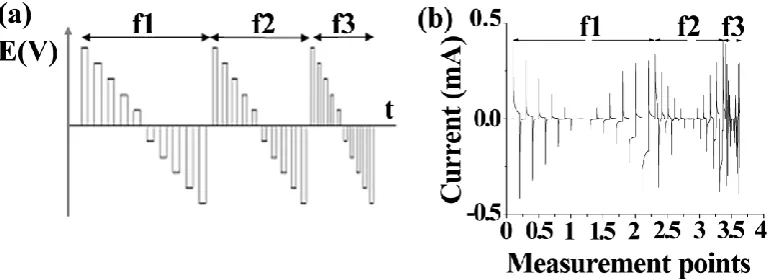
Measurement principle: Multi-frequency large amplitude pulse voltammetry (MLAPV) with three frequencies, 1 Hz, 10 Hz and 100 Hz, was used by Smartongue (Fig. 2). The waveform of one frequency started at the pulse of the maximal voltage value at 1.0 V, and followed up pulses with the decreased amplitude rate at 0.2 V for each step till the minimal voltage value at −1.0 V. The interval between different successive frequency is 5 s with 0 V. According to the principle of MLAPV and the characteristics of non-specific sensor array of Smartongue, the data collected by Samrtongue contains abundant of overlapping and non-linear information [15] [16].
Fig. 2: Multifrequency large amplitude pulse voltammetry: (a) applied potential and (b) responding current of one working electrode
DATA PROCESSING
The data generated by six work electrodes in Smartongue was treated as input vectors. Three non-linear dimensionality reduction methods, Kernel PCA, LLE and Sammon mapping, were applied while one linear dimensionality reduction method, PCA, was used as a reference method. Discrimination Index (DI value) was used as a quantitative index for discrimination ability. All the methods were run by Matlab 2009b.
Principal Component Analysis (PCA): PCA (Principal Component Analysis) [9] is a traditional linear technique of dimensionality reduction. It transforms complex variables into some principal components by using dimensionality reduction technique, of which principal components are orthogonal and reflect main information of original variables. So far, it is the most commonly linear multivariate data analysis method for E-tongue and was used as a reference method in this paper.
Matrix X is assumed as the original data with n rows (samples) and p columns (eigenvalues). In principle, X is able to decomposed into two matrices
X = TL’
here matrix T is the score matrix with n rows and d columns (equal to the number of the principal components), which was used to exhibit the difference of the samples; matrix L is loading matrix with p rows and d columns. The diagonal elements of the matrix T’T are eigenvalues.
______________________________________________________________________________
dataset Xi is defined by
( ,
)
ij i j
k
k x x
where k is a kernel function. Now there are three common kernel functions, gauss kernel function, polynomial kernel function and sigmoid kernel function with the expressions as following:
Gauss - k (xi, xj)=exp{-‖xi-xj ‖^2/(2*
)^2}Poly - k (xi, xj) = (xiTxj +c)d
Sigmoid - k(xi, xj) = tanh(axi T
xj +r)
where
, c and d, as well as r and a are constant parameters in each kernel function respectively. In the paper, all kernel functions are expressed by K without further differentiation in the Kernel PCA.Local Linear Embedding (LLE): LLE used the local linear expression to mimic the nonlinear behavior. Thus the global structural information was provided by overlapping local neighborhoods without changing the whole geometric property during this process. The key point of LLE is to construct reconstruction weights. Generally, LLE algorithm is summarized by three steps:
(i) Construct a local neighborhood and select local neighbor points (k - nearest neighbor method) [18]. (ii) Calculate the reconstruction weights Wij of samples to minimize the reconstruction error with one constraint
min
2
( )
||
i ij ij||
i j
W
x
W x
11
k ij jw
where xij (j=1, 2, ,k) is k neighbor points of xi, wij is the weight between xi and xij.
(iii) Find Yi that was embedded in low-dimensionality space of xi by remaining wij. In order to fix Y and avoid
collapsing to the origin of coordinates in low dimensionality, there are two constraints of Y:
1
0
N i iy
, 11
N T i j iy y
I
N
, where I is a N-dimensional identity matrix. Furthermore, Y should satisfy the following requirtments2 2
1 1
min ( ) || || || ( ) || min
N N
T
i i i i
i i
Y Y I YW Y I W trYMY
YY
T
I
where
M
(
I
W
) (
TI
W
)
. Using the Lagrange operator method, the result is MY
T
=
YT, the jth componentembedded by the ith sample is ivji, where
v
ji is the ith component of vj.Sammon mapping: Sammon mapping is a projection method for geometric image dimensionality reduction. This method is a nonlinear transform to display the structural information of the original data in low dimensionality directly and visually via an approximate image of interrelation between high-dimensional points [14].
Assuming there are n points dictated by xi (i=1,2,…,n) in the D-dimensional space and n responses indicated by yi
(i=1,2,…,n) to xi in the d-dimensional space(d < D, usually d=2 or d=3). Besides,
*
ij
d
is denoted the distance between xi and xj, while dij the distance between yi and yj. These distances are the Euclidean Distance. With the______________________________________________________________________________
2
1
(
)
d
ij ik jk k
d
y
y
The intrinsic algorithm of Sammon mapping is to find a mapping:
f:
The mapping is calculated by applying the iterative gradient method to minimize the objective function, and the low-dimensional expression is obtained after mapping. One vital characteristic of Sammon mapping is the conservation of the distance between the data during the transformation between two spaces with the formula read as
* 2
* *
(
)
1
nij ij i j
i j ij ij
d
d
E
d
d
Discrimination Index (DI value): DI value [19] is a number to evaluate the separation level for the above non-linear multivariate data analysis methods. Generally there are two kinds of conditions to determine DI value.
(i) Each area has been clearly separated, DI= (1- ∑Si/Sall) × 100%
where Si is the area occupied by the one group of samples; Sall is the area occupied by the whole samples. Thus, the bigger DI value reflects the bigger distance between two groups of samples.
(ii) Overlap is exist, DI= - (∑Si/Sall ) × 100%
(iii) The area was calculated by the following steps 1> Connect two points in the plot by straight line. 2> Repeat the first step for all points.
3> Determinate the maximal area defined by the above mentioned lines. The area is S. 4> Si is the area from the points made by the ith sample.
5> Sall is the area from the points made by the all samples.
The maximum DI value is 100%, indicating the best separation of the samples.
RESULTS AND DISCUSSION
______________________________________________________________________________
Table 3. The Results of Different Data Processing Methods for Bitter SolutionsData processing methods PCA Kernel PCA LLE Sammon mapping
Gauss Poly Sigmoid
Classification - + + + + +
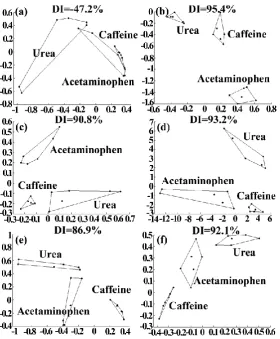
DI value (%) -47.2 93.2 86.9 92.1 90.8 95.4
[image:6.595.165.446.155.495.2](‘+’ means all samples were distinguished, ‘-’ means some samples were overlapped)
Fig. 3. The results of bitter solutions from the different data processing methods: (a) PCA; (b) Sammon mapping; (c) LLE; (d) Kernel PCA with gauss kernel function; (e) Kernel PCA with polynomial kernel function; (f) Kernel PCA with sigmoid kernel function
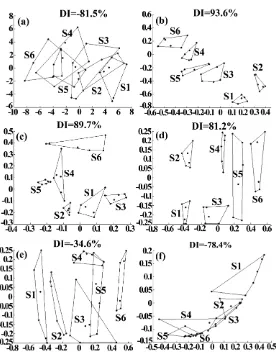
Separation of the artificial green tea samples: Fig 4 displays the results of three nonlinear dimensionality reduction methods in artificial green tea samples. The number of iterative operation of Sammon mapping is 500 and the initial locative value of green tea is provided by PCA. The optimal neighbor number is 10 and the optimal eigenvalue number is 30 for LLE. It can be seen that PCA has the worst separation ability among these project techniques due to its limited ability in non-linear data process. The six green tea samples cannot be discriminated by PCA and the DI value is -81.5% (Fig. 4(a)). In Kernel PCA treatments, only the Gauss kernel function can classify the quality of six green tea samples with the DI value 81.2%, while Kernel PCA with the polynomial kernel function and the sigmoid kernel function cannot differentiate six samples. The DI value is -34.6% for the polynomial kernel function and -78.4% for the sigmoid kernel function (Fig. 4(d-f)). Parallel Sammon mapping and LLE exhibits the strong separation ability, although the components of artificial green tea products were more complex than bitter solutions. Therefore they were more difficult for classification than the bitter solutions do. The DI value of Sammon mapping is 93.6% and the DI value of LLE is 89.7% (see Fig. 4(b-c)). All results for the DI value are summarized in
______________________________________________________________________________
Fig. 4. The results of artificial green tea samples from the different data processing methods: (a) PCA; (b) Sammon mapping; (c) LLE; (d) Kernel PCA with gauss kernel function; (e) Kernel PCA with polynomial kernel function; (f) Kernel PCA with sigmoid kernel function
Table 4. The Results of Different Data Processing Methods for Artificial Green Tea Samples
Data processing methods PCA Kernel PCA LLE Sammon mapping
Gauss Poly Sigmoid
Classification - + - - + +
DI value (%) -81.5 81.2 -34.6 -78.4 89.7 93.6
(‘+’ means all samples were distinguished, ‘-’ means some samples were overlapped)
______________________________________________________________________________
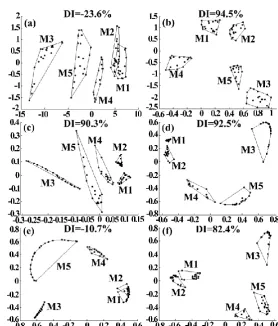
Fig. 5: The results of milk powder solutions from the different data processing methods: (a) PCA; (b) Sammon mapping; (c) LLE; (d) Kernel PCA with gauss kernel function; (e) Kernel PCA with polynomial kernel function; (f) Kernel PCA with sigmoid kernel function.
Table 5. The Results of Different Data Processing Methods for Milk Power
Data processing methods PCA Kernel PCA LLE Sammon mapping
Gauss Poly Sigmoid
Classification - + - + + +
DI value (%) -23.6 92.9 -10.7 82.4 90.3 94.5
(‘+’ means all samples were distinguished, ‘-’ means some samples were overlapped)
the DI value of PCA is -23.6%. The other non-linear techniques, i.e. Sammon mapping, LLE, Kernel PCA with the gauss kernel function, and Kernel PCA with the sigmoid kernel function, show an well separation ability for the quality change of milk powder solutions (Fig. 5(b-d, f)). The DI values of each non-linear method are listed in
Table 5. The DI value of Sammon mapping is 94.5%, the highest value among all the non-linear data processing techniques.
CONCLUSION
In this paper, three kinds of non-linear multivariate data analysis methods, such as Kernel PCA with three kernel functions, Locally Linear Embedding (LLE) and Sammon mapping are applied to process the data from Smartongue with MLAPV, and PCA is used as the reference method. Three bitter solutions, six artificial green tea products and five milk powder solutions with different storage times, which are not easily separated by voltammetric electronic tongue with normal PCA, are our samples to evaluate the discrimination ability of the above mentioned methods. Three non-linear multivariate data analysis methods exhibit better separation ability than PCA, and Sammon mapping has the best discrimination ability for Smartongue. It indicates that the data from the electronic tongue contains plenty of useful non-linear information due to the non-specific sensors array and the waveform of MLAPV [8] [15]. The non-linear data process methods will have a great development in electronic tongue.
Acknowledgments
______________________________________________________________________________
REFERENCES
[1] Winquist, F., 2008. Microchimica Acta, 163: 3-10. DOI:10.1007/s00604-007-0929-2
[2] Toko, K., 2000. Sensors and Actuators, B: Chemical, 64: 205-215. DOI:10.1016/S0925-4 005(99)00508-0 [3] Legin, A., A. Rudnitskaya and Y. Vlasov, et al., 1997. Sensors and Actuators B: Chemical, 44: 291-296. DOI: 10.1016/S0925-4005(97)00167-6
[4] Winquist, F., P. Wide and I. Lundström, 1997. Analytica Chimica Acta, 357: 21-31. DOI:
10.1016/S0003-2670(97)00498-4
[5] Campos, I., M. Alcañiz and R. Masot, et al., 2012. Sensors and Actuators B: Chemical, 161: 556-563. DOI: 10.1016/j.snb.2011.10.075
[6] Riul Jr, A., R. R. Malmegrim and F. J. Fonseca, et al., 2003. Biosensors and Bioelectronics, 18: 1365-1369. DOI: 10.1016/S0956-5663(03)00069-1
[7] Sehra, G., M. Cole and J. W. Gardner, 2004. Sensors and Actuators B: Chemical, 103: 233-239. DOI: 10.1016/j.snb.2004.04.055
[8] Vlasov, Y. G., A. V. Legin and A. M. Rudnitskaya, 1997. Sensors and Actuators, B: Chemical, 44: 532-537. DOI:
[9] Park, M. S. and J. Y. Choi, 2009. Pattern Recognition, 42: 2353-2362. DOI: 10.1016/j.patcog.2009.04.011 [10] Gay, M., C. Apetrei and I. Nevares, et al., 2010. Electrochimica Acta, 55: 6782-6788. DOI: 10.1016/j.electacta.2010.05.090
[11] Garcia-Breijo, E., J. Atkinson and L. Gil-Sanchez, et al., 2011. Sensors and Actuators A: Physical, 172: 570-582. DOI: 10.1016/j.sna.2011.09.039
[12] Shawe-Taylor, J. and N. Cristianini, 2004. Kernel Methods for Pattern Analysis.: Cambridge University Press. [13] Chang, H. and D. Yeung, 2006. Pattern Recognition, 39: 1053-1065. DOI: 10.1016/j.patcog.2005.07.011 [14] Sun, J., C. Fyfe and M. Crowe, 2012. Information Sciences, 187: 72-92. DOI: 10.1016/j.ins.2011.10.013 [15] Tian, S. Y., S. P. Deng and Z. X. Chen, 2007. Sensors and Actuators, B: Chemical, 123: 1049-1056. DOI: 10.1016/j.snb.2006.11.011
[16] Tian, S. Y., S. P. Deng and C. H. Ding, et al., 2007. Sensors and Materials, 19: 287-298.
[17] Zhang, R., W. Wang and Y. Ma, 2010. Expert Systems with Applications, 37: 6531-6537. DOI: 10.1016/j.eswa.2010.02.133
[18] Li, Y., 2006. Pattern Analysis and Machine Intelligence, IEEE Transactions on, 28: 827-831. DOI: 10.1109/TPAMI.2006.89
[19] Woertz, K., C. Tissen and P. Kleinebudde, et al., 2011. Journal of Pharmaceutical and Biomedical Analysis, 55: 272-281. DOI: 10.1016/j.jpba.2011.02.002