© 2017, IRJET | Impact Factor value: 5.181 | ISO 9001:2008 Certified Journal
| Page 1943
Seismic Evaluation of Multi-Storey Building using E-tabs
Sunil S K
1, Mahesh Kumar C L
2, Shwetha K G
3, Raghavendra H J
41
Assistant Professor, Department of Civil Engg, Acharya Institute of Technology, Bengaluru, Karnataka
2, 3Assistant Professor, Department of Civil Engg, Nitte Meenakshi Institute of Technology, Bengaluru, Karnataka
4
Assistant Professor, Department of Civil Engg, Sri Krishna Institute of Technology, Bengaluru, Karnataka
---***---Abstract -
Tall building or Tallness, however, is a relativematter and tall buildings cannot be defined in specific terms related just to height or to the number of floors. The tallness of a building is a matter of a person's or community's circumstance and their consequent perception. From the structural engineer's point of view, however a tall building may be defined as one that. Because of its height, is affected by lateral forces due to wind or earthquake actions to an extent that they play an important role in the structural design.
The influence of these actions must therefore be considered from the very beginning of the design process.
In this Paper, considering the multi-storey building of G+30 floors. The various loads applied on the building such as Dead load, Live load and Earthquake load. Then analysing the behaviour of structure subjected to combination of the above mentioned loads using E-tabs software.
For the irregularity building considering the equivalent static method for different zones and soil types the clear visible that there is an increasing order in the values obtained for cumulative storey shear, displacement, storey drift and overturning moment are follows in the order of soil-I, soil-II and soil-III types in all zones in X direction. And also it comes same in the order of zone II, zone III, zone IV, zone V in all soil types in X direction.
Key Words: lateral forces, irregularity, storey drift, E-tabs.
1.INTRODUCTION
Tall towers and buildings have fascinated mankind from the beginning of civilization, their construction being initially for defense and subsequently for ecclesiastical purposes. The growth in modern tall building construction, however, which began in the 1880s. Tall commercial buildings are primarily a response to the demand by business activities to be as close to each other, and to the city center, as possible, thereby putting intense pressure on the available land space. Also, because they form distinctive landmarks, tall commercial buildings are frequently developed in city centers as prestige symbols for corporate organizations. Further, the business and tourist community, with its increasing mobility, has fuelled a need for more, frequently high-rise, city center hotel accommodations. The rapid
growths of the urban population and the consequent pressure on limited space have considerably influenced city residential development. The high cost of land, the desire to avoid a continuous urban sprawl, and the need to preserve important agricultural production have all contributed to drive residential buildings upward. In some cities, for example Hong Kong and Rio de Janeiro Local topographical restrictions make tall buildings the only feasible solution for housing needs.
Recently there has been a considerable increase in the number of tall buildings, both residential and commercial, and the modern trend is towards taller structures. Thus the effects of lateral loads like winds loads, earthquake forces are attaining increasing importance and almost every designer is faced with the problem of providing adequate strength and stability against lateral loads. For this reason to estimate wind load and earthquake loading on high-rise building design.
Wind speed increases at the higher levels. The dynamic responses of the wind have to be taken into consideration. There are certain methods to estimate the Static and Dynamic nature of the wind forces and have been illustrated in this paper.
1.1 IRREGULAR BUILDINGS ACCORDING TO IS
CODES(1893-2002)
[7]a. Definitions of Irregular Buildings —Plan Irregularities
Torsion Irregularity to be considered when floor diaphragms are rigid in their own plan in relation to the vertical structural elements that resist the lateral forces. Torsional irregularity to be considered to exist when the maximum storey drift, computed with design eccentricity, at one end of the structures transverse to an axis is more than 1.2 times the average of the storey drifts at the two ends of the structure
b.Definition of Irregular Buildings —Vertical Irregularities
Stiffness Irregularity —Soft Soil Storey
© 2017, IRJET | Impact Factor value: 5.181 | ISO 9001:2008 Certified Journal
| Page 1944
Stiffness Irregularity —Extreme Soft Soil Storey
A extreme Soft Soil storey is one in which the lateral stiffness is less than 60 percent of that in the storey above or less than 70 percent of the average stiffness of the three storeys above. For example, buildings on TILTS will fall under this category,
2. OBJECTIVE
The main objective of the present work is
To study the various load combinations on high rise buildings.
To consider earthquake loads for G+30 storey building
analysis by equivalent static analysis.
To determine the cumulative storey shear for different
zones and a soil types.
To study the storey drift, displacement for different zones and a soil types.
3. METHODOLOGY
In this project, considering the multi-storey building of
G+30 floors. The various loads applied on the building such as Dead load, Live load and Earthquake load. Then analysing the behaviour of structure subjected to combination of the above mentioned loads using Etabs Software.
3.1
SEISMIC ANALYSIS
Seismic Analysis is a subset of structural analysis and is the calculation of the response of a building (or non-building) structure to earthquakes. It is part of the process of structural design, earthquake engineering or structural assessment and retrofit in regions where earthquakes are prevalent. A building has the potential to ‘wave’ back and forth during an earthquake (or even a severe wind storm). This is called the ‘fundamental mode‘, and is the lowest frequency of building response. Most buildings, however have higher modes of response, which are uniquely activated during earthquakes.
Structural analysis methods can be divided into the following five categories.
1. Equivalent static analysis 2. Linear dynamic analysis
3. Nonlinear static analysis [pushover analysis] 4. Nonlinear dynamic analysis
Among these different types, we had chosen ―Equivalent Static Analysis” as an suitable means for our project studies.
From IS code for earthquake design 1893-2002[7].
Step 1: Total base shear, VB = Ah x W
Where, Ah = [Z*I*Sa/2*R*g] Design horizontal acceleration spectrum value
Z = zone factor (table 1) [7] I = Importance factor (table 2) [7]
R= Response reduction factor (table 3) [7] Sa/g = average response acceleration coefficient (fig 2)
W = Seismic weight of the building
Step 2: Fundamental period of vibration [A] (Without infill)
T = 0.075 h0.75 for RC frame building T = 0.085 h0.75 for steel frame building [B] (With infill)
Ta = (0.09 h)/ (d0.5)
Where, h = Height of building
d =Base dimension of the building at the plinth level, in m.
Step 3: Distribution of seismic forces with height of the structure
Qi = VB Wi hi² ∑ Wj hj²
Where, Qik = Design lateral force at floor i, Wi = Seismic weight of floor i,
Hi = Height of floor i measured from base
n = Number of storey's in the building is the number of levels at which the masses are located.
Step 4: Distribution of story forces to individual resisting elements
[A] Design lateral force at each floor in each mode: Qik = Ai Øik Pk Wi
Where, Ai = Design horizontal acceleration spectrum value Øik = modal shape coefficient at floor i
Pk = modal participation factor
Wi = seismic weight of floor
[B] Story shears force in each mode: Vik = ∑ Qik
4. MODELLING AND ANALYSIS
BASIC DATA FOR MODELLING
Wall thickness = 200 mm
Live load = 3 kN/m2 (IS 1893 – 2002, clause 7.3.1, table 8) Terrace live load = 1.5 kN/m2
Floor finish = 1 kN/m2
© 2017, IRJET | Impact Factor value: 5.181 | ISO 9001:2008 Certified Journal
| Page 1945
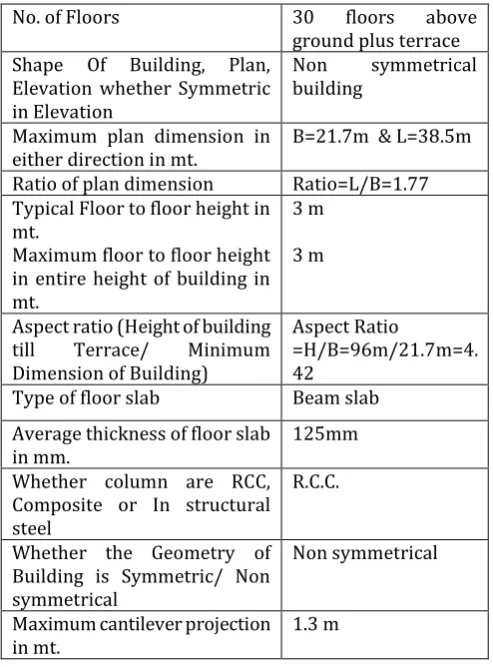
Table -1: DESCRIPTION OF STRUCTURENo. of Floors 30 floors above
ground plus terrace Shape Of Building, Plan,
Elevation whether Symmetric in Elevation
Non symmetrical
building
Maximum plan dimension in
either direction in mt. B=21.7m & L=38.5m
Ratio of plan dimension Ratio=L/B=1.77
Typical Floor to floor height in mt.
Maximum floor to floor height in entire height of building in mt.
3 m
3 m
Aspect ratio (Height of building
till Terrace/ Minimum
Dimension of Building)
Aspect Ratio
=H/B=96m/21.7m=4. 42
Type of floor slab Beam slab
Average thickness of floor slab
in mm. 125mm
Whether column are RCC, Composite or In structural steel
R.C.C.
Whether the Geometry of Building is Symmetric/ Non symmetrical
Non symmetrical
Maximum cantilever projection
in mt. 1.3 m
Fig -1: 3D RENDER VIEW OF G+30 (Tall Structure)
5. RESULTS AND DISCUSSIONS
CUMULATIVE STOREY SHEAR:
[image:3.595.311.558.238.703.2]Cumulative storey shear is an estimate of the maximum expected lateral force that will occur due to seismic ground motion at the base shear (V). Considering load case RESX Max has been taken for the analysis
Table -2: CUMULATIVE STOREY SHEAR V/S NO. OF STOREYS FOR ZONE-II IN X-DIRECTION
© 2017, IRJET | Impact Factor value: 5.181 | ISO 9001:2008 Certified Journal
| Page 1946
Table -2: CUMULATIVE STOREY SHEAR V/S NO. OFSTOREYS FOR ZONE-III IN X-DIRECTION
[image:4.595.319.549.135.664.2]Chart -2: Graph of Cumulative storey shear v/s No. of storeys for Zone-III in X direction.
Table -3: CUMULATIVE STOREY SHEAR V/S NO. OF STOREYS FOR ZONE-IV IN X-DIRECTION
© 2017, IRJET | Impact Factor value: 5.181 | ISO 9001:2008 Certified Journal
| Page 1947
Table -4: CUMULATIVE STOREY SHEAR V/S NO. OFSTOREYS FOR ZONE-V IN X-DIRECTION
Chart -4: Graph of Cumulative storey shear v/s No. of storeys for Zone-V in X direction.
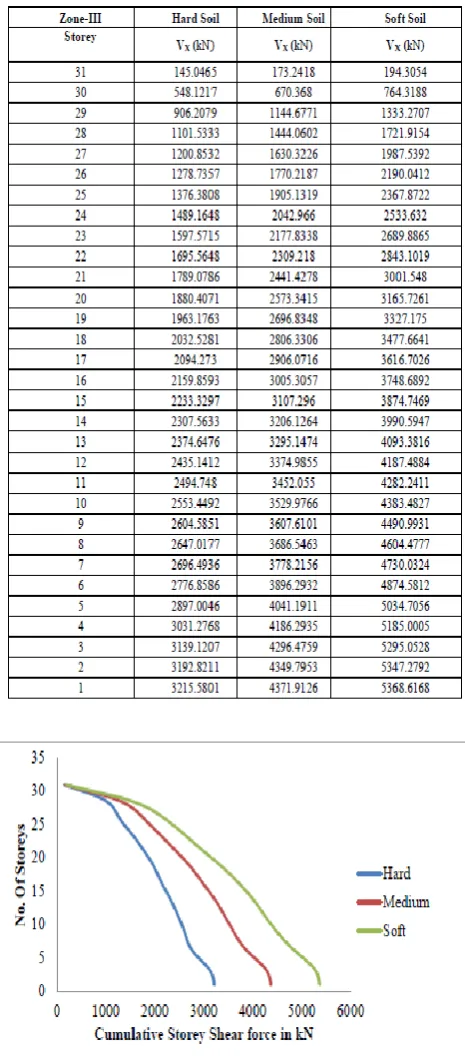
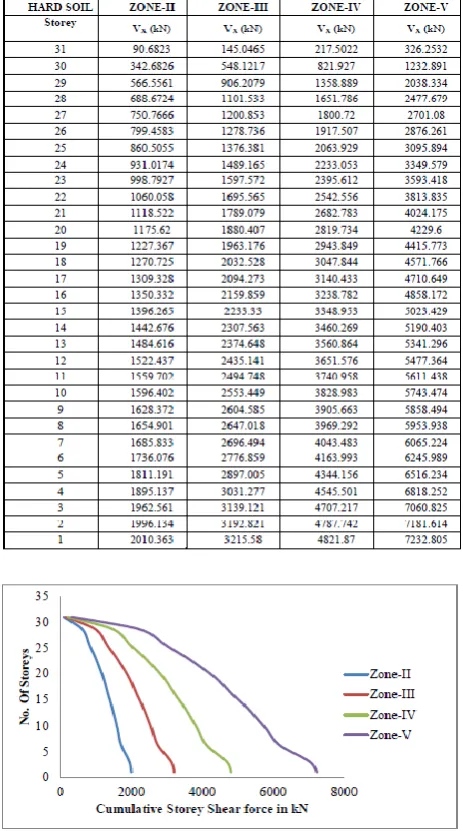
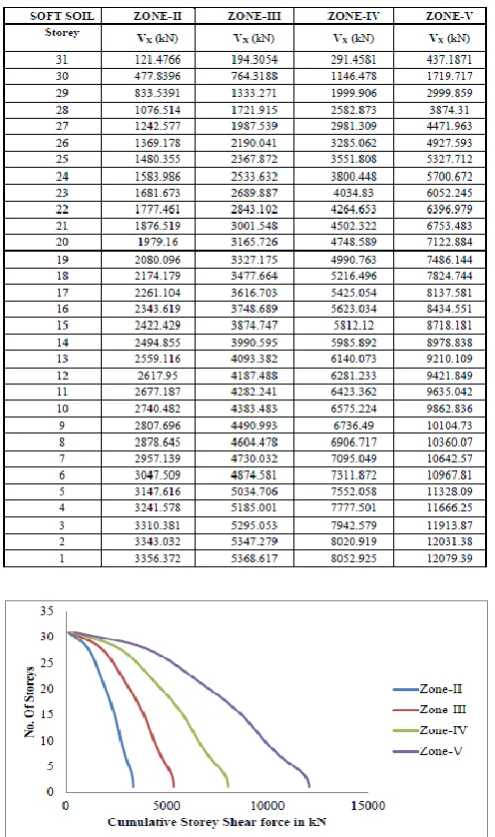
For a clear view of this increasing order in the values obtained in model for cumulative storey shear force from Etabs Software. By Plotting a graph of Cumulative storey shear v/s Number of storeys for all zones in X direction for all three different soil types namely, soil-I(Hard Soil), Soil-II(Medium Soil), Soil-III(Soft Soil) as shown in above figures, From the graph it is clearly visible that there is an increasing order in the values obtained for cumulative storey shear and follows in the order of soil-I, soil-II and soil-III types in all zones and in X direction.
Chart -5: Cumulative Storey Shear Force v/s Zones in X Direction
Table -5: CUMULATIVE STOREY SHEAR V/S NO. OF STOREYS FOR HARD SOIL IN X-DIRECTION
[image:5.595.319.551.311.727.2]© 2017, IRJET | Impact Factor value: 5.181 | ISO 9001:2008 Certified Journal
| Page 1948
Table -6: CUMULATIVE STOREY SHEAR V/S NO. OFSTOREYS FOR MEDIUM SOIL IN X-DIRECTION
Chart -7: Graph of Cumulative storey shear v/s No. of storeys for Medium Soil in X direction.
Table -7: CUMULATIVE STOREY SHEAR V/S NO. OF STOREYS FOR SOFT SOIL IN X-DIRECTION
Chart -8: Graph of Cumulative storey shear v/s No. of storeys for Soft Soil in X direction.
[image:6.595.318.555.605.737.2]© 2017, IRJET | Impact Factor value: 5.181 | ISO 9001:2008 Certified Journal
| Page 1949
6. CONCLUSIONS
From the above results we can conclude that, the
capacity of the irregular buildings may be significant but the seismic demand varies with respect to the different zones and also different soil types.
From the graph of equivalent static analysis, it is clearly visible that there is an increasing order in the values obtained for cumulative storey shear, displacement, storey drift and overturning moment are follows in the order of soil-I, soil-II and soil-III types in all zones in both X direction. Therefore cumulative storey shear force, displacement, storey drift and overturning moment of zones are affected by different soil types and the Soft Soil type is the critical.
ACKNOWLEDGEMENT
The success associated with the accomplishment of any task would be incomplete without acknowledging the people who made it possible. I am immensely and sincerely thankful to Dr. N. Balasubramanya, Dean Civil,CTM and Mining and Dr. M R Prakash, Head of the Department, our Principal Dr. SHARANABASAVA C PILLI and our Director CBM Bhooshan and Management of Acharya Institute of Technology, Bangalore, and My Co-Authors Mahesh Kumar C L, Shwetha K G and Raghavendra H J under whose constant support and encouragement this paper has been accomplished flawlessly.
REFERENCES
[1] Ahsan Kareem, “Dynamic Response of High-Rise
Buildings to Stochastic Wind Loads” Department of civil engineering, university of Notre dame, Notre dame, Indiana 46556-0767-1992.
[2] Azlan Adnan, Suhana Suradi, “Comparison on the Effect
of Earthquake on the Performance of Reinforced Concrete” World conference on earthquake engineering-2008, vol-1, pp 37-67.
[3] Khaled M. Heiza, “Comparative Study of the Effects Of
Wind And Earthquake Loads On High-Rise Buildings” Corresponding author, associate professor, civil engineering department-2012, vol-3(1), pp 386-405.
[4] K. R. C. Reddy, Sandip A. Tupat, “Effect of Zone Factors
on Earthquake Loads Of High Rise Structures” International conference on advances in engineering and technology-2014(ICAET-2014), vol-3, pp 53-58.
[5] Misam Abidi and Mangulkar Madhuri N, “Structural
Damage Suffered by Several Modern Buildings during Recent Earthquakes” Department of civil engineering, institute of technology, Banaras Hindu university-2011,vol-1, pp 43-59.
[6] Tatheer Zahra, Yasmeen Zehra, “Effect of Rising Seismic
Risk on The Design of High Rise Buildings In Karachi” International journal of civil IJCEE-IJENS-2010, vol: 12 pp: 06.-10.
[7] IS 1893-2002: Criteria For Earthquake Resistant Of Structures.
BIOGRAPHIES
Sunil S K presently working as Asst. Professor in Acharya Institute of technology, Bengaluru. He has obtained his B.E. in Civil Engineering from JNNCE Shimoga and M.Tech in Structural Engineering from VVIT Bngaluru. He has 3Years of teaching Experience.
Mahesh Kumar C L was born in 1989 Chitradurga, Karnataka, India. He received the B.E. degree in Civil Engineering from the SJM Institute of Technology, Chitradurga, India, in 2011 and M..Tech in CAD Structures from University B D T College of Engineering, Davangere, India, in 2013 He is Pursuing Ph.D In VTU RRC Belagavi from 2014.Presently he is working as Assistant Professor at Nitte meenakshi Institute of Technology from 2016. He is a life member of Indian Society of Technical Education. He Has published one International journal. He has 4Years of teaching Experience.
Shwetha K G presently working as Assistant Professor in Nitte meenakshi Institute of Technology, Bengaluru. She has obtained her B.E. from SJM Institute of Technology Chitradurga and M.Tech in CAD Structures from UBDTCE Davangere. She has published one International journal. She has 4Years of teaching Experience.