© 2018, IRJET | Impact Factor value: 6.171 | ISO 9001:2008 Certified Journal | Page 1443
A STUDY ON A DIESEL HYDROTREATER USING COMBINED REFINERY
STREAMS
Mr. Meet S. Vadodaria
1, Dr. Piyush B. Vanzara
21Masterof Engineering, Dept. of Chemical Engineering, V.V.P. Engineering College, Rajkot, Gujarat, India. 2 Professor & Head, Dept. of Chemical Engineering, V.V.P. Engineering College, Rajkot, Gujarat, India.
---***---Abstract –
Today’s refiners are facing a number ofchallenges to maximize their product at existing condition. Hydro treating of Diesel is one of the most important process in crude oil refineries in which compounds such as sulfur, nitrogen, oxygen and metal are removed and government standards are met. In this work will study on a Hydrotreater using combined refinery streams. Process simulation of Hydrotreater will be carried out by using CHEMCAD (Chemstations).
Key Words: Diesel, Hydrotreater, Combined refinery streams, Chemcad.
1. INTRODUCTION
Diesel Hydrotreating is a major technology today with legislations enforcing improved diesel quality specifications. The technology offers the flexibility to upgrade middle range straight run distillates and light cycle oil from catalytic cracking to low sulphur, high cetane diesel suitable for meeting ULSD (Ultra Low Sulphur Diesel) pool requirement. Diesel feed is mixed with recycled hydrogen over a catalyst bed in a trickle bed reactor or a fix bed reactor at temperature of 290-400°C and pressure of 35- 125 kg/cm2.
The main chemical reactions are hydrodesulphurization (HDS), hydrodenitrification (HDN), aromatic and olefin saturation. Reactor effluent is separated into gas and liquid in a separator. Gas is recycled back to the reactor after amine wash along with makeup hydrogen and liquid is sent to the stripper for removal of light gases and H2S. Hydrotreating
catalyst is typically made of Nickel-Cobalt-Molybdenum.
Fig -1: Block diagram of Diesel Hydrotreater
Thermally cracked feed have some amount of Diesel component which will to be stripped in Hydrotreater. So, in the treatment of diesel, naphtha will also treated. It is important to understand the impact of processing new feed streams. At the end throughput also will increased.
Fig -2: Block diagram of Diesel Hydrotreater
In the Diesel Hydrotreating process, organic sulfur, nitrogen, and oxygen compounds are converted to H2S, ammonia, and
& water, respectively. [1]
1.1 The Need for Diesel Treating
Fractionation only separates products according to boiling point differences.
Further corrections are necessary before a product is fit for marketing.
This is done by Treatment as well as by Blending.
2. Literature Survey
[image:1.595.323.542.278.398.2] [image:1.595.38.283.591.729.2]© 2018, IRJET | Impact Factor value: 6.171 | ISO 9001:2008 Certified Journal | Page 1444 distillation column, and the associated heat exchanger
network.
Brain [3] had did a hydrotreating of Straight Run oil, mixed Straight run oil & LCO at different composition at pilot stage. The amount of LCO blended into the diesel Hydrotreater has a much greater effect on catalyst performance when producing ULSD. Use of diesel range products from emulating bed residue or fixed bed residue desulfurizers can also have a significant impact on catalyst activity. The general properties of diesel streams from these units often indicate that they may be fairly easy to hydrotreat due to their unusually low sulfur content.
Andrew [4] suggested ideal reactor profile for Diesel hydrotreating and for mild hydrotreating in the case of IsoTherming technology. Difference between conventional technology and IsoTherming technology also given. What are the merits of IsoTherming technology for processing of combined feed is given by taking a test run in Giant Industries refinery in Gallup, New Mexico.
Jose [5] had given a model based on operating data is used to meet sulphur product specifications at lower reactor temperatures. The results of this study were used to determine the optimum sulphur operating target for implementation into the APC system. The model will also be used to determine remaining catalyst life.
Dr. Zaid [6] had used CHEMCAD process simulator for the analysis of the literature experimental phase equilibrium data of H2S with three physical solvents (Sulfolane,
Propylene Carbonate, and N-Methyl-2-Pyrrolidone) at different temperatures. Two thermodynamic models, PR and SRK were used. The equilibrium data of H2S- Sulfolane and
H2S- Propylene Carbonate systems were successfully
correlated using SRK thermodynamic model. The deviation was noticed only for H2S-Sulfolane system as the
temperature increases to 373 K, to give a deviation of less than 5%. Therefore CHEMCAD simulator, with SRK thermodynamic models without modification, is recommended for processes including H2S- Sulfolane and
H2S- Propylene Carbonate systems.
Krivtcova N.I. et al. [7] had given The experimental data for hydrogenation of sulfur compounds including BT and DBT in the diesel fuel with 1.4 mass% of sulfur content is obtained using the laboratory setup with the aluminum-cobalt-molybdenum catalyst GKD-202 at the pressure of 3.5 MPa and different temperatures. Dynamics of DBT and BT concentrations allowed designing a kinetic model represented by the system of differential equations of individual sulfur compound rates. The kinetic model was included in the developed software. The rate of desulfurization decreases with increase in alkyl substituents concentrations. DBT desulfurization is much worse than the one of BT.
Brain et al. [8] gave a few examples demonstrating significant differences in feed reactivity for a variety of different feed components which are not necessarily anticipated from the usual bulk feed analyses. The quality of the LCO varies with distillation range, and depends on the severity of the pretreatment of the FCC feed as well as on the conditions in the FCC and the FCC catalyst employed. A common element in LCO is a very high concentration of polynuclear aromatic compounds relative to other feeds. ART conducted pilot plant testing to investigate the impact of various diesel feed components on catalyst activity.
Torkil Hansen [9] had done complete revamp of Diesel Hydrotreater at BPCL, Mahul, India. After revamp, an increased in throughput from 4200 t/d to 6000 t/d. reduced the sulphur in their diesel product from 350 ppm to 10 ppm. Increased catalyst cycle length of three years. Completed revamp in just 40 days during a turnaround. The challenges were Low-pressure operation i.e. 41 bar(g). Large variety in feed composition, High radial temperature spread in existing reactor beds, Congested plot space, Vibrations in charge heater, Power restrictions for recycle gas compressor and charge pump, Various hydraulic limitations. Low capital expenditure, Maximum reused of existing equipment. BPCL had made a precise identification of the unit’s hydraulics bottlenecks in advance.
Renata Szynkarczuk et al. [10] had aim to improve cold flow properties. Catalytic dewaxing provides an alternative method for cold flow improvement in diesel and lube oil that cannot be met to a significant level by more conventional methods. The latest generation of dewaxing catalysts is specifically tailored to application and feedstock type by utilizing shape selective zeolites to preserve maximum distillate yields. With the current increase in heavy paraffinic material on the market, refiners must adapt their processing facilities to meet these new challenges. The development of light tight oils in North America and the presence of highly paraffinic crudes in the former Soviet Union, China and North America are opening the way to an increase in applications of dedicated catalytic dewaxing solutions in refineries.
A. A. Lappas et al. [11] investigated the hydrotreating process of a diesel in order to achieve lower sulphur and aromatics content. The entire work was performed in a HDS pilot plant unit located in Chemical Process Engineering Research Institute (CPERI). For the tests, a commercial HDS catalyst (CoMo) was used while the feed was provided by the deep desulphurization unit of a Greek refinery (Motor-Oil refinery). For the determination of diesel aromatics, a method based on the ASTM D- 2549-85 was applied. The objective of the work was to investigate the ability of a typical HDS catalyst for aromatics saturation. The effect of the main hydrotreating operating parameters (T, P, WHSV, H2/Oil ratio) on sulphur and aromatics removal was also
© 2018, IRJET | Impact Factor value: 6.171 | ISO 9001:2008 Certified Journal | Page 1445 decreased as the temperature or pressure increased or space
velocity decreased. It was concluded that with the present catalyst an aromatics saturation degree of up to 40% could be achieved, giving a diesel product with aromatics content of about 20-25% wt. However, high temperatures (>370°C) were required in order to achieve 500 ppmw sulphur in this feedstock. The various hydrotreatment operating parameters have a different influence on the aromatics and sulphur content of diesel. Thus, by decreasing the space velocity and increasing the temperature, the pressure and the H2/Oil ratio, the aromatics and sulphur contents
decrease and inversely, the saturation degree increases. Singh Shraddha R. et al [12] studied of hydrocracking as well as other cracking processes. It is the transformation of the heavy fractions of crude oil into light fractions. The use of this process is determined by the high quality of some of the products obtained, such as the jet fuel and the lubricating oils of high viscosity index. It is more expensive than catalytic cracking due to the high price of hydrogen and operation at high pressure. In addition, the role of hydrocracking increased due to the new requirements for gasoline. This paper reviews this excellent process used in Petroleum Refineries. Hydroprocessing: Hydrotreating and Hydrocracking. They can be designed and operated to maximize the production of a gasoline blending component (called hydrocrackate) or to maximize the production of diesel oil.
Sepehr Sadighi et al, [13] had been done revamp of Naphtha Hydrotreater of Iranian Refinery, Iran. The Design capacity of unit was 12000 BPSD, but because of increasing gasoline demand, the unit capacity was turned on 15000 BPSD. It made many difficulties such as increasing pressure drop of air coolers and corrosion, and decreasing of recycle compressor discharge pressure. To reduce mentioned difficulties, a supplementary flash drum was added to the primary designed separation process. To show the effect of that, the revamped process was simulated by Aspen Plus software. Results confirmed that not only the mentioned problems was removed, but also a considerable energy saving was achieved.
Michael D. Ackerson et al. [14] had been done Revamp of Diesel Hydrotreater by using Isotherming Technology. This paper also shows how the new IsoTherming technology can overcome the barriers to ULSD production in the most cost efficient way. Installed in a pretreat mode, IsoTherming allows the unit to be revamped without encountering hydraulic limitations in the existing conventional unit; thus, the refiner can minimize the capital required to meet ULSD specifications. In that work the integration of an IsoTherming unit into an existing conventional reactor to produce ULSD has been shown. The IsoTherming technology is the most efficient, low-cost approach to dealing with the barriers to ULSD production. The total cost of an IsoTherming revamp is 60 percent of a conventional revamp and can be integrated with less down time since there are only minor modifications to the existing system.
Vasant P. Thakkar et al. [15] had worked on LCO upgrading. LCO is a poor diesel fuel blending component due to its poor engine ignition performance and its high sulfur. Beyond middle distillate blending, LCO has also historically been used as a blend-stock into heavy fuel oil for viscosity adjustment. This opportunity is also becoming constrained by declining demand for heavy fuel oil. In the overall context of a high conversion, clean-fuels refinery, light cycle oil is an issue, both in terms of product blending and product-value maximization. In addition to the use of conventional hydrotreating, high pressure hydrocracking units have historically been used to crack LCO into naphtha and lighter products. These units are relatively high in capital cost, consume large quantities of hydrogen, and the naphtha product requires reforming before blending to gasoline. This paper will address an alternative LCO processing solution to the growing demand for clean fuels and product slate flexibility with much lower capital investment.
Mainak Sarkar et al. [16] had invited one of the unconventional approaches for improving the cetane of LCO, is through oxidation route, wherein Cetane value of certain Aromatic compounds gets enhanced upon oxidation. In their research, results were discussed for a new process, where LCO is first hydrotreated at mild operating severity for removal of hetero-atoms specially sulphur and nitrogen below 50 ppm wt and then oxidized in presence of catalyst & oxidizing agent. The product in this process is observed to have higher cetane values than hydrotreated LCO. The process may be extended to enhance cetane of product generated from low pressure Diesel hydrodesulfurization (DHDS) unit. The main disadvantage of the process is the residence time for oxydation which is about 4-5 hour. Three types of catalyst were used for the selective oxidation reaction purpose (i) CAT-1, (ii) CAT-2 and (iii) CAT-3. The first two catalysts are metal oxide based catalysts, the metal of which belonging to base metal category supported on different supports and the third catalyst system is an organo-metallic complex of a base metal supported on a suitable support. These three catalysts have been selected on the basis of their different oxidation capabilities.
© 2018, IRJET | Impact Factor value: 6.171 | ISO 9001:2008 Certified Journal | Page 1446 ppm and 600 ppm respectively. Unfortunately, the Diesel
fraction produced in an FCC process from such a VGO feed typically has a cetane number of only about 20—30, which is considered “out of spec” and prevents this product from being incorporated into the Diesel pools. In order to be used, this Diesel fraction must be treated with additional hydrotreating steps. In addition, numerous other Diesel streams are readily available in the refineries such as straight run kerosene and Diesel, thermal cracked Diesel and the like, all of Which have high sulfur content and typically medium cetane number that will require an additional deep hydrotreatment. The invention further relates to an integrated processing method which integrates a hydrotreating-hydrocracking stage or system into a vacuum residue hydrocracking process.
Odette T. [18] invented “Integrated Hydrotreating Process for the Dual Production of FCC Treated Feed and an Ultra-Low Sulfur Diesel Stream”. An integrated hydrotreating process which produces a high quality feed for the FCC to maintain sulfur in FCC gasoline a level lower than 30 ppm from a high boiling feedstock and an ultra-low sulfur diesel stream preferably less than 10ppm from a cracked stock diesel boiling material. The high boiling feedstock is firstly hydrotreated to reduce the concentration of heterogeneous compounds which Produces lower boiling hydrocarbonaceous compounds in the diesel range. The resulting hydrocarbonaceous compounds boiling in the diesel range together with other cracked material in the diesel boiling range are further hydrotreated to meet ultra-low sulfur diesel specifications and high cetane index. The present invention is an integrated hydrotreating process which combines two very different functions in one unit: (1) treating VGO boiling range material to prepare feed for the FCC unit and (2) treating low quality cracked diesel boiling range material to produce an ultra-low sulfur diesel stream of high quality and high cetane index.
3. SIMULATION IN CHEMCAD
CHEMCAD is an integrated suite of intuitive chemical process engineering software. It has the power and tremendous range of capabilities to meet an engineer's chemical process simulation needs, from day-to-day challenges to large, multifaceted projects. Creating flow sheets and running simulations is fast and easy with CHEMCAD. For more than 25 years, Chemstations and its chemical process simulation software CHEMCAD have been evolving with the highly dynamic chemical engineering industry.
Simulation of Stripper Column:
Stripper Feed: Alkenes component NBP: 160 °C - 360 °C, Super-heated MP steam.
Stripper Overhead: NBP 160 °C-200 °C Stripper Bottom: NBP 200 °C-360 °C
[image:4.595.309.571.72.226.2]Fig -3: Snap shot of Stripper column in CHEMCAD.
Fig -4 Snap shot of Hydrotreater in CHEMCAD when processed combined feed.
[image:4.595.309.573.260.426.2] [image:4.595.325.532.478.736.2]
© 2018, IRJET | Impact Factor value: 6.171 | ISO 9001:2008 Certified Journal | Page 1447
4. CONCLUSION
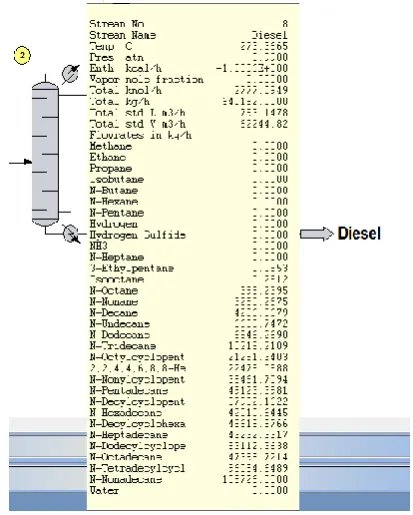
Thermally cracked feed contains some Diesel components which are further stripped in stripper column. Moistures that is contains in that diesel is further removed in Fractionator column. From Fig 5 we can conclude that we can get Diesel component in the range of C12 to C20 which is
desirable. Others process parameters of column is also fixed. We are increased capacity of unit so for processing extra bottlenecks for processing heavy feed also to be studied. Pilot test run will be done in the scope of future work.
REFERENCES
[1] James H. Gary, Glenn E. Handwerk. “Petroleum Refining Technology and Economics.” Fourth Edition, published by Marcel Dekker, 2001, 16-17.
[2] Muhammad Imran Ahmada, Nan Zhangb, Megan Jobson, “Integrated design of diesel hydrotreating processes.” Chemical Engineering Research and Design, July 2011, 1025–1036.
[3] Brian Watkins, “Maximizing ULSD Unit Performance when Processing LCO and Other Processed Feeds.” Advanced Refining Technology (ART) Catalagram, 2008, 104, 07-11
[4] Andrew Tyas, “Diesel hydrotreating and mild hydrocracking.” Digital refining, PTQ Q4, 2011, 01-06.
[5] Jose Bird, “Optimization of a diesel hydrotreating unit.” Digital refining, PTQ Q1, 2015, 01-10.
[6] Dr. Zaid A. Abdel-Rahman, “A Study of Phase Equilibrium of H2s in Several Physical Solvents Using CHEMCAD Simulator.” Tikrit Journal of Eng. Sciences, 15-1, March 2008, 38-48.
[7] Krivtcova N.I., Tataurshikov A.A., Ivanchina E.D., Krivtsov E.B. , “Mathematical modelling of diesel fuel hydrodesulfurization kinetics” Procedia Chemistry 15 2015, 180 – 186.
[8] Brian Watkins, Charles Olsen, “Distillate Pool Maximization by Exploiting the Use of Opportunity Feedstocks Such as LCO and Syncrude.” Advanced Refining Technology (ART) Catalagram 2009, 105, 15-22.
[9] Torkil Hansen, “Diesel hydrotreater revamp” Catalysis 1000150 2011, 1-5.
[10] Renata Szynkarczuk, Michelle Robinson and Laurent Huve, “Dewaxing challenging paraffinic feeds.” Catalysis 1000927 2014, 1-10.
[11] A. A. Lappas, R. Budisteanu, K. Drakaki, I. A. Vasalos, “Production of Low Aromatics and Low Sulphur Diesel
in A Hydrodesulphurization (Hds) Pilot Plant Unit”, Global Nest: the Int. J. Vol 1, 1999, 15-22.
[12] Singh Shraddha R., Chaturvedi A*, Lal Dori, Ranjan A., Lodhi S. K., Singh A., Gola Neeraj, “Hydro cracking for Maximizing Middle Distillates” International Journal of Scientific Research and Reviews, 2013, 2(2), 27-35.
[13] Sepehr Sadighi, S.Reza Seif Mohaddecy, Omid Ghabouli, Majid Bahmani, “Revamp Of Naphtha Hydrotreating Process In An Iranian Refinery”, Petroleum & Coal 51 (1) , 2009, 45-50.
[14] Michael D. Ackerson, M. Steven Byars, J.B. Roddey, “Revamping Diesel Hydrotreaters for Ultra-Low Sulfur Using Isotherming Technology”, AM-04-40, 1-17.
[15] Vasant P. Thakkar, Suheil F. Abdo, Visnja A. Gembicki and James F. Mc Gehee, “Lco Upgrading A Novel Approach for Greater Added Value And Improved Returns” AM-05-53, UOP 4399B, 1-15, 2005.
[16] Mainak Sarkar, Ganesh V. Butley, A. Arun, Dr. M. Sau, Brijesh Kumar, Santanam Rajagopal and R. K. Malhotra, “ Light Cycle Oil (LCO) Upgradation- A New Look.” RTM 2013, 22-36.
[17] Roberto Gal1ass and Edllberto Rodnguez, “Process Scheme for Sequentially Hydrotreating-Hydrocracking Diesel and Vacuum Gas Oil”, United States Patent US 6444116 B1, Sep 3 2002.