REHABILITATION FOR FOOT/ANKLE - CONTINUOUS PASSIVE
MOTION (CPM) USING SHAPE MEMORY ALLOY (SMA)
ACTUATED STEWART PLATFORM
S. Krishnan1, T. Nagarajan1, A. M. A Rani1, Winson Ambaraj2 and Ramanathan Ramiah2 1Department of Mechanical Engineering, Universiti Teknologi Petronas, Bandar Seri Iskandar, Perak, Malaysia
2Hospital Raja Permaisuri Bainun, Ipoh, Perak, Malaysia
E-Mail: [email protected]
ABSTRACT
The research was mainly focused towards developing a device that was economical and affordable to patients recovering from foot and ankle injuries with a better chance of rehabilitation in comparison to the existing devices. The Mechanical properties of Shape Memory Alloy (SMA) wires which are used as actuators in the Stewart platform rehabilitation device are experimentally investigated to estimate displacement and force developed. In order to investigate the relationship between force and deflection of the upper platform, a accelerometer (ADXL335 with 3 axis) has been mounted on the moving platform to measure the deflection angle. Six force sensors have been fabricated and mounted with a three pairs of strain gauges to measure the force developed by the respective actuators. Calibration of the Sensor has been accomplished with known weights and for the tilt sensor with the indexing table of a CNC (Computerized Numerical Control) machine. SMA wires actuated Stewart platform rehabilitation device had been designed, fabricated and tested experimentally with the transducers mentioned above. The prototype is demonstrated to the orthopaedic departments of the hospital and the trails were conducted with the experts for their opinion and feedback. They were enthusiastic and very much in favours for this device.
Keywords: ankle foot rehabilitation, shape memory alloy, stewart platform, dorsi/plantar flexion.
INTRODUCTION
World Health Organization (WHO) has identified foot and ankle injuries as a leading course in adult human disability affecting close to 15 million people worldwide. A whopping one third die and another one third suffer from permanent disability. Malaysia registered 10,000 new stroke patients annually, where by almost three quarter of them are unable to return to their normal lives while the remaining quarter need assistances throughout the remaining of their lives to perform their daily chores. It is to be noted that close to 1,500 of them who suffer from stroke die within the first month[1]. The last decade has seen a growing interest in the use of SMA actuators, specifically in robotics arena which has a direct link to medical applications [2-4].
SMAs have some muscle-like properties that are useful in medical and robotics applications. On the other hand properties like good kink resistance, steerability and torquability, less sensitivity to magnetic resonance, crush recoverability, Radiopacity, etc make the SMA a suitable candidate for medical applications [5]. This SMA is compact in sized and smooth and silent operation Shape memory alloys are thermally activated [6].
The above graph in Figure-1 was obtained from Hospital Raja Permaisuri Bainun (HRPB) for the entire 2013 which comprised a total of 133 patients. The ratio of male to female was approximately two to one.
ANKLE JOINTS
Following a stroke or ankle surgery, a well planned rehabilitation program is compulsory for quick and adequate recovery from the injury. Prolonged immobilization after an injury to a joint will only slow the
process of recovery. Early movement of the joint passively will ensure flexibility and return of muscle tone and consequently improve the circulation when the patient is unable exercise actively. Passive stretching in the acute phase of injury will prevent contracture formation. Once contracture develops recovery will become long drawn and only invites more complications [7].
Figure-1. Male and female diagnosis amongst foot and ankle disability patients between Jan 2013- Dec 2013.
In order to be a reliable device for rehabilitation purposes, this Stewart platform actuated by SMA should comply with number of clinical and functional requirements. It should be capable of promoting cyclic mobilization of the ankle joint across at least a range of -5 to 100 (negative towards plantar flexion), be thermally and electrically safe for patient, lightweight and compact [7]. The foot/ankle joint is a very complex structure which
0 2 4 6 8 10 12 14 16
Jan Feb M… Ap r M…
Jun Jul Aug Se… Oct Nov De
c
Female
enables inversion and eversion movement along with dorsiflexion and plantar flexion as shown in Figure-2(a). The ankle joint is a combination of two different joints working at two levels. Using the talus bone as the reference the joint above is the true ankle joint producing upward and downwards (Plantar and dorsi flexion) movement. Below the talus is the sub talar joint which allows the foot to look inwards or outwards (Inversion/eversion) [7].
The first joint is a tibia-fibula and talus and a secondly a pseudo ankle joint which works at talus and calcaneus as shown in Figure-2(b). Therefore, tibia-fibula with talus joint enables dorsiflexion and plantarflexion of the ankle. However, talus and calcaneus joint forms the inversion and eversion of the ankle joint [7].
Figure-2. (a) Rotation and (b) joints of the ankle[7].
METHODOLOGY
As observed in Figure-3 and experiment was developed with an aim to study the relationship between the pulling force and angle against the Stewart platform. This Stewart platform has two plates. The lower plate is static. The upper plate moves according to the pull by SMA wires which are shorten according to the applied temperature.
This alternate shortening and return to the original length is the basis on which the platforms tilt to simulate the ankle movement to promote continuous passive motion (CPM) [8]. The SMA wire shortens by applying current to heat it. NiTi alloy has this unique property of shortening on heating - Unlike other metals which lengthen on heating. A three axis ADXL 335EB accelerometer in mounted on the top of the upper moving platform to measure the angle as shown in Figure-3(b). The accelerometer was calibrated using CNC rotary indexing table as shown in Figure-4. The
overall experimental setup is shown in the Figure-3. Figure-3. Compliant mechanism under development (a) Fixing diagram in AutoCAD (b) Arrangement of
force sensor with dimensions in mm (c) Developed Prototype Model
RESULTS AND DISCUSSIONS
Dorsiflexion Movement Plantarflexion Movement
Figure-4. SMA actuated stewart platform for ankle/foot rehabilitation therapy.
Table-1. Specifications of stewart platform \ actuated SMA.
Weight 2.5 kg
Max ankle displacement 20°
Max linear displacement of the SMA
Wire 1-meter length 48 mm Dimension
Nominal Height 200 mm Diameter of the upper platform 150 mm Diameter of the lower Platform 300 mm
Movable Scope
Dorsal (+) & Plantar (-) Flexion + 20°/ -20°
Eversion (+) & Inversion (-) +19.87° / - 19.87°
Table-1 shows the ankle movements (dorsi/plantar flexion and Inversion/eversion). This was calculated using 3 axis accelerometer. Dorsi and plantar flexion were measured by the X axis by increasing the temperature from 30 to 50 degree Celsius. K type thermocouples were attached to all the SMA wires to measure the temperature in each SMA wire. For the experimental heating and cooling of the SMA wires, the ASTM standard F2004-05(2010) was followed[10]. The results suggested that the maximum angle of movement for the Dorsi/plantar flexion was up to 20 degrees. Whereas for the inversion and eversion was 19.5 degree which is similar to the normal angles movements seen in normal people.
i. Performance evaluation of SMA actuated stewart platform
The angle of upper platform of the developed SMA platform was measured to evaluated whether the design specification was measured to evaluate whether the design specification satisfactory. This Table-2 shows that the Stewart platform satisfies the design specification.
Table-2. Average reproducibility
Degree of freedom(DOF)
Subject A B C D Ave
Dorsal 20 19 21 20 20 Plantar 20 19 21 20 20 Inversion 19 19 21 20 19.5 Eversion 19 19 21 20 19.5
The following Figure-5 shows the relationship between the temperature of SMA wire and the tilt of platform. This platform attached to the ankle of human subjects (Four) and the measurements made subsequently. Tables-2 show the correlation between the natural angle joint and our Stewart Platform. Both shows the same measurement.
Figure-5. Platform movements in a pure dorsi/plantar flexion movement.
ii. Response surface methodology
Response Surface Methodology (RSM) is a Statistical Technique based on a collection of Mathematical data. This is useful for modelling and analysis of problem.
Figure-6. Predicted vs actual value.
‐30
‐20
‐10 0 10 20 30
30 34 40 44 48 50 46 42 36 32
Angle
pl
at
fo
rm
[D
egree]
Tamperature [Celcius]
Dorsiflexi…
2 2
2 2
Actual
P
redi
ct
ed
Predicted vs. Actual
3.00 7.25 11.50 15.75 20.00
In our research experiment we used RSM using an initial design of one factor with one variable in a total of 7 runs.
[image:4.612.341.513.89.269.2]Figure-6 shows the graph of the actual response values versus the predicted response values. From the Figure we can be observed that all the point’s fall split on the 45 degree fitted line.
Figure-7. Angle platform vs temperature.
Figure-8. Force vs temperature.
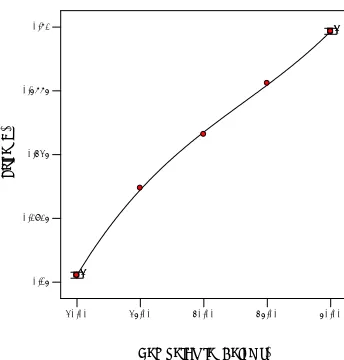
The Response surface analysis using one factor design shows generated graph of angle platform Vs temperature with regression analysis R-squared is equal to 0.9965 and 0.9998 for force Vs temperature as shown in the Figure-7 and Figure 8. From the Figure the angle trend increases as variation of the increased temperature. After eliminating the non-significant terms, the final response equation for angle platform and Force is given by equation 1 and 2.
2
65
.
3
04
.
8
78
.
14
A
A
y
(1)Where y = angle of upper platform and A = is the temperature.
2
047
.
0
22
.
0
49
.
0
A
A
y
(2) [image:4.612.78.292.173.387.2]Where y = force and A = is the temperature.
Table-3. Analysis of variance for angle of stewart platform.
Source SS df MS F P
Model 307.3 2 153.67 75.61 0.0007 Significant Linear 22.64 3 7.54 7.77 0.1160
Quadratic 6.18 2 3.09 3.18 0.2387 Suggested Cubic 4.32 1 4.32 4.45 0.1692
A-Temperature 290.8 1 290.88 143.1 0.0003 A^2 16.45 1 16.45 8.09 0.0466 Residual 8.12 4 2.03
Lack of Fit 6.18 2 3.09 3.18 0.2387 not significant Pure Error 1.94 2 0.97
Cor Total 315.4 6
Analysis of variance also identifies as ANNOVA the tests perform for regression, coefficients and fittings.
30.00 35.00 40.00 45.00 50.00
2 6.75 11.5 16.25 21
Temperature (Celcius)
A
ngl
e
P
la
tf
or
m
(
D
egr
ee
)
3
3
33
33
30.00 35.00 40.00 45.00 50.00 0.15
0.2925 0.435 0.5775 0.72
Temperature (Celcius)
F
orc
e
(N
)
3
3
33
[image:4.612.138.477.530.703.2]statistically significant for analysis of angle of Stewart Platform. The model P-value is 0.0007 less than 0.0500 indicates that the model is significant. Only 0.7% of chance that the true hypothesis is occurred. From the above table 3 the quadratic model is suggested with R2 equal to 0.9742.
CONCLUSIONS
In this paper we present a new Stewart Platform actuated by Smart Material “Shape Memory Alloy (SMA)”. We have proven that his Stewart Platform can mimic the normal movements of the human ankle joint (Inversion/Eversion and Dorsi/Plantar Flexion). It also can act as a CPM machine for the ankle rehabilitation. The proposed Stewart Platform can follow the movement Dorsi/ Planter Flexion and Inversion/eversion of the foot with respect to the angle and can be act as Continuous Passive Motion (CPM) for ankle rehabilitation therapy. The performance verification experiments were conducted to validate the performance of the developed Stewart Platform for rehabilitation. The other uses are to assess muscle strength objectively and thus be a yards sticks for the therapist to intensify the therapy as required.
ACKNOWLEDGEMENT
The authors who have undertaken this research under the FRGS Scheme wish to convey their heartiest thanks to Universiti Teknologi PETRONAS (UTP) for their undivided support. The authors also wish to acknowledge Hospital Raja Permaisuri Bainun (HRPB) for his collaboration with this research
REFERENCES
[1] M. Z. Abdullah, "Neurological rehabilitation of stroke patients by means of a robotically assisted brain controlled interface," Malaysian Journal of Medical Sciences, vol. 16, 2009.
[2] L. Schetky, "Shape memory effect alloys for robotic devices," Robotics Age, vol. 6, pp. 13-17, 1984.
[3] Y. Nakano, M. Fujie, and Y. Hosada, "HITACHI'S Robot Hand," Robotics age, vol. 6, pp. 18-20, 1984.
[4] S. Krishna, T. Nagarajan, and A. Rani, "Review of Current Development of Pneumatic Artificial Muscle," Journal of Applied Sciences, vol. 11, pp. 1749-1755, 2011.
[5] M. Sreekumar, M. Singaperumal, T. Nagarajan, M. Zoppi, and R. Molfino, "Recent advances in nonlinear control technologies for shape memory alloy actuators," Journal of Zhejiang University Science A, vol. 8, pp. 818-829, 2007.
[6] T. Anson, "Shape memory alloys–medical applications," Materials World, vol. 7, pp. 745-747, 1999.
[7] H. Takemura, T. Onodera, D. Ming, and H. Mizoguchi, "Design and control of a wearable stewart platform-type ankle-foot assistive device," International Journal of Advanced Robotic Systems, Int J Adv Robotic Sy, vol. 9, 2012.
[8] M. Girone, G. Burdea, M. Bouzit, V. Popescu, and J. E. Deutsch, "A Stewart platform-based system for ankle telerehabilitation," Autonomous robots, vol. 10, pp. 203-212, 2001.
[9] Z. Zhong and C. Yeong, "Development of a gripper using SMA wire," Sensors and Actuators A: Physical, vol. 126, pp. 375-381, 2006.