Physics and Astronomy Dissertations Department of Physics and Astronomy
5-10-2017
Determining the Mass of the Supermassive Black
Hole in NGC 6814
Emily Rachel Manne-Nicholas
Georgia State University
Follow this and additional works at:https://scholarworks.gsu.edu/phy_astr_diss
This Dissertation is brought to you for free and open access by the Department of Physics and Astronomy at ScholarWorks @ Georgia State University. It has been accepted for inclusion in Physics and Astronomy Dissertations by an authorized administrator of ScholarWorks @ Georgia State University. For more information, please [email protected].
Recommended Citation
Manne-Nicholas, Emily Rachel, "Determining the Mass of the Supermassive Black Hole in NGC 6814." Dissertation, Georgia State University, 2017.
by
EMILY R. MANNE-NICHOLAS
Under the Direction of Misty C. Bentz
ABSTRACT
Supermassive black holes (SMBH) are now thought to exist at the center nearly all massive
galaxies. Not only are they thought to be ubiquitous, but it was also discovered nearly two
decades ago that the mass of these SMBHs correlate strongly with properties of their host
galaxies including bulge stellar velocity dispersion (MBH-σ?) and bulge luminosity (MBH
-Lbulge). This correlation was not expected due to the tiny size of the SMBH gravitational
sphere of influence compared to the size of the host galaxy, and imply a connection between
the two, but this connection is still not well-understood. One step toward understanding
this connection is to accurately measure the masses of these black holes. Two of the most
common direct SMBH mass measurement techniques are stellar dynamical modeling (SDM),
which generally only applies to quiescent galaxies, and reverberation mapping (RM), which
can only be applied to active galactic nuclei (AGN) that exhibit broadened emission lines.
to bring it into agreement with the SDM sample on the MBH-σ? relation. It is unknown
how well this f-factor, being a population average, applies to individual RM masses. It
would therefore be useful to measure an SMBH mass with both methods simultaneously
to test whether they produce the same black hole mass. However, because the RM and
SDM techniques usually apply to galaxies that are not possible for both, this has only been
attempted twice before (NGC 3227 and NGC 4151).
The purpose of this dissertation is to apply SDM to the SMBH at the center of NGC 6814
for which there already exists an RM mass. This makes it only the third broad-lined AGN
for which an SDM mass has been derived. In order to perform SDM accurately, the distance
to the galaxy needs to be well-constrained as the error in the SDM mass scales linearly with
distance. Because no adequate distance measurements already exist, the first half of this
dissertation is devoted to deriving a Cepheid distance to NGC 6814 from V- and I-band HST
WFC3 time series photometry. We measure the distance to NGC 6814 to be 17.54+1−1..4433 Mpc.
In the second half, we incorporate that distance measurement into our stellar dynamical
modeling on Gemini NIFS+Altair IFU data of NGC 6814’s central 1.55”×1.55”. We
de-rive a mass of 1.19+37−1.17.57×108 M
and best fit mass-to-light ratio of 0.948−+00..032208 M/L.
This mass is nearly an order of magnitude larger than the RM mass but has a 3σ range
spanning nearly three orders of magnitude. We describe possible reasons for our
larger-than-expected mass value, such as the existence of a bar, which would not be well-modeled
by an axisymmetric dynamical code. Finally, we describe future steps that may be taken to
by
EMILY R. MANNE-NICHOLAS
A Dissertation Submitted in Partial Fulfillment of Requirements for the Degree of
Doctor of Philosophy
in the College of Arts and Sciences
by
EMILY R. MANNE-NICHOLAS
Committee Chair:
Committee:
Misty C. Bentz
D. Michael Crenshaw
Rachel Kuzio de Naray
Vadym Apalkov
Christopher Onken
Electronic Version Approved:
Office of Graduate Studies
College of Arts & Sciences
Georgia State University
ACKNOWLEDGMENTS . . . v
LIST OF TABLES . . . ix
LIST OF FIGURES . . . x
1 Introduction . . . 1
1.1 Background . . . 1
1.2 Stellar Dynamical Modeling . . . 7
1.3 Reverberation Mapping . . . 10
1.4 The Role of NGC 6814 . . . 14
2 Cepheid Observations and Measurements . . . 17
2.1 Background . . . 17
2.2 Observations . . . 19
2.3 Data Processing: Tweakreg and Astrodrizzle . . . 23
2.4 Measurements . . . 26
2.4.1 DoPHOT . . . 26
2.4.2 Data Processing . . . 29
2.4.3 Aperture Corrections . . . 32
2.4.4 Magnitude Calibrations and Corrections . . . 36
3.1 Sample Selection Cuts . . . 39
3.1.1 Initial Cuts . . . 39
3.1.2 Variability Index Cut . . . 41
3.1.3 Color Index Selection . . . 45
3.2 Light-Curve Fitting . . . 46
3.3 Final Sample Cuts and P-L Relation . . . 49
3.4 Reddening Correction . . . 56
3.5 Metallicity Correction . . . 57
3.6 Uncertainty and Comparison to Previous Distance Measurements . . . 58
4 Stellar Dynamical Modeling . . . 60
4.1 Background . . . 60
4.2 Observations . . . 60
4.3 Data Processing: NIFS Pipeline . . . 63
4.4 Measurements . . . 67
4.4.1 PPXF . . . 67
4.4.2 Voronoi Binning, Bisymmetrization, and Fitting the Kinematic PA . 73 5 Dynamical Modeling Analysis . . . 76
5.1 SOSA and SOLPA . . . 76
5.2 Inputs and Outputs . . . 77
5.2.2 Multi-Gaussian Expansion . . . 79
5.2.3 Mass-to-Light Ratio Estimation . . . 83
5.2.4 Model Setup . . . 86
5.3 Discussion and Future Work . . . 97
6 Conclusions and Future Work . . . 99
REFERENCES . . . 102
Appendices . . . 112
A Appendix A . . . 113
2.1 HST Observations . . . 22
3.1 Cepheid Model Fit Parameters . . . 55
4.1 Gemini NIFS Observations . . . 61
4.2 Spectral Templates . . . 70
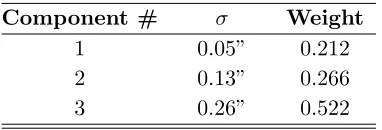
5.1 PSF Gaussian Component Fit Parameters . . . 79
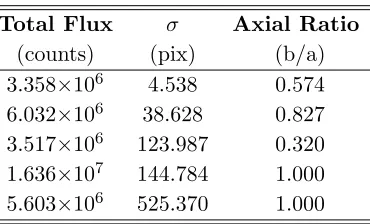
5.2 MGE Code Output . . . 80
5.3 MGE Parameters . . . 82
5.4 Modeled black hole masses and mass-to-light ratio values. . . 88
5.5 Modeled black hole masses and mass-to-light ratio values. . . 93
1.1 Stacked HST WFPC3 image centered on NGC6814. The image orientation
is North up and East to the right. The stacked frames were taken in filters
F555W, F814W, and F160W. . . 1
1.2 Diagram illustrating structure of an AGN from Urry & Padovani (1995) . 6
1.3 Illustration of interdependence of distance measuring techniques used in
as-tronomy. No single technique can be used at all distances, so nearer methods
are used to calibrate farther ones, which are in turn used to calibrate even
farther ones and so forth. Each method’s range is illustrated by a horizontal
blue bar. Blue bars are stacked vertically and with overlapping ranges to
show the interdependence of the technicques. . . 9
1.4 From Bentz et al. 2006. Light curves and time delay curves for Seyfert
1 galaxy, NGC 4151, in 5100 ˚A continuum and broadened Hβ λ4861 light.
Left panels: the rise in Hβ flux is delayed with respect to the rise continuum
emission. This delay is quantified in the right-hand panels. . . 12
1.5 Figure from Park et al. (2012) illustrating the derivation of the f-factor by
bringing the RM sample (red) onto the same line as the SDM sample (black).
Shaded regions represent 1σ confidence intervals of the best fit lines. SDM
1.6 Plot of distance versus size of the SMBH’s gravitationaly sphere of
influ-ence for reverberation-mapped AGN. Solid line represents a typical current
spatial resolution limit. Generally, objects above and to the left of line are
resolvable, and thus eligible for stellar dynamical mass measurements;
ob-jects below and to the right of the solid line are not currently, or for the
forseeable future, resolvable. Note that NGC 6814 falls well inside the
re-solvable region, as does NGC 4151. It should also be noted that distance
values do not have error bars because most of these are redshift distances,
and so horizontal error bars would add very little information to the plot. . 15
1.7 Same as previous plot except zoomed out to show all of the RM sample
of black hole masses for which there also exists a sphere of influence size
estimate. Here it is even more apparent how far out of reach most RM
supermassive black holes are from being able to be studied with SDM. . . . 16
2.1 HST WFC3 image of NGC 6814 using the V-band, F555W filter. This image
was formed by aligning and stacking all 12 visits to form a “deep” frame. . 29
2.2 Zoomed-in section of V-band image of NGC 6814 with region file overlay
showing DoPHOT’s identifications. Green circles are point sources with
enough S/N to perform a 7-parameter fit. Yellow circles represent lower SNR
point source identification yielding only a 4-parameter fit. Red designates
an object that is not as peaked as a star and is possibly a background galaxy.
Blue is also not as peaked as a single star, but probably a double star, and
2.3 Aperture correction measured from Omega Centauri V-band frame plotted
as a function of position on the chip. Red points represent the difference (in
magnitudes) between PSF model and 10-pixel aperture flux. Blue surface
traces the best-fit, slightly tilted plane that was fit to the red points. . . 34
2.4 Side view (y=0) of same data as Figure 2.3. Note that the tilt of the blue points composing the best-fit plane is very slight, and is almost imperceptible in this image. . . 35
2.5 Side view (x=0) of same data as Figure 2.3. Note that the tilt of the blue points composing the best-fit plane is very slight, and is almost imperceptible in this image. . . 35
3.1 Variability index plot. . . 44
3.2 Color-Magnitude plot. V-I colors come from Ducati et al. (2001) . . . 45
3.3 V-I color plotted against average I-band apparent magnitude. . . 46
3.4 I-band (top set of 5 points) and V-band (bottom set of 12 points) Cepheid candidate light curve. Black lines are best-fit Cepheid model light curve. Best fit period is 51.6 ±3.14 days. . . 49
3.5 V-band image of NGC 6814 with probable Cepheid locations identified in green. . . 51
3.6 V-band P-L Relation. . . 52
3.7 I-band P-L Relation. . . 53
4.1 Reproduction of Figure 1 from Riffel (2010) comparing Gaussian
superpo-sition (dotted lines) to Gauss-Hermite series (solid lines) for varying values
of h3 and h4 while holding amplitude, h1 (central wavelength), and h2 (line
width) fixed to the same values for both lines. . . 68
4.2 pPXF model fit to spaxel at x,y = 7,7. Black line is spectral data. Red line
is model fit. Green dots are data minus model residuals. . . 72
4.3 Dynamical Maps of NGC 6814 resulting from pPXF fitting of NIFS spectra.
From left to right: velocity (v), velocity dispersion (σ?), h3 and h4. Red
corresponds to positive values, blue to negative. . . 73
4.4 Voronoi-binned NIFS dynamical maps of NGC 6814. . . 74
4.5 Voronoi-binned and bisymmetrized NIFS dynamical maps of NGC 6814. . . 75
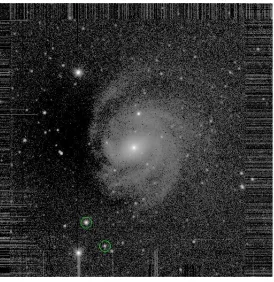
5.1 Left: PSF image; Center: PSF model; Right: Residual image . . . 79
5.2 Stars marked with green circles that were used to calibrate our MGE
compo-nents. Brighter star is 2MASXJ19424441-1018504 with mH = 12.808±0.028
mag. Fainter star is 2MASXJ19424561-1019039 with mH = 14.756±0.066
mag. Brightnesses are from the 2MASS Point Source Catalog. . . 82
5.3 MGE contours overlaid onto WHIRC/WIYN H-band image of NGC 6814. . 83
5.4 Figure from the Carnegie-Irvine Nearby Galaxy Survey showing NGC 6814’s
color profile in B, V, R, and I. . . 84
5.5 Data (top) and model (bottom) dynamical maps. Maps are of (left to right)
v, σ?, h3, and h4. The model σ? overestimates the measured σ?. . . 89
5.6 Four-parameter fit marginalized χ2 plots for Υ (left) and M
5.7 Data (top), four-parameter model (middle, same as previous plot except h3
and h4 not shown), and two-parameter fit (bottom) dynamical maps of v
(left) and σ? (right). The two-parameter fit on the bottom reproduces the
data (especially σ?) better than four-parameter fit in middle. . . 91
5.8 Two-parameter fit marginalized χ2 plots for Υ (left) and M
BH (right). . . . 92
5.9 Top: data. Bottom: model. Left: v. Right: σ? . . . 94
5.10 Contour plot of expanded-range models of v and σ?. Inclination set to 15◦
and number of orbits was 8 100. First six contours represent 1σ, 2σ, 3σ, etc.
All other contours are equally spaced inχ2. . . . 95
5.11 Two-parameter fit marginalizedχ2plots for M
BH (left) and Υ (right). Dashed
lines represent 1σ, 2σ, 3σ. . . 96
A.1 Cepheid 163 image. . . 113
A.2 Cepheid 163 light curve. I-band (top set of points) and V-band (bottom set
of points) Cepheid candidate light curve. Black lines are best-fit Cepheid
model light curves. . . 113
A.3 Cepheid 165 image. . . 114
A.4 Cepheid 165 light curve. I-band (top set of points) and V-band (bottom set
of points) Cepheid candidate light curve. Black lines are best-fit Cepheid
model light curves. . . 114
A.6 Cepheid 166 light curve. I-band (top set of points) and V-band (bottom set
of points) Cepheid candidate light curve. Black lines are best-fit Cepheid
model light curves. . . 115
A.7 Cepheid 167 image. . . 116
A.8 Cepheid 167 light curve. I-band (top set of points) and V-band (bottom set
of points) Cepheid candidate light curve. Black lines are best-fit Cepheid
model light curves. . . 116
A.9 Cepheid 168 image. . . 117
A.10 Cepheid 168 light curve. I-band (top set of points) and V-band (bottom set
of points) Cepheid candidate light curve. Black lines are best-fit Cepheid
model light curves. . . 117
A.11 Cepheid 169 image. . . 118
A.12 Cepheid 169 light curve. I-band (top set of points) and V-band (bottom set
of points) Cepheid candidate light curve. Black lines are best-fit Cepheid
model light curves. . . 118
A.13 Cepheid 170 image. . . 119
A.14 Cepheid 170 light curve. I-band (top set of points) and V-band (bottom set
of points) Cepheid candidate light curve. Black lines are best-fit Cepheid
model light curves. . . 119
A.15 Cepheid 171 image. . . 120
A.16 Cepheid 171 light curve. I-band (top set of points) and V-band (bottom set
of points) Cepheid candidate light curve. Black lines are best-fit Cepheid
A.17 Cepheid 172 image. . . 121
A.18 Cepheid 172 light curve. I-band (top set of points) and V-band (bottom set
of points) Cepheid candidate light curve. Black lines are best-fit Cepheid
model light curves. . . 121
A.19 Cepheid 173 image. . . 122
A.20 Cepheid 173 light curve. I-band (top set of points) and V-band (bottom set
of points) Cepheid candidate light curve. Black lines are best-fit Cepheid
model light curves. . . 122
A.21 Cepheid 174 image. . . 123
A.22 Cepheid 174 light curve. I-band (top set of points) and V-band (bottom set
of points) Cepheid candidate light curve. Black lines are best-fit Cepheid
model light curves. . . 123
A.23 Cepheid 175 image. . . 124
A.24 Cepheid 175 light curve. I-band (top set of points) and V-band (bottom set
of points) Cepheid candidate light curve. Black lines are best-fit Cepheid
model light curves. . . 124
A.25 Cepheid 177 image. . . 125
A.26 Cepheid 177 light curve. I-band (top set of points) and V-band (bottom set
of points) Cepheid candidate light curve. Black lines are best-fit Cepheid
model light curves. . . 125
A.28 Cepheid 178 light curve. I-band (top set of points) and V-band (bottom set
of points) Cepheid candidate light curve. Black lines are best-fit Cepheid
model light curves. . . 126
A.29 Cepheid 180 image. . . 127
A.30 Cepheid 180 light curve. I-band (top set of points) and V-band (bottom set
of points) Cepheid candidate light curve. Black lines are best-fit Cepheid
model light curves. . . 127
A.31 Cepheid 181 image. . . 128
A.32 Cepheid 181 light curve. I-band (top set of points) and V-band (bottom set
of points) Cepheid candidate light curve. Black lines are best-fit Cepheid
model light curves. . . 128
A.33 Cepheid 182 image. . . 129
A.34 Cepheid 182 light curve. I-band (top set of points) and V-band (bottom set
of points) Cepheid candidate light curve. Black lines are best-fit Cepheid
model light curves. . . 129
A.35 Cepheid 183 image. . . 130
A.36 Cepheid 183 light curve. I-band (top set of points) and V-band (bottom set
of points) Cepheid candidate light curve. Black lines are best-fit Cepheid
model light curves. . . 130
A.37 Cepheid 184 image. . . 131
A.38 Cepheid 184 light curve. I-band (top set of points) and V-band (bottom set
of points) Cepheid candidate light curve. Black lines are best-fit Cepheid
A.39 Cepheid 185 image. . . 132
A.40 Cepheid 185 light curve. I-band (top set of points) and V-band (bottom set
of points) Cepheid candidate light curve. Black lines are best-fit Cepheid
model light curves. . . 132
A.41 Cepheid 186 image. . . 133
A.42 Cepheid 186 light curve. I-band (top set of points) and V-band (bottom set
of points) Cepheid candidate light curve. Black lines are best-fit Cepheid
model light curves. . . 133
A.43 Cepheid 188 image. . . 134
A.44 Cepheid 188 light curve. I-band (top set of points) and V-band (bottom set
of points) Cepheid candidate light curve. Black lines are best-fit Cepheid
model light curves. . . 134
A.45 Cepheid 190 image. . . 135
A.46 Cepheid 190 light curve. I-band (top set of points) and V-band (bottom set
of points) Cepheid candidate light curve. Black lines are best-fit Cepheid
model light curves. . . 135
A.47 Cepheid 193 image. . . 136
A.48 Cepheid 193 light curve. I-band (top set of points) and V-band (bottom set
of points) Cepheid candidate light curve. Black lines are best-fit Cepheid
model light curves. . . 136
A.50 Cepheid 194 light curve. I-band (top set of points) and V-band (bottom set
of points) Cepheid candidate light curve. Black lines are best-fit Cepheid
model light curves. . . 137
A.51 Cepheid 196 image. . . 138
A.52 Cepheid 196 light curve. I-band (top set of points) and V-band (bottom set
of points) Cepheid candidate light curve. Black lines are best-fit Cepheid
model light curves. . . 138
A.53 Cepheid 197 image. . . 139
A.54 Cepheid 197 light curve. I-band (top set of points) and V-band (bottom set
of points) Cepheid candidate light curve. Black lines are best-fit Cepheid
model light curves. . . 139
A.55 Cepheid 198 image. . . 140
A.56 Cepheid 198 light curve. I-band (top set of points) and V-band (bottom set
of points) Cepheid candidate light curve. Black lines are best-fit Cepheid
model light curves. . . 140
A.57 Cepheid 199 image. . . 141
A.58 Cepheid 199 light curve. I-band (top set of points) and V-band (bottom set
of points) Cepheid candidate light curve. Black lines are best-fit Cepheid
model light curves. . . 141
A.59 Cepheid 201 image. . . 142
A.60 Cepheid 201 light curve. I-band (top set of points) and V-band (bottom set
of points) Cepheid candidate light curve. Black lines are best-fit Cepheid
A.61 Cepheid 202 image. . . 143
A.62 Cepheid 202 light curve. I-band (top set of points) and V-band (bottom set
of points) Cepheid candidate light curve. Black lines are best-fit Cepheid
model light curves. . . 143
A.63 Cepheid 203 image. . . 144
A.64 Cepheid 203 light curve. I-band (top set of points) and V-band (bottom set
of points) Cepheid candidate light curve. Black lines are best-fit Cepheid
model light curves. . . 144
A.65 Cepheid 204 image. . . 145
A.66 Cepheid 204 light curve. I-band (top set of points) and V-band (bottom set
of points) Cepheid candidate light curve. Black lines are best-fit Cepheid
model light curves. . . 145
A.67 Cepheid 205 image. . . 146
A.68 Cepheid 205 light curve. I-band (top set of points) and V-band (bottom set
of points) Cepheid candidate light curve. Black lines are best-fit Cepheid
model light curves. . . 146
A.69 Cepheid 208 image. . . 147
A.70 Cepheid 208 light curve. I-band (top set of points) and V-band (bottom set
of points) Cepheid candidate light curve. Black lines are best-fit Cepheid
model light curves. . . 147
A.72 Cepheid 209 light curve. I-band (top set of points) and V-band (bottom set
of points) Cepheid candidate light curve. Black lines are best-fit Cepheid
model light curves. . . 148
A.73 Cepheid 210 image. . . 149
A.74 Cepheid 210 light curve. I-band (top set of points) and V-band (bottom set
of points) Cepheid candidate light curve. Black lines are best-fit Cepheid
model light curves. . . 149
A.75 Cepheid 211 image. . . 150
A.76 Cepheid 211 light curve. I-band (top set of points) and V-band (bottom set
of points) Cepheid candidate light curve. Black lines are best-fit Cepheid
model light curves. . . 150
A.77 Cepheid 213 image. . . 151
A.78 Cepheid 213 light curve. I-band (top set of points) and V-band (bottom set
of points) Cepheid candidate light curve. Black lines are best-fit Cepheid
model light curves. . . 151
A.79 Cepheid 215 image. . . 152
A.80 Cepheid 215 light curve. I-band (top set of points) and V-band (bottom set
of points) Cepheid candidate light curve. Black lines are best-fit Cepheid
model light curves. . . 152
A.81 Cepheid 218 image. . . 153
A.82 Cepheid 218 light curve. I-band (top set of points) and V-band (bottom set
of points) Cepheid candidate light curve. Black lines are best-fit Cepheid
Introduction
Figure 1.1: Stacked HST WFPC3 image centered on NGC6814. The image orientation is North up and East to the right. The stacked frames were taken in filters F555W, F814W, and F160W.
1.1 Background
Astronomers have known since the 1970s that the central regions of many galaxies host
extremely luminous point-sources of highly redshifted light. Their resemblance to a star led
them to be called Quasi Stellar Objects (QSOs) (Schmidt 1963), but they turned out to
by bright emission across nearly the full electromagnetic spectrum, their enormous power
output puzzled astronomers. How could so much energy be produced in such a compact
region at the center of galaxies? In 1974, Sir Martin Rees hypothesized that black holes,
objects of such extreme density that even light cannot escape, might be the engines at the
center of these QSOs. He proposed that matter falling under the influence of gravity toward
a central black hole could produce the extreme luminosities necessary to power the QSOs.
That same year, Balick and Brown discovered a point source of radio emission at the center
of our Milky Way galaxy in the direction of the constellation Sagittarius. They named it
Sagittarius A*, and quickly drew a connection between it and the QSOs being found in other
galaxies.
Sure enough, when astronomers became capable of observing Sagittarius A* at infrared
wavelengths, they noticed that the stars, gas, and dust were moving much faster than
ex-pected (5 000 km/s) (Sch¨odel et al. 2002). The gravitational attraction necessary to cause
these motions could only be produced by an object (or objects) millions of times more
mas-sive than the Sun. However, because the region could not be resolved at the time due to
instrumental limitations, nobody knew what type of object it could be. Many models were
put forth to explain what that compact dark mass might be including a cluster of evolved
low-mass stars (Becklin & Neugebauer 1968), neutron stars Becklin & Neugebauer (1968),
a cluster of supermassive stars with heavy accretion disk (Kundt 1990), a ball of heavy
neutrinos supported by degeneracy pressure (Tsiklauri & Viollier 1998), a ball of bosons
(Torres et al. 2000), or a black hole of a mass millions of times that of our Sun, aptly called
a supermassive black hole (SMBH) (Salpeter 1964; Zel’dovich 1964). Each of these types
disperse. The only way to rule out these models was to better resolve the motions of objects
closer and closer to the dark mass. If matter is observed to be orbiting at a radius smaller
than the minimum radius required for that object to exist, then that model got ruled out.
As telescope resolutions improved, gas and individual stars in Keplerian orbit around the
dark mass were observed to pass by the dark mass at shorter and shorter distances. One
by one, each model put forth to explain the dark mass was excluded by observations that
showed matter orbiting at radii smaller than the density of those models would allow. 2002
marked the year that proved the unseen mass must be a supermassive black hole. Sch¨odel
et al. (2002) had been tracking the movements of stars near the central mass for 10 years,
and had measured the orbit of one of the stars (S2) to pass within 17 light hours of the
massive object. The only object that could hold that much mass in that small of a volume
was a black hole!
Similar studies have been conducted on the spatially resolved central regions of other
nearby galaxies. The Hubble Space Telescope’s incredible resolving power has made a
su-permassive black hole the only plausible explanation for the observed dynamics of gas and
stars in the centers of these galaxies. Dynamical studies combined with theory used to
ex-plain the power and emission characteristics of AGN has led to the current paradigm that
most every massive galaxy in the Universe hosts a supermassive black hole (Magorrian et al.
1998; Kormendy 2004).
The very ubiquity of SMBHs implies that they are formed quite readily during the lifetime
of a galaxy. If they form readily, then that begs the question of how they formed in the first
place. Does the black hole form first and then the galaxy forms around it, or vice versa?
called scaling relationships, which are correlations between the mass of the black hole and
certain properties of the host galaxy. One would not necessarily expect the black hole to have
much of an effect on its host galaxy because the size of the gravitational sphere of influence of
an SMBH is quite tiny compared to its galaxy. It is not intuitive, therefore, why the mass of
an SMBH correlates tightly with characteristics of the host galaxy. It should be noted that
these correlations seem to be tightests between the SMBH and the spheroidal component of
its host galaxy, though this is still a matter of debate. (For elliptical galaxies, the spheroidal
component is the whole galaxy; for spiral galaxies, the spheroidal component would be the
bulge.) Spheroidal characteristics that correlate tightly with the mass of the black hole
include bulge stellar mass (e.g., Magorrian et al. 1998; Marconi & Hunt 2003; H¨aring & Rix
2004; Hu 2009; Sani et al. 2011), bulge stellar velocity dispersion (e.g, Ferrarese & Merritt
2000; Gebhardt et al. 2000; Tremaine et al. 2002; Hu 2008; G¨ultekin et al. 2009; Schulze
& Gebhardt 2011; Graham et al. 2011; Beifiori et al. 2012), shape of the luminosity profile
of the bulge (e.g., Graham et al. 2001; Graham & Driver 2007; Beifiori et al. 2012), and
bulge luminosity (e.g., Kormendy & Gebhardt 2001; Kormendy et al. 2011; Beifiori et al.
2012). For these correlations to exist, the black hole and the much larger galaxy need a way
to “communicate” with one another besides through gravity. So how can the bulge of the
galaxy “communicate” with the SMBH?
It is hypothesized that AGN provide the link between the SMBH and its host galaxy
via a feedback mechanism. AGN occur when material from the host galaxy such as dust
and gas loses angular momentum and falls toward the center of the galaxy and into the
gravitational sphere of influence of the SMBH. Some of this matter orbits the SMBH at
narrow line region (NLR) and the broad line region (BLR) (see Figure 1.2). Encircling the
BLR and partially obscuring it is what is called the dusty torus. Some material falls even
closer to the SMBH and as it does, it heats up and flattens out forming the accretion disk.
Finally, some of the material will actually make it quite close to the black hole and either
cross the event horizon and add to the mass of the black hole (a.k.a. feeding), or it will be
ejected at high speeds back out into the galaxy either via magnetic field gradients that twist
and form a jet and/or by outflows in the form of winds. This ejected material can then, in a
process known as feedback, collide with and heat up the intergalactic medium, thus shutting
down star formation and also decreasing the likelihood that more material will fall toward
the center to feed the AGN. This is the leading hypothesis for how SMBHs are connected to
and shape the evolution of their host galaxies (see reviews by e.g., Fabian 2012; Kormendy
& Ho 2013; Heckman & Best 2014).
In order to test this hypothesis, we must make some important measurements. One of the
most fundamental, yet challenging measurements we can make is the mass of the SMBH. To
date, only about 100 direct measurements of black hole masses have been made. The time and
effort required to make these direct measurements is costly, and yet it is important to make
that investment. Tens of thousands of SMBH mass measurements have been made using
indirect methods (Shen et al. 2011) that rely upon and are calibrated by the smaller sample
of directly measured ones. These indirect measurements are used to constrain modeling of
host galaxy and black hole co-evolution over cosmic time. Without a supermassive black
hole, models of galaxy evolution tend to result in too much star formation (e.g., Katz et al.
Jet
Obscuring
Torus
Black
Hole
Narrow Line
Region
Broad Line
Region
[image:31.612.92.523.71.550.2]Accretion
Disk
Figure 1.2: Diagram illustrating structure of an AGN from Urry & Padovani (1995)
measurements are therefore needed to calibrate indirect measurements, which are in turn
needed to constrain models of galaxy evolution.
Because our understanding of galaxy evolution depends on our knowledge of SMBH
The likelihood of being able to directly measure the mass of any given SMBH is very low.
However, for about 100 SMBHs, all the necessary conditions are met to enable direct
mea-surements. There are two main methods of directly measuring SMBH masses: reverberation
mapping (RM) and stellar dynamical modeling (SDM). Which method one uses depends on
the proximity, type and orientation of galaxy in which the SMBH resides. Typically, if the
galaxy is quiescent, nearby (less than 100 Mpc), and has an unobscured central region, then
one can attempt SDM. If, however, the galaxy is active and shows emission from the BLR,
then RM is used. These methods both have their own unique challenges, but to understand
them, one must first understand how SDM and RM work.
1.2 Stellar Dynamical Modeling
Stellar dynamical modeling has been used to measure over 50 SMBH masses to date
(Mc-Connell & Ma 2013). Like its name suggests, SDM involves modeling the motions of the
stars within the gravitational sphere of influence of the SMBH. It uses the orbit
superposi-tion technique (Schwarzschild 1979) whereby one builds a library of possible orbits, and then
superposes them, seeking to find the comination of orbits that best matches the observed
kinematics. The models assume the stars form a collisionless system. The accuracy of mass
measurements via SDM are dependent upon the validity of such an assumption and several
others, as well as our ability to model such a system.
The observations required to constrain these models must spatially resolve (or nearly
spatially resolve) the sphere of influence of the black hole as well as contain spectroscopic
in-formation about as much of that region as possible. The somewhat recent advent of Integral
information for every spatial element, thereby allowing for brightness and dynamical
mea-surements simultaneously. Resolving the sphere of influence of a black hole with
spectropho-tometric data is therefore limited by our instrumental resolving power. Said in another way,
the SDM sample size is limited by the number of galaxies with unobscured central regions
that are nearby enough for us to spatially resolve them.
In addition to resolving power, SDM requires knowledge of the distance to the host
galaxy; the error associated with the mass scales linearly with the error in the distance.
Because our resolving power limitations require that the host galaxy be relatively nearby,
and the motions of nearby galaxies are not dominated by the Hubble flow, we cannot simply
use the redshift as an indicator of distance and therefore must calculate the distance to the
galaxy in some other way. Essentially, getting an accurate SDM mass of a black hole requires
a two-step process. The first step is carefully measuring the distance to that galaxy. The
second step is actually performing the SDM itself with distance as an input parameter.
Distance measurements in astronomy are as important as they are challenging. Without
knowledge of an object’s distance, it is difficult to accurately study its intrinsic properties
such as brightness, size, etc. Astronomers are continuously developing and refining distance
measuring techniques that are effective for different ranges of distances and types celestial
objects. Because no one method is applicable to all objects at all distances, distance methods
with overlapping ranges must be compared to one another, and the one that is considered
more reliable is used to calibrate its neighbor. As is illustrated in Figure 1.3, these techniques
form what is commonly referred to as the “Cosmic Distance Ladder”. Like the rungs of a
ladder that must be climbed in succession to reach greater heights, so too must astronomers
calibrate even longer-distance methods, and so forth. This bootstrapping way of measuring
distances makes the accuracy and precision of final measurements dependent upon proper
calibration of all lower rungs. These calibrations will become important in later chapters.
Figure 1.3: Illustration of interdependence of distance measuring techniques used in as-tronomy. No single technique can be used at all distances, so nearer methods are used to calibrate farther ones, which are in turn used to calibrate even farther ones and so forth. Each method’s range is illustrated by a horizontal blue bar. Blue bars are stacked vertically and with overlapping ranges to show the interdependence of the technicques.
Because our goal is to accurately measure the distance to NGC 6814, we had to justify
an observationally expensive Cepheid study by ruling out all other possible extragalactic
distance measurement techniques. For example, the Surface Brightness Fluctuations (SBF)
technique (Tonry et al. 1997), which relies on measuring the amount of granulation in the
surface brightness profile of a galaxy caused by resolving individual stars, works best for
elliptical galaxies because they lack the dust and substructure that would affect the amount
of granulation observed. The Tully-Fisher technique (TF) (Tully & Fisher 1977) involves
al-ready exists a T-F measurement to NGC 6814 of 22.8+4−3..68 Mpc (Tully 1988). However, due
to its large uncertainty most likely caused by NGC 6814’s nearly face-on orientation, as well
as the high systematic uncertainties that plague this technique in general (e.g., Bradford
et al. (2016)), we must pursue a more secure measurement. The Cepheid Period-Luminosity
relation (Leavitt 1908) is our only feasible option for obtaining an accurate distance
mea-surement to NGC 6814.
1.3 Reverberation Mapping
The distance limitations of SDM require one to use a different technique if one wants to
directly measure the black hole masses of very distant galaxies. It is for this very situation
that reverberation mapping becomes necessary.
AGN are powerful tools with which to study the Universe. They are one of natures
most energetic processes, rivaling the luminosity of their host galaxies, and as such can be
observed at cosmic distances. Their emission varies across almost all wavelengths and on
timescales of minutes to years, and that variation itself conveys information about the size,
shape, and physics of its substructures. The reverberation mapping method takes advantage
of the fact that AGN are bright and variable, and uses those traits to measure the mass of
the SMBH.
As stated before, the BLR is made of fast-moving material that is located within light days
of the black hole. This region absorbs a continuum of photons emitted from hotter regions
closer to the black hole called the accretion disk, and then re-emits them in broadened
emission lines. If the AGN is in the correct orientation (see Figure 1.2), we can actually
change in flux from the broad lines (see Figure 1.4) (Blandford & McKee 1982; Peterson
1993). In other words, as regions close to the SMBH change in brightness, this change
can be seen reverberating in broadened emission lines. The lag in the reverberation tells
us information about the size of the BLR. If we assume the BLR is symmetric and that
the motions in the BLR are dominated by the SMBH’s gravity (i.e. there is no significant
radiation pressure) (these assumptions have been verified in several cases such as Peterson
& Wandel (1999), 2000, Onken & Peterson (2002); Kollatschny (2003)), then by invoking
the Virial theorem we can derive the mass of the SMBH via the equation:
MBH =f
r∆V2
G
Wherer is the characteristic radius of the BLR, ∆V2 is the velocity dispersion of the
broad-ened emission line, andf is a constant that carries information about the shape of the BLR.
(More on the f-factor later.)
The main advantage of RM is that it is not distance dependent. It is not only not
dependent on being able to spatially resolve the often angularly tiny sphere of influence of
the SMBH, but it is not even dependent upon knowing the distance to the galaxy itself.
RM essentially trades spatial resolution requirements for temporal. Therefore, RM can be
used on much more distant SMBHs. This means that our entire understanding of SMBHs
at cosmic distances depends on the accuracy of the RM sample of SMBHs.
However, RM has some limitations too. Firstly, AGN in the local universe are rare,
and AGN that exhibit broad-line emission even rarer, so RM is impossible to apply to the
majority of SMBHs. Secondly, in order to precisely measure time lags, one must have the
Figure 1.4: From Bentz et al. 2006. Light curves and time delay curves for Seyfert 1 galaxy, NGC 4151, in 5100 ˚A continuum and broadened Hβ λ4861 light. Left panels: the rise in Hβ
flux is delayed with respect to the rise continuum emission. This delay is quantified in the right-hand panels.
months, and monitoring campaigns can be observationally expensive, especially if the AGN
happens to be in a more quiescent phase. The other main limitations, as alluded to above,
are the assumptions that RM requires, namely the symmetry and shape of the BLR and
the lack of importance of radiation pressure. Because we have not yet fully characterized
the detailed structure of the BLR for most AGN (though studies are currently underway to
factor to bring it into agreement with the SDM sample. This dependence on the SDM sample
makes RM a secondary mass measurement technique.
How is this average correction factor, hfi, determined? As mentioned above, SMBH
masses correlate tightly with host galaxy properties, and we call these correlations “scaling
relationships”. One particularly tight scaling relationship, the MBH−σ? relation (Ferrarese
& Merritt 2000; Gebhardt et al. 2000), is used to calibrate the RM sample. (It should be
noted that yet another assumption is being made here that the RM and SDM sample of
black hole share the same correlation between mass and stellar velocity dispersion of the
spheroidal component of the host galaxy.) As Figure 1.5 from Park et al. (2012) shows, the
average f-factor is the number that brings best-fit line of the RM sample into agreement
with the best-fit line for the SDM sample. The f-factor in this case is a population average,
but may vary for individual galaxies.
Calculating the f-factor is by no means a trivial task with results ranging from 2.8 ±
0.6 (Graham et al. 2011) to 5.5 ± 1.8 (Onken et al. 2004). It would, therefore, be quite
informative to use both RM and SDM on the same SMBH and see, on an individual basis,
whatf-factor would be needed to make both masses the same. Would thef-factor be similar
to the sample average? If it is, then perhaps the size and shape of the BLR is similar for
most AGN, and individual measurements of SMBH masses made with RM can be trusted to
be accurate. If not, then on an individual basis, RM might only be accurate if one can know
the size and structure of the BLR a priori. Regardless of the outcome, understanding the
f-factor and how SDM and RM compare is essential to our understanding of SMBH masses
at cosmic distances, and therefore our understanding of the role the SMBH plays in host
Figure 1.5: Figure from Park et al. (2012) illustrating the derivation of the f-factor by bringing the RM sample (red) onto the same line as the SDM sample (black). Shaded regions represent 1σ confidence intervals of the best fit lines. SDM sample is from McConnell et al. (2011).
1.4 The Role of NGC 6814
As Figures 1.6 and 1.7 illustrate, there exist only a handful of reverberation-mapped AGN to
which SDM can be applied. This is because broad-lined AGN are not often nearby enough
to be able to resolve the gravitational sphere of influence of the black hole. The possible
exceptions occupy the area of Figure 1.6 that is upwards from and to the left of the solid
line that represents ourl observational resolution limit of 0.1 arcseconds. NGC 4151’s black
Figure 1.6: Plot of distance versus size of the SMBH’s gravitationaly sphere of influence for reverberation-mapped AGN. Solid line represents a typical current spatial resolution limit. Generally, objects above and to the left of line are resolvable, and thus eligible for stellar dynamical mass measurements; objects below and to the right of the solid line are not currently, or for the forseeable future, resolvable. Note that NGC 6814 falls well inside the resolvable region, as does NGC 4151. It should also be noted that distance values do not have error bars because most of these are redshift distances, and so horizontal error bars would add very little information to the plot.
(Bentz et al. 2006) measured. NGC 3227’s black hole has also had a marginal SDM mass
measurement made Davies et al. (2006) as well as an RM mass measurement (Denney et al.
2010). NGC 5273 and NGC 3783 are within reach, and will be the topic of future SDM
studies.
The purpose of this dissertation research is to perform SDM on NGC 6814 for the first
time, and to compare both the SDM and RM masses of the SMBH. NGC 6814 will be only
the third Seyfert 1 on which SDM will have been performed. The RM mass has already been
Figure 1.7: Same as previous plot except zoomed out to show all of the RM sample of black hole masses for which there also exists a sphere of influence size estimate. Here it is even more apparent how far out of reach most RM supermassive black holes are from being able to be studied with SDM.
method will be employed to measure the most precise distance to NGC 6814 to date. Once
this number is known, then it will be incorporated into the determination of the stellar
dynamical mass of the SMBH in NGC 6814.
In Chapter 2 we describe the Cepheid observations and data reduction, and in Chapter 3
we detail our work on defining the Cepheid P-L relationship for NGC 6814. Chapter 4
de-scribes our Gemini observations of the nuclear stellar dynamics, and Chapter 5 reveals the
results of the stellar-dynamical modeling. Finally, in Chapter 6 we discuss the implications
Cepheid Observations and Measurements
2.1 Background
Cepheid variable stars are incredibly important in astronomy and have profoundly influenced
our understanding of the nature of the Universe. They were first discovered by Henrietta
Leavitt at the Harvard College Observatory in the early 1900s. While she was studying
photographic plates of the Small Magellanic Cloud and Large Magellanic Cloud, she noticed
that some of the stars were periodically varying in brightness. Further, she noticed that the
brighter the star, the longer the period of the variation. Her research led directly to the
discovery of the Cepheid Period-Luminosity relation, also know as The Leavitt Law (Leavitt
& Pickering 1912) that states that the distance to a Cepheid can be derived by measuring its
period of pulsation and its average apparent magnitude, and then comparing its brightness
to Cepheids of known distance. Cepheids became newly established standard candles and ten
years later were used by Edwin Hubble to settle the famous Shapley-Curtis debate (Hubble
1922); by identifying a Cepheid in the Andromeda galaxy he proved that “spiral nebulae”
were really other galaxies that exist outside of our own galaxy and therefore our Universe is
much larger than the Milky Way. Since their discovery, Cepheids have continued to play an
indispensible role in cosmic distance measurements.
“Classical” or “Type I” Cepheid variable stars are population I giants/supergiants of
spectral class F6-K2 with masses between 4 and 20 solar masses and luminosities between
500 and 30,000 solar luminosities (−5 < Mv < −2). Because they are so massive, they
are by definition young and found in areas of recent star formation like the spiral arms
become Cepheids when they briefly (and sometimes multiple times) cross whats called the
“instability strip”, where the star’s outer layers become unstable and expand and contract
periodically (Eddington 1917). The current accepted driver of this instability is changes
in the ionization state of helium in its atmosphere. Doubly ionized helium is more opaque
to outgoing radiation, and so the stars atmosphere experiences more radiation pressure
and expands. As the atmosphere expands, it cools and the doubly ionized helium starts
to recombine to form singly ionized helium thereby decreasing the opacity, which in turn
decreases the radiation pressure. The force of gravity then causes the atmosphere to contract,
and the cycle repeats. All stars experience some form of pulsations, though they are usually
damped. Cepheids, however, experience extreme pulsations because their partially ionized
zone of helium occurs at the exact depth to cause a resonance (Hofmeister et al. 1964).
The expansion and contraction of the star’s atmosphere leads to a typical relative change
of 5% in radius and 10% percent in area as well as surface temperature changes of around
1 000 K. These size and temperature changes lead to extremely regular changes in luminosity
with time–as regularly as the rotation of the Earth. A Cepheid’s light curve can range from
a few tenths to two magnitude in amplitude, and it exhibits a characteristic shape that
deviates substantially from a sinusoid; the luminosity increases steeply toward maximum,
then decreases more gradually toward minimum–like a backward sawtooth wave. The longer
the period, the higher average luminosity the Cepheid. The high average luminosity, the
large changes in luminosity over time, the characteristic saw-tooth shape of these changes,
and the tightness in correlation between luminosity and period are all characteristics that
Probably the Cepheid P-L relation’s most important function has been calibrating
an-other type of standard candle called Type Ia supernovae (Sne Ia). Sne Ia are even more
luminous standard candles than Cepheids with absolute magnitudes reaching -19
magni-tudes. Their incredible brightnesses allow them to be observed at even greater distances
(up to z=1), and so have been used to measure the age, size, and expansion rate of the
Universe. The two billion dollar Hubble Space Telescope (HST) was launched in 1990 with
one of its main goals being to better constrain H0 using Cepheid calibrations of secondary
distance indicators such as Sn Ia, surface brightness fluctuations, and the Tully-Fisher
rela-tion (Freedman et al. 2001). Before the launch, ground-based Cepheid light curves had led
to estimates of Ho, the Hubble constant, of anywhere from 50 to 100 km/s/Mpc. depending
on the method used. HST, therefore, had the express goal of measuring H0 to within a 10%
uncertainty. The Hubble Key Project, as it was called, led to the discovery of new Cepheids
in the 18-galaxy sample. The recalibration of the Sn Ia’s distance ladder led to a much
more constrained value for H0 of 72 ± 8 km/s/Mpc. It also led to the discovery in 1998 that
the Universe was not only expanding, but it was accelerating. Cepheid variable stars have
played a prominent role in shaping humankind’s conception of the Universe’s fundamental
properties.
2.2 Observations
The very first step toward finding a Cepheid distance to NGC 6814 is to take pictures of it
at different times. Thanks to the hard work of Dr. Misty C. Bentz and her Co-Investigators,
we were able to collect the necessary HST data. Much of our observing strategy is guided by
demonstrated that HST is uniquely suitable for detecting Cepheids at up to 30 Mpc. Previous
studies used the Wide Field Pixel Camera 2 (WFPC2), the Near-Infrared Camera and
Multi-Object Spectrograph (NICMOS), or the Advanced Camera for Surveys (ACS), whereas we
chose to use the Wide Field Camera 3 (WFC3) for several reasons. Firstly, the UVIS and
IR detectors have a relatively small plate scale (0.0400x0.0400) for UVIS and 0.1300x0.1300 for
IR), which is important for decreasing the effects of crowding from the many other stars in
the galaxy field as well as from background sources. Secondly, WFC3 has the large field of
view (16200x16200 for UVIS and 13600x12300 for IR) necessary to capture the majority of the
galaxy in a single exposure, thereby increasing the observing efficiency. Thirdly, the V-band
F555W filter that we used for the majority of our exposures happily coincides with the
maximum throughput of WFC3-UVIS. Lastly, and most importantly, WFC3 is a relatively
new instrument, and so has not yet been degraded by the harsh environment of space.
The timing of our observations followed Freedman et al. 1994 who showed that in order
to maximize detection efficiency and reduce aliasing, it is best to image the galaxy with
a power law spacing between epochs. The range of epochs chosen is designed to be most
sensitive to Cepheids with periods between 20 and 60 days, which represents an apparent
magnitude range of mV ≈ 25.2 – 27.4 for an assumed distance of 22 Mpc. While it is true
that the longer the period, the brighter the Cepheid and the more likely we are to detect
it, there is a practical limit to how long we can monitor an object. In order to adequately
sample the light curve on a very long-period Cepheid, one would have to implement a very
long observing campaign. However, based on similar studies, we expected to detect enough
Cepheids at high enough signal to noise to be able to constrain the distance to NGC 6814
of 69.1 days total beginning 2013-08-10 and ending 2013-10-08, and contain thirteen visits
with power-law spacing. This limit for total campaign length was set by the largest time
period in which we could hold the orientation of the spacecraft fixed for all the visits —
making all the stars fall on the same parts of the chip in every image.
Our choice of filters also follows the well-established strategy of Freedman et al. (1994).
The filter which was used during 12 of the visits was the UVIS detector’s V-band F555W
filter (λc = 530.8 nm, ∆λ = 156.2 nm). Even though Cepheid light curves are known to
display the largest amplitudes of variation at shorter wavelengths, the reddening and
extinc-tion combined with diminished throughput at these wavelengths counteracts this advantage
Freedman et al. (1994). Therefore, the V-band is a good compromise between variability
am-plitude and extinction/reddening. Each of the V-band epochs spans most of the 56-minute
visibility of NGC 6814 during a single 96-minute orbit of HST, and are composed of four
600-second exposures in a four-point dither pattern to decrease the effects of systematic
errors of individual pixels and increase the sampling of the point spread functions (PSFs).
The total on-source time for the V-band was 28.8 ks.
The high variability of the Cepheids in the F555W filter is ideal for locating them and
measuring their periods of pulsation, but because we also needed their mean apparent
magni-tudes, five of the twelve visits also included UVIS I-band F814W (λc = 802.4 nm, ∆λ= 153.6
nm) observations. Cepheids’ mean apparent magnitudes vary less in the I-band, so fewer
epochs are needed than in the V-band. The I-band visits, each consisting of four 630-second
exposures in a four point dither pattern, occurred at visits 1, 3, 7, 10, and 12 on the orbit
directly after the V-band’s orbit. These individual I-band exposures are slightly longer than
A longer exposure time will increase the S/N and hopefully make up for the increased
crowd-ing. The total I-band on-source time is 12.6 ks. The I-band and V-band observations were
taken as close together in time as possible so that the I-band variability, though smaller in
amplitude, can be used to corroborate the variability in the V-band.
Table 2.1: HST Observations
Visit:Orbit Setup Middle MJD Days after Visit 1 Exp. Time
(days) (s)
1:1 UVIS/F555W 56514.54296 0.0 2400.00
1:2 UVIS/F814W 56514.60735 0.1 2520.00
2:1 UVIS/F555W 56525.08347 12.2 2400.00
3:1 UVIS/F555W 56531.55688 19.7 2400.00
3:2 UVIS/F814W 56531.61996 19.8 2500.00
4:1 UVIS/F555W 56535.60736 24.4 2400.00
5:1 UVIS/F555W 56541.04396 30.7 2400.00
6:1 UVIS/F555W 56543.20700 33.2 2400.00
7:1 UVIS/F555W 56545.09639 35.4 2400.00
7:2 UVIS/F814W 56545.20650 35.5 2520.00
8:1 UVIS/F555W 56546.66917 37.2 2400.00
9:1 UVIS/F555W 56554.16888 45.9 2400.00
10:1 UVIS/F555W 56560.12535 52.8 2400.00
10:2 UVIS/F814W 56560.18920 52.8 2520.00
11:1 UVIS/F555W 56567.87078 61.7 2400.00
12:1 UVIS/F555W 56574.27629 69.1 2400.00
12:2 UVIS/F814W 56574.33932 69.2 2520.00
13:1-2 IR/F160W 56518.79585 5.0 5041.57
Total F555W 28800.00 Total F814W 12600.00 Total F160W 5041.57
(See Table 2.1 for an overview of the observations.) If a Cepheid candidate shows the
same pattern of brightness changes in both bands, then we can be more certain that we have
found a true variable star as opposed to noise.
Finally, H-band observations using the WFC3-IR detector and the F160W filter (λc =
for a total exposure time of 5.04157 ks. These data are taken for three purposes: first, to
further counter the effects of extinction and reddening by factor of 5 over the V-band (Riess
et al. 2011); second, to ensure that there are no zeropoint errors when tying our work to the
Sne Ia calibration of Cepheids of Riess et al. (2011); and third, because metallicity affects
the Cepheid P-L relation less at longer wavelengths (Marconi et al. 2005).
2.3 Data Processing: Tweakreg and Astrodrizzle
One of the many perks of working with HST WFC3 data is that they can be downloaded from
the Multimission Archive at Space Telescope (MAST) both in raw form and in calibrated
form. If no special initial processing is needed, which is the case for our data, then they
can be downloaded having already been through a standard image processing pipeline called
“calwf3:. This pipeline treats the UVIS and IR data slightly differently, but in the end
outputs images in the same stage of preliminary processing that carry the suffix “flt.fits”.
The basic UVIS pipeline processing begins with a module called “wf3ccd”, which creates
a ERR (error) and DQ (data quality) fits extension by computing the error for each pixel
and flagging known bad pixels. It then subtracts the bias and trims the overscan regions.
Next, “wf3rej” is called to reject cosmic rays and combine the images from the two chips
into one. Lastly, the images are run through “wf32d” to be dark-subtracted and flat-fielded.
Because IR detectors are different from CCDs in that all the pixels are independently
sampled and can be read out non-destructively, the IR pipeline is slightly different. The
first module called “wf3ir” flags bad pixels, subtracts the zeroth read, attaches ERR and
DQ extensions, corrects for non-linearity, subtracts the dark current (very important in
same as for the UVIS cosmic ray rejection. All of these steps can be done even before the
data are downloaded from the MAST archive because they are standard steps that usually
do not require customization. The next steps including aligning, correcting for geometric
distortions, and stacking the images all require the user-modified input parameters, so the
data are downloaded and run through another pipeline package called Drizzlepac.
Our first post-download step was to run the data through a task called TweakReg in
order to very precisely align the images. Because the goal of our science is to identify the
sames stars in images taken across several epochs, it is very important to align our images
as accurately as possible. Though the headers of the fits files contain WCS information that
can be used to align the images taken within the same visit, TweakReg is needed to account
for slight pointing errors that occur between visits and correct these WCS files to within 0.1
pixel accuracy (4 mas for UVIS, 10 mas for IR) (Gilliland 2005). One cause of these pointing
errors is that HST experiences periodic thermal expansion and contraction, or ‘breathing’,
as it orbits the Earth. As the telescope breathes, the focus changes, thereby changing the
shape and centroid location of the point spread function (PSF)1. This change in focus affects
the telescope’s Fine Guidance Sensors’ ability to track guide stars (see Drizzelpac Handbook
Appendices for more info).
Another source of error that affects the alignment of images is geometric distortions.
HST’s WFC3 images suffer from a few different sources of geometric distortions, the most
obvious of which is tilt of the focal surface as it reaches the detectors. This is due to the
limited amount of space each instrument’s optical bench can occupy and to the desire to
1A point spread function is the distribution of flux on the detector that is created by a point source of
reduce the number of reflections in the light path in order to preserve throughput. The
UVIS detector is tilted approximately 21◦ with respect to one of its diagonals, whereas the
IR detector is slanted at approximately 10◦ about its x-axis. This causes the UVIS field of
view (FOV), when projected on the sky, to take the shape of a rhombus, and the IR FOV to
resemble a rectangle. These tilts are not difficult to correct. What is difficult to correct is
the change in plate scale across the UVIS and IR detectors. The slight change in plate scale
leads to change in area-per-pixel of 7% across the diagonal of the UVIS chip and 4% across
the IR chip.
To counteract breathing and geometric distortions to achieve sub-pixel image registration,
TweakReg uses an algorithm similar to DAOFIND to identify point sources from each image.
It then creates a catalog of source positions for each image and applies a distortion model that
is stored in each image’s .fits header. Next, it matches these undistorted source positions to
a user specified reference. In our case, we used the default reference image, which is the one
that has the most sources in common with all the other images. To make sure cosmic rays
or faint sources do not affect the alignment correction, tweakreg allows the user to specify
a lower and upper pixel value threshold, which we chose 400 for our lower threshold and
50 000 for our maximum (below the full well depths of the IR and UVIS detectors). After
all undistorted offsets between frames are calculated, they are used to update the WCS
coordinates of each image’s header.
With the shifts stored in the image headers, the data were then stacked using the task
Astrodrizzle. Astrodrizzle (short for astrometric drizzle) uses a technique known as drizzling
(Fruchter & Hook 1997) formally referred to as variable-pixel linear reconstruction, the goal
signal-to-noise ratio. On a basic level, it works by combining two separate image
reconstruc-tion methods into one: interlacing and shift and add. Interlacing, which really only works if
dithers are integer pixel values away from one another, is just matching up de-shifted,
corre-sponding pixels values and adding them together. The other method, shift-and-add, involves
resampling the pixels onto a finer grid, then de-shifting them by the dither amount, and
fi-nally adding them to the output image. This method still ends up convolving the images
by the original pixel shape, thus blurring the final output image. Because our images are
a combination of integer and non-integer dithers, astrodrizzles combination of shift-and-add
and interlacing is key to reducing correlated noise while increasing final resolution.
So, using astrodrizzle we first we stacked all of the V-band images (48 images total, 4 per
visit for 12 visits) to create one “deep” frame. Then, using the V-band deep frame as the
reference image to which all other frames were aligned, each of the individual visits for the
V- and I-bands were combined yielding 12 V-band images and 5 I-band images. Next, all of
the I-band images (20 images total, 4 per visit for 5 visits) were drizzled together to create an
I-band deep frame, but once again using the V-band deep frame as a reference. Finally, all of
the H-band data was combined, also using the V-band deep frame as a reference. Once the
exposures for each orbit are combined and all visits are all drizzled to a common reference,
then it was finally time to perform photometry.
2.4 Measurements
2.4.1 DoPHOT
Our photometry software of choice is a Fortran code called DoPHOT (Mateo & Schechter
and output their brightness, positions, and classification. Our main reason for choosing
DoPHOT over the several other photometry packages available is, as the manual states:
“The particular application for which DoPHOT was designed...involved large numbers of
poorly sampled, low signal-to-noise images for which a fast, hands-off approach seemed
desirable.” These attributes describe our needs quite well. There are tens of thousands of
very crowded point sources in our images. Another reason we chose to use DoPHOT is that
our collaborator, Laura Ferrarese, was already quite familiar with it; she used it when she was
working the Hubble Key Project. Not only did this mean we had excellent mentoring during
the learning-how-to-use-it process, but our results can be tied in with the many important
previous studies that used this same software to perform Cepheid photometry. Furthermore,
DoPHOT’s capabilities are already well-studied and have been refined over the more than
20 years since its first release.
Conceptually, DoPHOT works by creating a model for different types of object that may
be found in the image. For example, DoPHOT uses an elliptical gaussian to model stars,
a more extended elliptical gaussian to model background galaxies, two elliptical gaussians
to model stars with double stars or stars whose PSFs overlap, etc. Dophot scans an image
and fits models to the sources of emission, and then outputs their classifications as well as
their shape, brightness, and positional data. The user guides DoPHOT toward appropriate
classifications and accurate apparent magnitudes by modifying an input parameter file. This
parameter file allows the user to specify among other things information about the expected
size of the PSF, the sky value, the noise properties of the image, the upper and lower
pixel value threshold for object identification, and desired significance of the identifications.
objects in the image that have roughly the same FWHM as the user specified. Next, it
averages the shape of those PSFs together to get an average PSF shape. Starting at the
upper threshold, it searches for objects whose flux is above that value and classifies them
according to how they compare to the PSF shape. DoPHOT then subtracts those objects
from the image, lowers the threshold, creates a new average PSF model, adds back in and
re-fits the brighter objects using the new PSF model, subtracts them again, identifies fainter
objects and subtracts these too, and repeats the process iteratively until the lower threshold
is reached. By remaking the PSF model for every iteration, the PSF shape should get more
and more accurate. It should also be noted that DoPHOT creates a noise model for the
image. Every time a model PSF is subtracted from the image, the program runs the risk of
falsely identifying the residuals as a new source. To avoid this problem DoPHOT adds noise
to the image after every PSF subtraction, which by default is 30% of the brightness of the
subtracted object.
Another useful feature of DoPHOT is that it allows for “warmstarts”. A warmstart is
a way the user can use information from an image with higher S/N (e.g. a deep frame) to
force identifications in lower S/N images. For example, if a star is detected in a stacked deep
frame but is only marginally detected in a single visit frame, then DoPHOT will perform
the fit in the single frame even if it does not meet the original threshold criteria for that fit.
It should be noted that DoPHOT’s model magnitudes are calculated by fitting a model to
the PSF and then using information about the height of that model rather than integrating
Figure 2.1: HST WFC3 image of NGC 6814 using the V-band, F555W filter. This image was formed by aligning and stacking all 12 visits to form a “deep” frame.
2.4.2 Data Processing
DoPHOT requires input images to be in a very specific format down to the length of the
header. To prepare our data for DoPHOT, we first multiplied by the summed exposure time
to get the images in units of electrons, rather than electrons per second, the default unit for
pipeline-processed HST data. Next, because the sky background flux had been subtracted
during drizzling, we added back in the sum of the sky backgrounds for each of the stacked
images. Because DoPHOT requires data to be of integer type, we multiplied our images
by a factor of four to maintain precision, and then converted our data to integers. We also