S T U D Y P R O T O C O L
Open Access
START NOW - a comprehensive skills
training programme for female adolescents
with oppositional defiant and conduct
disorders: study protocol for a
cluster-randomised controlled trial
Linda Kersten
1*, Martin Prätzlich
1, Sandra Mannstadt
1, Katharina Ackermann
2, Gregor Kohls
3, Helena Oldenhof
4,
Daniel Saure
5, Katrin Krieger
6, Beate Herpertz-Dahlmann
3, Arne Popma
4, Christine M. Freitag
2,
Robert L. Trestman
7and Christina Stadler
1Abstract
Background:In Europe, the number of females exhibiting oppositional defiant disorder (ODD) and conduct disorder (CD) is growing. Many of these females live in youth welfare institutions. Consequently, there is a great need for evidence-based interventions within youth welfare settings. A recently developed approach targeting the specific needs of girls with ODD and CD in residential care is START NOW. The aim of this group-based behavioural skills training programme is to specifically enhance emotional regulation capacities to enable females with CD or ODD to appropriately deal with daily-life demands. It is intended to enhance psychosocial adjustment and well-being as well as reduce oppositional and aggressive behaviour. We present the study protocol (version 4.1; 10 February 2016) of the
FemNAT-CD intervention trial titled‘Group-Based Treatment of Adolescent Female Conduct Disorders: The Central Role
of Emotion Regulation’.
Methods/design:The study is a prospective, confirmatory, cluster-randomised, parallel-group, multi-centre, randomised controlled trial with 128 institutionalised female adolescents who fulfil the diagnostic criteria of ODD and/or CD. Institutions/wards will be randomised either to provide the 12-week skills training as an add-on intervention or to provide treatment as usual. Once the first cycle is completed, each institution will run a second cycle with the opposite condition. Primary endpoints are the pre-post change in number of CD/ODD symptoms as assessed by a standardised, semi-structured psychiatric interview (Kiddie Schedule for Affective Disorders and Schizophrenia
for School-Age Children–Present and Lifetime, CD/ODD section) between baseline and the end of intervention, as well
as between baseline and a 3-month follow-up point. Secondary objectives include pre-post change in CD/ODD-related outcome measures, most notably emotional regulation on a behavioural and neurobiological level after completion of START NOW compared with treatment as usual.
Discussion:To our knowledge, this study is the first to date to systematically investigate the effectiveness of an adapted integrative psychosocial intervention designed for female adolescents with ODD and CD in youth welfare settings.
(Continued on next page)
* Correspondence:[email protected]
1Department of Child and Adolescent Psychiatry/Department of Psychology,
University Psychiatry Clinics Basel/University of Basel, Basel, Switzerland Full list of author information is available at the end of the article
(Continued from previous page)
Trial registration:German Clinical Trials Register (DRKS) identifier: DRKS00007524. Registered on 18 December 2015 and with the World Health Organisation International Clinical Trials Registry Platform.
Keywords:Randomised controlled trial, Treatment, Adolescents, Females, Residential care, Conduct disorder, Oppositional defiant disorder, Skills training, Emotion regulation
Background
Across European countries, an increase in mental health problems, along with a growing rate of violence and aggression in youths, can be observed [1]. Children and adolescents with conduct problems, including aggres-sion, represent a highly heterogeneous group. From a
diagnostic perspective, aggressive and oppositional
behaviour has been subsumed under the diagnoses con-duct disorder (CD) and oppositional defiant disorder (ODD) [2]. The heterogeneity is reflected not only by a great variety of symptoms ranging from impulsive, hot-tempered quarrels or stealing to acts of cruelty to ani-mals or people but also by the extent of co-morbidity (e.g., attention-deficit disorder, depression, anxiety disor-ders, learning difficulties, posttraumatic stress disorder). Furthermore, research indicates that especially children and adolescents with ODD and CD bear a high risk for maladjustment and the persistence of aggressive and
antisocial behaviour symptoms into adulthood [3–6]. In
that sense, youth with ODD or CD represent a highly vulnerable group with a significant risk and cost, not only to themselves but also to their immediate sur-roundings and ultimately to society as a whole.
Although especially CD has long been considered a male-typical disorder (with male-to-female prevalence ratio estimates ranging from 2:1 to 8:1 [7]), recent re-search suggests rising and rather high prevalence rates
of about 1–3% among girls and female adolescents [8–
10]. Conduct problems (including ODD or sub-clinical symptoms) are observed in approximately 14% of girls and 16% of boys in Europe [11]. Not surprisingly, preva-lence rates of specific populations, such as incarcerated females, are considerably higher, ranging between 32% and 73% [12]. Although the number of females exhibit-ing ODD and CD is growexhibit-ing, the majority of studies on therapeutic treatment options for CD have been focused primarily on male subjects, despite strong evidence that the course and overall psychosocial adjustment problems associated with CD are often more severe in females than in males [7, 13]. Sequelae such as school failure, substance abuse, delinquency, child prostitution, and early pregnancy (often associated with poor parenting skills) pose serious problems on an individual as well as a societal level.
The development of ODD and CD is generally seen to be caused by an interplay between adverse psychosocial
and neurobiological factors that can ultimately result in severely impaired emotional regulation capacities [14]. Patients with ODD and patients with CD are charac-terised predominantly by impulsive-aggressive behaviour that is often associated with high emotional vulnerability exemplified by hypervigilant behaviour in response to neutral stimuli. In addition, patterns of thought that include automatic appraisals and distortions of attribu-tion are often found. On top of that, adolescents with conduct problems frequently experience interpersonal difficulties, which are oftentimes associated with high levels of psychological distress. For these youth, a thera-peutic approach focused on stress tolerance, mindful-ness, emotional regulation, interpersonal skills and adequate handling of emotions is well-suited and directly tailored to their needs [15]. As for a specific sub-group of adolescents with CD that can be best described as callous-unemotional with associated features, such as a lack of emotional responsivity, lack of empathy, extreme patterns of thought (e.g., black-and-white think-ing), and interpersonal difficulties without any associated psychological distress, different kinds of therapeutic strat-egies seem to be needed. Here, interventions focused on enhancing empathic capacities, moral reasoning and perspective-taking are required [15]. So far, research indi-cates that, next to individual skills training, adolescents with ODD/CD benefit immensely from therapeutic approaches that involve their direct environment [16, 17]. More specifically, children with disruptive behaviours pri-marily benefit from parent-focused interventions, whereas adolescents with externalising behaviours respond very well to multi-modal approaches [16].
The intervention
emotion recognition and regulation, (3) making judge-ments and decisions on the basis of consequences and (4) improving stress management and coping skills [19]. START NOW is an integrative evidence-informed intervention based on several therapeutic approaches. These therapeutic elements were chosen because of research findings as well as suitability for the target population (i.e., patients with behaviour disorders) and for integration with other aspects of
the planned treatment. More specifically, the
programme combines aspects of cognitive behavioural
therapy (CBT), motivational interviewing (MI),
dialectical behaviour therapy (DBT) and trauma-sensitive care. The subsequent sections outline the different elements that comprise START NOW in more detail and elaborate on their relevance with regard to the target population.
Cognitive behavioural therapy
CBT represents the theoretical underpinning of the intervention. The programme integrates functional analysis to help group members break down behaviour patterns and understand their own behaviour in the con-text of its antecedents and consequences. In addition, CBT serves to help patients understand how their own conceptualisation of events is connected to their mood and behaviour. Understanding these cognitive processes
increases patients’ control and understanding of their
behaviour. Furthermore, it facilitates recognition and coping with potential triggers, the modification of cogni-tions and attitudes, as well as the replacement of prob-lematic behaviours with alternate conduct. Within the CBT framework, new skills are being taught and prac-ticed within as well as between sessions (including role-playing, problem-solving, group discussions or practice exercises) to facilitate transfer [20].
A meta-analysis of outcomes from 26 research articles addressing the effectiveness of group therapy with adult offenders [21] revealed positive effects of CBT, including improved interpersonal functioning, improved self-esteem and anger management, as well as a decrease in feelings of anxiety and in disciplinary sanctions. There is also long-standing support for using CBT-based ap-proaches with adolescents who exhibit externalising
problem behaviours [22–25]. Furthermore, evidence
sug-gests that a therapeutic group approach incorporating practical issues in daily-life situations is well-accepted in adolescents and may show high effectiveness even in se-verely aggressive youth [26]. In addition, CBT has been shown to be feasible for use with counsellors: A training programme using treatment manuals resulted in highly
skilled implementations, high levels of counsellors’
self-reported confidence to use the intervention effectively, and high satisfaction ratings [27].
Motivational interviewing
MI forms an additional part of the START NOW programme. It is seen as a useful complement to CBT because it represents a client-centred approach that
dir-ectly addresses a patient’s ambivalence and facilitates
motivation for change [28]. In this sense, MI helps to
provide the basis for the patient’s willingness to engage
in the intervention [29, 30], whereas CBT provides the specific tools and strategies to change problematic be-haviours. Adolescents with ODD or CD do not tend to show much insight into the degree of inadequacy of their misconduct and as a result do not present with a great motivation for change. Therefore, a therapeutic stance that is marked with validation and empathy on the one hand, and the exploration of dysfunctional be-haviours and their associated negative consequences on the other hand, is a feasible treatment strategy also for the treatment of adolescents with disruptive behaviour disorders [31]. START NOW uses several MI aspects, such as the view that ambivalence toward change is common and normal. Furthermore, discussions and exercises stimulating change talk and designed to over-come potential ambivalence are provided. Finally, self-ef-ficacy and positive behaviours are evoked and reinforced throughout the whole intervention [32].
In the past, there have been other effective interven-tions that have combined the two approaches [33, 34]. The literature reveals positive indications for the use of MI with adolescents: Effects have been found in the areas of substance use [35, 36], weight-related problems [37, 38] and diabetes [39]. In a cluster-randomised trial investigating the effectiveness of single-session MI intended to reduce adolescent substance use behaviour, for instance, researchers found moderate to large effect sizes [36]. Furthermore, MI has been linked to better treatment retention rates mostly in adult populations in various settings [40–42].
Cognitive modifications
reported having sustained a TBI at some point in their lives [45]. Because TBI has been linked to reduced verbal capacities, school problems and concentration problems [46], START NOW was designed to address such limita-tions by using participant workbooks written at a fifth-grade reading level, with little jargon, using many pictures and repetitions of key concepts and integrating a lot of practice exercises and group discussions to enhance understanding and recollection.
Dialectical behaviour therapy
START NOW further includes some principles that are compatible with DBT. The therapy, which was originally developed for patients with borderline personality disorder [47], has been increasingly applied to forensic sample populations living in residential care settings or correctional facilities [48, 49]. Fundamental to the devel-opment of DBT is a biosocial theory that conceptualises
a patient’s emotional dysregulation as the result of a
biological tendency toward emotional vulnerability in conjunction with an invalidating rearing environment [50]. Within START NOW, two key concepts of DBT are found: (1) emphasis on dialectics and (2) mindful-ness. The balance between validation and confrontation mainly represents the so-called dialectical relationship work that can also affect the degree of motivation for change as well as the willingness to explore new behav-iour patterns [51]. Mindfulness stemming from Eastern spiritual practices was first and innovatively combined with CBT strategies within DBT [52]. Within START NOW, a subset of mindfulness exercises is offered, ran-ging from interactive exercises to inner mindfulness
practices that involve paying close attention to one’s
own body. Adolescents are encouraged throughout the programme to try each type of exercise and decide for themselves what kind of mindfulness practice best works for them.
Applying DBT strategies to settings where there is a high prevalence of ODD and CD is highly reasonable because this target population shows many of the same risk factors for the development of emotion dysregula-tion as do borderline patients [49, 53]. The first evidence that DBT is likely to be effective in females with CD
symptoms has already been shown [54–56].
Nelson-Gray and colleagues [54], for instance, found significant reductions in externalising and internalising symptoms in an outpatient sample of youth with ODD. With re-gard to mindfulness specifically, a randomised controlled trial with 228 non-clinical first- to third-grade students showed significant improvements in terms of text anx-iety, social skills and selective attention [57]. The use of mindfulness techniques with adolescents with externalis-ing problems has also been investigated in a handful of studies, and to date the results are encouraging, with
small to medium effect sizes, with regard to aggressive, non-compliant acts; social behaviour; attention; and
sub-jective happiness [58–60].
Trauma-sensitive care
START NOW integrates aspects of trauma-sensitive care. This approach includes the central idea that dysfunctional behaviour can emerge as a result of an
individual’s adjustment to adverse, highly stressful life
circumstances. In this sense, many kinds of currently problematic behaviours may be understood as initially adaptive coping strategies in response to negative situa-tions. In the long term, however, those adaptive strat-egies may become associated with a preponderance of negative consequences. START NOW specifically uses some concepts of Trauma Affect Regulation: Guide for
Education and Therapy [61], including focusing
exercises as well as self-monitoring. Research indicates that adolescents in residential care settings represent a population with a high incidence of trauma histories and trauma symptoms. In one study of different types of maltreatment experiences over and above the incidence of conduct problems in female adolescents in out-of-home care, researchers identified a large proportion of the sample reporting severe to extreme maltreatment experiences, ranging from 20% for sexual abuse to 33% for emotional abuse [62]. Furthermore, these maltreat-ment experiences were shown to be connected to trauma-related symptoms in emerging adulthood. These findings speak to the relevance of using trauma-sensitive interventions for maltreated adolescents to help them connect their current symptoms with traumatic past experiences.
The context
From the perspective of the social worker, adolescents’
behavioural dysregulation and persistent tendency to test boundaries, along with their lack of insight into their problematic situation, trigger anger, disappointment and helplessness [53]. It is therefore necessary to introduce a multi-modal concept that integrates all involved professions and parties to enhance communi-cation, transparency and support and to decrease stress levels that originate from the challenges of dealing with adolescents with ODD/CD [53]. Because of the decreased chance of generalisation of the taught skills, in vivo coach-ing seems most adequate to help ensure that youth with ODD and CD will practice newly introduced strategies consistently in daily-life situations [15]. Unfortunately, to date, there is no study in which researchers have specific-ally investigated the effectiveness of a skills training
programme combining the above-listed therapeutic
Effectiveness of START NOW
A treatment evaluation study of the original START NOW intervention in the United States showed that this approach is effective for difficult-to-manage, impulsive and aggressive detainees [63]. Analyses of a mixed-gender
sample of inmates (n= 946 participation events) indicated
that START NOW was effective in reducing the number of disciplinary reports received. More specifically, a dose-response relationship was found: Zero-inflated nega-tive binomial regression analyses indicated that each additional session was associated with a 5% reduction in the incidence rate of disciplinary infractions. Furthermore, participation in the skills training yielded high satisfaction rates and reduced psychiatric hospitalisation days [19, 64].
It was therefore concluded that the intervention
programme represents a viable treatment option for redu-cing problem behaviour in incarcerated populations.
The present study
Within the framework of the FP7 project Neurobiology and Treatment of Adolescent Female Conduct Disorder: The Central Role of Emotion Processing (FemNAT-CD; see http://www.femnat-cd.eu/ for more information), a European multi-disciplinary study, the aim of the present study is to evaluate the effects of an adapted, gender-specific START NOW intervention for females with ODD/CD living in youth welfare institutions. To our knowledge, no prior study has evaluated the effects of such a CBT-based intervention combining aspects of multiple other therapeutic approaches for this specific population in the youth welfare sector. The adaptation of the original START NOW intervention still employs the same underlying principal components of the skills train-ing, but it uses a slightly modified framework (i.e., individ-ual sessions on top of group sessions to enhance personal understanding and relevance of content; shortened length of the programme due to frequent temporary, time-constrained placements) and adjusted content (i.e.,
illustra-tions and theme stories tailored to teenage girls’interests).
Furthermore, the intervention will be conducted by staff members of the respective youth welfare institution.
Inten-sive pre-training and supervision, including fidelity
monitoring, will be provided. The intervention comprises weekly group sessions (14 sessions, 90 minutes each) and individual sessions (45 minutes each). The aim of the indi-vidual sessions is to ensure the transfer of the content of the group training into the personal, daily routines of the participants. Girls are encouraged to practice the skills introduced during the START NOW training between ses-sions in their daily social interactions with the aid of the re-sponsible social worker. In addition, parents will be sent information on START NOW and information regarding efficient parenting strategies and communication skills with adolescents. In essence, key aspects of the START NOW
skills training have remained the same within the adapted version and are well-suited for the target population that can, similarly to the target population of the original format, be described by emotional regulation deficits, many invalidating and traumatic relationship experiences, high impulsivity and a low motivation for change.
Hypotheses
On the basis of the literature, it is hypothesised that female adolescents participating in the add-on START NOW programme will show a greater reduction of aggressive symptoms and co-morbid psychopathology as well as enhanced emotional regulation as compared with adolescents undergoing treatment as usual (TAU). The primary outcome measure refers to the change in number of ODD/CD symptoms endorsed over time as assessed using a semi-structured psychiatric interview (Kiddie Schedule for Affective Disorders and Schizophrenia for
School-Age Children–Present and Lifetime [K-SADS-PL],
sections ODD/CD) with the female adolescent and her respective social worker.
Regarding secondary outcomes, it is hypothesised that START NOW will result in a reduction of co-morbid psychopathology and an enhancement of life satisfaction and emotional regulation skills compared with TAU alone. The predictive value of psychosocial and neuro-biological as well as specific personality variables will be investigated. The question of who benefits most from intervention programmes (and who does not) is of major interest to offer effective and tailored intervention strat-egies. There is accumulating evidence that patients with CD with elevated callous-unemotional traits profit less from current interventions [14, 65]. This might be due to a biologically determined hyporesponsiveness to distress cues that might interfere with social learning [66]. We thus hypothesise that reduced emotional re-sponsiveness/elevated callousness is predictive of low intervention success in females with CD/ODD. Accord-ingly, we will focus on change in heart rate variability (HRV) because HRV has been identified as an important correlate of emotional regulation difficulties and treat-ment response [67]. In addition, in a sub-sample, we will evaluate change in neural functional correlates using a functional paradigm specifically assessing emotional regulation capacities under emotionally distressing
con-ditions [68–71]. Further, we expect that the intervention
comprising staff training and regular supervision will re-duce self-reported stress and symptoms of burn-out in involved social workers.
Methods/design
trial with two parallel groups (intervention vs. TAU) and three trial phases (baseline assessment, 12 weeks of treatment, 12 [±1] weeks of follow-up observation). The intervention condition is incorporated into the usual standard care within residential care (START NOW + TAU) vs. TAU. A randomised controlled AB-BA design will be used. Institutions will be randomised to start either with the intervention group (A) or with the control group (B) (TAU). After having conducted A or B, each institution will run the other condition: Institutions starting with TAU receive START NOW, and institutions that finished START NOW and the follow-up assess-ment conduct a new group with TAU, whereby strict rules are defined to eliminate the risk of carry-over effects.
Study centres
The study will take place at youth welfare institutions located in proximity to four clinical trial centres. Study centres include the departments of child and adolescent psychiatry at the university hospitals in Basel, Switzerland
(CS, principal investigator); Frankfurt, Germany
(CMF); Aachen, Germany (BHD); and Amsterdam, The Netherlands (AP). Data management as well as biometric and statistical support are provided by the Institute of Medical Biometry and Informatics (IMBI), University of Heidelberg, Germany. The Coordination Centre for Clinical Trials (Koordinierungszentrum für Klinische Studien [KKS]) at the University of Heidelberg is in charge of study monitoring.
Participants
Several youth welfare institutions will be asked to partici-pate. If they agree, female adolescents in the institutions
who are aged 12–20 years and their legal guardians will be
asked if they want to participate. Diagnostic assessment
will be standardised according to criteria of theDiagnostic
and Statistical Manual of Mental Disorders, Fourth Edition, Text Revision(DSM-IV-TR) or theDiagnostic and Statistical Manual of Mental Disorders, Fifth Edition
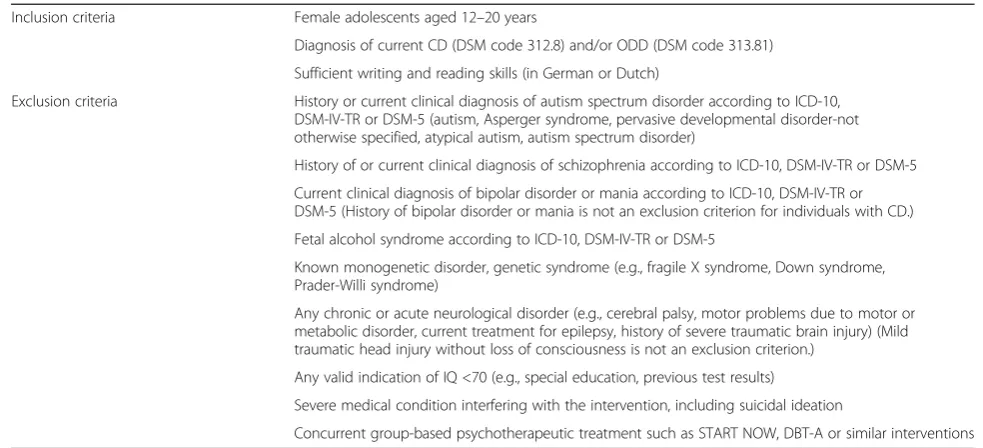
(DSM-5). Diagnostic information is obtained via a semi-structured clinical interview (K-SADS-PL). Inclusion and exclusion criteria are listed in Table 1.
Criteria for withdrawal
Participants may withdraw from the study (1) at their own request or the request of their parents/legal
repre-sentatives; (2) if, according to the investigator’s opinion,
participation in the trial would be harmful for the
partic-ipant’s well-being; or (3) if the participant’s behaviour
significantly disturbs and impedes group sessions due to, for example, aggressive behaviour directed toward other group members or herself.
Concomitant treatment
[image:6.595.51.543.482.706.2]Additional treatments administered to the participants on entry into the trial or at any time during the study are documented as concomitant treatments on the respective pages of the case report form (CRF). Concomitant treatments are allowed in the intervention group as well as the control group as long as they do not represent a group-based psychotherapeutic approach.
Table 1Inclusion and exclusion criteria
Inclusion criteria Female adolescents aged 12–20 years
Diagnosis of current CD (DSM code 312.8) and/or ODD (DSM code 313.81)
Sufficient writing and reading skills (in German or Dutch)
Exclusion criteria History or current clinical diagnosis of autism spectrum disorder according to ICD-10, DSM-IV-TR or DSM-5 (autism, Asperger syndrome, pervasive developmental disorder-not otherwise specified, atypical autism, autism spectrum disorder)
History of or current clinical diagnosis of schizophrenia according to ICD-10, DSM-IV-TR or DSM-5
Current clinical diagnosis of bipolar disorder or mania according to ICD-10, DSM-IV-TR or DSM-5 (History of bipolar disorder or mania is not an exclusion criterion for individuals with CD.)
Fetal alcohol syndrome according to ICD-10, DSM-IV-TR or DSM-5
Known monogenetic disorder, genetic syndrome (e.g., fragile X syndrome, Down syndrome, Prader-Willi syndrome)
Any chronic or acute neurological disorder (e.g., cerebral palsy, motor problems due to motor or metabolic disorder, current treatment for epilepsy, history of severe traumatic brain injury) (Mild traumatic head injury without loss of consciousness is not an exclusion criterion.)
Any valid indication of IQ <70 (e.g., special education, previous test results)
Severe medical condition interfering with the intervention, including suicidal ideation
Concurrent group-based psychotherapeutic treatment such as START NOW, DBT-A or similar interventions
Abbreviations: CDConduct disorder,DBT-ADialectical behaviour therapy for adolescents,DSM-IV-TR Diagnostic and Statistical Manual of Mental Disorders, Fourth Edition, Text Revision,DSM-5 Diagnostic and Statistical Manual of Mental Disorders, Fifth Edition,ICD-10International Classification of Diseases, Tenth Revision,IQ
Examples of concomitant treatments include individual psychotherapy or external support activities that serve to strengthen social-emotional, cognitive or physical compe-tencies (e.g., drama club, chess club, soccer). Medication and changes in dosage will also be documented through-out the study.
Measurement time points
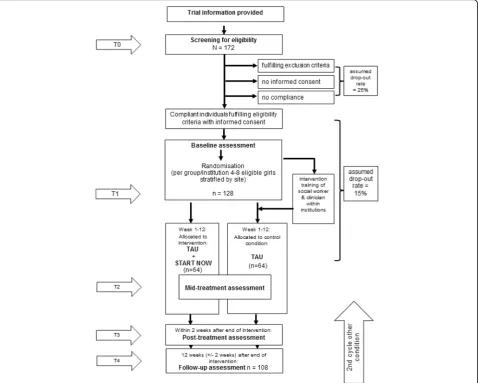
Assessments will be conducted at baseline (T1), 6 weeks after the start of the intervention (mid-treatment [T2]), 3 months after the start of the intervention (end of treat-ment [T3]) and 3 months after the end of the interven-tion (T4). The flow of participants from recruitment through the end of the study is shown in Fig. 1. To promote participant retention, regular contact with par-ticipants through telephone calls, on-site visits and information letters is provided. Furthermore, partici-pants who discontinue the intervention but are still in-terested in taking part in the data assessments are
nevertheless assessed. Because the number of sessions attended is a control variable in the analysis, continuing data collection with participants who are drop-outs is not a problem.
Primary outcome measure
The primary outcome variable is defined as change in number of fulfilled CD/ODD diagnostic criteria as assessed by a standardised, semi-structured clinical interview between baseline and post-treatment and between baseline and follow-up. The K-SADS-PL will be used [72, 73]. Interviewers will be trained by an experi-enced clinician, and regular consensus meetings will be held. The K-SADS-PL is a widely used and validated semi-structured diagnostic interview designed to assess current and past episodes of psychopathology in children
and adolescents according to DSM-IV-TR/DSM-5
criteria. Interviews are conducted with the adolescent as
well as with a social worker from the participant’s
[image:7.595.60.539.329.712.2]respective youth welfare institution who is not involved in the intervention. Symptom measures, diagnoses and severity ratings derived from the interview are based on the obtained information combined with clinical judge-ment. Thus, summary ratings are achieved by including all sources of information.
Secondary outcome variables
Further objectives of the present trial are to assess pre-post changes in different aggression phenotypes and CD/ODD-related outcome measures in girls participat-ing in the START NOW trainparticipat-ing compared with those receiving TAU. In adolescents, the Reactive-Proactive Aggression Questionnaire [74], used to distinguish be-tween reactive and proactive/instrumental forms of aggression, and the Relational Aggression Questionnaire [75], which assesses relational aggression strategies such as excluding members of the peer group or spreading gossip, will be used. The Child Behaviour Checklist [76] is used to assess various externalising (attention prob-lems, aggression, delinquency) and internalising (e.g., anxiety/depression) symptoms in adolescents via self-and parent-report. The Affective Reactivity Index (as self-rating form and as caretaker rating) [77] is used to capture general irritability. To assess psychopathic traits, the Youth Psychopathic Traits Inventory [78] will be used. Next to this self-rating questionnaire, the Inven-tory of Callous-Unemotional Traits, Parent Report [79], will be obtained from parents to capture change in
parent-reported callous-unemotional traits. Social
workers will rate aggression symptoms in daily-life situa-tions with the modified Overt Aggression Scale origin-ally developed by Yudolfsky et al. [80]. In adolescents also, a time-sampling short assessment procedure (eco-logical momentary assessment) will be used with mea-sures collected twice daily (after lunch and after supper on 4 consecutive days; pre-, mid- and post-assessment) to capture current emotions and regulation capacities while minimising retrospection effects and interference with the daily routine. To assess change in deliberate emotional regulation strategies, the Difficulties in Emo-tion RegulaEmo-tion Scale [81] will be used.
Each female adolescent will define individual goals, and their attainment will be investigated on the basis of Goal Attainment Scaling [82]. In addition, general life satisfaction of the adolescents [83] will be assessed with
the Brief Multidimensional Students’ Life Satisfaction
Scale. Caretakers’self-efficacy, burn-out symptoms and
job satisfaction will be assessed with the Burnout Screening Scale, a composite instrument comprising
dif-ferent questionnaires [84–88]. In the intervention group,
the clients’and trainers’satisfaction with the programme
will be assessed (Client Satisfaction Questionnaire/ Training Satisfaction Questionnaire) [19].
Moderators of outcome measures
Several potential moderators of the outcome variables will be assessed. The Massachusetts Youth Screening Instru-ment version 2 [89] is a self-report questionnaire that screens for a multitude of behaviour problems and poten-tial emotional distress. The Pubertal Development Scale [90] is used to assess pubertal stage using words, rather than pictures, in those participants aged 12 years and
above. The Social and Health Assessment scales [91]—
specifically the subscales that relate to peers and neigh-bourhood environment, but also those that assess alcohol
and drug use, bullying and future outlook—are used in the
present study. To assess intelligence quotient (IQ), two sub-tests of the Wechsler Intelligence Scale for Children, Fourth Edition [92], or the Wechsler Adult Intelligence Scale, Fourth Edition, are performed with the adolescents: vocabulary as a measure of verbal comprehension and matrix reasoning to examine perceptual reasoning capacity. The Diagnostic Interview for DSM-IV Personality Disorders (Axis II [93]) is a semi-structured diagnostic interview done to assess the ten DSM-IV personality disorders. In the present study, a sub-section is used to assess bor-derline personality disorder symptoms. The quality of the youth welfare institution is systematically assessed through use of the Institutional Quality Index (IQI). The Treatment as Usual Questionnaire (TAU-Q) is distributed
to assess the youth welfare institution’s standard care. Both
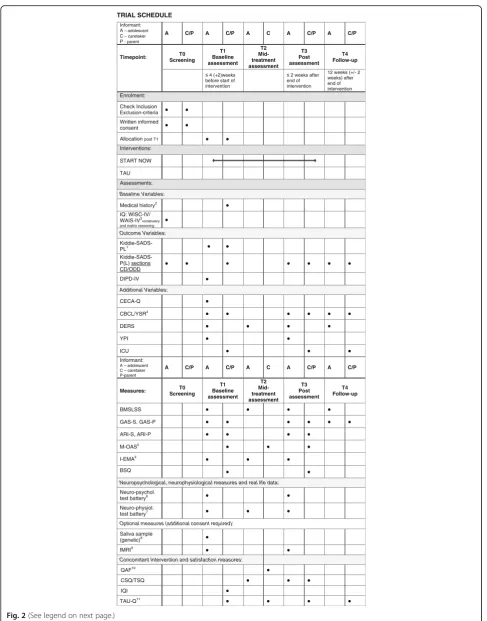
the IQI and TAU-Q were developed specifically for the purpose of the present study. The Childhood Experience of Care and Abuse Questionnaire [94] is a self-report questionnaire that was developed to mirror an existing validated interview measure: the childhood experience of care and abuse. The questionnaire assesses lack of parental care (neglect and antipathy), parental physical abuse, and sexual abuse from any adult before age 17 years. Information regarding pre-natal and peri-natal risk fac-tors for antisocial behaviour, such as maternal smoking in pregnancy, post-natal depression and negative living conditions in early life, as well as the socio-economic status, is additionally assessed during a standardised interview with primary caregivers. For a detailed overview on measurement time points/trial schedule, please refer to the Standard Protocol Items: Recommendations for Interventional Trials (SPIRIT) checklist shown in Fig. 2. For a detailed overview on information given within this protocol please consult (Additional file 2).
Neurobiological measures of emotion processing
Neuropsychological correlates
TRIAL SCHEDULE
Informant: A– adolescent
C– caretaker
P - parent
A C/P A C/P A C A C/P A C/P
Timepoint: T0 Screening
T1 Baseline assessment
T2 Mid-treatment assessment
T3 Post assessment
T4 Follow-up
≤ 4 (+2)weeks before start of intervention
≤ 2 weeks after end of intervention
12 weeks (+/- 2 weeks) after end of intervention Enrolment:
Check Inclusion Exclusion-criteria ● ● Written informed
consent ● ●
Allocation post T1 ● ●
Interventions:
START NOW
TAU Assessments:
Baseline Variables:
Medical history2 ●
IQ: WISC-IV/ WAIS-IV3vocabulary and matrix reasoning
●
Outcome Variables:
Kiddie-SADS-PL1 ● ●
Kiddie-SADS-P(L) sections
CD/ODD ● ● ● ● ● ● ●
DIPD-IV ●
Additional Variables:
CECA-Q ●
CBCL/YSR4 ● ● ● ● ● ●
DERS ● ● ● ●
YPI ● ●
ICU ● ● ●
Informant:
A – adolescent C – caretaker P-parent
A C/P A C/P A C A C/P A C/P
Measures: ScreeningT0 T1 Baseline assessment
T2 Mid-treatment assessment
T3 Post assessment
T4 Follow-up
BMSLSS ● ● ● ●
GAS-S, GAS-P ● ● ● ● ● ●
ARI-S, ARI-P ● ● ● ●
M-OAS5 ● ● ●
I-EMA5 ● ● ●
BSQ ● ●
Neuropsychological, neurophysiological measures and real life data:
Neuro-psychol.
test battery6 ● ●
Neuro-physiol.
test battery7 ● ● ●
Optional measures (additional consent required):
Saliva sample
(genetic)8 ●
fMRI9 ● ●
Concomitant Intervention and satisfaction measures:
QAF10 ●
CSQ/TSQ ● ● ●
IQI ●
TAU-Q11 ● ● ● ●
[image:9.595.56.544.83.705.2]Test, we intend to assess stimulus-reinforcement learning (adapted from [96]).
Autonomous correlates
Autonomous correlates will be measured as part of a neuropsychological test battery. Basal autonomic ner-vous system (ANS) parameters will be measured during a 5-minute resting protocol [97]. ANS reactivity will be measured during a countdown task [98] and while watching emotion-evoking film clips [99]. Especially HRV seems to be a promising indicator of treatment success [67, 100].
Neural correlates
Neural correlates will be studied using functional and structural magnetic resonance imaging at baseline. Changes in these neural correlates will be investigated (in a sub-sample post-intervention in Basel and Aachen
only) as mechanisms underlying the brain’s adaptation
to treatments likely related to both structural plasticity and functional response alterations [101].
Genetic functional variants
Genetic functional variants in saliva (serotonergic, norad-renergic, dopaminergic, neuropeptide) will be investigated to test the hypothesis that specific functional genetic vari-ants are predictive of low intervention success.
Sample size calculation and statistical analysis
The sample size calculation is based on the primary
effi-cacy endpoint ‘pre-post treatment change in number of
fulfilled CD/ODD diagnostic criteria’ after the 12-week
group-based START NOW training programme for female adolescents (as add-on therapy to TAU) com-pared with TAU only within youth welfare institutions. On the basis of results reported by Nelson-Gray et al.
[54], pre-post changes in the treatment group of μ= 3
and in the control group ofμ= 1, as well as a
conserva-tive common standard deviation of 3.5 for both groups, are expected. Because the Nelson-Gray et al. study inter-vention comprised only 1 DBT training module and only 16 sessions instead of 14 group sessions + 12 individual sessions as in our study, compared with the change of
2.24 in the Nelson-Gray study, we expect at least μ= 3.
In addition, it has to be assumed that TAU in youth welfare settings will also result in reduction of ODD/CD symptoms. Owing to the group therapy and the respect-ive appropriate randomisation procedure, we will have a correlated data structure. To account for that, a design effect of 1.08 to adjust for intra-group correlation of
0.02 is assumed. To achieve a power of 80% (α= 5%,
two-sided; two-sample t test), a total of 108 patients is
required for the analysis. Therefore, 172 patients will be assessed for eligibility to obtain 128 patients to be randomised (assuming that 25% of screened patients are not eligible). A drop-out rate of 15% is expected (includ-ing major protocol violations and loss to follow-up). The problem of missing values is partly resolved in the confirmatory analysis by application of an imputation strategy. Nevertheless, another 15% of patients will be randomised to compensate for the loss of information caused by drop-outs and loss to follow-up. The sample size calculation was done using nQuery Advisor 7.0 soft-ware (Statistical Solutions, Cork, Ireland).
Statistical methods
The full analysis of the primary outcome measure will be conducted on the basis of the intention-to-treat (full analysis set) population, including all randomised pa-tients. To account for the data structure, a linear mixed model with the primary endpoint (change in ODD/CD score between baseline and end of intervention) as the response variable, including baseline CD/ODD symp-toms, group, age, site and IQ as fixed factors and the respective cluster as a random factor, will be applied. The random intercept, as well as the residuals, will be assumed to be normally distributed. The correlation structure can be referred to as compound symmetry [102], which is a common assumption in cluster-randomised trials [103]. The results will be presented as the mean between-group difference with the corre-sponding two-sided 95% confidence interval. The
associ-ated Hedges’ effect size g [104] will be calculated, in
addition to the practice-related intra-cluster correlation coefficient. To fit the primary model, the restricted maximum likelihood approach will be used.
(See figure on previous page.)
Fig. 2Standard Protocol Items: Recommendations for Interventional Trials (SPIRIT) checklist for the trial.ANSAutonomic nervous system,ARI
The overall type I error rate is set at α= 5% (two-sided) and will be controlled by applying the multiple test procedure for hierarchically ordered hypotheses. The first null hypothesis states that the change in ODD/ CD score between baseline and end of intervention is
equal for both the intervention and control groups (H0I:
μ1I=μ2I). This hypothesis will be tested at a two-sided
level of significance of 5% against the alternative
hypoth-esis (H1I: μ1I≠μ2I). Only if the first hypothesis can be
rejected will the second null hypothesis, which states
that the change between baseline and follow-up
(12 weeks after end of intervention) will be equal in both
groups (H0II:μ1II=μ2II), be tested in the same way. This
second hypothesis can then be tested also at a two-sided level of significance of 5% against the alternative
hypoth-esis (H0II: μ1II≠μ2II). Application of this multiple test
procedure for hierarchically ordered hypotheses assures control of the overall type I error rate of 5%. Both null hypotheses will be tested by applying a random effects model that includes baseline CD/ODD symptoms, group, age, institution and IQ as fixed factors and cluster as a random factor. This statistical analysis plan was spe-cified before the opening of the database.
Methods against bias
Eligibility assessment, obtaining informed consent and en-rolling the participants in the trials are performed at each trial site by one of the local investigators. Institutions will be randomised to start with either the intervention group or the TAU control group. The institutions will be rando-mised in fully eligible groups (group size of four to eight participants), stratified by site using a centralised web-based tool (http://www.randomizer.at [14 Jan 2013], Med-ical University of Graz, IMBI, Statistics and Documenta-tion, c/o Prof. Andrea Berghold). The randomisation tool is supervised by the IMBI at the University of Heidelberg, Germany.
Screening and baseline assessment are performed be-fore the randomisation procedure, so that data obtained at intake are blinded with regard to group membership. Furthermore, all interviews will be conducted with someone who is not involved in the training.
To ensure that START NOW is implemented in all residential institutions in a comparable way, all staff trainers are trained before the beginning of the study and have to pass a practical and written test. The 2-day-long pre-training will be conducted after randomisation and before the start of the intervention. To increase treatment adherence, a facilitator manual with a detailed session-by-session outline will be used next to the work-book for adolescents. The application of the modularised sessions is strictly monitored. In addition, trainers are supervised by START NOW facilitators every other
week during the intervention period. To assess
adherence and competence, two training sessions of the programme (one in unit 1, one in unit 2) will be either directly attended by one START NOW super-visor or videotaped. The quality check (Quality Assur-ance Form [QAF] [19]) will be focused on adherence to the content of the programme and basic trainer competencies (use of motivation interviewing, rolling with resistance, validation).
With regard to the trial design, institutions that were ran-domised to start with the intervention condition first and subsequently provide a second cycle of TAU have to fulfil two conditions to eliminate potential carry-over effects:
1. Only social workers are involved who have not been previously trained and an exchange on START NOW content between girls is unlikely because of rare opportunity.
2. In case girls who participated in START NOW remain in the institution in the same living group after the whole cycle has ended, the time interval between the end of an intervention group and a second cycle of TAU is longer than 6 months.
Data quality is continuously monitored by the data management team (IMBI), University of Heidelberg, and the KKS). Data will be entered electronically at each local study centre site. Range checks for data values are done to promote data quality. Clinical monitors inspect subject-related data during on-site visits to ensure that all data are correct, complete and gathered according to data protection laws.
The original study forms will be kept at the trial site.
Participants’ files are stored in locked cabinets, and
access to the study data will be restricted. Data will be collected, processed and stored according to the data protection laws.
Safety and ethical issues
Research activities within the FemNAT-CD START NOW project will be carried out in compliance with the fundamental ethical principles stated in the Declaration of Helsinki. The KKS, an institution that is independent from other trial staff and experienced in monitoring psychotherapy trials, will monitor the study, adapted to good clinical practice guidelines as stated by the International Conference on Harmonisation of Technical Requirements for Registration of Pharmaceuticals for Human Use, and KKS has approved the standard operat-ing procedures. The trial (protocol version 4.1) has received approval from the local ethics committees at the University of Basel (reference EKNZ 2014/075), the
University of Frankfurt (445/13–version 5), the University
Any modification to the protocol will require a formal amendment and approval by each local research ethics committee. The protocol must be agreed upon by the trial steering committee (principal investigators at the Department of Child and Adolescent Psychiatry, University of Basel, and local investigators at the University of Frankfurt, University of Aachen and University of Amsterdam) and the data management team (KKS and IMBI) at the University of Heidelberg.
Participants will be enrolled only after they have received comprehensive information from the respon-sible investigator. Participants and their parents/legal representatives will also receive information sheets and will have the opportunity to discuss the trial with the in-vestigator. Written informed consent for the study will be obtained by the investigator from all participants and their parents/legal representatives who are willing to participate in the trial. An example consent form is pro-vided (see Additional file 1). All participants will be in-formed that they can stop participating in the study at any time without having to give justification. Participants are provided with the right to have their information re-moved from the database at any time. Because TAU is allowed for both the intervention the control groups, and because the control group will subsequently undergo the intervention condition, participants in ei-ther group do not experience any disadvantage with
re-gard to group allocation in relation to clinical
intervention. Control subjects who leave the institution before the start of the intervention condition are given the opportunity to participate in an outpatient START NOW group. Results will be published regardless of the magnitude or direction of the effect and will follow Consolidated Standards of Reporting Trials (CONSORT) and its extension 5 to cluster-randomised trials.
An independent data and safety monitoring board (DSMB) including three independent clinical experts and one biometrician is established to monitor the pro-gress of the trial and ensure adherence to protocol. Safety parameters include that all serious adverse events (SAEs) or adverse events reported by the subject or detected by the local investigator that occur during the trial and all noticeable problems must be documented in the CRF. In case of an SAE, the ethics committee will be informed within 7 days after the SAE has been reported. In addition, the DSMB will also be regularly informed. In case of a significant preponderance of SAEs that might causally be associated with the trial, the DSMB will terminate the trial. Patients who are enrolled in the study are covered by indemnity for negligent harm by study insurance policies.
To guarantee confidentiality and anonymity, all partic-ipants are allocated consecutive participant identification (ID) numbers. The local principal investigator of each
study site will maintain a subject ID list (participant ID
codes with the corresponding participants’ names) to
enable records to be identified. Authorised persons may inspect the subject-related data collected during the trial, ensuring compliance with the data protection law (in-spectors, monitors, auditors). Only encoded data will be stored (centre code and consecutive ID number). Saliva samples will be stored for 30 years. Data identifying a person will be available only at the local sites. All data collected in the online database will be managed in a safe and secure environment. The system used for data management is validated and is compliant with U.S. Food and Drug Administration regulations (21 CFR part 11). All data transmission is encrypted with Secure Sockets Layer (SSL) technology. All changes to data are logged with computerised timestamps in an audit trail which includes the name of the author/editor, the date/ time of the change, a reason for the change and the new information. The IMBI Heidelberg database server with the stored data is located in a secure data centre of the university and is protected by a firewall. The system pro-vides an infrastructure to support user roles and rights. Only authorised users are able to enter or edit data, and access is restricted to data of the subjects in the respect-ive centre.
Discussion
This study protocol presents a randomised controlled trial testing the effectiveness of an adapted version of a cognitive behavioural skills training programme, START NOW, in institutionalised females with a diagnosis of ODD and/or CD. To date, to our knowledge, the study represents the only randomised controlled trial of the efficacy of the START NOW intervention specifically de-signed for female adolescents with disruptive behaviour problems within youth welfare institutions. There is an internationally recognised lack of randomised controlled studies investigating the efficacy of integrative thera-peutic approaches [48, 49]. Consequently, the present study gives profound consideration to the repeatedly formulated necessity to develop integrative intervention approaches deriving from sound theoretical rationales, addressing core deficits of patients with ODD and pa-tients with CD, and applying gender-specific strategies and materials. On the basis of convincing evidence that emotion processing is severely affected in ODD and CD, the presented approach, focused on enhancing emo-tional regulation and interpersonal capacities, is well-suited for this target group.
symptoms [107]. Effective treatment of severely aggres-sive, rule-breaking and unit-destructive behaviour is cru-cial to the safe operation of the residential environment [53]. This is of major relevance for staff workers dealing with adolescents who experience severe behavioural and emotional dysregulation. Thus, the implementation of evidence-based intervention approaches within youth welfare institutions is needed to strengthen the chance of continuous care and to avoid repeated relationship break-offs in severely affected adolescents living in these settings [107]. As such, the results of the present study shall be of high relevance for residential care settings and shall evoke further debates over, if not directly en-hance, the standard of care provided within the youth welfare sector.
Essential methodological issues will be considered to manage threats to internal validity on the outcome of the present randomised controlled trial [108]. START NOW is manualised, and all facilitators receive 2 days of rigorous, standardised training. Beyond an in-depth
preparation, START NOW’s implementation will be
checked via regular fidelity monitoring assessed by the respective supervisor through use of a standard QAF. The study is large enough to determine the presence of clinically important effects, and mediators and modera-tors of response will be investigated. Our primary out-come measure is based on a clinical interview conducted by independent observers with both the adolescent and a (non-involved) social worker. In doing so, we gather comprehensive information that does not rely on a sole source and combines interview information, file infor-mation and clinical judgement to reach a final conclusion. Furthermore, the fact that we continuously collect neuro-biological and neuropsychological data presents a major advantage because we will subsequently be able to combine and compare these objective indicators with the clinical data collected. Procedurally, the randomised AB-BA design is a further benefit because it will enable us to assess within-institution effects. This point is of particular importance because youth welfare institutions vary ex-tremely with regard to size, type of population served, or-ganisational and structural aspects, financial resources, and professional training opportunities. The automated online randomisation procedure is clearly defined and re-flects the study design. The statistical analysis takes the different study centres and institutions into account. Fur-thermore, a strong advantage of the present study is the 3-month follow-up period to investigate long-term effects of the intervention.
Limitations
A limitation of this study lies in the fact that a blind as-sessment can be realised only during baseline assess-ment. At post-assessment and follow-up, participants
and other informants included in the assessments (social workers and adolescents) are aware of the condition they are in, and thus their evaluation may be biased. How-ever, to overcome potential bias with regard to the pri-mary outcome measure, the interview assessing CD/ ODD symptoms will be conducted with social workers who are not involved in the training. In addition, to as-sess main secondary measures of emotion processing, objective neurobiological indicators are used which are not influenced by expectation effects.
Trial status
In January 2015, the first group was randomised. Recruitment is expected to be finished by January 2017.
Additional files
Additional file 1:Example informed consent form used at the Basel
site. (PDF 194 kb)
Additional file 2:SPIRIT 2013 Checklist. (DOC 121 kb)
Abbreviations
ANS:Autonomic nervous system; ARI: Affective Reactivity Index; BMSLSS: Brief Multidimensional Students’Life Satisfaction Scale; BSQ: Burnout Screening Scale; CBCL: Child Behaviour Checklist; CBT: Cognitive behavioural therapy; CD: Conduct disorder; CECA-Q: Childhood Experience of Care and Abuse Questionnaire; CONSORT: Consolidated Standards of Reporting Trials; CRF: Case report form; CSQ: Client Satisfaction Questionnaire; DBT: Dialectical behaviour therapy; DBT-A: Dialectical behaviour therapy for adolescents; DERS: Difficulties in Emotion Regulation Scale; DIPD-IV: Diagnostic Interview for DSM-IV Personality Disorders; DSMB: Data and safety monitoring board; DSM-IV-TR:Diagnostic and Statistical Manual of Mental Disorders, Fourth Edition, Text Revision; DSM-5:Diagnostic and Statistical Manual of Mental Disorders, Fifth Edition; EMA: Ecological momentary assessment; FemNAT-CD: Neurobiology and Treatment of Adolescent Female Conduct Disorder; fMRI: Functional magnetic resonance imaging; GAS: Goal Attainment Scaling; HR: Heart rate; HRV: Heart rate variability; ICD-10: International Classification of Diseases, Tenth Revision; ICU: Inventory of Callous-Unemotional Traits; ID: Identification; IMBI: Institute of Medical Biometry and Informatics; IQ: Intelligence quotient; IQI: Institutional Quality Index; KKS: Coordination Centre for Clinical Trials (Koordinierungszentrum für Klinische Studien); K-SADS-PL: Kiddie Schedule for Affective Disorders and Schizophrenia for School-Age Children–Present and Lifetime; MI: Motivational interviewing; MOAS: Modified Overt Aggression Scale;
ODD: Oppositional defiant disorder; QAF: Quality Assurance Form; RSA: Respiratory sinus arrhythmia; SAE: Serious adverse event; SCL: Skin conductance level; SCR: Skin conductance response; SPIRIT: Standard Protocol Items: Recommendations for Interventional Trials; SSL: Secure Sockets Layer; T1: T2, T3, T4, Time points 1, 2, 3 and 4;
TARGET: Trauma Affect Regulation: Guide for Education and Therapy; TAU: Treatment as usual; TAU-Q: Treatment as Usual Questionnaire; TBI: Traumatic brain injury; TSQ: Training Satisfaction Questionnaire; WAIS: Wechsler Adult Intelligence Scale; WISC-IV: Wechsler Intelligence Scale for Children, Fourth Edition; YPI: Youth Psychopathic Traits Inventory; YSR: Youth Self-Report
Acknowledgements
This study is being performed within the FemNAT-CD consortium (Group-Based Treatment of Adolescent Female Conduct Disorders: The Central Role of Emotion Regulation), a European collaboration project that is funded by the European Union.
Funding
Regulation). FemNAT-CD is a Collaboration Project funded by the European Union under the 7th Framework Programme (grant agreement no. 602407).
Availability of data and materials
The study protocol is officially registered with the German Clinical Trials Register (DRKS) (DRKS00007524; date of registration 18 December 2015) and the World Health Organisation International Clinical Trials Registry Platform, and thus the data and materials are publicly available.
Authors’contributions
CS wrote the grant application. CS and LK drafted the manuscript. CS designed the trial with the help of DS, CMF, AP, BHD and RLT. CS and LK supervised the implementation of the study. DS contributed to calculating statistical power for the primary outcome variable and writing of the statistical and data analytical plan. LK, MP, SM, GK, KA and HO collected the data. KK contributed to the safety and ethical part of the manuscript. All authors read and approved the final manuscript.
Competing interests
The authors declare that they have no competing interests.
Consent for publication
Not applicable.
Ethics approval and consent to participate
The trial (protocol version 4.1) has received approval from the local ethics committees at the University of Basel (reference EKNZ 2014/075), the University of Frankfurt (445/13–Version 5), the University of Aachen (EK 037/ 15) and the University of Amsterdam (2014.581- NL52038.029.14). Written informed consent and legal guardian consent (for participants <18 years old or in accordance with legal requirements of the respective country) must be provided before enrolment in the trial.
Data and safety monitoring board members
Prof. H.-C. Steinhausen, Chair of Child and Adolescent Psychiatry, Aalberg Psychiatric University, Aarhus University, Aarhus, Denmark
Prof. J. Gaab, Department of Psychology, University of Basel, University of Basel, Basel, Switzerland
Dr. Klaus Bader, psychologist, supervisor of cognitive behaviour therapy, University of Basel, Basel, Switzerland
Dr. Andrea Meyer, biostatistician, University of Basel, Basel, Switzerland
Author details
1Department of Child and Adolescent Psychiatry/Department of Psychology,
University Psychiatry Clinics Basel/University of Basel, Basel, Switzerland. 2Department of Child and Adolescent Psychiatry, Psychosomatics and
Psychotherapy, University Hospital Frankfurt, Goethe-Universität, Frankfurt am Main, Germany.3Department of Child and Adolescent Psychiatry,
Psychosomatics and Psychotherapy, RWTH Aachen University, Aachen, Germany.4Department of Child and Adolescent Psychiatry, de Bascule, University of Amsterdam/VUmc, Amsterdam, The Netherlands.5Institute of Medical Biometry and Informatics, Department Medical Biometry, University of Heidelberg, Heidelberg, Germany.6Coordination Centre for Clinical Trials, University Hospital Heidelberg, Heidelberg, Germany.7Correctional Managed Health Care, UConn Health, Farmington, CT, USA.
Received: 8 July 2016 Accepted: 14 November 2016
References
1. Fernandez-Rivas A, Gonzalez-Torres MA. The economic crisis in Spain and its impact on the mental health of children and adolescents. Eur Child Adolesc Psychiatry. 2013;22(9):583–6.
2. American Psychiatric Association. Diagnostic and statistical manual of mental disorders. 5th ed. Washington, DC: American Psychiatric Association; 2013.
3. Fontaine N, Carbonneau R, Vitaro F, Barker ED, Tremblay RE. Research review: a critical review of studies on the developmental trajectories of antisocial behavior in females. J Child Psychol Psychiatry. 2009;50(4):363–85.
4. Gelhorn HL, Sakai JT, Price RK, Crowley TJ. DSM-IV conduct disorder criteria as predictors of antisocial personality disorder. Compr Psychiatry. 2007;48(6):529–38.
5. Cohen MA, Piquero AR. New evidence on the monetary value of saving a high risk youth. J Quant Criminol. 2009;25(1):25–49.
6. Foster EM, Jones DE. The high costs of aggression: public expenditures resulting from conduct disorder. Am J Public Health. 2005;95(10):1767–72. 7. Berkout OV, Young JN, Gross AM. Mean girls and bad boys: recent research
on gender differences in conduct disorder. Aggress Violent Behav. 2011;16(6):503–11.
8. Collishaw S, Maughan B, Goodman R, Pickles A. Time trends in adolescent mental health. J Child Psychol Psychiatry. 2004;45(8):1350–62.
9. Keenan K, Loeber R, Green S. Conduct disorder in girls: a review of the literature. Clin Child Fam Psychol Rev. 1999;2(1):3–19.
10. Maughan B, Rowe R, Messer J, Goodman R, Meltzer H. Conduct disorder and oppositional defiant disorder in a national sample: developmental epidemiology. J Child Psychol Psychiatry. 2004;45(3):609–21. 11. Ravens-Sieberer U, Erhart M, Wille N, Bullinger M, BELLA study group.
Health-related quality of life in children and adolescents in Germany: results of the BELLA study. Eur Child Adolesc Psychiatry. 2008;17 Suppl 1:148–56. 12. Teplin LA, Abram KM, McClelland GM, Dulcan MK, Mericle AA. Psychiatric
disorders in youth in juvenile detention. Arch Gen Psychiatry. 2002;59(12):1133–43.
13. Javdani S, Sadeh N, Verona E. Expanding our lens: female pathways to antisocial behavior in adolescence and adulthood. Clin Psychol Rev. 2011;31(8):1324–48.
14. Stadler C, Kröger A, Clement HW, Grasmann D. Störungen des Sozialverhaltens: Wirksamkeit des intensivtherapeutischen
Behandlungsansatzes VIA. Kindheit und Entwicklung. 2012;21(2):103–13. 15. Stadler C, Manetsch M, Vriends N. Dialektisch-behaviorale
Behandlungsansätze bei aggressiven Verhaltensstörungen. Z Kinder Jugendpsychiatr Psychother. 2016;44(6):443–54.
16. Natioinal Collaborating Centre for Mental Health; Social Care Institute for Excellence. Antisocial behaviour and conduct disorders in children and young people: recognition, intervention and management. NICE Clinical Guidelines no. 158. Leicester: British Psychological Society and the Royal College of Psychiatrists; 2013.
17. Weisz JR, Kazdin AE. Evidence-based psychotherapies for children and adolescents. 2nd ed. New York: Guilford Press; 2010.
18. Sampl S, Trestman RL, Harrison J. START NOW workbook for female participants, version 2.1. Farmington, CT: UConn Health; 16 July 2010. http:// cmhc.uchc.edu/programs_services/startnow.aspx. Accessed 22 Nov 2016. 19. Shelton D, Wakai S. A process evaluation of START NOW skills training for inmates with impulsive and aggressive behaviors. J Am Psychiatr Nurses Assoc. 2011;17(2):148–57.
20. Monti PM, Kadden RM, Rohsenow DJ, Cooney NL, Abrams DB. Treating alcohol dependence: a coping skills training guide. New York: Guilford Press; 2002.
21. Morgan RD, Flora DB. Group psychotherapy with incarcerated offenders: a research synthesis. Group Dy. 2002;6(3):203–18.
22. Botvin GJ, Griffin KW. Life skills training: empirical findings and future directions. J Prim Prev. 2004;25(2):211–32.
23. Feindler EL, Ecton RB. Adolescent anger control: cognitive-behavioral techniques. New York: Pergamon Press; 1986.
24. Glick B, Gibbs JC. Aggression replacement training: a comprehensive intervention for aggressive youth. 3rd ed. Champaign: Research Press; 2010. 25. Lochman JE, Wells KC. Effectiveness of the Coping Power Program and of
classroom intervention with aggressive children: outcomes at a 1-year follow-up. Behav Ther. 2003;34(4):493–515.
26. Stadler C, Grasmann D, Fegert JM, Holtmann M, Poustka F, Schmeck K. Heart rate and treatment effect in children with disruptive behavior disorders. Child Psychiatry Hum Dev. 2008;39(3):299–309.
27. Morgenstern J, Morgan TJ, McCrady BS, Keller DS, Carroll KM. Manual-guided cognitive-behavioral therapy training: A promising method for disseminating empirically supported substance abuse treatments to the practice community. Psychol Addict Behav. 2001;15(2):83–8.
28. Miller WR, Rollnick S. Motivational interviewing: preparing people for change. 2nd ed. New York: Guilford; 2002.