Moringaoleifera: Nature is Most Nutritious and Multi-
Purpose Tree
Fatima Al Gunaid Hassan
*, Muna Abdalla Ibrahim
** *Assistance Professor, Field: Natural Resources, Environmental Science Faculty of Agriculture and Natural Resources, Forestry and Range Sciences Department, University of Bakht Er Ruda Ministry of Higher Education and Scientific Research Sudan White Nile state (AD Duwem)
**
Food Science and Technology faculty of Agricultural and Natural Resources, Food Science and Technology Department University of Bakht Er Ruda Ministry Higher Education and Scientific Research Sudan White Nile state (AD Duwem).
Abstract- Moringaoleifera, commonly called the horseradish tree, drumstick tree, ben oil tree, miracle tree, and Mother’s Best Friend, known for its multi-purpose attributes, wide adaptability, and ease of establishment. Its leaves, pods and flowers packed with nutrients important to both humans and animals. This review gives information regarding cultivation, nutrients and uses potentials of Moringaoleifera. Where diets lack in these essential nutrients the Moringa tree makes a major contribution to human health.
Index Terms- Moringaoleifera- multi-purpose- uses- cultivation- ecology
I. INTRODUCTION
n recent years, interest has grown in the utilization of what have come known as 'multipurpose' plants. One such plant is
Moringa oleifera Lam (syn. Moringa pterygosperma), the most widely cultivated species of a monogeneric family Moringaceae.
Moringaoleifera is one of the 14 species of family Moringaceae, native to India, Africa, Arabia, Southeast Asia, South America, and the Pacific andCaribbean Islands (Iqbal et al., 2006). Because M. oleifera naturalized in many tropic and subtropics regions worldwide, a number of names such as horseradish tree, drumstick tree, ben oil tree, miracle tree, and Mother’s Best Friend refer to the plant. (jahn, 1981). It called 'Shagara al Rauwaq’ in Nilevalley (von Maydell, 1986). According to Muluvi et.al (1999), the Moringa tree introduced to Africa from India at the turn of the twentieth century where used as a health supplement and it was originally an ornamental tree in the Sudan, planted during British rule in the alleys along the Nile, public parks, and the gardens of foreigners. It seems likely that the Arab women of Sudan discovered this remarkable clarifier tree (Jahn1986). The Moringa consumed by humans throughout the century in diverse culinary ways (Iqbal et al., 2006). Almost all parts of the plant used for taste, flavor or as vegetable and seed activities (Chumark et al, 2008) culturally for it,s nutritional value, purported medicinal properties (DanMalam et al, 2001; Dahiru et al, 2006). The investigation of the different parts of the plant is multidisciplinary, including but not limited to nutrition, ethnobotany, medicine, analytical chemistry, phytochemistry and anthropology (McBurney et al, 2004(. The purpose of this review is to summarize the uses and benefit of Moringaoleifera
II. IDENTIFICATION
Moringa is a small, fast-growing, drought deciduous tree or shrub that reaches 12 m in height at maturity. It has a wide-open, typically umbrella- shaped crown, straight trunk (10-30 cm thick) and a corky, whitish bark. The plant (depending on climate) has leaflets 1-2 cm in diameter and 1.5-2.5 cm in length its leaves are impair pinnate ,rachis 3 to 6 cm long with 2 to 6 pairs of pinnules. Each pinnule has 3 to 5 obovate leaflets that are 1 to 2 cm long (Von Maydell, 1986). The terminal leaflet is often slightly larger. Its leaflets are quite pale when young, but become richer in color with maturity. Cream-colored flowers emerge in sweet-smelling panicles during periods of drought or water stress when the tree loses its leaves. The pods are triangular in cross-section-30 to 50 cm long and legume-like in appearance. The oily seeds are black and winged. . The tree produces a tuberous taproot, which explains its tolerance to drought conditions (F/FRED, 1992).
III. ECOLOGY
Originally Moringa considered as a tree of hot semi-arid regions (annual rainfall 250-1500 mm), which is adaptable to a wide range of environmental conditions; from hot dry to hot, humid and wet conditions. The tree is tolerant to light frosts, but does not survive as a perenniall under freezing condition. Moringa is quite drought tolerant and is well suited for a wide range of adverse environments that would not be suitable for other fruit, nut and tree crops. Moringa grows more rapidly, reaching higher heights, when found in well-drained soils with ample water, but tolerates sandy soils, heavier clay soils and water-limited conditions. The tree can be established in slightly alkaline soils up to pH 9 as well as acidic soils as low as pH 4.5 but it yields much less foliage (chumark et al 2008). In Oaxaca State, Mexico, traditional cultivation of Moringaoleifera carried out in the highlands even up to altitudes of 800-1200 m, if the sites protected by mountains. The highest site with abundantly flowering and fruiting Moringa trees was at San Juan Gegoyache in the valley of the Totolepan River. In Oaxaca, Moringaoleifera
transferred from the lowlands of the Pacific coast toward this region because the tree provided poor people's white flowers for religious feasts in churches and houses. This successful migration also provides a good indication that Moringa trees can be grown in other micro-climates at similar altitudes even if up
ISSN 2250-3153
until now it has been maintained that the tree is only suitable for
lowlands under 600 m(Jahn1986 ).
IV. OCCURRENCE THROUGHOUT THE WORLD
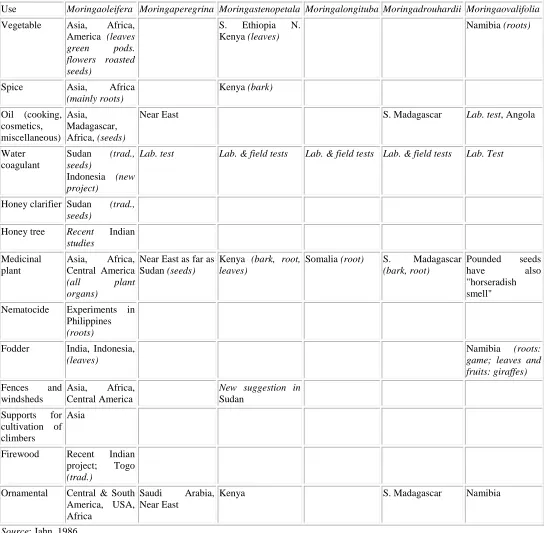
Moringa trees though native in the sub-Himalayan tracts, it is widely cultivated in Africa, Central and South America, Sri Lanka, India, Mexico, Malaysia, Indonesia and the Philippines (Anwar and Bhanger, 2003). According to Muluvi et al (1999), the Moringa tree wide natural spread in the world and introduced to Africa from India where it used as a health supplement and it was originally an ornamental tree in the Sudan, planted during British rule in the alleys along the Nile, public parks, and the gardens of foreigners. It seems likely that the Arab women of Sudan discovered this remarkable clarifier tree (Jahn, 1986). Table (1) illustrates the uses of different moriga species at different part of the warld.
V. GROWING MORINGA
Moringa planted by direct seeding, transplanting, or using hard stem cuttings. Direct seeding is preferred when plenty of seed is available and labor is limited Transplanting allows flexibility in field planting but requires extra labor and cost in raising seedlings, Stem cuttings are used when the availability of seed is limited but labor is plentiful (pM.C. Palada and L.C. Chang 2003). Transplanting entails collection of seeds from the tree, development of plantlets in the greenhouse for two to three months and transplantation of mature stems (1-1.5 m long) to the main fields (chumark et al, 2008(.Moringaoleifera is easily established by seed and no seed treatment is required (chumark et al, 2008). The rapidly germinating seedlings, can reach 5 m in one year if sheltered from drying winds and provided with enough water, however it normally cut back annually to one meter or less and allowed to regrow, so that pods and leaves remain within arm's reach (Shen et al 2006). Plants rose from 1 m cuttings beat pods from the second year of growth onwards, with maximum production at four to five years. An individual tree can yield 50 to 70 kg of pods in one year (Shen et al 2006). Moringa is an ideal tree for Accompanying/ Inter-row crops and agro-forestry uses, as the branches can be easily trimmed to regulate shade effects; It,s open crown allows plenty of sunlight to reach under-story crops often garden vegetables that benefit from some shading. Frequent pruning, lopping, coppicing or pollarding will increase and maintain leaf production. Moringa will sprout back repeatedly and vigorously when lope or pollard (chumark et al 2008) it is best to keep trees at a height that facilitates leaf harvesting. The leaves are attractive to all livestock however, so Limitation (Chen et al 2006) though quite tolerant to drought, the tree is deciduous, and it loses most of its leaves in periods of mended water-stress and susceptible to breakage in high winds. (pM.C. Palada and L.C. Chang 2003) Moringa is relatively short-lived reaching only 20 years on average (vonMaydell, 1986) it is so easy to establish, however, this limitation does not discourage cultivation of this very useful and adaptable tree
VI. USES AND NUTRITIONAL BENEFIT
Every part of the Moringa tree used as medicine and food commodity, which has received enormous attention as the ‘natural nutrition of the tropic’. According to Jed, et .al (2005) and Anwar et al (.2005), Moringa trees have been used to combat malnutrition especially among infants and breastfeeding woman in many developing countries, particularly in India, Pakistan, the Philippines, Hawaii and many parts of Africa. Elkhalif, et.al (2007) studies the nutritive values of the leaves of M. Olaeifera tree (Rawag) which is available in Sudan and the results showed that, moisture content was 74.42%, protein 16.7% ,fiber 3.5%, ash 8%, and oil 1.7%. In addition, the minerals content were determined and they found that the calcium content was 0.20 mg/100g, magnesium 0.13mg/100g, potassium 0.075mg/100g, and phosphorus 0.031 mg/100g.
The pod, seed and oil
The pods are often cooked and eaten like green beans. The whole seeds also ate green, roasted or powdered, and steamed in tea and curries (Fahey, 2005). The pods and seeds, often referred to as Moringa kernels, have a taste that ranges from sweet to bitter and are most popularly consumed after frying to get a peanut-like taste (Makkar et al, 1996). The pods are generally prepared in a similar fashion to green beans and have a slight asparagus taste. The pods are highly nutritious containing all the essential amino acids (Ramachandran et al., 1980). Although primarily utilized worldwide by the Asian Asia, Africa, America population as a vegetable, usage by other peoples is increasing. An international market already exists for both fresh and tinned pods (Jahn, 1986)
The leaves
Moringa leaf has been purported to be a good source of nutrition and a naturally organic health supplement that used in many therapeutic ways (McBurney et al, 2004; Fahey, 2005; DanMalam et al, 2001). The leaves are a very rich source of nutrients and contain the essential vitamins A, C and E. Table 2 illustrates the nutritional value of M. Oleifera leaves compare with other food (Fahey 2005).
nourishment. especially, in underdeveloped countries mothers suffering from malnutrition (McBurney et al, 2004; Lockett et al, 2000; WHO Readers Forum, 1999(. Kasolo et al (2011) stated that Moringa oleifera leaves were safe for human consumption because no serious side effects have been observed by the people using them. However, the toxicity of biologically active agents has been found to depend on the dose, they study the acute toxicity profile of Moringa oleifera leaves, they concluded that,
Moringa oleifera leaves extracts of ether, ethanol and water contains phytochemical compounds which when given orally as a single dose in 24 hours to mice were relatively non-toxic.
The stem and bark
Planted as a hedge in courtyards, Moringaoleifera provides wind protection, shade and support for climbing garden plants. One can easily understand the household/garden component. The wood of Moringa is relatively soft. Because of this, is n, t used in heavy construction. The wood is light, but provides a good fuel for cooking. It yields approximately 4,600 kcal/kg (F/FR.F-D, 1992). The fiber from the bark used to make ropes. (Jahn, 1981)
The flowers
The Moringa flowers also produce a good honey and Honey clarifier in India and Sudan (Jahn, 1984)
The root
The root tastes similar to horse radish and is a popular food in East Africa (; Sattaur, 1983; Jahn, 1986).
Plant growth enhancer
Lab experimentation had shown that Moringa spray had a wide range of beneficial effects on plant crop. Effects of spray indicated accelerated growth of young plants. Plants were firmer, more resistant to pests and disease, longer life-span, heavier roots, stems and leaves, produced more fruit, larger fruit, increase in yield 20-35%f even a fraction of these results could be reproduced in the field, it could be a great help in increasing food supplies for millions of hungry people (Fahey 2005)
Medicinal Benefits
A number of natural compounds have been isolated from M. oleifera leaves including fully acetylated glycosides bearing thiocarbamates, carbamates or nitriles (Faizi et al., 1995; Murakami et al, 1998). Glycosides containing isothiocyanates, malonates and flavonoids also identified and isolated in the leaves of the Moringa plant.(Faiziet al, 1995; Bennett et al, 2003; Miean et al, 2001).Plant glycosides can be used as treatments for cancer or chronic conditions such as high cholesterol and atherosclerosis (Chumark et al, 2008; Ghasi et al, 2000). Plant flavonoids are important to the diet becauseof their effects on human nutrition. These phyto chemicals can modulate lipid peroxidation involved in atherogenesis, carcinogenesis and thrombosis and other known properties of free radical scavenging or inhibition of hydrolytic and oxidative enzymes (phospholipidase A2, cyclooxygenase, lipooxygenase), shows strong antioxidant and anti-inflammatory activity (Siddhuraju et al, 2003). Numerous studies have indicated that flavonoids also have anti-carcinogenic, anti-viral and anti-estrogenic activities
(Havstee, 2002; Miean et al., 2001and Middletonet al., 2000). These identified bioactive compounds in the leaves of M. oleifera make this an excellentcandidate for nutritional and pharmaceutical supplementation.The World Health Organization (WHO) has been studying the use of M. oleifera for many decades as a low cost supplement enhancer in the poorest countries around the world (WHO Readers Forum, 1999). This organization has been promoting the use of this plant to help those countries suffering from malnutrition, which is one of the major causes of death worldwide. United Nations Food and Agriculture reported that one in twelve people worldwide is malnourished, including 160 million children under the age of five (United Nations Food and Agriculture Statistics, 2008).
Water Purifier
In parts of the world where clean drinking water is scarce, Moringa offers another crucial benefit such as the ability to purify water. Many countries use river water as their primary water source, but this water can contain harmful particles, bacteria and microorganisms. Water treatment plants are not available in many countries, but if there, is a Moringa tree nearby, river water users can still enjoy clean water seed from (Jahn and Dirar, 1979; Jahn, 1981). The Moringa tree harvested from the seedpod, crushed, and then put into vats of the water. Harmful particles bind to the seed and sink after an hour of treatment, and then clean water can remove from the top of the vat (Jahn 1986).
VII. CONCLUSION
These findings together demonstrate that moringa is an excellent multiuse plant Used to improve the health and nutrition of communities and appears to be a most promising candidate from which specific nutraceutical bioactive products could be developed. In Sudan moringa has a great potential to cultivate as an economically profitable crop and contribute in poverty elevation.
REFERENCES
[1] Abilgos, R. G.; Barba, C. V. C.(1999) Utilization of Malunggay (M. oleifera Lam.) leavesin rice (Orya sativa L.) flat noodle-production. Philippine J. Science. , 128, 79-84
[2] Anwar, F. Bhanger, M .I. 2003. Analytical characterization of Moringa oleifera seed oil grown in temperate regions of Pakistan. J Agric Food Chem 51: 6558-63.
[3] Anwar, F. Nadeem, R. Rashid, U, Kazi, T .G. Nadeem,M. (2005.) Mineral compositionofMoringaoleiferaleaves and pods from differentregions of Punjab, Pakistan. Asian J Plant Sci4(4):417-21.
[4] Bennett, R. N.; Mellon, F. A.; Foidl, N.; Pratt, J. H.; Dupoint, S. M.; Perkins, L.Kroon, P. A. Profiling(2003)Glucosinolates and phenolics in vegetative and reproductivetissues of the multi-purpose trees M. oleifera L. (Horseradish Tree) and Moringastenopetala L. J. Agri. Food Chem., 51, 3546-3553.
[5] Bulletin of the World Health Organization, Readers Forum.( 1999) [6] Chumark, P.; Khunawat, P.; Sanvarinda, Y.; Phornchirasilp, S.; Morales,
ISSN 2250-3153
[7] Dahiru, D.; Obnubiyi, J. A.; Umaru, H.A(2006). Phytochemical screening and antiulcerogenic effect of Moringa. African Journal of Traditional, Complimentaryand Alternatives Medicines. 2006, 3, 3, 70-57
[8] DanMalam, H. U.; Abubakar, Z.; Katsayal, U. A.(2001)Pharmacognostic studies on theleaves of Moringaoleifera. Nigerian Journal of Natural Product and Medicine5,45-49.
[9] Dongmeza, E.; Siddhuraju, P.; Francis, G.; Becker, K.(2006) Effects of dehydratedmethanol extracted Moringa (Moringaoleifera Lam.) leaves and three of itsfractions on growth performance and feed nutrient assimilation in Nile tilapia(Oreochromisniloticus (L.)). Aquaculture., 261, 1, 407-422. [10] Elkhalifa AO, Ahmed SA, Adam S. 2007.Nutritional evaluation of
MoringaOleiferaleavesand extracts. Ahfad Journal 24: 113 -22.
[11] Fahey J. W.(2005) M. oleifera: A Review of the Medical Evidence for Its Nutritional,Therapeutic, and Prophylactic properties.Part 1. Trees for Life Journal, 1:5
[12] Faizi, S.; Siddiqui, B. S.; Saleem, R.; Siddiqui S.; Aftab K.; and Giliani A.H.(1995)Fullyacetylatedcarbamate and hypotensive thiocarbamate glycosides from M. oleifera.J. Phytochemistry., 38, 957-963.
[13] F/FRED.1992. Forestry/Fuelwood Research and Development Project. Growing Multipurpose Trees on Snlall Farms.Bangkok, Thailand: WinrocInternational. 195 + ixpp(including 41 spec http://agrss.sherman.hawaii.edu/onfarm/tree/tree0012.html
[14] Ghasi, S.; Nwobodo, E.; and Ofili, J. O.(2000); Hypocholesterolemic effects of crudeextracts of leaf of M. oleifera Lam in high-fat diet fed wistar rats. J.Ethnopharmacology. 0, 69, 21-25
[15] Havsteen, B.H.(2002) The biochemistry and medical significance of the flavonoids.Pharmacol.andTher., 96, 67–202.
[16] Iqbal, S.; Bhanger,(2006) M. I. Effect of season and production location on antioxidantactivity of Moringaoleifera leaves grown in Pakistan. J. of Food Comp. and Anal.19,544-551
[17] Kasolo, J.N.; Bimenya, G.S.; Okwi, A.L.; Othieno, E.M.; Ogwal-Okeng, J.W. (2011). Acute toxicity evaluation of Moringa oleifera leaves extracts of ethanol and water in mice. Africa Journal of Animal and Biomedical Sciences 6(1), 40-44
[18] Lockett, C. T.; Calvert, C. C.; Grivetti L. E(2000). Energy and micronutrient compositionof dietary and medicinal wild plants consumed during drought. Study of ruralFulani, northeastern Nigeria. Int. J. Food Sci. Nutr., 51, 195-208
[19] Makkar, H. P. S.; Becker, K. (1996)Nutrional value and whole and ethanol antinutritionalcomponentsofextractedMoringaoleifera leaves. Animal Feed Science Technology.63,211-228
[20] Manzoor,M.,F.Anwar,T.TIqbal(2007)physic-chemical characterization of moringaconcanensis seed oil.j.AmOilchem .Soc 84:413-419
[21] McBurney, R. P. H.; Griffin, C.; Paul, A. A.; Greenberg, D. C.(2004) The nutritionalcomposition of African wild food plants: from compilation to utilization. Journalof Food Composition and Analysis.17, 277-289. [22] Middleton Jr., E.; Kandaswami, C.; Theoharides, T.C(2000). The effects of
plantflavonoids on mammalian cells: implications for inflammation, heart disease, andcancer. Pharmacological Reviews., 52, 673–751.
[23] Miean, H. K.; Mohamed, S. (2001)Flavonoid (Myricetin, Quercetin, Kaempferol, Luteolin, and Apigenin) Content of Edible Topical Plants.J. Agri. Food Chem49,3106-3112.
[24] Muluvi G.M.; Sprent J.I.; Soranzo N.; Provan J.; Odee D.; Folklard G.; McNicolJ.W.; and Powell W(1999). Amplified fragment length polymorphism (AFLP) analysis ofgenetic variation in M. oleifera Lam. J. of Mol. Ecol., 8, 463-470.
[25] Palada, M.C.( 1996). Moringa (Moringaoleifera Lam.): A versatile tree crop with horticultural potential in the subtropical United States. HortScience, 31(5): 794-797.
[26] Sánchez-Machado, D. I.; Lopez-Cervantes, J.; Rios Vasquez, N.J.(2006) High performance liquid chromatography method to measure α- and γ-tocopherol in leaves, flowers and fresh beans from M. oleifera. J. Chromatogr. A., 1105, 1-2,111-114
[27] Sarwatt, S. V.; Kapange, S. S.; Kakengi A. M. V.(2002) Substituting sunflower seed-cakewithMoringaoleifera leaves as a supplemental goat feed in TanzaniaAgroforestrySystems., 56, 3, 241-247
[28] Sattaur, O(1983, The light of the village. New Sci., 100 (15 December): 830-32.http://savegaia.blogspot.com/2005/06/wondertree-100-facts-Moringa-fact-04.htmlz
[29] Shen, D.; Wu, Q.; Sciarappa, W. J.; Lavoie, E.J.; Simon, J. E. An analytical surveyofisoflavones in Tofu-type soybeans cultivated in North America. 2006. New Useand Natural plant Products Program, Department of Plant Biology anPathology, School of Environmental and Biological Sciences, RutgersUniversitNew Brunswick, New Jersey 08901, USA
[30] Siddhuraju, P.; Becker, K.(2003) Antioxidant properities of various solvent extracts oftotal phenolic constituents from three different agroclimatic origins of drumsticktree (M. oleiferaAgric. Food Chem. 51, 2144-2155 [31] Smolin, L. A. Grosvenor, M. B 920070.Nutrition: Science & Application. [32] Soliva, C.R.; Kreuzer, M.; Foidl, N.; Foidl G.; Machmüller, A.; Hess,
H.D(2005). Feedingvalue of whole and extracted Moringaoleifera leaves for ruminants their effects onruminal fermentation in vitro. Anim. Feed Sci. Technol., 118, 47-62
[33] Jed W. Fahey. ( 2005) Moringaoleifera: Areview of the medical evidence for its nutritional,therapeutic, and prophylactic properties. Part 1.Trees for Life J 1: 5-20.
[34] Jahn, S.A&Dirar.H..( 1979,)Studies on natural coagulants in the Sudan, with special reference to Moringaoleifera seeds. Water (5): 90-97. [35] Jahn, S A.(1981, )Traditional water purification in tropical developing
countries: existing methods and potential application. Eschborn, Fed. Rep. Germany, Deutsche GesellschaftfürTechnischeZusammenarbeit (GTZ). Publ. No. 117.
[36] Jahn,S.A. (1984) Effectiveness of traditional flocculants as primary coagulants and coagulant aids for the treatment of tropical raw water with more than a thousand-fold fluctuation in turbidity. Water Supply, 2 (3/4), Special Subject 6, 8-10.
[37] Jahn, S.A.(1986)Proper use of African natural coagulants for rural water supplies: research in the Sudan and a guide for new projects.Eschborn, Fed. Rep. Germany, GTZ (in press
[38] Ramachandran, C; Peter, K.V. and Gopalakrishnan, P.K. (1980).Drumstick (MoringaOleifera) multipurpose Indian vegetable. Economic Botany, 34, 276-283.
[39] United Nation World food programe interactive Hunger Map (2008)www.wfp.org
[40] vonMaydell, H.J. 1986. Trees and shrubs of the Sahel, their characteristics and uses. Deutsche Gesellschaft fur TechnischeZusammenarheit (GTZ). FederalRepublic of Germany. pp. 334-337.
AUTHORS
First Author – Fatima Al Gunaid Hassan, Assistance Professor
Field: Natural Resources, Environmental Science Faculty of Agriculture and Natural Resources, Forestry and Range Sciences Department, University of Bakht Er Ruda Ministry of Higher Education and Scientific Research Sudan White Nile state (AD Duwem), Cell phone 00249911633434 (Email:
Second Author – Muna Abdalla Ibrahim, Food Science and
www.ijsrp.org
Table (1): Uses and locations of the most important Moringa species
Use Moringaoleifera Moringaperegrina Moringastenopetala Moringalongituba Moringadrouhardii Moringaovalifolia
Vegetable Asia, Africa, America (leaves
green pods.
flowers roasted seeds)
S. Ethiopia N. Kenya (leaves)
Namibia (roots)
Spice Asia, Africa
(mainly roots)
Kenya (bark)
Oil (cooking, cosmetics, miscellaneous)
Asia, Madagascar, Africa, (seeds)
Near East S. Madagascar Lab. test, Angola
Water coagulant
Sudan (trad., seeds)
Indonesia (new project)
Lab. test Lab. & field tests Lab. & field tests Lab. & field tests Lab. Test
Honey clarifier Sudan (trad., seeds)
Honey tree Recent Indian
studies
Medicinal plant
Asia, Africa, Central America
(all plant
organs)
Near East as far as Sudan (seeds)
Kenya (bark, root, leaves)
Somalia (root) S. Madagascar
(bark, root)
Pounded seeds have also "horseradish smell"
Nematocide Experiments in Philippines
(roots)
Fodder India, Indonesia,
(leaves)
Namibia (roots: game; leaves and fruits: giraffes)
Fences and windsheds
Asia, Africa, Central America
New suggestion in
Sudan
Supports for cultivation of climbers
Asia
Firewood Recent Indian project; Togo
(trad.)
Ornamental Central & South America, USA, Africa
Saudi Arabia, Near East
Kenya S. Madagascar Namibia
[image:5.612.35.579.78.611.2]