A review of camera trapping for
conservation behaviour research
Caravaggi, A, Banks, PB, Burton, AC, Finlay, CMV, Haswell, PM, Hayward, MW,
Rowcliffe, MJ, Wood, M, Pettorelli, N and Sollmann, R
http://dx.doi.org/10.1002/rse2.48
Title
A review of camera trapping for conservation behaviour research
Authors
Caravaggi, A, Banks, PB, Burton, AC, Finlay, CMV, Haswell, PM,
Hayward, MW, Rowcliffe, MJ, Wood, M, Pettorelli, N and Sollmann, R
Type
Article
URL
This version is available at: http://usir.salford.ac.uk/id/eprint/42873/
Published Date
2017
USIR is a digital collection of the research output of the University of Salford. Where copyright
permits, full text material held in the repository is made freely available online and can be read,
downloaded and copied for noncommercial private study or research purposes. Please check the
manuscript for any further copyright restrictions.
A review of camera trapping for conservation behaviour
research
Anthony Caravaggi1 , Peter B. Banks2, A Cole Burton3, Caroline M. V. Finlay4, Peter M. Haswell5 , Matt W. Hayward5,6, Marcus J. Rowcliffe7& Mike D. Wood8
1School of Biological Sciences, Queen’s University Belfast, Belfast BT9 7BL, United Kingdom
2School of Life and Environmental Sciences, The University of Sydney, Sydney, New South Wales 2006
3Department of Forest Resources Management, University of British Columbia, 2215-2424 Main Mall, Vancouver, British Columbia, Canada V6T 1Z4 4Ulster Wildlife, McClelland House, 10 Heron Road, Belfast BT3 9LE, United Kingdom
5School of Biological Sciences, Bangor University, Bangor, Gwynedd LL57 2UW, United Kingdom
6Centre for African Wildlife Ecology, Nelson Mandela University, Port Elizabeth 6031 South Africa; and Centre for African Wildlife Ecology,
University of Pretoria, Pretoria 0001,South Africa
7ZSL Institute of Zoology, Regent’s Park, London NW 4RY,United Kingdom
8School of Environment & Life Sciences, University of Salford, Manchester M5 4WT, United Kingdom
Keywords
Anthropogenic impacts, behavioural indicators, ethology, management, monitoring, remote sensing
Correspondence
Anthony Caravaggi, School of Biological Sciences, Queen’s University Belfast, Belfast BT9 7BL, United Kingdom. Tel: +44 (0)28 9097 5787; Fax: +44 (0)28 9097 5877; E-mail: [email protected]
Funding Information
The contribution of M.D. Wood was supported by the TREE project (www.ceh.ac. uk/TREE) funded by the Natural Environment Research Council (NERC), Environment Agency and Radioactive Waste Management Limited. The contributions of C.M.V. Finlay were supported by the Red Squirrels United project (http://www.redsquirrelsunited.org.uk/) funded by EU Life and Heritage Lottery Fund.
Editor: Nathalie Pettorelli Associate Editor: Rahel Sollmann
Received: 30 December 2016; Revised: 22 April 2017; Accepted: 25 April 2017
doi: 10.1002/rse2.48
Abstract
An understanding of animal behaviour is important if conservation initiatives are to be effective. However, quantifying the behaviour of wild animals presents significant challenges. Remote-sensing camera traps are becoming increasingly popular survey instruments that have been used to non-invasively study a vari-ety of animal behaviours, yielding key insights into behavioural repertoires. They are well suited to ethological studies and provide considerable opportuni-ties for generating conservation-relevant behavioural data if novel and robust methodological and analytical solutions can be developed. This paper reviews the current state of camera-trap-based ethological studies, describes new and emerging directions in camera-based conservation behaviour, and highlights a number of limitations and considerations of particular relevance for camera-based studies. Three promising areas of study are discussed: (1) documenting anthropogenic impacts on behaviour; (2) incorporating behavioural responses into management planning and (3) using behavioural indicators such as giving up densities and daily activity patterns. We emphasize the importance of reporting methodological details, utilizing emerging camera trap metadata stan-dards and central data repositories for facilitating reproducibility, comparison and synthesis across studies. Behavioural studies using camera traps are in their infancy; the full potential of the technology is as yet unrealized. Researchers are encouraged to embrace conservation-driven hypotheses in order to meet future challenges and improve the efficacy of conservation and management processes.
Introduction
Animal behaviour is an important component of conser-vation biology (Berger-Tal et al. 2011) and, hence, is of considerable interest to researchers and wildlife managers (Caro and Durant 1995). For example, behavioural
tool, with individual- and group-level responses used to evaluate the impacts of management (Morehouse et al. 2016). It is important, therefore, to incorporate behaviour into conservation planning; its omission limits efficacy of conservation actions and could lead to failure (Berger-Tal et al. 2011). The confluence of conservation biology and ethology has come to be known as ‘conservation beha-viour’, wherein conservation problems are addressed by the application of behavioural research (Blumstein and Fernandez-Juricic 2004; Berger-Tal et al. 2011).
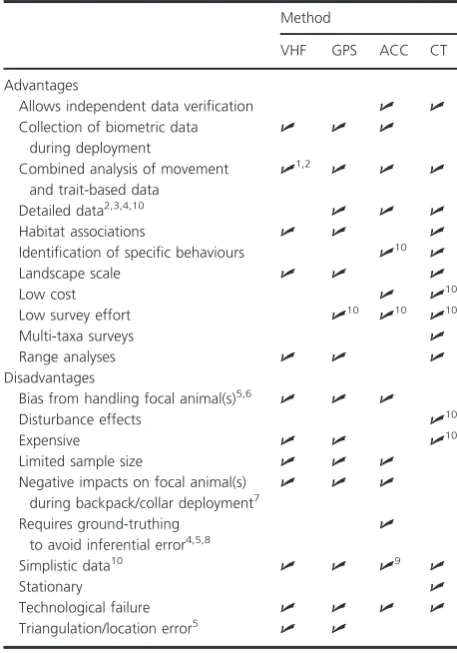
Quantifying the behaviour of wild animals presents sig-nificant challenges. Direct observation of animals can allow the evaluation of individual responses to environmental stimuli. Such studies may be weakened, however, by the influence of the human observer on focal animals (Nowak et al. 2014) and limited by small sample size and logistical constraints (Bridges and Noss 2011). Furthermore, only a limited number of species and habitats are amenable to direct, field-based observations (e.g. larger species and those that can be habituated; and in open and accessible habitats). Many of these have already been the focus of direct behavioural research (Schaller 1967; Kruuk 1972; Caro 1994) or may be atypical of more common habitats and can lead to inconsistent results (Laurenson 1994 vs. Mills and Mills 2014). In cases where focal animal(s) can-not easily be directly observed, the vast majority of field-based behavioural studies have used radio (VHF) or satel-lite (GPS) telemetry, activity sensors and/or biologgers (e.g. Lewis et al. 2002; Grignolio et al. 2004; Shamoun-Baranes et al. 2012; Bouten et al. 2013). The advantages and disad-vantages of these methods, which are currently the gold standards for obtaining spatiotemporal behavioural data, are summarized in Table 1, highlighting that while these devices can provide powerful insights, they also have signif-icant logistical and inferential limitations. Consequently, the suite of species that have had their behaviour quantified is biased and limited. New methods of obtaining beha-vioural data are, therefore, urgently required.
Camera traps (i.e. cameras that are remotely activated via an active or passive sensor; hereafter referred to as CTs) offer a reliable, minimally invasive, visual means of survey-ing wildlife that substantially reduces survey effort. CTs are increasingly popular in ecological studies (Burton et al. 2015; Rovero and Zimmermann 2016) and provide a wealth of information that is often of considerable conser-vation value (e.g. Ng et al. 2004; Di Bitetti et al. 2006; Car-avaggi et al. 2016). Continued technological improvements and decreasing equipment costs (Tobler et al. 2008a), com-bined with their demonstrated versatility (Rovero et al. 2013), mean that CTs will only continue to grow in popu-larity. CT data take the form of a still image or video of an individual or a group of individuals, of one or more spe-cies, which have been detected within the camera and
[image:3.595.309.538.93.420.2]location-specific zone of detection. These images can be linked with additional information, including the date, time and location at which the image was recorded. CT surveys have been effectively used to quantify species diver-sity (Tobler et al. 2008b), relative abundance (Carbone et al. 2001; Villette et al. 2017), and population parameters (Karanth et al. 2006; Rowcliffe et al. 2008); demonstrate site occupancy of rare or cryptic species (Linkie et al.
Table 1. Potential advantages and disadvantages of three conven-tional methods commonly used to collect animal behavioural data.
Method
VHF GPS ACC CT
Advantages
Allows independent data verification U U Collection of biometric data
during deployment
U U U
Combined analysis of movement and trait-based data
U1,2 U U U
Detailed data2,3,4,10 U U U
Habitat associations U U U Identification of specific behaviours U10 U
Landscape scale U U U
Low cost U U10
Low survey effort U10 U10 U10
Multi-taxa surveys U
Range analyses U U U
Disadvantages
Bias from handling focal animal(s)5,6 U U U
Disturbance effects U10
Expensive U U U10
Limited sample size U U U
Negative impacts on focal animal(s) during backpack/collar deployment7
U U U
Requires ground-truthing to avoid inferential error4,5,8
U
Simplistic data10 U U U9 U
Stationary U
Technological failure U U U U
Triangulation/location error5 U U
These are not necessarily contextual constants. For example, GPS accuracy is affected by vegetation density. Similarly, activity sensors may return detailed or simplistic data, depending on the device used. VHF, Radio telemetry tags; GPS, Global Positioning System tags; ACC, activity sensors; CT, camera traps (still images and video footage, equally).
1Grignolio et al. (2004). 2Lewis et al. (2002). 3Bouten et al. (2013). 4
Shamoun-Baranes et al. (2012).
5Bridges and Noss (2011). 6Wilson et al. (1986). 7
Barron et al. (2010).
8Ware et al. (2015). 9Coulombe et al. (2006).
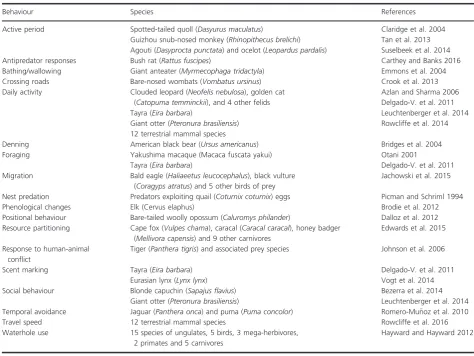
2007), and describe species replacement processes (Car-avaggi et al. 2016). CTs have also been used in behavioural studies (Maffei et al. 2005; Bridges and Noss 2011). In a recent review of 266 CT studies, Burton et al. (2015) char-acterized one-third as addressing behavioural questions (e.g. activity patterns, diet; Table 2).
In this paper, we review some of the recent literature on animal behaviour as elucidated by camera trapping studies. We then describe a number of common issues encountered by researchers undertaking such surveys and, finally, suggest future avenues of research that may be of considerable bene-fit to conservation initiatives. This review serves as a point of reference for researchers and practitioners undertaking conservation-oriented CT surveys of animal behaviour.
Current applications of camera traps
to animal behaviour
CTs are well suited to ethological studies, providing increasing opportunities to undertake extensive and
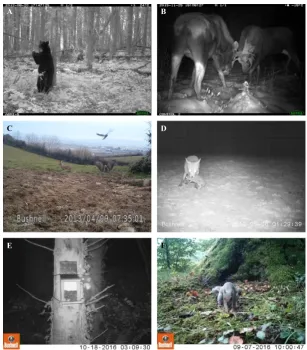
[image:4.595.55.530.346.702.2]detailed sampling of wild animal behavioural repertoires (see Fig. 1 and Table 2 for examples). The nature of the technology confers a number of important benefits. For example, CTs facilitate detailed studies of behaviours in species that were previously considered too small or elu-sive to be reliably observed in the field. CTs have been used to understand burrowing behaviour in <40 g northern hopping mice (Notomys aquilo; Diete et al. 2014) and olfactory communication in native and intro-duced <120 g rats (Rattus sp.; Heavener et al. 2014). Furthermore, CTs remove the need for a human obser-ver in situ, thereby reducing the potential for bias as a result of the observer’s influence on behaviour. The use of CTs may also lead to further reduction in observer bias as, while a human observer is required to review collected images and assign individual and/or species identities and behaviours, cameras allow independent verification and recurrent analysis of observations. This is in contrast to conventional field methods for docu-menting behaviour, where it is rarely possible for
Table 2. Examples of behavioural observations of wildlife via camera trapping. Species are ordered chronologically following the date of corre-sponding references.
Behaviour Species References
Active period Spotted-tailed quoll (Dasyurus maculatus) Claridge et al. 2004 Guizhou snub-nosed monkey (Rhinopithecus brelichi) Tan et al. 2013 Agouti (Dasyprocta punctata) and ocelot (Leopardus pardalis) Suselbeek et al. 2014 Antipredator responses Bush rat (Rattus fuscipes) Carthey and Banks 2016 Bathing/wallowing Giant anteater (Myrmecophaga tridactyla) Emmons et al. 2004 Crossing roads Bare-nosed wombats (Vombatus ursinus) Crook et al. 2013 Daily activity Clouded leopard (Neofelis nebulosa), golden cat
(Catopuma temminckii), and 4 other felids Tayra (Eira barbara)
Giant otter (Pteronura brasiliensis) 12 terrestrial mammal species
Azlan and Sharma 2006 Delgado-V. et al. 2011 Leuchtenberger et al. 2014 Rowcliffe et al. 2014
Denning American black bear (Ursus americanus) Bridges et al. 2004 Foraging Yakushima macaque (Macaca fuscata yakui)
Tayra (Eira barbara)
Otani 2001
Delgado-V. et al. 2011 Migration Bald eagle (Haliaeetus leucocephalus), black vulture
(Coragyps atratus) and 5 other birds of prey
Jachowski et al. 2015
Nest predation Predators exploiting quail (Coturnix coturnix) eggs Picman and Schriml 1994 Phenological changes Elk (Cervus elaphus) Brodie et al. 2012 Positional behaviour Bare-tailed woolly opossum (Caluromys philander) Dalloz et al. 2012 Resource partitioning Cape fox (Vulpes chama), caracal (Caracal caracal), honey badger
(Mellivora capensis) and 9 other carnivores
Edwards et al. 2015
Response to human-animal conflict
Tiger (Panthera tigris) and associated prey species Johnson et al. 2006
Scent marking Tayra (Eira barbara) Eurasian lynx (Lynx lynx)
Delgado-V. et al. 2011 Vogt et al. 2014 Social behaviour Blonde capuchin (Sapajus flavius)
Giant otter (Pteronura brasiliensis)
Bezerra et al. 2014 Leuchtenberger et al. 2014 Temporal avoidance Jaguar (Panthera onca) and puma (Puma concolor) Romero-Mu~noz et al. 2010 Travel speed 12 terrestrial mammal species Rowcliffe et al. 2016 Waterhole use 15 species of ungulates, 5 birds, 3 mega-herbivores,
2 primates and 5 carnivores
another scientist to independently verify observational data.
Many types of animal behaviours have been studied with CTs (Table 2), including foraging (Otani 2001), daily activity patterns (Tan et al. 2013), scent marking (Del-gado-V et al. 2011), movement (Ford et al. 2009), live-stock depredation (Bauer et al. 2005), and use of a variety of habitat features including dens/burrows (Clapham et al. 2014), urban habitats (Marks and Duncan 2009), corridors (LaPoint et al. 2013) and waterholes (Hayward and Hay-ward 2012). CT studies have often yielded key behavioural insights that may otherwise have remained unknown, many of which could be important to conservation pro-cesses. For example, studies investigating the efficacy of highway crossings in Banff National Park, Canada, described the effectiveness of under- and over-passes, an expensive and controversial means of impact mitigation
(Clevenger and Waltho 2000; Ford et al. 2009), which is now being duplicated in other parts of the world. Picman and Schriml (1994) observed the predators of quail ( Cotur-nix coturCotur-nix) nests in a variety of habitats, elucidating tem-poral variation and relative importance of each predatory species. The application of this method to the study of threatened avifauna has clear conservation benefits via the identification of direct impacts on egg success and the development of appropriate mitigation and monitoring techniques. Similarly, cameras provide more accurate post-hibernation den-emergence estimates for American black bears (Ursus americanus) than conventional methods, that is, den visits and radio telemetry (Bridges et al. 2004). Long-term monitoring of emergence relative to climate may yield important insights into the effects of climate change on black bears and other hibernating species (sensu Bridges and Noss 2011).
A B
C D
[image:5.595.145.453.278.629.2]E F
The majority of ethological CT studies conducted thus far have been primarily curiosity-driven, rather than being motivated by applied conservation-focussed hypotheses. This is not to say that a large number of these studies do not have conservation value. On the contrary, the conser-vation relevance of the data is often explicitly discussed. It is apparent, however, that there is an increasing need for conservation-driven studies. CTs are among the most promising and flexible tools available and we are only beginning to explore their potential.
Emerging directions in camera-based
conservation behaviour
The growth in popularity and application of CT surveys and novel solutions to non-behavioural questions of ani-mal ecology (e.g. Rowcliffe et al. 2008; Martin et al. 2015; Bowler et al. 2016) suggests that creative methodological and analytical solutions will be increasingly used to investi-gate animal behaviours. If these novel studies are to be developed, it is important that researchers strive for true experimental designs focussed on conservation behaviour. A particular strength of CT surveys is the potential for mul-tiple studies to be carried out concurrently (e.g. estimation of focal species population density and the species richness of the surveyed area). Thus, behaviour can be recorded alongside other important parameters, thereby facilitating insight into processes such as density-dependent beha-viours and responses to climate change. New approaches are also being developed to move beyond correlational approaches and incorporate CTs into manipulative experi-ments, such as measuring animal behavioural responses to introduced stimuli (e.g. predator calls; Suraci et al. 2016).
Berger-Tal et al. (2011) described three ways in which behavioural research can be of conservation benefit: (1) identifying the impact of anthropogenic environmental changes on behaviour; (2) considering behavioural aspects of conservation initiatives (‘behaviour-based management’); and (3) identifying behavioural indicators which are sugges-tive of changes in populations or the environment. We use this framework as a basis for our recommendations, below.
Anthropogenic impacts
An important area of conservation research lies in under-standing the influence of anthropogenic stressors on animal behaviours and predicting the resulting popula-tion-level responses in order to inform management prac-tices. Stressors such as habitat fragmentation, disturbance, the creation of ecological traps and the introduction of non-native species can have significant effects on beha-viour (Robertson and Hutto 2006) and, hence, fitness (Berger-Tal et al. 2011). For example, animals may
exhibit increasing wariness in areas of greater disturbance (Stewart et al. 2016) and may change their daily activity patterns in close proximity to human populations (Carter et al. 2012). While anthropogenic impacts are generally negative, some species show benefits such as increased occupancy in fragmented landscapes (Fleschutz et al. 2016), or using human activity to evade apex predators (Muhly et al. 2011; Steyaert et al. 2016). Impacts on one species may also have spillover effects on the wider eco-logical community (Wright et al. 2010; Clinchy et al. 2016).
Habitat fragmentation, the division of large, connected habitats into small, isolated fragments separated by dis-similar habitats, is a major conservation issue (Haddad et al. 2015). Fragmentation has a wide range of potential impacts on species and ecosystems (e.g. via edge effects, patch size, shape and complexity and distance from other patches; Fahrig 2003), and these impacts may be mediated through effects on animal behaviour. CTs provide new opportunities for documenting behavioural responses to fragmentation. For example, the activity patterns of nine-banded armadillos (Dasypus novemcinctus) varied in asso-ciation with forest patch size, among other factors, while patch time since isolation was predictive of agouti (Dasyprocta leporina) activity (Norris et al. 2010).
The disruption of dispersal behaviour can lead to the endangerment and potential extinction of isolated popula-tions by various mechanisms, including changes to genetic diversity and structure (Keyghobadi 2007), stochastic threats (Fischer and Lindenmayer 2007) and long-term displacement effects (Ewers and Didham 2005). Using CTs to document dispersal behaviour can improve understanding of responses to movement disruption (Blumstein and Fernandez-Juricic 2004) and inform design and implementation of mitigation measures that encourage dispersal. Individual-level analysis of dispersal is potentially possible for animals with individually identi-fiable markings or tags, although designing such a study may be challenging as dispersal routes and, hence, appro-priate locations for CT deployment may not be known a priori. Inferences about dispersal, however, can also be drawn without individual identification. For example, cameras are well suited to quantifying use of presumed dispersal routes or movement corridors, including mitiga-tions designed to promote connectivity (e.g. highway crossings; Clevenger and Waltho 2005; Ford et al. 2009). CTs can also be used to identify colonization of new habitat patches (including range expansions or species invasions) and parameterize landscape connectivity models (Brodie et al. 2015).
development. Local temperature, precipitation and humidity can readily be recorded, and phenocams can be used to document vegetation and environmental changes (Brown et al. 2016). Collecting such information along-side CT-based behavioural data will allow us to increase our understanding of how animals respond to changing conditions at both large (population) and small (localities within home ranges) spatial scales. This is particularly important given the rapid changes that are predicted to occur under climate change.
Behaviour-based management
Berger-Tal et al. (2011) suggested that behaviour-sensitive management and behavioural modification are two key pathways through which ethology can inform active man-agement for conservation. The former considers animal behaviour in the design of reserves and corridors, plan-ning species reintroductions and translocations, and epi-demiology with the goal of stabilizing or increasing threatened populations or controlling pest or invasive species. Behavioural modification focuses on changing or preserving key behaviours within a focal population. CT surveys have the potential to inform both of these areas.
Considering social dynamics is one important area in which CT surveys can inform behaviour-sensitive manage-ment. Social species, that is, those that interact and/or live together, often exhibit complex inter-group relationships and social structure (Rowell 1966; Creel et al. 1997; Archie et al. 2006; Wolf et al. 2007; Wey et al. 2008), that are susceptible to rapid change via the social displacement or death of one or more individuals. This can have severe consequences for the species and/or their environment (e.g. Nyakaana et al. 2001). Social Network Analysis (SNA) facilitates the study of relationships between nodes (i.e. individuals), within networks (i.e. social groups; Sueur et al. 2011). The methodology is increasingly used to study animal behaviour (Lusseau et al. 2006; Whitehead 2008; Voelkl and Kasper 2009; Jacoby and Freeman 2016). Examples of SNA demonstrating a direct benefit to con-servation, however, are few. SNA studies are limited in that they require the reliable identification of individuals and, hence, are only applicable with CTs where animals exhibit individual characteristics or markings, or where marks (e.g. tags) can be attached. However, placing cam-eras in areas frequented by social groups such as feeding or resting sites, and with a sufficient number of units, could yield a considerable amount of important data for behaviour-sensitive management. Such site-specific studies have some limitations and incur biases that require evalu-ation. For example, individuals may not be equally detect-able, or full groups may not be observed. Furthermore, it would be difficult to account for behaviours and social
interactions which occur while away from the focal site. However, SNA analyses do not require constant observa-tion of all group members to be effective (see Jacoby and Freeman 2016). Assessing potential bias with calibration by direct observation or other methods and placing obser-vations in appropriate contexts is, therefore, important.
SNA has the potential to increase our understanding of disease or pathogen transmission and individual or group vulnerability (Krause et al. 2007), an issue of particular relevance to the conservation of species which are suscep-tible to outbreaks (e.g. Hamede et al. 2009). SNA studies have demonstrated that the removal of certain individuals (e.g. via hunting) can have a considerable effect on the stability of the social network (e.g. Flack et al. 2006), thus demonstrating their potential utility in elucidating the impacts of the bushmeat trade on inter- and intra-group dynamics in primates, for example. Furthermore, SNA has implications for reintroduction programmes, where the (re)construction of cohesive social structures in a cap-tive setting would be necessary for the return of the focal species to the wild (Abell et al. 2013). Studies of the rela-tionships between individuals, therefore, can help us to understand how social behaviour is influenced by a vari-ety of factors and, hence, provide an additional means by which practitioners can build an evidence base to address conservation questions.
CTs can also be applied to studies of behavioural mod-ification. For example, Davies et al. (2016) used CTs to investigate responses of African herbivores to changes in predation risk resulting from recently reintroduced lions. Cameras are also well suited to monitoring animal responses to conflict mitigation measures and have been used to demonstrate the efficacy of bees as a deterrant of crop-raiding elephants (Ngama et al. 2016).
Behavioural indicators
The ways in which animals adapt their foraging behaviour in human-impacted environments have important impli-cations for their abilities to adapt and persist under increasing pressures. Behavioural indicators can be used to assess the state of animals and the environments they inhabit, highlighting important conservation issues such as population decline or habitat degradation, or being used to monitor the efficacy of management (Berger-Tal et al. 2011). Behaviour effectively acts as an early-warning system, indicating changes to processes before they are evident through, for example, population decline.
and forage quality (Hayward et al. 2015), plant toxins (Emerson and Brown 2015), competition (Brown et al. 1997) and predator–prey dynamics (Andruskiw et al. 2008). It is also central to describing the ‘landscape of fear’ (i.e. relative levels of predation risk within an area of use) of an animal and its habitat preferences, which are direct behavioural indicators with significant conservation implications (Kotler et al. 2016). CTs offer a relatively reliable way of using the GUD technique to ask more in-depth questions of conservation relevance. For example, CTs have been used to calculate GUDs for multiple spe-cies (Lerman et al. 2012), examine (Mella et al. 2015) and differentiate individual versus group foraging habits (Carthey and Banks 2015). These observations can then be used to inform the development of hypotheses relating to the broader effects of local food and predator abun-dance, predation pressure and inter- and intra-specific competition. With advancements in CT technology and creative experimental design, a wealth of conservation-focussed GUD applications are now possible.
A key strength of CTs lies in collecting data on multi-ple species, either as bycatch in a focal study, or as part of a specific multi-taxa investigation. Accordingly, there has been an increasing focus on assessing species interac-tions and niche partitioning via comparisons of co-occur-rence and activity patterns (de Almeida Jacomo et al. 2004; Kukielka et al. 2013; Farris et al. 2014; Wang et al. 2015; Bu et al. 2016; Cusack et al. 2016; Sweitzer and Furnas 2016). Animal activity patterns are shaped by a number of factors, including foraging efficiency (Lode 1995), predator/prey activity (Middleton et al. 2013), photoperiodism (McElhinny et al. 1997) and competition (Rychlik 2005). Conservation-focussed studies using these methodologies, however, are scarce. Changes in the way species interact and use the landscape may be indicative of responses to changing environmental pressures and, hence, can direct development of early conservation strategies. For example, brown bears (Ursus arctos; Ordiz et al. 2013) altered their movement patterns, and wolveri-nes (Gulo gulo; Stewart et al. 2016) behaved differently when faced with human disturbance, potentially impact-ing their ecosystem roles and, hence, associated species and habitats. Disturbance of the activity patterns of one or more species in a dynamic interaction, particularly ecological competitors or predators and prey, can, there-fore, be interpreted as indicative of environmental changes and, hence, suggest additional lines of enquiry and highlight areas of conservation concern.
Scaling-up
Cameras can be used to monitor large-scale biodiversity conservation processes (O’Brien et al. 2010; Ahumada
et al. 2013) and investigate animal behaviour on a land-scape scale. Scaling-up CT networks would provide stron-ger, larger-scale inferences on spatiotemporal variation in behaviours (Steenweg et al. 2016). Studies conducted on a broader scale have inherent limitations, however, that are not necessarily considerations for more localized investiga-tions. The trade-off between the scale of investigation and camera array density has spatiotemporal implications which must be considered when designing a study, formu-lating hypotheses and deriving inferences from resultant data. Broad-scale studies are also ostensibly limited by the number of researchers available to place and check cam-eras and process data. The recruitment of volunteers (i.e. citizen scientists), however, offers a means of expanding the scope of research (Cohn 2008), greatly expanding spa-tial coverage and delivering a wealth of temporally compa-rable data (McShea et al. 2016). Emerging large-scale camera monitoring initiatives, such as Snapshot Serengeti (www.snapshotserengeti.org; Swanson et al. 2015) and Wildcam Gorongosa (www.wildcamgorongosa.org), demonstrate the benefits of this approach. CT projects uti-lizing citizen science have the potential to deliver a sub-stantial amount of behavioural data (McShea et al. 2016) and inform conservation processes. However, few large-scale studies utilizing citizen science involve behavioural analyses. CT video data can produce vast amounts of video footage, but the extraction of key behavioural data from video footage is time consuming, imposing a major obstacle. Crowdsourcing video interpretations can over-come this limitation, however, and the use of robust etho-grams, simple training regimes and blinding of observers to treatments can assuage concerns about the reliability of citizen science interpretations (e.g. Carthey 2013).
Synthesizing across projects offers another means of conducting broader analyses (Steenweg et al. 2016). We recommend that researchers embrace emerging CT meta-data standards and associated opportunities to use com-mon data repositories such as Wildlife Insights (www. wildlifeinsights.org; Forrester et al. 2016), thus increasing the potential for the synthesis of inferences across large scales. The value of current data repositories is reduced, however, by their reliance on static images and omission of video. Expenses notwithstanding, it is in the interests of conservation behaviour researchers to establish a digital repository for video data.
Relevant limitations and
considerations
(Clapham et al. 2014), sex (Bezerra et al. 2014) or, indeed, identify individuals (Karanth et al. 2006; Zheng et al. 2016), the collection of biometric, genetic and other data of interest requires the application of supplementary or alternative methodologies. Furthermore, CTs are fre-quently considered to be non-intrusive, causing little to no disturbance. However, while the sound produced by recording units is largely inaudible to humans, it is fre-quently detected by wildlife (Meek et al. 2014a). Similarly, CTs which utilize visible light (as opposed to infra-red) increase the chances of the camera being detected by ani-mals, potentially disrupting their natural behaviour (Meek et al. 2016a).
Camera failure, although rare, can result in the loss of large quantities of data. Similarly, camera theft is becom-ing increasbecom-ingly common (Meek et al. 2016b). It is, there-fore, necessary to balance the frequency of visits to maintain CTs with risk of data loss. To accommodate this, it is advisable to build some redundancy into the study design, such as the use of cameras that allow the transmission of images via Global Packet Radio Service (GRPS) and/or Wi-Fi and can, therefore, facilitate remote data collection and inform the timing of maintenance visits.
Researchers utilizing CTs have the option of recording data in the form of still images or video footage. In many cases, still images are adequate; it is possible to derive important behavioural data from them and, indeed, the format offers some obvious benefits. For example, still images require considerably less memory than video footage (Glen et al. 2013) and, hence, may be more suitable for studies which require CTs to be deployed, without intervention, for a prolonged period of time. However, similar capture success rates can be achieved with either format (Glen et al. 2013) and the majority of operational limitations apply equally to both. For example, some cameras have a slow trigger time meaning that initial behaviours, which might be the most important in terms of measuring detection of a stimulus (rather than the response), can be missed. Fur-thermore, many cameras offer only a limited number of high-speed ‘burst’ (i.e. sequentially captured) images or length of video (e.g. 60 sec), requiring the camera to be retriggered to continue the capture of the behaviours and, hence, creating gaps in the observation. However, video footage opens up new opportunities, for example, observing interactions at focal sites, or measuring the duration of behavioural bouts. While both formats can be effectively used in most of the applications described herein (SNA being the one exception, with video being preferred), videos are undoubtedly more informative and an important future direction for CT-based behavioural research.
Sampling the behaviours of small species can be par-ticularly challenging, with CTs typically designed for deer-sized game species (Weerakoon et al. 2014), a prob-lem that will require novel solutions. For example, flash-illuminated images are frequently obscured by overexpo-sure when close enough to small mammals to observe behaviour clearly, whereas at the correctly exposed dis-tance, animals can be too far away to reliably identify species or discern behaviours. Furthermore, understand-ing the reliability of camera surveys for addressunderstand-ing mul-ti-species objectives remains an important area of methodological research (see Burton et al. 2015). Multi-taxa studies also require careful planning to ensure that CTs are appropriately located and adequately spaced to maximize the chances of capturing a diverse species assemblage while meeting analytical assumptions such as independence of sampling sites. The choice and place-ment of cameras should, therefore, be dictated by the objectives of the study, the ecology of the study species, the statistical sampling framework and associated consid-erations.
An oft-repeated concern relates to study repeatability; specific details of study design (e.g. how survey sites were chosen, use of lures) and camera protocols (e.g. camera model, deployment details) are often lacking (Meek et al. 2014b; Burton et al. 2015). A number of factors influence the detection of individuals (see Burton et al. 2015), and sampling details may have important implications for analytical assumptions such as effective sampling area and site independence (Harmsen et al. 2010; Mccoy et al. 2011; du Preez et al. 2014; Newey et al. 2015). Compre-hensive methodological descriptions and utilization of emerging CT metadata standards (Forrester et al. 2016) are important for facilitating reproduction, comparison and synthesis across studies.
Finally, as with any survey method, observations from CTs are incomplete and may contain biases that affect inferences. As noted above, species and individuals may vary in their detectability by CTs according to attributes such as body size, movement speed, curiosity and wari-ness. Behaviours observed by CTs may also not always be representative of behaviours more generally. Thus it is incumbent upon researchers to remain vigilant for poten-tial biases and test CT-based inferences through compar-ison and calibration with more established ethological methods.
Conclusions
reporting of methodologies and metadata will facilitate broader ethological inferences on species’ behavioural responses to environmental change. The development and application of new techniques and analytical methods explicitly focussed on anthropogenic impacts, behaviour-based management and behavioural indicators would undoubtedly benefit conservation programmes. CTs are not a panacea, but they confer many benefits to research-ers and the divresearch-ersity of possible applications is gradually being realized. We hope that this paper will act as a cata-lyst, advancing the adoption of CT technology within conservation behaviour. It is important, therefore, that potentially profitable avenues of investigation are identi-fied and pursued if we are to maximize the generation of valuable data and, hence, improve the conservation out-look for the ever-increasing number of threatened or endangered species.
Acknowledgments
The authors thank the journal for their encouragement and support of this review and, specifically, the editor and reviewers for their valuable comments which strengthened the final manuscript. Authors are ordered alphabetically by surname, except for A. Caravaggi who conceived, orga-nized and compiled the manuscript. The contribution of M.D. Wood was supported by the TREE project (www.ce h.ac.uk/TREE) funded by the Natural Environment Research Council (NERC), Environment Agency and Radioactive Waste Management Limited. The contribu-tions of C.M.V. Finlay were supported by the Red Squir-rels United project (http://www.redsquirSquir-relsunited.org.uk/ ) funded by EU Life and Heritage Lottery Fund.
References
Abell, J., M. W. B. Kirzinger, Y. Gordon, J. Kirk, R. Koke^s, K. Lynas, B. Mandinyenya, et al. 2013. A social network analysis of social cohesion in a constructed pride: implications for ex situ reintroduction of the African lion (Panthera leo).PLoS ONE8, e82541.
Ahumada, J. A., J. Hurtado, and D. Lizcano. 2013. Monitoring the status and trends of tropical forest terrestrial vertebrate communities from camera trap data: a tool for
conservation.PLoS ONE8, e73707.
de Almeida Jacomo, A. T., L. Silveira, and J. A. F. Diniz-Filho. 2004. Niche separation between the maned wolf (Chrysocyon brachyurus), the crab-eating fox (Dusicyon thous) and the hoary fox (Dusicyon vetulus) in central Brazil.J. Zool.262, 99–106.
Andruskiw, M., J. M. Fryxell, I. D. Thompson, and J. A. Baker. 2008. Habitat-mediated variation in predation risk by the American marten.Ecology89, 2273–2280.
Archie, E. A., T. A. Morrison, C. A. H. Foley, C. J. Moss, and S. C. Alberts. 2006. Dominance rank relationships among wild female African elephants,Loxodonta africana.Anim. Behav.71, 117–127.
Azlan, J. M., and D. S. K. Sharma. 2006. The diversity and activity patterns of wild felids in a secondary forest in Peninsular Malaysia.Oryx40, 36.
Barron, D. G., J. D. Brawn, and P. J. Weatherhead. 2010. Meta-analysis of transmitter effects on avian behaviour and ecology: Meta-analysis of avian transmitter effects.Methods Ecol. Evol.1, 180–187.
Bauer, J. W., K. A. Logan, L. L. Sweanor, and W. M. Boyce. 2005. Scavenging behaviour in puma.The Southwestern Naturalist50, 466–471.
Berger-Tal, O., T. Polak, A. Oron, Y. Lubin, B. P. Kotler, and D. Saltz. 2011. Integrating animal behavior and
conservation biology: a conceptual framework.Behav. Ecol. 22, 236–239.
Bezerra, B. M., M. Bastos, A. Souto, M. P. Keasey, P. Eason, N. Schiel, et al. 2014. Camera trap observations of nonhabituated critically endangered wild blonde capuchins, Sapajus flavius (formerly Cebus flavius).Int. J. Primatol.35, 895–907. Blumstein, D. T., and E. Fernandez-Juricic. 2004. The
emergence of conservation behavior.Conserv. Biol.18, 1175–1177.
Bouten, W., E. W. Baaij, J. Shamoun-Baranes, and K. C. J. Camphuysen. 2013. A flexible GPS tracking system for studying bird behaviour at multiple scales.J. Ornithol.154, 571–580.
Bowler, M. T., Tobler M. W., Endress B. A., Gilmore M. P., and Anderson M. J., 2016. Estimating mammalian species richness and occupancy in tropical forest canopies with arboreal camera traps.Remote Sens. Ecology and Conserv. [online]. Available at: http://doi.wiley.com/10.1002/rse2.35 [accessed 7 December. 2016].
Bridges, A. S., and A. J. Noss. 2011. Behaviour and activity patterns. Pp. 57–69 in: A. F. O’Connell, J. D. Nichols, K. U. Karanth. eds.,Camera traps in animal ecology: methods and analyses. Springer, New York.
Bridges, A. S., M. R. Vaughan, and S. Klenzendorf. 2004. Seasonal variation in American black bear Ursus americanus activity patterns: quantification via remote photography. Wildlife Biol.10, 277–284.
Brodie, J., E. Post, F. Watson, and J. Berger. 2012. Climate change intensification of herbivore impacts on tree
recruitment.Proceed. Royal Soc. B: Biol. Sci.279, 1366–1370. Brodie, J. F., A. J. Giordano, B. Dickson, M. Hebblewhite, H.
Bernard, J. Mohd-Azlan, et al. 2015. Evaluating multispecies landscape connectivity in a threatened tropical mammal community: multispecies habitat corridors.Conserv. Biol.29, 122–132.
Brown, J. S., B. P. Kotler, and W. A. Mitchell. 1997.
Competition between birds and mammals: a comparison of giving-up densities between crested larks and gerbils.Evol. Ecol.11, 757–771.
Brown, T. B., K. R. Hultine, H. Steltzer, E. G. Denny, M. W. Denslow, J. Granados, et al. 2016. Using phenocams to monitor our changing Earth: toward a global phenocam network.Front. Ecol. Environ.14, 84–93.
Bu, H., F. Wang, W. J. McShea, Z. Lu, D. Wang, and S. Li. 2016. Spatial Co-Occurrence and Activity Patterns of Mesocarnivores in the Temperate Forests of Southwest China.PLoS ONE11, e0164271.
Burton, A. C., E. Neilson, D. Moreira, A. Ladle, R. Steenweg, J. T. Fisher, et al. 2015. Wildlife camera trapping: a review and recommendations for linking surveys to ecological processes.J. Appl. Ecol.52, 675–685.
Cant, M. A. 2000. Social control of reproduction in banded mongooses.Anim. Behav.59, 147–158.
Caravaggi, A., M. Zaccaroni, F. Riga, S. C. Schai-Braun, J. T. A. Dick, W. I. Montgomery, et al. 2016. An invasive-native mammalian species replacement process captured by camera trap survey random encounter models.Remote Sens. Ecology Conserv.2, 45–58.
Carbone, C., S. Christie, K. Conforti, T. Coulson, N. Franklin, J. R. Ginsberg, et al. 2001. The use of photographic rates to estimate densities of tigers and other cryptic mammals. Anim. Conserv.4, 75–79.
Caro, T. M. 1994.Cheetahs of the Serengeti Plains: group living in an asocial species. University of Chicago Press, Chicago. Caro, T., and S. M. Durant. 1995. The importance of
behavioral ecology for conservation biology: examples from Serengeti carnivores. Pp. 451–472 in A. R. E. Sinclair and P. Arcese, eds.Serengeti II: Dynamics, Management, and Conservation of an Ecosystem. University of Chicago, Chicago.
Carter, N. H., B. K. Shrestha, J. B. Karki, N. M. B. Pradhan, and J. Liu. 2012. Coexistence between wildlife and humans at fine spatial scales.Proc. Natl Acad. Sci.109, 15360–15365. Carthey, A. J. R., 2013.Naivete, novelty and native status:
mismatched ecological interactions in the Australian environment. University of Sydney, Australia.
Carthey, A. J. R., and P. B. Banks. 2015. Foraging in groups affects giving-up densities: solo foragers quit sooner. Oecologia178, 707–713.
Carthey, A. J. R., and P. B. Banks. 2016. Naivete is not forever: responses of a vulnerable native rodent to its long term alien predators.Oikos125, 918–926.
Clapham, M., O. T. Nevin, A. D. Ramsey, and F. Rosell. 2014. Scent-marking investment and motor patterns are affected by the age and sex of wild brown bears.Anim. Behav.94, 107–116.
Claridge, A. W., G. Mifsud, J. Dawson, and M. J. Saxon. 2004. Use of infrared digital cameras to investigate the behaviour of cryptic species.Wildl. Res.31, 645–650.
Clevenger, A. P., and N. Waltho. 2000. Factors influencing the effectiveness of wildlife underpasses in Banff National Park, Alberta, Canada.Conserv. Biol.14, 47–56.
Clevenger, A. P., and N. Waltho. 2005. Performance indices to identify attributes of highway crossing structures facilitating movement of large mammals.Biol. Cons.121, 453–464. Clinchy, M., L. Y. Zanette, D. Roberts, J. P. Suraci, C. D.
Buesching, C. Newman, et al. 2016. Fear of the human ‘super predator’ far exceeds the fear of large carnivores in a model mesocarnivore.Behav. Ecol.27, 1826–1832.
Cohn, J. P. 2008. Citizen science: can volunteers do real research?Bioscience58, 192.
Coulombe, M., A. Masse, and S. C^ote. 2006. Quantification and accuracy of activity data measured with VHF and GPS telemetry.Wildl. Soc. Bull.34, 81–92.
Creel, S. 1997. Handling of African wild dogs and chronic stress: reply to East et al.Conserv. Biol.11, 1454–1456. Crook, N., S. C. Cairns, and K. Vernes. 2013. Bare-nosed
wombats (Vombatus ursinus) use drainage culverts to cross roads.Aust. Mammal.35, 23–29.
Cusack, J. J., et al. 2016. Revealing kleptoparasitic and predatory tendencies in an African mammal community using camera traps: a comparison of spatiotemporal approaches.Oikos. Available at: http://doi.wiley.com/10. 1111/oik.03403 (accessed: 18 December 2016).
Dalloz, M. F., D. Loretto, B. Papi, P. Cobra, and M. V. Vieira. 2012. Positional behaviour and tail use by the bare-tailed woolly opossumCaluromys philander(Didelphimorphia, Didelphidae).Mamm. Biol. - Zeitschrift f€ur S€augetierkunde 77, 307–313.
Davies, A. B., C. J. Tambling, G. I. H. Kerley, and G. P. Asner. 2016. Limited spatial response to direct predation risk by African herbivores following predator reintroduction.Ecol. Evol.6, 5728–5748.
Delgado-V., C. A., Arias Alzate A., Botero S., and S anchez-Londo~no J. D. 2011. Behaviour of theTayra Eira barbara near Medellın, Colombia: preliminary data from a video-capturing survey.Small Carnivore Conserv,44:19–21. Di Bitetti, M. S., A. Paviolo, and C. De Angelo. 2006. Density,
habitat use and activity patterns of ocelots (Leopardus pardalis) in the Atlantic Forest of Misiones, Argentina.J. Zool.270, 153–163.
Diete, R. L., P. D. Meek, C. R. Dickman, and L. K.-P. Leung. 2014. Burrowing behaviour of the northern hopping-mouse (Notomys aquilo): field observations.Aust. Mammal.36, 242–246.
Doerr, V. A. J., Barrett T., and Doerr E. D. 2011. Connectivity, dispersal behaviour and conservation under climate change: a response to Hodgson et al.: Connectivity and dispersal behaviour.J. Appl. Ecol.,48:143–147.
Emerson, S. E., and J. S. Brown. 2015. The influence of food chemistry on food-safety tradeoffs in samango monkeys.J. Mammal.96, 237–244.
Emmons, L. H., R. P. Flores, S. A. Alpirre, and M. J. Swarner. 2004. Bathing behavior of giant anteaters (Myrmecophaga tridactyla).Edentata6, 41–43.
Ewers, R. M., and R. K. Didham. 2005. Confounding factors in the detection of species responses to habitat
fragmentation.Biol. Rev.81, 117–142.
Fahrig, L. 2003. Effects of habitat fragmentation on biodiversity.Annu. Rev. Ecol. Evol. Syst.34, 487–515. Farris, Z. J., S. M. Karpanty, F. Ratelolahy, and M. J. Kelly.
2014. Predator–primate distribution, activity, and co-occurrence in relation to habitat and human activity across fragmented and contiguous forests in northeastern Madagascar.Int. J. Primatol.35, 859–880. Fischer, J., and D. B. Lindenmayer. 2007. Landscape
modification and habitat fragmentation: a synthesis.Glob. Ecol. Biogeogr.16, 265–280.
Flack, J. C., M. Girvan, F. B. M. de Waal, and D. C. Krakauer. 2006. Policing stabilizes construction of social niches in primates.Nature439, 426–429.
Fleschutz, M. M., N. Galvez, G. Pe’er, DaviesZ. G., K. Henle, and E. Sch€uttler. 2016. Response of a small felid of conservation concern to habitat fragmentation.Biodivers. Conserv.25, 1447–1463.
Ford, A. T., A. P. Clevenger, and A. Bennett. 2009. Comparison of methods of monitoring wildlife crossing-structures on highways.J. Wildl. Manage.73, 1213–1222. Forrester, T., T. O’Brien, E. Fegraus, P. Jansen, J. Palmer, R.
Kays, et al. 2016. An open standard for camera trap data. Biodiversity Data Journal4, e10197.
Glen, A. S., S. Cockburn, M. Nichols, J. Ekanayake, and B. Warburton. 2013. Optimising camera traps for monitoring small mammals.PLoS ONE8, e67940.
Grignolio, S., I. Rossi, B. Bassano, F. Parrini, and M. Apollonio. 2004. Seasonal variations of spatial behaviour in female Alpine ibex (Capra ibex ibex) in relation to climatic conditions and age.Ethology Ecol. Evol.16, 255–264. Haddad, N. M., L. A. Brudvig, J. Clobert, K. F. Davies, A.
Gonzalez, R. D. Holt, et al. 2015. Habitat fragmentation and its lasting impact on Earth’s ecosystems.Sci. Adv.1, e1500052.
Hamede, R. K., J. Bashford, H. McCallum, and M. Jones. 2009. Contact networks in a wild Tasmanian devil (Sarcophilus harrisii) population: using social network analysis to reveal seasonal variability in social behaviour and its implications for transmission of devil facial tumour disease.Ecol. Lett.12, 1147–1157.
Harmsen, B. J., R. J. Foster, S. Silver, L. Ostro, and C. P. Doncaster. 2010. Differential use of trails by forest mammals and the implications for camera-trap studies: a case study from Belize: trail use by Neotropical forest mammals. Biotropica42, 126–133.
Hayward, M. W., and M. D. Hayward. 2012. Waterhole use by African fauna.South African J. Wildlife Res.42, 117–127. Hayward, M. W., S. Ortmann, and R. Kowalczyk. 2015. Risk
perception by endangered European bison Bison bonasus is context (condition) dependent.Landscape Ecol.30, 2079– 2093.
Heavener, S. J., A. J. R. Carthey, and P. B. Banks. 2014. Competitive na€ıvete between a highly successful invader and a functionally similar native species.Oecologia175, 73–84. Jachowski, D. S., T. Katzner, J. L. Rodrigue, and W. M. Ford.
2015. Monitoring landscape-level distribution and migration phenology of raptors using a volunteer camera-trap network.Wildl. Soc. Bull.39, 553–563.
Jacoby, D. M. P., and R. Freeman. 2016. Emerging Network-Based Tools in Movement Ecology.Trends Ecol. Evol.31, 301–314.
Johnson, A., C. Vongkhamheng, M. Hedemark, and T. Saithongdam. 2006. Effects of human-carnivore conflict on tiger (Panthera tigris) and prey populations in Lao PDR. Anim. Conserv.9, 421–430.
Karanth, K. U., J. D. Nichols, N. S. Kumar, and J. E. Hines. 2006. Assessing tiger population dynamics using
photographic capture-recapture sampling.Ecology87, 2925– 2937.
Keyghobadi, N. 2007. The genetic implications of habitat fragmentation for animals.Can. J. Zool.85, 1049–1064. Kotler, B. P., D. W. Morris, and J. S. Brown. 2016. Direct behavioral indicators as a conservation and management tool.Conservation Behavior21, 307.
Krause, J., D. P. Croft, and R. James. 2007. Social network theory in the behavioural sciences: potential applications. Behav. Ecol. Sociobiol.62, 15–27.
Kruuk, H. 1972.The Spotted Hyaena. University of Chicago Press, Chicago.
Kukielka, E., J. A. Barasona, C. E. Cowie, J. A. Drewe, C. Gortazar, I. Cotarelo, et al. 2013. Spatial and temporal interactions between livestock and wildlife in South Central Spain assessed by camera traps.Prev. Vet. Med.112, 213– 221.
LaPoint, S., P. Gallery, M. Wikelski, and R. Kays. 2013. Animal behavior, cost-based corridor models, and real corridors.Landscape Ecol.28, 1615–1630.
Laurenson, M. K. 1994. High juvenile mortality in cheetahs (Acinonyx jubatus) and its consequences for maternal care.J. Zool.234, 387–408.
Lerman, S. B., P. S. Warren, H. Gan, and E. Shochat. 2012. Linking foraging decisions to residential yard bird composition.PLoS ONE7, e43497.
Leuchtenberger, C., C. A. Zucco, C. Ribas, W. Magnusson, and G. Mour~ao. 2014. Activity patterns of giant otters recorded by telemetry and camera traps.Ethology Ecol. & Evol.26, 19–28.
behaviour in a monomorphic seabird.Proceed Royal Soc. London B: Biol. Sci.269, 1687–1693.
Linkie, M., Y. Dinata, A. Nugroho, and I. A. Haidir. 2007. Estimating occupancy of a data deficient mammalian species living in tropical rainforests: Sun bears in the Kerinci Seblat region, Sumatra..Biol. Cons.137, 20–27.
Lode, T. 1995. Activity pattern of polecats Mustela putorius L. in relation to food habits and prey activity.Ethology100, 295–308.
Lusseau, D., B. Wilson, P. S. Hammond, K. Grellier, J. W. Durban, K. M. Parsons, et al. 2006. Quantifying the influence of sociality on population structure in bottlenose dolphins.J. Anim. Ecol.75, 14–24.
Maffei, L., A. J. Noss, E. Cuellar, and D. I. Rumiz. 2005. Ocelot (Felis pardalis) population densities, activity, and ranging behaviour in the dry forests of eastern Bolivia: data from camera trapping.J. Trop. Ecol.21, 349–353.
Marks, B. K., and R. S. Duncan. 2009. Use of forest edges by free-ranging cats and dogs in an urban forest fragment. Southeast. Nat.8, 427–436.
Martin, E. H., N. Cavada, V. G. Ndibalema, and F. Rovero. 2015. Modelling fine-scale habitat associations of medium-to-large forest mammals in the Udzungwa Mountains of Tanzania using camera trapping.Trop. Zool.28, 137–151. Mccoy, J. C., S. S. Ditchkoff, and T. D. Steury. 2011. Bias
associated with baited camera sites for assessing population characteristics of deer.J. Wildl. Manag.75, 472–477. McElhinny, T. L., L. Smale, and K. E. Holekamp. 1997.
Patterns of body temperature, activity, and reproductive behavior in a tropical murid rodent.Arvicanthis niloticus.. Physiol. Behav.62, 91–96.
McShea, W. J., T. Forrester, R. Costello, Z. He, and R. Kays. 2016. Volunteer-run cameras as distributed sensors for macrosystem mammal research. Landscape Ecol.31, 55–66.
Meek, P. D., G. Ballard, A. Claridge, R. Kays, K. Moseby, T. O’Brien, et al. 2014a. Recommended guiding principles for reporting on camera trapping research.Biodivers. Conserv. 23, 2321–2343.
Meek, P. D., G.-A. Ballard, P. J. S. Fleming, M. Schaefer, W. Williams, and G. Falzon. 2014b. Camera traps can be heard and seen by animals.PLoS ONE9, e110832.
Meek, P. D., G. Ballard, P. Fleming, and G. Falzon. 2016a. Are we getting the full picture? Animal responses to camera traps and implications for predator studies.Ecol. Evol.6, 3216–3225.
Meek, P. D., G. A. Ballard, and G. Falzon. 2016b. The higher you go the less you will know: placing camera traps high to avoid theft will affect detection.Remote Sens. Ecology Conserv.2, 204–211.
Mella, V. S. A., A. J. W. Ward, P. B. Banks, and C. McArthur. 2015. Personality affects the foraging response of a
mammalian herbivore to the dual costs of food and fear. Oecologia177, 293–303.
Merckx, T., and H. Van Dyck. 2007. Habitat fragmentation affects habitat-finding ability of the speckled wood butterfly Pararge aegeriaL.Anim. Behav.74, 1029–1037.
Middleton, A. D., M. J. Kauffman, D. E. McWhirter, M. D. Jimenez, R. C. Cook, J. G. Cook, et al. 2013. Linking anti-predator behaviour to prey demography reveals limited risk effects of an actively hunting large carnivore.Ecol. Lett.16, 1023–1030.
Mills, M. G. L., and M. E. J. Mills. 2014. Cheetah cub survival revisited: a re-evaluation of the role of predation, especially by lions, and implications for conservation.J. Zool.292, 136–141.
Moller, A. P. 2004. Protandry, sexual selection and climate change.Glob. Change Biol.10, 2028–2035.
Morehouse, A. T., T. A. Graves, N. Mikle, and M. S. Boyce. 2016. Nature vs. nurture: evidence for social learning of conflict behaviour in grizzly bears.PLoS ONE11, e0165425. Muhly, T. B., C. Semeniuk, A. Massolo, L. Hickman, and
M. Musiani. 2011. Human activity helps prey win the predator-prey space race.PLoS ONE6, e17050.
Newey, S., P. Davidson, S. Nazir, G. Fairhurst, F. Verdicchio, R. J. Irvine, et al. 2015. Limitations of recreational camera traps for wildlife management and conservation research: A practitioner’s perspective.Ambio44, 624–635.
Ng, S. J., J. W. Dole, R. M. Sauvajot, S. P. Riley, and T. J. Valone. 2004. Use of highway under crossings by wildlife in southern California.Biol. Cons.115, 499–507.
Ngama, S., L. Korte, J. Bindelle, C. Vermeulen, and J. R. Poulsen. 2016. How bees deter elephants: beehive trials with forest elephants (Loxodonta africana cyclotis) in Gabon.PLoS ONE11, e0155690.
Nolet, B. A., V. N. Fuld, and M. E. C. van Rijswijk. 2006. Foraging costs and accessibility as determinants of giving-up densities in a swan-pondweed system.Oikos112, 353–362. Norris, D., F. Michalski, and C. A. Peres. 2010. Habitat patch
size modulates terrestrial mammal activity patterns in Amazonian forest fragments.J. Mammal.91, 551–560. Nowak, K., A. le Roux, S. A. Richards, C. P. J. Scheijen, and
R. A. Hill. 2014. Human observers impact habituated samango monkeys’ perceived landscape of fear.Behav. Ecol. 25, 1199–1204.
Nyakaana, S., E. L. Abe, P. Arctander, and H. R. Siegismund. 2001. DNA evidence for elephant social behaviour breakdown in Queen Elizabeth National Park, Uganda. Anim. Conserv.4, 231–237.
O’Brien, T. G., J. E. M. Baillie, L. Krueger, and M. Cuke. 2010. The Wildlife Picture Index: monitoring top trophic levels. Anim. Conserv.13, 335–343.
Ordiz, A., O.-G. Støen, S. Saebø, V. Sahlen, B. E. Pedersen, J. Kindberg, et al. 2013. Lasting behavioural responses of brown bears to experimental encounters with humans.J. Appl. Ecol.50, 306–314.
Otani, T. 2001. Measuring fig foraging frequency of the Yakushima macaque by using automatic cameras.Ecol. Res. 16, 49–54.
Picman, J., and L. M. Schriml. 1994. A camera study of temporal patterns of nest predation in different habitats. The Wilson Bulletin456–465.
Pienkowski, M. W. 1979. Differences in habitat requirements and distribution patterns of plovers and sandpipers as investigated by studies of feeding behaviour.Verhandlungen der Ornithologische Gesellschaft in Bayern23, 105–124. du Preez, B. D., A. J. Loveridge, and D. W. MacDonald. 2014.
To bait or not to bait: a comparison of camera-trapping methods for estimating leopardPanthera pardusdensity. Biol. Cons.176, 153–161.
Robertson, B. A., and R. L. Hutto. 2006. A framework for understanding ecological traps and an evaluation of existing evidence.Ecology87, 1075–1085.
Romero-Mu~noz, A., L. Maffei, E. Cuellar, and A. J. Noss. 2010. Temporal separation between jaguar and puma in the dry forests of southern Bolivia.J. Trop. Ecol.26, 303–311. Rovero, F., and F. Zimmermann. 2016.Camera trapping for
wildlife research. Pelagic Publishing Ltd., UK.
Rovero, F., F. Zimmermann, D. Berzi, and P. Meek. 2013. ‘Which camera trap type and how many do I need?’ A review of camera features and study designs for a range of wildlife research applications.Hystrix, Italian J. Mammal24, 148–156.
Rowcliffe, J. M., J. Field, S. T. Turvey, and C. Carbone. 2008. Estimating animal density using camera traps without the need for individual recognition. J. Appl. Ecol. 45, 1228–1236.
Rowcliffe, J. M., R. Kays, B. Kranstauber, C. Carbone, and P. A. Jansen. 2014. Quantifying levels of animal activity using camera trap data.Methods Ecol. Evol.5, 1170–1179. Rowcliffe, J. M., P. A. Jansen, R. Kays, B. Kranstauber, and C.
Carbone. 2016. Wildlife speed cameras: measuring animal travel speed and day range using camera traps.Remote Sens. Ecology Conserv.2, 84–94.
Rowell, T. E. 1966. Hierarchy in the organization of a captive baboon group.Anim. Behav.14, 430–443.
Rychlik, L. 2005. Overlap of temporal niches among four sympatric species of shrews.Acta Theriologica50, 175–188. Schaller, G. B. 1967.The deer and the tiger: a study of wildlife
in India. University of Chicago Press, Chicago.
Severud, W. J., J. L. Belant, J. G. Bruggink, and S. K. Windels. 2011. Predator cues reduce American beaver use of foraging trails.Human-Wildlife Interact.5, 296–305.
Shamoun-Baranes, J., R. Bom, E. E. van Loon, B. J. Ens, K. Oosterbeek, and W. Bouten. 2012. From sensor data to animal behaviour: an oystercatcher example.PLoS ONE7, e37997. Steenweg, R., M. Hebblewhite, R. Kays, J. Ahumada, J. T.
Fisher, and C. Burton. 2016. Scaling up camera traps: monitoring the planet’s biodiversity with networks of remote sensors.Front. Ecol. Environ.15, 26–34.
Stewart, F. E. C., N. A. Heim, A. P. Clevenger, J. Paczkowski, J. P. Volpe, and J. T. Fisher. 2016. Wolverine behavior varies spatially with anthropogenic footprint: implications for conservation and inferences about declines.Ecol. Evol.6, 1493–1503.
Steyaert, S. M. J. G., M. Leclerc, F. Pelletier, J. Kindberg, S. Brunberg, J. E. Swenson, et al. 2016. Human shields mediate sexual conflict in a top predator.Proceed. Royal Soc. B: Biol. Sci. 283, 20160906.
Sueur, C., A. Jacobs, F. Amblard, O. Petit, and A. J. King. 2011. How can social network analysis improve the study of primate behavior?Am. J. Primatol.73, 703–719.
Suraci, J. P., Clinchy M., Mugerwa B., Delsey M., Macdonald D. W., Smith J. A., et al. , 2016. A new automated behavioural response system to integrate playback experiments into camera trap studies.Methods Ecol. Evol. [online], Available at: http://doi.wiley.com/10.1111/2041-210x.12711 (accessed: 22 December 2016).
Suselbeek, L., W.-J. Emsens, B. T. Hirsch, R. Kays, J. M. Rowcliffe, V. Zamora-Gutierrez, et al. 2014. Food
acquisition and predator avoidance in a Neotropical rodent. Anim. Behav.88, 41–48.
Swanson, A. M., M. Kosmala, C. Lintott, R. Simpson, A. Smith, and C. Packer. 2015. Snapshot Serengeti, high-frequency annotated camera trap images of 40 mammalian species in an African savanna.Scientific Data2, 150026. Sweitzer, R. A., and B. J. Furnas. 2016. Data from camera surveys identifying co-occurrence and occupancy linkages between fishers (Pekania pennanti), rodent prey,
mesocarnivores, and larger predators in mixed-conifer forests.Data in Brief6, 783–792.
Tan, C. L., Y. Yang, and K. Niu. 2013. Into the night: camera traps reveal nocturnal activity in a presumptive diurnal primate,Rhinopithecus brelichi..Primates54, 1–6.
Tobler, M. W., S. E. Carrillo-Percastegui, R. Leite Pitman, R. Mares, and G. Powell. 2008a. An evaluation of camera traps for inventorying large- and medium-sized terrestrial rainforest mammals.Anim. Conserv.11, 169–178. Tobler, M. W., S. E. Carrillo-Percastegui, R. Leite Pitman, R.
Mares, and G. Powell. 2008b. Further notes on the analysis of mammal inventory data collected with camera traps. Anim. Conserv.11, 187–189.
Villette, P., Krebs C. J., and Jung T. S. 2017. Evaluating camera traps as an alternative to live trapping for estimating the density of snowshoe hares (Lepus americanus) and red squirrels (Tamiasciurus hudsonicus).Eur. J. Wild. Res.,6:3. Available at: http://link.springer.com/10.1007/s10344-016-1064-3. (accessed 18 December 2016).
Voelkl, B., and C. Kasper. 2009. Social structure of primate interaction networks facilitates the emergence of cooperation.Biol. Let.5, 462–464.
Wang, Y., M. L. Allen, and C. C. Wilmers. 2015. Mesopredator spatial and temporal responses to large predators and human development in the Santa Cruz Mountains of California.Biol. Cons.190, 23–33. Ware, J. V., K. D. Rode, A. M. Pagano, J. Bromaghin, C. T.
Robbins, J. Erlenbach, et al. 2015. Validation of mercury tip-switch and accelerometer activity sensors for identifying resting and active behavior in bears.Ursus26, 86–96. Weerakoon, M. K., L. Ruffino, G. P. Cleary, S. Heavener, J.
P. Bytheway, et al. 2014. Can camera traps be used to estimate small mammal population size. Pp. 307–316 in P. Fleming, P. Meek, P. B. Banks, A. Claridge, J. Sanderson and D. Swann, eds. Camera trapping: wildlife management and research. CSIRO Publishing, Collingwood, Australia.
Wey, T., D. T. Blumstein, W. Shen, and F. Jordan. 2008. Social network analysis of animal behaviour: a promising tool for the study of sociality.Anim. Behav.75, 333–344.
Whitehead, H. 2008.Analyzing animal societies: quantitative methods for vertebrate social analysis. University of Chicago Press, USA.
Wilson, R. P., W. S. Grant, and D. C. Duffy. 1986. Recording devices on free-ranging marine animals: does measurement affect foraging performance?Ecology67, 1091–1093. Wolf, J. B. W., D. Mawdsley, F. Trillmich, and R. James. 2007.
Social structure in a colonial mammal: unravelling hidden structural layers and their foundations by network analysis. Anim. Behav.74, 1293–1302.
Wright, J. T., J. E. Byers, L. P. Koukoumaftsis, P. J. Ralph, and P. E. Gribben. 2010. Native species behaviour mitigates the impact of habitat-forming invasive seaweed.Oecologia163, 527–534.