International Journal of Emerging Technology and Advanced Engineering
Website: www.ijetae.com (ISSN 2250-2459,ISO 9001:2008 Certified Journal, Volume 3, Issue 9, September 2013)
608
An Energy Saving System by Replacing Window & Split
Air-Conditioning By Centralized Air-Air-Conditioning
Sonali Suhane
1, Prof. Ruchi Pandey
2 1,2Gyan Ganga Institute of Technology & Science, Jabalpur
Abstract – This paper concentrates on the energy management side of the implementation of energy saving measures in the Jabalpur hospital and research center. This paper consist of audit of a hospital in which various electrical and thermal utilities are considered such as transformer, lighting, air conditioning system, pumps etc. audit was conducted and various measurements and calculation was done on the basis of the data collected and performance assessment was done of the equipments installed in the hospital. In this paper the main concern on air conditioning system, the total load of window and split air conditioning system in tonnage is 159.5 kW and total cooling is 526.6 kW. In case we replace the window and split air conditioning system by centralized air conditioning system with considering 20% duct losses [2] then we gets annual saving in electricity is 2,99,592 kWh and their respective cost 15,27,326 /-Rs. are annually savings .In order to benefit from energy-saving measures there are a number of steps that should be taken to ensure maximum effect.
Keywords - Energy conservation, energy management, energy saving, loads, losses
I. INTRODUCTION
Air-conditioning System consists of a group of components or equipment connected in series to control the environmental parameters. An air-conditioning system, by ASHRAE (American Society of Heating, Refrigerating and Air-Conditioning Engineers) definition is a system that must accomplish four objectives simultaneously. These objectives are to: control air temperature; control air humidity; control air circulation; and control air quality. The cooling is typically done using a simple refrigeration cycle, but sometimes evaporation is used, commonly for comfort cooling in buildings and motor vehicles. In construction, a complete system of heating, ventilation and air conditioning is referred to as "HVAC". Air conditioning is needed in different sections and units for efficiently cool room air during Operating Room ,Delivery Rooms, Treatment Rooms, Patient Care Rooms, Nurseries Intensive Care Units, Diagnostic and related areas, laboratories and Sterile Storage. Air conditionings used in hospital for efficiently remove from the air micro-organisms, dust, soot, and other foreign bodies.
II. TYPES OF AIR CONDITIONING SYSTEM
1. Window Air Conditioner- This system is technically called a "unitary" air conditioning system and consists of a self contained air conditioning unit that is placed in a window or through a hole in an exterior wall. Since adding holes in your homes outside walls are not a really good idea, these units are almost always placed in a window. The unitary system has all the refrigeration components on one compact box. It ejects heat out one end and blows cooled air out the other end.
2. Portable Air Conditioner- This system is another flavor of the unitary air conditioning system. The portable air conditioner consists of a mobile self contained air conditioning unit that is placed on the floor inside a room and discharges exhaust heat using a hose vent through an exterior wall. Portable air conditioning units are a bit noisier than other types of units and can typically cool rooms under 500 Sq.ft. These units are a solution to those stubborn hot rooms that may exist even with central air conditioning. Like the window air conditioner, the portable unitary system has all the refrigeration components on one compact box. It also ejects heat out one end and blow cooled air out the other end.
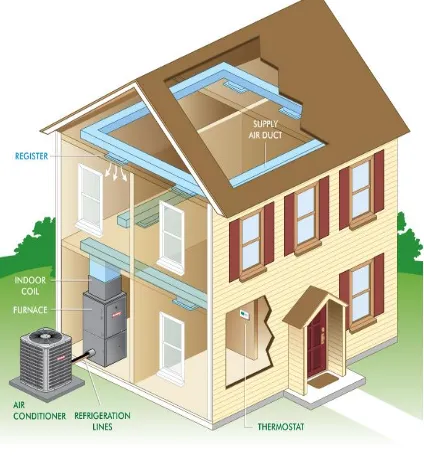
3. Split Air Conditioner- In a split-system, an outdoor metal cabinet contains the condenser and compressor, and an indoor cabinet contains the evaporator. In many split-system air conditioners, this indoor cabinet also contains a furnace or the indoor part of a heat pump. The air conditioner’s evaporator coil is installed in the cabinet or main supply duct of this furnace or heat pump. If your home already has a furnace but no air conditioner, a split-system is the most economical central air conditioner to install.
4. Central Air Conditioner - In a central air conditioner, the evaporator, condenser, and compressor are all located in one cabinet, which usually is placed on a roof or on a concrete slab next to the house’s foundation. This type of air conditioner also is used in
International Journal of Emerging Technology and Advanced Engineering
Website: www.ijetae.com (ISSN 2250-2459,ISO 9001:2008 Certified Journal, Volume 3, Issue 9, September 2013)
609
[image:2.612.59.271.226.454.2]Air supply and return ducts come from indoors through the home’s exterior wall or roof to connect with the packaged air conditioner, which is usually located outdoors. Packaged air conditioners often include electric heating coils or a natural gas furnace. This combination of air conditioner and central heater eliminates the need for a separate furnace indoors.
Figure-1
III. OBJECTIVES OF ENERGY AUDIT
The energy audit provides the vital information base for overall energy conservation program covering essentially energy utilization analysis and evaluation of energy conservation measures. It aims at:
Identifying the quality and cost of various energy inputs.
Relating energy inputs and production output.
Assessing present pattern of energy consumption in different cost centers of operations.
Identifying potential areas of thermal and electrical energy economy.
Highlights wastages in major areas.
Fixing of energy saving potential targets for individual cost centers.
Implementation of measures for energy conservation & realization of savings.
The analysis of building and utility data, including study of the installed equipment and analysis of energy bills.
The survey of the real operating conditions.
The understanding of the building behavior and of the interactions with weather, occupancy and operating schedules.
The selection and the evaluation of energy conservation measures.
The estimation of energy saving potential.
The identification of customer concerns and needs.
IV. ENERGY CONSERVATION MEASURE & METHODOLOGY
The energy management includes planning and operation of energy related production and consumption units. Objectives are resource conservation, climate protection and cost savings, while the users have permanent access to the energy they need. It is connected closely to environment management, production management, logistics and other established business functions. Table 1 shows that different load condition in Jabalpur Hospital.
Table 1 Type of loads
TYPE OF LOAD kW
Lighting 31.67
AC load 184.03
Fan 20.135
Pumps 15.666
Sterilizer & autoclaves 18
Medical equipments 116.49
Computing equipments 10.375
UPS & Inverter 18
Miscellaneous load 7.255
Geyser (Hot Water) 20
[image:2.612.339.547.428.642.2]International Journal of Emerging Technology and Advanced Engineering
Website: www.ijetae.com (ISSN 2250-2459,ISO 9001:2008 Certified Journal, Volume 3, Issue 9, September 2013)
[image:3.612.61.294.141.391.2]610
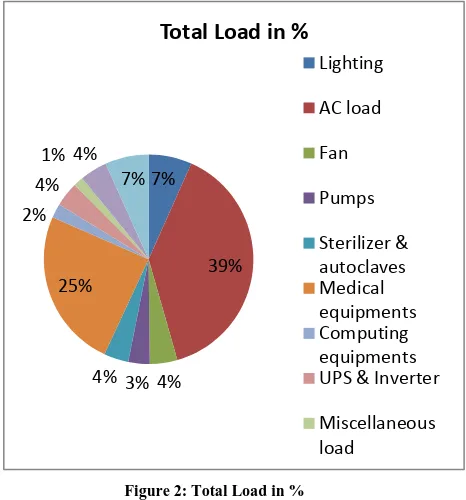
Figure 2: Total Load in %Figure 2 shows that the maximum load in Jabalpur Hospital & Research Center is due to 39% of AC load and 25% of medical equipment are used.
We replacing presently used window and split air conditioning system by centralized air conditioning system. Sun is the major cause of generation of heat during the summer seasons and it is also the major source of heat generation inside the room. The rays of the sun enters the room via windows, walls and roof of the room, partitions etc. This is the major cause of heat production inside the room. This heat increases the temperature inside the room and we feel uncomfortable.
The total amount of heat generated inside the room due to sun depends largely on the direction or alignment of the room with respect to the sun. In the morning maximum amount of heat is absorbed from the walls and windows in the east direction. During noon the maximum amount of heat is absorbed by the walls and windows in the south direction and in late noon the maximum heat comes inside the room from walls and windows in the western direction. Table 2 shows that the hospital is having total air conditioning load is 184.03 kW.
[image:3.612.60.553.464.730.2]But we are work out presently first four type of air conditioning system, removing the centralized air conditioning system. Table 3 shows that the total load of hospital by using window and split air conditioning system is 182.77kW.
Table 2: An inventory of the air conditioning load
S. No.
Ton Type Quantity Total
Tonnage
Cooling (watt)
Total Cooling
(kW)
Power Input (Watts)
Total Power
Input (kW)
Cost in Rupees
Total Cost in Rupees
1. 1 T Window AC
43 43 3457 148.6 1235 53.105 18,990 8,16,570
2. 1 T Split AC 10 10 3350 33.5 1130 11.3 22,000 2,20,000
3. 1.5 T Split AC 19 28.5 5200 98.8 1735 32.965 29,790 5,66,010
4. 2 T Split AC 39 78 6300 245.7 2190 85.41 39,173 15,27,747
5. 2 T Centraliz ed AC
2 4 7000 14 627 1.252 70,915 1,41,830
TOTAL - 163.5 - 540.6 - 184.03 - 32,72,157
7%
39%
4% 3% 4% 25% 2%
4% 1% 4%
7%
Total Load in %
Lighting
AC load
Fan
Pumps
Sterilizer & autoclaves Medical equipments Computing equipments UPS & Inverter
International Journal of Emerging Technology and Advanced Engineering
Website: www.ijetae.com (ISSN 2250-2459,ISO 9001:2008 Certified Journal, Volume 3, Issue 9, September 2013)
[image:4.612.55.285.137.306.2] [image:4.612.65.550.406.630.2]611
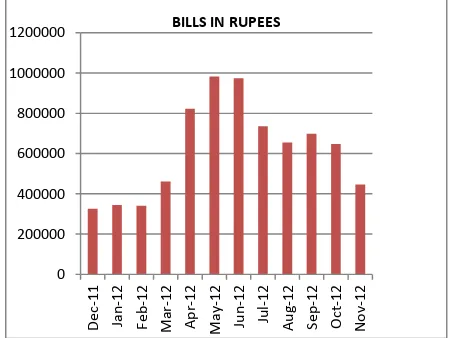
Figure 3: Graph between Different Months & Bill Payable In RupeesFigure 3 shows that the maximum load in the month of April’12, May’12, June’12. So, we can say that, this load is mainly generated by using the Air-conditioner System in this duration.
A study has been done separately for presently used window and split air conditioning system and centralized air conditioning system. The total load of window and split air conditioning system in tonnage is 159.5 kW and total cooling is 526.6 kW. The Goodman DSZC180601 centralized air conditioning system having one unit is 5 ton, then fulfill the requirement of cooling we used 31 units of Goodman DSZC180601 centralized air conditioning system. Table 4 shows that the total load of centralized air conditioning system in tonnage is 155 kW and total cooling is 542.5 kW. In case duct losses are produced in a centralized air conditioning system (20% duct losses) [2] then Goodman DSZC180601 centralized air conditioning system used 36 units of centralized air conditioner. Then total load of centralized air conditioning system in tonnage is 180 kW and total cooling is 630 kW.
Table 3: An inventory of the air conditioning load without centralized air conditioning
V. EQUIVALENT MONEY SAVING AND ANNUAL ENERGY SAVINGS
In centralized air conditioning system efficiency refers to the amount of energy converted into cool air compared to the amount of energy lost.
This is the most important factor in an air conditioner because it dictates long-term savings. Efficiency is expressed as Seasonal Energy Efficiency
0 200000 400000 600000 800000 1000000 1200000
D
ec
-11
Jan
-1
2
Fe
b-12
M
ar
-1
2
A
pr
-12
M
ay
-1
2
Jun
-12
Jul
-12
A
ug
-12
Se
p-12
O
ct
-12
N
o
v-12
BILLS IN RUPEES
S. No.
Ton Type Quantity Total
Tonnage
Cooling (watt)
Total Cooling
(kW)
Power Input (Watts)
Total Power
Input (kW)
Cost in Rupees
Total Cost in Rupees
1. 1 T Window AC
43 43 3457 148.6 1235 53.105 18,990 8,16,570
2. 1 T Split AC 10 10 3350 33.5 1130 11.3 22,000 2,20,000
3. 1.5 T Split AC 19 28.5 5200 98.8 1735 32.965 29,790 5,66,010
4. 2 T Split AC 39 78 6300 245.7 2190 85.41 39,173 15,27,747
International Journal of Emerging Technology and Advanced Engineering
Website: www.ijetae.com (ISSN 2250-2459,ISO 9001:2008 Certified Journal, Volume 3, Issue 9, September 2013)
612
Ratio, or SEER. The higher the rating, the more energy efficient the unit is. The higher the SEER, the less you’ll pay in utility costs to operate your air conditioner. In any centralized air conditioning system having SEER ratings range from 13 to 23. In my research work, the total load of window and split air conditioning system is 39%.
[image:5.612.110.505.236.432.2]In case we maintain the cooling level as existing system and replace the window and split air conditioning system by centralized air conditioning system with considering 20% duct losses [2] then 29% power gets reduced to 10% annually savings.
Table 4: Difference between present air conditioning and installation of centralized AC
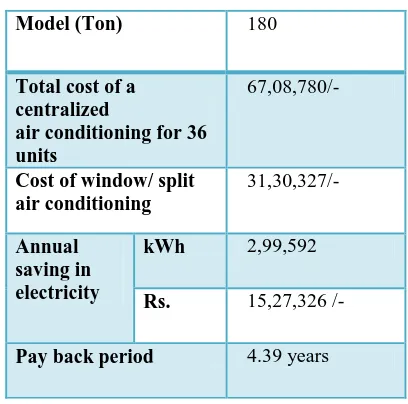
A study has been done separately for presently used window and split air conditioning system and centralized air conditioning system. Table 5 shows that the total load of window and split air conditioning system in tonnage is 159.5 kW and total cooling is 526.6 kW. In case we replace the window and split air conditioning system by centralized air conditioning system (considering 20% duct losses) [2] then we gets annual saving in electricity is 2,99,592 kWh and their respective cost 15,27,326 /-Rs. are annually savings. The payback period of centralized air conditioning system is 4.39 years. If we consider the salvage value of existing system, then we reduced the cost of centralized air conditioning system as well as their payback period is also reduced.
Table 5: Annual savings in Electricity Parameters At present used
window/ split air conditioning
For Installation of centralized air
conditioning
For Installation of centralized AC with
20% duct losses
For 31 units For 36 units
Total Tonnage 159.5 155 = (5*31) 180 = (5*36)
Total Cooling (kW)
526.6 542.5 630
Total Power Input (kW)
182.77 117.8 136.8
Total Cost in Rupees
31,30,327 57,76,985 67,08,780
Model (Ton) 180
Total cost of a centralized
air conditioning for 36 units
67,08,780/-
Cost of window/ split air conditioning
31,30,327/-
Annual saving in electricity
kWh 2,99,592
Rs. 15,27,326 /-
[image:5.612.341.545.459.661.2]International Journal of Emerging Technology and Advanced Engineering
Website: www.ijetae.com (ISSN 2250-2459,ISO 9001:2008 Certified Journal, Volume 3, Issue 9, September 2013)
613
The various advantages by using centralized air conditioning system in place of window and split air conditioning system can be summarized as follows:
Indoor comfort during warm weather - Central air conditioning helps keep your home cool and reduces humidity levels.
Cleaner air - As your central air conditioning system draws air out of various rooms in the house through return air ducts, the air is pulled through an air filter, which removes airborne particles such as dust and lint. Sophisticated filters may remove microscopic pollutants, as well. The filtered air is then routed to air supply duct work that carries it back to rooms.
Quieter operation - Because the compressor bearing unit is located outside the home, the indoor noise level from its operation is much lower than that of a free-standing air conditioning unit.
VI.
ENERGY SAVING APPROACHESIn each of the key end use areas, there are three basic approaches to save energy.
Switching off – All energy consuming equipment should be switched off when not in use. This can be done manually by hospital staff or automatically with special devices.
Maintancence – A number of energy efficiency measures can be carried out as part of routine maintaince procedures at no extra cost.
Refurbishment – Energy saving measures can be extremely cost effective when planning for refurbishment in the hospital.
VII. CALCULATION
Energy Cost of presently used window and split air conditioning system–
Suppose 6 hours air conditioning system used for 182.77 kW. Then Energy consumed for 6 h = 182.77 x 6
= 1097 kWh
Assuming usage of air conditioning for 365 days/ year. Then Energy consumed for 6 h Daily = 1097 x 365
= 4,00,405 kWh/year
Calculate at tariff rate of Rupees 5.10/kWh. Then Energy cost
= 4,00,405 x 5.10 = Rs. 20,42,065.5 /-
Energy cost for 1 month = Total Energy Cost / Total Months
= 20,42,065.5 / 12 = Rs. 1,70,172.125 /-
Replace Window and Split air conditioning system by Centralized Air Conditioning System
Suppose 6 hours air conditioning used for 136.8 kW. Then Energy consumed for 6 h
= 136.8 * 6 = 820.8 kWh
Assuming usage of air conditioning for 365 days/ year. Then Energy consumed for 6 h Daily = 820.8 x 365
= 2,99,592 kWh/year
Calculate at tariff rate of Rupees 5.10/kWh. Then Energy cost
= 2,99,592 x 5.10 = Rs. 15,27,919 /-
Energy cost for 1 month = (Total energy cost) / (Total months)
= 15,27,919 / 12 = Rs. 1,27,326 /-
Pay back period = (Investment) / (money saving) = 67,08,780 / 15,27,919
= 4.39 years
VIII. CONCLUSIONS
International Journal of Emerging Technology and Advanced Engineering
Website: www.ijetae.com (ISSN 2250-2459,ISO 9001:2008 Certified Journal, Volume 3, Issue 9, September 2013)
614
REFRENCES
[1] Audit of an air conditioning system André Philippe, Hannay Cleide, Hannay Jules, Lebrun Jean University of Liège, Belgium
[2] Fiber-Glass Composites for designing molded duct and heat transfer analysis on HVACs and Commercial duct system by Mohan Kashyap, Alok Chauby, International Journal of Emerging Trends in Engineering and Development Issue 3, Vol.4 (June-July 2013) ISSN 2249-6149
[3] Comparing Central and Split Air-Conditioning Systems by H. Yang, Ph.D., J. Burnett, Ph.D., K. Lau and L. Lu Member ASHRAE, ASHRAE Journal
[4] An Introduction to Air Conditioning System Design by J. Paul Guyer, P.E., R.A., Fellow ASCE, Fellow AEI, 2009
[5] Duct Design using equal friction method & CFD by Raviraj Gurav, Sanjay Gaikwad, Pritee Purohit , International Conference On Recent Technology, 9-11 Feb. 2012.
[6] The Importance of Energy Audit in the Energy certification of Buildings by Andreas Androutsopoulos, Eleftheria Alexandri [7] A. Bhatia, Centralized Vs Decentralized Air Conditioning Systems [8] Small HVAC System Design Guide by Pete Jacobs, California
Energy Commission’s Public Interest Energy Research (PIER) program 2003
[9] HVAC Calculations and Duct Sizing by Gary D. Beckfeld, P.E. [10] Joshua Energy Audit Analysis of Residential Air-Conditioning
Systems in Austin, Texas by Rhodes, Brent Stephens, Michael E. Webber, PhD
[11] Energy efficient room air conditioners – Best Available Technology (BAT) by Anette Michel, Eric Bush, Jürg Nipkow, Conrad U. Brunner, Hu Bo, Topten International Services
[12] HVAC Design Manual for New, Replacement, Addition, and Renovation of Existing VA Facilities, Department of Veterans Affairs
[13] HVAC DESIGN GUIDE, Dr. Robert Hammon, California Energy Commission, Public Interest Energy Research (PIER) Program, JULY 2005
[14] WALTER GRONDZIK, HVAC Components and Systems, Vital Signs Curriculum Materials Project
[15] A. Bhatia, HVAC Cooling Load Calculations And Principles [16] ASHRAE Pocket Guide for Air Conditioning, Heating, Ventilation
and Refrigeration, 1997.
[17] Heating, Ventilating, and Air Conditioning Analysis and Design, Faye C. McQuiston and Jerald D. Parker, Wiley & sons, 1977 [18] S.B.wankhade M E. (elect. power system), carried out energy audit
of MLA. Hostel Nagpur year: Jun – Jul’2004
[19] Analysis of energy use for Ontorio Hospital,Finn project 13March 2009
[20] S. Jak.lius, Learning from experiences with Energy Savings in Hospitals, CADDET Energy Efficiency Analysis Series No. 20, The Netherlands, 1996.
[21] S. Aronsson, P.E. Nilsson, Learning from experiences with Energy Management of Commercial Buildings, CADDET Energy Efficiency Analysis Series No. 19, The Netherlands, 1996.
[22] Bureau of Energy Efficiency, Govt. of India, www.beeindia.nic.in [23] Detailed information and case studies on energy audits,
www.energymanagertraining.com and www.en.wikipedia.org/wiki/Energy_audit