International Journal of Emerging Technology and Advanced Engineering
Website: www.ijetae.com (ISSN 2250-2459, ISO 9001:2008 Certified Journal, Volume 6, Issue 4, April 2016)
202
Optimized Neighbour-Based Dynamic Source Routing in
Mobile Ad-hoc Network
Mayur G. Rathi
11Asst. Professor, Department of Information Technology, Walchand College of Engineering, Sangli
Abstract— In mobile ad-hoc network link breakage and
path failure occur due to high mobility which causes routing overhead decreases performance of MANET drastically. Route discovery and broadcasting is fundamental operation for data disseminations mechanism, where mobile node blindly broadcast the routing request which causes broadcast storm problem. In this paper we reduce the routing overhead by calculating uncover neighbor set, rebroadcasting delay to determine rebroadcast order and connectivity factor for defining density of node in given area. Combining additional coverage ratio and connectivity factor gives the rebroadcast probability, which reduces the routing overhead for MANET. Our Research work is focusing on broadcast storm problem in mobile ad-hoc network and solution is given with neighbor knowledge and probabilistically rebroadcast mechanism that significantly reduces number of retransmission and increases performance in MANETs.
Keywords— Mobile ad-hoc network, broadcast storm,
neighbor knowledge, probabilistic rebroadcast, routing overhead.
I. INTRODUCTION
A mobile ad hoc network (MANET) is a peer to peer network where each node can act as sender, receiver or router. There is no fixed infrastructure as in centralized system. Node dynamically organized themselves into the arbitrary topology network. Ad-hoc routing protocol can be categorized as table driven and on-demand route discovery [4]. In table driven approach, the routing table is maintain for each node and it is periodically updated, the example of such a routing algorithm is DSDV and OLSR. The second approach is on demand routing where route is find when required. The example of such a routing protocol is DSR and AODV where routing request are broadcast and route is discovered on demand. On demand routing protocol is widely used in MANET. Route discovery is fundamental operation in demand routing protocol causes the overhead due to collision or redundant retransmission, while reaching all the network nodes. One of the current challenges in MANET is designing of dynamic routing protocol with less overhead. Design should navigate the broadcast storm problem.
Node mobility in MANET network causes the link breakage and path failure leads to discover the route again causes the overhead in routing and decreases the performance drastically [3]. This reduces the packet delivery ratio and end to end delay is increased. Thus, reducing the routing overhead is important aspect to increases the performance in MANET. In route discovery broadcasting is the fundamental and effective data dissemination mechanism, where a mobile node blindly rebroadcast the first received route request packet till it has route to destination and thus, it causes the broadcast storm problem. The on-demand routing protocols conventionally uses the blind flooding mechanism. Echo reply confirms the finalized route between the source and destination. Blind rebroadcast causes the repetitive rebroadcast of RREQ [5]. This leads to considerable packet collision in dense network. This issue has to optimize so as to reduce the routing overhead. It broadcast a Route RREQ packet to the networks and the broadcasting induces excessive repetitive transmissions of RREQ packet and causes the broadcast storm problem, which leads to a considerable number of packet collisions, especially in dense networks. Broadcasting can be optimized in four classes:―Blind flooding, probability-based methods, area-based methods, and neighbor knowledge methods‖.
In blind flooding, it forwards the RREQ packets to its entire neighbor, ensures that each node in network are cover but causes broadcast storming. To filter this Kim proposed area based and probability based, it implies that with number of node in static network degrade the performance and coverage of each node is not ensures. Hence area based one and probability based ones have some defeat. This can be reduced with neighbor knowledge. Simulation by Kim showed that neighbor knowledge method is better than area based ones. For limiting the number of rebroadcast can effectively optimized with neighbor knowledge method better than area based and probability ones, and then proposed a neighbor coverage-based probabilistic rebroadcast.
International Journal of Emerging Technology and Advanced Engineering
Website: www.ijetae.com (ISSN 2250-2459, ISO 9001:2008 Certified Journal, Volume 6, Issue 4, April 2016)
203
1.We calculated the rebroadcast delay for node which intern determines the rebroadcast order. Rebroadcast delay decides forwarding order which helps to calculate the uncover neighbor set. In short, it works like preliminary filter for calculation of uncover neighbor set.
2.We also proposed rebroadcast probability calculation from uncover neighbor set and node mobility. Connectivity factor is the determinant for node density and mobility. Rebroadcast probability is comprise of following two parameter:
a. Additional coverage ratio, defined as ratio of number of node that should be cover in single broadcast to the total number of neighbor.
b.Connectivity factors, which defines the node density and relation with neighbor for a given node.
II. RELATED WORK
Routing is an essential mechanism but route discovery utilizes link, end to end transmission is delayed causes inefficiency in link utilization. DSDV and OLSR is table driven method where each node maintains the routing table between pair of source and destination. AODV and DSR are the on demand routing protocol which leads to the route discovery without periodic exchange of information between nodes. Peng and Lu [6] proposed a neighbor knowledge scheme named Scalable Broadcast Algorithm (SBA). This scheme determines the rebroadcast of a packet according to the fact whether this rebroadcast would r0each additional node. Abdulai et al. [7] proposed a Dynamic Probabilistic Route Discovery (DPR) scheme based on neighbor coverage. In this approach, each node determines the forwarding probability according to the number of its neighbors and the set of neighbors which are covered by the previous broadcast. This scheme only considers the coverage ratio by the previous node, and it does not consider the neighbors receiving the duplicate RREQ packet. Keshavarz-Haddad et al. [8] proposed two deterministic timer-based broadcast schemes: Dynamic Reflector Broadcast (DRB) and Dynamic Connector- Connector Broadcast (DCCB). The broadcasting protocol and simple packet flooding without a careful decision of a controlled rebroadcasting may produce an excessive redundancy of incoming packets, a greater channel contention, and a higher collision rate.
Hybrid approaches is combining the advantages of distance-based and area-based schemes in terms of reachability and saving of rebroadcasting without the overhead and also satisfy two goals, namely high reachable and low redundancy. In our protocol, we also set a deterministic rebroadcast delay, but the goal is to make dissemination of neighbor knowledge much quicker.
DSR routing algorithm are follows the simple flooding which causes the collision on channel as it repetitively transmitting RREQ message and causes the broadcast storm problem, which leads to a considerable number of packet collisions, especially in dense networks. Therefore, it is indispensable to optimize this broadcasting mechanism. Some methods have been proposed to optimize the broadcast problem in MANETs in the past few years. Williams and Camp categorized broadcasting protocols into four classes: ―simple flooding, probability-based methods, area-based methods, and neighbor knowledge methods.‖ Kim indicated that performance of network degrade with increase in number of node increases in area-based ones and in probability based-ones. Neighbor knowledge method is effective for dense network. Kim indicated that the performance of neighbor knowledge methods is better than that of area-based ones, and the performance of area-based methods is better than that of probability-based.
Disadvantages of existing system:
1. Routers may overloaded in a dense network leads to link breakages.
2. Packet delivery does not take place in time, so reduce in packet delivery.
3. Increase in end-to-end delay transmissions.
4. Broadcast storm problem occurs due to number of packet collisions in network.
III. NEIGHBOR-BASED OPTIMIZATION IN DSR In this section we determine the neighbor knowledge and connectivity factor which intern calculate rebroadcast probability.
A.
Uncover Neighbor Set and Rebroadcast DelayInternational Journal of Emerging Technology and Advanced Engineering
Website: www.ijetae.com (ISSN 2250-2459, ISO 9001:2008 Certified Journal, Volume 6, Issue 4, April 2016)
204
If node ni has more neighbors uncovered by the RREQ packet from s, which means that if node ni rebroadcasts the RREQ packet, the RREQ packet can reach more additional neighbor nodes[1]. We define the Uncovered Neighbors Set U(ni) of node ni as follows:
U (ni) = N (ni) – [N(ni) ᴒ N(s)] – {s}
Where N(s) and N (ni) are the neighbors sets of node s and ni, respectively. s is the node which sends an RREQ packet to node ni. To avoid the collision over the channel
while discovering the route we must define the rebroadcast order by calculating the rebroadcast delay. When node receives the RREQ packet it calculates rebroadcast delay according to neighbor list in RREQ packet and its own neighbor list.The rebroadcast delay Td (ni) of node ni is
defined as follows:
Td(ni) = MaxDelay × Tp(ni)
When node ni sends routing request to neighbor, where all neighbor ni, i=1,2,3…N(s) process the routing request.
Assume that node Nk has the largest common neighbors
with respect node s, then node Nk has lowest rebroadcast
delay has to rebroadcast first [1]. The objective of this rebroadcast delay is not to rebroadcast the RREQ packet to more nodes, but to disseminate the neighbor coverage knowledge more quickly.
B.Neighbor Knowledge and Rebroadcast Probability
If node ni receives a duplicate RREQ packet from its
neighbor nj, it knows that how many its neighbors have
been covered by the RREQ packet from nj. Thus, UCN set
according to the neighbor list in the RREQ packet from nj.
Then, the U (ni) can be adjusted as follows:
U (ni) = U (ni) – [U (ni) ᴒ N (nj)]
RREQ request coming from node Nj are now discarded,
the timer of node expires it optimize the final uncover set. If a node does not sense any duplicate RREQ packets from its neighborhood, its UCN set is not changed, which is the initial UCN set. We define the additional coverage ratio (Ra(ni)) node ni as:
Ra(ni) = |U(ni)| ÷ |N(ni)|
From above equation we can calculate number of node that we can additionally cover in next rebroadcast [1]. Ra becomes greater, more number of neighbors will be covered by this broadcast and more nodes will process the RREQ packet in single rebroadcast, thus rebroadcast probability should set to higher. Each node connect to more than 5.1774log n of its nearest neighbor [1].
The probability of network being connected is approach to 1 as n increases, where n is number of node in MANET. From this we define connectivity factor as the ratio of number node that need to receives RREQ packets to the total number of neighbor of node ni. Connectivity factor
can be denoted as Fc(ni), this implies that node is always
connected in network, formula that followed is N(ni) .Fc(ni)
≥5.1774log n. The connectivity factor can be illustrated as: Fc(ni) = | Nc | ÷ | N(ni) |
Where Nc=5.1774 log n, and n is number of nodes
in MANET. From above formula we can observe that when N(ni) is greater than Nc, Fc(ni) is less than 1, this
implies that node ni is in dense area and vice versa. Combining the additional coverage ratio and connectivity factor, we obtain the rebroadcast probability Pre(ni) of node
ni:
Pre(ni)= Fc(ni). Ra(ni)
Where, Pre(ni) is greater than 1 sometimes, it is
normalized to 1. It doesn’t impact on behavior of protocol.
It just implies that local density of node is so low that the node must forward the RREQ packets [1]. Then ni forward
the RREQ packets with probability Pre(ni).
IV. SIMULATION ENVIRONMENT
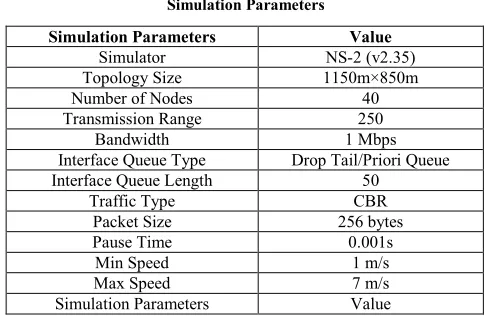
In order to simulate the proposed NCPR protocol, we used following simulation parameter:
[image:3.612.321.564.560.718.2]We have used IEEE 802.11 protocol as MAC layer protocol. Bandwidth of link is set to 1 Mbps. We taken CBR (constant bit rate ) as an traffic application in simulation and range of transmission is 250m. Destination is selected randomly as per the mobility model used in simulation. Whole MANET is design in 1150m×850m of transmission range.
TABLE 1 Simulation Parameters
Simulation Parameters Value
Simulator NS-2 (v2.35)
Topology Size 1150m×850m
Number of Nodes 40
Transmission Range 250
Bandwidth 1 Mbps
Interface Queue Type Drop Tail/Priori Queue
Interface Queue Length 50
Traffic Type CBR
Packet Size 256 bytes
Pause Time 0.001s
Min Speed 1 m/s
Max Speed 7 m/s
International Journal of Emerging Technology and Advanced Engineering
Website: www.ijetae.com (ISSN 2250-2459, ISO 9001:2008 Certified Journal, Volume 6, Issue 4, April 2016)
[image:4.612.326.587.122.283.2]205
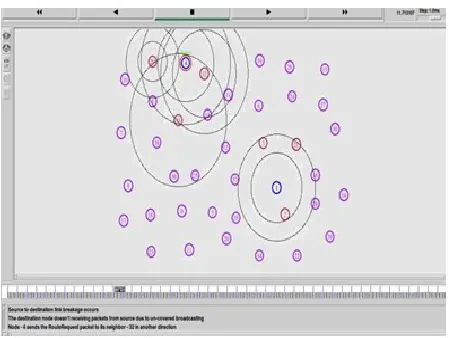
Fig. 1: Initialization of MANET’s [image:4.612.46.283.135.309.2]Movement of node to the destination is random as per the mobility model with random speed. Minimum speed of simulation is 1 m/s and maximum speed is 7 m/s. We determine rebroadcast delay to obtain forward node order by combining it with constant delay called as max delay which is set to 0.025 and the simulation time is of 160 sec.
Fig. 2: Sending RREQ to uncovered neighbor
[image:4.612.57.282.403.572.2]
Fig.3: Sending RREQ to random destination
V. CONCLUSION
In this paper, we proposed a probabilistic rebroadcast based on neighbor knowledge to reduce the routing overhead in MANET. The uncovered neighbor set is calculated by determining additional coverage ratio. Rebroadcast delay is set to maintain the rebroadcast order and efficiently forms the uncover neighbor set. In simulation it shows that redundant transmission is less so that the overhead due to the rebroadcast traffic is less than other protocol we studied in survey. This increases the packet delivery ratio and end-to-end delay is minimized that increases performance in MANET.
VI. FUTURE WORK
In future, we implement energy model for efficient utilization of MANET under energy constraint. Simulation can be analyzed by performance metric like packet drop rate, throughput calculation.
REFERENCES
[1] Xin Ming Zhang, En Bo Wang, ―A Neighbor Coverage-Based Probabilistic Rebroadcast Protocol for Reducing Routing Overhead in MANETs,‖ IEEE Trans. On Mobile Computing, Vol. 12, No. 3, March, 2013.
International Journal of Emerging Technology and Advanced Engineering
Website: www.ijetae.com (ISSN 2250-2459, ISO 9001:2008 Certified Journal, Volume 6, Issue 4, April 2016)
206
[3] Aditya Bakshi, A.K.Sharma, ―The significance of mobile Adhocnetwork,‖ International Journal of Innovative technology and Exploring Engineering, Vol. 2, ISSN.2278-3075, March 2013. [4] Abdalla M. Hanashi ,Mike Woodward, ―Improving Route Discovery
of Dynamic Probabilistic Flooding in On-Demand Routing Protocols for MANETs,‖ International Journal of Computer Science and Software Engineering.,vol. 6, no. 5, pp. 2314–2325, November 25,2008.
[5] Sreelakshmi. M Nair, B.Vivek,‖ Improving Routing Performance by Using Neighbor Coverage Knowledge and Energy Aware Metric In Mobile Adhoc Network,‖ International Journal of Computer Trends and Technology (IJCTT) – volume 8 number 3– Feb 2014.
[6] W. Peng and X. Lu,‖ On the Reduction of Broadcast Redundancy in Mobile Ad Hoc Network,‖ Proc. ACM MobiHoc, pp. 129-130, 2000.
[7] J.D. Abdulai, M. Ould-Khaoua, L.M. Mackenzie, and A. Mohammed ―Neighbour Coverage: A Dynamic Probabilistic Route Discovery for Mobile Ad Hoc Networks,‖ Proc. Int’l Symp. Performance Evaluation of Computer and Telecomm. Systems (SPECTS ’08), pp. 165-172, 2008.