c h a ll e n g e s of a d a p t a ti o n a n d
i m pl e m e n t a ti o n of BI M in p r oj e c t
lif e c y cl e
Tal e bi, S
T i t l e Ex plo ri n g a d v a n t a g e s a n d c h all e n g e s of a d a p t a ti o n a n d i m pl e m e n t a ti o n of BI M in p r oj e c t lif e cy cl e
A u t h o r s Tal e bi, S
Typ e C o nf e r e n c e o r Wo r k s h o p I t e m
U RL T hi s v e r si o n is a v ail a bl e a t :
h t t p :// u sir. s alfo r d . a c . u k /i d/ e p ri n t/ 3 2 2 7 5 /
P u b l i s h e d D a t e 2 0 1 4
U S IR is a d i gi t al c oll e c ti o n of t h e r e s e a r c h o u t p u t of t h e U n iv e r si ty of S alfo r d . W h e r e c o p y ri g h t p e r m i t s , f ull t e x t m a t e r i al h el d i n t h e r e p o si t o r y is m a d e f r e ely a v ail a bl e o nli n e a n d c a n b e r e a d , d o w nl o a d e d a n d c o pi e d fo r n o
n-c o m m e r n-ci al p r iv a t e s t u d y o r r e s e a r n-c h p u r p o s e s . Pl e a s e n-c h e n-c k t h e m a n u s n-c ri p t fo r a n y f u r t h e r c o p y ri g h t r e s t r i c ti o n s .
EXPLORING ADVANTAGES AND CHALLENGES
OF ADAPTATION AND IMPLEMENTATION OF BIM
IN PROJECT LIFE CYCLE
Saeed Talebi1
ABSTRACT
The major focus of this paper is to identify the advantages, challenges and usability of BIM during the project life cycle. Understanding the actual advantages of BIM is an essential driver for effective adaptation while both academic research and case studies particularly within construction and post construction stages failed to analyse and quantify BIM benefits. It was also found there is lack of investigation on inter-organisational challenges prior to adopt BIM and majority of undertaken research have focused merely on technical obstacles.
This study did a literature review and suggests there should be universal guidelines to quantify benefits gained not only during design and construction phase, but also in post construction phase. This can greatly contribute to increase the use of BIM in both public and private projects. In addition, the findings indicate there are more three challenges other than technical obstacles that need consideration when implementing BIM, namely process related obstacles, social context obstacles and associated costs.
KEY WORDS
BIM, Construction management, Business process, Social context, Interoperability, FM.
INTRODUCTION
BIM has begun to change the way buildings look, act and also the way in which they are designed and built (Eastman et al., 2008). There is a wealth of research material available on the topic, providing details on how BIM can be used for diverse purposes such as a modelling tool, information tool, communication tool and facilities management tool (Popov et al., 2006). The frequency and variety of the BIM definitions illustrate the confusion in defining and quantifying BIM and putting it in terms of potential benefits. In this research, BIM is
1
2 defined as a process for managing the information produced in the lifecycle of an asset (Gelder et al., 2013). This was chosen due to the fact that the real value of BIM is to provide accurate information with high efficiency in the whole building life cycle (Evans et al., 2004). Contrary to some technology focused definitions, BIM is not just a tool or a solution (BIFM, 2012), but rather value-creating collaboration, underpinned by 3D models and intelligent structured data (BIM Industry Working Group, 2012). BIM is not an “out-of-the-box” product, and requires new processes and new channels of communication (Teicholz, 2013). Overall, BIM is a fusion of process, technology and culture (Macdonald, 2011).
This paper was inspired by the current level of uncertainty that to what extent BIM affects the project life cycle including preconstruction, construction and facilities management. BIM is being rapidly embraced by the construction industry to reduce cost, time and enhance quality because owners are now realising benefits that BIM can offer them (Ku & Taiebot, 2011; Eastman et al., 208). However, there are challenges that make the adoption of BIM much slower than anticipated (Fisher and Kunz, 2004). A prominent challenge is the construction industry’s reluctance towards new innovations due to the lack of knowledge of how to use BIM and understand what benefits can be attained (Wikforss & Löfgren, 2007; Singh et al., 2011). Therefore, it is essential that all project participants expand their knowledge and awareness to ensure they can fully obtain potential benefits of BIM and cope with challenges.
BIM ADAPTATION AND IMPLEMENTATION BENEFITS
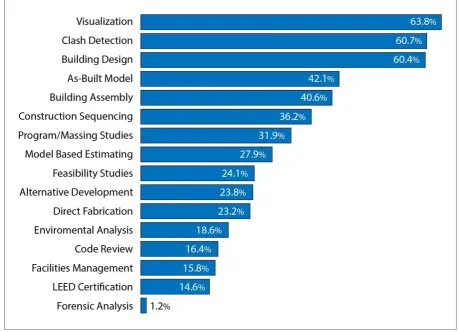
BIM adoption results in many different types of opportunities and challenges compared to traditional ways of working in the industry and many studies have been made to reveal them. For instance, Becerik-Gerber and Rice (2010) undertook a survey on amount of BIM usage in construction industry. 424 people including construction manager, contractor and subcontractor participated. The study indicates that participants have used BIM mostly for clash detection, visualisation and creation of as-built models (figure 1).
Figure 1. BIM uses for the survey participants (Becerik-Gerber, 2010)
BIM makes the design information explicit and available to all stakeholders (Wong et al., 2010) and supports decision making in construction projects through better management, sharing and use of information (Fischer & Kam, 2002). In contrast, project participants in the traditional production environment had their own information systems which were structured and suited for their specialised and specific needs. Therefore, the amount of information that could be jointly shared was limited due to the lack of a central source of information (Wu & Hsieh, 2011). Today, project data are easily accessible through diverse BIM software which makes the sharing and control of project information more efficient (Palos, 2012). In other words, BIM gathers core competences to jointly decide and address onsite related problems more effectively (Zeng & Tan, 2007).
4 followed by owners at 70 per cent, architects at 58 per cent and 46 per cent of engineers experiencing positive ROI when using BIM.
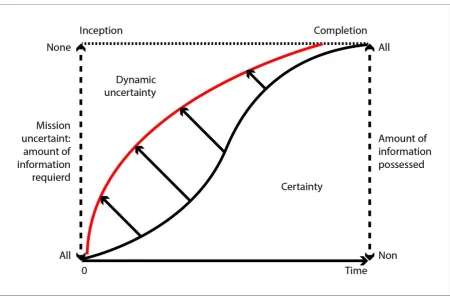
[image:5.595.73.524.253.550.2]Moreover, figure 2 shows during life cycle of a construction project, the mission uncertainty is highest at the beginning and then decreases as the project develops (Winch, 2010). In design phase, the level of information available to support essential decisions and perform value engineering is low. In contrast, performing BIM design in early stage of a project corresponds to increase of available information. This is illustrated by the red curve in figure 2 where dynamic uncertainty decreases and the certainty increases.
Figure 2. Reduced process uncertainty due to increase information availability provided by BIM during the project life cycle (Winch, 2010)
The lifecycle of a building in this paper is divided into 3 main stages: pre-construction, construction and post construction. The last stage concerns the exploitation that deals with facility management which has been dissociated in the processes of building management. The following are more detailed opportunities caused by BIM in each stage of a project life cycle.
Pre-construction stage
engineering which is “a conscious and explicit set of disciplined procedures designed to seek out optimum value for both initial and long-term investment.” From this perspective, BIM is used as a strategic business tool in estimating possible economic incentives for the contractor and client. Moreover, BIM technology not only provides a framework for assessing the project feasibility, but also evaluates the building’s performanceaccording to regulations regarding functionality and constructability.
The possibility to perform alternative studies such as energy, lightening and acoustic analysis of the virtual model is of great importance specially if the project scope includes designing a building with regard to certain environmental certificate standards such as Leadership in Energy and Environmental Design (LEED). Energy analysis should be performed in the early design phase by linking a building information model to tools which measures energy usage for heating and cooling during peak periods (Eastman et al., 2008). It allows users to make energy-conscious decisions and test the energy-saving ideas, thus improving the building quality without postponing the design process (Stumpf et al., 2009). Performing thorough sustainability analyses in the design stage is a capability that traditional design methods were not able to do (Azhar et al., 2011). In accordance with aforementioned issues, BIM provides an opportunity to perform value engineering in an early stage which enables the design team and project administrators (PA) to ensure the design intent (Azhar et al., 2008).
BIM implementation requires early involvement of design and construction stakeholders. Although this increases upfront costs, it has been proved overall costs of the construction phase will decrease due to savings gained by avoidance of delays, change orders, claims and requests for information (Hannon, 2007). For example, J. C. Cannistrato, a Plumbing, HVAC, and Fire Contractor in the Massachusetts area, utilised data from 408 projects over 6 years totalling $558,858,574 to quantify how much BIM saved them. In their company press release, they reportedly found that change orders for “2D” projects represented 18.42 per cent of base contract while change orders for “3D” projects represented 11.17 per cent of base contract (Cannistrato, 2009).
6 outcomes is highest and the cost of changes is minimal (The American Institute of Architects, 2007).
Figure 3. The MacLeamy Curve (The American Institute of Architects, 2007)
Digital representation of the physical building enables the design team and PA to evaluate the design performance and to detect errors before the production phase. In addition, BIM brings together and compares designs from all organisations. These two capabilities refer to performing quality control and ensuring constructability by detection, check and modification of geometrical design inconsistencies between different building components and installation systems (Wu and Hsieh, 2011; Eastman et al., 2008; Fisher & Kunz, 2004; Azhar et al., 2008). Consequently, coordination among different organisations is enhanced and errors and clashes are detected early in design phase that result in speeding up the construction process, reducing costs, minimising the likelihood of legal disputes and shortening the construction period.
Also, Geil and Issa (2011) stated BIM decreases the amount of change orders by nearly 40 per cent. Therefore, it can be concluded that clash detection by means of BIM minimises the number of change orders by 40 per cent. Regarding (Young et al., 2009), this ability adds maximum value to the project.
The object-based parametric modelling feature of BIM allows architects, MEP engineers, structural engineers and fabricators to leverage multiple functions on the same building model for their own use. With accurate building information and object models, the design/modelling process is greatly facilitated. The models can be rigorously analysed, simulations can be performed quickly and performance is benchmarked (Azhar et al., 2008). There is also better communication amongst parties and understanding from 3D visualisation (Young et al., 2009). The design efficiency and information sharing enhancement benefit all the activities in design/modelling process and the subsequent activities such as quantity take off.
BIM tools increase the accuracy of the cost estimation process by improving information availability (Sabol, 2008). From the BIM model, quantities can be extracted and form a basis for a bill of quantities which can be used in the procurement phase. This is of value since traditional approaches of quantity take offs (rough order of magnitude) often were insufficient (Sabol, 2008). With cost estimation, often also called 5D, the objects in a 3D design are linked to price lists for different materials. Estimations can be even more precise if productivity and other related information for building components in the model are available. The price lists are mainly based on volume cost of materials but can also include labourer and equipment expenditures for more detailed cost estimation. This enables BIM users to generate accurate and reliable cost estimates through automatic quantity take off and receive a faster cost feedback on changes in design stage (Eastman et al., 2008). The cost estimation (5D) can be as a foundation to control costs since it makes all involved organisations including contractor and client aware of the costs associated with the design before it progresses to a more detailed level. As a result, design can be optimised to honour the client’s budget (Eastman, et al., 2008).
Construction stage
8 The U.S. Bureau of Economic Analysis reported that construction accounted for approximately 4.1 per cent of the 2008 US Gross Domestic Product (GDP) with revenue of $582 billion (U.S. Bureau of Economic Analysis, 2009). Research conducted by the Construction Industry Institute also estimates that direct costs caused by rework make up nearly five per cent of the total construction costs (Hwang et al., 2009), which constitutes approximately $29 billion in 2008. This substantiates that the magnitude of the cost savings in eliminating or reducing rework is significant for contractors and is the major incentive for implementation of BIM technology into contractors' business practice.
The visual nature of BIM contributes to planning and control the construction processes in advance. All components of building and tasks in model can be checked and planned beforehand which leads to better collaboration, reduced need for on-site inventories and minimised costs (Eastman et al., 2008). In addition, BIM is able to follow up the actual construction status by regularly updating the installation dates of structures and systems to the model (Karppinen et al., 2012).
The design and construction schedule can be synchronised by linking the building model to the project schedule. The linkage to time plan, called 4D, makes it possible to graphically visualise the project schedule. It also enables the users to simulate the construction process and show the virtual view of the building and site at any point in time. This type of simulation provides considerable insight into the project and allows for early detection of planning errors instead of realising them later on in the construction phase and having to resolve problems on site which can be very costly (Eastman et al., 2008). Moreover, 4D BIM optimises the logistical aspects. Various alternative solutions for execution of the construction can be simulated and weighted against each other to find the most beneficial solution (Eastman et al., 2008).
It is also said that as a result of improved quality and facilitation of defect detection in design phase, the likelihood of any severe problematic issue on site is low. Errors, conflicts and change orders on site can be addressed as well more quickly by using BIM since there is no need for time consuming paper transactions. All of these advantages together will make the construction processes faster and smoother, reduce cost and minimise the risk of legal disputes (Eastman et al. 2008). (Young et al., 2009) state that over 80 per cent of contractors believe reduction of conflicts during construction has the highest value in implementing BIM.
Post construction stage
cent of the facility managers’ time is spent on finding information. The staffs need to carry out significant amount of on-site survey before any renovation or maintenance work. Contrary to explained background, BIM model contains important information in terms of manufacturer specifications and maintenance instructions linked to building components in order to provide an accurate database for client and operators (Sabol, 2008). Therefore, in theory it can greatly contribute to facilities management (Eastman et al., 2008).
Numerous add-ons are available for various purposes such as energy simulation, sustainability simulation and regulation compliance check (Arayici et al., 2012). These applications provided boundless opportunities for stakeholders in the whole life cycle of buildings. In the ideal situation, BIM model is linked to one of the existing FM packages and any modification in the FM package should be automatically updated in the model. Also, each object in the model can include links to operation, maintenance and warranty information (Eastman et al., 2008).
BIM ADAPTATION AND IMPLEMENTATION CHALLENGES
Advantageous outcome of BIM can be obtained only if possible pitfalls in both organisation and project level comprehensively are taken into account (Dainty et al., 2006). Most of the BIM literature, however, have focused merely on technical aspects rather than inter-organisational issues including social context and changed business processes (Wikforss & Löfgren, 2007; Peansupap & Walker, 2005). In this paper, all hindrances to BIM adaptation were divided into three major categories that will be described in detail. They are: (1) process related obstacles, (2) social context obstacles, (3) technical obstacles, and (4) associated costs with use of BIM.
Process related obstacles
This challenge is divided into 3 below subcategories:
New business processes
10 process is a collection of one or more linked activities that aim at obtaining business objective (Georgakopoulos and Tsalgatidou, 1998). However, there is a present challenge prior to BIM adoption that how construction companies can handle these ambiguous changed processes. In addition, it is difficult to foresee the consequences of BIM implementation due to an immature level of the users (Jacobsson & Linderoth, 2008).
New roles and responsibilities
Traditional interpersonal roles and relationships within the permanent and temporary organisations in an enhanced environment should change and the new roles in different processes have to be added (Gu & London, 2010; Owen et al., 2010). For instance, after integrating different BIM software, it is necessary to ensure who has to control the entry of data and be responsible for the inaccuracies. Taking the responsibility can be extremely risky as it may lead to major legal liability issues (Azhar et al., 2008). In case of defective integration between software tools, it comes back to the issue that who has been responsible for the entry of data into the model. In addition, Howard and Björk (2008) state that new roles are needed to expand knowledge and awareness of BIM within the organisation to assure effective implementation. However, a key question still has remained that how these roles should be built and introduced within the building project processes.
Contractual changes – economic incentives and ownership of information
As implied earlier, BIM aims to maximise the workload in early design phase. Figure 4 shows in BIM system nearly 75 per cent of design decisions should be made during pre-design and schematic design phases whereas the remuneration in these phases is only between 5 and 10 per cent of the total project fees (Konsulent Asbjørn Levring, 2010). This indicates that the remuneration has to change due to the new project development system.
Figure 4. A quick comparison between project life cycle in traditional delivery methods and integrated virtual building model (adopted from Konsulent Asbjørn Levring, 2010)
Furthermore, BIM co-operative environment presents a challenge that who has the right to access valuable information in the model such as design input information, simulation and analyses results and the actual BIM model (Azhar et al., 2008). This problem is exacerbated particularly when project participants provide proprietary information. In other words, legal concerns are presenting challenges as to who owns the design, fabrication and construction data set, who pays for them and who is responsible for their accuracy (Eastman et al., 2008). This type of questions related to the ownership of the data has to be addressed in every project (Percio, 2007). The Finnish Common BIM Requirements 2012 (COBIM) tried to solve this problem and stated that all models and electronic documents should be handed over to the customer according to the contract (Karppinen et al., 2012). Thus, the customer doesn’t automatically gain the right to fully access the model as the ownership of the model is determined in contract.
12 contractual relationships of the project participants but it requires the participants to communicate, collaborate and exchange information via using BIM tools. Information technology responsibilities are transferred to an information manager whose tasks consists of account maintenance, back up and security (Lowe & Muncey, 2009).
In general, there is a lack of guideline for contractual agreements to deal with such aforementioned problems. Currently, professional groups such as American Institute of Architects (AIA) and Associated General Constructors AGC are developing guidelines to cover legal issues raised by the use of BIM technology.
Social context obstacles
BIM implementation affects both the technological environment and social context (Jacobsson & Linderoth, 2009). Alignment of the social nature of construction projects with the functionality of technology is necessary (Wikforss & Löfgren, 2007). Disregarding the social issues in the implementation stage could lead to failure or misaligned usage (Jacobsson & Linderoth, 2009). However, the number of people who truly understand the advanced BIM systems are limited (Owen et al., 2010). The SmartMarket Report (Bernstein et al., 2010) showed that in Europe and the US more than 60 per cent of participants have not used BIM during design and construction stage. Thus, there is lack of awareness of possible benefits, challenges and absence of training in how to use BIM applications (Gu & London, 2010). In this case, even if the management recognised the value of BIM, it is hard for them to persuade the organisation to adopt the technology. Therefore, training of staff is imperative to be able to effectively enhance the use of BIM at the project level (Pfitzner et al., 2010).
Technical obstacles
This challenge will be investigated from two perspectives:
Problems of interoperability
Various organisations are involved in construction projects and they often use different types of software. Interoperability between all software is not guaranteed as many major BIM vendors address interoperability only among their own products (Palos, 2012). This makes the sharing of information and the communication between participants ineffective (Wu & Hsieh, 2011).
(Wong et al., 2010). In recent years, many institutions have been working on this subject. Industry Foundation Classes (IFC) and Construction Operation Building Information Exchange (COBIE) are the two most popular standards that have been adapted but there is still limited successful evidence for them (Ahamed et al., 2010). For instance, transferring information between different software using IFC format may cause huge problems related with information losses or wrong representation of building elements in different environments. Software vendors also can contribute to develop technical interfaces between different BIM tools albeit this approach is less favourable (Bernstein & Pittman, 2004).
Moreover, many different national and regional initiatives have been launched to address this problem (Wong et al., 2010; Palos, 2012). Although this can lead to new challenges in a global level because of different BIM policies, in national level it is helpful if government demands the use of BIM at least in public sector projects (Wong et al., 2010). As a result, companies in the industry will use the same policies when adopting BIM and interoperability can be improved. However, despite of all developments in technical aspects of information exchange, interoperability amongst BIM software tools still is problematic.
Lack of integration between the project phases due to absence of BIM software
The implementation of BIM highlights a number of benefits to all members of a project team. Nonetheless, current practice within the industry has not been enough developed to integrate the all distinct project phases. Particularly, BIM software tools presently are not applicable or 'ready packed' to fit the production and FM processes. In other words, number of BIM tools supporting production and FM processes by far is fewer than tools supporting design stage (Wikforss & Löfgren, 2007; Jacobsson & Linderoth, 2008). This issue causes ineffective administrative work routines and gives restricted support to the crew onsite (Wikforss & Löfgren, 2007). Lack of technology alignment also leads to a digital divide between the design and other stages (Dainty et al., 2006). Balancing the project lifecycle and available BIM software tools is hereby crucial (Hartman et al., 2012; Wikforss & Löfgren, 2007).
Associated costs with use of BIM
14 of detail, complexity of the project and the expertise of modelling team. If in-house architect does not use the BIM software, general contractor needs to outsource the entire model. This is not only time consuming but also costly. Furthermore, the model developed by the architect might not include all the necessary information for the contractor and more costly development would be required. These costs incurred by the contractor in implementing building information modelling are categorised as overhead cost and can be potentially the difference between being awarded a contract or losing it.
CONCLUSION
This research has provided substantial evidence on the current understanding and perception of BIM benefits and challenges during project life cycle. The findings show there is an insufficient knowledge to develop a clear guideline and to quantify the advantages gained by use of BIM. It was also noticed much of the existing research material have focused on technical barriers whilst associated barriers with people, management and costs were neglected.
The paper shows there is lack of framework across the industry to facilitate the implementation and evaluation of BIM. Despite of some potential benefits have been reported, few quantifiable measurements and sparse framework methodologies increase the uncertainty. As a result, owners still have a dilemma of making decision that whether they should utilise BIM based on perceived benefits from theory. Therefore, there is a need to develop consistent and adaptable guidelines for all sectors in the industry and organisations with different sizes. These guidelines should be able to quantify benefits and consider both monetary and managerial outcome.
established yet to ensure that its utilisation is beneficial to the overall outcome of a construction project.
Furthermore, the paper proposes that challenges triggered by BIM adaptation should be considered from four perspectives, namely (1) process related obstacles, (2) social context obstacles, (3) technical obstacles, and (4) associated costs. Process related challenges have three aspects. First, BIM changes the traditional processes in building projects and accordingly construction organisations should adapt themselves to new business processes. However, due to immaturity of users and absence of any clear guideline, it is difficult to foresee the consequences. Second, there is a need for building new roles but it is ambiguous how they should be integrated into current processes. The last found issue in process related obstacles is about a need for developing new contractual agreements for BIM based projects. These agreements must be able to deal with division of economic incentives and also ownership of information.
Social context obstacles are more about socio-technical gap. Alignment of the social nature of construction projects with the functionality of technology can be obtained only by training employees for new roles and enhancing the awareness of possible benefits. Technical obstacles are related to interoperability constraints between different BIM software. Also, there is a lack of technology alignment between BIM software tools since most of them are not applicable to fit the production and FM processes. This causes digital divide between project phases. The costs associated with acquisition of BIM software and hardware, training the staff to operate them and developing the building information model are the last found barrier.
16
REFERENCES
Ahamed, S., Neelamkavil, J., & Canas, R. (2010). Attributes of building information modelling implementations in various countries. Architectural Engineering and Design Management, 6(4), 288-302.
Ahmad, I., Russel, J., & Abou-Zeid, A. (1995). Information technology (IT) and integration in the construction industry. Construction Management and Economics, 13(2), 163-171. Ahuja, V., Yang, J., & Shankar, R. (2009). Benefits of collaborative ICT adoption for
building project management. Construction Innovation: Information, Process, Management, 9(3), 323-340.
Alshawi, M., & Ingirige, B. (2003). Web-enabled project management: an emerging paradigm in construction. Automation in construction, 12(4), 349-364.
Aranda-Mena, G., Crawford, J., Chevez, A., & Froese, T. (2009). Building information modeling demystified: does it make business sense to adopt BIM? International Journal on Managing Projects in business, 2(3), 419-434.
Arayici, Y., Onyenobi, T. C., & Egbu, C. O. (2012). Building information modelling (BIM) for facilities management (FM): The MediaCity case study approach. International Journal of 3D Information Modelling, 1(1), 55-73.
Azhar, S., Carlton, W., Olsen, D., & Ahmad, I. (2011). Building information modeling for sustainable design and LEED rating analysis. Automation in construction, 20(2), 217-224.
Azhar, S., Nadeem, A., Mok, J. Y., & Leung, B. H. (2008). Building information modeling (BIM): A new Paradigm for Visual Interactive Modeling and Simulation for Construction projects. First International Conference on Construction in Developing Countries, (pp. 435-446). Karachi, Pakistan.
Becerik-Gerber, B., & Rice, S. (2010). The perceived value of building information modeling in the U.S building industry. Information technology in Construction, 15(2), 185-201. Bernstein, H. M., Jones, S. A., & Gudgel, J. E. (2010). Smart Market Report-The Business
Value of BIM in Europe. Bedford, MA: McGraw-Hill Construction.
Bernstein, P. G., & Pittman, J. H. (2004). Barriers to the Adoption of Building Information Modeling in the Building Industry. Autodesk Building Solutions, White Paper.
BIM Industry Working Group. (2011). A Report for the Government Construction Client Group Building Information Modelling (BIM) Working Party Strategy Paper.
Cannistrato, J.C. LLC. (2009). How much does BIM save? The industry's toughest question finally gets an answere. Retrieved from Shop Talk, a quarterly newsletter: http://www.cannistraro.com/Newsletter%20Q3%2009(final).pdf
Construction Innovation. (2005a). House, Building Information Modelling for FM at Sydney Opera. Brisbane, Australia: Cooperative Research Centre for Construction Innovation. Cullen, S. (2010, December 15). Value engineering. Retrieved from Whole Building Design
Guide: http://www.wbdg.org/resources/value_engineering.php#mr
Dainty, A., Moore, D., & Murray, M. (2006). Communication in Construction. Abingdon, Oxon: Taylor & Francis.
Eastman, C., Teicholz, P., Sacks, R., & Liston, K. (2008). BIM Handbook: A Guide to Building Information Modelling for Owners, Managers, Designers, Engineers, and
Contractors. Hoboken, New Jersey: John Wiley & Sonic, Inc.
Evans, R., Haryott, R., Haste, N., & Jones, A. (2004). The long-term costs of owning and using buildings. In S. Macmillan, Designing Better Buildings: Quality and Value in the Built Environment. New York: Taylor & Francis.
Fischer, M., & Calvin, K. (2002). PM4D final report. California: Stanford University.
Fisher, M., & Kunz, J. (2004). The Scope and Role of Information Technology in Construction. California: Stanford University.
Geil, B., & Issa, R. (2011). BIM Return on Investment: A Case Study. Journal of Building Information Modeling, 24-27.
Gelder, J., Tebbit, J., Wiggett, D., & Mordue, S. (2013). BIM for the terrified: a guide for manufacturers. London: Construction Products Association and NBS.
Georgakopoulos, D., & Tsalgatidou, A. (1998). Technology and tools for comprehensive business process lifecycle management. In A. Dogac, L. Kalinichenko, T. Oszu, & A.Sheth, Workflow Management Systems and Interoperability (Vol. 164, pp. 356-395). Springer Berlin - Heidelberg.
Gu, N., & London, K. (2010). Understanding and facilitating BIM adoption in the AEC industry. Automation in construction, 19(8), 988-999.
18 Hartman, T., van Meerveld, H., Vossebeld, N., & Adriaanse, A. (2012). Aligning building information model tools and construction management methods. Automation in construction, 22, 605-613.
Howard, R., & Björk, B. C. (2008). Building information modeling– Experts views on standardization and industry deployment. Advanced Engineering Informatics, 22(2), 271-280.
Hwang, B. G., Thomas, S. R., Haas, C. T., & Caldas, C. H. (2009). Measuring the impact of rework on construction cost performance. Journal of Construction Engineering and Management, 135(3), 187-198.
Jacobsson, M., & Linderoth, H. (2009). The influence of contextual elements, actors’ frames of reference, and technology on the adoption and use of ICT in construction projects: a Swedish case study. Construction Management and Economics, 28(1), 13-23.
Karppinen, A., Törrönen, A., Lennox, M., Peltomäki, M., Lehto, M., Maalahti, J., et al. (2012). Common BIM Requirements 2012: Series 13: Use of models in construction.
Retrieved from Building Smart Finland:
http://www.en.buildingsmart.kotisivukone.com/3
Khemlani, L. (2006). Use of BIM by facility owners: an ‘expositions’ meeting. AECbytes Building the Future.
Kim, D. D., Lindberg, B. M., & Monaldo, J. M. (2009, May). Annual Industry Accounts: Advance Statistics on GDP by Industry for 2008. Retrieved from U.S. Bureau of Economic Analysis:
http://www.bea.gov/scb/pdf/2009/05%20May/0509_indyaccts.pdf
Konsulent Asbjørn Levring. (2010). BIM-implementering og praktisk projekthåndtering (BIM implementation and practical project management). Retrieved from the Danish Association of Consulting Engineers: http://www.frinet.dk/media/147328/bim-implementering%20og%20praktisk%20projekth%C3%A5ndtering.pdf
Ku, K., & Taiebat, M. (2011). BIM Experiences and Expectations: The Constructors' Perspective. International Journal of Construction Education and Research, 7(3), 175-197.
Love, P., Edwards, D., Han, S., & Goh, Y. (2010). Design error reduction: toward the effective utilization of building information modeling. Research in Engineering Design, 22(3), 173-187.
Lowe, R. H., & Muncey, J. M. (2009). ConsensusDOCS 301 BIM Addendum. Retrieved from Associated General Contractors of America:
http://www.agc.org/galleries/contracts/ConsensusDOCS%20301%20BIM%20Addend um%20Article.pdf
Macdonald, J. (2011). BIM- Adding value by assisting collaboration. Retrieved 06 09, 2014, from http://www.academia.edu/1767394/BIM_-_ADDING_VALUE_BY_ASSISTING_COLLABORATION
Owen, R., Amor, R., Palmer, M., Dickinson, J., Tatum, C. B., Kazi, A. S., et al. (2010). Challenges for Integrated Design and Delivery Solutions. Architectural Engineering and Design Management, 6(4), 232-240.
Palos, S. (2012). State-of-the-art analysis of product data definitions usage in BIM. In G. Gudnason, & R. Scherer, eWork and eBusiness in Architecture, Engineering and Construction: ECPPM 2012. London: Taylor & Francis Group.
Peansupap, V., & Walker, D. (2005). Factors enabling information and communication technology diffusion and actual implementation in construction organizations. Journal of information technology in construction, 10(14), 193-218.
Percio, S. D. (2007). Building Information Modeling- BIM: Contractual Risks are Changing with Technology. Retrieved from Green Real Estate Journal: http://www.greenrealestatelaw.com/2007/02/building-information-modeling-bim-contractual-risks-are-changing-with-technology/
Pfitzner, M., Benning, P., Tulke, J., Outters, N., Nummelin, O., & Fies, B. (2010). Barriers and Opportunities – Future ICT and Organizational Requirements. The InPro Consortium.
Popov, V., Juocevicius, V., Migilinskas, D., Ustinovichius, L., & Mikalauskas, S. (2010). The use of a virtual building design and construction model for developing an effective project in 5D environment. Automation in Construction, 19(3), 357-367.
Sabol, L. (2008). Challenges in Cost Estimating with Building Information Modeling.
Washington DC: Design and Construction Strategies.
20 Singh, S., Gu, N., & Wang, X. (2011). A theoretical framework of a BIM-based multidisciplinary collaboration platform. Automation in Construction, 20(2), 134-144. Smith, D. K., & Tardif, M. (2009). Building Information Modeling: A Strategic
Implementation Guide for Architects, Engineers, Constructors, and Real Estate
Managers. New Jersey: John Wiley & Sons.
Stumpf, A., Kim, H., & Jenicek, E. (2009). Early Design Energy Analysis Using BIMs (Building Information Models). Construction Research Congress 2009, (pp. 426-436). Teicholz, P. (2013). BIM for Facility Managers (1st Edition ed.). New Jersey: John Wiley &
Sons.
The American Institute of Architects. (2007). Integrated Project Delivery: A Guide. (1 version). Retrieved from
http://www.aia.org/groups/aia/documents/pdf/aiab083423.pdf
Wikforss, Ö., & Löfgren, A. (2007). Rethinking communication in construction. Information technology in construction, 12, 337-345.
Winch, G. M. (2010). Managing Construction Projects (Second ed.). Chichester, West Sussex: Blackwell Publishing Ltd and 2002 Blackwell Science Ltd.
Wong, A. K., Wong, F. K., & Nadeem, A. (2010). Attributes of Building Information Modelling Implementations in Various Countries. Architectural Engineering and Design Management, 6(4), 288-302.
Wu, C., & Hsieh, S. (2012). A framework for facilitating multi-dimensional information integration, management and visualization in engineering projects. Automation in Construction, 23, 71-86.
Young, N. W., Jones, S. A., Berstein, H. M., & Gudgel, J. E. (2009). Building Information Modelling (BIM): Transforming Design and Construction to Achieve Greater Industry
Productivity. New York: SmartMarket Report, McGraw-Hill Construction.