A computational framework for boosting
confidence in high-throughput protein-protein
interaction datasets
Hosur
et al
.
M E T H O D
Open Access
A computational framework for boosting
confidence in high-throughput protein-protein
interaction datasets
Raghavendra Hosur
1, Jian Peng
1,2, Arunachalam Vinayagam
3, Ulrich Stelzl
4, Jinbo Xu
2, Norbert Perrimon
3,5,
Jadwiga Bienkowska
6*and Bonnie Berger
1,7*Abstract
Improving the quality and coverage of the protein interactome is of tantamount importance for biomedical research, particularly given the various sources of uncertainty in high-throughput techniques. We introduce a structure-based framework, Coev2Net, for computing a single confidence score that addresses both false-positive and false-negative rates. Coev2Net is easily applied to thousands of binary protein interactions and has superior predictive performance over existing methods. We experimentally validate selected high-confidence predictions in the human MAPK network and show that predicted interfaces are enriched for cancer -related or damaging SNPs. Coev2Net can be downloaded at http://struct2net.csail.mit.edu.
Background
Protein-protein interactions (PPIs) play a critical role in all cellular processes, ranging from cellular division to apop-tosis. Elucidating and analyzing PPIs is thus essential to understanding the underlying mechanisms in biology. Indeed, this has been a major focus of research in recent years, providing a wealth of experimental data about pro-tein associations [1-9]. Current PPI networks have been constructed using a number of techniques, such as yeast-two-hybrid (Y2H), co-immunopurification or coaffinity purification, followed by mass spectroscopy and curation of published low-throughput experiments [10-16]. Despite this tremendous push, the current coverage of PPIs is still rather poor (for example, < 10% of interactions in humans) [17]. Additionally, despite considerable improve-ments in high-throughput (HTP) techniques, they are still prone to spurious errors and systematic biases, yielding a significant number of false-positives and false-negatives [18-21]. This limitation impedes our ability to assess the true quality and coverage of the‘interactome’[22-24].
Akin to sequencing of the human genome, complete high-confidence descriptions of PPIs is a fundamental step towards human interactome mapping [22,25]. Also pre-sent are the challenging issues of data quality and size esti-mation, as encountered in the human genome project [23,24,26]. However, unlike the challenges faced previously with sequencing, we still do not understand the rules of association of protein molecules, and are unable to distin-guish between biophysical interactions, true biological interactions and false-positives [20]. Further unresolved questions as to the proportion of experimental artifacts in the current interactomes are coming to light as a conse-quence of the low degree of overlap between data curated from multiple HTP (as well as low-throughput) studies [27].
Several attempts have been made to characterize the quality of the interactions obtained from HTP experiments [7,23,24,28-31]. Experimental methods aim to limit false discovery by performing multiple iterations of the screen, which are time-consuming and expensive [29]. Secondary data, such as co-expression, co-localization, ontology cor-relation, topological features and orthology information are often used to further improve confidence in predicted interactions [32,33]. In addition to non-trivial correlations between these features (that is, co-expression need not imply interaction), these data are not complete for all
* Correspondence: [email protected]; [email protected] 1
Computer Science and Artificial Intelligence Laboratory, 32 Vassar Street, MIT, Cambridge, MA 02139, USA
6
Computational Biology group, Biogen Idec, 14 Cambridge Center, Cambridge, MA 02142, USA
Full list of author information is available at the end of the article
proteins. Furthermore, as more and more genomes are sequenced, only a fraction of proteins will have additional data to complement any experimental HTP study. Techni-ques developed from integrating interactions observed in common across multiple secondary experimental assays of an initial network are laborious, expensive and time-con-suming. Moreover, as suggested by Venkatesanet al.[22] and Cusicket al.[27], the low overlaps achieved across different datasets highlight the differences in sampling and biases in experimental techniques rather than pinpoint the true interactions. Further, in many experimental methods, the confidence of observations is evaluated for that specific technique - they are seldom generalizable. Thus, cost-effective and high-confident strategies are clearly required to complete the human interactome.
[image:3.595.66.538.558.692.2]Recently, a number of algorithms have been developed to predict protein interactions by integrating complemen-tary data such as sequence features and structural features [12,34-42]. Also recently, computational approaches to PPI prediction using structural information have been gaining much attention due to the rapid growth of the Protein Data Bank (PDB) [32,35,43-65]. An important advantage of structure-based approaches is their ability to identify the putative interface, thereby providing more information than any other HTP method. The common strategy of structure-based methods is to find a best-fit template complex structure for the two query sequences; the prediction is then based on the similarity of the two proteins to the template complex. Threading-based approaches extend coverage further ‘into the twilight zone’, making accurate predictions even when there is low sequence similarity (typically < 40%) between the query proteins and the best-fit template complex [32,49,66]. However, to the best of our knowledge, there have been no studies that integrate HTP techniques with PPI predic-tion algorithms to quantitatively address both false-nega-tive and false-posifalse-nega-tive issues.
In this paper, we introduce a general framework to pre-dict, assess and boost confidence in individual interac-tions inferred from a HTP experiment. Our contribution is three-fold: 1) we develop a novel computational algo-rithm to quantitatively predict interactions, given just the protein sequences; 2) we show how the algorithm can be used in a general framework to quantify confidence in observed interactions; and 3) we demonstrate the utility of our structure-based framework in providing biologi-cally significant additional information about binding sites, which is not provided by any other HTP method (either computational or experimental). We first validate our method on a high-confidence network in the recently investigated human mitogen-activated protein kinase (MAPK) interactome [67,68]. We experimentally validate predicted high-confidence interactions for the MAPK interactome using a complementary assay and show that the concordance between prediction and experimental validation is as good as the overlaps achieved in previous protocols involving multiple secondary assays [25]. Finally, we show that the interfaces predicted by our algorithm are enriched for functionally important sites in the context of signaling networks; and utilize this infor-mation to hypothesize a novel regulatory mechanism involving crosstalk between the insulin and stress-response pathways via interactions between MAPK6, YWHAZ and FOXO3 proteins.
Results
The Coev2Net framework for quantifying confidence in protein interactions
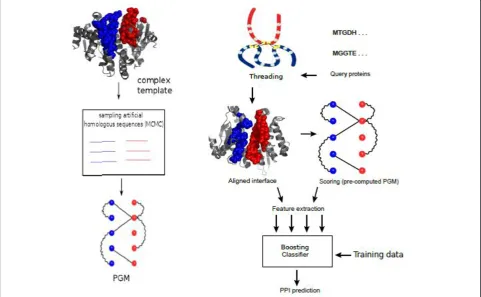
We developed Coev2Net (Figure 1), a framework for assessing confidence in protein interactions. To quantify confidence in an interactome, we incorporate high-confidence data sources, namely low-throughput inter-actions and structural information. The framework gives a confidence score for each interaction, along with a
predicted model of the binding interface for the proteins (Figure 1).
Inputs to the framework are a high-confidence network (usually much smaller than the HTP screen) and the inter-actions identified from the HTP experiment for which one wishes to quantify confidence. For every pair of interaction in the HTP screen, Coev2Net provides a score to assess their likelihood of being co-evolved from interacting homologous sequences (see Materials and methods). To do this, Coev2Net first predicts a likely interface model for the two proteins, by threading [69] the sequences onto the best-fit template complex in our library. It then computes the likelihood of co-evolution of the two proteins (that is, of the predicted interface) with respect to a probabilistic graphical model (PGM) induced by the aligned interfaces of artificial homologous sequences (Figure 2; Materials and methods; Additional file 1). By generating artificial sequences, we enrich the interfacial sequence/structure profiles for those protein-pairs with sparse interacting-sequence profiles and thus improve protein interface scor-ing accuracy. Note that this enrichment is carried out for all protein pairs, irrespective of the information content in their individual sequence profiles. These PGM scores are
then input into a classifier trained on a small high-confi-dence network to compute a score between 0 and 1, repre-senting the confidence of our method in that interaction (Figure 1). High-scoring interactions can then be investi-gated further using a secondary experimental assay or taken as true positives for subsequent analyses. Addition-ally, since Coev2Net is a structure-based algorithm, it also produces as output a putative interface for the interacting pair (Figure 2). This information can be analyzed to design site-directed experiments to further characterize the speci-ficity of the interaction.
Benchmarking Coev2Net
SCOPPI
[image:4.595.57.539.382.679.2]We first benchmark Coev2Net on SCOPPI [70], a protein complex database. The database is divided into interacting family pairs for which multiple complexes have been solved. Rigorous cross-validation tests on the database indi-cate that Coev2Net achieves high accuracies, thereby vali-dating our approach of modeling interface co-evolution as a high-dimensional sampling problem (Figure S3 in Addi-tional file 1). For the cross-validation tests, we considered only those family pairs in SCOPPI that have at least three
non-redundant (sequence id < 50%) complexes. We ran-domly selected one as the test complex and used the other complexes within our Coev2Net protocol to simulate inter-acting homologs and construct the PGM (Figure 2). We additionally compared Coev2Net’s performance on the SCOPPI dataset to another structure-based method, PRISM [45]. PRISM first identifies similar templates to two query structures by structural alignment. The final predic-tion is based upon the energy of complex formapredic-tion calcu-lated by docking these two predicted interfaces. We find that Coev2Net’s performance, measured in terms of sensi-tivity and specificity, is much better than PRISM’s on this dataset (Figure S3 in Additional file 1).
Furthermore, Coev2Net also performs well on SCOPPI family pairs not having more than two non-redundant complexes, indicating Coev2Net’s ability to deal with limitations of both structural and sequence training data (Figure S3 in Additional file 1).
MAPK interactome validation
To test the framework’s ability to predict interactions for which there is often no structural data available and to assign confidence values to interactions, we re-trained Coev2Net on a high-quality human MAPK PPI network [67] and tested it on another high-quality MAPK network [68] (Figure 3a-c). Oddly, these two MAPK networks are almost disjoint with only 6 overlapping interactions out of 4,904 total interactions (Figure 3a). In the Bandyopad-hyay set [67], we could make predictions for 461 interac-tions, in the Vinayagam set [68], 1,025 interacinterac-tions, and in the negatome (PDB-negative set, seeDatasetsin Addi-tional File 1), 330 non-interactors. To check for known complexes in the two MAPK networks, for each interac-tion, we ran BLAST against the entire PDB to identify homologous complexes. We were able to find only 22 pairs for which a solved homologous complex exists in the PDB (we used an E-value cutoff of 1e-40). On the other hand, our threading-based approach can make pre-dictions for approximately 1,500 interactions in the MAPK networks, indicating that our method extends predictions to those pairs for which a clear homologous complex does not exist. The Bandyopadhyay set was further divided into a‘core’set of interactions (640), of which we could make predictions for 173 pairs. The defi-nitions for core set and non-core set were taken as in the original citation [67]. This core set of interactions con-tains high-confidence interactions that are conserved in yeast [67].
To test the accuracy of Coev2Net’s predictions, we first validated our method via five-fold cross-validation on the high-confidence core set of interactions in the Bandy-opadhyay set (Figure 3c). In addition, to assess the contri-bution of co-evolutionary profiles for PPI predictions, we
compared the performance of our method to Struct2Net and a‘baseline’classifier that is trained on just the thread-ing-based features (no inter-protein features). Note that all methods are evaluated on the same dataset (the core set). Figure 3c clearly shows that Coev2Net accurately predicts interactions even when only a distant homologous com-plex is available and thus fills the existing gap in structure-based methods for PPI prediction. In addition, Figure 3c also shows that including long-distance correlations as in Coev2Net aids in PPI prediction as compared to other threading-based methods.
We trained our final classifier on the entire Bandyopad-hyay core data set, and predicted interactions in the Vinayagam dataset. For the predictions made for the lat-ter dataset, we found that the experimentally validated coverage of our method (approximately 55% with a confi-dence-score cutoff of 0.6) is significantly higher than that reported by other prediction methods based on conserva-tion, genomic data, gene ontology annotation and litera-ture extractions (approximately 14% to approximately 28%) [29], although each method was evaluated on a dif-ferent network. Here, coverage is defined as the percen-tage of total predicted interactions for which we make a positive prediction and that were validated experimen-tally in the Y2H screen (571 predicted positive out of 1,025 in the Vinayagam dataset). The cutoff of 0.6 was chosen since it corresponds to the maximum specificity and sensitivity of the logistic-regression classifier on the Bandyopadhyay core dataset.
Vinayagam dataset and testing it on the Bandyopadhyay core network yields similar results. By predicting only a fraction of interactions with high confidence, Coev2Net enables us to focus on only the most likely interactions, enabling a more accurate understanding of the biology (Figure 3b).
Experimental validation of predictions
The confidence scores given by our framework can be used to design additional experiments to enhance the quality of the initial interactome. We tested 19 randomly
chosen high confidence interactions (confidence score > 0.6) using a complementary assay (LUMIER) [71]. Each pair, along with a control, was tested at least three times using the LUMIER assay. To confirm an interaction, the average result (that is, fold change in luciferase intensity [RLU] as measured in a TECAN Infinite M200 lumines-cence plate reader) across the repeats had to be greater than 1.5 times the control. Of the 19 interactions, 14 exhibited luciferase intensity greater than 1.5 times the control (Figure 3d). Additionally, if the repeat experiments were too variable to confidently assess the interaction (as
"#$
!
"
#$
#%&!
'
()'
&*
+'*)&+,
[image:6.595.60.539.88.463.2]
!
measured using a z-score), the interaction pair was dis-carded. The z-score is calculated as:
zLUMIER=
RLU−RLUcontrol σRLU
Eight out of the 19 interactions were discarded in this way as they registered a z-score of less than 1.5 and were deemed too variable. For additional experimental details we refer the readers to a more comprehensive interactome mapping analysis in [72]. Notably, 10 out of the remaining 11 were confirmed as true interactions, that is, registering average intensity above 1.5 times the control. Overlaps achieved by our method compare favorably with previous approaches, such as Braunet al.[25], in which an initial positive reference set was re-tested experimentally using a LUMIER assay (Table 1). Furthermore, we evaluated the sequence identities between the interacting sequences and the templates used for predicting their interaction (Table 1; Additional file 1. Interestingly, we find that all of them have a medium to low average sequence identity (15 to 30%), indicating that Coev2Net yields accurate predic-tions even in the‘twilight zone’of sequence identities, where traditional homology methods usually fail. For exam-ple, IBIS [73], another homology/structure-based method, can detect only two pairs from the ten detected by Coev2-Net and experimentally validated by the LUMIER assay.
Abundance of missense SNPs at predicted interfaces
In addition to the confidence scores, Coev2Net also pro-vides a putative interface for the interaction. These inter-faces can yield novel mechanistic insights into the PPI and provide hypotheses about disease-associated mutations that occur at the interface. Missense SNPs occurring at the interface can potentially disrupt the interaction between the proteins, leading to abnormal functioning of the cell. We analyzed the predicted interfaces for existence of PolyPhen2 annotated missense mutations in dbSNP (build 131) [74]. PolyPhen2 classifies a SNP as‘benign’, ‘probably damaging’,‘possibly damaging’or ‘unknown’ based on various features, including conservation score, monomeric structure score (when available) and physico-chemical properties [75,76]. It does not, however, account
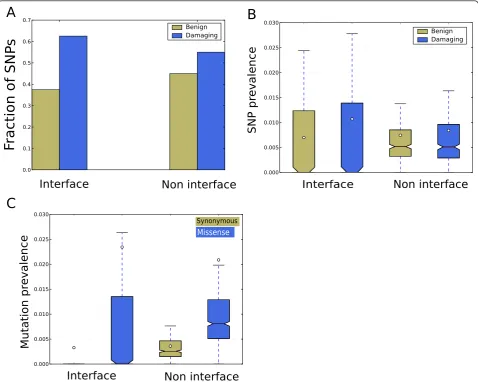
for SNPs occurring in potential interacting regions. Inter-estingly, SNPs annotated as damaging by PolyPhen2 are preferentially observed at the interface compared to non-interfaces (P = 0.0075, Fisher’s exact test; Figure 4a). Furthermore, if we take into account the number of inter-face and non-interinter-face sites, we find that the predicted interfaces are enriched for damaging SNPs compared to the rest of the protein (P < 7e-8, Fisher exact test). The same analysis with SNPs classified as benign by PolyPhen2 does not show up as highly significant (P= 0.06). We further analyzed the distribution of the SNPs in terms of their density at the interface and non-interface. Here again, we find that damaging SNPs are preferentially located on the interface. We find that the average density of damaging SNPs at the predicted interfaces is signifi-cantly higher than their density at non-interface positions (Figure 4b;P < 1e-10, Mann-Whitney test), a bias also observed by Wanget al.recently [63]. For benign SNPs, the average density at the interface is lower than that at non-interfaces (Figure 4b;P< 1e-10, Mann-Whitney test). These analyses show that there is an evolutionary pressure to admit only benign SNPs at the interface, since any potentially damaging SNP will hinder the interaction.
To investigate the structural distribution of annotated mutations, we analyzed somatic mutations characterized in cancer to see if there is any preference for their location on the protein. We analyzed annotated mutations in the cod-ing region deposited in the Cosmic database for their pre-dicted location [77]. We only considered mutations that are annotated as either synonymous or missense. Interest-ingly, for these mutations we find that missense mutations are more prevalent, on average, at the PPI interface than synonymous mutations (P< 10e-20, Mann-Whitney test; Figure 4c). This suggests that these mutations might be responsible for disruption of PPIs and the aberrant mole-cular signaling associated with cancer.
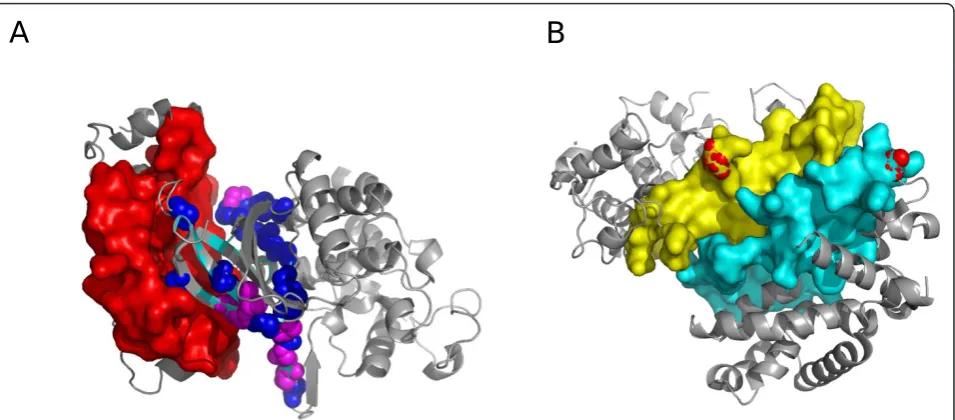
[image:7.595.55.539.635.721.2]Finally, we looked at the predicted locations for some of the un-annotated mutations in kinases (from the MoKCa database [78]). As an example, we considered the BRAF protein as it contained the highest number of annotated mutations in the database. Coev2Net predicts an interac-tion between BRAF and PAK2, using the template structure
Table 1 Comparison of overlaps achieved by Braunet al.and our method when some of the initial Y2H interaction pairs are re-tested using LUMIER assay
Yeast strains implementation Number validated (LUMIER) Y2H PPIs Percentage overlap
Y strain 2 m 1 reporter 1 mM_3-AT (Braunet al.) 19 33 57 Y strain 2 m 2 reporters 1 mM_3-AT (Braunet al.) 13 22 59 Y strain CEN 1 reporter 1 mM_3-AT (Braunet al.) 17 23 74
MaV CEN 2 reporters 20 mM_3-AT (Braunet al.) 9 14 64
Our prediction 14 19 74
Our predictiona 10 11 91
a
1G3N (chains E and F). Figure 5a shows the predicted interface for this interaction, with the annotated (magenta) and un-annotated (dark blue) mutations indicated. The presence of these mutations at the interface of the interact-ing proteins gives us an added insight into the investigation of such variations. Further study using this information can provide mechanistic details about how such mutations dis-rupt normal cellular signaling.
Novel potential cross-talk regulatory mechanism
Phosphorylation sites have been observed to be enriched at interfaces in solved structures [79]. This observation has mechanistic implications as the PPI can be used as an additional regulatory mechanism for phosphorylation, or the interaction could be a precursor to phosphoryla-tion. An example for such a mechanism is found in the
signaling protein YWHAZ [80]. Its phosphorylation is regulated by its dimerization, which buries the phospho-sites on YWHAZ [81]. Our predictions revealed an interesting observation that suggests similar regulatory mechanisms in the MAPK interactome. Coev2Net pre-dicts an interaction between MAPK6 and YWHAZ. Both are important signaling proteins, with much known about YWHAZ, including the experimental observation that MAPK8 regulates phosphorylation at S184 [82]. Relatively less is known about MAPK6’s func-tion and its substrates [83]. However, it is known that S189 is a phospho-site regulated by PAK1, PAK2 and PAK3 [84-86]. Interestingly, we found that the phos-phorylation sites for both MAPK6 (S189) and YWHAZ (S184) lie within the predicted interface for the interac-tion (Figure 5b). This structural observainterac-tion could imply
[image:8.595.59.538.89.471.2]
that the interaction regulates downstream activities of MAPK6 and YWHAZ by controlling their phosphoryla-tion. The most likely mechanism is that MAPK6 phos-phorylates YWHAZ, thereby preventing its dimerization and regulating downstream activities of YWHAZ. Addi-tionally, Coev2Net also predicts an interaction between MAPK6 and FOXO3. From a signaling context, these observations suggest a possible mechanism of crosstalk between the MAPK and insulin pathways. Analysis and validation of such a hypothesis is, however, beyond the scope of the present study.
Discussion
We have proposed a novel structure-based computa-tional approach to identify PPIs on a genome-wide scale. Using structural features, we have demonstrated that our method can not only identify true-interactions better than previous approaches, but also provide key biological insights that are absent from HTP experiments.
While it has been shown previously for some families that residues in and around the interface have correlated evolutionary histories, extracting such robust correlation signals for predictive purposes on a genome scale has remained difficult due to limited known interacting homologs. In the context of homology search for only monomers, enriching a multiple sequence alignment with artificial sequences has proven to be effective in the case of limited homologs [87,88]. Utilizing a statistical model for constructing evolutionarily correlated interact-ing homologs for a given interactinteract-ing pair of proteins, we
are able to simulate homologous sequences and predict PPIs from correlations at the interface of these homologs. The excellent performance of our method helps corrobo-rate the hypothesis of residue-level correlations for a wide variety of PPIs and provides an efficient way of using these correlations for predictive purposes.
As more and more HTP data for mapping the interac-tome are gathered, there would be a necessary demand for automatic protocols to evaluate the data quality and esti-mate the confidence in individual interactions. In particu-lar, transient interactions have been notoriously difficult to elucidate and validate. We have shown that confidence in PPIs investigated through HTP techniques can be quanti-fied and enhanced by our proposed complementary struc-ture-based PPI prediction algorithm. Our PPI predictions on recent HTP human MAPK interactomes and further experimental validations have indicated the efficacy of our predicted confidence scores. Moreover, since our frame-work requires only the sequences of the two candidate proteins, it can be used as a complementary feature to other methods that rely on additional features [31,89].
Limited studies have been undertaken to link structural features to genome-wide interactomes to gain a mechanis-tic understanding of underlying biological processes. Our threading-based approach enables us to extend coverage of structure-based studies further than that possible by homology models (see the‘MAPK interactome validation’ section). As a result, the predicted structures are more reliable and provide a sound basis for mechanistic hypoth-eses. We provide an anecdotal example by analyzing the
[image:9.595.61.539.88.298.2]distribution of annotated missense SNPs in our predicted models. In agreement with a recent study [63], we show that such mutations are enriched at the interfaces. Furthermore, detailed analysis of phosphorylation sites enables us to propose a crosstalk mechanism involving an atypical kinase, MAPK6. Predictions made by our model for the potential interactors of MAPK6 provide the basis for further exploration of the role of this relatively less-studied kinase.
Conventional homology-based methods such as inter-Prets [44], IBIS [73] and PRISM [45] perform well when a similar template is found in the PDB. Threading based-methods provide predictions even when such conventional methods cannot find a suitable template. Furthermore, as we show in this paper, accuracy achieved by our thread-ing-based method is the best amongst current structure-based methods. Coev2Net acts as a complement to con-ventional homology methods whenever a clear template for prediction is not available and expands threading methods by incorporating coevolution of protein inter-faces. However, performance of threading-based techni-ques has been shown to decline when the query sequences are distantly related to the template (sequence identities < 15 to 20%) [49,65]. While we currently use RAPTOR for identifying the putative interface, we hope to further push this limit by integrating new threading programs like RAP-TORX [90] and iWRAP [49] into Coev2Net. While we encode our interface profile as a spanning-tree based gra-phical model, we believe this is a simplistic approximation of the reality. More complicated graphs could potentially be required for particular families of interacting proteins. Finally, we note that transient interactions are notoriously difficult to predict using structure-based interactions. Our validation using a technique (LUMIER) that can detect even transient interactions provides some confidence in predictions of transient interactions by Coev2Net.
Materials and methods Coev2Net algorithm
The Coev2Net algorithm can be roughly divided into three distinct stages: 1) identification of the putative binding interface; 2) evaluation of the compatibility of the interface with an interface co-evolution-based model (see ‘Con-struction of the interface profile through simulated co-evolution’below); and 3) evaluation of the confidence score for the interaction.
Identification of the putative interface
The two query sequences are each threaded against a com-plex template library to search for the best template. We use a top-performing threader program‘RAPTOR’[69,90] to look for the best template match. Given a set of poten-tial template matches, the best match is selected based on the z-score of the alignment. In order to evaluate the
putative interface implied by the alignment, we calculate its compatibility with respect to the co-evolutionary profile for that interface.
Evaluating the interface
The predicted interface is evaluated by computing the log-likelihood of the interface residues with respect to the interface profiles described below - a PGM for inter-acting pairs (’positive’) and another graphical model representing background correlations (’negative’). A high log-likelihood with respect to the‘positive’PGM implies that the protein sequences show co-evolution at the interface, compatible with the model, and are hence likely to interact.
Computing confidence score
Once we have the compatibility scores for the predicted interface, we use these as features to predict our confi-dence in the interaction. A logistic-regression classifier is trained on a high-confidence network, and is used to pre-dict our confidence score for the interaction, which is the output of the classifier. Both alignment features (from stage 1: Identification of interface) and interface features (from stage 2: Evaluating the interface) are used as features in the classifier. Ifpis the probability of interaction (or our confidence score), then:
log p
1−p=α+β T
1X1+β2TX2+βiYi+β+TL++β−TL−
whereXiare the alignment features for each protein in
the interacting pair (these include sequence scores, sec-ondary structure scores and protein lengths);Yiis the size
of the interface;L+is the log-likelihood score of the
pre-dicted interface with respect to the positive tree, andL
-the log-likelihood score of -the predicted interface with respect to the negative tree. Thea,b1,b2,bi,b+ andb -are coefficients of the classifier.
Construction of the interface profile through simulated co-evolution
Seeding the co-evolution
We start the simulation from known complexes within a SCOPPI family. We first align the interfaces using a con-tact map alignment program, CMAPi [95]. CMAPi employs a contact map representation to efficiently align multiple interfaces and thereby improves alignments as compared to other sequence and structure-based techni-ques. The simulation is performed on each aligned interface.
Simulating co-evolution for an interface
For each pair of aligned seed sequences (full proteins forming the complex), additional sequences are con-structed via random mutations according to a probability distribution (Figure S1 in Additional file 1) based on paired positions within interfaces of complexes. To per-form a mutation at a contact, we first randomly fix one amino acid in the contact, and sample the contacting amino acid from a distribution conditioned on the fixed amino acid (see Figure S2 in Additional file 1 for a sche-matic). The new contact thus has one amino acid as before, and the contacting amino acid mutated according to a conditional probability distribution. Each contact is treated independently, with 5% of the interface contacts mutated at each step. For non-contacting residues, muta-tions are performed independently in the two proteins according to the BLOSUM62 matrix. Again, 5% of the non-contacting residues are mutated in one step. The percentage of mutations to carry out in one step (that is, 5%) was chosen based on previous studies on simulated evolution for remote homolog detection [96].
The new sequences are first aligned to the hidden Markov models (HMMs) representing the corresponding protein families, and the alignment scores computed. They are then accepted or rejected in a stochastic manner, based on their joint fitness score. The mutation and sto-chastic selection of interacting sequences can be viewed as a Markov chain Monte Carlo (MCMC) algorithm [97] for a high-dimensional sampling problem - we rigorously prove this correspondence in the supplemental methods in Additional file 1.
Learning the PGM
Once we have sufficient sequences (that is, after the MCMC converges), we encode the pairwise correlations observed in these‘interacting’sequences using a PGM. Our motivations for introducing a PGM are twofold: 1) analogous to a sequence profile, a PGM is a ‘profile’ that can be used to score predicted interfaces; and 2) to explicitly capture long-distance correlations (non-con-tact-based) at or near the interface residues. We select 1,000 interacting sequences per training complex as our interacting set (to avoid large sample-sample fluctuations, we select close to 2,500 sequences for SCOPPI families having only one training complex). To model the correla-tions between residues of these interacting proteins, we
use the Sanghavi-Tan-Willsky algorithm [98] to construct two trees - one for the simulated interacting proteins (’positive’) and one for background correlations (’nega-tive’). These two trees are our interface profiles for the particular SCOPPI family and can be pre-computed before making any predictions. We restricted ourselves to span-ning trees for ease of learspan-ning and inference. In fact, other inference methods, such as belief propagation, would work on a loopy graph (that is, the loopy network of contacts at the interface) but their behavior is not easy to control and very sensitive to the initialization. Note that our profiles of the interface residues are different from the HMM ones since our interface profiles are purposely computed from only interacting sequences; the HMM is constructed from independent sequences that do not necessarily interact.
Evaluation of the classifiers
The individual methods were evaluated based on their ability to correctly predict true-positives and true-nega-tives. To do this, we plot receiver operator characteristic (ROC) curves for each method. In our ROC curves, sensi-tivity is defined as True-positives/(True-positives + False-negatives) and specificity is defined as True-negatives/ (True-negatives + False-positives). For a high-confidence true-positive and true-negative dataset, we perform five-fold cross-validation (CV) tests for each method (Coev2Net, Struct2Net and Baseline), and plot the average sensitivities (at particular specificities) for these five runs. For Coev2Net, we run the MCMC sampling 5 times, and average the performance across these 25 curves (5 MCMC × 5 CV). To compare against interPrets, we used a cutoff on the z-score computed by the algorithm to classify a prediction as positive or negative. Since there is no train-ing required here, there was no need for a cross-validation. For the computationally intensive IBIS [73], we compared our predictions on the ten pairs validated using the LUMIER assay.
Additional material
Additional file 1: Supplementary methods on the algorithm, results on benchmarking and comparison with other methods.
Abbreviations
HMM: hidden Markov model; HTP: high-throughput; MAPK: mitogen-activated protein kinase; MCMC: Markov chain Monte Carlo; PGM: probabilistic graphical model; PPI: protein-protein interaction; ROC: receiver operator characteristic; SNP: single nucleotide polymorphism; Y2H: yeast-2-hybrid.
Authors’contributions
experiments. AV, NP and US provided feedback on the manuscript and suggested applications for the algorithm. RH, JP, JB and BB wrote the manuscript. All authors read and approved the final manuscript.
Competing interests
The authors declare that they have no competing interests.
Acknowledgements
We thank George Tucker and Jason Trigg for discussions on methods, and Lenore Cowen and Noah Daniels, simulated evolution. Funding for this work was provided by the NIH (grant number R01GM081871 to BB and grant number R01DK088718 to NP) and HHMI (to NP).
Author details
1Computer Science and Artificial Intelligence Laboratory, 32 Vassar Street, MIT, Cambridge, MA 02139, USA.2Toyota Technological Institute, 6045 S. Kenwood Ave, Chicago, IL 60637, USA.3Department of Genetics, 77 Avenue Louis Pasteur, Harvard Medical School, Boston, MA 02115, USA.4 Otto-Warburg Laboratory, Ihnestrabe 63-73, Max Planck Institute for Molecular Genetics, Berlin D14195, Germany.5Howard Hughes Medical Institute, 20 Shattuck Street, Boston, MA 02115, USA.6Computational Biology group, Biogen Idec, 14 Cambridge Center, Cambridge, MA 02142, USA.7Department of Mathematics, 77 Massachusetts Avenue, MIT, Cambridge, MA 02139, USA.
Received: 3 May 2012 Revised: 31 July 2012 Accepted: 31 August 2012 Published: 31 August 2012
References
1. Giot L, Bader JS, Brouwer C, Chaudhuri A, Kuang B, Li Y, Hao YL, Ooi CE, Godwin B, Vitols E, Vijayadamodar G, Pochart P, Machineni H, Welsh M, Kong Y, Zerhusen B, Malcolm R, Varrone Z, Collis A, Minto M, Burgess S, McDaniel L, Stimpson E, Spriggs F, Williams J, Neurath K, Ioime N, Agee M, Voss E, Furtak K, Renzulli R,et al:A protein interaction Map ofDrosophila melanogaster.Science2003,302:1727-1736.
2. Li S, Armstrong CM, Bertin N, Ge H, Milstein S, Boxem M, Vidalain PO, Han JD, Chesneau A, Hao T, Goldberg DS, Li N, Martinez M, Rual JF, Lamesch P, Xu L, Tewari M, Wong SL, Zhang LV, Berriz GF, Jacotot L, Vaglio P, Reboul J, Hirozane-Kishikawa T, Li Q, Gabel HW, Elewa A, Baumgartner B, Rose DJ, Yu H,et al:A map of the interactome network of the metazoanC. elegans.Science2004,303:540-543.
3. Rual JF, Venkatesan K, Hao T, Hirozane-Kishikawa T, Dricot A, Li N, Berriz GF, Gibbons FD, Dreze M, Ayivi-Guedehoussou N, Klitgord N, Simon C, Boxem M, Milstein S, Rosenberg J, Goldberg DS, Zhang LV, Wong SL, Franklin G, Li S, Albala JS, Lim J, Fraughton C, Llamosas E, Cevik S, Bex C, Lamesch P, Sikorski RS, Vandenhaute J, Zoghbi HY,et al:Towards a proteome-scale map of human protein-protein interaction network. Nature2005,437:1173-1178.
4. Uetz P, Giot L, Cagney G, Mansfield TA, Judson RS, Knight JR, Lockshon D, Narayan V, Srinivasan M, Pochart P, Qureshi-Emili A, Li Y, Godwin B, Conover D, Kalbfleisch T, Vijayadamodar G, Yang M, Johnston M, Fields S, Rothberg JM:A comprehensive analysis of protein-protein interactions in Saccharomyces cerevisiae.Nature2000,403:623-627.
5. Stelzl U, Worm U, Lalowski M, Haenig C, Brembeck FH, Goehler H, Stroedicke M, Zenkner M, Schoenherr A, Koeppen S, Timm J, Mintzlaff S, Abraham C, Bock N, Kietzmann S, Goedde A, Toksöz E, Droege A, Krobitsch S, Korn B, Birchmeier W, Lehrach H, Wanker EE:A human protein-protein interaction network: A resource for annotating the proteome. Cell2005,122:957-968.
6. Yu H, Braun P, Yildirim MA, Lemmens I, Venkatesan K, Sahalie J, Hirozane-Kishikawa T, Gebreab F, Li N, Simonis N, Hao T, Rual JF, Dricot A, Vazquez A, Murray RR, Simon C, Tardivo L, Tam S, Svrzikapa N, Fan C, de Smet AS, Motyl A, Hudson ME, Park J, Xin X, Cusick ME, Moore T, Boone C, Snyder M, Roth FP,et al:High-quality binary protein interaction map of the yeast interactome network.Science2008,322:104-110.
7. Simonis N, Rual JF, Carvunis AR, Tasan M, Lemmens I, Hirozane-Kishikawa T, Hao T, Sahalie JM, Venkatesan K, Gebreab F, Cevik S, Klitgord N, Fan C, Braun P, Li N, Ayivi-Guedehoussou N, Dann E, Bertin N, Szeto D, Dricot A, Yildirim MA, Lin C, de Smet AS, Kao HL, Simon C, Smolyar A, Ahn JS, Tewari M, Boxem M, Milstein S,et al:Empirically controlled mapping of theCaenorhabditis elegansprotein-protein interactome network.Nat Methods2009,6:47-54.
8. Formstecher E, Aresta S, Collura V, Hamburger A, Meil A, Trehin A, Reverdy C, Betin V, Maire S, Brun C, Jacq B, Arpin M, Bellaiche Y, Bellusci S, Benaroch P, Bornens M, Chanet R, Chavrier P, Delattre O, Doye V, Fehon R, Faye G, Galli T, Girault JA, Goud B, de Gunzburg J, Johannes L, Junier MP, Mirouse V, Mukherjee A,et al:Protein interaction mapping: aDrosophila case study.Genome Res15:376-384.
9. Ewing RM, Chu P, Elisma F, Li H, Taylor P, Climie S, McBroom-Cerajewski L, Robinson MD, O’Connor L, Li M, Taylor R, Dharsee M, Ho Y, Heilbut A, Moore L, Zhang S, Ornatsky O, Bukhman YV, Ethier M, Sheng Y, Vasilescu J, Abu-Farha M, Lambert JP, Duewel HS, Stewart II, Kuehl B, Hogue K, Colwill K, Gladwish K, Muskat B,et al:Large-scale mapping of human protein-protein interactions by mass spectrometry.Mol Syst Biol2007,
3:89.
10. Sardiu ME, Washburn MP:Building protein-protein interaction networks with proteomics and informatics tools.J Biol Chem286:23645-23651. 11. Bonetta L:Protein-protein interactions: Tools for the search.Nature2010,
468:852.
12. Lees JG, Heriche JK, Morilla I, Ranea JA, Orengo CA:Systematic
computational prediction of protein interaction networks.Phys Biol2011,
8:035008.
13. Kocher T, Superti-Furga G:Mass spectrometry-based functional proteomics: from molecular machines to protein networks.Nat Methods
2007,4:807-815.
14. Guruharsha KG, Rual JF, Zhai B, Mintseris J, Vaidya P, Vaidya N, Beekman C, Wong C, Rhee DY, Cenaj O, McKillip E, Shah S, Stapleton M, Wan KH, Yu C, Parsa B, Carlson JW, Chen X, Kapadia B, VijayRaghavan K, Gygi SP, Celniker SE, Obar RA, Artavanis-Tsakonas S:A protein complex network of Drosophila melanogaster.Cell147:690-703.
15. Collins SR, Kemmeren P, Zhao XC, Greenblatt JF, Spencer F, Holstege FC, Weissman JS, Krogan NJ:Toward a comprehensive atlas of the physical interactome ofSaccharomyces cerevisiae.Mol Cell Proteomics2007,
6:439-450.
16. Elefsinioti A, Saraç ÖS, Hegele A, Plake C, Hubner NC, Poser I, Sarov M, Hyman A, Mann M, Schroeder M, Stelzl U, Beyer A:Large-scale de novo prediction of physical protein-protein association.Mol Cell Proteomics
2011,10, M111.010629.
17. Stark C, Breitkreutz B, Reguly T, Boucher L, Brietkreutz A, Tyers M:BIOGRID: A general repository for interaction datasets.Nucleic Acids Res2006,
34:535.
18. Sontag D, Singh R, Berger B:Probabilistic modeling of systematic errors in two-hybrid experiments.Pac Symp Biocomput2007,12:445-457. 19. Björkland A, Light S, Hedin L, Elofsson A:Quantitative assessment of the
structural bias in protein-protein interaction assays.Proteomics2008,
8:4657-4667.
20. Vazquez A, Rual J, Venkatesan K:Quality control methodology for high-throughput protein-protein interaction screening.Methods Mol Biol2011,
781:279-294.
21. von Mering C, Krause R, Snel B, Cornell M, Oliver SG, Fields S, Bork P:
Comparative assessment of large-scale data sets of protein-protein interactions.Nature2002,417:399-403.
22. Venkatesan K, Rual JF, Vazquez A, Stelzl U, Lemmens I, Hirozane-Kishikawa T, Hao T, Zenkner M, Xin X, Goh KI, Yildirim MA, Simonis N, Heinzmann K, Gebreab F, Sahalie JM, Cevik S, Simon C, de Smet AS, Dann E, Smolyar A, Vinayagam A, Yu H, Szeto D, Borick H, Dricot A, Klitgord N, Murray RR, Lin C, Lalowski M, Timm J,et al:An empirical framework for binary interactome mapping.Nat Methods2008,6:83-90.
23. Yu J, Finley RL:Combining multiple positive training sets to generate confidence scores for protein-protein interactions.Bioinformatics2009,
25:105-111.
24. Dreze M, Monachello D, Lurin C, Cusick ME, Hill DE, Vidal M, Braun P: High-quality binary interactome mapping.Methods Enzymol2010,470:281-315. 25. Braun P, Tasan M, Dreze M, Barrios-Rodiles M, Lemmens I, Yu H, Sahalie JM, Murray RR, Roncari L, de Smet AS, Venkatesan K, Rual JF, Vandenhaute J, Cusick ME, Pawson T, Hill DE, Tavernier J, Wrana JL, Roth FP, Vidal M:An experimentally derived confidence score for binary protein-protein interactions.Nat Methods2009,6:91-97.
26. Sambourg L, Thierry-Mieg N:New insights into protein-protein interaction data lead to increased estimates of the S. cerevisiae interactome size. BMC Bioinformatics2010,11:605.
Ecker JR, Roth FP, Vidal M:Literature-curated protein interaction datasets. Nature Methods2009,6:39-46.
28. Suthram S, Shlomi T, Ruppin E, Sharan R, Ideker T:A direct comparison of protein interaction confidence assignment schemes.BMC Bioinformatics
2006,7:360.
29. Schwartz A, Yu J, Gardenour K, Finley R Jr, Ideker T:Cost-effective strategies for completing the interactome.Nat Methods2009,6:55-61. 30. Choi H, Larsen B, Lin ZY, Breitkreutz A, Mellacheruvu D, Fermin D, Qin ZS,
Tyers M, Gingras AC, Nesvizhskii AI:SAINT: probabilistic scoring of affinity purification-mass spectrometry data.Nature Methods2011,8:70-73. 31. Bader J, Chaudhuri A, Rothberg J, Chant J:Gaining confidence in
high-throughput protein interaction networks.Nat Biotechnol2003,22:78-85. 32. Singh R, Xu J, Berger B:Struct2Net: integrating structure into
protein-protein interaction prediction.Pac Symp Biocomput2006,11:403-414. 33. Jansen R, Yu H, Greenbaum D, Kluger Y, Krogan NJ, Chung S, Emili A,
Snyder M, Greenblatt JF, Gerstein M:A Bayesian networks approach for predicting protein-protein interactions from genomic data.Science2003,
302:449-453.
34. Ben-Hur A, Noble W:Kernel methods for predicting protein-protein interactions.Bioinformatics2005,21:38.
35. Betel D, Breitkreuz K, Isserlin R, Dewar-Barch D, Tyers M, Hogue C:
Structure-templated predictions of novel protein interactions from sequence information.PLoS Comput Biol2007,3:e182.
36. Burger L, Nimwegen E:Accurate prediction of protein-protein interactions from sequence alignments using a Bayesian method. Mol Syst Biol2008,4:165.
37. Deng M, Mehta S, Sun F, Chen T:Inferring domain-domain interactions from protein-protein interactions.Genome Res2002,12:1540-1548. 38. Encinar JA, Fernandez-Ballester G, Sanchez IE, Hurtado-Gomez E, Stricher F,
Beltrao P, Serrano L:ADAN: a database for prediction of protein-protein interaction of modular domains mediated by linear motifs.Bioinformatics
2009,25:2418-2424.
39. Shen J, Zhang J, Luo X, Zhu W, Yu K, Chen K, Li Y, Jiang H:Predicting protein-protein interactions based only on sequences information.Proc Natl Acad Sci USA2007,104:4337-4341.
40. Valencia A, Pazos F:Computational methods for the prediction of protein interactions.Curr Opin Struct Biol2002,12:368-373.
41. Valencia A, Pazos F:In silicotwo-hybrid system for the selection of physically interacting protein pairs.Proteins2002,47:219-227. 42. Gomez S, Noble W, Rzhetsky A:Learning to predict protein-protein
interactions from protein sequences.Bioinformatics2003,19:1875-1881. 43. Aloy P, Russell R:Structural systems biology: modelling protein
interactions.Nat Rev Mol Cell Biol2006,7:188-197.
44. Aloy P, Russell RB:Interrogating protein interactions networks through structural biology.Proc Natl Acad Sci USA2002,99:5896-5901. 45. Aytuna A, Gursoy A, Keskin O:Prediction of protein-protein interactions
by combining structure and sequence conservation in protein interfaces. Bioinformatics2005,21:2850-2855.
46. Edwards AM, Kus B, Jansen R, Greenbaum D, Greenblatt J, Gerstein M:
Bridging structural biology and genomics: assessing protein interaction data with known complexes.Trends Genet2002,18:529-536.
47. Fukuhara N, Go N, Kawabata T:Prediction of interacting proteins from homology-modeled complex structure using sequence and structure scores.Biophys J2007,3:13-26.
48. Fukuhara N, Go N, Kawabata T:HOMCOS: a server to predict interacting protein pairs and interacting sites by homology modeling of complex structures.Nucleic Acids Res2008,36(Web Server):185.
49. Hosur R, Xu J, Bienkowska J, Berger B:iWRAP: an interface threading approach with application to cancer-related protein-protein interactions. J Mol Biol2011,405:1295-1310.
50. Huang Y, Hang D, Lu L, Tong L, Gerstein M, Montelione G:Targeting the human cancer pathway protein interaction network by strutural genomics.Mol Cell Proteomics2008,7:2048-2060.
51. Kim P, Lu L, Xia Y, Gerstein M:Relating three-dimensional structures to protein networks provides evolutionary insights.Science2006,
314:1938-1941.
52. Kittichotirat W, Guerquin M, Bumgarner RE, Samudrala R:Protinfo PPC: a web server for atomic level prediction of protein complexes.Nucleic Acids Res2009,37:519.
53. Kundrotas P, Vakser I:Accuracy of protein-protein binding sites in high-throughput template-based modeling.PLoS Comput Biol2010,6:1000727.
54. Lu H, Lu L, Skolnick J:Development of unified statistical potentials describing protein-protein interactions.Biophys J2003,84:1895-1901. 55. Lu L, Lu H, Skolnick J:MULTIPROSPECTOR: An algorithm for the
prediction of protein-protein interactions by multimeric threading. Proteins2002,49:350-364.
56. Mukherjee S, Zhang Y:Protein-protein complex structure predictions by multimeric threading and template recombination.Structure2011,
19:955-966.
57. Stein A, Russell R, Aloy P:3did: interacting protein domains of known three-dimensional structure.Nucleic Acids Res2005,33:D413-D417. 58. Stein A, Mosca R, Aloy P:Three-dimensional modeling of protein
interactions and complexes is going‘omics.Curr Opin Struct Biol2011,
21:200-208.
59. Tuncbag N, Gursoy A, Keskin O:Prediction of protein-protein interactions: unifying evolution and structure at protein interfaces.Phys Biol2011,
8:035006.
60. Tuncbag N, Gursoy A, Nussinov R, Keskin O:Predicting protein-protein interactions on a proteome scale by matching evolutionary and structural similarities at interfaces using PRISM.Nat Protoc2011,
6:1341-1354.
61. Tyagi M, Hashimoto K, Shoemaker BA, Wuchty S, Panchenko AR: Large-scale mapping of human protein interactome using structural complexes.EMBO Rep2012,13:266-271.
62. Tyagi M, Thangudu RR, Zhang D, Bryant SH, Madej T, Panchenko AR:
Homology inference of protein-protein interactions via conserved binding sites.PLoS One2012,7:28896.
63. Wang X, Wei X, Thijssen B, Das J, Lipkin S, Yu H:Three-dimensional reconstruction of protein networks provides insight into human genetic disease.Nat Biotechnol2012,30:159-164.
64. Wass MN, David A, Sternberg MJ:Challenges for the prediction of macromolecular interactions.Curr Opin Struct Biol2011,21:382-390. 65. Pulim L, Bienkowska J, Berger B:LTHREADER: Prediction of extracellular
Ligand-Receptor interactions in cytokines using localized threading. Protein Sci2008,17:279-292.
66. Singh R, Park D, Xu J, Hosur R, Berger B:Struct2Net: a web service to predict protein-protein interactions using a structure-based approach. Nucleic Acids Res2010,38(Web Server):W508-W515.
67. Bandyopadhyay S, Chiang C, Srivastava J, Gersten M, White S, Bell R, Kurschner C, Martin C, Smoot M, Sahasrabudhe S, Barber D, Chanda S, Ideker T:A human MAP kinase interactome.Nat Methods2010,7:801-805. 68. Vinayagam A, Stelzl U, Foulle R, Plassmann S, Zenkner M, Timm J, Assmus H, Andrade-Navarro M, Wanker E:A directed protein interaction network for investigating intracellular signal transduction.Sci Signaling2011,4:rs8. 69. Xu J, Li M, Kim D, Xu Y:RAPTOR: optimal protein threading by linear
programming.J Bioinform Comput Biol2003,1:95-117. 70. Winter C, Henschel A, Kim WK, Schroeder M:SCOPPI: a structural
classification of protein-protein interfaces.Nucleic Acids Res2006,
34(Database):310-314.
71. Barrios-Rodiles M, Brown K, Ozdamar B, Bose R, Liu Z, Donovan R, Shinjo F, Liu Y, Dembowy J, Taylor I, Luga V, Przulj N, Robinson M, Suzuki H, Hayashizaki Y, Jurisica I, Wrana J:High-throughput mapping of a dyamic signaling network in mammalian cells.Science2005,307:1621-1625. 72. Hegele A, Kamburov A, Grossmann A, Sourlis C, Wowro S, Weimann M,
Will C, Pena V, Lyhrmann R, Stelzl U:Dynamic protein-protein interaction wiring of the human spliceosome.Mol Cell2012,45:567-580.
73. Shoemaker A, Zhang D, Tyagi M, Thangudu R, Fong J, Marchler-Bauer A, Bryant S, Madej T, Panchenko A:IBIS (Inferred Biomolecular Interaction Server) reports, predicts and integrates multiple types of conserved interactions for proteins.Nucleic Acids Res2012,40(Database):D834-D840. 74. Sherry S, Ward M, Kholodov M, Baker J, Phan L, Smigielski E, Sirotkin K:
dbSNP: the NCBI database of genetic variation.Nucleic Acids Res2001,
29:308-311.
75. Ramensky V, Bork P, Sunyaev S:Human non-synonymous SNPs: server and survey.Nucleic Acids Res2002,30:3894-3900.
76. Adzhubei I, Schmidt S, Peshkin L, Ramensky V, Gerasimova A, Bork P, Kondrashov A, Sunyaev S:A method and server for predicting damaging missense mutations.Nat Methods2010,7:248-249.
78. Richardson C, Gao Q, Mitsopoulous C, Zvelebil M, Pearl L, Pearl F:MoKCa database - mutations of kinases in cancer.Nucleic Acids Res2009,
37(Database):824-831.
79. Nishi H, Hashimoto K, Panchenko A:Phosphorylation in protein-protein binding: effect on stability and function.Structure2011,19:1807-1815. 80. Morrison D:The 14-3-3 proteins: integrators of diverse signaling cues that impact cell fate and cancer development.Trends Cell Biol2008,
19:16-23.
81. Woodcock J, Murphy J, Stomski F, Berndt M, Lopez A:The dimeric versus monomeric status of 14-3-3zeta is controlled by phosphoryltion of Ser58 at the dimeric interface.J Biol Chem2003,278:36323-36327.
82. Yoshida K, Yamaguchi T, Natsume T, Kufe D, Miki Y:JNK phosporylation of 14-3-3 proteins regulates nuclear targeting of c-Abl in the apoptotic response to DNA damage.Nat Cell Biol2005,7:278-285.
83. Julien C, Coulombe P, Meloche S:Nuclear export of ERK3 by a CRM1-dependent mechanism regulates its inhibitory action on cell-cycle progression.J Biol Chem2003,278:42615-42624.
84. Opperman F, Gnad F, Olsen J, Hornberger R, Greff Z, Keri G, Mann M, Daub H:Large-scale proteomics analysis of the human kinome.Mol Cell Proteomics2009,8:1751-1764.
85. Deleris P, Trost M, Topsirovic I, Tanguay P, Borden K, Thibault P, Meloche S:
Activation loop phosphorylation of ERK3/ERK4 by group I p21-activated kinases (PAKs) defines a novel PAK-ERK3/4-MAPK-activated protein kinase 5 signaling pathway.J Biol Chem2011,286:6470-6478.
86. Dephoure N, Zhou C, Villen J, Beausoleil S, Bakalarski C, Elledge S, Gygi S:A quantitative atlas of mitotic phosphorylation.Proc Natl Acad Sci USA2008,
105:10762-10767.
87. Kumar A, Cowen L:Augmented training of Hidden Markov Models to recognize remote homologs via simulated evolution.Bioinformatics2009,
25:1602-1608.
88. Kumar A, Cowen L:Recognition of beta-structural motifs using hidden Markov models trained with simulated evolution.Bioinformatics2010,
26:287.
89. Huang H, Bader J:Precision and recall estimates for two-hybrid screens. Bioinformatics2009,25:372-378.
90. Peng J, Xu J:RaptorX: Exploiting structure information for protein alignment by statistical inference.Proteins2011,79:161-171.
91. Kann M, Shoemaker B, Panchenko A, Przytycka T:Correlated evolution of interacting proteins: Looking behind the mirror tree.J Mol Biol2009,
385:91-98.
92. Ramani AK, Marcotte EM:Exploiting the co-evolution of interacting proteins to discover interaction specificity.J Mol Biol2003,327:273-284. 93. Pazos F, Juan D, Izarzugaza JM, Leon E, Valencia A:Prediction of protein
interaction based on similarity of phylogenetic trees.Methods Mol Biol
2008,484:523-535.
94. Panjkovich A, Aloy P:Predicting protein-protein interaction specificity through the integration of three-dimensional structural information and the evolutionary record of protein domains.Mol Biosyst2010,6:741-749. 95. Pulim V, Bienkowska J, Berger B:Optimal contact map alignment of
protein-protein interfaces.Bioinformatics2008,24:2324-2328.
96. Daniels N, Hosur R, Berger B, Cowen L:SMURFLite: combining simplified markov random fields with simulated evolution improves remote homology detection for beta-structural proteins into the twilight zone. Bioinformatics2012,28:1216-1222.
97. Liu JS:Monte Carlo Strategies in Scientific ComputingNew York: Springer; 2001.
98. Sanghvi S, Tan V, Willsky A:Learning graphical models for hypothesis testing.Statistical Signal Processing Workshop (SSP)2007 [http://www1.i2r.a-star.edu.sg/~tanyfv/TanSanghaviFisherWillsky10.pdf].
doi:10.1186/gb-2012-13-8-r76
Cite this article as:Hosuret al.:A computational framework for boosting confidence in high-throughput protein-protein interaction datasets.Genome Biology201213:R76.
Submit your next manuscript to BioMed Central and take full advantage of:
• Convenient online submission
• Thorough peer review
• No space constraints or color figure charges
• Immediate publication on acceptance
• Inclusion in PubMed, CAS, Scopus and Google Scholar
• Research which is freely available for redistribution Submit your manuscript at