IDENTIFICATION OF BIODIESEL YIELD AND ITS PROPERTIES FROM MICROALGAE BOTRYOCOCCUS SP ISOLATED AT SEMBRONG DAM
WELLSON BIN RISIT
A thesis submitted in
Fulfillment of the requirement for the award of the Degree of Master of Civil Engineering
Faculty of Civil and Environmental Engineering University Tun Hussein Onn Malaysia
iii
DEDICATION
ACKNOWLEDGEMENT
v
ABSTRACT
ABSTRAK
vii
CONTENTS
CHAPTER 1 TITLE PAGE
TITLE i
DECLARATION ii
DEDICATION iii
ACKNOWLEDGEMENT iv
ABSTRACT v
ABSTRAK vi
CONTENTS vii
LIST OF TABLE xii
LIST OF FIGURE xiv
LIST OF ABBREVIATION xvi
LIST OF APPENDICES xIx
INTRODUCTION 1
1.1 Background of study 1
1.2 Problem statement 2
1.3 Objective of study 4
1.4 Scope of study 4
1.5 Importance of study 5
1.6 Limitation of study 6
1.7 Organization of the thesis 6
CHAPTER 2 LITERATURE REVIEW 9
2.1 Introduction 9
2.2 Microalgae 9
2.2.1 The Historical development of microalgae production system.
11
2.3 Biofuel 12
2.4.1 Biodiesel in malaysia 14 2.4.2 Microalgae biodiesel 14 2.4.3 Advantages of using microalgae
for biodiesel production
16
2.5 The potential of microalgae as bioenergy 18 2.6 Microalgae lipid content and
productivities
20
2.7 Global outlook on fuel and biodiesel 23
2.8 Sembrong Dam 25
2.9 Eutrophication and its impact on environmental
27
2.10 Lakes and reservoirs and its water quality standard
29
2.11 Isolation and identification of microalgae 32
2.12 Morphology 33
2.13 Microalgae cultivation 35
2.14 Microalgae culturing system 36
2.14.1 Open pond system 36 2.14.2 Closed photobioreactors 37 2.15 The environmental factors influencing
the growth of microalgae
38
2.15.1 Nutrient 39
2.15.2 Carbon 39
2.15.3 Nitrogen compound 40
2.15.4 Phosphorus compound 40
2.15.5 Trace metal 40
2.15.6 Temperature 41
2.15.7 Light 42
2.15.8 pH 42
2.15.9 Salinity 43
2.15.10 Mixing 43
2.16 Optimization of microalgae growth conditions
ix
2.17 Extraction of microalgae 48
2.18 Extraction of oil with soxhlet method 48 2.19 Microalgae and GC-MS analysis 50 2.20 Microalgae biodiesel production by
transesterification
52
2.21 Biodiesel fuel testing 54
2.21.1 Flash point 55
2.21.2 Kinematic viscosity 55 2.21.3 Specific gravity/density 56
2.21.4 Acid value 56
2.21.5 Water content 56
2.21.6 Calorific value 57
2.22 Overview of the quality standard for biodiesel.
57
2.23 Concluding remark 59
CHAPTER 3 METHODOLOGY 61
3.1 Introduction 61
3.2 Flow chart 62
3.2.1 Flow chart phase 1 62
3.2.2 Flow chart phase 2 63
3.3 Dam water sampling 64
3.4 Dam water characterization 64
3.5 Determination of chlorophyll-a 66 3.6 Isolation of single cell for microalgae 66 3.6.1 Washing and cleaning samples 67
3.6.2 Dilution techniques 67
3.6.3 Standard plating agarmethod 68 3.6.3.1 Agar plate preparation 68 3.6.3.2 Spreading method 68 3.6.3.3 Streaking method 69
3.7 Morphology analysis 69
3.7.1 Light microscopy 70
3.8 Method for cell count 71 3.9 Factor affecting microalgae growth 73 3.9.1 Light intensity optimization 73
3.9.2 pH optimization 74
3.9.3 Shaking speed optimization 75 3.10 The selection of synthetic media grow of
N:P
76
3.10.1 N:P synthetic media preparation (1.5:1)
76
3.11 The factors affecting N:P as media 78
3.12 Cultivation of microalgae 78
3.13 Harvesting of microalgae 80
3.13.1 Centrifugation procedure 80 3.13.2 Microalgae drying process 81
3.14 Microalgae oil extraction 82
3.14.1 Folch extraction method procedure
82
3.14.2 The optimization of temperature in soxhlet extraction
83
3.15 Biodiesel profiling analysis 84
3.16 Transesterification 85
3.17 Biodiesel properties 87
CHAPTER 4 RESULT AND ANALYSIS 91
4.1 Introduction 91
4.2 Water characteristic of Sembrong Dam 91
4.3 Chlorophyll-a 96
4.4 Microalgae isolation 98
4.5 Microscope morphological identification 99 4.6 The SEM morphological identification 101 4.7 Factor affecting the growth of
microalgae using BBM
103
4.7.1 Light intensity factor 104
xi
4.7.3 Shaking speed optimization 107 4.8 Modified N:P as a media grow for
Botryococcus sp
110
4.9 Factors affecting N:P as a media grow 111 4.9.1 Light intensity factor on
Botryococcus sp growth
111
4.9.2 pH factor on Botryococcus sp growth
112
4.9.3 Rotational speed factor on Botryococcus sp growth
113
4.10 The comparison of cell concentration by using BBM and synthetic media.
114
4.10.1 Light optimization for BBM and N:P
114
4.10.2 pH optimization using BBM and N:P media
115
4.10.3 Rotational speed optimization using BBM and synthetic.
117
4.11 Optimization of temperature in soxhlet extraction of Botryococcus sp
118
4.12 Transesterification of Botryococcus sp lipids
119
4.13 Analysis of fatty acid methyl ester in Botryococcus sp biodiesel
120
4.14 The Fuel properties of Botryococcus sp biodiesel
123
CHAPTER 5 CONCLUSION & RECOMMENDATION
5.1 Conclusion 127
5.2 Recommendation 130
REFERENCE 131
LIST OF TABLES
2.1 Oil content of microalgae 19
2.2 The comparison of oil yields between microalgae and other terrestrial crops
20
2.3 Lipid content and productivities of different microalgae species
20
2.4 Comparison of microalgae with other biodiesel feedstock
22
2.5 DOE Water Quality Index Classification 30
2.6 Water classes and uses 31
2.7 DOE Water Quality Classification based on Water Quality Index
31
2.8 Trophic Status 32
2.9 The comparison between microalgae in open and closed bioreactors
38
2.10 Review of various microalgae cultures conditions adapted and optimized.
46
2.11 The chemical composition by using GC-MS analysis 51 2.12 Fatty acid profile of Nannochloropsis salina 52 2.13 Fatty acid profile of Botryococcus sp biodiesel 52 2.14 Overview of microalgae biodiesel properties 58 2.15 Comparison of properties of microalgae oils,
conventional diesel oil fuel and ASTM biodiesel standard
59
3.1 Standard Method and equipment 65
3.2 Parameter requirement of biodiesel according to ASTM D6751
xiii
4.1 The range, reading and mean values of water quality parameters at different sampling time
92
4.2 The range, reading and mean values of water quality parameters at different sampling time compared with WQI class
93
4.3 Index range for water quality at Sembrong Dam 94
4.4 Trophic state vs chlorophyll-a 97
4.5 Trophic status 908
4.6 The highest reading of chlorophyll-a on 9 N:P ratios. 111 4.7 Effect of temperatures on lipid production 119 4.8 The final extraction and transesterification of
Botryococcus sp
120
4.9 Fatty acid compositions in Botryococcus sp 123
LIST OF FIGURES
2.1 Biofuel production sources 13
2.2 Overview options to covert algal into energy 18 2.3 Molecular structure of tricylglycerols 19 2.4 The comparison of Oil productivity among the four type
of plants
23
2.5 Global Oil Product Demand 25
2.6 Satellite view of Sembrong Dam 26
2.7 Chlorophyll- a map of Sembrong Dam Catchment 27 2.8 Trophic states’s color intensity range 29
2.9 Open ponds photobioreactor 37
2.10 Closed photobioreactors 38
2.11 The overall process of transesterification of triglycerides 54
3.1 Dilution of the sample 67
3.2 Agar plates preparation 68
3.3 Microalgae observation under the microscope 74
3.4 The SEM Carl Zeiss EVO LS 10 71
3.5 Microscope and hemocytometer 70
3.6 Area in hemocytometer 72
3.7 The experiment setup for light optimization 74 3.8 The experiment preparation for pH optimization 75 3.9 The experiment preparation for speed optimization 76
3.10 Microalgae culture 79
3.11 (a) Centrifugation process; b) Botryococcus sp wet biomass
81
3.12 a) The wet microalgae biomass in plates being dried in oven: b) Dried microalgae homogenized by using mortal
xv
pestle to powder
3.13 Soxhlet extraction set-up 83
3.14 a) Extraction of microalgae: b) Drying the solvent inside the oven: c) The lipids on the plates were weighed.
84
3.15 GC-MS machine 85
3.16 The mixture of methanol and NaOH 86
3.17 Transesterification’s steps to produce Botryococcus sp biodiesel.
87
4.1 Chlorophyll-a sample reading within 4 consecutive weeks 96 4.2 Isolation: a) Colonies formed; b) Culturing
microalgae colonies
99
4.3 The comparison the Botryococcus sp cells pictures captured under microscope
100
4.4 Surface microstructure of a colony Botryococcus sp from Sembrong Dam
102
4.5 Surface microstructure of a colony Botryococcus sp 102 4.6 Microscopic picture of Botryococcus sp colony 103 4.7 Light optimization using BBM as growth medium 105 4.8 Initial pH optimization using BBM as growth medium 107 4.9 The cell was accumulated in the center of the flask. 108 4.10 Botryococcus brunii cells, grown in 500 mL in conical
Fernbach flasks upon orbital shaking.
109
4.11 Mixing speed optimization using BBM as growth medium 110 4.12 Light optimization using synthetic media 112 4.13 Initial pH optimization using synthetic media 113 4.14 Mixing speed optimization using synthetic media 114 4.15 The comparison of cell concentrations in light
optimization for both BBM and synthetic media.
115
4.16 The comparison of cell concentrations in initial pH optimization for both BBM and synthetic media.
116
4.17 The comparison of cell concentrations in mixing speed optimization for both BBM and synthetic media.
117
LIST OF SYMBOLS AND ABBREVIATION
APHA - American public health association ASE - Accelerated solvent extraction ASTM - American society for testing and
materials
BLPD - Barrels of oil per day
BOD - Biochemical oxygen demand
BBM - Bold’s basal medium
cell/ml - Cell concentration
CLSM Confocal laser scanning microscopy
Co - Cobalt
COD - Chemical oxygen demand
CO2 - Carbon dioxide
Cu - Copper
DME - Dimethyl ether
DNA - Deoxyribonucleic acid
DOE - Department of environment
DO - Dissolved oxygen
EN - European standard
EPA - Environmental protection agency
FAME - Fatty acid methyl ester
Fe - Iron
GC-MS - Gas chromatography-Mass
spectrometry
GHG - Greenhouse gas
GWP - Green wall panel
xvii
HCO3 - Bicarbonate
HLPC - High pressure liquid
chromatography
H2SO 4 Sulphuric acid
IEA - International energy agency
IES - International energy statistic INWQS - Interim national water quality
Standard for Malaysia
K - Potassium
Kg - Kilogram
KH2PO4 - Monopotassium phosphate
KOH - Potassium hyroxide
lux - Illuminance
MAE - Microwave extraction
Mt - Metric ton
Mn - Manganese
MUFA - Monounsaturated fatty acids
N - Nitrogen
NES - The national eutrophication survey
NH4 - H - Ammonium
NH3 - H - Ammoniacal nitrogen
NH4Cl - Ammonium chloride
NaOH - Sodium hydroxide
Ni - Nickel
NSF - National sanitation foundation
N:P - Nitrogen and phosphorus ratio
O2 Oxygen
OECD - Organisation for economic
Cooperation and development
P - Phosphorus
PBCSB - Pahang bio valley corporation Sdn Bhd
ppm - parts per million
rpm - Revolutions per minute
RT - Retention time
RNA - Ribonucleic acid
SEM - Scanning electron microscopy
SFE - Supercritical fluid extraction
TAG - Triacylglyceride
TEM - Transmission electron microscopy
TLC - Thin layer chromatography
TP - Total phosphorus
TSS - Total suspended solid
UTHM - Universiti Tun Hussien Onn
Malaysia
U.S - United States
WQI - Water quality index
xix
LIST OF APPENDICES
APPENDIX TITLE PAGE
A Cell Concentration of Botryococcus sp on Optimization Using BBM and N:P
150
B Process of Converting Botryococcus sp Into Biodiesel
160
C GC-MS Chromatograph of Botryococcus sp Biodiesel (fames)
CHAPTER 1
INTRODUCTION
1.1 Background of study
Nowadays the human population is rapidly increasing that has burst into the phenomena of over-population which has induced further industrialization, leads into invention of enormous modes of transportation as well as machineries which have triggered energy shortages. This great challenge will be more worsening in the near future and will hit the hydrocarbon-driven society imminently. The demand for commodities will increase explosively as fossil fuel is the primary source of energy and currently its rate of depletion is dwindling by time (Scott et al., 2010).
Fossil fuel is non-renewable and unsustainable that has becoming the impediment for energy sustainability. Not only that, the continual use of fossil fuels increases the greenhouse gas which is directly related to global warming. The negative implications of fossil fuels towards the humanity and environmental has made biodiesel as an attractive source of energy in the future (Ashokkumar et al., 2014).
2
water or seawater, thereby avoiding demand for fresh water (Mata et al., 2010), thus more adaptable to marginal lands.
According to Nagaraja et al., (2014) the growth of microalgae will be tremendously better in wastewater with enough nutrients from nitrogen and phosphorus compound. The wastewater is the ideal place for the habitation due to the high nutrient quantity in wastewater and microalgae is feasible to be grown within a broad range of environments, started from the open ocean through to land-based tanks and ponds production farming, therefore makes microalgae to have no limited areas for cultivation thereby avoiding the highly contentious food versus fuel debate (Chisti, 2007).
In recent years, scientists have been using various mechanical and chemical methods to extract oil from microalgae and convert it into fuel (Kong et al., 2012). The oil extracted is referred to as green crude that is not ready to be used as fuel until it undergoes transesterification process. The process of converting microalgae into biofuel in the large scale is indeed costly and expensive but today there are many researchers trying to make the production more economical and sustainable (Alwi, 2014 & Mata et al., 2010).
Biodiesel is an example of biofuel and a promising source of energy, its production will be beneficial towards the sustainability of energy production especially in dealing with the depletion of fossil fuels feedstock by developing a long term replacement of fossil fuels. Therefore, exploring natural microalgae bloom from local dam to be extracted as biofuel is an attempt as alternative source of energy.
1.2 Problem statement
The price of the fossil fuels is unstable and inconsistent. In near Future, the price of fuels will be sky rocketing and its volatility could jeopardize the energy security as well as the whole economy of the world. The approach of sustainable fuel will be able to control and guarantee the stability of oil price over times.
The burning of fossil fuels over the past 100 years or so, has contributed trillions tons of CO2. Since around 1920, the large scale of commercial extraction of
petroleum, the CO2 embedded within oil, gas and coal once was permanently store
underground and being there since the era of existence of dinosaurs and owing to human disruption the CO2 were bringing up to the surface and burning it (Shannon,
2013).
More than that, Ong et al., (2011) stressed that the extreme usage of diesel and petrol in transportation is the major cause in declining Malaysian oil reserve. In addition, Malaysia, primarily still relying on using natural gas for electricity generation which account for about 60 % fuel mix in electricity generation in year 2016 (Eleventh Malaysia Plan).
Upon realising high demand of alternative source for biodiesel, extensive study on bioresources for biofuel is currently needed and the choice of bioresource should be easily available for ensuring the sustainability of the source. Therefore, microalgae are one of the best choices for biofuel.
The algal bloom at Sembrong Dam due to non-points pollution coming from agricultural source has created unpleasant conditions at the dam. Nevertheless, besides adopting microalgae treatment method, the unexploited algal could be isolated as a potential species for biodiesel production. Initial study on dam water characteristic should also be studied to stimulate favorable condition for microalgae growth. Other experimental were conducted namely optimization of factor influencing microalgae growth, biodiesel conversion and biodiesel testing would beneficial to produce good quality biodiesel.
4
According to Vicente et al., (2004) the biodiesel production is better than the fossil-driven diesel, that is renewable, biodegradable and low pollutant emission. It had been proved long time ago that microalgae could produce up to 70 percent of oxygen in the atmosphere owing to the huge population of microalgae in ocean, as the oceans cover about 71% of the earth as stated by Jack (2015).
1.3 Objective of study
Objective of this research is to:
i. To isolate and characterize microalgae Botryococcus sp species from Sembrong Dam
ii. To optimize the factors influencing the growth of Botryococcsu sp for higher biomass yielding.
iii. To determine and characterize the feasibility of Botryococcus sp fuel properties to be used as biodiesel feedstock.
1.4 Scope of study
nutrient supplement or microalgae media growth has optimally modified, the mass cultivation of microalgae were cultivated and harvested after three weeks of cultivation at optimum growth conditions for three batches. After the harvesting process, the extraction of microalgae lipids was performed using soxhlet extraction based on the standard (EPA Method 9071B), the method also conducted by Rawat et al., (2011). The examination of fatty acid methyl ester (FAMEs) of microalgae biodiesel was determined using GG-MS screening analysis. The conversion of lipids into biodiesel was conducted through transesterification by using sodium methoxide as catalyst (Farooq et al., 2013). Finally, Botryococcus sp biodiesel underwent fuel properties quality examination which includes the kinematic viscosity, flash point and density, acid number, water content and moisture content based on the ASTM D6571.
1.5 Importance of study
The significance of this study is to fully utilize over the third generation biofuels which is oil-rich microalgae. Problems arising coming from the continual use of fossil fuels is worsening over times such as supply shortages, pollution and price hikes. Biodiesel which is a renewable source of energy and sustainable is capable to control the oil price and to reduce the dependence upon fossil fuels.
More than that, cultivation of microalgae will be able to reduce the CO2 from
atmosphere because microalgae will convert it into biomass energy and thus the release of oxygen will increase. Decrease in carbon dioxide rates in atmosphere which in turns will have the greatest effect on the environment and an effective way to control global warming. Apart from that, the nutrients in wastewater can be reduced by culturing microalgae species in wastewater. Thus, there is great potential of microalgae to be used to treat the wastewater to remove the chemical and organic contaminants, heavy metal and pathogen.
6
1.6 Limitation of study
There are a couple of limitations has been set in this study and one of them is the exclusion of carbon dioxide factor to be optimized due to limitation of closed bioreactor as it is expensive to purchase. Thus, carbon dioxide was sourced from the surrounding atmosphere as this way of supplying could be applied for large scale of cultivation to meet the cost-effective cultivation as well as to reduce the carbon dioxide level in atmosphere. The limitation of the ranges of light intensity and initial pH value was based on previous study on genus Botryococcus as well as other freshwater green microalgae species.
Furthermore, rotation speed optimization was limited to only 30 rpm which is the lowest speed settable for laboratory orbital shaker. The growth of Botryocccus sp grew better as the rotation speeds were reduced. Therefore, due to this limitation the optimum speed rotation for Botryococcus sp is unknown as the most abundant biomass yielded observed at speed 30 rpm. By the way, the speed optimization proved that Botryococcus sp contains higher hydrocarbon as they tend to congregate and had a slow growth when being continuously shaken at higher speed.
1.7 Organization of the thesis
Chapter 1 of this study introduced the topic research which is the potential of microalgae as a biodiesel feedstock and highlighting the specific problems arising from fossil fuel as primary source of fuel. In this part, the thesis is constructed by its objectives that focusing over isolation of microalgae strains, optimization of the factor influencing the growth of isolated microalgae, the oil productivity as well as the fuel properties of microalgae biodiesel. More than that, the scope of study and limitation of study in this part also constructed the whole thesis as they determine and limit and scope of the research.
study are very helpful especially to adopt the ranges of value for microalgae growth optimization and to compare the whole result of the study for further discussion. The descriptive research questions can be found in the entire of this literature review part. Chapter 3 presents the methodology and procedures used in the study. The examination of Dam water quality is conducted following the Standard Method and Examination of Wastewater 22st edition. The method adopted for chlorophyll-a concentration is based on ISO 10260 while the isolation of Botryococcus sp was conducted based on the standard plating method adopted from APHA Method 9215 and previous studies (Lee et al., 2014 & Duong et al., 2012). In addition, the soxhlet extraction was conducted according to EPA Method 9071B. Since there is no standard method established for transesterification for algal oil, the methods from previous study had been adapted from transesterification lab procedure using alkali catalyst and methanol as well as based on previous study (Farooq et al 2013; Duong et al., 2012 & Phang and Chu, 1999). Lastly, the fuel properties of microalgae biodiesel were adopted according to ASTM 6715 and EN 14214.
Chapter 4 contains an analysis of the data and presentation of the whole result in this study. First and foremost the quality of Sembrong Dam is polluted and needs a treatment based on INQWS classification. The presence of algal population has caused the dam water to be in hypereutrophication state based on Us Trophic Status Index (1974) and Carlson Trophic State index (1977). The isolated strain belongs to genus Botryococcus after examined under light microscopy and scanning electron microscopy. Furthermore, the optimal growth of Botryococcus sp is achieved when illuminated with 6000 lux, cultured with initial pH 7 and its growth was not growing well when continuously rotated at higher rpm. The FAMEs analysis of Botryococcus sp has revealed the four major fatty acids which are palmitic acid, oleic adid, linoleic acid and octadecanoic acid. Apart from that, the lipid production of Botryococcus sp can be as high as 64.8 % of its dry weight biomass. The transesterification of microalgae oil into biodiesel can be up to 88 % of microalgae oil weight. Finally, the biodiesel properties comply with ASTM D6715.
8
CHAPTER 2
LITERATURE REVIEW
2.1 Introduction
Nowadays, the demand of fuel has become a serious concern among the countries around the globe. As the fossil-driven fuel is still the dominant among another sources, the adverse effect will be increasing over items and the air pollution will be worsening that will lead to the increase of global warming. The fossil fuel feedstock is running low over times in accordance with the advancement of technology and has attracted many researchers to turn into another alternative feedstock that are sustainability and renewable. Microalgae had been identified as a plant that produces the most oil yield as studied by Chisti (2007). In present, the production of biofuel keeps increasing and United States emerges as a top country producing the largest biofuel from microalgae with 898 thousand barrels per day (Alwi, 2014). In fact, in Malaysia there is no implementation of any project for microalgae biodiesel production but recently Pahang Bio Valley Corporation Sdn Bhd (PBCSB) is started implementing their large project called “Pahang Bio Valley” for primary production of microalgae crude oil and microalgae meal that still under construction. In this study, the information, methods and techniques are collected from different sources of information.
2.2 Microalgae
10
they also called as eukaryotic photosynthetic microorganisms that able to grow rapidly and can live in harsh conditions due to their unicellular (Chisti, 2007). Apart from that, they are aquatic biomass same with the seaweeds (Wolkers et al., 2011). The microalgae is considered as a very common as they existed in hundreds and thousands species and can live both in freshwater and seawater.
Interestingly, microalgae are living in all existing earth ecosystem, not only present in aquatic but also terrestrial which makes them as the abundant species living in a vast range of environmental conditions and there are more than 50,000 species were estimated and of around 30,000 so far have been analysed and studied (Richard, 2004). With time, microalgae are colonizing the entire planet as they can be found in everywhere including in marine environments like in the lakes, geysers, ice, snow, high mountains, wastewater, and soil (Scott et al., 2010). More than that, the so-called term microalgae is referring into different unicellular eukaryotic organisms which belong to several classes such as Cyanophyceae (cyanobacteria), Euglenophyceae, Chlorophyceae, Xanthophyceae, Rhodophyceae, and Bacillariophyceae which having different photosynthetic assimilatory pigments (Minowa et al.,1999).
Most of the species of microalgae are containing chlorophyll-a which utilize over the sunlight to make its own food or the sunlight as their source of energy and they are capable to convert carbon dioxide (CO2) into biomass (Wolker et al., 2011).
During the photosynthesis takes place the microalgae releases oxygen O2 (Mata et
2.2.1 Historical development of microalgae production system.
For the past 55 years ago, the quest of energy-rich oil from various microalgae species has been incredibly increased (Channamtum et al., 2015). The researchers were performing variety of research to fully optimize green microalgae for higher production of biofuel (Sharma, 2011; Ethier et al., 2011; Dayananda et al., 2005). The first large cultivation of microalgae was initiated in the early 1960s in Japan by culturing Chlorella (Spolaore et al., 2006). Afterwards, microalgae started to gain popularity in 1970s as an alternative source of renewable energy during the first oil crisis (Spolaore et al., 2006).
More than that, The United State National Renewable Energy Laboratory (NREL) had launched a Research & Development program through the Aquatic Species Program (ASP) with interest of alternative renewable fuels and also comprising the production of biodiesel from microalgae with goals to explore the biochemistry and physiology of lipid production of oleaginous microalgae and improve the strain through genetic variability (Sheehan et al., 1998). After being operated for years, the cost production of biodiesel by using microalgae was technically feasible, but the R&D with its long term vision to attain the high productivities as possible. Nevertheless, the Department of Energy reduced the financial plan allocated in funding this program and this hampered and discontinued the planned experiments (Sheehan et al., 1998).
The volatility of current crude oil with unstable prices and a push of cutting down pollutant emissions and greenhouse lead to an increase of microalgae biodiesel production (Barclay, 2005). Therefore, several emerging companies were observed selling key process units for photo-bioreactors equipped with optimized designs for large scale cultivation of microalgae (Behrens et al., 2007 & Kanel, 1999). As studied by Torrey (2008), there are 37 companies with interest of using microalgae as fuel source.
12
the research still in the running for better microalgae biofuel production (Yokochi et al., 2004 & Bijl, 2001).
Furthermore, applying metabolic engineering genetic methods towards microalgae growth with aims to optimize their productivity for abundance hydrocarbon evidenced the well-progressing of microalgae development (Rosenberg et al., 2008 & Barclay, 2005).
2.3 Biofuel
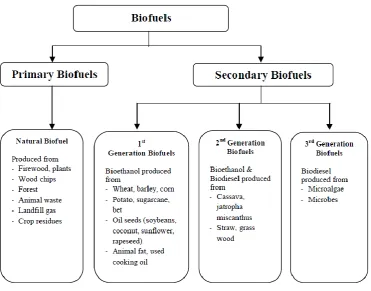
Biofuel can be classified into two categories which are primary and secondary biofuels (Nigam & Singh, 2011). The primary biofuels normally used for an unprocessed form such as for heating, cooking, and electricity production like fuel wood, wood chips and many other. Meanwhile, the secondary biofuel basically generated from the work of processing the biomass such as ethanol, biodiesel, dimethyl ether (DME) and many others for vehicles and any industrial processes. More than that, the secondary biofuels also divided into three categories namely first, second and third generation biofuel (Dragon et al., 2012). Figure 2.1 shows the basis of raw materials and also technology used for the production of biofuels. Besides that, biofuels are also categorized based on the source, type and the origins for example some of them may be derived from forest, fishery, agricultural products and municipal wastes, also they also originated from ago-industry, food industry and food services (Gupta et al., 2013 & Dragon et al., 2012).
In fact, the biofuels can be in form of solid such as charcoal, fuel wood, and
Figure 2.1: Biofuel production sources (Dragon et al., 2012).
2.4 Biodiesel
Biodiesel is best defined as an alternative fuel which exhibits the same function as the fossil fuels (Fangrui & Hanna, 1998). Biodiesel can be generated directly from vegetable oil, animal oil or fats, plants oil, tallow and waste cooking by transesterification process which changes the organic group R of an ester with the organic group R of an alcohol (Horseman et al., 2008). Based on the previous research, the high potential of oil sources for biodiesel is coming from crops such as rapeseed, palm oil and soybean and recently microalgae has been the most promising among all of them (Mata et al., 2010 & Chisti, 2007).
14
Numerous researches proved that biodiesel has great advantages over fossil fuel (Dragon et al., 2012; Mata et al., 2010 & Chisti, 2007). As a renewable energy source, biodiesel is an environmental friendly energy that releases less greenhouse gas, discharges less carbon dioxide and low content sulphur and carbon monoxide (Fangrui & Hanna, 1998)
Technically speaking, 90% of air toxicity and 95% of cancers can be decreased by biodiesel due to their less pollutants emission (Huang et al., 2010). Furthermore, biodiesel has a great potential in the energy market since the price of fossil fuel will be tremendously skyrocketed imminently and the high energy demand (Alwi, 2014). The renewable microalgae energy will not have an issue with price hike as they can be produced sustainably and the price will be well- balanced by the intense competing of wide markets around the globe.
2.4.1 Biodiesel in Malaysia
Biofuel production in Malaysia is synonymous with palm oil, a major established agricultural product in Malaysia. The average national blend of biodiesel in Malaysia’s transport diesel pool has steadily increased since 2011 by blending the biodiesel from palm oils with the conventional diesel. From 1.3% in 2011, where biofuel was only available in the central region of Negeri Sembilan and Selangor states, it increased to 2.0% in 2012 when biofuel was available in the Southern region of Malacca and Johore states. When the government fully committed to implement B5 program in 2014, it increased to 5%. After many delays, the Government of Malaysia’s (GOM) introduced the B7 mandate in 2015, thus increased the national blend rate to 7%. In 2015, Malaysia exported 65 % of biodiesel to Spain, 19% to the Netherlands and 11% to Switzerland (Wahab, 2016). As far as today Malaysia has not developed the biodiesel based on microalgae feedstock (Huang et al., 2010). The feasibility of microalgae as biodiesel feedstock is still under research and has yet to be implemented.
2.4.2 Microalgae biodiesel
microalgae biodiesel are an alternative to common known biofuel sources, such as corn, sugarcane, soya bean and palm oil. They are several companies and government agencies are funding efforts to cut down capital and operating costs as well as make microalgae fuel production commercially viable (Scott et al., 2010). Like fossil fuel, microalgae biodiesel releases carbon dioxide when burnt, but unlike fossil fuel, microalgae fuel and other biofuels only release carbon dioxide recently removed from the atmosphere via photosynthesis as the microalgae or plant grew. Microalgae biodiesel has attractive characteristics that they can be grown with minimal impact on fresh water resources, can be also produced using saline and wastewater, have a high flash point, biodegradable and relatively harmless to the environment if spilled (Dinh et al., 2009 & Aslan & Kapdan, 2008). Microalgae costs more per unit mass than other crops due to high capital and operating costs but are claimed to yield between 10 and 100 times more fuel per unit area (Mata et al., 2010 & Chisti, 2007)
Lately, researchers are utilizing microalgae to produce biofuels, chemicals, oils, food, medicine and many other (Lang et al., 2001). Although some researches are inclined to use crops such as corn, soybean, repressed and palm oil for biodiesel production and yet some green microalgae are still topping them with possibility of 75 % oil of its dry weight (Metzger & largeau, 2005). Nevertheless, as far as today, biodiesel cannot meet the increased energy demand since their production is too low due to the higher cost of cultivation. However, its biodiesel productivity is much better than crops plants (Chisti, 2007).
16
2.4.3 Advantages of using microalgae for biodiesel production
According to Sheehan et al., (1998), microalgae can be cultivated easily and can grow using water that is unsuitable for human consumption such as waste water and lastly easy to get nutrients. Alwi, (2014) also concluded that microalgae practically able to grow anywhere including in the dessert and marine environments, thus makes them so flexible and will having no intense competition with another food crops. Furthermore, microalgae can grow almost anywhere just needing sunlight and some simple nutrients and it is possible to accelerate its growth by adding some specific nutrients and with sufficient aeration as stated by Aslan & Kapdan (2008).
Microalgae is effortless for cultivation, it can grow with little of them even no attention, using any water that unsuitable for human consumption which is containing nutrients prerequisite for their growth and microalgae will reproduce themselves through photosynthesis to convert sunlight energy into chemical energy in order for completing an entire growth cycle (Li et al., 2008; Reinhardt et al., 2008 & Sheehan et al., 1998). Furthermore, microalgae are incredibly flexible whereby they can grow to almost everywhere, needing sunlight and with simple nutrients such as phosphorus and nitrogen compound, however their growth can be accelerated by adding some specific growth driving nutrients and with sufficient aeration (Aslan and Kapdan, 2006 & Pratoomyot et al., 2005).
which able to reduce emissions of particulate matter such as carbon dioxide, hydrocarbon and sulphur oxides (Pires et al., 2012). The emission of nitrogen dioxide maybe higher depending on engine types (Delluchi, 2003). The biofuel from microalgae also serve other purposes such as having a big potential as an agent of removal CO2 fromindustrial flue gases through microalgae bio-fixation, which able
to in reducing the GHG emissions (Wang et al., 2008).
Furthermore, microalgae can be used for waste water by removing ammonium, nitrate, phosphorus and microalgae also can be grown in the waste water as stated by Wang et al., (2008). After the oil from microalgae is extracted, the resulting microalgae biomass can be processed for production of ethanol, methane, livestock fees, fertilizers because of its high N:P ratio, and can be burned for energy cogeneration either for electricity or heat (Wang et al., 2008). More than that, the other species of microalgae is also viable to be extracted into variety products which including a large range of fine chemicals and bulk products such as fats, natural dyes, oil, sugars, antioxidants, high-value bioactive compounds, polyunsaturated fatty acids (Raja et al., 2008 & Horseman et al., 2008).
18
Figure 2.2: Overview options to covert algal into energy (Iersel & Flammini, 2010).
2.5 The potential of microalgae as bioenergy
As a matter of fact, microalgae can be fully utilized in generating energy in several ways. Currently, one of the most sought after of utilization of microalgae is to turn them into microalgal biodiesel. As far as today, there are many other valuable products have been introduced from microalgae such as the production of hydrogen gas under specialized growth conditions (Canakci & Van, 1999). More than that, the biomass from microalgae can be used in generating electricity and heat when they are burnt (Wang et al., 2008)
Microalgae biomass has three main components which are carbohydrates, proteins, lipids or natural oils. Biodiesel can be produced from any oil or lipid source that contains largely components of tricylglycerol molecules (TAGs) such as shown in Figure 2.3. The present of bulk natural oil made by microalgae in the form of
Hydrocarbon
Biomass
HTU Fuel gas
Lipids
Gasification
Unique Products
Fermentation
Ethanol
Digestion
Methane
Hydrogen
Heat
Burning Biodiesel
Starch
Esterification Haydrocracking
Purification
Fermentation
SVO 0il
High Value Products
Hydrogen Traditional Fuels
TAGs makes the microalgae oil the right kind of oil for producing biodiesel (Grobbelaar, 2004).
[image:37.595.172.477.132.283.2]
Figure 2.3: Molecular structure of tricylglycerols (Grobbelaar,2004).
According to Chisti (2007) microalgae are commonly doubled in size for every 24 hours and at the optimum growth phase, some microalgae able to double every 3.5 hours. Furthermore, the oil content of microalgae can be between 20 % up to 75 % of its dry weight as shown in Table 2.1, while some species able to reach up to 80 % (Spolaore et al., 2006 & Metting, 1996).
Table 2.1: Oil content of microalgae (Chisti, 2007 & Zhiyou, 2009)
Microalga Oil content (% dry weight)
Botryococcus braunii 25–75
Chlorella sp. 28–32
Crypthecodinium cohnii 20
Cylindrotheca sp. 16–37
Nitzschia sp. 45–47
Phaeodactylum tricornutum 20–30
Schizochytrium sp. 50–77
Tetraselmis suecia 15–23
In comparison with the other terrestrial crops, it takes much longer time to grow and lesser oil yield or particularly, contain roughly of about 5 % of oil yielding. Thus, makes the green microalgae as the most favourable for biodiesel feedstock.
CH2O-OCHCH2CH2 ………. CH2CH3
CHO-OCHCH2CH2 ………. . CH2CH3
[image:37.595.117.518.514.678.2]20
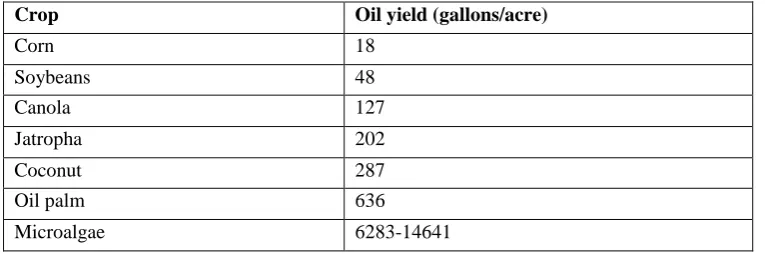
[image:38.595.133.516.231.358.2] [image:38.595.133.511.231.357.2]The different oil yield percentages by microalgae compared with the other terrestrial crops in the open pond cultivation is shown in Table 2.2. Based on the previous study, the oil yield of microalgae is superior to the other terrestrial crops as shown in Table 2.2.
Table 2.2: The comparison of oil yields between microalgae and other terrestrial crops (Mata et al., 2010; Zhiyou, 2009; Chisti, 2007)
2.6 Microalgae lipid content and productivities
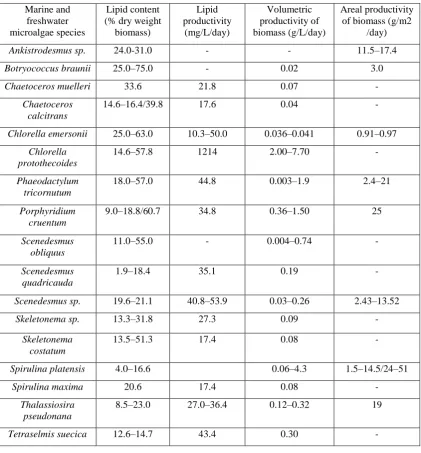
Generally, numerous number of microalgae species can be induced to generate substantial quantities of lipids as studied by Sheehan et al., (1998).The productivity of oil yield was studied to be as high as 75% and under the good conditions some species able to reach 90% (Li et al., 2008; Chisti, 2007; Spolaore et al., 2006). Table 2.3 shows the lipid content and biomass productivities between different freshwater and marine microalgae species that are totally different from previous researches (Rodolfi et al., 2009; Li et al., 2008; Spolaore et al., 2006; Richmond, 2004; Renaud et al., 1999).
Furthermore, Table 2.3 evidenced that genus from Botryococcus is able to produce high oil yield as high as 75% by weight from dry biomass. Thus, Botryococcus braunii is a good choice for biodiesel feedstock. In selecting the most adequate species for cultivation there is a need to take into account another factor, such as the capability of microalgae to be developed by using nutrients available and under particular environmental conditions for biodiesel production.
Crop Oil yield (gallons/acre)
Corn 18
Soybeans 48
Canola 127
Jatropha 202
Coconut 287
Oil palm 636
Table 2.3: Lipid content and productivities of microalgae (Richmond, 2004)
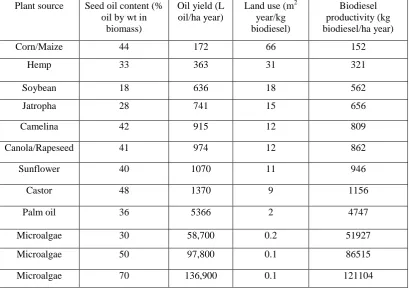
Mata et al., (2010) proved that the microalgae oil yield is supremely greater than the another vegetable oil crops as shown in Table 2.4 that compares the biodiesel production efficiencies and land use for microalgae cultivation and other vegetable oil crops, including the yielding of biodiesel. Generally, Table 2.4 portraying the advantages of microalgae as the best choice for biodiesel as they are capable to produce the highest oil content up to 70 %, has the slightest land use, highest oil yield (L oil/ha year) as well as the highest biodiesel productivity (Kg biodiesel/ha year). Thus, the development of microalgae as a biodiesel feedstock is very promising to neutralize the imbalance and immoderately usage of fossil fuel.
Marine and freshwater microalgae species
Lipid content (% dry weight
biomass) Lipid productivity (mg/L/day) Volumetric productivity of biomass (g/L/day) Areal productivity of biomass (g/m2
/day)
Ankistrodesmus sp. 24.0-31.0 - - 11.5–17.4
Botryococcus braunii 25.0–75.0 - 0.02 3.0
Chaetoceros muelleri 33.6 21.8 0.07 -
Chaetoceros calcitrans
14.6–16.4/39.8 17.6 0.04 -
Chlorella emersonii 25.0–63.0 10.3–50.0 0.036–0.041 0.91–0.97
Chlorella protothecoides
14.6–57.8 1214 2.00–7.70 -
Phaeodactylum tricornutum
18.0–57.0 44.8 0.003–1.9 2.4–21
Porphyridium cruentum
9.0–18.8/60.7 34.8 0.36–1.50 25
Scenedesmus obliquus
11.0–55.0 - 0.004–0.74 -
Scenedesmus quadricauda
1.9–18.4 35.1 0.19 -
Scenedesmus sp. 19.6–21.1 40.8–53.9 0.03–0.26 2.43–13.52
Skeletonema sp. 13.3–31.8 27.3 0.09 -
Skeletonema costatum
13.5–51.3 17.4 0.08 -
Spirulina platensis 4.0–16.6 0.06–4.3 1.5–14.5/24–51
Spirulina maxima 20.6 17.4 0.08 -
Thalassiosira pseudonana
8.5–23.0 27.0–36.4 0.12–0.32 19
22
Table 2.4: Comparison of microalgae with other biodiesel feedstock (Mata et al., 2010).
According to a research study by Alwi (2014), microalgae oil production is indeed much greater than other any terrestrial crops. He created a chart bar to compare the oil yields among the other crops such as soybean, rapeseed, babassu, palm oil and microalgae as shown in Figure 2.4. The result shows that among them microalgae produces more than 150 times fuel compared to soybean.
Plant source Seed oil content (% oil by wt in
biomass)
Oil yield (L oil/ha year)
Land use (m2 year/kg biodiesel)
Biodiesel productivity (kg biodiesel/ha year)
Corn/Maize 44 172 66 152
Hemp 33 363 31 321
Soybean 18 636 18 562
Jatropha 28 741 15 656
Camelina 42 915 12 809
Canola/Rapeseed 41 974 12 862
Sunflower 40 1070 11 946
Castor 48 1370 9 1156
Palm oil 36 5366 2 4747
Microalgae 30 58,700 0.2 51927
Microalgae 50 97,800 0.1 86515
Figure 2.4: The comparison of Oil productivity among the four type of plants (Alwi, 2014)
2.7 Global outlook on fuel and biodiesel
Nowadays, global oil consumption is increasing at an unprecedented rate owing to a rising in consumption of fuels in some developing nations. Started 1990 to 2012, big countries such as China, India, and Brazil have an increase in oil consumption by 311%, 186% and 100% respectively and at present consume about 19.6% of the 3590 tonnes (Mt) of the oil generated annually (Enerdata, 2013). In 2002, U.S Geological had published a survey of 128 territories which is containing 95% of discovered of potential oil and gas reserves in the world (Balzani & Armaroli, 2007). From that survey, it was concluded that the remaining undiscovered and discovered reserves of oil from the unconventional and conventional sources are around 2.3 trillion barrels of oil equivalent. In 2008, the International Energy Agency (IEA) conducted a separate study and estimated the recoverable resource with value of 3.5 trillion barrels of conventional oil left (IEA, 2008) and it shows the oils reserve is being dwindling.
Furthermore, IEA had reported that a daily global consumption of fuels is about 85.41 mega barrels for 2008 (Owen et al., 2010). There is possibility that the huge rate of consumption which is equivalent to 311.2 giga barrels a year and by
0 20000 40000 60000 80000 100000 120000 140000 160000 180000
Soybean Rapeseed Babassu Palm oil Microalgae
O
il
yi
e
ld
(kg
/hect
re
24
assumption of zero growth in the global demand, the complete depletion of oil or liquid fuels and gas reserves will occur in just over 100 years (Owen et al., 2010). The earth’s population is increasing, and the poorer countries are struggling for higher energy consumption and lead to an increase by 2% of the yearly growth of global energy demand (Balzani and Armaroli, 2007). Some developed countries who is involved in the Organization for Economic Cooperation and Development (OECD) are consuming more than half of world’s oil annually and it was predicted of 12% increase of oil consumption during the next 25 years period started from year 2010 to year 2035, the non-OECD countries are estimated to have about 72% increase (OECD report, 2009).
Brazil, China and India were spawning hundreds of new opportunity for the microalgae feedstock development, biofuel production and export (Thurmond, 2008). In U.S, the marketing of biodiesel is growing rapidly, from 25 million gallons per year in 2004 and increased until 450+ million gallons in year 2007. Thus, the total biodiesel being sold in U.S. is less than 1% of all the diesel consumption. More than that, biodiesel in Europe is 2 to 3% of total transportation consumption and was targeted to increase by 6% in year 2010. In India, China, Brazil and Europe, They are currently aiming to increase the consumption of biodiesel instead of importing petroleum from other countries (Thurmond, 2008). World biodiesel production is expanding progressively, volatility prices and feedstock shortage in US, Europe and Asia are causing to a growing delta between capacity and production in many regions.
According to Browne et al., (2009), United States appears to be the largest consumer of oil in the world, in 2008 US consumed about 19.5 million barrels of oil per day and the production is far below its consumption which is only 8.154 million barrels per day as shown in Figure 2.6. As of 2009 there were 84.9 million barrels of oil consumed. In the year 2010, the was predicted that the oil demands will far exceeding the availability by almost 1 million barrels of oil per day, this would cause the oil price to be skyrocketed.
REFERENCES
Alwi, H. (2014). Environmental economic and energetic costs and benefits of biodiesel and ethanol biofuels. Renewable and Sustainable Energy Reviews, 24(14), pp. 1947-1968.
American Public Health Association (APHA) (2012). Standard Methods for the Examination of Water and Wastewater. Washington.
American Public Health Association (APHA), American Water Works Association (AWWA), and Water Environment Federation (WEF). 1999. Standard Methods for the Examination of Water and Wastewater 20th Edition. United Book Press, Inc., Baltimore, Maryland.
Anitha, S. & Narayanan, S.J. (2012). Isolation and identification of microalgal strains and evaluation of their fatty acid profiles for biodiesel production. International Journal of Pharmaceutical and Biological Archives, 3(4), pp. 939-944.
American Public Health Association (APHA) (1998). Standard Methods of Water and Waste Water Analysis, 20 Edn. Washington, D.C:American Public Health Association.
American Public Health Association (APHA) (2012). Standard methods for the examination of water and wastewater 22nd edition. Washington DC: pp. 10-23.
Andersen, R.A. (2005). Algal Culturing Techniques 1st Edition, Burlington, USA: ELSEVIER Academic Press.
Ashraf, M.A., Jamil, M.J. & Yusoff, I. (2010). Study of Water Quality and Heavy Metals in Soil & Water of Ex-Mining Area Bestari Jaya, Peninsular Malaysia. International Journal of Basic & Applied Sciences, 10(3), pp. 7-23.
132
microalgae botryococcus grown at semi-continuous system. Energy Conversion and Management, 88, pp. 936-946.
Aslan, S. & Kapdan I.K. (2006). Batch kinetics of nitrogen and phosphorus removal from synthetic wastewater by algae. Ecological Engineering, 28(1), pp. 64-70.
ASM, NAHRIM. (2009). PelanStrategi: Strategi Pembangunan danPengurusan Lestari bagi Tasik dan Empangan Air di Malaysia Jilid 1: LaporanUtama. Azcan, N. & Danisman, A. (2008). Microwave assisted transesterification of
Rapeseed oil. Fuel, 87(2), pp. 1781-1788.
Baharim, N.B., Yusop, Z., Zakaria, W., Tahir, M.W., Yusoff, I., Askari., Othman, Z. & Abidin, M. R. Z. (2015). Multivariate analysis on heavy metals distribution in tropical reservoir. Applied Science, Engineering and Technology, 9(11), pp. 916-921.
Baharim, N.B., Yusop, Z., Yusoff, I., Zakaria, W., tahir, M., Askari, M., Othman, Z. & Abidin, M.R.Z. (2016). The Relationship between Heavy Metals and Trophic Properties in Sembrong Lake, Johor. Sains Malaysiana, 45(1), pp. 43-53.
Balzani, V & Armaroli, N. (2007). The future of energy supply: Challenges and opportunities. Angewandte Chemie International Edition, 46 (1-2), pp. 52-66 Banerjee, A., Sharma, R., Chisti, Y. & Banerjee, U.C. (2002). Botryococcus braunii:
a renewable source of hydrocarbons and other chemicals. Critical Reviews in Biotechnology, 22, pp. 245-79.
Barbosa, M.J., Wijffels, R.H. & Eppink, M.H.M. (2010). Microalgae for the production of bulk chemicals and biofuels. Biofuels, Bioproducts and Biorefining, 4, pp. 287-295.
Barclay W.R. (2005). Mixtures of omega-3 and omega-6 highly unsaturated fatty acids from euryhaline microorganisms. U.S. Patent 6, 977,167.
Bart, J.C.J., Palmeri, N. & Cavallaro. (2010). Biodiesel Science and Technology. Abington Hall, Granta Park, Great Abington, Cmbridge UK: Woodhead Publishing Limited.
Behrens, P.W., Thompson J.M., Apt, K., Pfeifer J.W., Wynn J.P. & Lippmeier, C. (2007). Production of high levels of DHA in microalgae using modified amounts of chloride and potassium. U.S. Patent 7,163,811.
Bijl H.L., Wolf J.H., Schaap, A. & Visser J.M.J. (2004). Preparation of microbial polyunsaturated fatty acid containing oil from pasteurised biomass. U.S. Patent 6,727,373.
Biller, P. & Ross, A.B. (2014) Pyrolysis GC–MS as a novel analysis technique to determine the biochemical composition of microalgae. Algal Research, 6, pp. 91-97.
Bligh, E.G. & Dyer, W.J. (1959). A rapid method of total lipid extraction and purification. Canadian Journal Biochemistry and Physiology, 37(8), pp. 911-917.
Boonma, S., vacharapiyasophon, P., peerapornpisal, Y., pekkoh, J. & pumas, C. (2014). Isolation and Cultivation of Botryococcus braunii Ktzing from Northern Thailand. Chiang Mai Science, 41(2), pp. 298-306.
Bozbas, K. (2008). Biodiesel as an alternative motor fuel: production and policies in the European Union. Renewable and Sustainable Energy Reviews, 12, pp. 542-52.
Brennam, L. & Owende, P. (2010). Biofuels from microalgae - A review of technologies for production, processing and extractions of biofuels and co-products. Renewable and Sustainable Energy Reviews, 14, pp. 557-577. Browne, B., Gibbs, R., Mcleod, J., Parker, M., Schwanda, W. & Warrren, K. (2009).
Oil extraction from microalgae. University of Maine, United State: Ph.D. Thesis.
Bunnag, B. (2009). Microalgae Research in Thailand and Southeast Asia. International Workshop Aquatic Biomass Sustainable Bioenergy from Algae. Retrieved November 2nd , 2015, from doi:10.1089/ees.2014.0219.
Burkholder, J. M. (2000). Eutrophication and oligotrophication. In Levin, S. (Ed.). Encyclopedia of Biodiversity. New York: Academic Press. Volume 2. pp. 649-670.
134
Canakci, M. & Van J. (1999). Biodiesel production via acid catalysis. Transactions of the ASAE, 42, pp. 1203-1210.
Carlson, R.E. and J. Simpson. (1996). A Coordinator’s Guide to Volunteer Lake Monitoring Methods. North American Lake Management Society, 36, pp. 54-74.
Carvalho, J., Ribeiro, A., J. Castro, J., Vilarinho, C. & Castro, F. (2011). Biodiesel Production by Microalgae and Macroalgae from North Littoral Portuguese Coast. WASTES: Solutions, Treatments and Opportunities 1st International Conference September 12th - 14th.
Castro, M. D. L. & Ayuso, L. E. (2000). Soxhlet extraction of solid materials: An outdated technique with a promising innovative future. Analytica Chimica Acta, 369, pp. 1-10.
Castro, A., Castilho, L. & Freire D.G. (2011). An overview on advances of amylases production and their use in the production of bioethanol by conventional and non-conventional processes. Biomass Conversion and Biorefinery, 1, pp. 245-255.
Channamtum, S., Yongmanitchai, W. & Chonudomkul, D. (2015). Optimization of Growth and Hydrocarbon Production from a Green Microalga Botryococcus braunii. In Plackett-Burman. (Ed.). Design and Response Surface Methodology. Kasetsart: Natural science. pp. 67-79.
Chavan, K.J., Sheetal, C., Sonal, J., Pushpendra, S., Mahavir, Y. & Archana, T. (2014). Environmental Factors Influencing Algal Biodiesel Production. Environmental Engineering Science, 31(11), pp. 602-611.
Chen, C.Y. & Durbin, E.G. Effects of pH on the growth and carbon uptake of marine phytoplankton. Marine Ecology progress Series, 109, pp. 83-94.
Cheirsilp, B. & Torpee, S. (2012). Enhanced growth and lipid production of microalgae under mixotrophic culture condition: Effect of light intensity, glucose concentration and fed-batch cultivation. Bioresource Technology, 110, pp. 510-516.
Chislock, M.F., Doster, E., Zitomer, R.A. & Wilson, A.E. (2013) Eutrophication: Causes, Consequences, and controls in Aquatic Ecosystem. Nature Education Knowledge, 4(4), pp. 10.
Chisti, Y. (2007). Biodiesel from microalgae. Biotechnology Advances, 25(3), pp. 294-306.
Curtis, B.A.G., Tanifuji, F., Burki, A., Gruber, M., Irimia, S. & Maruyama. (2012). Algal genomes reveal evolutionary mosaicism and the fate of nucleomorphs. Nature, 49, pp. 59-65.
Dayananda, C., Sarada, R., Bhattacharya, Sila. & Ravishankar, G.A. (2005). Effect of media and culture conditions on growth and hydrocarbon production by Botryococcus braunii. Process Biochemical, 40, pp. 3125-3131.
Daud, Z., Awang, H., Zainuri, M. & Hatta, M. (2015). Hydrology Properties and Water Quality Assessment of the Sembrong Dam, Johor, Malaysia. Social and Behavioral Sciences, 195, pp. 2868 -2873.
Delucchi, M.A. (2003). A Lifecycle Emissions Model (LEM): lifecycle emissions from transportation fuels; motor vehicles, transportation modes, electricity use, heating and cooking fuels. ucd-its-rr, 8(4), pp. 03-17.
Department of Environment (DOE) 2005a. Interim National Water Quality Standards (INWQS) for Malaysia. http://www.doe.gov.my Accessed 28 Feb., 2009 Department of Environment. Malaysia: Environmental Quality Act report, Ministry
of Science, Technology and the Environment, Putrajaya, Malaysia, 2012. Derenne, S., Largeau, C., Hete´nyi, M., Brukner-Wein, A., Connan, J. & Lugardon,
B. (1997). Chemical structure of the organic matter in a Pliocene maar-type shale: Implicated Botryococcus race strains and formation pathways. Geochimica et Cosmochimica Acta, 61, pp. 1879-1889.
Dictrich, U. (1980). Stability and multiple steady states of hypereutrophic ecosystem Development in hydrobiology. Hypertrophic Ecosystem, 2, pp. 235-247. Dinh, L. T. T., Guo, Y. & Mannan, M. S. (2009). "Sustainability evaluation of
biodiesel production using multicriteria decision-making". Environmental Progress & Sustainable Energy, 28, pp. 38-46.
136
Duong, V.T., Yan, L., Nowak, E. & peer, M.S. (2012). Microalgae isolation and selection for prospective Biodiesel Production. Energies, 5, pp. 1835-1849. Enerdata. (2013). "Global Energy Statistical Yearbook 2013," Retrieved on
November 21, 2015, from http://yearbook.enerdata.net/oil-consumption.html. Eroglu, E., Okada, S. & Melis, A. (2011). Hydrocarbon productivities in
different Botryococcus strains: comparative methods in product quantification. Journal Application Phycology, 23(4), pp. 763-775.
Eroglu, E. & Melis, A. (2009). “Density equilibrium” method for the quantitative and rapid in situ determination of lipid, hydrocarbon, or biopolymer content in microorganisms. Biotechnologu and Bioengineering, 102(5), pp. 1406-1415. Ethier, S., Woisard, K. & Vaughan, D. (2011). Continuous culture of the microalgae
Schizochytrium limacinum on biodiesel-derived crude glycerol for producing docosahexaenoic acid. Bioresource Technology, 102(1), pp. 88-93.
Farooq, A., Amin, U.K. & Yasar, A. (2013). Transesterification of oil extracted from different species of algae for biodiesel production. African Journal of Environmental Science and Technology, 7(6), pp. 358-364.
Fazeli, M., Tofighi, H., Samadi, N., Jamalifar, H. (2006). Carotenoids accumulation by Dunaliella tertiolecta (Lake Urmia isolate) and Dunaliella Salina (CCAP 19/18 & WT) under stress conditions. DARU,14, pp. 3.
Fangrui, M. & Hanna. M. A. (1998). Biodiesel Production: A Review. Bioresource Technology, 70(1), pp. 1-15.
Folch, J. M., Lees & Sloane-Stanley, G.H. (1957). “A simple method for the isolation and purification of total lipides from animal tissues,”. Journal of Biological Chemistry, 226, pp. 497-509.
Fregolente, P.B.L., Fregolente, L.V. & Maciel, M.R.W. (2016). Water Content in Biodiesel, Diesel, and Biodiesel–Diesel Blends. Journal of Chemical & Engineering Data, 57(6), pp. 1817-1821.
Grobbelaar. J. U. (2004). Algal nutrition. In Richmond, A. (Ed.). Handbook of Microalgal Culture: Biotechnology and Applied Phycology. Ames, Iowa: Blackwell Publishing. pp. 97-115.
Hamilton, S., Hamilton, R.J. & Sewell, P.A. in Hamilton, R.J. (Ed.). Lipid Analysis: a practical approach. New York: Oxford University Press. pp. 13-64; 1992. Han, F.H., Pei, W., Hu, M., Song, G. & Ma, R. P. (2015). Optimization and lipid
production enhancement of microalgae culture by efficiently changing the conditions along with the growth-state. Energy Convers Manage, 90, pp. 315-322.
Hernández-mariné, M., Martinez, A.G., Fontarnau & Cortadellas, N. (2010). SEM studies of arborescent aerophytic biofilms. In Dominguez, R. (Ed.). Use of acrolein and osmium vapour impregnation. Universitat de Barcelona: Microscopy. pp. 334-335.
Hidzrami, S.A. (2010). Bukit Merah, Perak Lake Brief.Lakes and Their Basins for Sustainable Use in Malaysia (Lake Briefs Report Series 1). Kuala Lumpur: AkademiSains Malaysia.
Ho, S., Chen, C., Lee, D. & Chang, J. (2011). Perspectives on microalgal CO2 -emission mitigation systems - A review. Biotechnol. Advance, 29, pp. 189-198.
Hoekman, S.K., Broch, A., Robbins, C., Ceniceros, E. & Nataraan, M. (2012). Review of biodiesel composition, properties, and specifications. Renewable and. Sustainability of Energy Review, 16, pp. 143-169.
Horseman., Li, Y., Wu, N., Lan, C.Q. & Dubois-Calero, N. (2008). Biofuels from microalgae. Biotechnology Progress, 24, pp. 815-820.
Hu, Q., Sommerfeld, M., Jarvis, E., Ghirardi, M., Posewitz, M. & Seibert, M. (2008). Microalgal triacylglycerols as feedstocks for biofuels production: perspectives and advances. The Plant Journal, 54, pp. 621-39.
Hu, Q. (2004). Environmental Effects on Cell Composition. in Richmond, A. (E.d). Handbook of Microalgal Culture:Biotechnology and Applied Phycology. Oxford, UK: Blackwell. pp. 83-93.
Huang, Y., Chen, M., & Liu, D. (2008).Effect of Nitrogen, Phosphorus, Light Formation and Disappearance and Water Temperature on the of Blue - green Algae Bloom. Journal of Northwest Science - Technology University of Agriculture and Forest (Nature Science Edition), 36(9), pp. 93-100.