Journal of Chemical and Pharmaceutical Research, 2017, 9(1):118-122
Research Article
CODEN(USA) : JCPRC5
ISSN : 0975-7384
118
Development and Validation of High Performance Liquid Chromatography
Assay Method of Spironolactone
Hozyfa A Hamdan
*and Ahmed E Mohammed
Department of Chemistry, College of Graduate Studies, Sudan University of Science and Technology, Sudan
__________________________________________________________________________________
ABSTRACT
A new, precise and accurate reversed-phase high performance liquid chromatograph a method was developed for determination of spironolactone. High performance liquid chromatograph was carried out by isocratic technique on a reverse-phase using C18 inertstil (250 *4.6 mm), 5µm column with a mobile phase consisting of phosphate buffer
solution PH = 4 and acetonitrile in (1:1) ratio. The flow rate was adjusted at 1.5 ml/min, detection wavelength at 240 nm, temperature at 40 ᵒC and retention time was found to be 4.5 min. Beer's low was obeyed in concentration range 20-30 ppm. The assay percentage of spironolactone in tablet dosage form was found to be (98.25±0.59) %. The % of recovery was found to be (99.4-101.99) %. The limit of detection (LOD) and limit of quantization (LOQ) were found to be 0.553 ppm and 1.677 ppm respectively. The results of analysis have been validated statistically and recovery studies confirmed the accuracy of accuracy of developed method which was carried out according to ICH guidelines [3].
Keywords: Spironolactone; HPLC; Method development and Validation
__________________________________________________________________________________
INTRODUCTION
Spironolactone (aldactone) is potassium -aspiring diuretic agent and has half-life of about 16 hour. Spironolactone one diuretics agents which increase renal excretion of water and solutes (mainly sodium salt). It is used mainly in the treatment of refractory edema in patients with congestive heart failure nephrotic syndrome, or hepatic cirrhosis.On its own, spironolactone is only a weak diuretic, but it can be combined with other diuretics.[1][4] Spironolactone is 7α-acetyle thio-3-oxo-17α-pregn-4-ene-21,17β- carbolactone. Its molecular formula is C24 H32O4S
[image:1.612.219.396.579.684.2]having a molecular weight 416.58 gm/mole. It has following structure:
119
The literature reviews regarding spironolactone suggest that various analytical methods were reported for its determination as drugs, in pharmaceutical formulation and in various biological fluids such as artificial neural network and near-infrared spectrometry [6], colorimetric [5], micellar enhanced spectrofluorimetry [2] and RP-HPLC [4] methods.
In this method compered to method ananlysis of spironolactone in USP in tablet dosage form it simpler which used the mobile phase as diluent and time of preparation of sample is less than USP method.
EXPERIMENTAL SECTION
The instruments used for this work; UV-visible double beam spectrophotometer; model UV-2201, SHIMADZU. A pair of matched quartz cell (10mm) was used for the measurement, HPLC SHIMADZU CORP 03137 serious number LC202544 (Model of pumb LC-20Ab, Model of detector: SPD-20A, Model of oven: CTO – 20 AC) with LC- Solution Software: LC- Solution, PH/Temperature Bench Meter Mi 150 (Milwaukee) and Analytical Balance (keranabs).
Chemicals and reagents
Acetonitrile HPLC GRADE reagent, potassium dihydrogen phosphate anhydrous A.R, ortho phosphoric acid, Spironolactone working standard (purity 99.4%) gift from Shanghai- Sudan Pharmaceutical CO-LTD and spironolactone tablet 25 mg dosage form from the local market (yesalactone).
Method development Selection of solvent
After study the solubility of spironolactone in different solvents and different buffer solutions acetonitrle and buffer solution PH 4 of potassium dihydrogen phosphate in 1:1 ratio were chosen for developing of the method.
Mobile phase preparation
6.8 g of potassium dihydrogen phosphate were weighted and transferred to 1000 ml volumetric flask and dissolved by purified water then completed to the mark by purified water. The solution was adjust to PH = 4 with orthophosphoric acid. Acetonitrile and buffer solution were mixed by (1:1) ratio.
Preparation of diluents
The same mobile phase
Preparation of standard stock solution
20.6 mg of spironolactone working standard was dissolved in 100 ml volumetric flask by mobile phase and sonication for 30 second then completed to the mark by mobile phase. Solution was diluted by pipetting 5ml of solution to 100ml volumetric flask. The solution was scanned and found to have maximum absorption wavelength at 240 nm using mobile phase as blank.
Preparation of the sample for assay
Equivalent to 25 mg of spironlactone from crushed 20 tablet of spironlaction were weighted and dissolved in 100 ml volumetric flask by mobile phase and sonication for 20 minutes then completed to the mark by mobile phase. 2.5 ml of solution were transferred to 25 ml volumetric flask then completed to the mark by mobile phase.
Table 1: Assay of spironolactone in commercial formulation for HPLC method
Drug Amount taken 𝞵g/ml Amount found 𝞵g/ml % recovery % RSD
Yesalactone
25 24.4 97.6
25 24.68 98.73 0.59
25 24.61 98.44
Method validation
120 Specificity
[image:3.612.157.456.117.262.2]Specificity is the ability to assess unequivocally the analyte in the presence of components which may be expected to be present.
Figure 2: specificity of HPLC method
Linearity
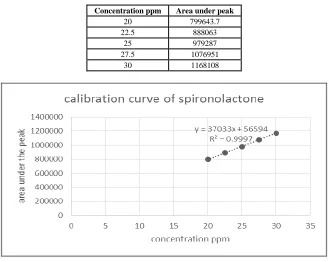
[image:3.612.142.471.370.632.2]Aliquots 2, 2.25, 2.5, 2.75 and 3 ml of spironolactone standard solution were transferred to series of 25 ml volumetric flask and made up to volume by mobile phase to obtain final concentrations of spironolactone of 20, 22.5, 25, 27.5 and 30 ppm (range from 80 to 120 %).
Table 1: calibration curve of spironolactone
Concentration ppm Area under peak
20 799643.7
22.5 888063
25 979287
27.5 1076951
30 1168108
Figure 3: calibration curve of spironolactone in HPLC method
Precision
121
Table 4: repeatability precision of the system in HPLC method
Run Area under the peak
1 991027
2 984376
3 984029
4 978274
5 985478
6 988032
Mean 985202.7
RSD% 0.4355
Table 5: intermediate precision of spironolactone in HPLC method
Run Area the under peak of 1st analyst Area the under peak of 2st analyst Area the under peak of 3st analyst
1 1002754 1016599 1003482
2 993339 1005208 1001133
3 1000558 1007729 1006187
Mean 998883.7 1009845 1003601
RSD % 0.493126 0.59248 0.252002
Accuracy
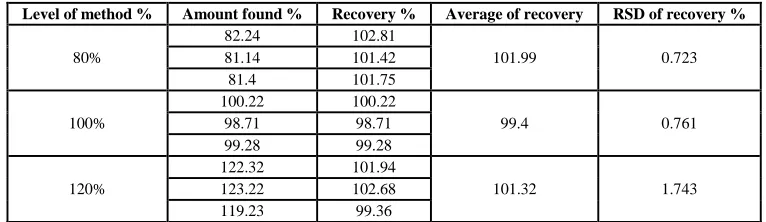
Accuracy is closeness of test results with the true value which is express as % of recovery. The studies were performed at three levels (80,100 and 120 %).
Table 6: accuracy of HPLC method
Level of method % Amount found % Recovery % Average of recovery RSD of recovery %
80%
82.24 102.81
101.99 0.723
81.14 101.42
81.4 101.75
100%
100.22 100.22
99.4 0.761
98.71 98.71
99.28 99.28
120%
122.32 101.94
101.32 1.743
123.22 102.68
119.23 99.36
Accuracy was carried out by adding a known amount of drug to reanalyzed sample and the percentage of recovery was recorded.
Limit of detection and limit of quantization
Limit of detection (LOD) and limit of quantization (LOQ) for spironolactone was determined from the recession equation graph of spironolactone, LOD = 0.553 ppm, LOQ = 1.677 ppm.
DISCUSSION
In this work isocratic technique on a reverse-phase chromatography was used and The chromatographic condition of the method was adjust by using C18 inertstil (250 *4.6 mm), 5µm column with a mobile phase, flow rate at 1.5
[image:4.612.114.497.371.482.2]122
above information we can notice that the method is accurate and precise for determination of assay of spironolactone in raw material and tablet dosage form.
CONCLUSION
The described analytical method was validated according to ICH Q2 (R1) guideline and they meet to specific acceptance criteria. So these validated methods were found to be liner, accurate, precise, and sensitive and can be used for routine analysis for estimation of spironolactone in raw material and tablet dosage form.
ACKNOWLEDGEMENT
Thankful to quality control department of SHANHAI–SUDAN Pharmaceutical CO. LTD., Khartoum-Sudan for providing the required facilities to carry out this research work.
REFERENCES
[1] A Chaudhary; KR Vadalia; P Thummer., IJPSR, 2013, 3(10), 3999-4003. [2] HY Ma; G Qi. Guangpu Shiyanshi,1999, 309-312.
[3] ICHQ2 (R1) Harmonized triptite guideline, Validation of analytical procedure: text and methodology International Conference on Harmonization ICH, Genava Nov 2005.