International Journal of Emerging Technology and Advanced Engineering
Website: www.ijetae.com (ISSN 2250-2459,ISO 9001:2008 Certified Journal, Volume 3, Issue 8, August 2013)
499
A Widespread Study, Analysis, and Management of a Squint
Eye Using Support vector Machine (SVM)
Seira Tak
1, Prof. K. J. Satao
2 1Asst.Prof, Bit, Raipur 2H.O.D.(IT), RCET, Bhilai
Abstract— Squint Analysis comes under a Biometrical study, which is a very important research problem with respect to Testing of medical problem for diagnosis. So far most of & Biometrical research work has been carried out using template based approach for & Testing of medical problem. Squint eye Detection (SED) is one of the biometrical research problems, which can be applied for medical diagnosis. As per literature most of the work has been carried out for the detection of various problem like left or right squint detection, red eye detection, angle of squint detection, recovery type of problems using squint analysis, Training and Testing phases using soft-computing tools and so on. The methods that have been applied so far are not based on support vector machine. Very slight extent of work has been carried out with Training and Testing set using SVM tools like Artificial Neural Network (ANN). In the present thesis work Neural Network approach (SVM) has been applied for SED problem that is completely based on training feature and testing feature. The work has been carried out in two different phases: Training set and Testing set. In the Training set, first an input eye image is enriched and compressed for the removal of distortion with loss less information, and then relevant geometrical features are extracted, which are then used in neural network in Testing phase for the detection of squint eye problem. This process has been carried out by implementing an algorithm developed in the present thesis work. To summarize this detection process first an unknown eye image has been studied with proper enhancement, pre-processing and post pre-processing. In the enhancement stage removal of noise from the eye image has been carried out. Later processing stage has been applied for further compression. Hence enhancement and compression has been done using known method SVM. After pre-processing, post processing stage has been carried out for relevant geometric features extraction. The extracted geometric features are used for obtaining Textural Feature and additional features of a particular eye. The present work has been tested only on still images.
Keywords- Divergent squint, Strabismus, Support Vector Machine, Training Set, Vertical squint
I. INTRODUCTION
The medical name for squint is abnormal condition. It‟s a condition wherever the eyes don't look within the same direction. While one eye appearance forwards to specialize in associate object, the opposite eye turns either inwards, outwards, upwards or downward. Within the modern times most of the work ended human eye has been administered for the detection of left, right squint, detection of red eye, detection of angle of squint, recovery form of drawback exploitation squint analysis and applied mathematics approach with PCA and example matching on soft-computing like Artificial Neural Network, Training section and Testing section so on. This work has been administered exploitation Support Vector Machine (SVM) for detection of squint eye, within which essentially coaching and testing of options are done.
II. ROLE OF BIOMETRIC
During this study, "Biometrics" means that "life measurement" however the term is typically related to the utilization of distinctive physiological characteristics to spot a private. The appliance that most of the people escort statistics is security. Statistics identification has eventually a far broader connection as laptop interface becomes a lot of natural. Knowing the person with whom you're conversing is a crucial a part of human interaction and one expects computers of the longer term to possess identical capabilities. A number of biometric traits are developed and are wont to evidence the person's identity. The concept is to use the special characteristics of someone to spot him. By exploitation special characteristics they have a tendency to mean the exploitation the options like face, iris, fingerprint, signature etc.
There are many styles of identification schemes and frequently divided into 2 quantities that is:
International Journal of Emerging Technology and Advanced Engineering
Website: www.ijetae.com (ISSN 2250-2459,ISO 9001:2008 Certified Journal, Volume 3, Issue 8, August 2013)
500
1. Physiological Face: the analysis of facial characteristics
Fingerprint: the analysis of somebody's distinctive fingerprints.
Hand geometry: the analysis of the form of the hand and therefore the length of the fingers.
Retina: the analysis of the capillary vessels situated at the rear of the attention.
Iris: the analysis of the coloured ring that surrounds the eye's pupil.
2. Behavioural
• Signature: the analysis of the approach someone signs his name.
• Vein: the analysis of pattern of veins within the back if the hand and therefore the wrist joint
• Voice: the analysis of the tone, pitch, cadence and frequency of somebody's voice.
III. METHOLODGY USED
There are four problems that can be associated with Squint eye Testing (SER).The First problem is the detection of noise and loss-less information in the image. Due to presence of noise the performance of the system may degrade. The second problem is the selection and extraction of relevant features from enhanced and compressed image, the third problem is forming neural network for squint eye analysis. The fourth problem is the Testing problem: given an input eye image, the goal is to find out whether the eye is squint eye or normal eye using neural network.
1. Training set
A training set is a set of data used in various areas of information science to discover potentially predictive relationships. Training sets are used in artificial intelligence, machine learning, genetic programming, intelligent systems, and statistics. In all these fields, a training set has much the same role and is often used in conjunction with a test set.
2. Testing set
A test set is a set of data used in various areas of information science to assess the strength and utility of a predictive relationship. Test sets are used in artificial intelligence, machine learning, genetic programming and statistics. In all these fields, a test set has much the same role.
3.Support Vector Machine
In machine learning, support vector machines are supervised learning models with associated learning algorithms that analyse data and recognize patterns, used for classification and regression analysis. The basic SVM takes a set of input data and predicts, for each given input, which of two possible classes forms the output, making it a non-probabilistic binary linear classifier. Given a set of training examples, each marked as belonging to one of two categories, an SVM training algorithm builds a model that assigns new examples into one category or the other. An SVM model is a representation of the examples as points in space, mapped so that the examples of the separate categories are divided by a clear gap that is as wide as possible
EXAMPLE
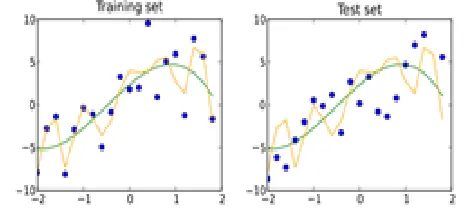
A training set (left) and a take a look at set (right) from identical applied mathematics population area unit shown as blue points. 2 prophetic models area unit suited the coaching information. Each fitted models area unit planned with each the coaching and take a look at sets. Within the coaching set, the MSE of the match shown in orange is four whereas the MSE for the match shown in inexperienced is nine. Within the take a look at set, the MSE for the match shown in orange is fifteen and also the MSE for the match shown in inexperienced is thirteen. The orange curve severely over fits the coaching information, since its MSE will increase by nearly an element of 4 once comparison the take a look at set to the coaching set. The inexperienced curve over fits the coaching information abundant less, as its MSE will increase by but an element of two .In the current thesis Neural Network approach (Support Vector Machine) has been used for higher presentation. Normally SVM is split into 2 categories: training set & testing set. The target of this thesis is to explore and improve a scientific approach for analysis of Squint Eye exploitation Support Vector Machine (SVM) inside one define of biometrical study and analysis.
[image:2.612.326.558.591.699.2]
International Journal of Emerging Technology and Advanced Engineering
Website: www.ijetae.com (ISSN 2250-2459,ISO 9001:2008 Certified Journal, Volume 3, Issue 8, August 2013)
501
IV. THE STEPS OF ACCOMPLISHING TRAINING &TESTINGSET OBJECTIVE ARE
1.Training of information set or sample is completed. 2.Trained information area unit obtained.
3.Testing of trained information is completed. 4.Test result area unit obtained
5.Finally result's obtained with detection of squint eye.
In the current work Neural Network approach (Support Vector Machine) has been used for better presentation. In general SVM is divided into two categories: Training set & testing set. The objective of this thesis is to explore and improve a systematic approach for analysis of Squint Eye using Support Vector Machine (SVM) within a single outline of biometrical study and analysis. The steps of accomplishing this objective are:
a)Training of data set or sample is done. b)Trained data are obtained.
c)Testing of trained data is done. d)Test result are obtained
e)Finally result is obtained with detection squint eye.
V. TRAINING SET
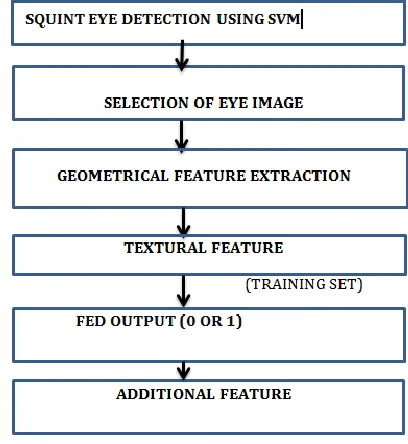
The construction of the Squint Model Consists of various steps as depicted in figure. The present work has been divided into two sets· Training Set and Testing Set. The Training starts with a pre- processing step, which consists of two major tasks: De-noising of image and compression of image. The De-noising has been used to obtain the distortion free enhanced image for further processing. The compression of the noise free image is to obtained by using some compression techniques such that the information should not be lost. In this present work compression has been used to compress the noise free image. After obtaining the compressed image some relevant geometric features are extracted, that are fed as input to a neural network for Testing of squint or normal eyes in the Testing set. In this present work some statistical parameters have also been extracted such as: Mean Variance, Skewness, and Kurtosis energy and entropy and so on. In the Testing set the trained neural network can recognize the squint or normal eye by classification based on best fit matching .The neural network performs best fit matching by SVM. In this present work, by using the methods of Support Vector Machine and the relevant geometric features a computer has been formulated.
Fig 2.Representation of steps for training set
The appropriate geometric features, textural feature, and additional feature have been extracted and used in testing feature for detection of squint eye are:
Distance between Left Eye of Left point (ll)
Distance between Left Eye Of Centre (lc) Distance between Right Eye of Left point (rl
Distance between Right Eye of Right point (rr)
Distance between Right Eye of Centre (rc)
[image:3.612.340.544.140.362.2]The relevant geometric features that are selected above parameter are represented diagrammatically in figure 3.
Fig 3. Representation of geometric features for squint eye detection.
VI. TESTING SET
[image:3.612.335.548.534.591.2]International Journal of Emerging Technology and Advanced Engineering
Website: www.ijetae.com (ISSN 2250-2459,ISO 9001:2008 Certified Journal, Volume 3, Issue 8, August 2013)
[image:4.612.74.264.328.549.2]502
The Testing process starts with feeding the geometric parameters based on selected geometric natures to the SVM. The neural network then computes the output based on inputs. The binary output generated by neural network has been used for making the decision about Testing process i.e. whether the eye is normal or squint. On the other hand, the statistical parameters calculated in the Training phase of present work that have been used to form the corpus: 'Squint Detection' .Then this trained data can be used in the Testing phase to automate the squint Testing process. In this automatic squint Testing process an unknown eye image is to be pre-processed by de-noising and compression technique for obtaining enhanced image. The relevant statistical features are to be calculated from enhanced image. These calculated features have to be compared against the training model for squint eye Testing.Fig 4. Representation of steps for testing set
VII. RESULT
To start with first eye image has been read as input in training set and some statistical features have been extracted. After extraction of features additional features of selected eye are calculated because it is training set therefore output has to be feed either 0 or 1 mainly, then additional features are evaluated if denoising images are present with the help of JTOOL denoising can be removed and about 32 features of a particular eyes can be calculated with this tool. once training set of selected data is done then training of data set are done .After this testing process is done which is same as training set mainly only difference occur in providing output in this output is not given though it is already fetched in training of data therefore after testing result is obtained which show whether eye is squint or not and as well as percentage of squint of selected eye.
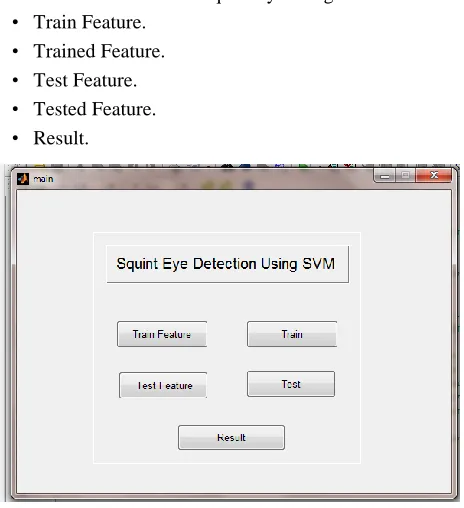
From the fig it is clear that detection of squint is done with the help of SVM, Which describe the popup menu for cooperating with application. Following Labels are Present in the detection of squint eye using SVM
• Train Feature. • Trained Feature. • Test Feature. • Tested Feature. • Result.
[image:4.612.329.561.367.621.2]International Journal of Emerging Technology and Advanced Engineering
Website: www.ijetae.com (ISSN 2250-2459,ISO 9001:2008 Certified Journal, Volume 3, Issue 8, August 2013)
[image:5.612.333.550.136.362.2]503
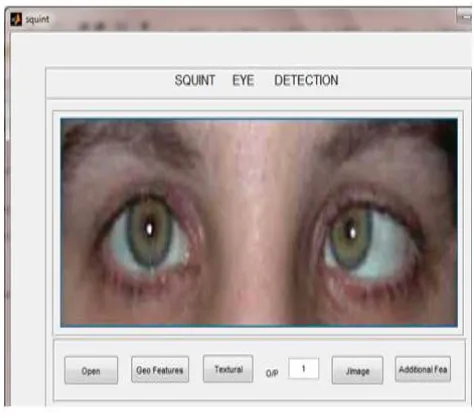
Shows that after selection of Eye image then geometrical feature are collected for both the eye i.e. for Left eye & Right eye.Fig 6: Extraction of Geometric Feature Of selected Eye
Once the geometrical & textural features extraction are done, the OUTPUT is provied to training set i.e. either 0 & 1.With the help of output traininig of seleted data are done and which are strored and obtained with the help of „TRAIN‟ option present.
Fig 7: Output Given For Training of Data
After training and testing of data set are done then result are obtained of selected eye image which describe following features:
Whether eye is squint or not.
Which eye is squint?
[image:5.612.65.274.176.339.2] Percentage of squint.
Fig 8: Shows Obtained Result for selected Eye image
VIII. CONCLUSION AND FUTURE WORK
[image:5.612.55.292.418.627.2]International Journal of Emerging Technology and Advanced Engineering
Website: www.ijetae.com (ISSN 2250-2459,ISO 9001:2008 Certified Journal, Volume 3, Issue 8, August 2013)
504
REFERENCES[1 ] R. Effert, J.C. Barry, A. Kaupp and M. Dahm, Eine neue photographische Methode zur Messungvon Schielwinkeln bei Sauglingen und Kleinkindern, Klinische Monatsblatter fur Augenheilkunde,198:284-289,1991
[2 ] R. Effert, J.C. Barry, A. Kaupp, M. Kleine, New method for the assessment of eye deviations instrabismus. Chibret International Journal of Opthalmology, 9(2):49-6 1, 1992.
[3 ] T. Lehmann, A. Kaupp, D. Meyer-Ebrecht, R. Effert, AutomatischeSchielwinkelmessungdurchHough- Transformation und Kreuz-Kovarianz- Filterung, In: S.J.Poppl, H. Handels (Hrsg.), Mustererkennung 1993,pp. 237-244,Springer-Verlag, Berlin, 1993.
[4 ] Otsu Nobuyuki, “A Threshold Selection Method from gray level Histograms”, ,((( 7UDQVDFWLRQV RQ 6\VWHPV0DQ DQG &\EHUQHWLFV, vol. SMC-9, no.1, January 1979
[5 ] P.V.C. Hough, A method and means for recognizing complex pattern, US Patent 3069654, 1962.
[6 ] T. Lehmann, A. Kaupp, D. Meyer-Ebrccht, R. Effert, Automatische Schielwin kelmessun 5 durch Hough-Transformation und Kreuz-Ko\ arianz-Filterung, In: S.J. Poppl, H. Handels: Hrsg.), Must e re rkennung 1993, p p . 237-244, springer-Verlag, Berlin, 1993. [7 ] Pratt W.K., “Digital Image Processing”,1991
[8 ] John Daugman, How iris recognition works, IEEE Trans. Circ. Syst. Video Technol. 14 (1) (2004) 21–30.
ABOUT AUTHORS
Seira Tak received the B.E. From CSVTU Bhilai (C.G.), India in Computer Science & Engineering in the year 2011. She is currently pursuing M.Tech. Degree in
Computer Science Engineering with
specialization in Software Engineering from CSVTU Bhilai (C.G.), India. She is currently working as Assistant Professor with the Department of Computer Science & Engineering in BIT, Raipur (C.G.), and India. Her research areas include Software Engineering, Neural Network, Pattern Recognition, Image Processing etc.
Prof.s K. J. Satao is Professor of Computer Science & Engineering and Head of Information Technology Department at
Rungta College of Engineering &