Journal of Chemical and Pharmaceutical Research, 2014, 6(10):274-280
Research Article
CODEN(USA) : JCPRC5
ISSN : 0975-7384
Study on the original page oriented load balancing strategy
Kunpeng Kang
School of Computer and Information Technology, Shangqiu Normal University, Shangqiu, China
_____________________________________________________________________________________________
ABSTRACT
Load balance plays an important role to information acquisition system performance. Excellent load balancing strategy is a key for us to make full use of system memory and computing resources, to reduce the response time of the distributed operation. Internal mechanism of original page load balance is given, based on analysis of the two recent commonly used dynamic load balance methods. Five original page oriented load balancing strategies are compared From the experimental and theoretical perspectives On the premise of calculating load index. Finally, the conclusion is drawn that date channel storage calculation sensitive partition is the most optimal load partition strategy.
Keywords: Original Page, Load Balance, Polling, Load Balancing Strategy
_____________________________________________________________________________________________
INTRODUCTION
The load balancing in storage system of distributed search engine. It can be divided into two aspects from the machine resources: hard disk storage load balancing, including the original page, page content and index files in different nodes of the hard disk storage. Load balance of computation, which refers to the load balancing of the calculation among the storage nodes. Each node needs to carry out many computing tasks, including the original page writing disk, the original page content extraction, content page update, index update and index query etc.
From the point of view of application, the load balancing of these computing and storage resources may be divided into two stages. The first stage is related with the original page, with the crawler node writing the original page drive on the system. For the storage it is the three data volume increasing and for the calculation it is writing disk caused by the original page writing disk, content extraction, index and content page update; the second stage is relevant to the index query, between storage nodes equilibrium index query load, to make the system have faster response time of distributed index query. The load balancing of the first stage is critical for the equilibrium and full use of the storage capacity, as well as for the improvement of the writing response time of grasping subsystem. The load balancing of the second stage can optimize index query response time.
This paper mainly studies the storage facing the original page and computational load balancing. The second section analyses the research status of the original page load balance; the third section puts forward the original page load balance system; the fourth quarter puts forward five strategies of the original page load balancing; the fifth section carry out the test and performance analysis for the load balancing strategies; the last section is the summary.
2. Relevant Task
it. A good load balance algorithm is not omnipotent; generally speaking it is closely linked with application scene. So we should consider the equalization algorithm comprehensively according to the characteristics of the process and make use different algorithms and techniques [1] [2] [3]. At present, there are two commonly used dynamic load balance methods:
2.1 Polling method
In a task queue node, every member has the same status. Polling method simply makes cycle selection in turn in this group. In load balancing environment, the algorithm will distribute new request next node in this node queue, so continuous, round and round. Each node is chosen in turn in equal status. Polling method activity is predictable, that is, each node’s chance to be chosen is 1 / N (assuming there are N nodes). Polling method is the most simple and most easy implementation approach. This method doesn't consider the machine isomerism.
2.2 Load Index Method
Load index algorithm calculates nodal Load Index LI (Load Index) based on node current Load condition. The Load Index constitutes the Load priority queue of a storage node; it takes the team node from priority queues and forwards service request every time when the service request arrives. Load index is a dynamic estimate [4][5]. The disadvantage of this method is that the cost of the dynamic monitoring of load index and the calculation is too high.
3. The original page load balance system
The computation load of this part is the first two stages of three processing phases of storage node, namely the original page analysis storage and the content page processing. The content page processing needs to update the content page and index; storage load refers to the hard disk storage of three data, of which the storage of the original page accounts for more than 80% of the storage; the weight of original page load balance is maximum.
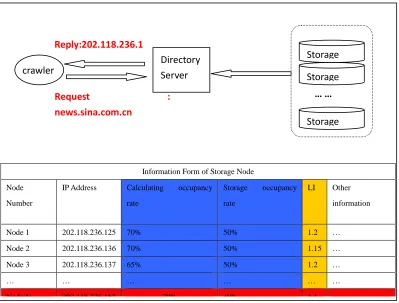
[image:2.595.109.508.397.700.2]The first target of the load balance is that the storage capacity of the machine can be fully and balanced used, make full use of the system’s hard disk storage space; secondly, the computing power is equalization, avoid calculation overloading of the node and make the whole storage system completes analyzing the received original page as soon as possible.
Figure 1: The basic procedure of load balancing
Information Form of Storage Node Node
Number
IP Address Calculating occupancy rate
Storage occupancy rate
LI Other information
Node 1 202.118.236.125 70% 50% 1.2 … Node 2 202.118.236.136 70% 50% 1.15 … Node 3 202.118.236.137 65% 50% 1.2 …
… … … …
Node N 202.118.236.157 70% 40% 1.1 …
crawler
Directory Server
Storage
Storage
Storage … …
Reply:202.118.236.1
Request :
Information Form of File directory Date Channel Storage Node 2012-08-17 News.sina.com.cn Node 1 2012-08-17 It.sohu.com.cn Node 2 2012-08-17 Sports.qq.com Node 3
… … …
2012-08-18 News.sina.com.cn NodeN 2012-08-17 It.sohu.com.cn Node 4 2012-08-17 News.ifeng.com Node 1
[image:3.595.218.396.72.175.2]… … ……
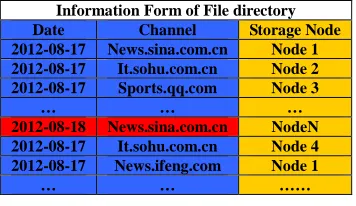
Figure 2: The logic directory table
Figure 1 is the load balancing schematic diagram. First of all, grab subsystem’s crawler inquiry storage unit; then load balancing module chooses the storage node of which the current load index being the smallest as the storage destination of this unit; At last, modifying figure 2 files in a directory information sheet, recording the unit storage information for subsequent query, and returning the unit storage node information to the crawler.
4. The Original Page Oriented Load Balancing Strategy
The isomerism of machine is not considered in Simple polling method; on the other hand, even the isomerism is considered, there are differences in size of the cells partitioned by task, in order to ensure the instantaneity of the information collection, we can't make the big unit write request after the cache. There is great uncertainty as long as the storage unit is big enough.
The premise of load index method is to designate the distributed system a load index which can correctly reflect current load condition of the system. The definition of the load index is critical. Literatures[4] suggest using resource utilization rather than resources queue length as the load index. Besides, in the distributed applications, processing memory, hard disk, CPU and I/O etc will affect the overall speed. It is more practical to define the composite load index comprehensively according to the nature of the task [6].
To balance the relevant storage and computational load of the original page, we considered the overall effect of the size of the load cell, load balance method, load information acquisition and load balancing algorithm for storage system, and designed a variety of load balance methods. In each method, the load index is defined (polling method after considering machine isomerism transmitting into load index method, just without dynamic monitoring load information).
4.1 Page Round Partition
Page Round Partition P - RP (Page Round Partition) method regards the original Page as the load partition unit, proportionally distributes load according to the initial storage capacity of each storage node. It does not take the balance of computing power into consideration. Its load index calculation is shown as follows:
( )
( )
ii
i
pages t
LI t
S
=
In the formulation,
pages t
i( )
means at the moment t, the page numbers that the storage node i has received, Sirefers to the hard disk storage capacity of storage nodes
i
. This method hypothesizes that the page size is equal, due to the huge number of pages and pages being small files. The equalization of the number of page represents the equalization of the storage capacity, so it can balance capacity load very well. But this strategy brings much metadata traffic and yuan data storage to management node. Because the number of the page in the system memory is large, management node cannot stand these loads.4.2 Channel Round Partition
Channel round partition C - RP (Channel Round Partition) method regards Channel as load partition unit, proportionally distributes load according to initial storage capacity of each storage node, and not take the balance of computing power into consideration. Its load index calculation is as follows:
( )
( )
ii
i
channels t
LI t
S
=
Si refers to the hard disk storage capacity of the storage nodes
i
. This method hypothesizes the channel size is equal, and its load is uneven because the channel number is not large and the sizes are different; on the other hand, its load difference will become worse with the passage of time because once a channel is assigned to a node, the data that the channel later grabs will be stored in this node, then the original load difference will become greater with time goes on. But the related operations of page content of this method can only be carried out in the machine, making the whole system simple in design.4.3 Channel Date Round Partition
Channel Date Round Partition CD - RP (Channel Date Round Partition) methods regards the day Channel as load partition unit, proportionally distributes load according to the initial storage capacity of each storage node. It does not take the balance of computing power into consideration. Its load index calculation is as follows:
( )
( )
ii i
DateChannels t
LI t
S
=
In the formulation the
DateChannels t
i( )
refers to the day channel number stored by the storage nodei
at themoment of
t
,S
irefers to the hard disk storage capacity of storage nodei
. This method hypothesizes that the size ofday channel is equal, though there is great difference between the channel sizes, day channel number is large, and at the same time C - RP load deterioration does not exist. The same big channel data will be stored in different nodes on different dates, and the effect of load balance is good. But the same channel is divided into different storage nodes. In the operation of the content page it needs to transmit in different nodes in order to have a judgment of new content.
4.4 Channel Date Storage-Sensitive Partition
Channel Date Storage-Sensitive Partition CD - SSP (Channel Date Storage - Sensitive Partition) method regards Channel date as load partition unit, measuring the disk occupation of storage nodes real time, distributing load unit to those machines of which the disk occupation rate is low. Its load index calculation is as follows:
( )
( )
iused i i
S
t
LI t
S
=
In the formulation, i
( )
usedS
t
refers to the data quantity stored by the storage node
i
at the momentt
; Si refers to the storage capacity of hard disk of storage nodesi
. This method distributes load according to the storage occupation rate on the basis of CD - RP, which reflects the storage load condition of nodes. But in addition to the shortcoming CD - RP, the management node needs to real-time monitoring disk’s occupation quantity of the storage nodes , to increase the load balance mechanism expense.4.5 Channel Date Storage-Compute-Sensitive Partition
Channel Date Storage-Compute-Sensitive Partition CD - SCSP (Channel Date Storage - Compute - Sensitive Partition) method regard Channel date as load partition unit, real-time measuring the Storage nodes disk and computational load, calculating the comprehensive load index, assigning load unit to lower index. Its load index calculation is as follows:
1 2
1
( )
( )
( )
( )
( )
( )
( )
( )
( )
/ 2
( )
( )
i i
i i i i i
i
S C
i S C
S C S C C
i S C C
S i
LI t
K
t
RT
t
RT
LI t
u
t
u
t
t
RT
t
RT
t
RT
LI t
u
t
others
ρ
ρ
ρ
ρ
ρ
ρ
ρ
ρ
=
≥
∨
≥
=
+
<
∧
<
∧
≥
=
( )
( )
i used S i iS
t
t
S
ρ
=
is the hard disk occupancy rate of storage nodes
i
at the moment oft
;( )
( )
i used C i iC
t
t
C
ρ
=
refers to the calculation occupancy rate of storage node
i
at the momentt
;u
1与 2
u
calculating adjustment factor Respectively, equally large;
RT
S和
RT
Cis storage and computing occupancy rate threshold Respectively, being less than and close to 1;
K
is a very large Number, on behalf of overload. When the node calculates or memory occupancy rate is more than threshold, the load index indicates overload; In the premise of not more than the threshold value, if the node calculation load up to more than half calculation threshold value, it will add the calculation load to load index, otherwise, it only takes capacity load as load index. This method adds calculation load regulation factor based on CD - SSP method, gives full consideration to the influence on the system load of storage and calculation. The shortcoming is load information acquisition quantity increases.4.6 dynamic load information acquisition
The premise to calculate load index is the load information acquisition, fast and simple load information acquisition mechanism ensures the timely and effective load index. The first three kinds of methods do not need to acquisition the dynamic load information, because management node has distribution unit of each node [7]. The later two strategies need to obtain dynamic load information: storage load and computational load.
Storage load is hard disk occupancy rate; each node obtains the disk occupation through the system call, and then takes the information real-time feedback to management node. Because the content page analysis is the most onerous link of storage node calculation. The computation load takes the original page cache data quantity to be analyzed of the storage nodes as the measurement, and takes the buffer occupancy rate as calculating load to sent to management node at true time.
5. Experiment
Since the Page Round Partition method is infeasible in actual deployment, we do not make further experimental analysis. This paper makes further experimental measurement with the later four methods about their equilibrium effect. Two experiments are carried out, and each experiment takes six days. In each experiment, the storage node is 8 , storage node operating system is Red Hat Enterprise Linux AS release 4. The former one isomorphism storage nodes, the machine’s processing speed is the same between hard disk and CPU; the later one is heterogeneous storage nodes, the machine’s processing speed is different between hard disk and CPU. No matter which group of machine, the network card is MB Enteric card,the size of cache area of content analysis is 1 G. At the end of the first
day of each experiment, the load is recorded, and at the end of the sixth day, the load is recorded again. Coefficient of Variation is statistical mathematical concepts, its value is the mean square error divided by average of the statistic data, representing the distribution of the data. If the coefficient of variation is smaller, the difference between data is smaller, and the distribution is more average; on the contrary, if the difference is bigger, the distribution is uneven. In this paper, the load balance is measured, calculation or storage load of each machine is quantized, and then coefficient of variation of these values is calculated. By using load coefficient of variation we indicate storage system load balance. The load coefficient of variation is the smaller, the load is well-distributed. Statistics are made with three kinds of load Coefficient of Variation.
Storage load Coefficient of Variation (S - CV): Coefficient of Variation of hard disk space occupancy of all storage nodes, this value represents storage load distribution.
Computation load Coefficient of Variation (C - CV): Coefficient of Variation of content analysis buffer occupancy of all storage nodes, this value represents computation load distribution.
Total load Coefficient of Variation (T - CV): Average of S - CV and C - CV values, indicating total load distribution of system.
This paper made statistics on the distribution of date channel partition unit. Figure 3 is date channel data distribution, comparison is made between its distribution and random data distribution.
Figure 3: The data distribution of the unit of channel date
[image:6.595.114.497.404.568.2]Figure 4 and figure 5 are the result of the first group of experiments. With C - RP method, storage load is deterioration, the effect of long-term operation is the worst; with CD - RP method, although the load coefficient is larger in the first day, it declined in six day, which is the adjustment by the Date Channel Partition ; C - RP and CD - RP are two methods based on the storage round, S - CV is much greater compared with non-round method; CD - SSP method and CD - SCSP method are the most load balanced, they are almost the same. CD - SCSP method is a little better in the calculation of loading. With CD - SSP method, the main reason for calculating the coefficient of variation is the isomorphism of machines, the result of storage balance is that the calculation is nearly equal for each machine (calculation is written by the original page drive).
Figure 4: One day of isomorphism stores Figure 5: Six days of isomorphism stores
Figure 6 and figure 7 are the results of the second set of experiment. Compared with the first set of experiments, the C - CV of this group of data of the former three methods is particularly big, because with the former three methods it only carries out storage load balancing, without considering computation load, to make the machine calculation overload, which will as a result increase the crawler writing response time. CD - SCSP method still has the least load coefficient of variation, although its S – CV is bigger than CD - SSP, its C - CV is much smaller, and in CD - SCSP method, S - CV and C - CV both are about 0.3. The system can accept this uneven load.
Figure 6: One day of heterogeneous stores Figure 7: Six days of heterogeneous stores
CONCLUSION
Load balance plays a key role to information acquisition system performance. only load balance is well done, can we make full use of system memory and computing resources, to reduce the response time of the distributed operation. This paper deals with balance processing to storage and calculation related load brought by the original page write system, and puts forward a variety of load balancing strategies, and further measures the load balance effect of each scheme through experiments. Finally, we find that date channel storage calculation sensitive partition is the most optimal load partition strategy.
Acknowledgements
This paper is supported by Science and Technology Department of Henan Province (No.142300410188).
REFERENCES
[1] Poli R; Kennedy J; Blackwell T. Swarm Intelligence, 2007, 1(1), 33-57. [2] He Jialiang; Ouyang Dantong; Zhu Xi; Ji Jinchao, AISS, 2012, 4(7), 155 - 162. [3] Banks A; Vincent J; Anyakoha C. Natural Computing, 2007, 45(6), 467-484. [4] ZHANG Deyu; LI Chunyan.JDCTA, 2012,6(23), 766 - 773.
[5] Jiping Li; Shouyin Liu; Shixun Wu. IJACT, 2012, 4(12), 233 - 240.