Good practice guidelines for improving
dissertation assessment: a case study
Pathirage, CP, Haigh, RP, Amaratunga, RDG and Baldry, D
Title Good practice guidelines for improving dissertation assessment: a case study
Authors Pathirage, CP, Haigh, RP, Amaratunga, RDG and Baldry, D
Type Conference or Workshop Item
URL This version is available at: http://usir.salford.ac.uk/2012/ Published Date 2006
USIR is a digital collection of the research output of the University of Salford. Where copyright permits, full text material held in the repository is made freely available online and can be read, downloaded and copied for noncommercial private study or research purposes. Please check the manuscript for any further copyright restrictions.
Conference Proceedings
Good Practice Guidelines for Improving Dissertation
Assessment: A Case study
Chaminda Pathirage, [email protected], Richard Haigh, [email protected],
Dilanthi Amaratunga, [email protected], David Baldry, [email protected]
Abstract
There have been increasing calls for higher education, during the last decade, to improve standards, increase the quality of assessment, and for greater accountability of lecturers. The need to ensure quality, consistency and improved criteria of assessment is greatly emphasised within modules where assessment is through one large piece of work such as a dissertation. This paper highlights the main findings of the literature and the case study phase from a research project that aimed to identify good practices for dissertation assessment, in an attempt to improve the quality and consistency of assessment. The case study included several components like two dissertation assessment exercises, a workshop organised among dissertation assessors and analysis of previous years’ dissertation assessment results. Outcomes of these components are outlined using appropriate statistical analyses. The paper highlights the many challenges that a Programme Leader faces, when devising an assessment strategy for a dissertation module.
Introduction
Dissertation modules typically pose problems in consistency of assessment due to the large number of students and the consequential need for large numbers of lecturers to participate in assessment. In response to these concerns and experiences from its own degree programmes, the School of Construction and Property Management (SCPM) undertook to investigate methods for improving quality and consistency of dissertation assessment by examining a range of assessment practices utilised by other disciplines and universities including degree programmes of the SCPM, with the aim of identifying good practices for undergraduate dissertation assessment in the built environment education sector. However, the research outcomes have a wider application to postgraduate courses offered by SCPM, and also degree programmes offered by other Schools within, and outside, the University. The 12 month project – completed in June 2005 – was funded under the University of Salford Teaching and Learning Quality Improvement Scheme (TLQIS).
Conference Proceedings
Assessment of Undergraduate Dissertation Modules
It is widely acknowledged that the undergraduate dissertation is special both to teachers and to students. From the students’ point of view, the dissertation is the single most substantial, and independently worked upon, piece of work they will undertake while at the university (Webster et al, 2000). From the assessors’ perspective, the assessment of a dissertation is also significant since such modules can account for up to 30 percent of marks awarded in a year. Therefore any inconsistencies in assessment will almost certainly be reflected in students’ overall grade for the year and ultimately the final degree classification (Saunders and Davis, 1998). Dissertation modules typically pose further problems in consistency of assessment due to the large number of students and the consequential need for large numbers of lecturers to participate in its assessment. As the size of the team expands, so the difficulties associated with achieving and maintaining consistency of assessment between lecturers becomes more apparent. However, in spite of the dissertation’s status within degree courses, and its perceived educational value and challenges, the assessment of the dissertation appears to be relatively under-explored within the published research literature in the UK (Todd et al, 2004). Three major areas were highlighted in the literature in relation to dissertation assessment i.e. quality, consistency and criteria of assessment.
Quality and Consistency in Assessment
There is increasing concern expressed at the quality of assessment practices, which emphasises a need to maintain the ‘gold standard’ of current assessment practices by individuals, departments and institutions involved with higher education (Webster et al, 2000; Saunders and Davis, 1998). This is further highlighted by the HEQC:
Student assessment is clearly central to standards. If the work of students is not assessed by valid and reliable methods, standards cannot be rigorous. (Higher Education Quality Council, 1997, pp. 8, cited in Webster et al, 2000)
The QAA code of practice (Section 6) on assessment of students can be perceived as a means of regularising the assessment of undergraduate students, which is directly applicable for undergraduate dissertation assessment as well. The following list details some of the requirements stipulated within this code of practice:
The principles, procedures and process of all assessment to be explicit
Publication of clear rules and regulations governing the conduct of assessment
Publication & implementation of consistently clear criteria for the marking and
grading of assessment
Appropriate feedback to students on assessed work
Competent staff to undertake roles and responsibilities in assessment work.
It is questionable how far higher education institutions adhere and follow these stipulated requirements of QAA, at least when it comes to the assessment of dissertation, which has a large bearing towards the ultimate degree classification of the students. Concern in higher education has also focused on the need for greater accountability of lecturers and on ensuring consistency of standards (Aper et al, 1990; Brown et al, 1995; Norton, 1990). Consistency of standards in assessment is important for all assessed
Conference Proceedings
uniformity betweenlecturers for a single piece of work and ensuringthe same standards
across pieces of workfrom similar modules for different courses (Saunders and Davis,
1998). However, the literature reveals several important factors which directly contribute on the consistency of dissertation assessment.
Scepticism of the lecturer’s on their own decision is believed to be a major contributor for the inconsistency in dissertation assessment (Rowntree, 1987). The following comments made by a few assessors will itself speak on this issue.
‘Real evidence of awareness of the various perspectives’, mark awarded 46%; ‘Results section unclear’, mark awarded 57%; ‘this is a clear, well presented [dissertation]… which fulfils it specific aims’, mark awarded 49%
(cited in Webster et al, 2000)
In addition, time spent on assessment, relative experience of the lecturer, lecturer’s attitude/ values and ownership of the criteria were considered to be the other leading determinants of the consistency in dissertation assessment. It was apparent that, in general terms, the longer a lecturer had spent assessing a dissertation, the lower the grade it received. As such it is argued that a lecturer should not revisit a piece of work that has already been rigorously assessed against the criteria.
Relative levels of experience of assessing dissertations were also felt to have been an important contributory factor. As Balla and Boyle’s (1994) and Brown et al.’s (1995) contend, lecturers need to be involved in the development of criteria so as to create the ownership of the criteria used for the dissertation assessment. As such, criteria designed carefully and used with clear procedures can reduce inconsistency in assessment and joint development of criteria by those assessing the work provides a useful start for ensuring that each lecturer understands them in the same way. This enables lecturers to be more certain as they are following the same process and judging each piece of work against the same criteria, thereby assessing each student in the same way. Having discussed the factors affecting quality and consistency of dissertation assessment, the following section outlines the literature pertaining to assessment criteria.
Criteria in Assessment
Assessment criteria are widely used in the education system when student’s work is being marked. It is good practice to publish, explain and clarify on what basis students are assessed, treating each student similarly, fairly and with consistency (as stipulated in QAA code of practice). Two different types or extremes of assessment criteria practiced in dissertation assessment were unearthed, namely impressionistic/ holistic and analytic (weighting method). The grade or the final marks for the dissertation was arrived on the basis of impression made in the holistic method where as in analytic method marks were given against each category based on a predetermined mark (Harris and Bell, 1994). It is argued that students’ awareness about the relative importance attributed by markers to each criterion used is of immense importance for the students to get the maximum out of the assessment. Yet, a holistic framework, using criteria to rationalise an overall mark has the considerable advantage of maximising flexibility from the assessors’ point of view.
Conference Proceedings
method of criteria, the process of assessment is much more standardised than having an impressionistic based criteria. As contended by Webster et al (2000), if the dissertation is a very individual piece of work presented by students’, surely it is the last piece of work which anyone would want to standardise by insisting the same or similar criteria and approaches.
Furthermore, Hands and Clewes (2000), whilst acknowledging the value of criterion referencing, have pointed out that too many criteria, specifically to the marking of dissertations, could diminish the importance of tutors’ judgments and lead to an increase in ‘marking fatigue’ which itself is a cause of much variability found in assessment quality. Nevertheless, assessment criteria can be seen as an important tool for giving new assessors confidence to take part in the assessment process. This is important as many academics report feelings of discomfort and fear when participating in exam boards or when double-marking work (Hand and Clewes, 2000). Partington (1994) has gone so far as to suggest that explicit assessment criteria that are freely available to staff and students should negate the need for double-marking.
Two marking strategies which need to be avoided are also highlighted within the literature, namely the Defensive marking strategy and Game theory. In defensive marking strategy the assessors avoid giving very high or low marks for the students making them unnoticeable to stakeholders (colleagues, external examiners). Game theory suggests that staff may try to anticipate the reaction of other stakeholders in the process, thereby marking dissertations to have marks close to the average with a very narrow range of marks. It was observed that assessors’ deploy these strategies especially when double marking is followed.
This research project aimed to identify good practices for undergraduate dissertation assessment, by addressing the quality, consistency and criteria of assessment as discussed above.
Research Methodology
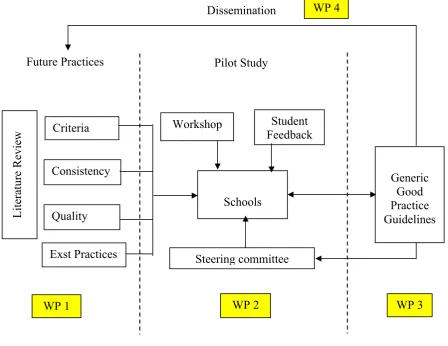
The research was carried out according to four Work Packages, as Figure 1 illustrates. Work Package one (WP1) reviews the literature and existing practices pertaining to undergraduate dissertation assessment. Outcomes and the understanding obtained from the literature review stage (WP1) are fed into the next case study phase (WP2), in which a series of exercises and workshops were planned. These workshops were designed to pilot a range of assessment approaches and criteria in an attempt to measure and ultimately improve assessment consistency within SCPM’s dissertation module on undergraduate programmes. Further, students were surveyed to ascertain understanding of dissertation requirements and assessment criteria. The project culminates in the publication of good practice guidelines (WP3), outlining good practices from other universities and disciplines, as well the results of the case study undertaken as part of the research. Finally, the Project’s findings are disseminated (WP4) to inform the teaching and research community, both internally and externally.
Conference Proceedings
WP1 – Literature review WP2 – Case study
[image:6.595.92.541.82.428.2]WP3 – Development of generic good practice guidelines WP4 – Research Dissemination
Figure 1: The project’s research methodology
A Study to Improve Dissertation Practices within SCPM
The research programme included a study of dissertation assessment practices within SCPM, the aim being to improve the quality and consistency of assessment within the School. This study included several components:
Two exercises were carried out to study the consistency of dissertation
assessment across the School’s dissertation assessors
A workshop was held to reflect upon the exercise results and identify
mechanisms to improve consistency
Dissertation marks over a three year period were analysed to the level of
consistency between first and second markers
Liter
atur
e Review
Criteria
Consistency
Quality Future Practices
Schools
Workshop Student
Feedback
Steering committee
Generic Good Practice Guidelines Pilot Study
WP 1 WP 2 WP 3
WP 4 Dissemination
Conference Proceedings
Dissertation Assessment Exercises
All of the School’s lecturers responsible for the supervision and assessment of undergraduate dissertations were given a complete, unmarked and anonymous copy of a dissertation, which was drawn from a general subject area in the construction and property field. Copies of the assessment criterion and the School’s standard pro forma / marking sheet for recording comments, together with assessment guidelines, were also distributed. In total, 26 dissertation copies were distributed and 18 (70 percent) assessed sheets were returned and analysed.
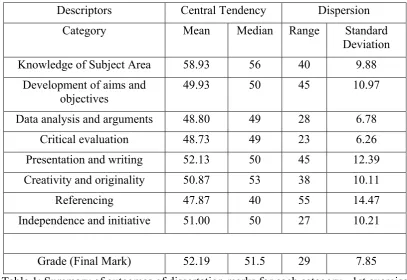
The School’s existing grade descriptors for dissertations (criterion) contained 8 categories (as shown in Table 1) and a specific number of marks were requested for each of these assessment areas, but, in accordance with the School’s policy, the weighting of marks between the categories was at the lecturer’s discretion. Space was provided to insert comments for each category in order to justify the marks awarded. Both marks and comments were analysed. Further, overall marks and comments given for the dissertation and, marks and comments made for each and every category were analysed separately. Table 1 summarises the analysis.
[image:7.595.106.514.413.693.2]In terms of final mark, the dissertation received a mean mark of 52.19 percent with a standard deviation of 7.85 and a range of 29 marks. Moreover, the overall grade given for the dissertation varied from a failure to a second upper (2:1) pass with highest number of marks aggregating between 50-54 marks range. Overall comments made for the dissertation seemed to be consistent except comments made among dissertation copies which had received above 60 marks.
Table 1: Summary of outcomes of dissertation marks for each category - 1st exercise
Descriptors Central Tendency Dispersion
Category Mean Median Range Standard
Deviation
Knowledge of Subject Area 58.93 56 40 9.88
Development of aims and objectives
49.93 50 45 10.97
Data analysis and arguments 48.80 49 28 6.78
Critical evaluation 48.73 49 23 6.26
Presentation and writing 52.13 50 45 12.39
Creativity and originality 50.87 53 38 10.11
Referencing 47.87 40 55 14.47
Independence and initiative 51.00 50 27 10.21
Grade (Final Mark) 52.19 51.5 29 7.85
Conference Proceedings
objectives (standard deviation of 10.97). Referencing showed the most significant difference in marks, ranging from a maximum of 90 marks to a minimum of 35 marks (range of 55 marks). Comments made for this category varied from ‘thorough and consistent’ to ‘very poor referencing’.
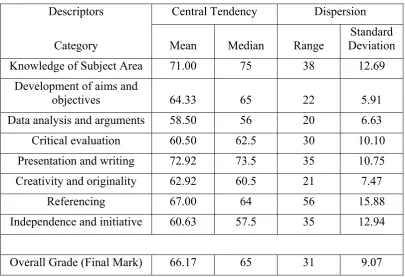
In summary, the exercise revealed considerable inconsistency in dissertation assessment across the School’s assessors. To substantiate these results, a second exercise that repeated the process, albeit with a different student’s dissertation, was conducted. As per first exercise, dissertation copies were distributed among the current dissertation supervisory panel of SCPM together with instructions, marking sheet and the marking criteria. In total, 26 dissertation copies were distributed and 12 (46 percent) assessed sheets were returned and analysed. The significantly lower return rate, at least in part, has been attributed to the timing of the second exercise, which coincided with a period of heavy assessment across many of the School’s modules. Table 2 summarises the results from the second exercise.
The final mark of the dissertation received a mean value of 66.17 percent with a standard deviation of 9.07 and a range of 31 marks. The grade awarded for the dissertation varied from a second lower pass (56) to a high first class (87) pass with most number of marks (75%) aggregating between 55-69 marks range. Comments made about the standard of the dissertation showed considerable consistency across assessors, except by those that awarded above 80 marks.
Descriptors Central Tendency Dispersion
Category Mean Median Range Deviation Standard
Knowledge of Subject Area 71.00 75 38 12.69
Development of aims and
objectives 64.33 65 22 5.91
Data analysis and arguments 58.50 56 20 6.63
Critical evaluation 60.50 62.5 30 10.10
Presentation and writing 72.92 73.5 35 10.75
Creativity and originality 62.92 60.5 21 7.47
Referencing 67.00 64 56 15.88
Independence and initiative 60.63 57.5 35 12.94
[image:8.595.109.515.381.658.2]Overall Grade (Final Mark) 66.17 65 31 9.07
Table 2: Summary of outcomes of dissertation marks for each category - 2nd exercise The highest mean mark of 72.92 was awarded under the Presentation and Writing category, whereas the lowest of 58.50 was received for the Data Analysis and Cogency
of Arguments category. The categories of Referencing (standard deviation of 15.88),
Conference Proceedings
(standard deviation of 10.75) showed the highest variation in marks for standard
deviation and range. Referencing showed the most significant difference in marks,
ranging from a maximum of 95 marks to a minimum of 39 marks (range of 56 marks). Yet again, there were differences in opinion when marking the category Independence
and Initiative due to anonymity of the dissertation copy. As might be expected, many
assessors refrained from awarding a mark for this category, having no knowledge of the student’s progression through the dissertation process. Surprisingly, several assessors did assign a mark despite this.
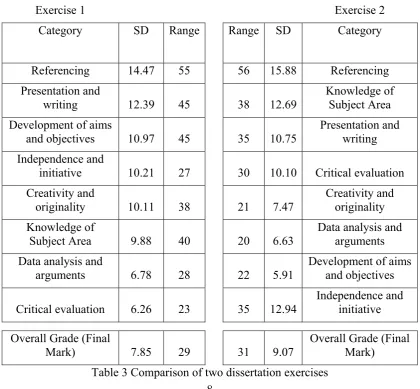
In summary, the second exercise supported the findings of the first and highlighted wide variation in the assessment of dissertations by the School’s assessors. For overall grading, (refer the Table 3) both showed a considerable dispersion in final marks. The second exercise shows a greater dispersion than in the first exercise, but by a narrow margin and this may in part be explained by the lower response rate.
Referencing shows the highest dispersion in both exercises, both in standard deviation and range. Similarly, Presentation and Writing received the next most significant variation in both cases, although it shows only as the third highest dispersion in the second exercise. As stated previously, there were differences in opinions when marking the independence and initiative category, which may explain the considerable variation in results. Having administered two dissertation exercises, a workshop was organised to disseminate the results and to explore the implications, as detailed in the next section.
Exercise 1 Exercise 2
Category SD Range Range SD Category
Referencing 14.47 55 56 15.88 Referencing
Presentation and
writing 12.39 45 38 12.69
Knowledge of Subject Area Development of aims
and objectives 10.97 45 35 10.75
Presentation and writing Independence and
initiative 10.21 27 30 10.10 Critical evaluation
Creativity and
originality 10.11 38 21 7.47
Creativity and originality Knowledge of
Subject Area 9.88 40 20 6.63
Data analysis and arguments Data analysis and
arguments 6.78 28 22 5.91 Development of aims and objectives
Critical evaluation 6.26 23 35 12.94 Independence and initiative
Overall Grade (Final
Mark) 7.85 29 31 9.07
[image:9.595.101.522.362.751.2]Overall Grade (Final Mark)
Conference Proceedings
Dissertation Assessment Workshop
A workshop was organised within the dissertation supervisory team of the School to:
Disseminate the results of the dissertation assessment exercises to the
supervisory team;
Explore the implications of the exercise results for assessment practice within the
School; and,
Generate a discussion on the appropriateness of the existing dissertation criterion
used by the school.
During the workshop the existing dissertation assessment criterion were revisited and other possible reasons for the differences in assessment were debated among the dissertation supervisors, with a view to identifying future actions. Discussions covered all categories of the assessment criterion, although more time was devoted to categories which depicted greater variations. Most of the lecturers commented on the difficulty of interpreting and understanding the precise meaning of the grade descriptors used in the categories of the assessment criterion and pointed out the necessity for them to be clearer. In particular, several lecturers found the difference between grade level descriptors within categories to be vague and/or too small, which may have increased the variation in marks awarded. Significantly, several lecturers felt, knowing the nature of the project and exercise, they had strictly tried to apply the criteria, when under normal circumstances they would have taken a more impressionistic approach. As a result, they were not always comfortable with the final mark awarded. Other lecturers admitted to not spending enough time in carrying out the assessment, thereby missing obvious flaws in the work and awarding unrealistically high marks. Although this may in part reflect the nature of an exercise such as this, the time pressures present when most dissertation assessment takes place (i.e. shortly before the end of the second semester, when many other module marks are being finalised and exam boards are imminent), may lead to similar errors. Discussions highlighted the need to ensure more consistent and common understanding and interpretation of the criterion. For example, it was clear that there was considerable disagreement on what is deemed good practice for referencing and what is required to demonstrate critical evaluation. Interestingly, many of the workshop attendees felt the exercise and subsequent workshop themselves would prove useful in developing a more consistent interpretation of the criteria.
Several initiatives were identified by the participants, with the aim of improving the consistency and the quality of the dissertation assessment practice within the School:
To interview dissertation assessors whose marks fell at the extreme ends of
overall and individual category assessments, thereby understanding individual interpretation of terms used within each category.
To organise a similar exercise and workshop among the same dissertation
supervisory panel just before the commencement of dissertation assessment to generate a common understanding about the dissertation assessment criterion.
To benchmark the results by organising a similar workshop in some other school
Conference Proceedings
To facilitate a meeting among the first and the second dissertation markers, prior
to the assessment of dissertation, in order to have a proper understanding of the dissertation student’s performance throughout the process.
As a further means of assessing the consistency of the dissertation marking within the School, an analysis of past undergraduate dissertation marks was carried out. The succeeding section explores the findings of this analysis.
Analysis of Previous Years’ Dissertation Assessment Results
In addition to assessing the consistency of dissertation marks, also this analysis aimed to test the belief that the supervisor’s mark has a bias in favour of the student (i.e. awards a higher mark), when compared to the second marker. As such, both the first marker’s (supervisor) and second marker’s marks were analysed to find any differences and the magnitude of those differences. Table 4 depicts the average marks of first marker and the second marker over a three year period. The 04/05 assessments were performed after the two dissertation exercises and workshop.
02/03 03/04 04/05
First Marker 62.57 61.63 62.41
Second Marker 60.02 60.53 62.05
Difference in
[image:11.595.107.517.285.385.2]Averages 2.55 1.10 0.36
Table 4 Average marks of first and second dissertation assessor’s
At the outset this shows a marginal difference in first markers averages in all three academic years, where first markers assessment seems to be biased towards the dissertation student. Nevertheless, the difference in averages between the two markers is decreasing. For a more comprehensive analysis, a hypothesis test was carried out.
H0: μ1 – μ2 = 0 (null hypothesis)
H1: μ1 – μ2 > 0 (alternative hypothesis)
By substituting the values of each academic year to the above formula, the Z value for three academic years were calculated and compared with the critical value at 95 percent confidence level. Table 5 depicts the comparison of Z value and critical value for each academic year.
Academic year 02/03 03/04 04/05
Z Value 1.735 0.782 0.273
Critical Value at 95% confidence level
1.6449 1.6449 1.6449
Table 5 Comparison of Z value with the critical value
[image:11.595.108.519.565.647.2]Conference Proceedings
Although, it shows a very similar result for first and second marker’s assessments when considering the overall averages for these two categories, it can be misleading as it doesn’t consider the individual differences in assessments. As such the analysis needs to consider the individual differences in assessment, where positive difference is recorded when first assessors mark exceed the second marker and a negative difference when vice versa. The following “t” test was carried out which considers this limitation. H0: μ = 0
H1: μ≠ 0
By substituting the values of each academic year to the above formula, the t value for three academic years were calculated and compared with the critical value at 95 percent confidence level. Table 6 depicts the comparison of t value and critical value for each academic year.
Academic year 02/03 03/04 04/05
t Value 3.894 1.822 0.516
Critical Value at 95% confidence level
[image:12.595.106.519.260.337.2]1.966 1.966 1.966
Table 6 Comparison of t value with the critical value
Depicting a very similar behaviour to the previous hypothesis test, this test too shows that there is a significant inconsistency in dissertation marking in 02/03 academic year and no significant difference in years 03/04 and 04/05. This conclusion was derived as the t value (3.894) in 02/03 is greater than the critical (1.966) and vice versa in years 03/04 and 04/05.
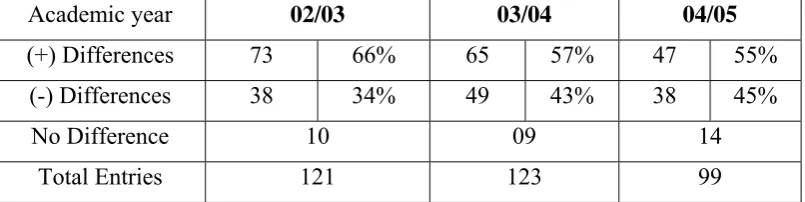
Further to this, another analysis was carried out that considered the number of occurrences of positive and negative differences in two markings, which is illustrated in Table 7. In year 02/03 academic year there had been a significant number of positive differences which could support the belief of supervisor’s bias towards the student. Yet, in 03/04 and 04/05 the difference has gradually reduced.
Academic year 02/03 03/04 04/05
(+) Differences 73 66% 65 57% 47 55%
(-) Differences 38 34% 49 43% 38 45%
No Difference 10 09 14
[image:12.595.112.515.506.607.2]Total Entries 121 123 99
Table 7 Comparison of number of positive and negative occurrences
Conference Proceedings
external examiners’ comments in these years, which complemented the improvement in the quality of the actual dissertations and their marking, most notably in the year 04/05.
Conclusion
This paper reported the main findings of the literature and the case study phase of a research project that is attempting to identify good practices for dissertation assessment on undergraduate programmes. It summarised the literature pertaining to dissertation assessment across three different areas i.e. quality, consistency, and criteria of assessment. Findings from the two dissertation assessment exercises revealed wide variation in the assessment of dissertations by the School’s assessors. Hence, the dissertation workshop was organised to disseminate the results and to discuss the implications for school’s assessment practice, which identified several initiatives to enhance the quality and consistency of assessment. The introduction of revised assessment criteria for dissertation marking, as well as an increasing emphasis on dissertation assessment, including the running of the two dissertation exercises and workshop, may have had a role to play in the improvement shown in academic year 2004/05, as highlighted in analysis of previous years’ dissertation assessment results. All in all, this project highlights the many challenges that a Programme Leader faces, when devising an assessment strategy for a dissertation module.
References
Aper, J. P. Cuver, S. M. and Hinkle, D. E., (1990), Coming to terms with the
accountability versus improvement debate in assessment, Higher Education, Vol. 20, pp.
471-83.
Balla, J. and Boyle, P. (1994)Assessment of student performance: a framework for
improving practice, Assessment and Evaluation in Higher Education, Vol. 19 No. 1, pp.
17-28.
Brown, S. Race, P. and Rust, C., (1995), Using and experiencing assessment, in Knight,
P. (Ed.), Assessment for Learning in Higher Education, Kogan-Page, London.
De Vries, P., (1996), Could ‘criteria’ in quality assessments be classified as academic
standards? Higher Education Quarterly, 3, July, pp. 193–206.
Hand, L. and Clewes, D., (2000), Marking the difference: an investigation of the criteria
used for assessing undergraduate dissertations in a business school. Assessment &
Evaluation in Higher Education, Vol.25, 5-21.
Harris, D. and Bell, C. (1994), Evaluating Assessing for Learning, Kogan-Page, London.
Harris, M. (1996) The Harris Report: Review of Postgraduate Education. HEFCE.
Higher Education Quality Council, (1997), Graduate Standards Programme, Final
Report, (London, HEQC).
Norton, L.S. (1990), Essay writing: what really counts?, Higher Education, Vol. 20, pp.
411-422.
Partington, J. (1994) Double marking students’ work. Assessment & Evaluation in
Higher Education, 19, 57-60.
Rowntree, D., (1987), Assessing Students: How Shall We Know Them?, Kogan-Page,
Conference Proceedings
Saunders, M. and Davis, S., (1998), The use of assessment criteria to ensure
consistency of marking, Quality Assurance in Education, Vol. 6 (3), pp162-171.
Section 6: Assessment of Students, (2000), Code of practice for the assurance of
academic quality and standards in higher education, Quality Assurance Agency for
Higher Education, May 2000, Gloucester.
Todd, M., Bannister, P and Clegg, S., (2004), Independent inquiry and the undergraduate dissertation: perceptions and experiences of final-year social science
students, Assessment & Evaluation in Higher Education, Vol 29 (3), pp 335-355.
Webster, F, Pepper, D and Jenkins, A., (2000), Assessing the Undergraduate
Dissertation, Assessment & Evaluation in Higher Education, Vol 25 (1), pp 71-80.
Wright, P., (1996), Mass higher education and the search for standards: reflections on
some issues emerging from the Graduate Standards Programme, Higher Education