BIROn - Birkbeck Institutional Research Online
McCants, Cody and Berggren, Nick and Eimer, Martin (2017) The guidance
of visual search by shape features and shape configurations. Journal of
Experimental Psychology: Human Perception and Performance 44 (7), pp.
1072-1085. ISSN 0096-1523.
Downloaded from:
Usage Guidelines:
Please refer to usage guidelines at or alternatively
1
Running Head: PART-BASED AND CONFIGURAL ATTENTIONAL GUIDANCE
The guidance of visual search
by shape features and shape configurations
Cody W. McCants*, Nick Berggren, and Martin Eimer
Department of Psychological Sciences, Birkbeck College, University of London, Malet Street, London WC1E 7HX, UK
* Corresponding author Phone: 0044 20 76316522 Fax: 0044 20 76316312
2 ABSTRACT
Representations of target features (attentional templates) guide attentional object selection during visual search. In many search tasks, targets objects are defined not by a single feature but by the spatial configuration of their component shapes. We used electrophysiological markers of attentional selection processes to determine whether the guidance of shape configuration search is entirely part-based or sensitive to the spatial relationship between shape features. Participants searched for targets defined by the spatial arrangement of two shape components (e.g., hourglass above circle). N2pc components were triggered not only by targets but also by partially matching distractors with one target shape (e.g., hourglass above hexagon) and by distractors that contained both target shapes in the reverse arrangement (e.g., circle above hourglass), in line with part-based attentional control. Target N2pc components were delayed when a reverse distractor was present on the opposite side of the same display, suggesting that early shape-specific attentional guidance processes could not distinguish between targets and reverse distractors. The control of attention then became sensitive to spatial configuration, which resulted in a stronger attentional bias for target objects relative to reverse and partially matching distractors. Results demonstrate that search for target objects defined by the spatial arrangement of their component shapes is initially controlled in a feature-based fashion but can later be guided by templates for spatial configurations.
PUBLIC SIGNIFICANCE STATEMENT
Search for a specific target object in a visual display is controlled by mental representations of these objects which are called ‘attentional templates’. The present study used electrical brain potentials to investigate whether these templates are able to distinguish between a target object that is defined by a configuration of two shape parts (e.g., a hexagon above a cross) and a nontarget object that has the same shape components as the target but in a different configuration (e.g., a cross above a hexagon). Our results show that during the early phase of a search episode, attentional processes cannot distinguish these two objects. At a later phase, search templates for shape configurations become available and are able to guide attention towards target objects.
3 INTRODUCTION
During visual search, knowledge about the properties of target objects guides the attentional selection of these objects in visual scenes. Currently task-relevant features are represented in top-down task sets (e.g., Folk, Remington, & Johnston, 1992) or attentional templates (e.g., Duncan & Humphreys, 1989). Such target templates are activated during the preparation for a search episode, and bias attentional selection towards objects with target-matching features (Desimone & Duncan, 1995; Eimer, 2014). The effects of feature-specific target templates on attentional selectivity have been well documented. For example, when targets are defined by a particular colour, nontarget objects that match this colour will capture attention even when they have to be ignored, whereas objects without target-matching features will not trigger any task-set contingent attentional capture (e.g., Folk et al., 1992).
In many search tasks, target objects are not defined by a single feature but by a feature combination. Search for such conjunctively defined targets is typically less efficient than search for a unique target feature (e.g., Treisman & Gelade, 1980; Duncan & Humphreys, 1989, 1992). How do attentional templates control object selection during search for feature conjunctions? According to the Guided Search model (Wolfe, 1994, 2007), top-down attentional biases operate simultaneously and independently for different target-matching features to guide attention towards likely target objects. However, only one feature per dimension can be involved in this type of attentional guidance (Wolfe, 2007). In other words, conjunction search can be guided by templates for a particular target colour and target shape, but it is not possible to concurrently activate templates for two features from the same dimension (e.g., two colours or two shapes). This hypothesis is based on the observation that search for targets defined by the conjunction of two features from the same dimension (colour) is much more difficult than search for targets defined by a combination of features from two different dimensions (Wolfe, Yu, Stewart, Shorter, Friedman-Hill, & Cave, 1990; but see Wolfe, Friedman-Hill, & Bilsky, 1994; Carrasco, Ponte, Rechea, & Sampedro, 1998, for task contexts where colour/colour conjunction search can be relatively efficient).
4
lateralised objects with template-matching features among distractor objects in visual search displays (e.g., Eimer, 1996; Luck & Hillyard, 1994). This component is characterised by an enhanced negativity at occipito-temporal electrodes contralateral to the side where a template-matching object is presented, and typically emerges around 180-200 ms after stimulus onset. While most N2pc studies have used tasks where targets were defined by one specific constant feature (e.g., Eimer & Kiss, 2008; Leblanc, Prime, & Jolicoeur, 2008; Lien, Ruthruff, Goodin, & Remington, 2008), N2pc components are also triggered during conjunction search (e.g., Luck, Girelli, McDermott, & Ford, 1997; Fuggetta, Pavone, Walsh, Kiss, & Eimer, 2006). When search targets are defined by a conjunction of features from different dimensions (colour and size, or colour and shape), N2pc components are elicited not only by target objects, but also by nontargets that match one of these features (Kiss, Grubert, & Eimer, 2013). Notably, this is the case even when a target object is present in the same display (Eimer & Grubert, 2014). These observations suggest that template-guided attentional selection processes operate in parallel and independently for different target features at different locations in the same search display.
Several recent studies have shown that target selection can be guided by search templates for multiple features from the same dimension (colour), thus challenging the assumption of the Guided Search model that only a single feature per dimension can be involved in attentional guidance. Using behavioural measures, Irons, Folk, & Remington (2012) showed that during search for one of two possible target colours (e.g., red or green objects), task-irrelevant stimuli that matched either of these colours captured attention, whereas nonmatching colours did not (see also Grubert & Eimer, 2016, for corresponding N2pc results). To assess how such multiple-colour templates control attentional target selection in search tasks where targets are defined by a combination of two colours (e.g., red and green objects), Berggren & Eimer (2016a) measured N2pc components to target objects with both two target-defining colours and to distractors that matched one of these colours. Reliable N2pc components were elicited not only by targets but also by partially matching distractor objects, even when a target was simultaneously present in the same display. This suggests that, analogous to colour/shape search (Eimer & Grubert, 2014), colour/colour conjunction search can be guided simultaneously by separate target templates for two different colours.
5
are defined by having two features (e.g., two colours) in a specific spatial arrangement (e.g., red above green). The spatial relationship between two target features should be entirely invisible to strictly feature-specific attentional guidance processes, which are sensitive only to the presence of task-relevant features, but not to their configuration within a target object. A recent N2pc study (Berggren & Eimer, 2016b, Experiment 3) investigated the attentional guidance of target selection in such a colour/colour configuration search task. Targets were defined by the spatial arrangement of two colours (e.g., objects with a red top half and a green bottom half). In a subset of all search displays, these targets were accompanied by reverse-colour distractor objects composed of both target-defining colours in the opposite spatial configuration (e.g., green top and red bottom half). When targets and reverse-colour distractors appeared in opposite hemifields, no N2pc component was elicited at all, demonstrating that colour-based attentional guidance processes were insensitive to colour configuration information, and thus unable to distinguish between these two types of objects. For displays where targets and reverse-colour distractors appeared on the same side, the N2pc was nearly twice as large as for target displays without a reverse-colour distractor, suggesting that attention was allocated in parallel and independently to both types of objects.
These findings are relevant for models of attentional guidance mechanisms in visual search and for our understanding of the nature of attentional templates. They suggest that search goals are not represented as integrated objects or “images in the mind” (James, 1890), which would include information about the spatial/configural relationships between individual features, but instead separately as independent features. The critical question is whether this applies generally to all search tasks, or only to relatively artificial tasks where target objects are defined in a way that is rarely relevant in the real world. Apart from situations where we look for the national flag of a particular country among other flags, we normally do not search for targets characterized by a specific spatial arrangement of different colours. It is possible that search can be guided by the spatial-configural arrangement of target features in other more ecologically relevant task contexts. Colour/colour configuration search could also be a special case because individual colours are powerful guiding features (e.g., D’Zmura, 1991; Wolfe & Horowitz, 2004) and therefore may override any residual effects of relational properties on attentional guidance during colour-colour configuration search.
6
colour, we now used shape as the task-relevant feature dimension. Unlike colour/colour configuration search (Berggren & Eimer, 2016b), search for target objects that are defined by the arrangement of two (or more) component shapes is very common. Most real-world visual objects are characterised by specific spatial configurations of basic shape attributes, and the two- and three-dimensional arrangement of geometric components is critical for object recognition (e.g., Biederman, 1987). For this reason, the guidance of attention during shape/shape configuration search should not be primarily or exclusively based on independent templates for individual shape parts, but may also be sensitive to the overall spatial configuration of these parts. This possibility has so far rarely been addressed. In one behavioural study, Wolfe, Klempen, and Shulman (1999) found that search for target objects defined by two component shapes in a particular spatial arrangement (e.g., “snowmen” composed of a smaller circle on top of a larger circle) among rotated distractors (e.g., upside-down snowmen) was inefficient, suggesting that object polarity is not an effective guiding attribute. The goal of the present study was to investigate this issue with electrophysiological measures.
7
different types of distractors), and for the three different partially matching distractors on target-absent trials.
8 EXPERIMENT 1
Method
Participants
Fifteen participants with normal or corrected-to-normal vision were paid in exchange for their participation in Experiment 1. One participant was excluded from analysis due to excessive artifact rejection (over 50% of trials excluded), and another two due to faults in data recording. Of the remaining 12 participants, four were male and 3 were left-handed (M age=31, SD=6).
Sample size was set a priori at 12 participants, based on many previous N2pc studies in our lab. To assess whether this sample size would be sufficient for the current feature configuration search task, we calculated the effect size from a previous N2pc study examining search for targets defined by the spatial configuration of two colours (Berggren & Eimer, 2016b, Experiment 3). In this experiment, the difference of target N2pc amplitudes in the presence versus absence of a reverse-colours distractor object showed a Cohen's d effect size of 1.79, suggesting a minimum required sample size as low as N = 5 when assuming standard power of 0.8 and an alpha level of 0.05. Furthermore, when determining effect size estimates on the higher order ANOVA interaction from this study, a partial eta squared effect size of .65 was obtained, suggesting a minimum sample size of N = 7. Cohen’s d effect size was calculated using the classic method of dividing condition mean difference by the pooled standard deviation.
Stimuli and procedure
The experiment was programmed and executed on-line using Matlab software (MathWorks, Natick, MA) and presented on a 24-inch BenQ widescreen monitor (60 Hz, 1920 x 1080 screen resolution) at a viewing distance of approximately 90 cm. Participants’ behavioural responses and response times were recorded with a BlackBox Toolkit (The Black Box Toolkit Ltd, 2016) response box with a custom 4-button layout arranged in cardinal directions and equidistant from the centre of the box. In both experiments, only the top and bottom buttons were used.
9
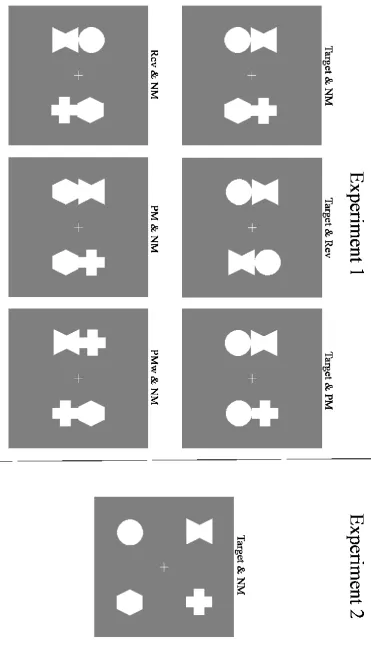
block. Each search display contained one object to the left and one to the right of fixation, at an eccentricity of 2.16° from the central fixation cross. Both objects were grey, and were composed of two vertically aligned geometric shapes (e.g., a hexagon above a cross). There were four possible shapes: hexagon, cross, hourglass, and circle. All shapes were vertically and horizontally symmetrical, and equal in size (1.15° x 1.15°). Participants were instructed to maintain central fixation, and to detect a target object that was defined by a specific spatial arrangement of two shapes (e.g., hourglass above circle). Each participant was assigned a different target object, with the restriction that all four component shapes served as part of the target object for the same number of participants.
Search displays were presented for 150 ms, and the interval between two successive search displays was 1850 ms. Participants had to press the top response key when the target object item was present and the bottom key when it was absent. Target-present and target-absent displays were equiprobable and randomly intermixed in each block. There were three types of target-present trials that differed with respect to the distractor object that accompanied the target on the opposite side. This distractor could be a nonmatching (NM) object composed of two nontarget shapes (Target & NM displays), a partially matching (PM) object that contained one target-defining shape in its correct vertical position and one nontarget shape (Target & PM displays), or an object that contained both target shapes but in the reverse (Rev) spatial arrangement (e.g., a circle above hourglass during search for hourglass above circle; Target & Rev displays). These three target-present trials were equiprobable, and targets were equally likely to appear on the left or right side. Target-absent trials always contained one nonmatching distractor object that was accompanied either by an object with both target shapes in the reverse configuration (Rev & NM displays), by an object with one target-matching shape in its correct vertical position (PM & NM displays), or by an object that also contained one target-matching shape but in the wrong vertical position (PMw & NM displays; see Figure 1 for an illustration of the different present and target-absent trials). These target-matching objects were equally likely to be presented on the left or right side on target-absent trials. Following practice, participants completed 20 blocks composed of 48 trials (960 trials in total).
EEG recording and data analysis
10
Channels were referenced online to an electrode on the left earlobe, and re-referenced to an average of both the left and right earlobes offline. No other filters were applied following EEG acquisition. Trials were rejected for incorrect responses, eye-blinks (> ± 60 µV at Fpz), eye-movements (> ± 30 µV in the HEOG channels), or muscle movement artefacts (> ± 80 µV at all other channels), and these trials were not included in any analysis. Remaining trials were segmented into epochs from 100 ms before to 500 ms after the onset of each search display. Averaged ERP waveforms were then computed for each of the six types of search display, separately for trials where the target object (on target-present trials) or the distractor object with target-matching features (on target-absent trials) appeared in the left and right visual field. N2pc amplitudes were quantified as the difference between ERP mean amplitudes obtained between 200 and 300ms after search display onset at posterior electrode sites PO7 and PO8. N2pc onset latencies were calculated by assessing grand averaged difference waveforms (contralateral minus ipsilateral ERPs), using a jackknife-based analysis method (Miller, Patterson, & Ulrich, 1998). In this analysis, 12 subsamples of grand-averaged difference waves were computed, each excluding a different participant from the original grand-averaged sample. N2pc onset was defined as the time at which each of these subsamples reached an absolute threshold of -1 µV, except in the case of double-difference waves in which a relative threshold of 50% of N2pc peak amplitude was used. N2pc onset latency differences were assessed using repeated-measures ANOVAs and two-tailed t-tests, with F- and t-values corrected according to the formulas described by Ulrich and Miller (2001) and Miller et al. (1998). The corrected tests are indicated with Fc and tc, respectively.
Results
Behavioural data
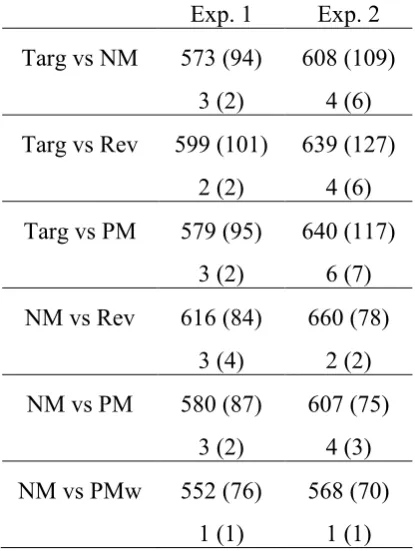
Table 1 (left panel) shows mean reaction times (RTs) and error rates for the six different target-present and target-absent displays. RTs on target-present trials with correct responses were entered into a one-way repeated measures analysis of variance (ANOVA) with the factor Distractor Type (NM, Rev, PM). There was a main effect of Distractor Type (F(2,22) = 7.91, p = .003, ηp2 = .42). Paired-sample t-tests revealed that the RTs were delayed
11
.129). A separate ANOVA for target-absent displays with correct responses showed that RTs were reliably affected by the type of target-matching distractor in these displays (Rev, PM, PMw: F(2,22) = 28.15, p < .001, ηp2 = .719). Target-absent RTs were slowest for displays
that contained a reverse distractor (M = 616 ms) relative to displays with a partially matching distractor (M = 580 ms; t(11) = 3.25, p = .008, d = .44), and with a PMw distractor (M = 552 ms; t(11) = 8.81, p < .001, d = .78). Furthermore, a partially matching distractor with a target shape in its correct vertical position delayed target-absent RTs relative to PMw distractors (t(11) = 4.27, p = .001, d = .35).
Error rates were also entered into one-way ANOVAs, separately for target-present and target-absent trials. Incorrect target-absent responses occurred on 3% of all target-present trials, and there was no significant effect of Distractor Type (F < 1). The percentage of incorrect present responses on absent trials was affected by the type of target-matching object in these displays (F(2,22) = 4.18, p = .029, ηp2 = .275). The presence of a
reverse distractor triggered more incorrect responses (M = 3.49 %) than a PMw distractor (M = 0.89 %; t(11) = 2.44, p = .033, d = .86). Additionally, incorrect target-present responses were more frequent for displays including a partially matching distractor (M = 2.56 %) than for displays with a PMw distractor (t(11) = 3.03, p = .012, d = 1.09). There was no difference in error rates between displays with reverse and partially matching distractors (t < 1).
N2pc components
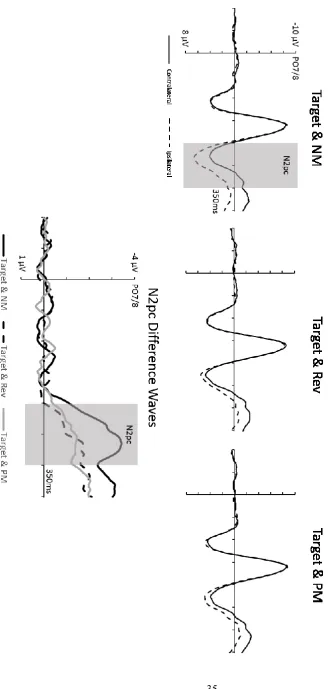
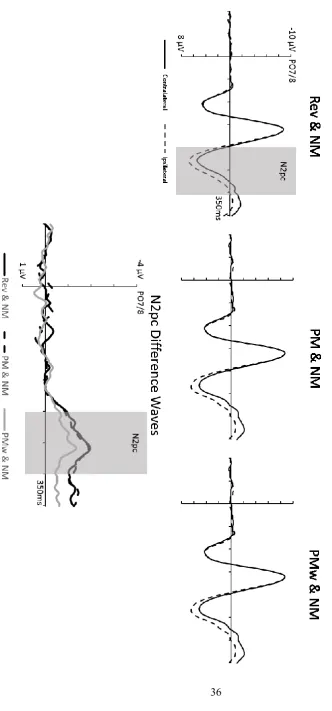
Target-present displays. Figure 2 shows ERPs elicited at electrodes PO7/8 contralateral and ipsilateral to the target objects for the three different target-present display types, together with the corresponding contralateral-ipsilateral N2pc difference waveforms. Target N2pc components were present for all three display types, but appeared to be larger and emerge earlier when targets were accompanied by nonmatching distractors relative to displays with reverse or partially matching distractors. A 3 x 2 repeated-measures ANOVA of N2pc mean amplitudes measured on target-present trials in the 200-300 ms post-stimulus time window with the factors Non-Target Item Type (NM, Rev, PM) and Laterality (electrode ipsilateral or contralateral to the target location) revealed a main effect of Laterality (F(1,11) = 36.77, p < .001, ηp2 = .77), reflecting the presence of target N2pc
components. Importantly, an interaction between Distractor Type and Laterality (F(2,22) = 22.96, p < .001, ηp2 = .67) confirmed that target N2pc amplitudes were affected by the type of
12
ipsilateral and contralateral mean amplitudes showed that significant target N2pc components were elicited for all three types of target-present displays (all t’s > 3.54, p’s < .01, d’s > .24). When targets were accompanied by nonmatching distractors, they triggered larger N2pc components (M = -3.42 µV) than when they were presented together with reverse distractors (M = 1.15 µV; t(11) = 5.32, p < .001, d = 1.61), or with partially matching distractors (M = -1.88 µV; t(11) = 6.08, p < .001, d = 1.05). Furthermore, reverse distractors attenuated target N2pc amplitudes more strongly than partially matching distractors (t(11) = 2.26, p = .045, d = .64). N2pc onset latencies on target-present trials were also reliably affected by Distractor Type (Fc(2,22) = 11.69, p < .001, ηpc2 = .52). When targets were presented together with
nonmatching distractors, the N2pc emerged earlier (M = 190 ms) than when they appeared together with reverse distractors (M = 238 ms; tc(11) = 4.33, p = .001, ηpc2 = .63), or partially
matching distractors (M = 212 ms; tc(11) = 2.57, p = .024, ηpc2 = .38). Reverse distractors
delayed target N2pc onset latency more strongly than partially matching distractors (tc(11) = 2.61, p = .026, ηpc2 = .37).
--- Insert Figure 2 about here --- --- Insert Figure 3 about here ---
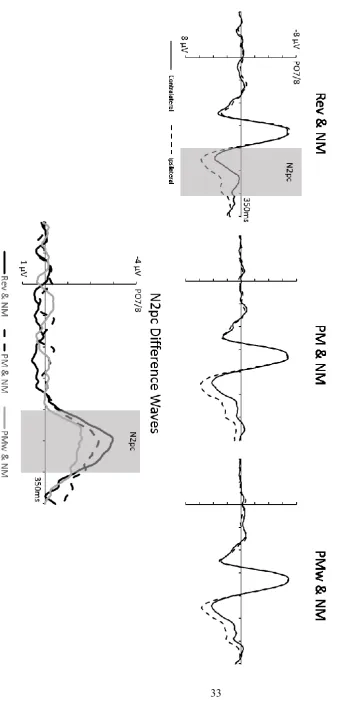
Target-absent displays. Figure 3 shows ERPs elicited contralateral and ipsilateral to target-matching distractors on target-absent trials, with the corresponding N2pc difference waveforms. Target-matching distractors triggered reliable N2pc components, as reflected by a main effect of Laterality (F(1,11) = 20.76, p < .001, ηp2 = .65) for N2pc mean amplitudes.
N2pcs were largest for displays with reverse distractors and smallest for displays with PMw distractors, confirmed by an interaction between Laterality and Distractor Type (F(2,22) = 3.54, p = .046, ηp2 = .24). N2pc components elicited by PMw distractors were smaller (M =
13
types (see Figure 3), there was no overall reliable effect of Distractor Type on N2pc latencies on target-absent trials (Fc(2,22) = 1.39, p = .271, ηpc2 = .11).
N2pc analyses across target-present and target-absent trials. To investigate how the spatial configuration of target-matching shapes affected N2pc components in Experiment 1, we compared N2pc components to targets objects and reverse distractors on trials where they were accompanied by a nonmatching distractor. Across the whole N2pc measurement window, target N2pcs were larger than N2pcs to reverse distractor objects (t(11)= 3.62, p = .004, d = .67). To determine when this N2pcs amplitude difference started to emerge, we employed two different methods (see Jenkins, Grubert, & Eimer, in press, for analogous procedures). First, individual N2pc difference waves for targets and reverse distractors were compared with successive one-tailed paired t-tests for each sampling point after display onset. A significant amplitude difference between N2pcs to targets and reverse distractors had to remain present for at least ten consecutive subsequent sampling points (corresponding to 20 ms) in order to be interpreted as marking the point in time where target N2pcs start to become larger than reverse distractor N2pcs. This procedure yielded an onset estimate of 226 ms after search display onset. In a second independent analysis, N2pc difference waveforms for reverse distractors was subtracted from N2pc difference waves for targets, separately for each participant, followed by a jackknife-based analysis of these double subtraction waveforms with a relative onset criterion of 50% of the peak N2pc amplitude. This analysis suggested a slightly later onset of N2pc amplitude differences between targets and reverse distractors (248 ms post-stimulus).1
The attenuation and delay of target N2pcs in displays where targets and reverse distractors appeared on opposite sides relative to Tar & NM displays could be due to the concurrent presence of a smaller N2pc of opposite polarity triggered in parallel by reverse distractors. If this was the case, the difference between N2pc components for Target & NM versus Target & Rev displays should match the N2pc elicited by reverse distractors on target-absent trials. As can be seen from the N2pc difference waveforms shown in Figure 4 (left panel), the N2pc to reverse distractors (solid line) was indeed equal in size to the difference between N2pcs to targets in the absence versus presence of a reverse distractor (dashed line; t
1
14
< 1). The same result was obtained when the attenuation of target N2pcs by the presence of partially matching distractors was assessed in the same way (Figure 4, right panel). The N2pc to partially matching distractors was identical in size to the difference of target N2pcs between displays with and without a partially matching distractor (t < 1).
--- Insert Figure 4 about here ---
Discussion of Experiment 1
The results of Experiment 1 demonstrate that the attentional selection of target objects defined by the configuration of two basic shapes is not entirely controlled by object templates that represent only the overall shape of targets and not their component parts. Distractor objects composed of both target shapes in the reverse spatial configuration produced clear behavioural costs and triggered substantial N2pc components, indicating that they were able to attract attention. Target-present RTs were delayed when targets were accompanied by a reverse distractor object, and the presence of these objects also produced the slowest RTs on target-absent trials. Reverse distractors not only triggered clear N2pc components in displays where they appeared together with a nonmatching distractor, but their presence also strongly delayed and attenuated N2pcs to target objects in the same display. This attenuation of the target N2pc by reverse distractors matched the size of the N2pc elicited by reverse distractors alone, suggesting that targets and reverse distractors triggered simultaneous N2pcs of opposite polarity when they appeared on opposite sides of the same display. Partially matching distractor objects that contained one target shape also elicited reliable N2pcs on target-absent trials, and attenuated target N2pc components on target-present trials. The size of this attenuation matched the N2pc to partially matching distractors alone, again indicating that attention was allocated in parallel to both targets and partially matching distractors in the same display. If attention had been exclusively guided by an integrated template of the overall shape of the target object, neither reverse nor partially matching distractors should have been able to attract attention and to elicit N2pc components.
15
sensitivity emerged later than the effects of part-based attentional guidance. The presence of a reverse distractor on the opposite side of the same display delayed and attenuated target N2pc components, but an N2pc to targets did eventually emerge for these displays, at around 240 ms after display onset, demonstrating that from this point in time onwards, the attentional bias triggered by targets was stronger than the bias elicited simultaneously by reverse distractors. Further evidence for this was provided by the comparison of N2pc components to targets and reverse distractors in displays with a nonmatching distractor on the other side. During the early N2pc time window, these two components did not differ in size, but from about 230-250 ms onwards, the target N2pcs were reliably larger than N2pcs to reverse distractors. Together, these observations suggest that attentional guidance processes became sensitive to shape configurations during this time period. The observation that N2pc components to distractors with one target-matching shape were larger when this shape appeared in its assigned vertical position than when it was presented at the other nonmatching position (PMw distractors) from about 230-240 ms post-stimulus is also in line with this hypothesis. Overall, this pattern of results suggests that attention was guided jointly by feature-specific templates for each target shape and by templates that represent the overall spatial configuration of target objects, and that the effects of part-based guidance precede the effects of guidance by shape configuration.
16 EXPERIMENT 2
Method
Participants
Thirteen participants took part in Experiment 2, and one participant was excluded due to error rates over 3 SDs above the group mean. Of the 12 remaining participants, 4 were male and 3 were left handed (M age = 31, SD = 5). All participants had normal or corrected-to-normal vision. To assess that our sample size in Experiment 1 had been appropriately powered, an analysis was conducted on the previously observed effect sizes. In Experiment 1, the higher order interaction of Display Type x Laterality yielded a partial eta square effect size of .74, in fact larger than the effect size previously observed by Berggren and Eimer (2016b) which informed Experiment 1, and suggesting a minimum sample size of N = 6. Thus, there was no evidence to suggest that Experiment 1 was underpowered, and we used the same sample size in Experiment 2, to ensure comparability between these two
experiments
Stimuli and procedure
This experimental design was identical to Experiment 1, except that the two shapes on each side were now presented in the upper and lower visual field quadrant. The vertical gap between the centre of the upper shape and the centre of the lower shape was 4.32° (see Figure 1, bottom panel, for an example display). This distance was identical to the distance between the centres of the two shapes on the left and right side. As in Experiment 1, targets were defined by the spatial configuration of two specific shapes on the same side.
EEG recording and Data analysis
These procedures were all identical to Experiment 1.
Results
Behavioural Data
17
faster when they were accompanied by a nonmatching distractor (M = 608 ms) than when they appeared together with a reverse distractor (M = 639 ms; t(11) = 2.91, p = .014, d = .27) or with a partially matching distractor (M = 640 ms; t(11) = 5.92, p < .001, d = .27). Target RTs did not differ between displays with reverse or partially matching distractors (t < 1). Target-absent RTs were also affected by which type of target-matching distractor was present (F(2,22) = 52.93, p < .001, ηp2 = .83). They were slower for displays that included a reverse
distractor (M = 660 ms) relative to displays with a partially matching distractor (M = 607 ms; t(11) = 4.74, p = .001, d = .70) and displays with a PMw distractor (M = 568 ms; t(11) = 6.56, p < .001, d = 1.30). Furthermore, target-absent RTs were slower for displays containing a partially matching distractor with a target shape in its correct position than for displays with a PMw distractor (t(11) = 10.21, p < .001, d = .56).
The corresponding analyses of error rates showed no significant main effect of Distractor Type for target-present trials (F(2,22) = 3.09, p = .066, ηp2 = .22). Mean error rate
on these trials was 5%. On target-absent trials, error rates were reliably affected by the type of target-matching distractor in the display (F(2,22) = 7.57, p = .003, ηp2 = .41). Paired
samples t-tests revealed fewer incorrect target-present responses for displays with a PMw distractor (M = 0.84 %) than for displays with reverse distractors (M = 2.24 %; t(11) = 2.89, p = .015, d = .98 ) or partially matching distractors (M = 4.17 %; t(11) = 3.81, p = .003, d = 1.48). Error rates for target-absent displays with reverse and partially matching distractors did not differ reliably (t(11) = 1.75, p = .108, d = .75).
N2pc components
Target-present displays. Figure 5 shows ERPs elicited contralateral and ipsilateral to target objects on the three different types of target-present displays, with the corresponding N2pc difference waveforms. The presence of target N2pcs was confirmed by a main effect of Laterality (F(1,11) = 27.82, p < .001, ηp2 = .72). A significant Distractor Type x Laterality
interaction (F(2,22) = 31.01, p < .001, ηp2 = .74) was due to the fact that these N2pcs were
18
The onset latency of target N2pcs was reliably affected by Distractor Type (Fc(2,22) = 9.20, p
= 001, ηpc2 = .46), as these N2pcs emerged earlier in displays with nonmatching distractors
(M = 197 ms) relative to displays with reverse distractors (M = 249 ms; tc (11) = 4.04, p =
.002, ηpc2 = .59). Additionally, there was an earlier N2pc for targets accompanied by a
partially matching distractor (M = 227 ms) relative to targets with reverse distractors (tc(11) =
2.49, p = .030, ηpc2 = .36). The target N2pc onset delay difference between displays with
nonmatching versus partially matching distractors narrowly failed to reach significance (tc(11) = 2.11, p = .058, ηpc2 = .29).
--- Insert Figure 5 about here ---
Target-absent displays. Figure 6 shows ERPs elicited contralateral and ipsilateral to target-matching distractor objects in target-absent displays, with the corresponding N2pc difference waveforms. These objects elicited N2pc components, confirmed by a main effect of Laterality (F(1,11) = 15.41, p = .002, ηp2 = .58). There was also a significant Distractor
Type x Laterality interaction (F(2,22) = 4.06, p = .032, ηp2 = .27), demonstrating that N2pc
amplitudes differed between the different types of distractors in target-absent displays. N2pc components to PMw distractors (M = -.83 µV) were smaller than N2pcs to partially matching distractors (M = -1.40 µV; t(11) = 3.38, p = .006, d = .62), and to reverse distractors (M = -1.42 µV), although the latter difference narrowly missed significance (t(11) = 2.06, p = .06, d = .51). N2pc amplitudes to reverse and partially matching distractors did not differ (t < 1). Additional analyses confirmed that significant N2pc components were elicited for all three types of target-matching distractors displays (all t’s > 3.27, p’s < .01, d’s > .19). N2pc onset latencies did not differ between the three different types of target-matching distractors (Fc <
1).
--- Insert Figure 6 about here ---
19
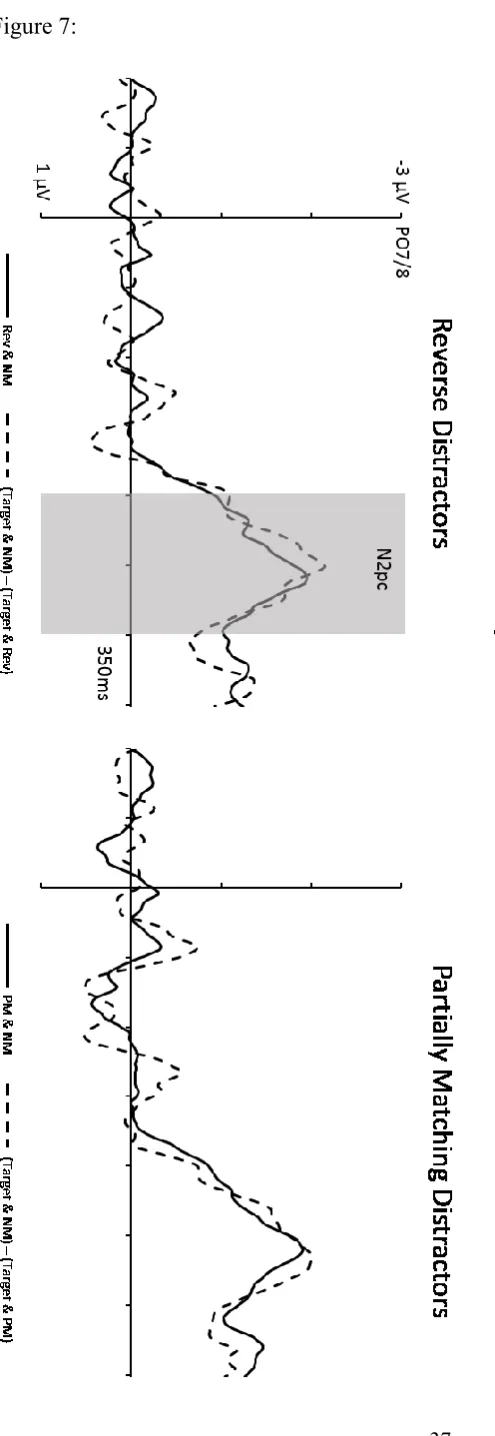
were compared to find out whether the spatial arrangement of the two target-matching shapes affected N2pc amplitudes. Across the whole N2pc measurement window, targets again triggered larger N2pcs than reverse distractor objects (t(11) = 5.87, p < .001, d = .84). Comparisons of N2pc difference waves for these two types of objects with successive one-tailed paired t-tests and with a jackknife-based analysis (using the same procedures and onset criteria as in Experiment 1) showed that target N2pcs started to become larger than N2pcs to reverse distractors at 220 ms (t-test analysis) or 222 ms (jackknife-based analysis) after display onset.2 The attenuation of target N2pc components in displays where targets were accompanied by reverse or partially matching distractors again matched the N2pc elicited by these two types of distractors on target-absent trials. As shown in Figure 7, the difference between N2pcs to targets presented with or without a reverse distractor N2pc was equal in size to the N2pc elicited by reverse distractors on target-absent trials (left panel), and the same result was found for partially matching distractors (right panel; both t’s < 1).
--- Insert Figure 7 about here ---
Discussion of Experiment 2
As in Experiment 1, reverse and partially matching distractors triggered reliable N2pc components on target-absent trials, and their presence attenuated and delayed target RTs and target N2pc components. The reduction of N2pcs to targets by reverse and partially matching distractors in the same display again matched the size of the N2pc components elicited by these distractors on target-absent trials, suggesting that this reduction was due to two N2pc components of opposite polarity elicited at the same time. These results show that, as in Experiment 1, reverse and partially matching distractors were able to attract attention, in line with the assumption that object selection was guided by part-based feature templates for component shapes.
20
Critically, attentional guidance remained sensitive to the spatial arrangement of the two component target shapes in Experiment 2, in spite of the fact that these shapes were vertically separated and appeared in different quadrants. Analogous to Experiment 1, target objects elicited larger N2pc components than reverse distractors, and this amplitude difference emerged around 220 ms after display onset. Furthermore, a reliable N2pc was triggered contralateral to targets when they appeared together with a reverse distractor on the opposite side, demonstrating that targets triggered a stronger attentional bias than reverse distractors. As in Experiment 1, this N2pc emerged later than the N2pc to targets with nonmatching distractors, indicative of configuration-based guidance mechanisms that are activated later than part-based processes.. Partially matching distractors again elicited larger N2pc components when the target-matching shape appeared at its assigned position than when it was presented in the opposite vertical position, and this difference now emerged around 250 ms post-stimulus. These results clearly show that, as in Experiment 1, attentional guidance was not fully part-based, but remained sensitive to the spatial arrangement of the two target-defining shapes even when these shapes were not spatially aligned and thus did not form composite perceptual objects. The implications of these findings will be further considered below.
GENERAL DISCUSSION
21
elicited larger N2pc components when this shape appeared in its assigned target-matching location. Together, these findings show that the guidance of attentional object selection during shape/shape configuration search was not entirely part-based, but was sensitive to the spatial arrangement of the two component shapes. The fact that this was also the case when the component shapes were spatially separated (Experiment 2) shows that the spatial arrangement of two task-relevant shapes influences attentional guidance even when these shapes do not form a single spatially contiguous perceptual object.
Even though attentional guidance was not completely part-based, separate feature templates for both target-defining shapes were clearly involved in the control of attentional object selection. Reverse and partially matching distractors triggered reliable N2pc components, and delayed N2pcs to targets in the same display, demonstrating that a target-matching shape remained able to attract attention even when it was part of a nontarget object. In both experiments, participants were slowest to report the presence or absence of a target when a reverse distractor was present in the same display, suggesting that these distractor objects triggered attentional biases that were at least initially similar to the biases triggered by targets. The fastest RTs were observed for PM & NM and PMw & NM displays, presumably because these displays only contained a single target-matching shape and could thus be rapidly classified as target-absent trials. Because targets were defined by a combination of two shapes, these results also provide further evidence that search can be controlled by templates for multiple features from the same dimension. This is in line with the conclusion drawn in previous studies of colour/colour conjunction search (Irons et al., 2012; Grubert & Eimer, 2016; Berggren & Eimer, 2016a), but inconsistent with the hypothesis of the Guided Search model that only a single feature per dimension can be involved in attentional guidance (Wolfe, 2007).
22
only object with target-matching features. Because the similarity of N2pc components to reverse and to partially matching distractors in target-absent displays is not entirely in line with a parallel account of feature-based attentional selectivity, this result needs to be confirmed and accounted for in future studies.
Overall, the current results show that shape parts and shape configurations are both employed in the control of attention during search for target objects defined by a specific configuration of component shapes, and that these two types of attentional guidance appear to differ in their time course. In displays where targets were accompanied by reverse distractors, N2pcs were delayed by about 40 ms relative to displays where targets appeared together with nonmatching distractors. As the onset latency of target N2pcs marks the moment when an attentional bias for target objects emerges, the delay caused by the presence of reverse distractors indicates that such biases did not emerge during the early part of the N2pc time window, but only beyond 230 ms post-stimulus. The absence of a target N2pc before that point in time indicates that targets and reverse distractors elicited equivalent attentional biases which cancelled each other out, as would be the case if attentional guidance was entirely part-based during this time period. Following this initial feature-part-based phase, guidance became sensitive to the spatial arrangement of target-matching shape components, resulting in a net attentional bias towards target objects. Further evidence for these two phases in attentional guidance was provided by the observation that N2pc components to targets and to reverse distractors in displays with a nonmatching distractor on the opposite side were initially identical in size, before the target N2pc started to become larger than the distractor N2pc from about 230 ms post-stimulus. The hypothesis that the guidance of search for shape configurations is initially part-based may also explain why search for targets defined by the configuration of two shapes among distractor objects with the reverse spatial arrangement (e.g., snowmen among upside-down snowmen; Wolfe et al., 1999) is relatively inefficient. An analogous sequence of feature-based followed by object-based attentional selection mechanisms has been found in previous N2pc experiments investigating conjunction search tasks where target-defining features came from different dimensions (colour and shape: Eimer & Grubert, 2014; colour/shape and alphanumerical category: Nako, Grubert, & Eimer, 2016) or from the same dimension (colour: Berggren & Eimer, 2016a).
23
the second phase, attentional control starts to be affected by spatial-configural information, resulting in an attentional bias towards objects with shape components in the correct spatial arrangement. This configural guidance of attentional selectivity could be based on integrated target object templates that represent overall target shape rather than individual shape parts, or on separate templates for each target shape that also represent the assigned task-relevant locations of these shapes (e.g., circle in lower visual field). The fact that attentional biases towards objects with the relevant spatial arrangement of shape components emerged beyond 230 ms post-stimulus not only when target objects were composed of spatially aligned component shapes (in Experiment 1), but also when these shapes were spatially separated (in Experiment 2) suggests that this type of attentional control is more likely to be based on separate templates for specific shape/location conjunctions. Recent electrophysiological studies (Adamo, Pun, & Ferber, 2010; Berggren, Jenkins, McCants, & Eimer, in press) have suggested that it is difficult to employ multiple templates for different target features at particular positions in order to restrict feature-based attentional guidance to specific locations. However, these experiments have only investigated task sets for specific colour/location combinations, and it therefore remains possible that such templates might be available in the shape domain.
The current results show that visual search for target objects defined by the vertical arrangement of two component shapes can be guided by the spatial arrangement of these shapes (albeit only after an initial part-based phase). In contrast, our previous N2pc experiment of colour/colour configuration search (Berggren & Eimer, 2016b, Experiment 3) found that guidance was entirely part-based throughout the 500 ms interval after search display onset. This discrepancy might be partially due to procedural differences. The search display employed in this earlier experiment always contained four objects, and displays in which targets and reverse distractors appeared together also contained two other objects with one target-matching colour. The competitive effects of these partially matching distractor objects may have reduced the sensitivity of colour-based attentional control processes to spatial-configural information in this study. The differences between these previous and the current results may also reflect more general differences between the colour and shape domains. Attentional guidance based on the spatial arrangement of component shapes will be useful during search for many real-world objects, but there are few occasions where search targets are defined by particular configuration of different colours.
24
fashion by independent templates for each target shape. Following this early strictly feature-based selection phase, attentional control processes become sensitive to spatial-configural information, and are therefore able to distinguish target objects from objects with the same shape components in a different spatial arrangement. These results also underline that attentional object selection should not be conceptualized as a single discrete stage that is controlled by a fixed top-down task set, but instead a temporally extended process that can be guided by different types of target templates at different moments in time.
25 REFERENCES
Adamo, M., Pun, C., & Ferber, S. (2010). Multiple attentional control settings influence late attentional selection but do not provide an early attentional filter. Cognitive Neuroscience, 1, 102-110.
Berggren, N., & Eimer, M. (2016a). The control of attentional target selection in a colour/colour conjunction task. Attention, Perception, & Psychophysics, 78, 2396.
Berggren, N., & Eimer, M. (2016b). The guidance of spatial attention during visual search for colour combinations and colour configurations. Journal of Experimental Psychology: Human Perception and Performance, 42, 1282-1296.
Berggren, N., Jenkins, M., McCants, C.W., & Eimer, M. (in press). The spatially global control of attentional target selection in visual search. Visual Cognition.
Biederman, I. (1987). Recognition-by-components: A theory of human image understanding. Psychological Review, 94, 115-147.
Carrasco, M., Ponte, D., Rechea, C., & Sampedro, M.J. (1998). “Transient structures”: The effect of practice and distractor grouping on within-dimension conjunction searches. Perception and Psychophysics, 60, 1243-1258.
D’Zmura, M. (1991). Color in visual search. Vision Research, 31, 951-966.
Desimone, R., & Duncan, J. (1995). Neural mechanisms of selective visual attention. Annual Review of Neuroscience, 18, 193-222.
Duncan, J., & Humphreys, G.W. (1989). Visual search and stimulus similarity. Psychological Review, 96, 433-458.
Duncan, J., & Humphreys, G. (1992). Beyond the search surface: Visual search and attentional engagement. Journal of Experimental Psychology: Human Perception and Performance, 18, 578-588.
Eimer, M. (1996). The N2pc component as an indicator of attentional selectivity. Electroencephalography and Clinical Neurophysiology, 99, 225-234.
Eimer, M. (2014). The neural basis of attentional control in visual search. Trends in Cognitive Sciences, 18, 526-535.
26
Journal of Experimental Psychology: Human Perception and Performance, 40, 1819-1831.
Eimer, M., & Kiss, M. (2008). Involuntary attentional capture is determined by task set: Evidence from event-related brain potentials. Journal of Cognitive Neuroscience, 20, 1423-1433.
Folk, C.L., Remington, R.W., & Johnston, (1992). Involuntary covert orienting is contingent on attentional control settings. Journal of Experimental Psychology: Human Perception and Performance, 24, 847-858.
Fuggetta, G., Pavone, E.F., Walsh, V., Kiss, M., & Eimer, M. (2006). Cortico-cortical interactions in spatial attention: A combined ERP/TMS study. Journal of Neurophysiology, 95, 3277-3280.
Grubert, A., & Eimer, M. (2016). All set, indeed! N2pc components reveal simultaneous attentional control settings for multiple target colours. Journal of Experimental Psychology: Human Perception and Performance, 42, 1215-1230.
Irons, J.L., Folk, C.L., & Remington, R.W. (2012). All set! Evidence of simultaneous attentional control settings for multiple target colors. Journal of Experimental Psychology: Human Perception and Performance, 38, 758-775.
Jenkins, M., Grubert, A., & Eimer, M. (in press). Target objects defined by a conjunction of colour and shape can be selected independently and in parallel. Attention, Perception & Psychophysics.
Kiss, M., Grubert, A., & Eimer, M. (2013). Top-down task sets for combined features: Behavioral and electrophysiological evidence for two stages in attentional object selection. Attention, Perception, & Psychophysics, 75, 216-228.
Leblanc, É., Prime, D., & Jolicoeur, P. (2008). Tracking the location of visuospatial attention in a contingent capture paradigm. Journal of Cognitive Neuroscience, 20, 657-671. Lien, M-C., Ruthruff, E., Goodin, Z., & Remington, R.W. (2008). Contingent attentional
capture by top-down control settings: Converging evidence from event-related potentials. Journal of Experimental Psychology: Human Perception and Performance, 34, 509-530.
27
Luck, S.J., & Hillyard, S.A. (1994). Spatial filtering during visual search: Evidence from human electrophysiology. Journal of Experimental Psychology: Human Perception and Performance, 20, 1000-1014.
Miller, J., Patterson, T., & Ulrich, R. (1998). Jackknife-based method for measuring LRP onset latency differences. Psychophysiology, 35, 99-115.
Nako, R., Grubert, A., & Eimer, M. (2016). Category-based guidance of spatial attention during visual search for feature conjunctions. Journal of Experimental Psychology: Human Perception and Performance, 42, 1571-1586.
Treisman, A.M., & Gelade, G. (1980). A feature-integration theory of attention. Cognitive Psychology, 12, 97-136.
Ulrich, R., & Miller, J. O. (2001). Using the jackknife-based scoring method for measuring LRP onset effects in factorial designs. Psychophysiology, 38, 816–827.
Wolfe, J.M. (1994). Guided Search 2.0: A revised model of visual search. Psychonomic Bulletin & Review, 1, 202-238.
Wolfe, J.M. (2007). Guided Search 4.0: Current progress with a model of visual search. In W. Gray (Ed.), Integrated Models of Cognitive Systems (pp. 99-119). New York: Oxford.
Wolfe, J. M., Friedman-Hill, S. R., & Bilsky, A. B. (1994). Parallel processing of part-whole information in visual search tasks. Perception & Psychophysics, 55, 537-550.
Wolfe, J.M., & Horowitz, T.S. (2004). What attributes guide the deployment of visual attention and how do they do it? Nature Reviews Neuroscience, 5, 495-501.
Wolfe, J. M., Klempen, N. L., & Shulman, E. P. (1999). Which end is up? Two representations of orientation in visual search. Vision Research, 39, 2075-2086.
28
Table 1: Mean reaction times (upper rows) and percentage error rates (lower rows) in Experiments 1 and 2 for the six different types of search displays (SD in parentheses).
Exp. 1 Exp. 2
Targ vs NM 573 (94) 608 (109) 3 (2) 4 (6)
Targ vs Rev 599 (101) 639 (127) 2 (2) 4 (6)
Targ vs PM 579 (95) 640 (117) 3 (2) 6 (7)
NM vs Rev 616 (84) 660 (78)
3 (4) 2 (2) NM vs PM 580 (87) 607 (75)
3 (2) 4 (3) NM vs PMw 552 (76) 568 (70)
[image:29.595.162.370.134.410.2]29 Figure captions
Figure 1. Left panel: Illustration of the six different stimulus display types in Experiment 1. In the example shown, targets were objects composed of an hourglass on top of a circle. On target-present trials, the target object was presented together with a distractor object with two nonmatching shapes (Target & NM), an object with both matching shapes in the reverse configuration (Target & Rev), or an object with one matching shape in its assigned vertical position (Target & PM). On target-absent trials, one nonmatching distractor was presented together with a reverse distractor (Rev & NM), a partially matching distractor (PM & NM), or an object with a matching shape in the wrong vertical position (PMw & NM). Right panel: Illustration of a Target & NM display in Experiment 2, where the two shapes on the left and right sides were spatially separated.
Figure 2. Top panel: Grand-average event-related brain potentials (ERPs) obtained in Experiment 1 on target-present trials at electrode sites PO7/8 contralateral and ipsilateral to the side of the target object during the 350 ms interval after display onset. ERPs are shown separately for the three different types of target-present displays. Bottom panel: N2pc difference waveforms obtained by subtracting ipsilateral from contralateral ERPs for the three target-present display types.
Figure 3. Top panel: Grand-average event-related brain potentials (ERPs) obtained in Experiment 1 on target-absent trials at electrode sites PO7/8 contralateral and ipsilateral to the side of the target object during the 350 ms interval after display onset. ERPs are shown separately for the three different types of target-absent displays. Bottom panel: N2pc difference waveforms obtained by subtracting ipsilateral from contralateral ERPs for the three target-absent display types.
30
Figure 5. Top panel: Grand-average event-related brain potentials (ERPs) obtained in Experiment 2 on target-present trials at PO7/8 contralateral and ipsilateral to the side of the target object during the 350 ms interval after display onset. ERPs are shown separately for the three different types of target-present displays. Bottom panel: N2pc difference waveforms obtained by subtracting ipsilateral from contralateral ERPs for the three target-present display types.
Figure 6. Top panel: Grand-average event-related brain potentials (ERPs) obtained in Experiment 2 on target-absent trials at electrode sites PO7/8 contralateral and ipsilateral to the side of the target object during the 350 ms interval after display onset. ERPs are shown separately for the three different types of target-absent displays. Bottom panel: N2pc difference waveforms obtained by subtracting ipsilateral from contralateral ERPs for the three target-absent display types.