N A N O E X P R E S S
Open Access
Characterization and Evaluation of Reverse
Osmosis Membranes Modified with Ag
2
O
Nanoparticles to Improve Performance
Abdullah S. Al-Hobaib
1*, Khalid M. AL-Sheetan
1, Mohammed Rafi Shaik
2*, Naser M. Al-Andis
2and M. S. Al-Suhybani
1Abstract
The objective of this work was to prepare and characterize a new and highly efficient modified membrane by in situ interfacial polymerization on porous polysulfone supports. The process usedm-phenylenediamine and trimesoyl chloride in hexane, incorporating silver oxide Ag2O nanoparticles of varied concentrations from 0.001 to 0.1 wt%. Ag2O nanoparticles were prepared at different sizes varying between 20 and 50 nm. The modified membranes were characterized by X-ray diffraction (XRD), scanning electron microscopy (SEM), energy-dispersive X-ray spectroscopy (EDX), atomic force microscopy (AFM), transmission electron microscopy (TEM), and contact angle measurement. The results showed a smooth membrane surface and average surface roughness from 31 to 74 nm. Moreover, hydrophilicity improved and the contact angle decreased to 41° at 0.009 wt% silver oxide. The performances of the developed membranes were investigated by measuring permeate fluxes and salt rejection capability by passing NaCl solutions (2000 ppm) through the membranes at 225 psi. The results showed that the flux increased from 26 to 40.5 L/m2h, while the salt rejection was high, at 99 %, with 0.003 wt% Ag2O nanoparticles.
Keywords:Ag2O nanoparticles; Interfacial polymerization; RO membrane; Modified membrane; Desalination
Background
Water purification technologies are attracting increasing attention, because of gradually increasing shortages of fresh water and lack of access to safe drinking water. Re-verse osmosis (RO) is an important membrane technol-ogy for water purification through decontamination of industrial effluents and desalination of sea water. Recently, a number of workers have focused on developing high water flux membranes with low processing cost [1–8]. Several methods have already been developed for RO membrane fabrication including phase inversion [9] and interfacial polymerization (IP) [10]. However, concerted efforts are constantly applied to innovate new efficient supports [11], polymer types [12], and tailor polymer structures [13].
From ancient times, human beings have collected con-sumable fresh water from rivers, lakes, canals, ponds, and underground aquifers [14]. The sources of fresh water are depleted over time because of several reasons
such as growth in population, industrialization,
modernization of human societies, and enormous changes in climate. The sources of the fresh water are being contaminated significantly due to agricultural and industrial effluents flowing into lakes, canals, and rivers which are constantly leaking into underground water. These effluents contain many contaminants, such as metals, dyes, pesticides, fertilizers, and biologics, which are harmful to human consumption because of their tox-icity [15, 16]. Therefore, human beings are always in search of fresh drinkable water sources for making it available to the consumer. In order to pursue this effort, many physical-chemical methods have been developed and adopted at different times. Some use chemical treat-ments to remove contaminants from polluted sweet water * Correspondence:[email protected];[email protected]
1Nuclear Science Research Institute, King Abdulaziz City for Science and Technology (KACST), P.O. Box 6086, Riyadh 11442, Saudi Arabia
2Department of Chemistry, College of Science, King Saud University, P.O. Box. 2455, Riyadh 11451, Kingdom of Saudi Arabia
philic membranes are characterized by the presence of active groups that have the ability to form hydrogen bonds with water and so these membranes have wetta-bility. Generally, higher charge density on a membrane surface is accompanying with higher hydrophilicity of the membrane. Membrane surface morphology also has a considerable effect on flux, fouling as pore size, pore geometry, and pore size distribution particularly at the surface of the membrane [17].
Surface hydrophilicity augmented when the hydro-philic nanoparticles (NPs) were presented onto the sur-face of the membrane. Enriched water flux came from the hydrophilic membrane surface. Furthermore, water affinitive surface area improved if the nanoparticle had a higher degree of dispersion and also by increasing mem-brane hydrophilicity and reduce the cross-linking degree of polyamide thin-film composite membrane by compet-ing withm-phenylenediamine (MPD), which ensued in a great enhancement of water flux. Further, the decrease of the cross-linking degree could also increase salt pas-sage through the membrane [18, 19].
A great number of RO and nanofiltration (NF) mem-branes with good decontamination performances and permeate fluxes have been developed [20–23]. RO mem-branes have very high levels of rejection of inorganic sol-utes such as monovalent ions, hardness components (e.g., calcium, magnesium), and organic matters such as trihalomethane precursor, pesticides, and deodorants at operating pressures of approximately 0.5–6.0 MPa [24].
An RO membrane is composed of three layers: a bot-tom layer made of unwoven polyester cloth of thickness
100–200 μm to support the entire membrane, a middle
layer consisting of polysulfone (PSF) or polyethersulfone (PES) of thickness 30–50 μm, and a top layer of poly-amide (PA) or polyetherimide (PEI), supported by PSF or PES, of average thickness 100–200 nm, which is used to separate solutes from feed water. A PA membrane is prepared on the surface of the middle layer by interfacial polymerization between a diamine moiety of 1,3-phenyl-enediamine (MPD) in the water phase and an acid chloride moiety of 1,3,5-benzenetricarbonyl trichloride (TMC) in the nonpolar organic phase. An industrial product named FT-30 is one such RO membrane, which has a high level of salt rejection of more than 99 % and
[27], because both reduce membrane permeability, in-crease energy costs, and dein-crease the lifetime of mem-branes. To effectively remove viruses, nanofiltration or reverse osmosis should be used with low-pressure mem-branes having anti-biofouling and antiviral properties. The antibacterial properties of silver are well known, and silver nanoparticles (nano-Ag) are now incorporated into polymer membranes, including RO membranes, as well as in a wide variety of consumer products for mi-crobial control [27].
In this study, nano-Ag2O was incorporated into RO membranes. Nanosilver oxide incorporation also in-creases membrane hydrophilicity and reduces the poten-tial for other types of membrane fouling. The objectives of this paper were to prepare and characterize new and highly efficient modified polyamide (PA) membranes in-corporating silver oxide (Ag2O) nanoparticles. Ag2O nanoparticles were prepared at different sizes, varying between 20 and 50 nm.
Methods Materials
The materials and chemicals which were used in this study are of analytical grade as demonstrated in the fol-lowing: polysulfone supports (PS-20) were purchased from Sepro, USA; n-hexane (99 %) was purchased from Oxford Laboratory, India; m-phenylenediamine (99 %)
(MPD), 1,3,5-benzenetricarbonyl trichloride (TMC),
silver nitrate, sodium oleate, triethylene glycol, and n -dodecane (99 %) were purchased from Sigma-Aldrich, USA; n-cyclohexane, n-heptane, and sodium carbonate anhydrous (99 %) were purchased from Scharlau, Spain; ammonium nitrate was purchased from Avonchem Lim-ited, UK; and ultrapure deionized (DI) water was pur-chased from a Millipore Milli-Q system which was used in all experiments.
Preparation of Ag2O Nanoparticles
2 h. The reaction mixture was then centrifuged for 10 min and the supernatant was discarded and dried in an oven at 250 °C for 3 h to a powder, which was finely ground to obtain silver oxide nanoparticles [28].
Preparation of Polyamide Membranes
Polyamide thin-film composite membranes were pre-pared by immersing a commercial polysulfone product support (PS-20) in an aqueous solution of MPD (2v/v%) for 2 min and then the excess MPD solution was re-moved by pressing the membrane under a rubber roller. The membrane was then immersed in 0.1 % of a TMC and hexane (99 %) solution for 1 min, rinsed with 0.2 % Na2CO3, washed with DI water, and finally stored in a refrigerator≈4 °C in DI water prior to use.
Synthesis of Polyamide/Silver Oxide Nanocomposite Membranes
The silver oxide-polyamide nanocomposite membranes were synthesized similarly to thin-film composite (TFC) membranes, except that silver oxide nanoparticles were added in the 0.001–0.1w/v% TMC inn-hexane solution beforehand. Various amounts of Ag2O nanoparticles
were dispersed in TMC-n-hexane solution by
ultra-sonicating for 60 min at 20 °C. The resultant solution was immediately used for interfacial polymerization (IP) with MPD-soaked PS supports to form the thin-film nanocomposite (TFN) membranes.
Characterization
Scanning Electron Microscopy (SEM)
The morphology and microstructure of the as-synthesized nanocomposite membrane was examined by scanning electron microscope (SEM; FEI Nova-Nano SEM-600, The Netherlands).
Atomic Force Microscopy (AFM)
The AFM device was a nanosurf scanning probe-optical microscope (Bruker Corporation). Atomic force micros-copy was used to analyze the surface morphology and roughness of the prepared membranes. Small squares of
the prepared membranes (approximately 1 cm2) were
cut and glued on a glass substrate for the analysis.
Goniometer
Contact angle analysis was performed using a Ramé-Hart Model 250 Standard Goniometer/Tensiometer with drop image advanced software (Ramé-Hart Instrument Co., Succasunna, NJ). A water droplet was placed on a dry, flat homogeneous membrane surface, and the con-tact angle between the water and membrane was mea-sured until no further change was observed. The average contact angle for distilled water was determined in a
series of eight measurements for each of the different membrane surfaces.
Cross-Flow (Flux and Salt Rejection)
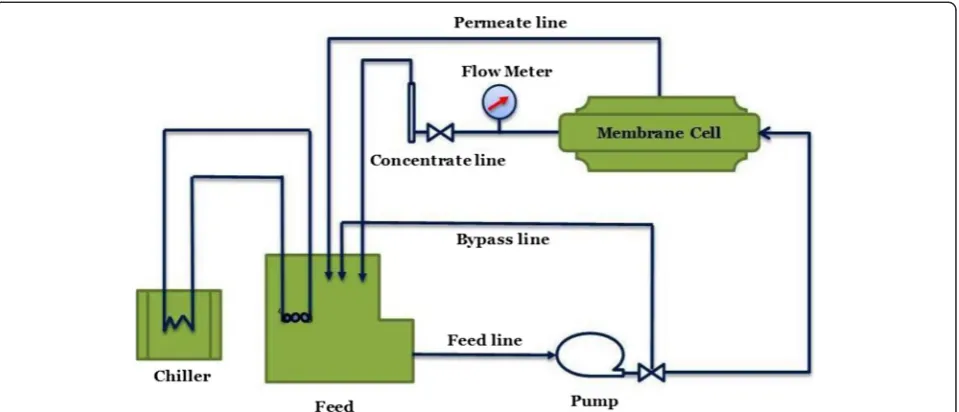
The performances of the prepared membranes were ana-lyzed through a cross-flow system (CF042SS316 Cell, Sterlitech Corp., USA). The active membrane area in this system was 42 cm2. The feed water temperature was 25 °C with pH adjusted between 6 and 7, for a 2000 ppm NaCl concentration and a feed flow rate of 1 gallon per minute (gpm). The filtration was carried out at a transmembrane pressure of 225 psi. All measure-ments of the water flux and salt rejection were measured after 30 min of water filtration experiments to ensure steady-state operation had been reached. A schematic of the cross-flow filtration system is shown in Fig. 1.
The flux was calculated using the following equation [29].
J¼ 1
A dVp
dt ð1Þ
where J is the water flux (L/m2 h),Vp is the permeate volume (L), A is the membrane area (m2), and t is the treatment time (h). The salt rejection (R) was calculated using the following equation:
R¼ 1−Cp Cf
100 ð2Þ
where CpandCf are the salt concentrations in the per-meate and feed streams, respectively.
Results and Discussion
The synthesized silver oxide nanoparticles were character-ized by SEM, transmission electron microscopy (TEM), energy-dispersive spectroscopy (EDX), and X-ray diffrac-tion (XRD) as follows.
The size and surface morphology of Ag2O nanoparti-cles were determined by SEM, as shown in Fig. 2b, and the size of silver nanoparticles was estimated, in the form of nanocrystallites. EDX carried out during the SEM analysis conformed to the characteristic peaks of Ag, as shown in Fig. 2a.
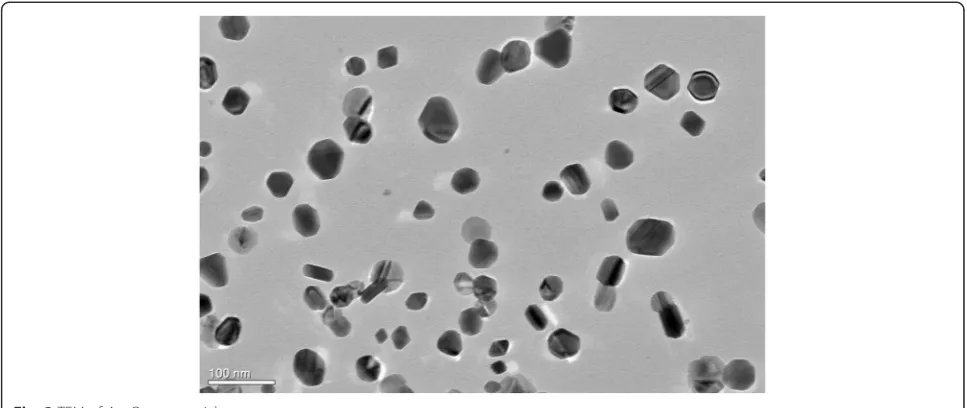
TEM analysis of Ag2O nanoparticles was also carried out to estimate the size of silver nanoparticles. Particle size was estimated to be in the range of 18 to 50 nm, confirming the results already estimated by SEM and EDX. TEM images are shown in Fig. 3.
calculated using the Debye-Scherrer equation (G= 0.9λ/
β cosθ), where λ is the X-ray wavelength (Cu, 1.
5418 Å), θ is the maximum of the Bragg diffraction
peak, and β is the full width at half maximum. After a correction for instrumental broadening, the average value obtained for the crystallites was 45 nm [30].
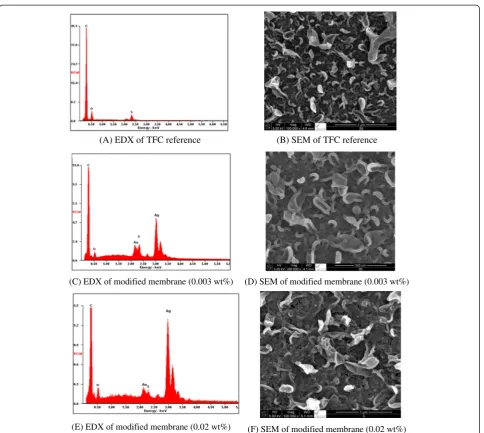
The TFC membrane layer was found to be coated onto the PS support base during the interfacial polymerization (IP) reaction process between MPD and TMC, leading to the formation of a leaf-like morph-ology. SEM and EDX analysis was used to determine such morphology as well as the size of silver nanoparti-cles in the membranes. EDX spectra and SEM images of the reference TFC membrane are shown in Fig. 5a, b, respectively. Similarly, EDX spectra and SEM images of polymer membranes containing silver nanoparticles are shown in Fig. 5c, d, respectively. It was observed that
impregnation of Ag2O nanoparticles in the polymer matrix does not affect the overall morphology of TFC membranes containing silver nanoparticles, even when the wt% range of Ag2O nanoparticles was increased to 0.02 wt% (Fig. 5f). However, partial aggregation of Ag2O nanoparticles was observed in the polymer matrix. The difference between the images clearly indicates the pres-ence of Ag2O nanoparticles. This was further confirmed by EDX quantitative analysis, which clearly shows the presence of carbon, oxygen, and silver peaks as compo-nent elements. In comparison, a TFC reference membrane exhibited an ascendant and broadened ridge-valley struc-ture, suggesting variation in surface roughness of TFC membranes under different nano-Ag2O loadings.
AFM analysis was carried out to further determine the morphology and roughness of the membrane surface after incorporation of silver oxide nanoparticles into the Fig. 1Schematic of the forward cross-flow filtration system
(A) EDX of graph (B) SEM of Ag2O nanoparticles
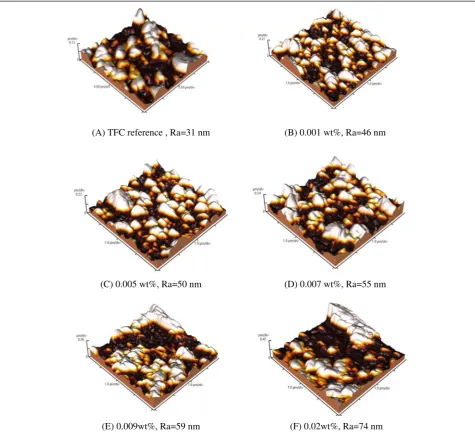
[image:4.595.60.540.89.295.2] [image:4.595.56.545.570.717.2]polymer membranes. AFM measurements of membranes containing different contents of silver oxide nanoparti-cles and are shown in Fig. 6. It can be observed that the roughness (Ra) values increased with increasing silver oxide content in the polymer membranes. TFC mem-branes with 0.02 wt% silver showed the highest surface roughness (i.e., Ra= 74 nm), compared with that of a TFC reference membrane without silver content (Ra= 31 nm). This difference is presumed to be caused by the leaf-like shape as well as by the aggregation of Ag2O nanoparticles present in the membrane surface. The sur-face comprised continuous ridge and valley structures, confirming previous results obtained by other re-searchers [16, 20–22].
Membranes containing different amounts of silver oxide nanoparticles were subjected to contact angle
measurements to evaluate the hydrophilic and hydro-phobic characteristics of the membranes; during contact angle measurements, reproducible standard deviation (SD) was taken into account with the ultimate aim of de-termining water permeate flux ability during the salt re-jection process for underground water. An acceptable reproducible standard deviation was taken into account during the measurements. Contact angles, as measured
with different PA membranes containing various
amounts (wt%) of Ag2O nanoparticles, are presented in Fig. 7.
It can be observed that contact angle significantly de-creased with inde-creased silver oxide content in the mem-branes. For example, the presence of a silver content of 0.003 wt% in the membrane dropped the contact angle from 94° ± 1.8° to 45° ± 0.7°. Contact angles of the Fig. 3TEM of Ag2O nanoparticles
[image:5.595.56.540.89.293.2] [image:5.595.57.540.522.717.2]membranes did not change/decrease markedly above 0.01 wt% silver loading. Additionally, the hydrophilicity did not change significantly, despite the increasing content of Ag2O nanoparticles. Our results are in agree-ment with those obtained by other researchers [31]. It is known that there is a strong correlation between the geometry/stereochemistry of water at the solid-liquid interface and the hydrophilicity of the solid surface [32, 33]. Rearrangement of interfacial water molecules can in-crease hydrophilicity, thus improving water’s ability to form hydrogen bonds and, in turn, producing stronger interactions between water and the solid phase in the polymer matrix, i.e., the TFC surface.
The remarkable decrease in contact angle in the pres-ence of embedded silver oxide nanoparticles can be explained as follows:
1. A large amount of embedded spherical Ag2O
nanoparticles could have been exposed on the membrane surface. The hydrophilic nature of the silver nanoparticles would increase the hydrophilic character of the membrane surface and would also help water molecules to adhere to the Ag2O
nanoparticles, through capillary effects [34]. This is consistent with the result of Jeong et al. [35], who observed that the contact angle of membrane
(A) EDX of TFC reference (B) SEM of TFC reference
(C) EDX of modified membrane (0.003 wt%) (D) SEM of modified membrane (0.003 wt%)
(E) EDX of modified membrane (0.02 wt%) (F) SEM of modified membrane (0.02 wt%)
[image:6.595.58.543.85.518.2]surface decreased with increased zeolite content and attributed this to the super-hydrophilic property of the zeolite.
2. Second, silver oxide nanoparticles may hydrate and release heat when contacting with MPD aqueous solution [36]. This process may affect the IP reaction between MPD and TMC and, subsequently, may change the matrix of the PS support. If a large number of acyl chloride groups of TMC remained on the membrane surface without reacting with the amine groups of MPD, the hydrolysis of acyl chloride could generate carboxylic acid functional groups, which may lead to increased hydrophilicity
[37]. It is known that the hydrophilic nature of Ag2O nanoparticles can significantly improve the
overall hydrophilicity of membranes, thereby creating favorable conditions for improved water flux and antifouling. It is well understood that the morphological structure and the hydrophilicity of the membrane are the two main factors that govern the filtration properties of membranes and those of
TFC membranes [38].
Polymer membranes containing various amounts of Ag2O nanoparticles were used to carry out a filtration process at 25 °C, using the cross-flow method. The
(A) TFC reference , Ra=31 nm (B) 0.001 wt%, Ra=46 nm
(C) 0.005 wt%, Ra=50 nm (D) 0.007 wt%, Ra=55 nm
(E) 0.009wt%, Ra=59 nm (F) 0.02wt%, Ra=74 nm
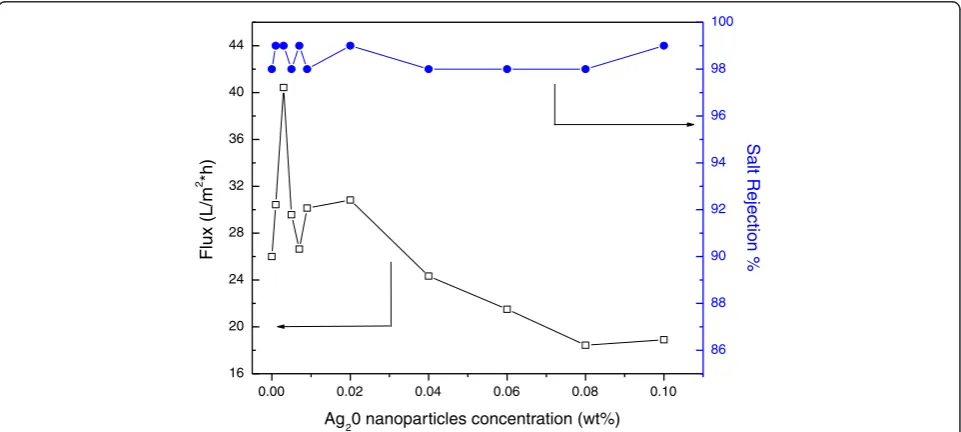
[image:7.595.60.536.89.521.2]results of water permeate fluxes and salt rejections for all membranes are presented in Fig. 8.
The maximum of the hybrid membranes’water fluxes
is greater than that of the TFC membranes (25 L/m2h ± 2.3), where ±2.3 is the standard deviation of three mea-surements which was used to estimate the uncertainty of these measurements. The quantity of Ag2O nanoparticles was increased, and then the membrane water flux corres-pondingly increased up to a peak value at 0.003 wt% (40.43 L/m2 h ± 3.0) and then started to decrease. The peak value of water flux displays an enhancement of 160 % over that of the TFC reference membrane. On the
other side, the salt rejection of both thin-film composite (TFC) and thin-film nanocomposite (TFN) membranes was established to be 98 % ± 0.7 and 99 % ± 0.1, respect-ively. The SD was measured for three measurements in each case. Consequently, the standard deviation of salt re-jection for TFN was within 2 %. It is postulated that the improved water permeability may be ascribed to the nano-meter pores in the silver oxide nanoparticles. On the other hand, the silver oxide nanoparticles may interrupt the interfacial polymerization method to amend the active layer permeability. Furthermore, the increased membrane surface roughness might relatively explain such flux
0.00 0.01 0.02 0.03 0.04 0.05
40 50
Ag2O nanoparticles Concentration (wt%)
Fig. 7Contact angles of PA membranes containing different amounts of silver nanoparticles
0.00 0.02 0.04 0.06 0.08 0.10 16
20 24 28 32 36 40 44
Ag20 nanoparticles concentration (wt%)
86 88 90 92 94 96 98 100
Salt Rejection %
[image:8.595.57.541.89.285.2] [image:8.595.58.539.498.714.2]enrichment. On the other hand, a high silver oxide loading may help to develop a comparatively thicker rejection polyamide layer, which decreased the water permeability and improved salt rejection. The transport properties of the membranes prepared in this study are listed in Table 1.
Both permeate flux and salt rejection ability depend on the polyamide layer density, which is related to cross-linking density [39]. The polymer density across the bar-rier layer is not uniform [40]. The core layer (near the original MPD/TMC interface) is the most dense region, and the polymer density decreases gradually as the poly-mer grows further into the organic phase [41, 42]. In many applications of interfacial polymerization using MPD and TMC, the initial amine concentration is much higher than the acyl chloride concentration. Whether
the amine concentration is decreased or the acyl chlor-ide concentration is increased, this results in a more dense polyamide layer, compared with those prepared using higher amine/acid chloride molar ratios [43]. An increase in density or in thickness of the MPD/TMC barrier layer would increase the mass transfer resistance of the resulting membrane, thereby reducing permeate flux. Thus, varying the initial concentration of mono-mers can influence the membrane’s water and salt trans-port properties.
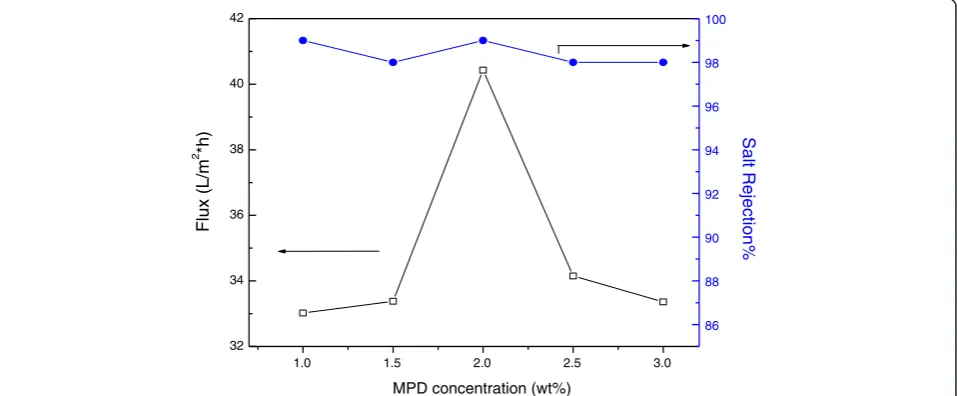
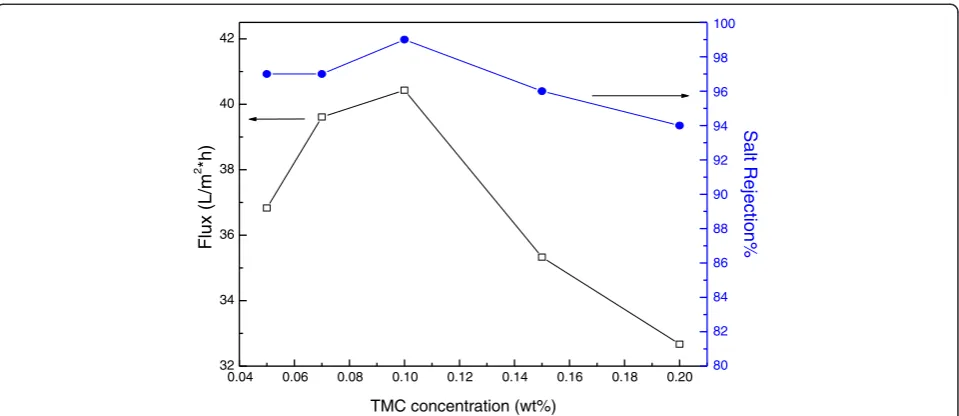
TFC-modified membranes were prepared by varying the concentrations of MPD and TMC and keeping the mass of added Ag2O nanoparticles at 0.003 wt%. Figure 9 shows the influence of varying the MPD concentration on permeate flux and salt passage. Similarly, Fig. 10 pre-sents the influence of changing the TMC concentration on flux and salt rejection.
Salt passage was found to be relatively insensitive to changes in MPD concentration. This suggests the forma-tion of defect-free membranes in all cases. Maximum permeate flux was exhibited near 2 w/v% MPD. As the MPD concentration was increased, the driving force for MPD diffusion into the organic phase increased. In-creased MPD concentration could, therefore, increase the barrier layer thickness and, thus, causes a lower per-meate flux. As MPD concentration decreased, layer thickness was expected to decrease, which would tend to increase flux, but the resulting layer was also ex-pected to become more dense as the molar ratio of amine/acyl chloride approached unity, which would lower flux [41, 44].
Figure 10 illustrates the influence of TMC concentra-tion in the organic phase on permeate flux and salt pas-sage at a constant MPD concentration of 2 w/v% in the
Table 1Summary of membrane characteristics of present study
MPD TMC Additives Conc. % Salt rejection % Flux (L/m2h)
Constant at 2 %
Constant at 0.1 %
Ag2O 0.001 99 ± 0.1 30.43 ± 2.1
0.003 99 ± 0.1 40.43 ± 3.0
0.005 98 ± 0.3 29.57 ± 1.9
0.007 99 ± 0.1 26.64 ± 2.2
0.009 98 ± 0.2 30.14 ± 2.1
0.02 99 ± 0.1 30.83 ± 2.9
0.04 94 ± 0.7 24.33 ± 1.7
0.06 98 ± 0.2 21.50 ± 2.2
0.08 97 ± 0.9 15.43 ± 2.9
0.10 99 ± 0.1 18.90 ± 2.1
n-Hexane (99 %), pressure (225 psi), and rate (1 gpm). The experimental data
were reported as the average value of at least three repeated measurements in tests, error bars based on measurements of three coupons
1.0 1.5 2.0 2.5 3.0
32 34 36 38 40 42
MPD concentration (wt%)
86 88 90 92 94 96 98 100
Salt Rejection%
[image:9.595.60.539.506.704.2]aqueous phase, which was observed in Fig. 9 to be near the optimum flux value. Interfacial polymerization is typically MPD diffusion-controlled during growth of the polyamide layer. If TMC concentration is increased, the amine/acyl chloride molar ratio will decrease. This will, in turn, increase film density, causing a lower permeate flux [41, 44]. However, a decrease in permeate flux was also observed at the lowest TMC concentration of <0.1 %. Thus, the interfacial polymerization reaction is also reported to be TMC diffusion-limited [45]. A low con-centration of acyl chloride groups in the reaction zone
may allow the polyamide film to grow thicker, which would decrease flux [39].
All the above experiments were carried out in a hex-ane medium. To investigate the influence of solvents on permeate flux and salt rejection, hexane was replaced withn-cyclohexane,n-heptane, andn-dodecane solvents. Figures 11 and 12 show the results for flux and salt re-jection, respectively, and are in the order of n -dode-cane >n-heptane >n-cyclohexane >n-hexane. However, the change in salt rejection with all these solvents was found to be within 2 % (Fig. 12).
0.04 0.06 0.08 0.10 0.12 0.14 0.16 0.18 0.20
32 34
TMC concentration (wt%)
[image:10.595.59.539.88.296.2]80 82 84 86
Fig. 10Water permeate flux and salt rejection of modified membranes containing fixed amounts of Ag2O nanoparticles at 0.003 wt% and MPD at 2w/v%
0.000 0.002 0.004 0.006 0.008 0.010 24
28 32 36 40 44 48 52 56
Ag2O nanoparticles concentration (wt%)
[image:10.595.62.540.501.712.2]n-Hexane n-Cyclohexane n-Heptane n-Dodecane
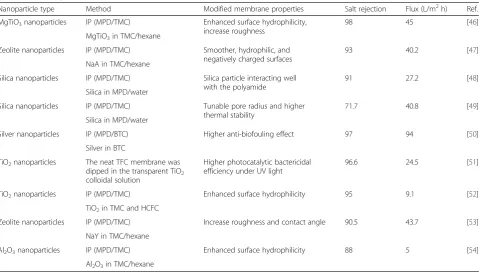
There are many literature reports regarding the per-formance of interfacial polymerized commercial poly-amide TFC membranes and of aromatic polypoly-amide and TFC desalination membranes based on MPD and TMC [46–54]. The transport properties of the membranes prepared in this study were found comparable to those of the membranes listed in Table 2.
Conclusions
Silver oxide nanoparticles were embedded into the poly-amide membrane through an interfacial polymerization process between MPD and TMC. EDX and SEM con-firmed the formation of polyamide membranes embed-ded with silver oxide nanoparticles. EDX quantitative analysis confirmed the presence of silver oxide in
0.000 0.002 0.004 0.006 0.008 0.010
86 88 90 92 94 96 98 100
Salt Rejection%
[image:11.595.58.540.88.321.2]Ag2O nanoparticles concentration (wt%) n-Hexane n-Cyclohexane n-Heptane n-Dodecane
Fig. 12Salt rejection with different solvents
Table 2Summary of membrane characteristics from previous studies
Nanoparticle type Method Modified membrane properties Salt rejection Flux (L/m2h) Ref.
MgTiO3nanoparticles IP (MPD/TMC) Enhanced surface hydrophilicity, increase roughness
98 45 [46]
MgTiO3in TMC/hexane
Zeolite nanoparticles IP (MPD/TMC) Smoother, hydrophilic, and negatively charged surfaces
93 40.2 [47]
NaA in TMC/hexane
Silica nanoparticles IP (MPD/TMC) Silica particle interacting well with the polyamide
91 27.2 [48]
Silica in MPD/water
Silica nanoparticles IP (MPD/TMC) Tunable pore radius and higher thermal stability
71.7 40.8 [49]
Silica in MPD/water
Silver nanoparticles IP (MPD/BTC) Higher anti-biofouling effect 97 94 [50]
Silver in BTC
TiO2nanoparticles The neat TFC membrane was dipped in the transparent TiO2 colloidal solution
Higher photocatalytic bactericidal efficiency under UV light
96.6 24.5 [51]
TiO2nanoparticles IP (MPD/TMC) Enhanced surface hydrophilicity 95 9.1 [52]
TiO2in TMC and HCFC
Zeolite nanoparticles IP (MPD/TMC) Increase roughness and contact angle 90.5 43.7 [53]
NaY in TMC/hexane
Al2O3nanoparticles IP (MPD/TMC) Enhanced surface hydrophilicity 88 5 [54]
[image:11.595.59.540.461.733.2]ASAl-H and MRS designed the project and helped to draft the manuscript. KMAL-S carried out the experimental part with synthesis of nanocomposite membrane and their characterization. MSAl-S carried out some of the characterizations and interpretation of the results. ASAl-H and NMAl-A provided scientific guidance for successful completion of the project and also helped to draft the manuscript. All authors read and approved the final manuscript.
Acknowledgements
The authors are grateful to the King Abdulaziz City for Science and Technology, Riyadh, Saudi Arabia, for the financial support of this work and the facilities in its labs. This work was supported by King Saud University, Deanship of Scientific Research, College of Science, Research Center.
Received: 13 July 2015 Accepted: 17 September 2015
References
1. Kim SH, Kwak S-Y, Sohn B-H, Park TH. Design of TiO2nanoparticle self-assembled aromatic polyamide thin-film-composite (TFC) membrane as an approach to solve biofouling problem. J Membr Sci. 2003;211(1):157–65. 2. Ghosh AK, Hoek EM. Impacts of support membrane structure and chemistry
on polyamide–polysulfone interfacial composite membranes. J Membr Sci. 2009;336(1):140–8.
3. Van Voorthuizen EM, Zwijnenburg A, Wessling M. Nutrient removal by NF and RO membranes in a decentralized sanitation system. Water Res. 2005;39(15):3657–67.
4. Peng X, Jin J, Nakamura Y, Ohno T, Ichinose I. Ultrafast permeation of water through protein-based membranes. Nat Nanotech. 2009;4(6):353–7. 5. Zhou M, Nemade PR, Lu X, Zeng X, Hatakeyama ES, Noble RD, et al. New
type of membrane material for water desalination based on a cross-linked bicontinuous cubic lyotropic liquid crystal assembly. J Am Chem Soc. 2007;129(31):9574–5.
6. Tsuru T. Inorganic porous membranes for liquid phase separation. Sep Purif Rev. 2001;30(2):191–220.
7. AL-Sheetan KM, Shaik MR, Al-Hobaib AS, Alandis NM. Characterization and evaluation of the improved performance of modified reverse osmosis membranes by incorporation of various organic modifiers and SnO2 nanoparticles. J Nanomater. 2015;Article ID 363175:1–11.
8. Suk M, Raghunathan A, Aluru N. Fast reverse osmosis using boron nitride and carbon nanotubes. Appl Phy Lett. 2008;92(13):133120.
9. Petersen RJ. Composite reverse osmosis and nanofiltration membranes. J Membr Sci. 1993;83(1):81–150.
10. Rao AP, Desai N, Rangarajan R. Interfacially synthesized thin film composite RO membranes for seawater desalination. J Membr Sci. 1997;124(2):263–72. 11. Yoon K, Hsiao BS, Chu B. High flux nanofiltration membranes based on
interfacially polymerized polyamide barrier layer on polyacrylonitrile nanofibrous scaffolds. J Membr Sci. 2009;326(2):484–92.
12. Li L, Zhang S, Zhang X. Preparation and characterization of poly (piperazineamide) composite nanofiltration membrane by interfacial polymerization of 3, 3′, 5, 5′-biphenyl tetraacyl chloride and piperazine. J Membr Sci. 2009;335(1):133–9.
13. Tarboush BJA, Rana D, Matsuura T, Arafat H, Narbaitz R. Preparation of thin-film-composite polyamide membranes for desalination using novel hydrophilic surface modifying macromolecules. J Membr Sci. 2008;325(1):166–75. 14. Jenerette GD, Larsen L. A global perspective on changing sustainable urban
water supplies. Global Planet Change. 2006;50(3):202–11.
19. Zhao L, Ho WW. Novel reverse osmosis membranes incorporated with a hydrophilic additive for seawater desalination. J Membr Sci. 2014;455:44–54. 20. Tang CY, Kwon Y-N, Leckie JO. Effect of membrane chemistry and coating
layer on physiochemical properties of thin film composite polyamide RO and NF membranes: I. FTIR and XPS characterization of polyamide and coating layer chemistry. Desalination. 2009;242(1):149–67.
21. Baker RW. Membrane Technology. Kirk- Othmer encyclopedia of Chemical technology. 2000; DOI: 10.1002/0471238961.1305130202011105.a01. 22. Kurihara M, Hanakawa M. Mega-ton Water System: Japanese national
research and development project on seawater desalination and wastewater reclamation. Desalination. 2013;308:131–7.
23. Xie W, Geise GM, Freeman BD, Lee H-S, Byun G, McGrath JE. Polyamide interfacial composite membranes prepared from m-phenylene diamine, trimesoyl chloride and a new disulfonated diamine. J Membr Sci. 2012;403:152–61.
24. Vrijenhoek EM, Hong S, Elimelech M. Influence of membrane surface properties on initial rate of colloidal fouling of reverse osmosis and nanofiltration membranes. J Membr Sci. 2001;188(1):115–28.
25. Cadotte JE. Interfacially synthesized reverse osmosis membrane. Google Patents. 1981.
26. Kamada T, Ohara T, Shintani T, Tsuru T. Optimizing the preparation of multi-layered polyamide membrane via the addition of a co-solvent. J Membr Sci. 2014;453:489–97.
27. Zodrow K, Brunet L, Mahendra S, Li D, Zhang A, Li Q, et al. Polysulfone ultrafiltration membranes impregnated with silver nanoparticles show improved biofouling resistance and virus removal. Water Res. 2009;43(3):715–23. 28. Siddiqui MRH, Adil S, Assal M, Ali R, Al-Warthan A. Synthesis and
characterization of silver oxide and silver chloride nanoparticles with high thermal stability. Asian J Chem. 2013;25(6):3405–9.
29. Lind ML, Eumine Suk D, Nguyen T-V, Hoek EM. Tailoring the structure of thin film nanocomposite membranes to achieve seawater RO membrane performance. Environ Sci Technol. 2010;44(21):8230–5.
30. Khan M, Khan M, Adil SF, Tahir MN, Tremel W, Alkhathlan HZ, et al. Green synthesis of silver nanoparticles mediated by Pulicaria glutinosa extract. Int J Nanomedicine. 2013;8:1507–16.
31. Yin J, Kim E-S, Yang J, Deng B. Fabrication of a novel thin-film nanocomposite (TFN) membrane containing MCM-41 silica nanoparticles (NPs) for water purification. J Membr Sci. 2012;423:238–46.
32. Hurwitz G, Guillen GR, Hoek EM. Probing polyamide membrane surface charge, zeta potential, wettability, and hydrophilicity with contact angle measurements. J Membr Sci. 2010;349(1):349–57.
33. Du Q, Freysz E, Shen YR. Surface vibrational spectroscopic studies of hydrogen bonding and hydrophobicity. Science. 1994;264(5160):826–8. 34. Li J-H, Xu Y-Y, Zhu L-P, Wang J-H, Du C-H. Fabrication and characterization
of a novel TiO2 nanoparticle self-assembly membrane with improved fouling resistance. J Membr Sci. 2009;326(2):659–66.
35. Jeong B-H, Hoek EM, Yan Y, Subramani A, Huang X, Hurwitz G, et al. Interfacial polymerization of thin film nanocomposites: a new concept for reverse osmosis membranes. J Membr Sci. 2007;294(1):1–7.
36. Lind ML, Ghosh AK, Jawor A, Huang X, Hou W, Yang Y, et al. Influence of zeolite crystal size on zeolite-polyamide thin film nanocomposite membranes. Langmuir. 2009;25(17):10139–45.
37. Kim C, Kim J, Roh I, Kim J. The changes of membrane performance with polyamide molecular structure in the reverse osmosis process. J Membr Sci. 2000;165(2):189–99.
39. Song Y, Sun P, Henry LL, Sun B. Mechanisms of structure and performance controlled thin film composite membrane formation via interfacial polymerization process. J Membr Sci. 2005;251(1):67–79.
40. Mitchell GE, Mickols B, Hernandez-Cruz D, Hitchcock A. Unexpected new phase detected in FT30 type reverse osmosis membranes using scanning transmission X-ray microscopy. Polymer. 2011;52(18):3956–62.
41. Freger V. Nanoscale heterogeneity of polyamide membranes formed by interfacial polymerization. Langmuir. 2003;19(11):4791–7.
42. Pacheco FA, Pinnau I, Reinhard M, Leckie JO. Characterization of isolated polyamide thin films of RO and NF membranes using novel TEM techniques. J Membr Sci. 2010;358(1):51–9.
43. Berezkin AV, Khokhlov AR. Mathematical modeling of interfacial polycondensation. J Polym Sci Part B: Polym Phy. 2006;44(18):2698–724. 44. Freger V, Srebnik S. Mathematical model of charge and density distributions
in interfacial polymerization of thin films. J Appl Polym Sci. 2003;88(5):1162–9. 45. Chai G-Y, Krantz WB. Formation and characterization of polyamide
membranes via interfacial polymerization. J Membr Sci. 1994;93(2):175–92. 46. AL-Hobaib A, El Ghoul J, El Mir L. Fabrication of polyamide membrane
reached by MgTiO3nanoparticles for ground water purification. Desalin Water Treat. 2015; 1–10. (ahead-of-print)
47. Domingues SH, Salvatierra RV, Oliveira MM, Zarbin AJ. Transparent and conductive thin films of graphene/polyaniline nanocomposites prepared through interfacial polymerization. Chem Commun. 2011;47(9):2592–4. 48. Singh PS, Aswal VK. Characterization of physical structure of silica
nanoparticles encapsulated in polymeric structure of polyamide films. J Colloid Interface Sci. 2008;326(1):176–85.
49. Jadav GL, Singh PS. Synthesis of novel silica-polyamide nanocomposite membrane with enhanced properties. J Membr Sci. 2009;328(1):257–67. 50. Lee SY, Kim HJ, Patel R, Im SJ, Kim JH, Min BR. Silver nanoparticles
immobilized on thin film composite polyamide membrane: characterization, nanofiltration, antifouling properties. Polym Advan Technol. 2007;18(7):562–8. 51. Kwak S-Y, Kim SH, Kim SS. Hybrid organic/inorganic reverse osmosis (RO)
membrane for bactericidal anti-fouling. 1. Preparation and characterization of TiO2nanoparticle self-assembled aromatic polyamide thin-film-composite (TFC) membrane. Environ Sci Technol. 2001;35(11):2388–94.
52. Lee HS, Im SJ, Kim JH, Kim HJ, Kim JP, Min BR. Polyamide thin-film nanofiltration membranes containing TiO2nanoparticles. Desalination. 2008;219(1):48–56.
53. Ma N, Wei J, Liao R, Tang CY. Zeolite-polyamide thin film nanocomposite membranes: towards enhanced performance for forward osmosis. J Membr Sci. 2012;405:149–57.
54. Saleh TA, Gupta VK. Synthesis and characterization of alumina nano-particles polyamide membrane with enhanced flux rejection performance. Sep Purif Technol. 2012;89:245–51.
Submit your manuscript to a
journal and benefi t from:
7 Convenient online submission
7 Rigorous peer review
7 Immediate publication on acceptance
7 Open access: articles freely available online
7 High visibility within the fi eld
7 Retaining the copyright to your article