BIROn - Birkbeck Institutional Research Online
Gomez, C. and Chessa, S. and Fleury, A. and Roussos, George and
Preuveneers, D. (2019) Internet of Things for enabling smart environments:
a technology-centric perspective. Journal of Ambient Intelligence and Smart
Environments 11 (1), pp. 23-43. ISSN 1876-1364.
Downloaded from:
Usage Guidelines:
Please refer to usage guidelines at
or alternatively
Internet of Things for Enabling Smart
Environments: a Technology-Centric
Perspective
Carles Gomez
a,*, Stefano Chessa
b, Anthony Fleury
c, George Roussos
dand Davy Preuveneers
e a Department of Network Engineering, Universitat Politècnica de Catalunya, C/Estev e Terradas, 7, 08860,Castelldefels, Spain
b Department of Computer Science, University of Pisa, largo Pontecorvo 3,56127 Pisa, Italy
c IMT Lille Douai, URIA, and University of Lille, 20 Rue Guglielmo Marconi, 59650 Villeneuve -d'Ascq, France d Department of Computer Science and Information Systems, Birkbeck College, University of London, Malet
Street, London WC1E 7HX, United Kingdom
e imec-DistriNet, KU Leuven, Celestijnenlaan 200A - bus 2402, B-3001 Heverlee, Belgium
Abstract. The Internet of Things (IoT) is a computing paradigm whereby everyday life objects are augmented with computa-tional and wireless communication capabilities, typically through the incorporation of resource-constrained devices including sensors and actuators, which enable their connection to the Internet. The IoT is seen as the key ingredient for the development of smart environments. Nevertheless, the current IoT ecosystem offers many alternative communication solutions with diverse performance characteristics. This situation presents a major challenge to identifying the most suitable IoT communication solu-tion(s) for a particular smart environment. In this paper we consider the distinct requirements of key smart environments, namely the smart home, smart health, smart cities and smart factories, and relate them to current IoT communication solutions. Specifically, we describe the core characteristics of these smart environments and then proceed to provide a comprehensive survey of relevant IoT communication technologies and architectures. We conclude with our reflections on the crucial features of IoT solutions in this setting and a discussion of challenges that remain open for research.
Keywords: IoT, smart home, smart health, smart cities, smart factories
*Corresponding author. E-mail: [email protected].
1. Introduction
The Internet of Things (IoT) is a co mputing and communications paradigm whereby everyday life objects are connected to the Internet. Such connectiv-ity, supported by the incorporation of resource-constrained devices including sensors and actuators, enables intelligent systems that obtain information fro m the physical world, process such information, and may perfo rm actions on the physical world ac-cordingly. Benefits of the IoT co mprise efficient re-source management, enhanced productivity, and in-creased quality-of-life fo r hu man populations [39]. The IoT is therefore a fundamental enabler of smart environments [24], such as smart ho mes, smart health,
smart cities and smart factories, among others. In-deed, the trend towards smart-x p ro mises a revolu-tion for most kinds of human-related activities.
en-viron ment challenging. While all s mart enen-viron ments collect, process and act upon information, d ifferent specific smart environ ments do so at different scales. Moreover, different vertical do mains (e.g. smart home/health/city/factory) come with diverse re-quirements, and hence technology choices, which also influences the tactics of how and where data is processed and how to act upon the information with-in a specific context. Furthermore, different types of smart environ ments evolve at a different pace: So me vertical do mains can evaluate and adopt new tech-nologies much faster (e.g. s mart ho me and smart health), while in others (e.g. smart factories and smart cities) changes cannot be adopted expediently due to the fact that such environments must deal with legacy systems. This requirement further co mplicates the choice of co mmunication technologies and solu-tion availability for particular smart environments.
In this paper, we identify emerg ing trends in IoT communication and co mpare d ifferent IoT technolo-gies and solutions. We then collect lessons learnt fro m specific vertical domains to elicit best practices that are reusable across families of s mart environ-ments. In Section 2, we describe the main character-istics and services of smart ho me, s mart health, smart cities, and s mart factories. In Sections 3-5, we survey a wide range of IoT co mmun ication technologies and architectures, including RFID (Section 3), CNN technologies (Section 4) and CNN architectures (Sec-tion 5). In Sec(Sec-tion 6, we d iscuss crucial features of IoT solutions for supporting the highlighted smart environments, and we elaborate on the main remain-ing challenges. Finally, Section 7 concludes with a summary of the main insights of this work.
2. Smart environments
This Section provides an overview of the main fea-tures and services in key smart environ ments, includ-ing the smart home, s mart health, s mart cities and smart factories. These four vertical do mains are cho-sen because of their d istinct characteristics in size and complexity, such as personal- vs business- ori-ented, single-user vs many users, different "smart-ness" objectives, etc. Although clearly other types of smart environ ments exist, we focus on the aforemen-tioned four domains as representative use cases.
2.1.Smart home
[image:3.596.319.525.128.256.2]Ho mes are environ ments particularly suitable to host smart technologies for three main reasons: (i)
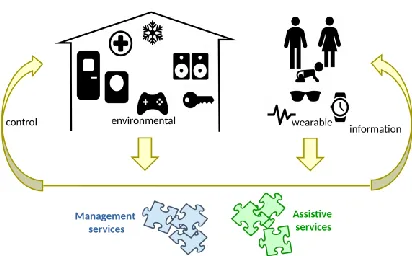
Fig. 1. Main components in smart home systems.
modern homes already contain a large number of technological devices, even if not always intercon-nected or interoperable; (ii) they are controlled envi-ronments and their owners can (at least in principle) provide the suitable investments for the deployment of technological solutions and provide to their maintenance, and (iii) they can provide to the inhab-itants a large nu mber of useful services and applica-tions.
Services of smart ho mes vary widely. We broadly classify them as assistive services and management services (Fig. 1). Assistive services in smart homes aim at provid ing direct support to the users in their interests [77] and in their daily actions and activities that take place in the ho me [15]. For example, if watching television or listening to music are particu-lar user interests, the smart ho me can assist by scheduling sources of noise caused by machine au-tomation (such as the activation of the washing ma-chine) at different hours, or by setting appropriately the lights and the multimedia devices configuration, according to the users’ preferences. Assistive ser-vices may also be tailored to some special needs of the user, especially when the user is an elder or a disabled or just sick, like amb ient assisted living [68] or e-health [18] services.
Further, management services are those that ad-dress specific functionalities of the s mart ho me. Ex-amp les of such services can be those concerning the security and safety of inhabitants (for examp le the anti-intrusion alarms or the detection of gas leaks) [35] or those concerning energy efficiency of the home [65], such as those that control ventilation and solar panels for the energy production and those that control the appliances and lights to reduce energy consumption while satisfying the inhabitants’ needs.
context-aware systems, which, in turn, are built on top of co mmon mechanisms and functions . In fact, at the foundation of such systems are home auto mation mechanis ms, which provide the ability to moni-tor/control the build ing blocks of a ho me like win-dows, doors, electrical system, air conditioning sys-tem, energy production subsyssys-tem, alarm, appliances and so forth.
Furthermore, most advanced services also need in-formation about the inhabitants that can be obtained by a co mbination of environ mental and wearable sensors, possibly those embedded in the users’ per-sonal devices such as smartphones for exa mp le. Such additional sensors are necessary to obtain a detailed context about the users that is crucial to make the smart ho me an intelligent environment at the service of the user. Examples of such information are the user position (by means of a localization system), the user physical condition (by means of wearable sen-sors) or the user activities (by means of combined wearable and environmental sensors).
However, this information, which is often high-level, cannot be obtained by a direct observation of raw data coming fro m sensors. Instead, it must be processed by suitable data fusion algorithms, usually based on signal processing, mach ine learning and/or data analysis algorithms.
Fro m the perspective of the information and com-munication technology (ICT), support for the full range of these mechanis ms and services requires the development of a co mp lete and co mplex IoT in fra-structure. Such infrastructure must span the full range fro m the sensor/state data acquisition, storage and fusion to the data presentation and control of the ac-tuation mechanisms present in the home , and should also include the appropriate support for deploy ment, commissioning and maintenance.
Emp loying contemporary standards and technolo-gies, basic functionalities for sensing, state acquisi-tion and control can already be achieved with relative ease. In particular, at the level of ho me automation, several standards [38] already provide adequate sup-port, which include accessing state or sensor infor-mation and binding this inforinfor-mation to the con-trol/actuation mechanis ms. Similarly, both Zig Bee [32] and Bluetooth [30] support the integration of wearable devices and, at an upper layer, M2M stand-ards [3] including but not limited to MQTT and CoAP, provide the mechanis ms necessary to inte-grate the smart ho me in cloud services over the Inter-net. On the other hand, the development of services and applications in smart ho mes reflecting use cases and business plans of rich application scenarios is
usually supported by specialized platforms for exa m-ple, see subsection 2.2.3 for AAL [28].
Another aspect of IoT that has been confined so far to research, concerns the adaptation and personal-ization of services offered by smart homes. Adapta-tion and personalizaAdapta-tion consider the ability of a smart ho me to automatically tailor its services to the individual user’s needs. This is often achieved by building on generic services designed for a specific group of users such as children or the elderly, and then by adapting the behavior of the service to the habits of the user. This implies the ability to detect habits as well as to discover deviations fro m these habits while at the same time, to auto matically recon-figure the business logic of the service or application. Such mechanis ms usually require a strong conver-gence among sensors and activity recognition, anom-aly detection and cognitive capabilities, especially in those cases in which at least part of these capabilities are integrated within the sensors themselves. Signifi-cant preliminary experiences with this approach which is often referred to as the Internet of Intelligent Things [4], has been obtained by EU projects RUBI-CON [56] and OPPORTUNITY [6].
2.2.Smart health
Over the last twenty years, due to significant re-ductions to the cost of sensors and improvements in both signal processing techniques and integra-tion/quality of signal, applications of smart environ-ments and Internet of Things to health have expanded rapidly. Th is Section relates some of the work in this domain with an overview description of enabling technologies.
2.2.1.General description of solutions
Fig. 2. General description of IoT or smart environments for health.
2.2.2.Distress situation detection
Continuous monitoring of a person using physio-logical data or even using contextual/activity data, can provide information on the physical condition of the person and the ability to raise alerts in case of distress or other hazardous situations.
One key examp le due to its importance in devel-oped countries, is detecting fall for elderly people liv ing independent. In France for instance it is one of the most frequent causes of emergency calls and of med ical intervention for the elderly at home. Solu-tions must be found to analyze it, detect it better and know which kind of persons have to be sent (medical or normal citizen) to help the person. Fall is a highly studied subject in the last years and one of the main uses of IoT and smart environments for health-related applications [53,67].
One of the most common ways to detect fall is us-ing inertial sensors that are worn by the person. With the wider availability and the power offered by smartphones in recent years, it has become possible to use their Inertial Motion Unit to detect falls. For example, [52]that fuses the different sensors of the smartphone (IMU, GPS, etc.) to try to understand the context of the alert raised by the motion sensors-based algorithm and reduce false positives. Another way to achieve this is to add external sensors to the IMU, such as PIR sensors in the home, and fuse them with the IMU to check the activity of the person in the next minutes after the detection of the event [36]. In the last years, video cameras [73] have been more and more used in this context. Depth cameras can give more info rmation and analy ze mo re easily the moving vs. backg round objects [27]. They can be
used to analyze the scene, detect the activities and this abnormal scenario of fall. Concerning 2D camer-as, [26]gives the state-of-the-art of the subject and tries to analyze the pertinence of the different results and the real advances that have been made versus what remains to overcome. Finally, other kinds of solutions exist and for instance [60]presents a solu-tion that is based on radar sensors that are integrated to the home. Fall remains a very difficult (consider-ing all the kinds of falls that exist) and challeng(consider-ing.
Another kind of situation that could be detected is heart conditions and for instance atrial fibrillation [59]. It can be detected using the camera of a smartphone or even now with a s martwatch. This detection concerns one of the most common heart problems in the world and is a subject of research nowadays by means of using phones and watches. Situations such as relapse in depression can also be detected and analyzed [5]. Such system can permit to act as soon as possible to prevent the state of the per-son to escalate.
2.2.3.Ambient Assisted Living
As presented in the previous Section, smart homes are a huge challenge in the last years and have been a hot topic of research. Indeed, data fro m amb ient as-sisted living can also be used to infer the behavior of the person and detect changes in it to find signs of a degradation of the health of the person as soon as possible. There are mu ltiple challenges in this case including the correct seg mentation of data in uncon-trolled trials [86], an important mult imodality using very different kind of data [90], how to adapt the models to the person that we have to monitor [21], the problem to infer behavior or high-level data fro m the activities that are recognized [21] o r the efficien-cy and capacities of different kind of recognitions [19]. This activity recognition is then crucial in ap-plications related to health in smart ho mes as it will be the basis to infer the well-being of the person and to link the results to well-known and use scales in geriatrics such as ADLs. The challenges are very difficult as the first problem is that it is very difficu lt to separate the activities that are performed, and sec-ondly the realization of the activities not only de-pends on the person that does it but also on the envi-ronment in which it is done. That leads to very com-plex models to construct and to evaluate.
im-pairment [2]. This evaluation allows to show the evo-lution of the problem of the person to determine when he/she is not any more able to live inde-pendently. The second kind of application is to help people performing these activities taking into account the specificity of their d isease/impairment [46]. It can improve their conditions of living at home and their experiences.
2.2.4.Prevention/assistance to healthcare
The final goal of all the solutions of smart sensors and environments for health is to help prevent or as-sist the person that has to face a specific condition. Dependence is one of the huge cost in our healthcare systems and if it can be imp roved, it would reduce this part. A lot of work focuses on that considering different kinds of assistance. For people with a d isa-bility for instance, [44] proposes a system that will combine a web-app to allow the caregiver to give instruction to the environment and a s martphone to help the person in daily living. Such development has required expertise to design it as efficiently as poss i-ble so that it can be useful to the person. It generally includes co-conception with users.
One of the majo r concerns in health is mon itoring and/or imp roving the condition of persons with chronic diseases or recurrent disorders. For instance, some smart devices and applications can help manag-ing chronic diseases such as diabetes [47]. The goal of such applications, that relies generally on meas-urement devices and/or on smartphones and other connected devices is to help the person to manage the effect of the disease and control it or control the ob-servance of med ication. Solutions can also be inte-grated in objects daily used such as the bed [92]. In this application, the goal is to analyze the sleep con-ditions in order to detect and/or quantify changes in it and thus detect disorders. To this end, sensors and strain gauge are integrated to the bed. The long-term evolution of the uses of the person is important and relevant to the improvement or degradation of living conditions of the person. Other data can be acquired, such as heart rate, to be able to mon itor in long terms the evolution of this data, and possibly in the future to raise alarms such as described before in the dis-tress situations detection [79].
To conclude this Section, one of the important ap-plications is the monitoring of and help offered to elderly people. In all developed countries, population is ageing fast due to improvements in medicine, and another fact is that the family is spreading all over countries and ageing people generally are lonelier
than in the past. In addition to the works that monitor activities of daily living of the person, mon itoring some characteristics of the living conditions of the person could be important. For instance, in [7] and [72], gait or time of transfers are measured along time, and their evolution is characterized. Th is evolu-tion is another point of evaluating possible entrance in dependency. As a prevention, some works [12,31] propose to train the person with some specific exer-cises (link to posture, transfers or movements) to prevent fall or give benefit to the person.
Finally, in case of dependence, robots can be of help for the person to allow measurement and moni-toring, and more importantly, to create a p resence for the person and bring help in case of specific needs [70].
As seen in this Section, health applications are numerous and go from distress situation detection to long-term mon itoring in s mart environments. Such monitoring can be included in larger architectures. In the future, we could think that it can be included in smart city arch itectures. Smart cities are the subject of the next Section.
2.3.Smart city
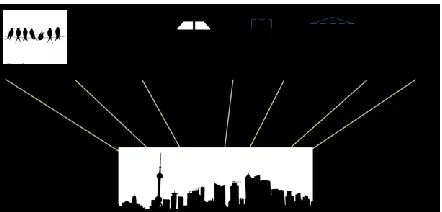
Smart cities are one of the richest and most com-plex scenarios for s mart environ ment (if not already the most complex) [87,88]. It crosses several do-mains including the environ ment, economy, mobility, energy, planning, governance among others (see Fig. 3) presenting a large number of associated challenges and involving multiple actors such as city admin istra-tors, operaistra-tors, service providers and citizens, with possibly competing objectives.
[image:6.596.313.534.615.721.2]It is thus clear that smart cities are not just a tech-nological challenge, but they are the place in which the challenges to the technology are the most diverse and heterogeneous, and the technological solutions must confront themselves against many interests and needs.
Fro m an ICT perspective, its technologies are of-ten transversal to all do mains and challenges, and they address a number of scenarios of smart cities spanning from touris m [89], culture [11], e-government [61], smart energy [63], s mart mob ility [96], e-health/wellbeing [25], just to mention a few.
The heterogeneity of technical problems and of available technologies [85], united to political issues [54], are barriers that may delay the development of smart cities. It is thus no surprise that the interopera-bility of technological solutions and standards are of utmost importance, especially in the field of the In-ternet of Things, wh ich is widely recognized as a key technological enabler o f s mart cities [95]. Most re-cent trends, under this respect, are the introduction of novel participatory sensing paradig ms that involve the citizens themselves in the (expensive) task of sensing data from the cities, by means mobile appli-cations for personal smartphones [17].
In addition to reducing or indeed avoiding the costs due to the deployment and maintenance of ca-pillary sensory apparatus in the city, such paradigms have also the great advantage of empowering users in the development of smart cities. However, the rela-tive youth of these approaches makes them even far-ther fro m a standardization, and many different e x-perimental p latforms have been tested in several smart cities [16,43,57]. Furthermore, recent ap-proaches to participatory sensing are also experienc-ing novel forms of network organization based on emerging edge computing [10].
2.4.Smart factory and Industry 4.0
[image:7.596.315.522.143.265.2]Industry 4.0 is an emerg ing business paradigm that is reaping the benefits of enabling technologies driv-ing intelligent systems and environments [74]. While acquiring, processing and acting upon various kinds of relevant context information is common in appli-cation areas such as smart homes and offices, smart automated manufacturing systems can benefit from these capabilities as well. For examp le, s mart manu-facturing systems can make well-informed decisions to adapt and optimize their production processes at runtime or adapt to a customer's personal preferences without any delay on the production process. The proliferation o f s mart enabling technologies has sparked a dig ital transformation in the manufacturing world. This paradig m shift is often referred to as the 4th Generation Industrial Revolution (Industry 4.0) [34,58] or the Factory of the Future (FoF) [50].
Fig. 4. The 4 industrial revolutions leading to the Smart Factory of the Future and Cyber-physical Production Systems
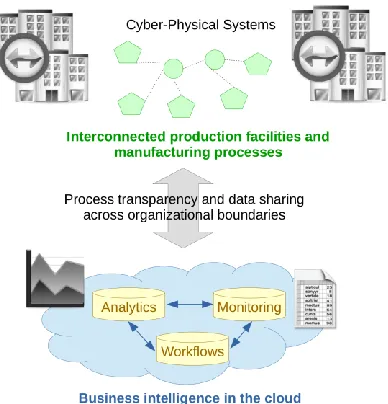
It envisions smart factories where the Internet of Things (IoT) and Cyber-Physical Systems (CPS)-enabled manufacturing [66] provide the foundations for creating smart products through smart processes and procedures. Large factories connect hundreds - if not thousands - of sensors and devices, not only with-in the p lant, but also with other factories and the out-side world. Smart products will plan, control and optimize their o wn production process with minimal human intervention by harnessing ongoing develop-ments in sensor technology, machine-to-machine communication [91], big data analytics [69] and ma-chine learn ing [71,75]. The purpose of this digital transformation is to enhance the transparency of the production process across the organizational bounda-ries of the manufacturing enterprise.
Enhanced access to data from the Industrial IoT (IIoT) [34] will support business applications on any device, any time, fro m any location. In turn, the data-intensive nature of smart production systems will enable timely, accurate and detailed log trails result-ing in a real-time augmented view on many systems and activities in a way that was not previously poss i-ble. A consequence is that the production floor has become an inherently co mplex intelligent environ-ment, as the digital and physical worlds are heavily intertwined.
Fig. 5. Networked production and manufacturing
With networked production as a key feature of In-dustry 4.0, people, machines and business processes will interact with one another to enable personalized products through flexib le, resource-efficient and cost-effective manufacturing.
3. Radio Frequency Identification
As it can be concluded from the previous Section, IoT co mmunication solutions constitute a fundamen-tal enabler of s mart environ ments . This Section fo-cuses on RFID, which is a family of solutions main ly intended to provide device identification.
A traditional RFID system consists of two ele-ments namely a reader or interrogator wh ich typically controls communication with several tags, low-cost devices that can be easily embedded into a variety of physical artefacts and assets. Contrary to other low-power wireless communication systems, RFID is an asymmetric system in that in most cases the interro-gator not only controls all co mmunication with the tags but also provides the energy source for the tags through the emission of its radio frequency signal [80,82]. Th is distinctive architecture enables the de-velopment of systems where a relatively small nu m-ber of expensive components are combined with a very-large number of lo w-cost tags to optimize the overall cost of the system. For examp le, a metropoli-tan transit ticketing system such as the Oyster card in
London or the Suica card in Tokyo, incorporate reade.rs in the thousands with millions of tags em-bedded in tickets and mobile devices.
The use of RFID in the IoT context introduces two additional elements that are necessary to enable large-scale open infrastructures: (i) universally unique identification (UUID) schemes that allow each entity connected to the IoT to be unambiguously identified through an alphanumeric handle, and (ii) networked services that allow the mapping of a han-dle to entity-related information and supporting me-ta-data.
3.1.RFID technologies
RFID is the u mbrella term in co mmon use wh ich covers a variety of distinct technologies using a wide range of frequencies, communication protocols, and device types. Moreover, RFID technologies have been standardized under many different organizations including international such as ISO, ITU and IEC as well as national such as DIN (Germany), JIS (Japan) and SINIA V (Brazil). The confusing landscape of RFID is further co mplicated by the common use of commercial brand names such as Mifare and RAIN RFID as alternatives to the difficult to use alphanu-meric standard names.
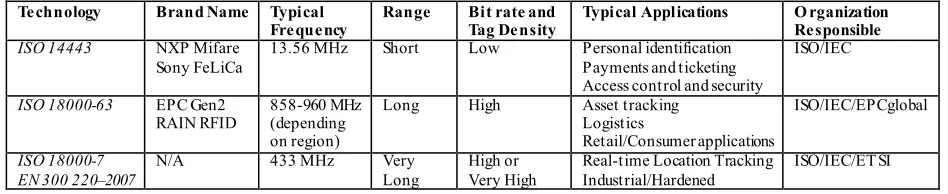
To provide some structure and help navigate the range of RFID technologies a common approach is to refer to different technologies using the names of the corresponding frequency band as summarized in Ta-ble 1. Furthermo re, often RFID technologies are characterized with reference to their tag chip tech-nology, which also defines their co mmun ication characteristics, as summarized in Table 2.
[image:8.596.89.283.130.332.2]T able 1. RFID technologies by Frequency Band T able 2. RFID technologies by Chip T ype
RFID Name Band Frequencies in Use
LF Low Frequency
(125–134.2 kHz) 125 kHz RFID 134 kHz RFID
HF High Frequency
(13.553–13.567 MHz) 13.56 MHz RFID
UHF Ultra-High Frequency
(433 MHz and 858–960 MHz)
433 MHz RFID UHF RFID
(includ-ing ET SI RFID at 865-868 and FCC RFID at 902-928)
Microwave Microwave
(2.4–2.454 GHz 5.725–5.875 GHz)
2.4 GHz RFID 5.8 GHz RFID
Chip Type Description
Passive T ag power source: RF energy transmitted by reader/integrator
Communication: by modulation of the read-er/integrator signal
Semi-Passive T ag power source: battery
Communication: by modulation of the read-er/integrator signal
Active T ag power source: battery
Communication: active transmission
Sensor Tag Simple sensor integrated in the tag (tempera-ture, pressure or humidity) T ag power source: battery or RF harvesting Communication: passive or active transmission
Chipless No chip but uses time-domain reflectometry (e.g. surface acoustic waves)
T able 3. Main flavors of RFID technologies used in IoT Systems
Technology Brand Name Typical
Frequency Range Bit rate and Tag Density Typical Applications O rganization Responsible
ISO 14443 NXP Mifare
Sony FeLiCa
13.56 MHz Short Low Personal identification
Payments and ticketing Access control and security
ISO/IEC
ISO 18000-63 EPC Gen2
RAIN RFID 858-960 MHz (depending
on region)
Long High Asset tracking
Logistics
Retail/Consumer applications
ISO/IEC/EPCglobal
ISO 18000-7 EN 300 220–2007
N/A 433 MHz Very
Long
High or Very High
Real-time Location Tracking Industrial/Hardened
ISO/IEC/ET SI
3.2.Identifier schemes
As noted earlier, for the development of open IoT systems, which typically incorporate a variety of stakeholders and must support scalable operation, RFID must support a common way to interpret iden-tifiers retrieved fro m tags [82]. Moreover, standard identifier schemes are already in widespread use for a variety of material objects, locations and even digital artifacts so demanding that RFID within the IoT starts fro m a clean slate would not be feasible either fro m a financial or an organizational point of v iew. Electronic Product Codes (EPC) developed by SG-1 and EPCg lobal, Object Identifiers (OID) according to the ISO/ITU standard, Ubiquitous IDs (uID) in wide use in Japan as well as a variety of other schemes commonly employed in RFID and barcode encodings, often in an industry-specific manner, are in current common use for the identification of b illions of al-ready tagged objects.
Although it is not possible to cover each one of these schemes in detail in this paper, we note that all schemes follo w a similar pattern to structure their codes. Specifically, each code starts with a prefix which identifies the particular type of code that
fol-lows, for examp le within the EPC system, the prefix of 00110000 identifies the remainder of the codes as a Serialized Global Trade Item Nu mber of length 96 bits (SGTIN-96). The remainder of the code is then typically organized in a hierarch ical manner to enable code allocation delegation across regions or organi-zations. In the case of SGTIN-96 codes for examp le, the code will include the company prefix identifying the manufacturer of the particular product, the item reference identifying the product type and finally a serial nu mber that is unique to the particular product item. Similar structures exist for OID (specified un-der Section 9834-8:2009 of ISO/IEC) and uID alt-hough of course identifier space management and regulation are carried out through their respective organizational custodians.
3.3.Identifier resolution systems
[image:9.596.60.534.320.417.2]In the content of IoT RFID, this system capability is referred to as the Identifier Resolution Service(s).
Many of the current proposals for IRSs provide specifications for scheme-specific services: for ex-amp le, EPCg lobal [55] provides resolution services that cater only for EPC codes issued within their eco-systems. Ongoing work by ISO/IEC JTC 1/SC 6/W G 9 and ITU-T Q12/SG17 has developed an OID re-solver specification known as X.oid -res or the SG17 ORS (OID Resolution Service). In contrast to that work, IoT applications require an open and inclusive approach. For examp le, the extensive experience and experimentation in this area conducted within the Internet Engineering Task Force (IETF) and specifi-cally the work carried out on the HIP (RFC 5201) and LISP (RFC 6115) protocols and on scalable In-ternet-scale resolution systems [39] offers valuable lessons on how to enable IoT-scale IRS that can cater to all types of RFID irrespective of the specific UUID scheme emp loyed. At the time of writing, there is no commonly accepted standard but certain developments point the way towards a usable solu-tion [81].
4.CNN communication technologies
While RFID systems mainly aim at co mmuni-cating the identification of a given object, CNNs serve more general purposes regarding interaction with the physical world. CNN devices are often tiny computers provided with sensing and/or acting capa-bilities, which however may exhib it co mputational constraints such as RAM in the order of ~10 kB or an 8-/16-bit processor, as well as energy constraints since many such devices will run on a limited energy source (e.g. a coin cell battery).
This Section introduces the main wireless or wired communication technologies used in the CNN space. Many such technologies typically provide on ly Phys-ical layer (PHY) and Mediu m Access Control layer (MAC) functionality, although some of them are de-fined as part of a larger protocol stack. As shown in this Section, a wide range of CNN technologies is available. However, each technology may have spe-cific characteristics and may be better suited for a limited set of environments and scenarios.
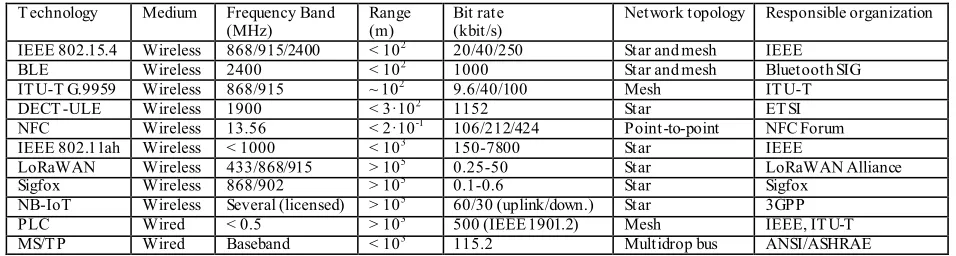
The set of technologies presented in this Section comprises IEEE 802.15.4, Bluetooth Low Energy (BLE), ITU-T G.9959, Digital Enhanced Cordless Teleco mmunications Ultra Low Energy (DECT-ULE), Near Field Co mmunication (NFC), W i-Fi,
Lo RaWAN, Sigfo x, Narrowband IoT (NB-IoT), Power Line Co mmunication (PLC) and Master-Slave/Token Passing (MS/TP). The main features of these technologies are summarized in Table 4.
4.1.IEEE 802.15.4
IEEE 802.15.4 is a family of wireless technologies intended to enable monitoring and control applica-tions for Wireless Personal Area Network (WPA N). Publication of its first version in 2003 was a mile-stone, since for the first time, an open standard tar-geted low-rate communication, with a focus on sim-plicity and low energy consumption [9].
IEEE 802.15.4 was not designed for a specific ap-plication do main. Instead, it is intended as a generic technology, and it has become the basis of relevant protocol architectures, supporting IPv6, and also non-IP-based protocol solutions such as ZigBee (see Sec-tion 5). Nevertheless, IEEE 802.15.4 has been opti-mized for specific environments, such as the IEEE 802.15.4e Time Slotted Channel Hopping (TSCH) mode, designed to overcome impairments in industri-al environ ments [94]. In fact, TSCH is industri-also used in standard protocol stacks on top of IEEE 802.15.4 for industrial environ ments such as ISA 100.11a and WirelessHART.
4.2.BLE
BLE was released in 2010 as a low-energy variant of classic Bluetooth [37]. Since BLE can partially reuse Bluetooth hardware, a device that supports classic Bluetooth can also support BLE for low addi-tional cost. Therefore, BLE can leverage its wide-spread presence in smartphones, which can be used to collect data fro m or send commands to surround-ing sensors and actuators. The smartphone can also be used as a gateway for interaction between sensors, actuators, and the Internet. In addition, BLE has be-come do minant in the areas of wearables, tablets, and other consumer electronics devices [1].
4.3.ITU-T G.9959 (Z-Wave)
T able 4. Main features of IoT technologies
T echnology Medium Frequency Band
(MHz) Range (m) Bit rate (kbit/s) Network topology Responsible organization
IEEE 802.15.4 Wireless 868/915/2400 < 102 20/40/250 Star and mesh IEEE
BLE Wireless 2400 < 102 1000 Star and mesh Bluetooth SIG
IT U-T G.9959 Wireless 868/915 ~ 102 9.6/40/100 Mesh IT U-T
DECT -ULE Wireless 1900 < 3·102 1152 Star ET SI
NFC Wireless 13.56 < 2·10-1 106/212/424 Point-to-point NFC Forum
IEEE 802.11ah Wireless < 1000 < 103 150-7800 Star IEEE
LoRaWAN Wireless 433/868/915 > 105 0.25-50 Star LoRaWAN Alliance
Sigfox Wireless 868/902 > 105 0.1-0.6 Star Sigfox
NB-IoT Wireless Several (licensed) > 105 60/30 (uplink/down.) Star 3GPP
PLC Wired < 0.5 > 103 500 (IEEE 1901.2) Mesh IEEE, IT U-T
MS/T P Wired Baseband < 103 115.2 Multidrop bus ANSI/ASHRAE
4.4.DECT-ULE
DECT-ULE is a low-energy variant o f DECT, which is the main technology used for voice and data communication for indoor cordless telephony [94]. Use of DECT-ULE has been proposed in order to enable commun ication between a gateway and sen-sors or actuators in the home, by exploit ing the strong presence of DECT equipment.
4.5.NFC
NFC is a wireless technology that provides very short range (e.g. ~10 cm). This feature offers intrinsic security properties, since it minimizes opportunities for unauthorized devices to capture transmitted data. NFC allo ws different co mmunication modes, such as card emulation (e.g. for pay ment applications), reader mode, and peer-to-peer communication [41].
4.6.IEEE 802.11
IEEE 802.11 is a massively successful Wireless Local Area Network (W LAN) family of standards , often referred to as Wi-Fi. While its design includes power-saving mechanisms, it has not been a clear choice for energy-constrained devices, given its im-plementation complexity and overall power con-sumption. In order to fill the gap of IEEE 802.11 for sensor/actuator applications, IEEE 802.11ah has been recently designed for low energy consumption, lower bit rate and increased range, enabling sensor data collection application areas such as smart grid [8].
4.7.LoRaWAN
Lo RaWAN is an unlicensed band wireless tech-nology that belongs in the emerging Lo w Power Wide Area Network (LPWAN) category. Lo RaWAN uses LoRa technology at the physical layer, and it allo ws an increased communication range up to the order of 10s of kms. Based on a star topology, whereby a gateway co llects data fro m up to hundreds of thousands of devices such as sensors, it offers a low infrastructure cost, at the expense of severe mes-sage rate and bit rate limitations [29].
4.8.Sigfox
Sigfo x is another flagship LPWAN wireless tech-nology, therefore it offers long range and low in fra-structure coverage for a massive amount of devices , at the expense of very reduced bit and message rates. This technology operates in unlicensed frequency bands, and it is managed by the company that is also called Sigfo x. Like other LPWAN technologies, it is based on the star topology, and a communication range in the order of 10s of kms is achievable [29].
4.9.NB-IoT
[image:11.596.60.538.141.269.2]4.10.PLC
Power Line Co mmunication (PLC) defines a fami-ly of technologies that leverage power grid in fra-structure as a means for co mmun ication. While PLC is based on using a wired mediu m, it is subject to interference, therefore it is subject to impairments similar to those of wireless media. There exist low b it rate PLC variants such as IEEE 1901.2 or ITU-T G.9903, wh ich are often used in smart ho me or relat-ed applications such as smart grid [42].
4.11.MS/TP
Master Slave / Token Passing (MS/TP) is a wired technology that belongs to the BACnet family of standards for building automation. Dev ices that use MS/TP are typically grid-powered. While the de-scribed features do not pose the same degree of limi-tations as other technologies overviewed in this Sec-tion, devices that use MS/TP are constrained, and the physical layer, based on RS-485 specification, offers low bit rates [62].
5.CNN protocol architectures
The previous Section provided an overview of the main co mmun ications technologies used in IoT ap-plications. This Section presents the main protocol architectures, i.e. co mp lete sets of communication protocols, from the PHY to the application layer in the IoT space. We first focus on IP-based architec-tures, and then we overview non-IP-based stacks.
5.1.IP-based architectures
In order to obtain the maximu m benefit fro m sen-sors and actuators, they need to be connected to the Internet, which allows the highest degree of flexibil-ity (i.e. making it possible to commun icate with these devices remotely) and interoperability (i.e. Internet connectivity maximizes the number of devices that one device can talk to).
Running IP can be considered the most suitable method for many constrained devices to achieve In-ternet connectivity. IP is an open protocol, it was designed for interoperability, and it simp lifies appli-cation development, since appliappli-cations run on well-known services on top of IP, regardless of the under-lying technology [39].
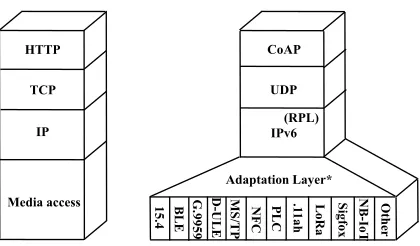
The least constrained devices (e.g. class 2 or great-er [14]) are considgreat-ered to be able to run a traditional IP-based protocol stack (e.g. using HTTP, TCP, and IP, on top of common network interfaces, see Fig. 6-left, especially when such devices are grid-powered. However, the most constrained devices, and/or those that are energy-constrained, cannot afford the more trad itional protocol stack, due to lack of suffi-cient computational power and energy availability. For this reason, the IETF engaged in 2005 in a dec-ade-long process to define adaptations, optimizations and new protocols for a first version of an IPv 6-based lightweight protocol stack for constrained devices. IPv6 was assumed at the core of the stack, since IPv4 faces the problem of address exhaustion, and also because IPv6 is provided with tools for device self-configuration. The lightweight, IoT-specific protocol stack (see Fig. 6-right) co mprises an adaptation layer below IPv 6 [83], the IPv 6 Routing Protocol for Low-power and lossy networks (RPL)[78], and the Con-strained Application Protocol (CoAP) [84].
IPv6 over Lo w power WPA N (6LoWPAN) is an adaptation layer that was designed in order to support IPv6 over IEEE 802.15.4 networks. A mong others, 6LoWPAN provides IPv6 (and UDP) header co m-pression, packet fragmentation and reassembly (giv-en the short IEEE 802.15.4 fra me size), and an adap-tation of the IPv 6 Neighbor Discovery protocol for energy-constrained devices [83].
The 6LoWPAN work has been extended to several other technologies. For examp le, as of the writing, the IETF effort called 6Lo has adapted 6LoWPAN for interfaces such as BLE, DECT -ULE, ITU-T G.9959, MS/TP, and NFC [1]. On the other hand, the effort called IPv6 over Time Slotted Channel Hop-ping (6TiSCH) has enabled IPv 6 support over IEEE 802.15.4e TSCH mode [94]. Finally, the IETF has recently targeted IPv6 support over LPWAN tech-nologies, such as Sigfox, LoRaWAN and NB-IoT [64]. While this effort also provides header compres-sion and fragmentation, the extremely severe com-munication constraints in some of the considered technologies, requires this adaptation layer to go sig-nificantly beyond 6LoWPAN-style adaptation.
BLE
Adaptation Layer*
G.9
95
9
D
-ULE MS/TP NFC PL
C
.1
1a
h
15
.4
IP TCP HTTP
Media access
IPv6 UDP CoAP
LoR
a
Sig
fo
x
NB
-Io
T
Ot
her
(RPL)
Fig. 6. IP-based protocol architectures, including typical applica-tion layer and transport layer protocols: classic architecture (left) and IoT-specific architecture (right). RPL is only used for mult i-hop topology IoT networks
Finally, at the application layer, CoAP was de-signed to follow the Representational State Transfer (REST) principles, which are also used in the World Wide Web (WWW) [13]. CoAP can be viewed as a lightweight cousin of HTTP, as it allows the man ipu-lation of resources identified by Uniform Resource Identifiers (URIs), and messages are self-contained, albeit with a lightweight binary header, and based (by default) on UDP.
5.2.Non-IP-based architectures
There exist also comp lete protocol architectures for sensor and/or actuator devices that are not based on IP. For examp le, ZigBee defined its own upper layer functionality on top of IEEE 802.15.4. BLE and Z-Wave are other non-IP-based complete protocol stacks. Internet connectivity for non-IP-based proto-col stacks can be achieved by means of Protoproto-col Translation Gateways (PTGs), which pose manage-ment issues and limit application develop manage-ment. Nev-ertheless, ZigBee, BLE and Z -Wave also support protocol stack variants that are based on IP.
6.Discussion
In this paper, we discussed selected smart envi-ronments of key relevance to research in Section 2; and, reviewed alternative IoT co mmunication solu-tions fundamental to enabling such smart environ-ments in Sections 3-5. In this Section, we reflect on different aspects of how smart environ ments are sup-ported by underlying IoT communication solutions.
In the first part of this Section, we identify and re-flect on crucial features of IoT solutions and then proceed to discuss the main challenges for the appli-cations of these IoT solutions in smart environments.
6.1.IoT solutions features and smart environments
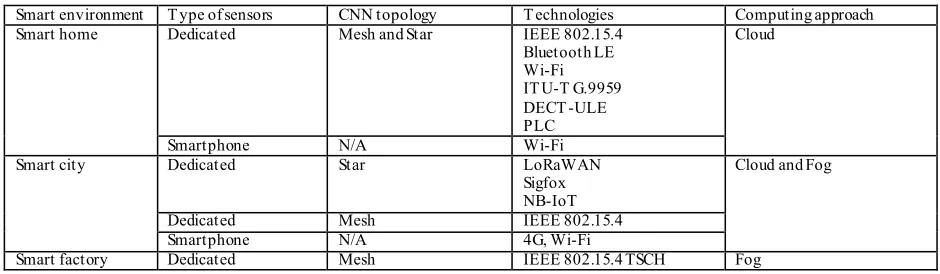
The following features of IoT solutions used in the selected smart environ ments are discussed first, spe-cifically the type of sensors used, CNN topology, technology capabilities, and co mputing approach (see Table 5).
6.1.1.Type of sensors
A smart environ ment will typically be instrument-ed with dinstrument-edicatinstrument-ed sensors that measure physical pa-rameters of interest. Such sensors may be statically located at points of interest within the target envi-ronment for examp le a home, a factory, a city, specif-ic locations on or in the hu man body and so forth. However, the popularity o f the s martphone as the main user device generates opportunities to explo it the information captured by smartphone sensors , even if these sensors have not been designed for the specific use case. However, this paradig m involves several challenges (detailed in Section 6.2).
In the smart factory, smartphones are not typically used to enrich the sensing capabilities of the envi-ronment, since dedicated systems focus on the pa-rameters of interest while prov iding the robustness, reliability and determin istic behavior highly required in this context. On the other hand, smart homes may leverage presence of the smartphone (and the user) as an additional input to that offered by dedicated sen-sors deployed in the home.
In a smart manufacturing environment, analog and digital sensors are co mmonly used to mon itor the status of Industry 4.0 automation applications, for predictive maintenance, or to diagnose production processes under the toughest operating conditions. That is why sensors must meet higher quality stand-ards compared to sensors deployed in less harsh con-ditions such smart home environ ments. These sensors may need to be more resistant to dust, moisture, chemicals, vibrations, shocks or high temperatures in order to prevent them fro m failing or their perfor-mance from degradation.
6.1.2.CNN topology
[image:13.596.75.285.123.246.2]ad-vantages. First, it allo ws overcoming the network range limitations of a star topology, especially when lin k range is reduced for examp le to just a few tens of meters. Secondly, it offers path diversity thus avoid-ing the savoid-ingle-point of failure issue of a star topology, which relies on the availab ility of a central device. This may help coping with link quality issues in wireless systems (e.g. due to multipath propagation, interference, etc.) or in noisy wired systems (e.g. PLC). Both smart ho mes and smart factories typical-ly use mesh networks for wireless sensor systems. In smart cities, wh ile IEEE 802.15.4 mesh networks have been deployed in some experiments, LPWAN technologies have recently gained high mo mentum. LPWAN technologies follow the star topology, and offer a high link range, therefore they allo w city-wide coverage of devices such as sensors at a low in fra-structure cost.
6.1.3.Technologies
Smart ho mes benefit fro m a larger variety of avail-able technologies among all s mart environ ments con-sidered. Some of these technologies have been de-signed specifically for s mart ho me scenarios (e.g. ITU-T G.9959) or leverage infrastructure typically available at a home (e.g. PLC and DECT -ULE). Nevertheless, general purpose technologies such as IEEE 802.15.4, Bluetooth LE o r Wi-Fi are also commonly used in smart homes.
At the other end of the spectrum, CNN technolo-gies used in smart factories are typically based on IEEE 802.15.4e TSCH, which appears to be domi-nant in this setting.
Smart cities employ both general-purpose CNN technologies (e.g. IEEE 802.15.4), technologies not specifically developed for CNNs (e.g. 4G or Wi-Fi), and moreover, have recently leveraged the emerging LPWAN technologies, such as LoRaWAN, Sigfo x or NB-IoT.
Finally, s mart health application scenarios benefit fro m the technologies used in the physical environ-ment where s mart health applications are carried out. Note that many smart health applications are home-centric, therefo re leveraging s mart home technolo-gies. In other cases, smart health users exploit the connectivity means provided by the smartphone.
6.1.4.Computing approach
IoT applications require services and support for storing, managing and processing the data collected fro m devices such as sensors. There exist different
trends in this regard, where Cloud computing and Fog computing appear to be the most relevant ap-proaches. The former leverages remote platforms available via the Internet, whereas in the latter, pro-cessing and storage is carried out locally, near the IoT device. Fog computing is suitable when low la-tency is required, and/or as a scalable solution when the number of devices is very high.
In smart homes, Cloud computing is the main par-adigm for co llected data processing and storage, gen-erally intended for s mart home monitoring and non-critical control operations. In this type of applications, Cloud computing is suitable, since latency require-ments are not strict. On the other hand, real-time in-teractions are also common in s mart ho mes, often involving humans in the loop: for examp le, a user turns on a lightbulb by pressing a button on a remote control. In such case, direct interaction between the communicating devices is a good fit, and neither cloud nor Fog computing are strictly needed.
In smart cities, a combination of cloud and Fog computing provides a suitable approach. The latter allo ws low latency, wh ile p roviding support for han-dling the data collected by the potentially h igh num-ber of IoT devices in a city.
T able 5. Main features of IoT solutions in smart environments
Smart environment T ype of sensors CNN topology T echnologies Computing approach
Smart home Dedicated Mesh and Star IEEE 802.15.4
Bluetooth LE Wi-Fi IT U-T G.9959 DECT -ULE PLC
Cloud
Smartphone N/A Wi-Fi
Smart city Dedicated Star LoRaWAN
Sigfox NB-IoT
Cloud and Fog
Dedicated Mesh IEEE 802.15.4
Smartphone N/A 4G, Wi-Fi
Smart factory Dedicated Mesh IEEE 802.15.4 TSCH Fog
6.2.Challenges
The following challenges for IoT solutions in smart environ ments are considered: interoperability and standardization, adaptation and personalization, and entity identification and virtualization.
6.2.1.Interoperability and standardization
The concept of IoT is strongly driven by the de-velopment of standards (either de facto or de jure) that address all layers fro m the physical to the appli-cation layer. Their majority have direct appliappli-cation in smart environ ments (see Section 4) and are still in continuous evolution. For example, in the context of smart factories, the networked production in Industry 4.0 requires interoperability between different ma-chines. To address this concern, the OPC Un ified Architecture (OPC UA) provides a secure, scalable and open platform for reliab le machine-to-machine communication. OPC UA emp loys standard transport protocols and encodings to ensure connectivity be-tween, fo r examp le, embedded controllers and h igh-end enterprise service environ ments [40]. It offers configuration capabilities fo r alarms and event notifi-cations, and from a security perspective, it provides authentication capabilities for users, clients and serv-ers to manage the integrity of their co mmunication. Many industrial control and automation applications and production networks are typically time sensitive. To ensure a precise time distribution across manufac-turing systems, many networks are adopting the IEEE Time Sensitive Networking (TSN) unified standard for this purpose [51]. In other contexts, such as smart homes, smart health or smart cities, the standardization process is often not as advanced as for the smart industry but still present and rich.
However, while, on the one hand, the presence of standards certifies the maturity of the technology, on the other hand the large number of standards and the fact that they have often significant overlaps certifies that the area is lively and that the market is fast-developing and still looking for an equilibriu m. Fro m the point of view of the users, the richness of the of-fer in terms of solutions based on standards is cer-tainly positive and it limits potential vendor locks -in, however, the fact that standards are often not easily interoperable may lead to standard locks -in. In a con-text of a fast-developing market in which standards may beco me easily obsolete, standards lock-in could be problematic and limiting for the further market development. For this reason, the interoperability of different IoT standards (for examp le by the defin ition of suitable gateways) may beco me, in perspective, a critical aspect.
6.2.2.Adaptation and personalization
A growing trend towards personalization, both in leisure and professional smart environ ments, triggers greater demands of transparency and interoperability. Sensor and actuator networks that operated well in isolation will face new connectivity and adaptation challenges for opening up IoT networks to different stakeholders, computing paradig ms (mob ile, fog, cloud), and technologies that will drive the personali-zation.
[image:15.596.61.531.140.277.2]be accepted and used long-term: they have to provide useful and verified in formation and be relatively simple to install, understand and maintain.
In the examp les that have been cited as applica-tions above, smart environ ments (smart ho mes, smart city, smart manufactories) or s mart health, these two points are crucial fo r the technology not to be aban-doned. For well-being o r health, devices are reputed to be abandoned quickly [23] as people are at the beginning motivated by the information that is brought, but this information is insufficient to moti-vate the use for a long time. Fo r instance, if an activi-ty tracking device is not able to detect the amount of activity that you do because the threshold defining it does not fit your use, it will have no use (for instance, an incorrect threshold for walk detection on the co m-bination IMU/changes of heartrate in fitness applica-tions). That is why such a device will “learn” in the first few days how the person behaves. Another ex-amp le is for distress. The goal of several researches on that topic is for instance to build systems that will be able to monitor the activity of an elderly person at home to detect changes in his behavior and infer some possible health-related problems that should need warning the family or the medical staff or to detect distress situations such as fall. Analy zing the activity to detect changes of behavior (for instance in repartition of walk/stand/sit/lie down) needs having learnt the ones of the person in a first place, but also to be able to detect what is a change. For instance, for devices measuring heart rate and activ ity, does an episode of fever, that will increase the heart rate, have to be considered as relevant for the adaptation of the thresholds of detections of anomalies in the values? Incremental learning algorithms can allow to create models that will evolve with time, but an im-portant question is when to adapt the model and when to warn? Th is very important question is the basis of all that kind of d istress/health mon itoring because we must not launch too much alarm, but we also must absolutely not miss an event.
The second important property is their relative simp licity to use, install and maintain a new technol-ogy. Installation and maintenance is primarily a tech-nological and design problem. But for the easiness of use, the algorithms embedded will have a role to p lay. An important topic that we can discuss to ease user experience is the adaptation of the environment be-havior to the user, so that it will not disturb his way of living. So me research projects are going through this problem (e.g. [48,49,76]), are on-going and are in their early stages. The idea is to use system traces
and what are called imp licit and explicit feedbacks fro m the user to adapt continuously the behavior of the system. These feedbacks are either a co mment that the user does to the system saying that he does not like the action that has been done or are actions of the user that are in contradiction with the behavior of the system. Analy zing the way a person lives with-in the smart environ ment to detect such discrepancies in the data is still very costly but important for the experience of the user and the usability of the sys-tems. If we want s mart environ ments and ambient assisted living be more and more used and dissemi-nated, these systems have to be simple and adapted to the person, not the contrary.
6.2.3.Entity identification and virtualization
IoT technologies bring together a variety o f d is-tinct elements and functionalities to construct inte-grated systems of increasing comp lexity consisting of numerous interacting complements. Entity identifica-tion is a core ingredient for managing this comp lexity and ensuring that assembly and co mmissioning of fully functional systems is successful as well as en-sure trustworthy operating in the context of flexible and dynamic operations. In turn, this suggests the need for IoT un iversal identification as well as for supporting services to resolve entity codes and relate them to associated meta-data. Note that IoT entities may incorporate widely heterogenous types including physical objects, manufactured artefacts and devices, locations, humans and other living animals and plants, as well as the built environment and locations. Alt-hough attempts have been made to use communica-tion identifiers for this purpose, there are many rea-sons that suggest that this is not a general solution including their typically limited scope with a specific communications context, multiho ming and surrogacy relationships between entities and their co mmunica-tion interfaces as well as the well understood need for separation of entity identifier and IoT location at-tachment point.
7.Conclusions
Wireless networking is a core ingredient in a varie-ty of IoT-enabled smart systems including ho mes, digital healthcare, smart factories and cities. Yet, choosing the right technology that best meets the requirements of a specific system can be a challeng-ing task for the system architect due to the large di-versity of options. In this paper, we have explored the advantages and limitations of d ifferent options with a view to p rovide guidance for the designer of smart systems in making an effective and efficient choice that best matches the goals of their work.
In conducting this survey, we recognise that low power wireless networking is in a state of flu x as a consequence of the rapid development of innovative IoT solutions, which stretch the limits of current technologies. To this end, in this paper we have also explored areas of current and future develop ment that investigate ways in which current technological limi-tations can be addressed. In particular, we have iden-tified key research questions relating to interoperabil-ity and standardisation, adaptation and personalisa-tion and entity virtualizapersonalisa-tion that are expected to e x-tend the functionality of current smart environments. As a final reflection, we position our work against the other contributions in this thematic issue. We note that the exchange of data allowed by IoT tech-nologies and systems is a starting point for creating smart environ ments powered by artificial and ambi-ent intelligence [33]. The process of building smart environments may also leverage the inputs from oth-er systems, such as computoth-er vision ones [73]. This whole process requires considering the human aspect, since the human is in fact, either d irectly or indirectly, the main subject of smart environments [20]. How-ever, designing smart environ ments involves grand societal challenges, fro m both technical and social points of view, that will require the efforts of the community in upcoming years [88].
Acknowledgments
Carles Go mez was funded in part by the European Regional Develop ment Fund (ERDF) and the Span-ish Government through project TEC2016-79988-P, AEI/FEDER, UE. Davy Preuveneers was supported by the H2020 pro ject EXCELL (http://excell-project.eu/). This project has received funding fro m the European Union's Ho rizon 2020 research and innovation programme under grant No. 691829.
References
[1] Aguilar, S., Vidal, R., & Gomez, C. (2017). Opportunistic sensor data collection with bluetooth low energy. Sensors, 17(1), 159.
[2] Akl, A., Chikhaoui, B., Mattek, N., Kaye, J., Austin, D., & Mihailidis, A. (2016). Clustering home activity distribu-tions for automatic detection of mild cognitive impair-ment in older adults 1. Journal of Ambient Intelligence and Smart Environments, 8(4), 437–451.
[3] Al-Fuqaha, A., Guizani, M., Mohammadi, M., Aledhari, M., & Ayyash, M. (2015). Internet of things: A survey on en-abling technologies, protocols, and applications. IEEE Communications Surveys & Tutorials, 17(4), 2347–2376. [4] Amato, G., Bacciu, D., Broxvall, M., Chessa, S., Coleman, S., Di Rocco, M., Dragone, M., Gallicchio, C., Gennaro, C., Lozano, H., McGinnity, H., Micheli, A., Ray, A. K., Renteria, A., Saffiotti, A., Swords, D., Vairo, C., & Vance, P. (2015). Robotic ubiquitous cognitive ecology for smart homes. Journal of Intelligent & Robotic Systems, 80(1), 57–81.
[5] Aziz, A. A., Klein, M. C., & Treur, J. (2010). An integrative ambient agent model for unipolar depression relapse pre-vention. Journal of Ambient Intelligence and Smart Envi-ronments, 2(1), 5–20.
[6] Bacciu, D., Chessa, S., Gallicchio, C., & Micheli, A. (2017). On the Need of Machine Learning as a Service for the In-ternet of Things. In ACM INTERNATIONAL CON-FERENCE PROCEEDINGS SERIES. ACM.
[7] Baldewijns, G., Claes, V., Debard, G., Mertens, M., Devriendt, E., Milisen, K., Tournoy, J., Croonenborghs, T., & Vanrumste, B. (2016). Automated in-home gait transfer time analysis using video cameras. Journal of Ambient Intelligence and Smart Environments, 8(3), 273– 286.
[8] Baños-Gonzalez, V., Afaqui, M. S., Lopez-Aguilera, E., & Garcia-Villegas, E. (2016). IEEE 802.11 ah: A technolo-gy to face the IoT challenge. Sensors, 16(11), 1960. [9] Baronti, P., Pillai, P., Chook, V. W., Chessa, S., Gotta, A.,
& Hu, Y. F. (2007). Wireless sensor networks: A survey on the state of the art and the 802.15. 4 and ZigBee stand-ards. Computer Communications, 30(7), 1655–1695. [10] Bellavista, P., Chessa, S., Foschini, L., Gioia, L., &
Girola-mi, M. (2018). Human-Enabled Edge Computing: Ex-ploiting the Crowd as a Dynamic Extension of Mobile Edge Computing. IEEE Communications Magazine, 56(1), 145–155.
[11] Bernardino, S., Freitas Santos, J., & Cadima Ribeiro, J. (2018). The legacy of European Capitals of Culture to the “smartness” of cities: The case of Guimarães 2012. In Journal of Convention & Event Tourism (Vol. 19, pp. 138–166). Taylor & Francis.
[12] Bleser, G., Steffen, D., Weber, M., Hendeby, G., Stricker, D., Fradet, L., Marin, F., Ville, N., & Carré, F. (2013). A personalized exercise trainer for the elderly. Journal of Ambient Intelligence and Smart Environments, 5(6), 547– 562.
[13] Bormann, C., Castellani, A. P., & Shelby, Z. (2012). CoAP: An application protocol for billions of tiny internet nodes. IEEE Internet Computing, 16(2), 62–67.
[14] Bormann, C., Ersue, M., Keranen, A., & Gomez, C. (2017). Terminology for Constrained-Node Networks. RFC 7228, Internet Draft (Work in Progress), Draft Name: draft
-bormann-lwig-7228-bis-02. Retrieved from