N A N O E X P R E S S
Open Access
Metal Surface Modification for Obtaining
Nano- and Sub-Nanostructured Protective
Layers
Volodymyr Ledovskykh
1, Yuliya Vyshnevska
2,3*, Igor Brazhnyk
4and Sergiy Levchenko
1Abstract
Regularities of the phase protective layer formation in multicomponent systems involving inhibitors with different mechanism of protective action have been investigated. It was shown that optimization of the composition of the inhibition mixture allows to obtain higher protective efficiency owing to improved microstructure of the phase layer. It was found that mechanism of the film formation in the presence of NaNO2-PHMG is due to deposition of slightly soluble PHMG-Fe complexes on the metal surface. On the basis of the proposed mechanism, the advanced surface engineering methods for obtaining nanoscaled and sub-nanostructured functional coatings may be developed.
Keywords:Metal protection, Surface engineering, Pitting corrosion, Isomolar series, Complexes, Phase layers
Background
Protection of metals under different conditions in various environments remains the important issue for science and technology. Recent advances in research of the nanoscaled systems allow the development of simple and inexpensive methods for obtaining nano-structured protective coatings with improved func-tional properties [1–5].
The protection mechanism of certain types of cor-rosion inhibitors is based on the formation of the phase protective layers on the metal surface. Among them, one may list the inorganic passivators that fa-cilitate the formation of the dense oxide or salt pro-tective films and complexing type inhibitors that are forming phase metalorganic layers. The mechanism of protective activity of the complexing type inhibitors consists in the formation of slightly soluble complexes of organic ligands with the metal ions. Deposition of such compounds on the metal surface in form of the phase layers leads to the gradual decrease in corro-sion rate thus providing the efficient anticorrosive
protection. The crucial parameters for ensuring high protective efficiency of the complexing type inhibitors are the high stability and low solubility of complexes with the cations of the metal being protected [6, 7].
Establishing regularities of the phase layer formation processes in multicomponent systems on a nano- and sub-nanoscale will enable the development of novel sur-face engineering techniques for obtaining functional coatings with desired functional properties.
The present study aimed to investigate the joint action of the inhibitors with different protective mechanism as well as their influence on the phase layer microstructure and achieved anticorrosive efficiency.
Methods
The studied materials were as follows: steels 08kp and 20, corrosion environment—aqueous saline solutions with compositions of 0.3 g/l NaCl, 0.3 g/l Na2SO4, and 0.3 g/l NaHCO3, inhibitors—NaNO2, Na2SiO3, polyhex-amethylene guanidine (PHMG), and their isomolar mixtures (with total concentration of 30 mmol/l).
Corrosion tests and determination of the inhibitor efficiency were performed gravimetrically according to the standard procedure. For this purpose, specimens were exposed into corrosion environment for different times from 72 to 168 h. The ratio of solution volume
* Correspondence:[email protected]
2National Technical University of Ukraine“Igor Sikorsky Kyiv Polytechnic
Institute”, 37K20, Peremohy Ave, Kyiv 03056, Ukraine
3Institute for Renewable Energy, 20A, H. Khotkevych Str., Kyiv 02094, Ukraine
Full list of author information is available at the end of the article
(ml) to the area of metal sample (cm2) was a 10:1. The inhibition efficiency was determined by the equation Z¼
Km−K0m
=Km
⋅100%, the inhibition coefficient−by the equationγ¼Km=K0m, whereKm;K0m−the corrosion rate of metal in solutions without and with inhibitor corres-pondingly (Km=Δm/(S⋅τ), where Δm− the loss of the sample weight, g; S−the sample area, m2; τ− exposure time, h).
Polarization measurements were carried out in poten-tiostatic regime in a three-electrode cell with separated cathodic and anodic compartments. Carbon steel was used as the working electrode, platinum—as the counter-electrode and an Ag|AgCl|KCl (sat.) counter-electrode—as the ref-erence one. In this paper, the potential values are given with respect to the normal hydrogen electrode potential.
The morphological characteristics and elemental com-position of the films were carried out with the scanning electron microscope (EVO-50, Zeiss, Germany) equipped with the energy-dispersive detector (INCA PENTA FET × 3, Oxford Instruments, Co., UK). Elemental analysis of the protective thin films has been carried out using Auger microprobe JAMP-9500F in the scanning electron micros-copy mode.
Investigation of the complex formation process and geometry optimization has been carried out with a hy-brid QM/MM approach using NWchem 6.5 computa-tional chemistry package [8].
Results and Discussion
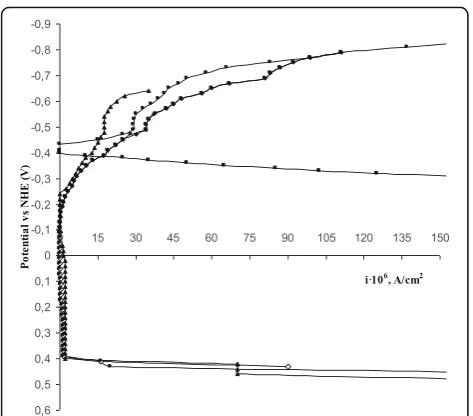
The results of gravimetric tests show high protective effi-ciency of NaNO2 in aqueous saline solutions. The inhib-ition efficiency reaches a value of 99.2% at the sodium nitrite concentration of 30 mmol/l. The polarization mea-surements in the presence of 30 mmol/l NaNO2show the potential shift toward the positive side that leads to increased corrosion resistance of the carbon steel. The pas-sive zone extends on a wide range of potentials with signifi-cant drop in current density (Fig. 1).
The protection mechanism of NaNO2 usually attrib-uted to its ability to facilitate the formation of dense Fe3O4 or mixed oxide films that prevent further cor-rosion damage [9]. Such properties may be associated with the electronic structure of NO2− ion due to the presence of lone pair of electrons in sp2-hybrid or-bital that provides with the electron-donor properties in contrast to NO3− ions that do not exhibit protective properties (Fig. 2).
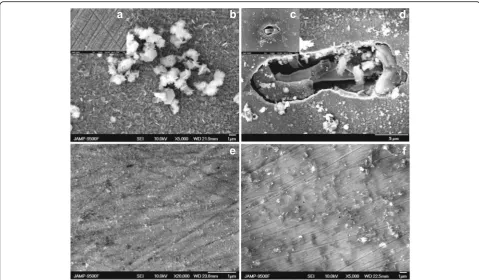
SEM images of the samples immersed into the NaNO2 solution reveal the significant changes in the morph-ology attributed to the formation of protective film as well as signs of corrosion attack (Fig. 3 c, d). While the gravimetric measurements have shown high inhibitive efficiency, the surface morphology has significant amount of localized corrosion damage. The Auger
Fig. 1Cathodic and anodic polarization curves for carbon steel: black square—in background aqueous saline solution,black up-pointing triangle—in the presence of Na2SiO3(30 mmol/l),
lozenge—in the presence of NaNO2(30 mmol/l),black circle—in the presence of synergetic mixture of NaNO2(10 mmol/l) and Na2SiO3(20 mmol/l)
[image:2.595.56.293.85.293.2] [image:2.595.60.539.581.716.2]spectroscopy has been employed to investigate the elemental composition of the protective layer. Obtained results indicate presence of the iron oxide and are found to be in a good agreement with theoretical expectations. Local types of corrosion such as pitting are considered as the most dangerous ones; hence, this drawback must be addressed during develop-ment of the inhibitive compositions based on sodium nitrite.
To achieve the synergistic effect, the inhibitive com-position should combine the components with different mechanism of the anticorrosive action [10–13]. The in-hibition mechanism of Na2SiO3is attributed to a forma-tion of slightly soluble silicates of iron on the metal surface. The distribution of the protective efficiency within the NaNO2-Na2SiO3 inhibitive mixture in rela-tion to the concentrarela-tion ratio of the components has been obtained using the isomolar series method (Fig. 4).
a
b
c
d
e
f
Fig. 3SEM images of carbon steel after exposition inawithout exposure,bbackground aqueous saline solution,c,dpresence of NaNO2(30 mmol/l),
epresence of Na2SiO3(30 mmol/l),fpresence NaNO2(10 mmol/l) + Na2SiO3(20 mmol/l). Exposure time, 168 h
Fig. 4Dependence of the inhibition efficiency for carbon steel in the aqueous saline solution on the ratio of molar concentrations of the individual components in isomolar mixtures NaNO2-Na2SiO3(the total concentration of the components—30 mmol/l)
[image:3.595.57.537.87.367.2] [image:3.595.56.291.533.686.2] [image:3.595.303.539.534.686.2]The regularity shows extreme character reaching peak value of z= 99.97% at the concentration ratio NaNO2-Na2SiO3as 1:2, which is higher than protective efficiency of both individual components.
Polarization measurements for this mixture are found to be in a good agreement with the gravimetric studies (Fig. 1). The inhibitive composition of NaNO2-Na2SiO3 ensures significant drop in the current density in a wide range of potentials that correspond to a passive state of the surface. SEM images reveal significantly improved morphology of the protective film formed in presence of the NaNO2-Na2SiO3 mixture compared to sole sodium nitrite solution (Fig. 4f ). Obtained protective film has continuous structure without signs of pitting corrosion. Elemental composition of the protective layer showed presence of the silicon that indicates direct participation of SiO32− ions in the film formation process. While the
NaNO2-Na2SiO3 mixture showed significant
im-provement in inhibition coefficient over sole sodium nitrite, the most valuable outcome of the compos-ition optimization is greatly enhanced efficiency to-ward local corrosion damage.
To ensure reliable corrosion protection for diverse appli-cations, the inhibitive composition should provide efficient reduction in corrosion rate (in wide range of pH and) under elevated temperature conditions. At the same time, it was found that NaNO2-Na2SiO3 mixture demonstrates high protective efficiency at room temperature, while the protec-tion coefficient declines as the temperature rises.
Further improvement in protective performance may be achieved by combining inorganic passivator with or-ganic ligands that could form complexes with the metal ions. The mechanism of protective activity of complex-ing type inhibitors for acidic medium has been proposed and extensively studied over the last decade [6, 7]. In such systems, protective layers are formed as a result of formation of the slightly soluble complexes of added organic ligands and the metal cations. Deposition of such compounds leads to the formation of the phase metalorganic layers on the metal surface and subsequent decrease in corrosion rate. Thus, application of complex-ing type inhibitors allows one to implement in situ sur-face modification for obtaining hybrid protective and functional coatings.
Fig. 6SEM images of the carbon steel surface after exposition in solutions withaPHMG (30 mmol/l) andbNaNO2(20 mmol/l) and PHMG (10 mmol/l). Exposure time, 168 h
[image:4.595.57.539.87.233.2] [image:4.595.59.539.555.714.2]Polyhexamethylene guanidine (PHMG) showed high inhibitive efficiency for protection of carbon steel in acidic medium [6, 7, 13, 14] while exhibiting moderate performance in neutral aqueous saline solutions. Gravi-metric measurements showed that PHMG provides 40% corrosion protection at the concentration of 30 mmol/l.
Relatively low efficiency of sole PHMG may be attrib-uted to the fact that according to the protection mech-anism of complexing type inhibitors, the corrosion process should provide sufficient amount of Fe2+ ions for the complexation. Suchlike state is spontaneously established and maintained in acidic medium, while in neutral aqueous saline solutions, such conditions should be engineered according the Pourbaix diagram for the particular system. Hence, sodium nitrite can stimulate the localized pitting attack; it may indirectly facilitate to establishing of the favorable conditions and engage the complexing type component of the inhibitive mixture. In addition, PHMG protection performance tends to in-crease under elevated temperature conditions that being combined with NaNO2 may further improve the effi-ciency of such mixture.
The isomolar series method showed a sharp increase in the protective efficiency with addition of sodium nitrite while the peak value of 99.8% is reached at the concentration ratio NaNO2-PHMG as 2:1 (Fig. 5). Polarization measurements are found to be in a good agreement with gravimetrical tests. Analysis of the polarization curves showed that electrochemical behav-ior of the NaNO2-PHMG mixture is close to sole NaNO2with extended passive zone in a wide range of potentials at the early stages of the measurements, while acting similar to PHMG at the later stages.
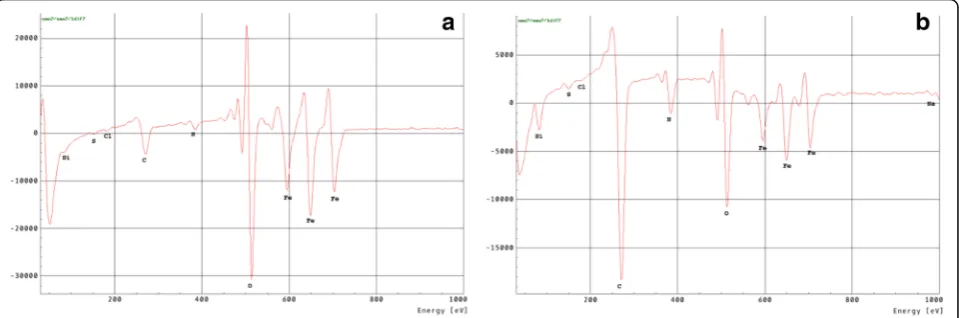
Investigation of the surface morphology after immersion in the solution with PHMG (Fig. 6a) expectedly shows sig-nificant amount of corrosion products mixed with organic inclusions that is also consistent with the Auger spectros-copy results (Fig. 7a, Table 1). Whereas in the case of NaNO2-PHMG mixture, the surface morphology is in al-most pristine condition (Fig. 6b) while the elemental com-position of the surface layer indicates presence of the protective film of mainly organic nature (Fig. 7b, Table 1).
Further analysis of the Auger spectra indicates the formation of nanoscaled protective film as a result of tandem action of the mixture components where NaNO2 facilitates establishing the conditions for the complexation process and formation of metalorganic
layers with PHMG-Fe complexes. According to the hybrid QM/MM calculations [14], the PGMG-Fe2+ com-plexes geometry will contribute to the formation of ir-regular three-dimensional mesh frameworks that will determine the sub-nanoscaled structure of the phase metalorganic layers.
Conclusions
Regularities and mechanism of the protective layers for-mation in presence of synergistic mixtures of the corro-sion inhibitors with different mechanism of action have been investigated. The isomolar series method has been employed for determination of optimal concentration ratios of the mixture components. For the NaNO2-Na2SiO3 mixture, the maximum protective efficiency of
z= 99.97% is achieved at the concentration ratio as 1:2, while for NaNO2-PHMG system z= 99.8% at the con-centration ratio as 2:1.
It was found that NaNO2-Na2SiO3 mixture demon-strates much improved anticorrosive behavior compared to sole sodium nitrite due to suppressing the pitting corrosion. The NaNO2-PHMG mixture ensures the for-mation of thin metalorganic layers with PHMG-Fe com-plexes and provides better protection under elevated temperature conditions.
The mechanism of joint action of the NaNO2-PHMG inhibitive mixture for protection of carbon steel in aque-ous saline medium has been proposed. Sodium nitrite may indirectly facilitate to the establishing of the favor-able conditions for the complexation process and engage the complexing type component of the mixture.
The inhibitive mixtures with such design where one component tuned to promote the most efficient realization of the other component protective mech-anism may be distinguished to a dedicated class of tandem inhibitors.
On the basis of the proposed mechanism, the ad-vanced surface engineering methods for obtaining nanoscaled and sub-nanostructured functional coat-ings may be developed.
Authors’Contributions
VL developed the plan of the study for inorganic inhibitive mixtures and took part in the general analysis of the result and preparation of the article. YuV and IB developed the plan of the study for organic inhibitive mixtures, carried out the electrochemical investigation, and took part in the general analysis of the result and preparation of the article. VL carried out the corrosion rate study. All authors read and approved the final manuscript.
Competing Interests
The authors declare that they have no competing interests.
Author details
1National Aviation University, 1, Kosmonavta Komarova Ave, Kyiv 03058,
Ukraine.2National Technical University of Ukraine“Igor Sikorsky Kyiv Polytechnic Institute”, 37K20, Peremohy Ave, Kyiv 03056, Ukraine.3Institute
for Renewable Energy, 20A, H. Khotkevych Str., Kyiv 02094, Ukraine.4Gimasi
SA Ukraine R&D Centre, 18, Via Luigi Lavizzari, Mendrisio 6850, Switzerland.
Table 1Key to Fig. 7: elemental composition of the protective films with Auger
Figure C N O Na Si S Cl Fe
7a 12.3 5.5 55.6 0.0 0.1 0.1 0.1 26.4
7b 48.1 16.1 22.3 0.5 1.8 0.3 0.1 10.9
Received: 2 January 2017 Accepted: 28 February 2017
References
1. Telegdi J, Szabó T, Románszki L, Pávai M (2014) The use of nano-/ microlayers, self-healing and slow-release coatings to prevent corrosion and biofouling. In: Handbook of Smart Coatings for Materials Protection. Woodhead Publishing Limited, Cambridge, pp 135–182
2. Farmer et al. High-performance corrosion-resistant materials: iron-based amorphous-metal thermal-spray coatings, UCRL-TR-206717, Lawrence Livermore National Laboratory, September 28, 2004, 178 pages
3. Ashassi-Sorkhabi H, Es’haghi M (2014) Corrosion protection of mild steel by nano-colloidal polyaniline/nanodiamond composite coating in NaCl solution. J Coat Technol Res 11(3):371–380
4. Qian Y, Yo L, Jungwirth S, Seely N, Fang Y, Shi X (2015) The application of anti-corrosion coating for preserving the value of equipment asset in chloride-laden environments: a review. Int J Electrochem Sci 10:10756–10780 5. Nykyforchyn H, Kyryliv V, Maksymiv O, Slobodyan Z, Tsyrulnyk O (2016)
Formation of surface corrosion-resistant nanocrystalline structures on steel. Nanoscale Res Lett 11:51
6. Vishnevska Yu.P., Brazhnyk I.V. Mechanism and kinetics of phase protective layers formation under various pH and temperature conditions // 18th International Conference Corrosion of underground structures (Košice, Slovakia, May, 23–24, 2013).–Košice, Slovakia, 2013.–P. 58–62. 7. Tkalenko DA, Vyshnevs’ka YP, Herasymenko YS, Khirkh-Yalan IF (2013)
Changes in polarization resistance in the process of formation of protective phase layers with participation of organic ligands. Materials Science 49(3):304–310
8. Valiev M, Bylaska EJ, Govind N, Kowalski K, Straatsma TP, van Dam HJJ, Wang D, Nieplocha J, Apra E, Windus TL, de Jong WA (2010) NWChem: a comprehensive and scalable open-source solution for large scale molecular simulations. Comput Phys Commun 181:1477
9. Kim KT, Kim HW, Chang HY, Lim BT, Park HB, Kim YS (2015) Corrosion inhibiting mechanism of nitrite ion on the passivation of carbon steel and ductile cast iron for nuclear power plants. Advances in Mat Sci and Engineering. doi:10.1155/2015/408138
10. Ledovs’kykh VM, Levchenko SV, Tulainov SM (2013) Synergistic extrema of the mixtures of corrosion inhibitors for metals in aqueous salt solutions. Materials Science 49(6):827–832
11. Ledovskikh VM (1984) Synergetic inhibition of the corrosion of steel in acids. Protection of Metals 20(1):54–61
12. Ledovskikh VM, Kuleshova NF (1982) Inhibition of metal corrosion in neutral medium. J of Kiev Polytecnic Institute Series Chem engineering and technology 19:59–61
13. Ledovskykh VM, Vyshnevska YP, Poznyak SK, Brazhnyk IV, Levchenko SV (2014) Inhibition mechanism, analytical prediction and purposeful design of highly efficient mixed-type corrosion inhibitors. Spec Issue of J Physicochem Mechanics of Mat 2(10):416–420
14. Ledovskykh VM, Vyshnevska YP, Brazhnyk IV, Levchenko SV (2016) Design and optimisation of synergistic mixtures for corrosion protections of steel in neutral and acidic media Physicochem. Mechanics of Mat 5:30–37
Submit your manuscript to a
journal and benefi t from:
7Convenient online submission
7Rigorous peer review
7Immediate publication on acceptance
7Open access: articles freely available online
7High visibility within the fi eld
7Retaining the copyright to your article