TH-HPG: THRESHOLD BASED HELLO PACKET
GENERATION SCHEME FOR INTRA WIRELESS BODY
AREA NETWORKS
BEENISH ABBAS*, DR. KAMALRULNIZAM ABU BAKAR, DR. ISMAIL FAUZI ISNIN
Department of Computer Science, Faculty of Computing, Universiti Teknologi Malaysia, UTM Johor Bahru, 81310, Johor, Malaysia.
[e-mail: [email protected], [email protected], [email protected]] *Corresponding author: Beenish Abbas
ABSTRACT
Sensor Nodes (SNs) in Wireless Body Area Network (WBAN) sense and forward data towards Body Network Coordinator (BNC). Sensed data in WBAN contains information related to human physiological signals and vital signs. Other than sensed data, control packets are also forwarded among Senosr Nodes (SNs) and commonly known as Hello packets which announce the status of SN to its Neighbor Nodes (NNs) in the network. Updated Hello packets are required to forward latest information about SNs in the network. However, reduced number of Hello packets is the necessity as control packets generate overhead traffic in the network. The proposed, Threshold based Hello Packet Generation (TH-HPG) scheme produces reduced number of Hello packets and announces the availability of SN with updated status information. Performance analysis of TH-HPG scheme with state-of-the-art schemes demonstrate the better performance in terms of energy consumption and number of control packets generated (control overhead).
Keywords:WBAN, Control packets, BNC, QoS, Congestion
1. INTRODUCTION
Wireless Sensor Network (WSN) is used in many applications to improve and facilitate human lifestyle, such as, health monitoring, emergency relief, intelligent transportation system, sports and entertainment [1]. One of the most prominent and popular wireless network nowadays is Wireless Body Area Network (WBAN), which is also referred as remote healthcare monitoring system. WBAN is a subset of Wireless Sensor Network (WSN). Sensed and monitored data in WBAN contains information related to human physiological signals and vital signs, whereas, Hello packets announce the status of SNs in the network.
The Hello packets usually contain information regarding Source ID (SID), remaining queue, remaining energy of the SN and number of hops to reach to the BNC [2, 3, 4]. Hello packets are required to initialize and maintain the network functionality. However, Hello packets do not contain actual sensed data of the SN, but contain information regarding SN itself which is required to forward the data packets in the network.
Routing schemes generate control traffic in the form of Hello packets. SNs inform its NNs in the network about their status information through Hello packets. Hello packet contains current statistics about the SN. Conventionally, in the WBAN, Hello packets are generated periodically. In some studies, Hello packets generated on the bases of remaining energy and topology change.
the TH-HPG scheme in comparison with the state-of-the-art schemes.
The remaining part of the paper is organized as follows. Background study and related work are discussed in Section 2 and 3 respectively. The proposed TH-HPG scheme is presented in Section 4 with methodology in Section 5. In Section 6, simulation setup. Whereas, in Section 7, the evaluation and analysis of the proposed TH-HPG scheme is presented. Section 8 concludes this paper.
2. PROBLEM BACKGROUND
WBAN is used in healthcare, military, sports and entertainment purposes. In case of healthcare, WBAN technology can be deployed within a hospital environment or can be in the patient’s own home. In WBAN, SNs are implanted under the human skin or wearable over the human skin or on clothes. These SNs are under the control of Body Network Coordinator (BNC), also called sink or master node [5, 6]. Huge amount of patient’s data should be reached to the BNC reliably and on time in the WBAN.
Energy efficiency which impact network lifetime and delivering the huge amount of information while considering reliability and time constraints are the common challenges faced by the WBAN. There is need to design a WBAN’s scheme to deliver information with efficient energy consumption, required QoS and increased network lifetime and throughput [7, 8]. Basically, efficient delivery of information, while considering limited battery power and SN’s storage capacity is the main objective in the WBAN. SNs need to be designed very light in weight and small in size to provide ease to the patient, which leads a small storage capacity and battery power.
To achieve efficiency in the WBAN, there are many design challenges like congestion avoidance and control, coexistence, interoperability, coverage area, body temperature, movement, location of the SN, scalability, QoS, security. The most critical challenge is to maximize the network lifetime [9, 10]. SNs in the WBAN, continuously sensing and transmitting data towards the BNC. Queues associated with SNs have very limited and fixed storage capacity and get overwhelmed when the amount of sensed or monitored data is more than the storage capacity of queue and the SN is unable to forward
that data towards the BNC or intermediate SN at the same time. Huge amount of traffic in the network further consumes more energy of the SNs and leads to congestion in the network which causes dropping of packets [11, 7, 12, 13].
3. RELATED WORK
Besides data packets, there are control packets in the network which commonly known as Hello packets. Hello packets contain the status information of the SNs, which require to forward data packets in the network [5, 14]. Hello packets are required to initialize and maintain the network functionality. The Hello packets usually contain information regarding Source ID, remaining queue space, remaining energy of SN and the Number Of Hops (NOH) to reach the BNC [2-4]. Conventionally, in the WBAN, Hello packets are generated periodically. Periodically generated Hello packets [17-20] are broadcasted by all SNs in the network after fixed interval of time. The control packets are periodically broadcasted which leads to traffic overhead in the network. The size and the time interval of control packets are need to be concerned due to its effect on energy consumption. Faster depletion of energy leads to congestion condition in the network. Smaller the size of a control packet leads to lower energy consumption. Whereas, short time interval between the control packets increases the overhead which causes more energy consumption and leads to congestion in the network.
There are two drawbacks of periodic generation of Hello packets. First is the sending of control information after the specified interval of time even when there is no change in the status information of SN. Second drawback is, not updating NNs when there is a change in queue or energy of the SN during the time interval of periodic Hello packet generation. In Intra-WBAN, the size of network is small, so even in the worst scenario, when the position of the SN changed to maximum hop count to reach the BNC, it will not have that much impact as compared to big size networks.
energy of the SNs is not a good criteria. Other factors like available queue space of the SN also matters for the proper operation of the network. Whereas, topology based hello packets are generated when there is some topology change in the result of the mobility of a SN to a new location from its previous location. Topology based generation of Hello packets does not inform Neighbor Nodes (NNs), if there is any status information change of SN in case of no topology change.
Author in [15] used on-demand scheme to generate control packet only at the time when there is need to forward data packet in the network. This on-demand scheme is not good for real time data forwarding. As, this on-demand scheme increases delay and energy consumption due to generation of control packets for every individual data packet. Whenever there is need to send data from the SN, that particular SN generates Hello packets to learn about the status of other SNs in the network.
Current status of the SN about its remaining queue and energy is the most important information to select as a next hop node to forward data packets and to avoid congestion. If the SN will not have sufficient remaining queue or energy then there are chances to loose data packets. The purpose of TH-HPG scheme is to provide better performance through efficient energy consumption and reduced control overhead as reduced Hello packets in the network. The TH-HPG scheme avoids congestion through decreased number of Hello packets between SNs in the WBAN with updated SN’s status information.
4. PROPOSED SOLUTION
TH-HPG scheme uses threshold based Hello packet generation strategy. The remaining queue space and the remaining energy of the SN are the key factors to decide threshold value to generate Hello packets in the proposed scheme. In the TH-HPG scheme, the threshold value depends on the Queue Factor (QF) and the Energy Factor (EF) of the SN. It provides updated reliable information about the SN, which can be the next hop node in future forwarding of data packets. Besides updated status information of the SN, the TH-HPG scheme generates and broadcast reduced number of Hello packets only when either one or both of the QF and EF threshold values reached. Reduced number of Hello packets
avoids congestion in the network. The TH-HPG scheme provides improved energy consumption and reduced control overhead in the network which cause congestion avoidance.
In the proposed scheme, the decision of generating Hello packets is on the bases of the QF and EF instead of simply remaining queue and remaining energy of the SN. Calculation of the QF and EF gives the more accurate and reliable values to take decision in the selection of threshold levels for Hello packet generation. The QF of the SN is calculated from the following
equation. Where, and are the
remaining free queue space and the total initial queue space of the SN respectively.
=
The EF of the SN is calculated from the
following equation. Where, and
are the remaining energy and the initial energy of the SN respectively.
=
On the bases of the QF and EF values, Low Threshold (LTH) and High Threshold (HTH) levels are decided.
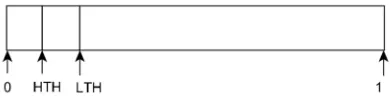
[image:3.612.324.519.607.656.2]The proposed scheme calculates the QF and EF from the remaining queue and the remaining energy of the SN respectively. In the proposed scheme uses two kinds of threshold levels and the decision of Hello packet generation is on the basis of these two threshold levels. In TH-HPG scheme, two threshold levels are HTH and LTH. In TH-HPG, value of Flag field depends on LTH and HTH. Figure 1 shows the general representation of LTH and HTH levels for both the QF and EF.
Figure 1: General Representation Of LTH And HTH Levels
the two threshold levels representing the values of the QF and EF. There are certain conditions which must be satisfied for the selection of these threshold levels. Both threshold levels correspond to either one or both of the QF or EF value.
The value of LTH must be greater than HTH and less than or equal to the value one, which is depicted in the following equation.
>
≥ 1
The value of HTH must be greater than or equal to the value zero and less than LTH which is depicted in the following equation.
>
≥ 0
Threshold value in the proposed scheme is based on either any one or both of the value of QF and EF instead of remaining queue and remaining energy respectively. The QF and EF give more accurate results which are beneficial for the SN to select threshold levels and to generate Hello packets. Adding QF and EF values in the Hello packet gives the best opportunity to NNs to select next forwarder node. QF and EF defines the TH value for both HTH and LTH. The QF and EF values are always in the range 0 to 1, which is ultimately the threshold value used in the proposed scheme.
5. METHODOLOGY
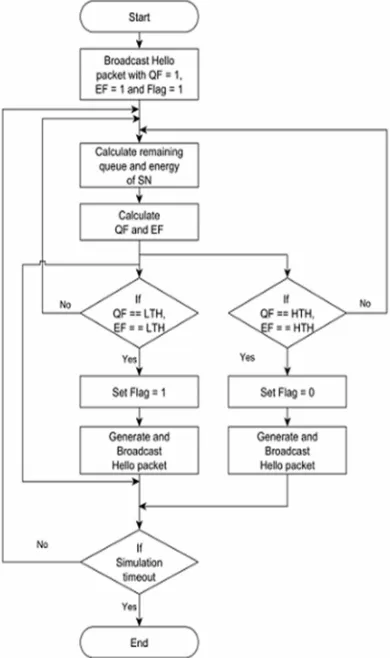
The flowchart for the design of TH-HPG scheme is shown in Figure 2. The flowchart illustrates three phases of the TH-HPG scheme, which are initialization, decision at LTH level and decision at HTH level. Phases of the TH-HPG scheme are described as follows:
i. Initialization
The first phase of the TH-HPG scheme is the initialization phase. When network setup initially, each SN in the network generates Hello packets and broadcasts Hello packets to exchange its status information with the NNs. In the initialization phase, all SNs generate and broadcast Hello packets to the NNs. In this phase, SN generates and broadcast Hello packets with the Flag bit set to the value one and updated status information of the SN. This Hello packet with Flag bit set to the value one will tell the NNs that this SN is available to receive data packets in future.
ii. Decision at LTH level
Initially, all SNs have full queue space available and full energy thus having the QF and the EF value respectively equal to one. At this time, Hello packet with Flag bit set to the value one is generated to tell the availability of the SN to NNs. Second time, when either one or both of the QF and the EF of a SN decreases from HTH to LTH then the SN again set the Flag bit to the value one and generate Hello packet with updated status information of the SN to broadcast it to NNs.
iii. Decision at HTH level
[image:4.612.323.518.388.717.2]With the passage of time, the SN continues its operation and there is possibility that either one or both of the QF and the EF of a SN reach to its HTH level. When a SN experience the HTH level it means that the remaining queue space and or the remaining energy of the SN is near to finish. In this case, the SN sets its Flag bit to the value zero, update its status information in the Hello packet and broadcast this Hello packet to the NNs. The Hello packet with the Flag bit set to the value zero informs the NNs that this sending SN is not available in future to receive data packets.
6. SIMULATION SETUP
The simulation of the proposed TH-HPG scheme is performed using Network Simulator-2 (NS-2) simulator [16]. The performance of the proposed scheme compared to the Efficient Next Hop Selection Algorithm for Multi-Hop Body Area Networks (ENSA-BAN) [4]. This paper considers LTH = HTH -1. The simulation results show that the TH-HPG scheme outperforms the state-of-the-art scheme in terms of average energy consumption and control overhead (number of Hello packets) in the network. The simulation parameters used for experimental setup are presented in the Table 1.
Parameter Values
Area 3m × 2m
Number of nodes 16
Traffic type CBR
Mobility None
[image:5.612.320.523.161.326.2]Queue length 150 packets Initial node energy 2 joules Packet size 60 bytes MAC protocol IEEE 802.15.4 Simulation time 200 seconds
Table 1: Simulation Parameters
7. PERFORMANCE EVALUATION
Performance of the proposed TH-HPG scheme is evaluated in this section on the bases of averged energy consumption of SNs and number of Hello packets generated in the network. The everage energy consumption impacts on the network lifetime in intra-WBAN. Reduced energy consumption causes congestion avoidance due to long alived SNs which increases network lifetime. Reduced number of Hello packets reduces control overhead in the intra-WBAN. Reduced control overhead utilizes energy and queue space of the SNs efficiently which causes congestion avoicance due to successful delivery and reduced data packet loss.
Figure 3 shows the average energy consumption in the network by using the TH-HPG scheme with respect to the QF change. It is noteworthy in the figure that initially there is more energy consumption during network setup time. Whereas, after network is in stable condition, there is less energy consumption.
However, with the passage of time, the QF decreases. After initialization phase, network stabilized and there is less number of Hello packets generated. Decreased number of Hello packets causes decreased energy consumption in the network which makes SNs alive for longer time and avoids the congestion.
Figure 3 : Average Energy Consumption Considering QF
Figure 4 shows the average energy consumption in the network by using the TH-HPG scheme with respect to the EF change. After the initialization phase, SNs only generate Hello packets when there is a change in the EF. However with the passage of time, the EF decreases. After the initialization phase, Hello packets are generated only when a SN experiences threshold levels while considering the EF change. Analysis shows that the TH-HPG scheme outperforms state-of-the-art-schemes in terms of energy consumption in the network. Decreased average energy consumption in the network help to avoid congestion. Due to decreased energy consumption network lifetitme increases and SNs participate longer in the routine operation of the network which helps to avoid congestion.
[image:5.612.103.295.276.432.2] [image:5.612.322.524.563.712.2]Figure 5 shows the number of control packets transmitted in the network by using the TH-HPG scheme with respect to the QF change. It is noteworthy in the figure that initially there are more number of Hello packets during network setup time. However, when the network is in stable condition, the number of Hello packets decreased. The less number of Hello packets causes reduced control overhead traffic in the network. After the initialization phase, SNs only generates Hello packets whenever experience change in the QF. Reduced number of Hello packets cause less control overhead in the intra-WBAN, which helps to reduce overall traffic of the network. Reduced traffic consumes energy and queue space of the network efficintly. Due to efficient consumption of energy and queue space, there is less packet loss with increased packet delivery ratio which helps in congestion avoidance.
Figure 5 : Control Overhead Considering QF
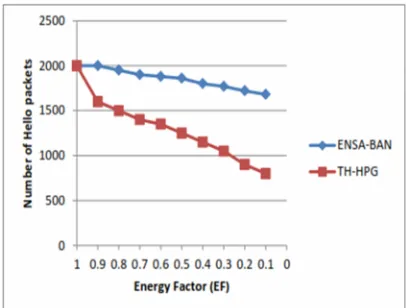
Figure 6 shows the number of control packets transmitted in the network by using the TH-HPG scheme with respect to the EF change. It is noteworthy in the figure that initially more number of Hello packets during the network setup time. However, when network is in stable condition, number of Hello packets decreased. Less number of Hello packets causes reduced control overhead traffic in the network. However with the passage of time EF is decreasing. After the initialization phase, Hello packets are generated only when a SN experiences threshold levels while considering EF change. Analysis shows that the TH-HPG scheme outperforms state-of-the-art-schemes in terms of control overhead in the network. Reduced control overhead packets reduce the overall traffic of the network. Reduced traffic consumes energy and queue space of the network efficintly. Due to
efficient consumption of energy and queue space, network lifetime increases with succesful packet delivery ration to the destination which helps to avoid congestion.
The proposed TH-HPG scheme outperforms state-of-the-art scheme in terms of average energy consumption and number of Hello packets in case of both QF and EF threshold value change.
Figure 6 : Control Overhead Considering EF
8. CONCLUSION
[image:6.612.90.295.338.481.2]such as number of dead nodes, network lifetime and throughput.
9. ACKNOWLEDGMENT
We gratefully acknowledge the technical support and research facilities provided by the Universiti Teknologi Malaysia (UTM), without which this work could not have been completed.
REFERENCES
[1] Alemdar, H. and Ersoy, C. Wireless sensor networks for healthcare: A survey. Computer Networks, 2010. 54(15): 2688–2710. [2] Razzaque, M. A., Hong, C. S. and Lee, S.
Data-centric multiobjective QoS- aware routing protocol for body sensor networks. Sensors, 2011. 11(1): 917–937.
[3] Khan, Z. A., Sivakumar, S., Phillips, W. and Robertson, B. A QoS-aware routing protocol for reliability sensitive data in hospital body area networks. Procedia Computer Science, 2013. 19: 171–179. [4] Ayatollahitafti, V., Ngadi, M. A., bin
Mohamad Sharif, J. and Abdullahi, M. An Efficient Next Hop Selection Algorithm for Multi-Hop Body Area Networks. PloS one, 2016. 11(1): e0146464.
[5] Smail, O., Kerrar, A., Zetili, Y. and Cousin, B. ESR: Energy aware and Stable Routing protocol for WBAN networks. 12th International Wireless Communications & Mobile Computing Conference (IWCMC 2016). 2016.
[6] Ullah, S., Higgins, H., Braem, B., Latre, B., Blondia, C., Moerman, I., Saleem, S., Rahman, Z. and Kwak, K. S. A comprehensive survey of wireless body area networks. Journal of medical systems, 2012. 36(3): 1065–1094.
[7] Rezaee, A. and Yaghmaee, M. HOCA: Healthcare Aware Optimized Congestion Avoidance and control protocol for wireless sensor networks. Journal of Network and . . . , 2014. 37: 216–228. ISSN 10848045. doi:10.1016/j.jnca.2013.02.014.
[8] Khan, Z. A., Sivakumar, S., Phillips, W. and Aslam, N. A new patient monitoring framework and Energy-aware Peering Routing Protocol (EPR) for Body Area Network communication. Journal of Ambient Intelligence and Humanized Computing, 2014. 5(3): 409–423.
[9] Latre´, B., Braem, B., Moerman, I., Blondia, C. and Demeester, P. A survey on wireless body area networks. Wireless Networks, 2011. 17(1): 1–18.
[10] Touati, F. and Tabish, R. U-healthcare system: State-of-the-art review and challenges. Journal of medical systems, 2013. 37(3): 1–20.
[11] Mohanty, P. and Kabat, M. R. Energy Efficient Reliable Multi-path Data Transmission in WSN for Healthcare Application. International Journal of Wireless Information Networks, 2016: 1–11. [12] Liang, L., Gao, D. and Leung, V.
Queue-based congestion detection and multistage rate control in event-driven wireless sensor networks. Wireless Communications and Mobile Computing, 2014. 14(8): 818–830.
[13] Rezaee, A. A., Yaghmaee, M. H. and Rahmani, A. M. COCM: Class Based Optimized Congestion Management Protocol for Healthcare Wireless Sensor Networks. Wireless Sensor Network, 2013. 5: 137. [14] Khan, J. Y., Yuce, M. R., Bulger, G. and
Harding, B. Wireless body area network (WBAN) design techniques and performance evaluation. Journal of medical systems, 2012. 36(3): 1441–1457.
[15] Adhikary, S., Choudhury, S. and Chattopadhyay, S. A new routing protocol for WBAN to enhance energy consumption and network lifetime. Proceedings of the 17th International Conference on Distributed Computing and Networking. ACM. 2016. 40. [16] Issariyakul, T. and Hossain, E. Introduction to network simulator NS2. Boston, MA: Springer US. 2011. ISBN 978-0-387-71759-3.
doi:10.1007/978-0-387-71760-9.
[17] Bangash, J. I., Abdullah, A. H., Razzaque, M. A. and Khan, A. W. (2014). Reliability Aware Routing for Intra-Wireless Body Sensor Networks. International Journal of Distributed Sensor Networks. 2014.