ORIGINAL RESEARCH ARTICLE
A REVIEW: INDICATIVE FUNCTION OF SEQUENCE
STRATIGRAPHY ON FLUVIAL TYPE
1, 2
Zhipeng Lin,
1, 2Le Chen,
*,1, 2Jingfu Shan,
1, 2Lili Xie,
1, 2Le Zhang,
1, 2Wei Fang and
1, 2Bo Liu
1
Key Laboratory of Exploration Technologies for Oil and Gas Resources, Ministry of Education, Yangtze
University, Wuhan 430100
,
China
2
School of Geosciences, Yangtze University, Wuhan 430100, China
3
School of Energy Resources, China University of Geosciences
,
Beijing 100083, China
ARTICLE INFO ABSTRACT
At present, the recognition and research of the classification of fluvial types mainly focus on the description and analysis of a series of indicators, such as the plane shape and sediment characteristics. However, there is limited information on how to study the fluvial types from the deposition process. To propose the application of sequence stratigraphic framework for fluvial systems. We use the principle of concrete analysis for concrete problems by summing up the predecessors of the river type classification scheme. With the research thinking of Process Sedimentology, New systems tracts for fluvial are presented here, including four parts: Low fluvial system tract, Advancing fluvial system tract, Flooding fluvial system tract, Receding fluvial system tract. And apply it to the analysis of the problem of attribution of the traditional division of fluvial. This study embodies the characteristics of Process Sedimentology and helps on research the deposition process of the formation and development of the fluvial system. Moreover, it develops the fluvial classification system from the description stage to a complete rational stage.
*Corresponding author:
Copyright ©2017,Zhipeng Lin et al. This is an open access article distributed under the Creative Commons Attribution License, which permits unrestricted use, distribution, and reproduction in any medium, provided the original work is properly cited.
INTRODUCTION
With the continuous deepening study on the fluvial sedimentary system, the emergence of new fluvial makes more and more scholars to recognize the contradictions between fluvial types and the classification scheme are gradually prominent. For instance, Leopold and Wolman(1957) put forward the classification of the meandering river and braided river very early. But in the actual situation, braided river and meandering river do not exist independently in a geological period, they will exist in the same provenance system during a
geological period, and will also make reciprocal
transformation with the development of the geological
history(Tang et al. 2016; Lin 2017; Lin et al. 2017). Miall
classified river as four types: braided river, meandering river, anastomosing river and straight river(Miall 2016). Qian Ning(1985), afterward, referred that many scholars in our
country thought it was inappropriate to take the anabranched river in the mid-lower Yangtze River and the wondering river in the lower reaches of the Yellow River as an anastomosing river, which is accepted gradually in foreign countries. The understanding of fluvial type is still in the view of the appearance and the results, so a new way of thinking and research methods is needed to solve the problem. The sequence framework of river system has been done some research by some predecessors. In 1988. Poasmentier and Vail(1988) established the first non-marine alluvial sequence stratigraphy models. Wright and Marriott(1993), based on the results, systematically proposed a simple sequence model for fluvial facies. Took that the lowstand systems tract(LST) was composed of channel fillings in incised valley and terrace soil layer, the transgressive systems tract(TST) featured with the uplift of base level and the growth of accommodation space, the highstand systems tract (HST) has a increased channel sand body density and more soil layer.
ISSN: 2230-9926
International Journal of Development Research
Vol. 07, Issue, 07, pp.13736-13741, July,2017
Article History:
Received 05th April, 2017
Received in revised form 24th May, 2017 Accepted 06th June, 2017
Published online 22nd July, 2017
Key Words:
Fluvial type;
Sequence Stratigraphy; Systems tract; Process Sedimentology
Citation: Zhipeng Lin, Le Chen, Jingfu Shan, Lili Xie, Le Zhang, Wei Fang and Bo Liu, 2017. “A Review: Indicative Function of Sequence
Stratigraphy on Fluvial Type”, International Journal of Development Research, 7, (07), 13736-13741.
Subsequently, in the summary of the control action for accommodation space from the tectonic subsidence, material supply, and many other factors, Shanley and McCabe(1994) proposed a set of fluvial facies strata sequence pattern from the mode of deposit loading. On the basis of summarizing the previous models of the predecessors, Zhang Zhouliang(1996) put forward the sequence patterns of fluvial facies, by analyzing the differences, similarities, advantages, and disadvantages of different models, systematically. And for the first time, he pointed out the relationship between fluvial
stratigraphic sequence and fluvial type. Just figure out the list
of previous research results, it is not difficult to find the development of the fluvial classification and stratigraphic sequence. In fact, there are many problems that are not suitable
for the fluvial system(Chen and Chen 2010; Crombez et al.
2016). In order to solve these problems, the author tries to combine the formation process of the fluvial sequence and the river course through the river channel evolution, and then reconstructs a set of sequence framework for the river, moreover, makes it respond to the fluvial type.
MATERIALS AND METHODS
Problems in the current classification scheme of rivers. River classification is the basis of the establishment of facies
model(Tang, Wang et al. 2016; Xu et al. 2016; Lin 2017), and
is also the term used in the petroleum geology work. In the continental petroleum basin of continental China, the fluvial
sand body is very important, and it has attracted people's attention in recent years. The following lists a brief
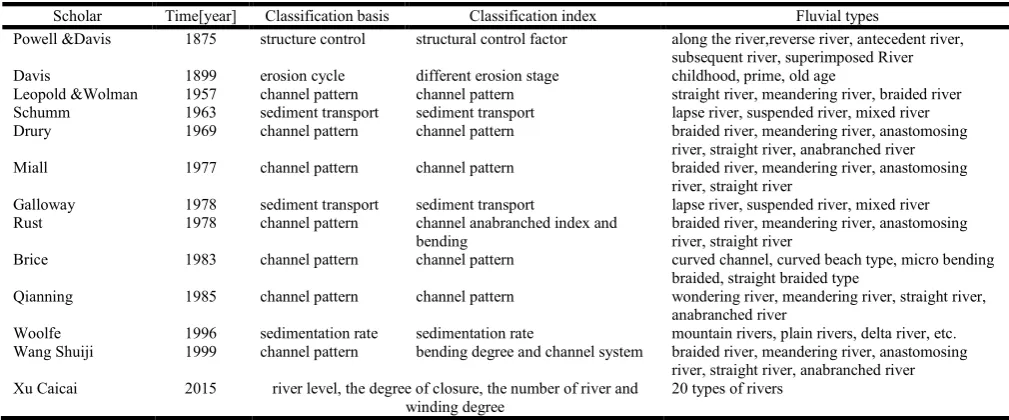
introduction to the classification status of fluvial
sedimentology (Table 1), for reference only. Shanley (1994) believed that classification was a cognitive process of complex things, according to the principle of cognition, there are three ways of classification. Leopold and Wolman(Leopold and Wolman 1960), according to the channel pattern, proposed the classification of “ straight river, meandering river, and braided river”. In accordance with the geometric characteristics of the river, Rosgen(1994) proposed geomorphic classification framework. These two reflect the first way. The second way is based on the prototype theory or probability theory. Montgomery and Buffington(1997) and Croke are in line with the method of prototype theory to some extent. The development and application of the theory of sequence stratigraphy. The sequence stratigraphy is a comprehensive interpretation science for stratigraphic sequence framework. It is based on seismic stratigraphy and the comprehensive utilization of seismic, drilling and outcrop data, combined with the sedimentary environment as well as lithofacies and ancient geographical interpretation. Gradually formed a set of
relatively independent theory and method system (Xiao et al.
2006; Yang 2009; Hu et al. 2017). The development of
[image:2.595.46.551.68.278.2]sequence stratigraphy can be divided into three stages: the origin, the classical sequence stratigraphy stage and the high-resolution sequence stratigraphy. The three stage of the understanding and summary is visible in Table 2.
Table 1. Different classification scheme of fluvial types
Scholar Time[year] Classification basis Classification index Fluvial types
Powell &Davis 1875 structure control structural control factor along the river,reverse river, antecedent river, subsequent river, superimposed River Davis 1899 erosion cycle different erosion stage childhood, prime, old age
Leopold &Wolman 1957 channel pattern channel pattern straight river, meandering river, braided river Schumm 1963 sediment transport sediment transport lapse river, suspended river, mixed river Drury 1969 channel pattern channel pattern braided river, meandering river, anastomosing
river, straight river, anabranched river Miall 1977 channel pattern channel pattern braided river, meandering river, anastomosing
river, straight river
Galloway 1978 sediment transport sediment transport lapse river, suspended river, mixed river Rust 1978 channel pattern channel anabranched index and
bending
braided river, meandering river, anastomosing river, straight river
Brice 1983 channel pattern channel pattern curved channel, curved beach type, micro bending braided, straight braided type
Qianning 1985 channel pattern channel pattern wondering river, meandering river, straight river, anabranched river
Woolfe 1996 sedimentation rate sedimentation rate mountain rivers, plain rivers, delta river, etc. Wang Shuiji 1999 channel pattern bending degree and channel system braided river, meandering river, anastomosing
river, straight river, anabranched river Xu Caicai 2015 river level, the degree of closure, the number of river and
winding degree
20 types of rivers
Table 2. Study of sequence stratigraphy
Scholar Time[year] Content stage Stage
Sloss 1950 The concept of sequence is put forward Origin stage
Vail 1977 Founded seismic stratigraphy
Vail 1987 Used stratigraphic unconformity or unconformity with the integrated interface as the sequence boundary; Took the seismic data to interpret the seismic stratigraphy. And then based on the relationship between the sequence and sequence unconformity interface, explained the sedimentary system and depositional system, In particular, the global sea level change was the main control factors of sequence development
Classical sequence stratigraphy stage
Galloway 1989 Used the maximum flooding surface and its corresponding sedimentary section as the sequence boundary, and the data of the well were used to analyze the sedimentary system. In particular, the sequence is a set of sediments deposited along the edge of the basin.
Johnson 1992 Used the stratigraphic unconformity or transgressive erosion unconformity interface as transgressive-regressive cycle, that is, from a enhance mutual events to another with equal in size to the deepening of events prior to the start of a period of time in the deposited layers
Cross 1995 High-resolution sequence stratigraphy theory was proposed, which includes the principle of the reference plane, the principle of volume partition, the principle of phase differentiation and the comparison of the cycles.
[image:2.595.69.546.301.468.2]Table 3. Fluvial sequence patterns of different scholars
Scholar Year Systems tract Features Fluvial types
Posamentier &Vail
1888 I type sequence Sea level falls incised valley fillings, linear and curved distribution. —— The Late stage of high water level, widely distributed in the plain, in the lateral is not restricted.
——
II type sequence In the late stage of high water level, river facies are widely deposited, and there is no filling in the valley.
——
wright 1993 Lowstand systems tract Composed of the incised valley fillings and the high maturity of soil layer, topographic slope larger, in the source region of the denudation rate is higher.
low sinuosity river
Transgressive systems tract Uplift of the base surface, increasing the accommodation space.The vertical accretion rate increases, and the distribution of a wide range of thick layers of the floodplain deposition.
Isolated and laterally confined river
Highstand systems tract Accommodation space growth rate decreased, The increase rate of the river floodplain is reduced, The density of river sand body increases.
——
Shanley & McCabe
1994 Lowstand systems tract The channel sand bodies are horizontal and vertical to each other, and the bed load is mainly coarse grain, and Upward coarsening.
braided river
Transgressive systems tract The bed load and suspended load are mixed, and the bed load can be changed to a fine and can accommodate space growth.
meandering river,
Highstand systems tract The suspended load is the main form of the channel sand body and more soil layer, which can slow down the speed of space growth.
anastomosing river
Zhang Zhouliang
1996 Lowstand systems tract The gravel sediment filling, river vertical cutting each other, mutually overlapping, contiguous transverse distribution of sand body.
braided river,
Transgressive systems tract Fine sediment deposition, which contains some of the narrow band channel sand body.
anastomosing river
Highstand systems tract The uplift rate of the surface is slow, accommodation space growth rate is lower.
meandering river,
Fangshi 1997,2 000
Lowstand systems tract The sand body in the horizontal, vertical contiguous, associated with the pervious soil on the terrace.
braided river,
Transgressive systems tract Two stage, first is the water surface increased, the large area of the development of the marsh, the formation of peat and coal bed, often to the bottom of the coal bed or mud layer. Then, the base surface uplift rate increases, the formation of a set of fine grain vertical to the accumulation of the characteristics of the deposit, associated with better preservation of coal
meandering river, anastomosing river
Highstand systems tract The base surface of the largest uplift, the rate of change is reduced, coal, peat, soil, etc.
meandering river,
Regressive systems tract The base surface uplift rate decreases, erosion of some of the material deposited in the high water level.
braided river,
[image:3.595.58.537.484.749.2]It can be seen, as one of the forefronts of the earth science research, the theory and practice of sequence stratigraphy has brought a leap to the theory and thinking, and therefore in
recent years, won much of the popular(Sloss 1963; Vail et al.
1977; Vail 1987; Galloway 1989; Johnson and Klapper 1992). New ideas for the division of the fluvial sequence framework. The river is a very important source of transmission tube system. The sediment will transport from provenance to the sedimentary basin and the ocean. In the new referred
source-sink system(Archer 2017; Bonneau et al. 2017; Hawie et al.
2017; Lin et al. 2017; Mason et al. 2017) - formed from
eroded area source, including weathering flake particles of the sediment and dissolved matter, moving into the final deposition in the deposition zone or catchment basin, rivers can also be regarded as the "blood". It is not only an important channel for the flow of water from the land to the lakes and oceans(Zhu 2008) but also the important medium for the completion of the whole ecological cycle.
Therefore, it is of vital significance for the whole geology research to realize the full and complete understanding of the
river. Influence factors of the fluvial sequence. In 2000, it was
concluded that the interaction between the supply and the accommodation space of the sediment is an important factor to affect the sequence of the river. In sequence stratigraphy, 4 basic control factors, such as tectonic subsidence, global sea level fluctuation, sediment supply and climate change, are basic factors. In the early stage of fluvial sequence stratigraphy, the classical sequence stratigraphy theory originated from the passive continental margin, and the sea level change and the river sediment structure were linked.
Shanley et al. (1994) researched the system in the Kaiparowits,
Wright and Wagoner did the alluvial system study of the BookCliffs system of the state of Utah and linked The changes of fluvial sedimentary characteristics to the changes of the sea level at that time. Catuneanu(2006) thought that sea-level change and shoreline migration of fluvial sequence sphere of influence from the shoreline to the upper reaches of the river and general was only a few tens of KM. For inland rivers, in addition to the tectonic and climatic factors, riparian and
floodplain material composition, vegetation coverage, basin sediment size, and sediment composition, flow rate changes can affect the base surface changes in a certain extent, thus influence river sediment(Sanz-Perez and Menendez-Pidal
2016; Debnath et al. 2017; Fryirs 2017; Hawie, Deschamps et
al., 2017). Sequence boundary of fluvial. In stratigraphic
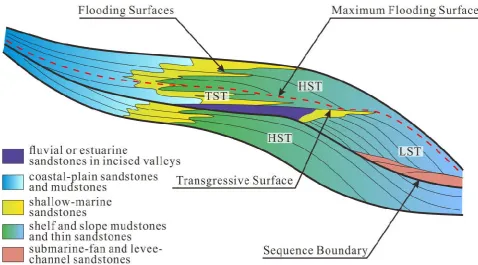
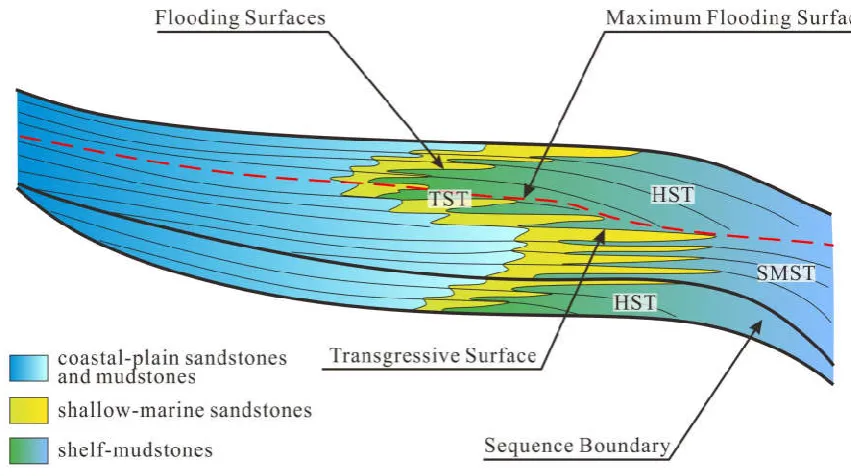
records, two types of sequences can be identified, that is, the sequence I and sequence II. Respectively correspond to the sequence I and sequence II. Sequence I boundary is a regional unconformity, which is that the decrease of the global sea level is greater than that of the sedimentation velocity of the sedimentary basin(Fig. 1). Sequence II boundary is due to the decrease of the global sea level, which is lower than that of the sedimentation velocity of the sedimentary basin. (Fig. 2) However, the sequence boundaries of the river, I do not know because people think it is not needed or is not meaningful, has been no one to mention. This paper argues that the river should have a unique set of sequence boundary, regardless of the meandering river, braided fluvial or anastomosing river. Sequence stratigraphic model of fluvial facies in fluvial
system.Here makes a systematic summary of previous results
about Sequence stratigraphic model in fluvial system. Different scholars get different answers, however, there is truth in these.
[image:4.595.79.505.66.304.2]Fluvial sequence stratigraphic model. Wirght and Marirott proposed a relatively simple fluvial facies sequence model. Their model is that the lowstand system tract is composed of channel fillings in incised valley and high maturity of soil layer in river terraces. The water inlet system is characterized by the uplift of the base surface and the growth of the accommodating space. The high water level system is formed with the reduced growth rate of the space and the decreased speed of the river flooding. Shanley and McCabe also proposed a sequence pattern of fluvial facies strata. The low water level system is composed of many horizontal and vertical cutting and merging channel sand bodies, which are composed of coarse grains and coarse grains. The water inlet system is composed of the bed load and suspended load. The total trend of the upward trend, which reflects the growth of
the space. The high water level system is the main material of suspended load but also can form some isolated river sand bodies and more soil layers.Zhang Zhouliang, combined with the actual data, put forward its own model, lowstand system tract composed of the vertical and horizontal interconnected braided channel sand body and the soil of layer terraces. Transgressive system tract is the anastomosing river for isolated inthick floodplain fine sand bodies. During the high water, the period is the lateral distribution of meandering river sand. The Fluvial sequence patterns of different scholars can take detailed as Table 3.
RESULTS AND DISCUSSION
In view of the problems in the model proposed by the river, there are some questions to discuss with you.
Will it be fixed in the actual situation to applicate the
sequence stratigraphy to fluvial facies analysis and decision and just use the previous situation of the river system?
There is no doubt that the relationship between the types of
the river and the sequence framework is important. But how to establish a better relationship between each other, so that the fluvial sequence can be a guide to the classification of the river, while the river type can reflect the corresponding sequence, to achieve a set of relatively complete standards.
Is it OK to consider a reconstruction for fluvial sequence
system, not traditionally for river basin inlet basin or lake basin inlet, but to proceed into the whole river system itself?
Combined with the problem discussed in this paper, some ideas are presented here. An analysis of the sedimentary sequence of the river can be made from the evolution history of the whole river system. From the mountain to sedimentary basins, the process can be divided into low water erosion stage, river-into sedimentary stage, water flooding stage and water receding and transforming stage. And combined with the research ideas of Process Sedimentology, they can be four systems tracts: Low fluvial system tract, Advancing fluvial system tract, Flooding fluvial system tract, Receding fluvial system tract. And hopefully it will work for the development of oil and gas reservoir.
ACKNOWLEDGMENTS
The project received co-financial support from the National Natural Sciences Fund “Research on Spatiotemporal Variations Mechanism of Lateral Accretion within Point Bar Based on Conditions of Physical Simulation” (41372125), Fund of Ministry of Education of Hubei Province “Research on Flow Units Controlling Remaining Oil Based on Conditions of Reservoir Architecture ” (Q20121210), and the Ministry of Education key Laboratory on Tectonics and Petroleum Resources in China University of Geosciences Wuhan) open foundation “Research on Reservoir Architecture Controlling Remaining Oil in the Meandering Channel
Sandbody ” (TPR-2012-23)
REFERENCES
Archer, S. T. 2017. Current management system for a stimulation output stage of an implantable neurostimulation system, Google Patents.
Bonneau, L., S. Toucanne, et al. 2017. Glacial erosion
dynamics in a small mountainous watershed (Southern
French Alps): A source-to-sink approach. Earth and
Planetary Science Letters 458: 366-379.
Catuneanu, O. 2006. Principles of sequence stratigraphy,
Elsevier.
Chen, X. and Chen, P. 2010. Spatial distribution of depositional system and evolution in Shiwu rift subsidence
of Songliao basin. Natural Gas Geoscience 21(03):
470-475.
Crombez, V., Rohais, S. et al. 2016. Facies, well-log patterns,
geometries and sequence stratigraphy of a wave-dominated margin: insight from the Montney Formation (Alberta,
British Columbia, Canada). Bulletin of Canadian
Petroleum Geology 64(4): 516-537.
Debnath, J., Pan, N. D. et al. 2017. Channel migration and its
impact on land use/land cover using RS and GIS: A study
on Khowai River of Tripura, North-East India. The
Egyptian Journal of Remote Sensing and Space Science.
Fryirs, K. A. 2017. River sensitivity: a lost foundation concept
in fluvial geomorphology. Earth Surface Processes and
Landforms 42(1): 55-70.
Galloway, W. E. 1989. Genetic stratigraphic sequences in basin analysis I: architecture and genesis of
flooding-surface bounded depositional units. Aapg Bulletin 73(2):
125-142.
Hawie, N., R. Deschamps, et al. 2017. Multi‐scale constraints
of sediment source to sink systems in frontier basins: a forward stratigraphic modeling case study of the Levant
region. Basin Research 29(S1): 418-445.
Hu, G., F. Chen, et al. 2017. Subdividing and comparing
method of the fluvial facies reservoirs based on the
complex sandbody architectures. Petroleum Geology &
Oilfield Development in Daqing 36(2): 12-18.
Johnson, J. and Klapper, G. 1992. North American
Midcontinent Devonian TR cycles. Oklahoma Geological
Survey Bulletin 145: 127-135.
Leopold, L. B. and Wolman, M. G. 1957. River channel
patterns: braided, meandering, and straight, US
Government Printing Office.
Leopold, L. B. and Wolman, M. G. 1960. River meanders.
Geological Society of America Bulletin 71(6): 769-793.
Lin, Z. 2017. Channel planform migration architecture of
meandering rivers. Journal of Geology & Geophysics 3(3).
Lin, Z., J. Shan, et al. 2017. Geomorphology Processes of
Channel Planform Migration on Meandering Rivers. Acta
Geographica Sinica (English Edition) 91: 134-135.
Lin, Z., J. Shan, et al. 2017. Meticulous Depiction and Genetic
Mechanism of Unconformity Belt Structure. Earth Science
Research 6(2): 19.
Mason, C. C., A. Fildani, et al. 2017. Climatic and
anthropogenic influences on sediment mixing in the Mississippi source-to-sink system using detrital zircons:
Late Pleistocene to recent. Earth and Planetary Science
Letters 466: 70-79.
Miall, A. D. 2016. Facies Models. Stratigraphy: A Modern
Synthesis, Springer: 161-214.
Montgomery, D. R. and Buffington, J. M. 1997. Channel-reach
morphology in mountain drainage basins. Geological
Society of America Bulletin 109(5): 596-611.
Posamentier, H. and Vail, P. 1988. Eustatic controls on clastic
deposition II—sequence and systems tract models. Society
of Economic Paleontologists and Mineralogists Special
Qian, N. 1985. On the classification and causes of formation of
different channel patterns. Acta Geographica Sinica 40(1):
1-10.
Rosgen, D. L. 1994. A classification of natural rivers. Catena
22(3): 169-199.
Sanz-Perez, E. and Menendez-Pidal, I. 2016. Utility of Geomorphology, Archeology and History in Understanding the Fluvial Dynamics of the Rivers Duero and Tera in
Numancia (Soria, Spain). Tecnologia Y Ciencias Del Agua
7(4): 5-23.
Shanley, K. W. and McCabe, P. J. 1994. Perspectives on the
sequence stratigraphy of continental strata. Aapg Bulletin
78(4): 544-568.
Sloss, L. 1963. Sequences in the cratonic interior of North
America. Geological Society of America Bulletin 74(2):
93-114.
Tang, W., Wang, Y. et al. 2016. A Review of Fluvial Pattern
Transformation. Geological Review 62(1): 138-152.
Vail, P. R. 1987. Seismic stratigraphy interpretation using sequence stratigraphy: Part 1: Seismic stratigraphy interpretation procedure.
Vail, P. R., Mitchum Jr, R. et al. 1977. Seismic stratigraphy
and global changes of sea level: Part 3. Relative changes of sea level from Coastal Onlap: section 2. Application of
seismic reflection Configuration to Stratigraphic
Interpretation.
Wright, V. P. and Marriott, S. B. 1993. The sequence stratigraphy of fluvial depositional systems: the role of
floodplain sediment storage. Sedimentary Geology 86(3-4):
203-210.
Xiao, C., Liu, L. et al. 2006. Current Situation of Sequence
Stratigraphy and Discussion on Related Theoretic
Problems. Journal of Petroleum and Natural Gas 28(6):
1-7.
Xu, J., Cai, G. et al. 2016. Research progress in river
geomorphology in China: In memory of 100-year
anniversary of Shen Yuchang's birth. Acta Geographica
Sinica 71(11): 2020-2036.
Yang, G. 2009. Review on advance, status and research
frontier of sequence stratigraphy. Petroleum Geology and
Engineering 23(2): 1-4.
Zhang, Z. 1996. Sequence stratigraphy and fluvial type.
Geological Review 42: 188-193.
Zhu, X. 2008. Sedimentary petrology. Beijing, Petroleum
Industry Press.