THE SYSTEM ARCHITECTURE OF VIBRATORY HAPTIC
INTERFACE (SA-VHI) APPLIED WITH JORDANIAN
AUTISM CHILDREN
FARAH.H.ZAWAIDEH
Irbid National University, Jordan [email protected]
ABSTRACT
This study aimed to bridge the gap between learning and social interaction by employing learning tools and techniques through the sense of touch to improve social interaction of autism children in Jordan. A computer game that includes haptic interface in a 3D environment which uses the 3D glass and 3D screen was developed. The effects of using vibratory haptic interface to improve social interaction was investigated. The subjects of this study were 20 autistic children suffering from mild autism aged between 9 to 14 years old in National Autism Society of Jordan (NASOJ), from the who have impairments in social interactions.
This is the main contribution made by the present study by which the autistic children will be effectively able to interact and communicate with their families, friends, and the entire community. Accordingly, the focus of the present study is autistic children and how to improve their social interaction capabilities, through using 3-D game and glasses; a screen supporting 3-D display with vibratory haptic interface. In particular, how the joystick technique can help the autistic children in improving their social interaction capabilities. Results revealed a significant relationship between satisfaction and social interaction among autism children by using the haptic interface (joystick).
Keywords:Vibratory Haptic Interface (VHI);social interaction;mild autism children, single-user Virtual Environment (SVE).
1. INTRODUCTION
The system architecture of vibration haptic interface (SA-VHI) and briefly review historical background of the concept of autism children, prevalent and Role virtual Environment with autism children. With this respect, The system architecture of vibration haptic interface (SA-VHI) are typically objects designed by involving heterogeneous components (e.g. hardware, software, humans) working together to perform designing of vibratory haptic interface within virtual 3-D environment (3-D screen and glass), to address one of problems faced Jordanian autistic children, which is social interaction in a Centre of Autistic in Jordan, in order to Improving the social interaction and communication for the rehabilitation of children with autism, by a vibratory haptic device in an interactive virtual 3-D environment, and with learning tools provided.
In general, children may face difficulties in their learning process. These difficulties may refer to either physically or mentally or both, such disabilities are dyslexia and dyscalculia. Dyslexia is a language disability, affecting reading, and writing, speaking and listening Cotugno, [9]. It is a dysfunction or impairment in the use of words. Other disabilities include children with autism which is identified as a
highly variable neurodevelopment
virtual environment on the autism children. A virtual environment (VE) encompasses a simulated computer generated three-dimensional environment in either real or imaginary sense Cobb et al [8].VE can be defined as a single-user Virtual Environment (SVE) which enables users to interact freely via the individual avatar. Although users of SVE have a restricted interaction with the environment and other avatars in which there need to be preprogrammed responses made prior to interaction Cobb et al [8].
VEs have helped patients with autism to undergo social skills training through computer-based task that monitors the received inputs while allowing the users in general and autism children particular to experience the ‘real world’ through technologically advanced graphics and design. Features that are shared between both virtual and real worlds allow for better generalization of skills required in the real world. This benefits the autism children tremendously as it enables them to utilize the shared features in more naturalistic settings. In addition, parents/guardians may be able to participate in the virtual environment, alleviating the autism children understanding within the social context National Institute of Mental Health [NIMH]. Ziedonis et al, [25]. Such example is prevalent in the use of desktop virtual environments Neale [15]. Hence, it will reduce the concerns among those fearing of the virtual environment being the only mode of interaction among patients with autism, therefore, in next section will discussion on the main problems faced the autism children elaborate.
The organization of this paper is fivefold. First, the researchers started with an overview of Autism children in Jordan. Second, the problem faced by the Autism children is presented. Third, the paper described the Proposed System Architecture of Vibratory Haptic Interface (Sa-Vhi) and the solution to help the Autism children. Fourth, results were presented and discussed in some detail. Finally, a conclusion was drawn based on the findings of the present study.
2. PROBLEMS FACED THE AUTISM CHILDREN
In recent years heavy discussions are on regarding the occurrence of the prevalence of ASDs (about 1% in western countries) is
increasing (Nicholas et.al, [21]. The frequency of conflict is complicated by two factors: the historical changes in diagnostic criteria, and the continuing debate over the causes of ASDs. Concerning the latter, those who favour a genetic cause, point to the strong evidence for a genetic component in the aetiology of ASD, specifically, the differences in prevalence between males and females, where prevalence in females is about a factor of four folds higher than in males, and between monozygotic than dyzygotic twins Baron-Cohen and Tead, [3], Bourgeron [5].
Children with autism are considered to be a heterogeneous group, with considerable individual differences in how autism manifests in each child Siegel, [19]. The Diagnostic and Statistical Model of Mental Disorder-IV-TR (DSM-IV-TR) criteria for autism states that, children display considerable impairments in social interactions, qualitative deficits in communication, and repetitive behaviour patterns. There is a growing awareness of autism in Jordan, necessitating naturalistic research to understand, how diagnosis and intervention can be best addressed at centres in Jordan Al Jabery and Zumberg [2], Dolah et.al, [11].
Social interaction implies an engagement with other human beings in a reciprocal social way. It is a process, which “involves participants altering their behaviour to adapt to the activities of a partner, and in doing this a coherent sequence of activities is created” Messer, [13]. Impairment in social interaction in London was reported to be occurring in 21.2 cases of every 10,000 children under the age of 15 Wing , [23]. Generally individuals suffering from neurological impairment will face difficulties in developing social relationships and interacting with other people Waterhouse and Fein [22].
enhance his or her social interaction performance. The User Acceptance Test (UAT) construct was to investigate and understand whether User Acceptance Test (UAT) policies that exist are meaningful that would benefit autistic children.
3. AREAS OF DIFFICULTY BY INDIVIDUALS WITH AUTISM
(Battocchi et.al, [4], Padgett, [17], Messer, [13]. stated that the prevalent complications, which persons with autism encounter, are associated to the ‘triad of impairments’. These complications are related with, disabilities in social interaction social interaction relationship, communication and imagination Wing [23]. Furthermore, many individuals with autism endure a strange sensitivity to neurological inciters, issues with attention span and motivation levels; and some individuals go through high levels of stress, along with specific fears Wing and Gould [24].
Generally, (Casenhiser et al [6], Higgins et.al, [12]; Naoi et.al, [14] stated that, ‘triad of impairments’ refers to a group of three kinds of social problems related to autism. In spite of variants in the symptoms of autism among individuals, the typical issues that influence social relationship, communication and imagination, are considered to impact all those with autism Wing and Gould [24]. The triad can happen on its own, however it is usually associated by other characteristics. It can be collectively identified with any degree of potential, from serious learning impairment, to typical or even excellent cognitive skills, in areas not specifically impacted by the fundamental disabilities. It can occur with any other physical, psychological, or psychiatric condition Wing and Gould [24].
The table:1 illustrates the summary of the ‘triad of (Casenhiser et al, [6], Higgins et.al, [12], Naoi et.al,[14] .The degrees detailed in the table begin with a outline of the more seriously impaired at level one, and progress to less affected children, described under level four. Nevertheless, it should be emphasized that, individuals have considerable differences in their ability levels, and children will be identified based on their functionality related to the stage of these categories Aarons and Gittens [1].
Table 1: Table of the ‘Triad of Impairments’
The ‘Triad of Impairments’ Impairment of
social interaction
1. Aloofness and indifference to others.
2. Accepting of social approaches by Others (passive).
3. Makes social approaches to others which are one-sided, and may be to indulge strange and unusual interests, e.g. railway timetables, vacuum cleaners, lavatory disinfectants, airport X-ray scanners, the marks socks make on ankles, etc.
4. Makes social contact, but lacks understanding of subtle rules of social behaviour.
Impairment of social
communication
1. Absence of any desire to communicate with others. Continue…
2. Communication confined to the expression of needs only.
3. Makes factual comments, not part of a social exchange, and often irrelevant to the social context. 4. Talks a great deal, but regardless of response of listeners, and has difficulty in engaging in reciprocal conversation. (This can be very subtle indeed, especially in individuals who have had access to social skills training).
Impairment of social imagination
1. Copying and pretend play are absent.
2. May copy the actions of others, but without real understanding of their Meaning and Purpose (may bath doll, make pretend cups of tea for example).
3. Repetitive and stereotyped enacting of a role, but without variation or empathy, e.g. a TV character, or even an object such as an aeroplane.
4. Awareness that things go on in the minds of others, but has few strategies to discover what these may be. (Minimally affected people appear to have ability to recognise others’ feelings, but this is learnt rather than empathetic).
4. IMPAIRMENT OF SOCIAL INTERACTIONS
their behaviour, according to the activities of an associate, hence a consistent pattern of pursuits is developed. Moreover, Cotugno, [9] have stated that, disability in social relationship is claimed to arise in 21.2 cases per 10,000 children, under the age of 15. According to Waterhouse and Fein [22], when there is a neurological disability found in individuals with autism, complications in developing social relationships, and communicating with other people can occur Rogers [18].
4.1 Main Features
In contrast to the normal infants, the child with autism shows lack of interest in social relationship or the social environment Volkmar et.al, [21]. There is a very obvious lack of interest towards others, and specially, individuals with autism are handled by others as things Baron-Cohen and Tead, [3]. Actually, during diagnosis a lot of parents report contemplative signs of social diversions arising in the first few months of life Rogers [18].
A distinct attribute, which might be recognized in case of autism, is the lack of eye contact, or an unusual eye glare Baron-Cohen and Tead, [3], Volkmar et.al, [21]. Initially it was believed that, individuals with autism averted eye contact, however, recently it has been indicated that, eye contact is afflicted by situational aspects, such as, methodized interaction by an adult, or the character of task requirements Volkmar et.al, [21]. Generally it is presumed that, individuals with autism will not be able to realize how to use eye-contact as a means of communicate, and hence, they will not be able to understand the motives of others in their eyes Baron-Cohen and Tead, [3], Volkmar et.al, [21]. A typical deficiency of knowledge or consideration for the feelings of others is another common aspect of individuals with autism. Baron-Cohen and Tead, [3], have described how children with autism, concentrate towards the non-social facets of others Rogers [18].For example, individuals with autism might know the names and comprehensive information about particular people, however, they will not involve in any kind of social relationship, with such people Baron-Cohen and Tead, [3].
According to Volkmar et.al, [21] lack or abnormality of bond is another apparent characteristic of disability of social relationship. Even though an individual might be unable to involve in social relationships, a relationship to a
specific item may be established rather, such as, showing desire in the fragrance, flavour and sense of such an object. Moreover, has claimed that, lack of mutual interest is a very distinct aspect in autism, where people tend to be isolated and do not share their feelings or thoughts to anyone, including their parents. Therefore lack of mutual interest indicates a considerable obstacle in the potential to socially indulge others Baron-Cohen and Tead, [3], Volkmar et.al, [21]. Measures of mutual interest are integrated in the current diagnostic schemes.
Deepa [10] stated that Different kinds of tactile stimulation methods have been described as crucial approaches to the health and development of autistic children. This underscores the significance of this study, which is particularly needed in order to integrate learning through the sense of touch and improving social interaction by using vibratory haptic interface within virtual 3-D environment, which includes 3-D game, glasses, screen supporting 3D display, joy stick, and guider design. In addition, this research emphasises on improving social interactions of autistic children with their classmates, in school by means of developing virtual 3-D environment ,3D screen, glasses, and vibratory haptic interface), to simulate reality thus creating tools and environment that have the potential for improving the every-day life of autistic children.
deeper understanding of the entities taught. So that we generate from previous problems and studies that need in order to integrate learning through the sense of touch and improving social interaction by using vibratory haptic interface within virtual 3-D environment, which includes 3-D game, glasses, screen supporting 3D display, joy stick, and guider design. Our proposed as shown next section
5. PROPOSED SYSTEM
ARCHITECTURE OF VIBRATORY HAPTIC INTERFACE (SA-VHI) SOLUTION TO HELP THE AUTISM CHILDREN
Different kinds of tactile stimulation methods have been described as crucial approaches to the health and development of autistic children. This underscores the significance of this paper, which is particularly needed in order to integrate improving social interaction by using vibratory haptic interface within virtual 3-D environment, which includes 3-D game, glasses, screen supporting 3D display, joy stick, and guider design. In addition, this research emphasises on improving social interactions of autistic children with their classmates, in school by means of developing virtual 3-D environment ,3D screen, glasses, and vibratory haptic interface), to simulate reality thus creating tools and environment that have the potential for improving the every-day life of autistic children.
This paper focus on the children with mild autism, who have impairment in social interaction in their daily life. This research has exclusively explored problems faced by Jordanian autistic children in a center of autistic, Amman, Jordan. This research has been conducted at two locations: the classroom and the court of the center of autistic, Amman, Jordan. The study has sampled 20 children with mild autism, who have impairment in social interaction, based on the records of the center of autistic of Jordan. The sample collection method followed the purposive sampling approach, it is a form of non-probability sampling that allowed us to choose a case because it illustrates some features or processes in which we are interested (Vieweg et al, [20].
This research emphasizes on improving social interactions of autistic children in school with their classmates, and teachers, based on
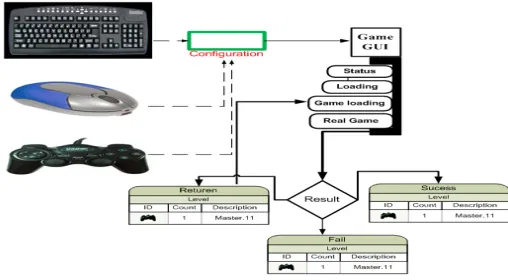
[image:5.612.329.583.303.443.2]incorporating vibration with haptic interface for the 3-D environment sessions, using computer software within a virtual environment. A setting has been chosen, which has demonstrated the use of a vibratory haptic interface within virtual 3-D environment, which includes 3-D game and glasses; a screen supporting 3-D display; joy stick; and guider design prototype by autistic children.The system architecture explains the requirement and input of Joystick-HI prototype, initially the devises such as: keyboard, mouse, joystick ,based on devise have been configured, until determining the path to GUI of the Game, and to explain the process to execute the game from status, loading, game loading, and real game, jump to run game, to determine the result.
Figure 1: Proposed System Architecture of Vibratory Haptic Interface (SA-VHI)
6. RESEARCH METHODOLOGY
The sample size of this research was 20 autistic children from the National Society of Autism (NASOJ) in Jordan. These children faced impairments in social interactions. Data was collected using a survey-based approach questionnaire. The 5-point scale is used to gauge user’s degree of acceptance. In this study, four hypotheses have been proposed in an attempt to analyse the relationships between the factors in the model proposed. Here, the variables’ mean scores within the factors or constructs were computed. Then, the obtained values underwent the correlation analysis.
6.1 Discussion Of The Results
capital city of Jordan, Amman. They are all suffering from neurological impairment, and therefore face difficulties in developing social relationships and interacting with other people. A purposeful sampling method was adopted which a form of non-probability sampling. Consequently, the setting was meaningful theoretically as the central characteristics of this paper have presented an example of a vibratory of haptic interface technique (joystick) prototype and a group of children with autism. A case research approach was used in order to facilitate naturalistic inquiry. The setting chosen for this research was selected because it provided a location from which knowledge about the use of a vibratory of haptic interface (joystick) prototype can be gained.
During the test of autistic children, a significant amount of feedback was provided by them deals with the positive feedback from using Haptic Interface Technique. They spend an average of 20-25 minutes with Proposed designing of Haptic Interface Technique for Autistic Children. The researchers observed a clear responding of interaction and communication among those children with the Haptic Interface Technique which seems to be flexible and more convenient. The researchers also have presented building the system (vibratory haptic interface within virtual 3-D environment, which includes 3-D game, glasses, screen supporting 3D display, joy stick, and guider design). Hence, the objective of the study has been successfully accomplished based on the result of system evaluation.
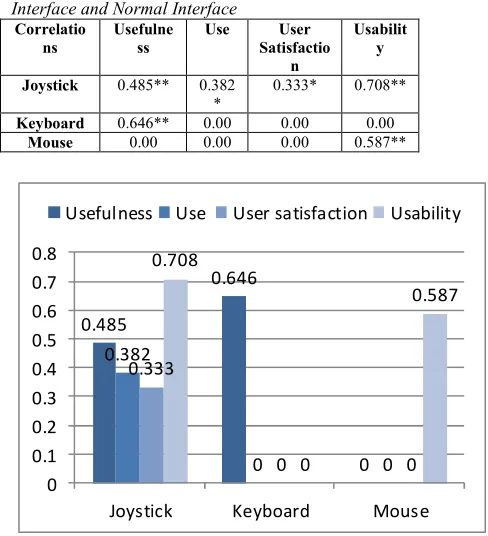
Definitely, haptic interfaces add the sense of touch to interactions with a virtual scene. Feelings of touch are generated by computing the forces of interaction between objects in the virtual environment and reflecting those forces back to the user. Haptic rendering is the term for computing these interaction forces between models. Normally, these forces have to be updated greatly faster than those for visual simulation. Thus, haptic forces are typically proportional to the distance of penetration between the models. Haptic rendering tools were regularly designed for specific devices. The employing of 3D graphics and 3D sound integrated together with haptic feedback create a multi-sensory immersion for the users. Using the haptic interface (joystick) showed that there is a important relation between satisfaction and social interaction among Jordanian autism
[image:6.612.318.562.181.449.2]children , and it was obvious more than in normal interface (keyboard and mouse).
Table 2: Summary Correlations among Haptic Interface and Normal Interface
Correlatio ns
Usefulne ss
Use User
Satisfactio n
Usabilit y
Joystick 0.485** 0.382
*
0.333* 0.708**
Keyboard 0.646** 0.00 0.00 0.00
Mouse 0.00 0.00 0.00 0.587**
0.485
0.646
0 0.382
0 0
0.333
0 0
0.708
0
0.587
0 0.1 0.2 0.3 0.4 0.5 0.6 0.7 0.8
Joystick Keyboard Mouse
Usefulness Use User satisfaction Usability
Figure 2: Summary Correlations among Haptic Interface and Normal Interface
7. RECOMMENDATIONS AND FUTURE WORK
population. In a study investigating specific techniques such as the haptic interface (CyberGlove), as well as an effectively designed user interface. In addition, these techniques should also be integrated within a virtual environment, and can often help to improve the quality of the special needs society,
8. CONCLUSION
This paper introduces and elaborates a Proposed System Architecture of Vibratory Haptic Interface VHI). The design of (SA-VHI) seems to be useful method for helping autistic children who have impairment in social interaction. This can be achieved through games that simulate virtual world, and thus beneficial for teaching the autistic children to play 3-D games on their own by means of video demonstrations and text guide. The contribution of the present study is seen in adding a new method of education using vibratory haptic interface within virtual 3-D environment (3-D screen and glass to address one of problems faced Jordanian autistic children, which is social interaction in a center of autistic in Jordan). Another contribution is made in improving the social interaction and communication for the rehabilitation of children with autism, by a vibratory haptic device in an interactive virtual 3-D environment, as well as with learning tools provided. Results have shown the benefits of the haptic interface with vibration and its integration in a virtual, 3-D environment. For instance, it seems to be helpful for autistic children in developing better mental and physical sense and conception of their surroundings. It also seems helpful in learning and enhancing their own skills, as well as getting the sense of innovation, or just feels relaxed, which eventually relieves body pain or stress and improve social interactions among those children.
REFERENCES:
[1] Aarons, M., & Gittens, T. (1999). The handbook of autism: a guide for parents and professionals. Psychology Press.
[2] Al Jabery, M., & Zumberg, M. (2008). General and Special Education Systems in
Jordan: Present and Future
Perspectives. International Journal of Special Education, 23(1), 115-122.
[3] Baron-Cohen, S., Hill, J., & Wheelwright, S. (2003). Mind Reading: The Interactive Guide to Emotions (London, New York: University of Cambridge, Kingsley Publishers).
[4] Battocchi, A., Ben-Sasson, A., Esposito, G., Gal, E., Pianesi, F., Tomasini, D & Zancanaro, M. (2010). Collaborative puzzle game: a tabletop interface for fostering collaborative skills in children with autism spectrum disorders. Journal of Assistive Technologies, 4(1), 4-13.
[5] Bourgeron, T. (2009). A synaptic trek to
autism. Current opinion in
neurobiology, 19(2), 231-234.
[6] Casenhiser, D. M., Shanker, S. G., & Stieben, J. (2013). Learning through interaction in children with autism: preliminary data from asocial-communication-based
intervention. Autism, 17(2), 220-241. [7] Centers for Disease Control and Prevention
(CDCP). (2009). Autism Spectrum Disorder (ASDs)-Facts about ASDs. Retrieved from http://www.cdc.gov/ncbddd/autism/facts.ht ml
[8] Cobb, S., Kerr, S., & Glover, T. (2001). The AS Interactive Project: Developing virtual environments for social skills training in users with Asperger syndrome. Robotic and Virtual Interactive Systems in Autism Therapy, Communications of the Adaptive Systems Research Group, University of Hertfordshire (Report no 364).
[9] Cotugno, A. J. (2009). Social competence and social skills training and intervention for children with autism spectrum disorders. Journal of autism and developmental disorders, 39(9), 1268-1277. [10]Deepa,M, D. (2008). Wearable
Haptics.Department of Computer Sciences,
p.15.Retrieved from
http://www.cs.uta.fi/hui/mobile/papers/Math ew-paper.pdf.
[12]Higgins, D. J., Bailey, S. R., & Pearce, J. C. (2005). Factors associated with functioning style and coping strategies of families with a child with an autism spectrum disorder. Autism, 9(2), 125-137.
[13]Messer, D. J. (1994). The development of communication: From social interaction to language. Wiley.
[14]Naoi, N., Tsuchiya, R., Yamamoto, J. I., & Nakamura, K. (2008). Functional training for initiating joint attention in children with autism. Research in developmental disabilities, 29(6), 595-609.
[15]Neale, H. R., Brown, D. J., Cobb, S. V. G., & Wilson, J. R. (1999). Structured evaluation of virtual environments for special-needs education. Presence:
teleoperators and virtual
environments, 8(3), 264-282.
[16]Noordin, S., Fatimah Wan Ahmad, W., & Kwang Hooi, Y. (2011). Study of effectiveness and usability of multimedia courseware integrated with 3-dimensional model as a teaching aid. International Journal of Computer Applications, 16(4), 20-27.
[17]Padgett, L. S., Strickland, D., & Coles, C. D. (2006). Case study: using a virtual reality computer game to teach fire safety skills to children diagnosed with fetal alcohol syndrome. Journal of pediatric psychology, 31(1), 65-70.
[18]Rogers, S. J. (2009). What are infant siblings teaching us about autism in infancy?. Autism Research, 2(3), 125-137.
[19]Siegel, M., & Beaulieu, A. A. (2012). Psychotropic medications in children with autism spectrum disorders: a systematic review and synthesis for evidence-based practice. Journal of autism and developmental disorders, 42(8), 1592-1605. [20]Vieweg, W. V. R., Sood, A. B., Pandurangi,
A., & Silverman, J. J. (2005). Newer antipsychotic drugs and obesity in children and adolescents. How should we assess drug‐associated weight gain?. Acta Psychiatrica Scandinavica, 111(3), 177-184. [21]Volkmar, F. R., & Lord, C. (1998). Diagnosis and definition of autism and other pervasive developmental disorders. Autism and pervasive developmental disorders, 1-31.
[22]Waterhouse, L., & Fein, D. (1997).
Perspectives on social
impairment. Handbook of Autism and Developmental Disorders, 901-19.
[23]Wing, L. (1996). Autistic spectrum disorders. BMJ: British Medical Journal, 312(7027), 327.
[24]Wing, L., & Gould, J. (1979). Severe impairments of social interaction and associated abnormalities in children: Epidemiology and classification. Journal of autism and developmental disorders, 9(1), 11-29.