BIROn - Birkbeck Institutional Research Online
Abakuks, Andris (2006) A statistical study of the triple-link model in the
synoptic problem. Journal of the Royal Statistical Society Series A 169 (1),
pp. 49-60. ISSN 0964-1998.
Downloaded from:
Usage Guidelines:
Please refer to usage guidelines at
or alternatively
2006 Royal Statistical Society 0964–1998/06/169049 169,Part1,pp.49–60
A statistical study of the triple-link model in the
synoptic problem
Andris Abakuks
Birkbeck College, London, UK
[Received February 2004. Revised March 2005]
Summary.InNew Testamentstudies, the synoptic problem is concerned with the relationships between the gospels of Matthew, Mark and Luke. A careful specification in probabilistic terms is set up of what is known as the triple-link model, and, as a special case, the double-link model. Counts of the numbers of verbal agreements between the gospels are examined to investigate which of the possible triple-link models appears to give the best fit to the data.
Keywords: Double-link model;New Testament; Probability model; Synoptic problem; Triple-link model
1. Introduction
Bartholomew (1988, 1996) has reviewed some of the uses of probability and statistics in theology and biblical studies, but in the present paper we shall examine an area that was not considered by Bartholomew. Honor´e (1968) in a pioneering paper carried out a statistical analysis of the synoptic problem, a well-known branch ofNew Testamentstudies, in which hypotheses about the relationships between the gospels of Matthew, Mark and Luke are investigated. A good introduction to the various theories that have been proposed for the relationships between the synoptic gospels is given by Goodacre (2001). Honor´e (1968) is particularly useful in that it pro-vides a comprehensive listing of the data that were used in the analysis and a detailed account of the mathematical and statistical reasoning. However, from the point of view of a statistician, one of the challenges of Honor´e (1968) is that his terminology tends not to conform to what is accepted usage in statistical theory.
The most widely accepted model for the relationships between the synoptic gospels is the two-source model, according to which Matthew and Luke had two sources, Mark and a hypo-thetical ‘Q’, the latter to account for the large quantity of material that is common to Matthew and Luke but absent from Mark. An authoritative exposition of the two-source model and the state of research on Q is provided by Kloppenborg Verbin (2000). What little attention Honor´e (1968) has received in the biblical studies literature—see Carlston and Norlin (1971, 1999), O’Rourke (1974) and Matilla (1994)—has been almost entirely restricted to his investigation of the two-source model, but a considerable part of his paper dealt with an innovative analysis of the so-called triple-link model. O’Rourke was dismissive of the triple-link model on the grounds that it gave a very poor fit to the observed data, but his conclusions were based on Honor´e’s erroneous analysis. We shall show that it is possible to find a good fit. What we aim to do in this paper is to recast Honor´e’s work on the triple-link model in the terminology and notation
Address for correspondence: Andris Abakuks, School of Economics, Mathematics and Statistics, Birkbeck College, University of London, Malet Street, London, WC1E 7HX, UK.
of probability theory. This helps to make more explicit certain assumptions that were made by him and to provide a more rigorous confirmation of some of his results. It also helps to show where Honor´e went astray and to come up with a more satisfactory analysis. Another issue that will be addressed is what version of the data it is most appropriate to use for the analysis.
In what follows, like Honor´e, we use the terms gospel A, B and C to refer to any permutation of the synoptic gospels, although the identification A≡Mark (Mk), B≡Matthew (Mt) and C≡Luke (Lk) conforms to the order that assumes Markan priority and is usually, though not exclusively, regarded as most likely. The statistical analysis is based on the numbers of verbal agreements between the gospels, i.e. the numbers of common occurrences of the same Greek word in the same grammatical form. It has been a matter of debate about what definition of verbal agreement should be used. Others, such as Carlston and Norlin (1971), have used less restrictive definitions of verbal agreement than did Honor´e, and the issues that are involved have been discussed by O’Rourke (1974) and Matilla (1994). Carlston and Norlin (1999), pages 120–121, later conceded that with hindsight they might have used a tighter definition of verbal agreement, yet one that was still broader than Honor´e’s. They also showed that, even if they had used Honor´e’s definition, their conclusions regarding the two-source model would have been the same. The use of alternative definitions might or might not lead to materially different conclusions for our triple-link model. Be that as it may, the method of analysis that we shall develop, which forms the main thrust of this paper, will be unaffected by the definition of verbal agreement that is adopted.
2. Basic data and notation for triple-link analysis
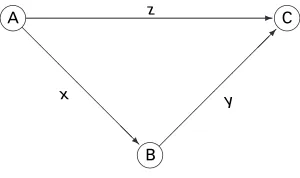
It is supposed in the triple-link model that gospels B and C both use gospel A and that gospel C also uses gospel B. Letxbe the probability that a given word in A is transmitted unaltered to B. Letybe the probability that a given word in B is transmitted unaltered to C. Letzbe the probability that a given word in A is transmitted unaltered directly to C. The relationship is illustrated in Fig. 1.
The gospels when laid out in parallel in a synopsis, as for example in Huck (1949), used by Honor´e, or in Aland (1996), may be split up into sections. Those sections which are represented in all three synoptic gospels are known astriple tradition, those which are represented in just two of the gospels are known asdouble traditionand those which are represented in just one gospel are known assingle tradition. A couple of points of clarification are in order.
(a) Under the influence of the two-source model, the term ‘double tradition’ is more com-monly used in a restricted sense to refer solely to the sections of material that are common to Matthew and Luke alone, but here we follow the more general usage of Honor´e, which
A z C
B
[image:3.485.165.315.527.616.2]x y
also refers to sections of material that are common either to Matthew and Mark alone or to Mark and Luke alone.
(b) Where a section of material is common to two or three of the gospel writers, there will still in general be variation from author to author of the detailed wording of the sec-tion—sometimes minor, but sometimes quite substantial. It is from these differences in wording, as well as from differences between the gospels in what sections they contain, that the data for our analysis have been obtained.
In his analysis of the triple-link model, Honor´e (1968) used, firstly, the data from the triple tradition and, secondly, the data from the whole of the synoptic material. We shall also make use of the data from the union of the triple tradition and double tradition, i.e. the whole of the synoptic material less the single tradition. This set of data includes all the material where there appear to be some links between the synoptic gospels but excludes blocks of material which are unique to any gospel author, i.e. material where the author may have had his own special source and which has not been taken up by any subsequent author or, possibly, material from a common hypothetical source, which was available to all or two of the evangelists, but used by only one of them. This appears to be the most natural set of data to use, and, as we shall see, it does also provide the best support for the triple-link model.
Table 1 gives the counts of words classified according to their presence or absence in each of the synoptic gospels,
(a) for the triple tradition,
(b) for the triple and double tradition combined and (c) for the whole of the synoptic material.
All three sets of data will be used in an attempt to validate the model. The data are taken from Honor´e (1968), Tables 1, 2, 4 and 10, although presented here in a different way. In any row of Table 1, the counts refer to the number of words that are present in the gospels marked with the number 1 but absent in the gospels marked with the number 0.
[image:4.485.123.370.473.626.2]In analysing the data using the notation of probability theory, we shall denote byA,BandC the events that a given word is in gospel A, gospel B and gospel C respectively. We shall further denote byC1the event that the given word is in gospel C and has been transmitted via gospel B and denote byC2the event that the given word is in gospel C and has been transmitted directly from gospel A. According to the triple-link model, any word that gospel C has in common with
Table 1. Counts of words in the synoptic gospels
Presence or absence Counts in the indicators for the following materials: following gospels:
Triple Triple plus All synoptic
Mt Mk Lk tradition double material
1 1 1 1852 1852 1852
1 1 0 1908 2735 2735
1 0 1 637 2386 2386
0 1 1 1039 1165 1165
0 0 1 4356 7231 13957
0 1 0 3831 5269 5576
either gospel A or gospel B has been transmitted to gospel C from either gospel A or gospel B. It follows that
A∩C=A∩.C1∪C2/ and
B∩C=B∩.C1∪C2/:
We also note that the occurrence of the eventC1impliesB, so we haveC1⊆B. Similarly, the occurrence of the eventC2impliesA, soC2⊆A.
With this notation, Pr.B|A/denotes the conditional probability that a given word is in gospel B given that it is in gospel A. Using the basic definition of conditional probability,
Pr.B|A/=Pr.A∩B/ Pr.A/ ,
we shall evaluate this conditional probability directly from the data by the corresponding rel-ative frequency, i.e. the ratio of the number of words that are in both gospels A and B to the number of words that are in gospel A. The conditional probability so evaluated is precisely the probability that, for the part of the synoptic material that is currently under consideration, a word chosen at random from gospel A is also in gospel B—in the same setting and in the same grammatical form. Similar direct evaluations can be made for all conditional probabili-ties involvingA,BandC, but conditional probabilities that involveC1andC2will have to be evaluated indirectly.
3. A probabilistic analysis
In terms of the notation that we have introduced, the probabilitiesx,yandzmay be expressed as
x=Pr.B|A/, .1/
y=Pr.C1|B/, .2/
z=Pr.C2|A/: .3/ We shall want to evaluate the probabilitiesx,y andz, which we shall do by expressing them in terms of conditional probabilities which can be evaluated directly. It is straightforward to evaluatexdirectly from equation (1), but expressions foryandzare not so immediate. In fact Honor´e (1968) in calculating his Table 6 went astray by working as ifywas given by Pr.C|B/.
In our analysis, we shall follow Honor´e in making certain conditional independence assump-tions.
(a) Assumption 1—given that a word is in gospel A, the event that it is transmitted to gospel B and the event that it is transmitted directly from gospel A to gospel C are independent. Thus
Pr.B∩C2|A/=Pr.B|A/Pr.C2|A/, which is equivalent to
Pr.C2|A∩B/=Pr.C2|A/:
Pr.A∩C1|B/=Pr.A|B/Pr.C1|B/, which is equivalent to
Pr.C1|A∩B/=Pr.C1|B/:
(c) Assumption 3—given that a word is in gospel A and gospel B, the event that it is trans-mitted from gospel B to gospel C and the event that it is transtrans-mitted directly from gospel A to gospel C are independent. Thus
Pr.C1∩C2|A∩B/=Pr.C1|A∩B/Pr.C2|A∩B/:
Using his own terminology of word selections being ‘unbiased’, Honor´e (1968) stated his use of assumptions 1 and 2, while not acknowledging his implicit use of assumption 3. As pointed out by Honor´e (1968), page 101, such assumptions will by no means hold exactly. For example, with regard to assumption 1 and assuming Markan priority, although it might reasonably be assumed that Matthew and Luke used the text of Mark independently of each other, in the sense of not collaborating, this does not imply that the choice of words that they selected from Mark was independent in the statistical sense. On the contrary, we should expect the criteria that Matthew and Luke used to select words from Mark to have some common features—Matthew and Luke would not be independent in their choice of words from Mark.
Wenham (1972), who favoured Matthean priority, also criticized Honor´e’s assumptions. With regard to the Griesbach hypothesis, which corresponds to the triple-link model with the identifi-cation A≡Mt, B≡Lk and C≡Mk, if Mark was attempting to produce a conflation of Matthew and Luke, he would be more likely to use Lukan material that Luke had taken from Matthew as against other Lukan material, which contradicts our assumption 2. A similar point with regard to the Farrer theory, which corresponds to the Mk–Mt–Lk model, emerges from the discussion by Goodacre (2002), pages 51–52.
It is a commonly made observation that all statistical models are simplifications which pro-vide only approximations to the situation that they are attempting to represent. Kloppenborg Verbin (2000), pages 50–52, made some related points specifically with regard to models for synoptic relationships:
‘Synoptic hypotheses are simplifications . . . unlikely to represent precisely or fully theactual compo-sitional processes of the gospels. . . . Hypotheses are heuristic models intended to aid comprehension and discovery; they do not replicate reality.’
So, despite the above criticisms of the simplifying assumptions that we have made to make some progress in the analysis of the data at our disposal, we shall continue with the analysis to see whether there is any support at all for the triple-link model and whether any insight may be gained into which, if any, of the possible choices of the gospels A, B and C gives the most plausible version of the triple-link model.
Using the three conditional independence assumptions, we may obtain expressions that will allow us to evaluatezandy—the details of the derivation of these and the remaining equations in this section are given in Appendix A. We find that
z=Pr.B¯∩C|A/
Pr.B¯|A/ , .4/
whereB¯represents the complementary event thatBdoes not occur, and
y=Pr.C|B/−zPr.A|B/
Once we have used equation (4) to evaluatez, we shall be able to use equation (5) to evaluatey. We shall use our values forx,yandzto calculate Pr.B∩C|A/and Pr.C|A/and then attempt to validate our model by checking how close these calculated values are to the direct evaluations that are obtained from the observed word counts. Again making use of assumptions 1–3, we can express Pr.B∩C|A/and Pr.C|A/in terms ofx,yandzas follows:
Pr.B∩C|A/=xy+xz−xyz .6/
and
Pr.C|A/=z+xy−xyz: .7/
The expressions of equations (6) and (7) are identical with those which were obtained by Honor´e (1968), page 104, without explicit use of the probability calculus.
4. A statistical analysis
We now evaluate the quantities that were described in Section 3 for each of the six possible permutations of the three synoptic gospels. To illustrate the calculations for the material in the triple tradition, using the data in Table 1, and taking A≡Mt, B≡Mk and C≡Lk, we have from equation (1)
x=Pr.B|A/= 1852+1908
1852+1908+637+3939=0:451: Using equation (4),
z= 637
637+3939=0:139: We also have that
Pr.C|B/= 1852+1039
1852+1908+1039+3831=0:335 and
Pr.A|B/= 1852+1908
1852+1908+1039+3831=0:436, from which it follows, using equation (5), that
y=0:335−.0:139/.0:436/
1−.0:139/.0:436/ =0:292:
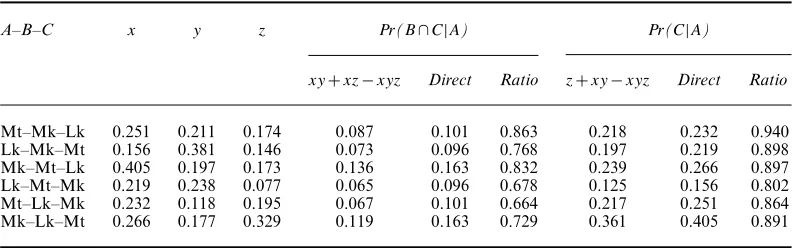
The full results for the material in the triple tradition are given in Table 2, for the triple and double tradition combined in Table 3 and for the whole of the synoptic material in Table 4.
Table 2. Triple-tradition material
A–B–C x y z Pr(B∩C|A) Pr(C|A)
xy+xz−xyz Direct Ratio z+xy−xyz Direct Ratio
Mt–Mk–Lk 0.451 0.292 0.139 0.176 0.222 0.793 0.253 0.299 0.846
Lk–Mk–Mt 0.367 0.410 0.128 0.178 0.235 0.758 0.259 0.316 0.820
Mk–Mt–Lk 0.436 0.224 0.213 0.170 0.215 0.791 0.290 0.335 0.866
Lk–Mt–Mk 0.316 0.418 0.193 0.167 0.235 0.712 0.299 0.367 0.815
Mt–Lk–Mk 0.299 0.294 0.326 0.157 0.222 0.705 0.385 0.451 0.855
[image:8.485.47.446.229.352.2]Mk–Lk–Mt 0.335 0.221 0.332 0.161 0.215 0.749 0.382 0.436 0.876
Table 3. Triple- plus double-tradition material
A–B–C x y z Pr(B∩C|A) Pr(C|A)
xy+xz−xyz Direct Ratio z+xy−xyz Direct Ratio
Mt–Mk–Lk 0.315 0.193 0.239 0.122 0.127 0.957 0.286 0.291 0.981
Lk–Mk–Mt 0.239 0.374 0.248 0.126 0.147 0.862 0.315 0.335 0.940
Mk–Mt–Lk 0.416 0.248 0.181 0.160 0.168 0.952 0.266 0.274 0.970
Lk–Mt–Mk 0.335 0.286 0.139 0.129 0.147 0.882 0.221 0.239 0.927
Mt–Lk–Mk 0.291 0.165 0.265 0.112 0.127 0.883 0.300 0.315 0.953
Mk–Lk–Mt 0.274 0.276 0.342 0.143 0.168 0.853 0.392 0.416 0.941
Table 4. All the synoptic material
A–B–C x y z Pr(B∩C|A) Pr(C|A)
xy+xz−xyz Direct Ratio z+xy−xyz Direct Ratio
Mt–Mk–Lk 0.251 0.211 0.174 0.087 0.101 0.863 0.218 0.232 0.940
Lk–Mk–Mt 0.156 0.381 0.146 0.073 0.096 0.768 0.197 0.219 0.898
Mk–Mt–Lk 0.405 0.197 0.173 0.136 0.163 0.832 0.239 0.266 0.897
Lk–Mt–Mk 0.219 0.238 0.077 0.065 0.096 0.678 0.125 0.156 0.802
Mt–Lk–Mk 0.232 0.118 0.195 0.067 0.101 0.664 0.217 0.251 0.864
Mk–Lk–Mt 0.266 0.177 0.329 0.119 0.163 0.729 0.361 0.405 0.891
It is to be expected that the ratio will be less than 1 in each case, since it is an acknowledged shortcoming of the model that unrealistic assumptions of statistical independence are made which will have the effect of making the predicted number of words that the gospels have in common smaller than what is actually observed. But the larger the ratio the better the model has performed.
[image:8.485.48.445.383.507.2]reas-suring that this set of data is the one that gives greatest support to the triple-link model, as we would want to use the model to explain the relationships between the gospels to the greatest extent possible, including the double tradition as well as the triple tradition. However, it seems natural to exclude the blocks of single-tradition material, where no transmission of material from one gospel to another has taken place.
To come up with another criterion for the validity of a specific triple-link model, Honor´e argued that, if the gospels were written in the order A–B–C then, since B has only A as his source, whereas C has both A and B as sources, we would expect C to make less use of each of A and B than B does of A. Furthermore, C should be expected to make more use of his most recent source B than of the earlier source A. Thus Honor´e expected
(a) C’s use of B to be greater than C’s use of A and (b) B’s use of A to be greater than C’s use of B.
However, when Honor´e came to examine whether his criterion is satisfied, he checked whether it is true that Pr.B|A/ >Pr.C|B/ >Pr.C|A/, whereas it is more appropriate to check whether
x > y > z: .8/ On examining Tables 2 and 4 we see that, irrespective of whether we use the triple-tradition material or the whole of the synoptic material, inequalities (8) are satisfied only for the two models Mt–Mk–Lk and Mk–Mt–Lk, which are precisely the two models that appeared to be the most plausible from our earlier analysis. But Honor´e, according to the calculations in his Table 11, found that only Mt–Mk–Lk satisfied his criterion, which was one of the considerations that led him to reject the Mk–Mt–Lk triple-link model.
More importantly, we have seen that it is the data for the triple and double tradition com-bined which are arguably the most natural to use and which provide the best support for the triple-link model, with the Mt–Mk–Lk and Mk–Mt–Lk models giving the best fit. When we check whether inequalities (8) are satisfied by the data of our Table 3, we find that they are satisfied by the Mk–Mt–Lk model but not by the Mt–Mk–Lk model. So if we accept Honor´e’s criterion as expressed in inequalities (8) then it is the Mt–Mk–Lk model which is eliminated, and we are left with the Mk–Mt–Lk model as the model which gives the best fit to the data.
But Honor´e’s criterion is itself open to criticism. We may envisage a scenario in which C has long been familiar with A, but the more recent B then comes into C’s hands, after which he writes his own version. In such a situation we might expect C to make more use of the long familiar A than of B, while still accepting with Honor´e that C makes less use of each of A and B than B does of A. This translates into the inequalities
x > z > y: .9/ Applying inequalities (9) to the data of Table 3 for the triple and double tradition combined, it is the Mk–Mt–Lk model that is eliminated and the Mt–Mk–Lk model that survives as the model of best fit.
5. Double-link models
A B C
A
B
(a) (b)
C
Fig. 2. Double-link models: (a) linear model; (b) fork model
In the so-called ‘linear model’, gospel B uses gospel A, and gospel C uses gospel B, but there is no direct use of gospel A by gospel C. In terms of the triple-link model, effectively
z=0 and C1=B∩C, but assumption 2 is made, so, givenB, the eventsAandC are condi-tionally independent. In the ‘fork model’, gospels B and C both make use of gospel A, but gospel C does not make use of gospel B, or vice versa. In terms of the triple-link model,y=0 andC2=A∩C, but assumption 1 is made, so, givenA, the eventsBandCare conditionally independent.
Both versions of the double-link model reduce to the assumption that two of the eventsA,B andCare conditionally independent given the third. As a consequence, the two models cannot be distinguished from each other in terms of the joint probability structure ofA,BandC: the fork model with gospel A as the source is effectively identical with the linear model with gospel A as the middle term.
Furthermore, in the fork model, the roles of gospels B and C are interchangeable, so there are just three distinct models: those with Matthew, Mark or Luke as the source for the other two. Correspondingly, there are just three distinct linear models: those with Matthew, Mark or Luke as the middle term. We may note that it is a consequence of the conditional independence assumption that in the linear model the roles of gospels A and C are in effect interchangeable.
In terms of the fork model, the conditional independence assumption is
Pr.B∩C|A/=Pr.B|A/Pr.C|A/,
and the ratio that was used by Honor´e (1968) to evaluate the adequacy of the model is just the calculated value from Table 1 of the quantity
Pr.B|A/Pr.C|A/ Pr.B∩C|A/ ,
[image:10.485.146.346.516.627.2]which corresponds to the ratio for Pr.B∩C|A/that we used above as a measure of the adequacy of the triple-link model. Table 5 gives the values of this ratio for the double-link models.
Table 5. Values of the ratio for Pr.B\CjA/
Source (A) Ratios for the following material: in fork model
Triple Triple plus All synoptic tradition double material
Matthew 0.606 0.721 0.575
Mark 0.680 0.678 0.660
Naturally, all the values of the ratios in Table 5 are smaller than the corresponding values for the triple-link model in Tables 2, 3 and 4, as the introduction of an extra parameter in mov-ing from the double-link to the triple-link model will necessarily improve the fit of the model. Clearly, the fork model with Mark as the source, or equivalently the linear model with Mark as the middle term, performs best for the triple tradition and for the whole of the synoptic material; but the fork model with Matthew as the source performs best for the triple and double tradition combined.
However, none of the double-link models with the associated conditional independence assumption provides an adequate fit to the data, as may formally be confirmed by analysing the data as an incomplete 2×2×2 contingency table with one missing cell, using the methods described by Bishopet al.(1975).
6. Conclusions
The aim of this paper has been in part to make more explicit the assumptions that underlay Honor´e’s (1968) original analysis and in part to improve on his statistical analysis of the triple-link model to see whether the model may be used to provide what seems to be an adequate fit to the word count data.
As we have noted, the conditional independence assumptions are open to serious criticism. Despite this, we have found that, especially for the word counts from the triple- plus double-tradition material, a very good fit may be found, which overcomes O’Rourke’s (1974) objection that the model simply did not fit the observed data. Specifically, we may conclude that the Mt–Mk–Lk and Mk–Mt–Lk models provide the best fit, i.e. the triple-link models that identify Luke as the last of the synoptic gospels to have been written. If, further, we accept Honor´e’s additional criterion, as expressed in inequalities (8), then we end up with the sequence Mk– Mt–Lk, which corresponds to the Farrer theory, as the preferred model. However, if we adopt the alternative criterion, expressed in equalities (9), we arrive at the Mt–Mk–Lk model, which corresponds to the so-called Augustinian hypothesis.
We may wish to go one step further and to use our analysis to compare the plausibility of different models of synoptic relationships, e.g. the Griesbach hypothesis (Mt–Lk–Mk) and the Farrer theory (Mk–Mt–Lk), that lie behind the triple-link model as it was set up by Honor´e (1968). But here we must be very careful, for these underlying models, although specified by linkages of the type that is illustrated in Fig. 1, do not in themselves include the further condi-tional independence assumptions that, following Honor´e, we have adopted for our analysis and specifically for calculating the ratios of Tables 2–4. Consequently, when comparing the ratios, two issues are confounded: the extent to which any underlying synoptic model is valid and the extent to which the independence assumptions hold. So when, at first sight, from an examina-tion of the ratios, it appears that our analysis gives more support to the Farrer theory, it may be argued rather that the Griesbach hypothesis requires more substantial departures from the conditional independence assumptions. We might also note with regard to the Griesbach hy-pothesis that for the triple- plus double-tradition material in Table 3 the corresponding Mt–Lk –Mk model satisfies inequalities (9)—the only model apart from Mt–Mk–Lk to do so—which represents some evidence in its favour.
the relative merits of the models proposed and in clarifying some of the issues that must be addressed.
Acknowledgements
It is a pleasure to record my indebtedness to current and past members of the Department of Theology and Religious Studies at King’s College London, who introduced me toNew Testa-ment studies, and especially to Dr Edward Adams, who first suggested to me that I might investigate statistical approaches to the synoptic problem. I am also grateful to the referees of this paper, whose comments have helped me to arrive at a more nuanced presentation of the material.
Appendix A
Using the fact thatB¯∩C= ¯B∩C2and that in assumption 1 we may validly replaceBbyB¯,
Pr.B¯∩C|A/=Pr.B¯∩C2|A/ =Pr.B¯|A/Pr.C2|A/
=Pr.B¯|A/z,
using equation (3). Thus
z=Pr.B¯∩C|A/
Pr.B¯|A/ ,
which is equation (4). Turning to the evaluation ofy,
Pr.C|B/=Pr.C1∪C2|B/
=Pr.C1|B/+Pr.C2|B/−Pr.C1∩C2|B/
=Pr.C1|B/+Pr.C2|A∩B/Pr.A|B/+Pr.C2| ¯A∩B/Pr.A¯|B/
−Pr.C1∩C2|A∩B/Pr.A|B/−Pr.C1∩C2| ¯A∩B/Pr.A¯|B/ =Pr.C1|B/+Pr.C2|A∩B/Pr.A|B/−Pr.C1∩C2|A∩B/Pr.A|B/,
where we have used the fact that, conditional onA¯∩B, the eventsC2 andC1∩C2 cannot occur, so the
corresponding conditional probabilities are 0. Using equations (2) and (3) and assumptions 1–3, we find that
Pr.C|B/=y+.z−yz/Pr.A|B/:
Rearranging this equation,
y=Pr.C|B/−zPr.A|B/
1−zPr.A|B/ ,
which is equation (5).
Making use of assumptions 1–3, the expressions of equations (6) and (7) for Pr.B∩C|A/and Pr.C|A/ respectively are obtained as follows.
Pr.B∩C|A/=Pr{B∩.C1∪C2/|A} =Pr{.B∩C1/∪.B∩C2/|A}
=Pr.B∩C1|A/+Pr.B∩C2|A/−Pr.B∩C1∩C2|A/
Pr.C|A/=Pr.C1∪C2|A/
=Pr.C1|A/+Pr.C2|A/−Pr.C1∩C2|A/ =Pr.B∩C1|A/+Pr.C2|A/−Pr.B∩C1∩C2|A/
=Pr.C1|A∩B/Pr.B|A/+Pr.C2|A/−Pr.C1∩C2|A∩B/Pr.B|A/ =z+xy−xyz:
References
Aland, K. (ed.) (1996)Synopsis Quattuor Evangeliorum, 15th edn. Stuttgart: Deutsche Bibelgesellschaft. Bartholomew, D. J. (1988) Probability, statistics and theology (with discussion).J. R. Statist. Soc.A,151, 137–178. Bartholomew, D. J. (1996)Uncertain Belief: Is it Rational to be a Christian?Oxford: Clarendon.
Bishop, Y. M. M., Fienberg, S. E. and Holland, P. W. (1975)Discrete Multivariate Analysis: Theory and Practice Cambridge: Massachusetts Institute of Technology Press.
Carlston, C. E. and Norlin, D. (1971) Once more—statistics and Q.Harv. Theol. Rev.,64, 59–78.
Carlston, C. E. and Norlin, D. (1999) Statistics and Q—some further observations.Nov. Test.,41, 108–123. Goodacre, M. (2001)The Synoptic Problem: a Way Through the Maze. London: Sheffield University Press. Goodacre, M. (2002)The Case Against Q: Studies in Markan Priority and the Synoptic Problem. Harrisburg:
Trinity Press International.
Honor´e, A. M. (1968) A statistical study of the synoptic problem.Nov. Test.,10, 95–147. Huck, A. (1949)Synopsis of the First Three Gospels, 9th edn. Oxford: Blackwell.
Kloppenborg Verbin, J. S. (2000)Excavating Q: the History and Setting of the Sayings Gospel. Minneapolis: Fortress.
Matilla, S. L. (1994) A problem still clouded: yet again—statistics and “Q”.Nov. Test.,36, 313–329.
O’Rourke, J. J. (1974) Some observations on the synoptic problem and the use of statistical procedures.Nov. Test., 16, 272–277.