ORIGINAL RESEARCH ARTICLE
FUNCTIONAL CAPACITY AND ASSESSMENT INSTRUMENTS IN THE ELDERLY ACCOMPANIED BY
IN THE FAMILY HEALTH STRATEGY: SYSTEMATIC REVIEW
1
Lídia Tarciana Santos da Paz,
1Isabel Lopes Pereira da Silva Amaral,
1Eliana Vieira do
Nascimento Marinho,
1Minéya Cabral da Silva and
*2Ana Carla Silva dos Santos
1
Nurse, Specialist in Public Health with Emphasis on Family Health-Sanitary, Faculty of Communication
Technology and Tourism of Olinda (FACOTTUR), Olinda, Brasil
2
PhD Student in Sports Sciences, University of Coimbra, Coimbra, Portugal, Teacher in the Institute of Training,
Advisory and Research (IFAP), Recife, Brasil
ARTICLE INFO ABSTRACT
The present study aims to analyze and describe scientific publications on the functional capacity and Instruments for assessing elderly people accompanied by the family health strategy. Searches were not limited by date of publication or any other restrictions. The survey of the information took place in the virtual environment, the following scientific bases: nursing database-BDENF, Spanish Bibliographic Index of Health Sciences – IBECS, Latin American literature and Caribbean Center on Health Sciences LILACS, International Literature – in Health Sciences – MEDLINE and Scientific Electronic Library Online-SciELO. The search took place at BDENF, LILACS, IBECS, and MEDLINE via the Virtual Health Library Portal-VHL, using the descriptors: elderly, functional capacity, family health program, associates with the Boolean logical operator “AND”. This integrative review showed that the year of publication of the articles ranged from 2018 to 2006, With a predominance of the transversal type study. The nurses ' professionals were the main responsible for the publications. Questionnaires and scales were used to evaluate the functional capacity of the elderly, with predominance of the Katz index and Lawton-Brody. The publications showed that, using scales and questionnaires, it is possible to identify the factors that limit the functional capacity of the elderly. Insufficient national research was observed, because the functional evaluation methods used in Brazil originate in other countries. The Family health strategy was understood as a propitious environment to Investigations of this magnitude.
Copyright © 2019,Lídia Tarciana Santos da Paz, et al. This is an open access article distributed under the Creative Commons Attribution License, which permits unrestricted use, distribution, and reproduction in any medium, provided the original work is properly cited.
INTRODUCTION
Population ageing is a phenomenon that affects developed and developing countries such as Brazil, country where the growth of the elderly population has reached value higher than the population growth (Santos &Leitão, 2019).Changes resulting from the physiological process of aging affect the homeostatic mechanisms of the elderly and their organic response, reducing the ability to defend and adapt, making them more vulnerable to traumas, infections and psychopathologies (Brasil, 2010). In the course of the intrinsic process of ageing, these alterations can cause increasing levels of limitations in performance of
*Corresponding author: Ana Carla Silva dos Santos, e-mail: [email protected].
basic activities of daily living (Esquenaziet al., 2014). The Functional capacity is intimately linked to the concepts of disability, disability, disadvantage, as well as those of autonomy and independence. Among the various disorders affecting the elderly, functional disability deserves special emphasis, since it has a high frequency and negative consequences for the quality of life of the elderly (Gazalleet al., 2004). The presence of difficulties in the performance of movements and of certain activities of daily life or even the impossibility of performing them to promote the occurrence of higher degrees of functional disabilities by associating as a risk factor for the presence of some disease, deficiencies or medical problems (Rosa et al., 2003). Since impairment of functional capacity can prevent self-care and cause burden on the family
ISSN: 2230-9926
International Journal of Development Research
Vol. 09, Issue, 04, pp. 27018-27022, April, 2019
Article History:
Received 14th January, 2019 Received in revised form 21st February, 2019 Accepted 19th March, 2019 Published online 29th April, 2019
Key Words:
Elderly, Functional capacity, Family health program.
Citation: Lídia Tarciana Santos da Paz, Isabel Lopes Pereira da Silva Amaral, Eliana Vieira do Nascimento Marinho, Minéya Cabral da Silva and Ana Carla Silva dos Santos. 2019. “Functional capacity and assessment instruments in the elderly accompanied by in the family health strategy: Systematic Review”, International Journal of Development Research, 09, (04), 27018-27022.
and heath system, the National Health Policy of the Person Through the Ordinance n.º 2.528, de 19 of October 2006 revealed the use of "functional capacity" as an effective measure to determine the degree of functional capacity of elderly, making it indispensable to use specific instruments (Santos & Cunha., 2014; Santos & Virtuoso, 2008).In this perspective, the present study aims to analyze and describe scientific publications on the functional capacity and Instruments for assessing elderly people accompanied by the family health strategy.
MATERIALS AND METHODS
A systematic review of the available literature on functional capacity and its measurement in elderly accompanied by the
family health strategy was conducted according to PRISMA
(Preferred Reporting Items for Systematic reviews and Meta-analyses) guidelines. Three independent reviewers separately conducted the analysis (LTSP, ILPSA, ACSS) performed on November 2018.
Search strategy: Searches were not limited by date of publication or any other restrictions. The survey of the information took place in the virtual environment, the following scientific bases: nursing database-BDENF, Spanish Bibliographic Index of Health Sciences – IBECS, Latin American literature and Caribbean Center on Health Sciences LILACS, International Literature – in Health Sciences – MEDLINE and Scientific Electronic Library Online-SciELO. The search took place at BDENF, LILACS, IBECS, and MEDLINE via the Virtual Health Library Portal-VHL, using the descriptors: elderly, functional capacity, family health program, associates with the Boolean logical operator “AND”.
Inclusion criteria: The inclusion criteria for these articles were: (1) approaching the theme under study; (2) the record in the selected databases (3) written in English, Portuguese and Spanish language; (4) included elderly (equal or greater 60 years); (2) included men and women.
If there was disagreement amongst authors regarding the inclusion of certain articles, the final decision was left to the senior author (ACSS) due to greater experience on these matters.
To organise the results, the studies were grouped according to the major research topics on functional capacity and its measurement in elderly accompanied by the family health strategy.
Excluded Criteria: Studies were excluded if they: (1) did not include any relevant data; (2) were conference abstracts; (3) included men and women (under 60 years); (4) studies conducted in health units other than family health strategies.
Evaluation of the methodological quality of the studies: The methodological quality of the studies was assessed according to selected criteria of the index of Downs & Black, developed and validated to evaluate the methodological quality of observational and experimental studies. Recognized as methodologically strong and composed of 27 evaluation items, divided into 5 domains: 1) report; 2) external validity; 3) bias; 4) confounding variables; 5) power. Responses are punctuated according to the value, 1 if the criterion is present, 0 if you are absent and only one item has the score that varies from 0 a 2
(Downs & Black, 1988; Bento, 2014; Brasil, 2014).As a result of this review being composed entirely of observational studies, the quality evaluation of the studies was adapted as suggested by the collaboration Cochrane, whereas some issues are not applicable for these studies (Brasil, 2014). Therefore, as questions 8, 14, 15, 19, 23 e 24, excluded from the evaluation. The score for question 27, referring to the power of the study, was modified, keeping the same scoring criteria as the other questions of the scale, ranging from 1 to 0.The total points of the scale would be equivalent to 22 points. Therefore, high quality studies were considered those that achieved a score greater than or equal to 15 points.
Characteristics of the studies and results presentation: The studies were characterized as to the period and journal, country of origin, research method, assessment instrument used.The results are presented descriptively and through a synoptic picture, whose main information function was to highlight the data considered relevant for the analysis of studies.Because it is not a study involving humans directly, there was no need to send the material for evaluation by the Ethics Committee, according to the Resolution Nº 466/2012 do National Health Council.
RESULTS
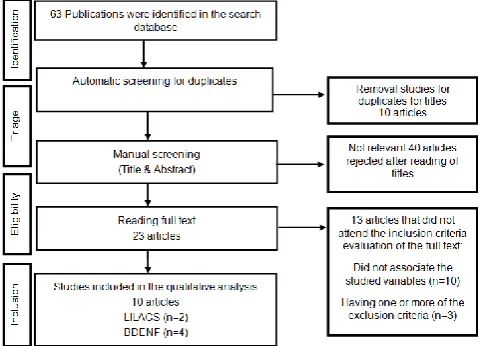
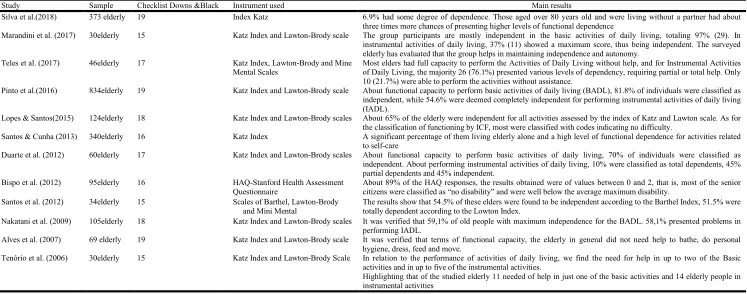
[image:2.595.310.553.452.625.2]The sample is composed of 2140 elderly. The initial search identified 63 titles in the described database. At the end of the screening procedure, only 12 articles remained for the systematic review (Figure 1).The selected researches presented different characteristics in relation to the authors, year, place, research method, journal and the instruments for the evaluation of functional capacity (Table 1).
Figure 1. Flowchart of studies included following PRISMA guidelines
In relation to the journal publication, the articles that are part of the sample were published in various journal is health, there is no predominance of a type of journal. As the research method, cross-sectional study of quantitative approach was predominant.The chronological Analysis of the articles published 2018 that comprise this review work evidenced: i) area of research multidisciplinary of professionals with highlights nursing by most studies, ii) the development in this area of research, highlighting that almost half (41,6%) of the studies were published in 2017 (Teleset al., 2017; Maradiniet al., 2017) and 2012 (Duarte et al., 2012; Bispoet al., 2012; Santos et al., 2012).
Table 1. Characterization of scientific production on Functional capacity in the elderly in primary care
Study Sample Checklist Downs &Black Instrument used Main results
Silva et al.(2018) 373 elderly 19 Index Katz 6.9% had some degree of dependence. Those aged over 80 years old and were living without a partner had about three times more chances of presenting higher levels of functional dependence
Marandini et al. (2017) 30elderly 15 Katz Index and Lawton-Brody scale The group participants are mostly independent in the basic activities of daily living, totaling 97% (29). In instrumental activities of daily living, 37% (11) showed a maximum score, thus being independent. The surveyed elderly has evaluated that the group helps in maintaining independence and autonomy.
Teles et al. (2017) 46elderly 17 Katz Index, Lawton-Brody and Mine Mental Scales
Most elders had full capacity to perform the Activities of Daily Living without help, and for Instrumental Activities of Daily Living, the majority 26 (76.1%) presented various levels of dependency, requiring partial or total help. Only 10 (21.7%) were able to perform the activities without assistance.
Pinto et al.(2016) 834elderly 19 Katz Index and Lawton-Brody scale About functional capacity to perform basic activities of daily living (BADL), 81.8% of individuals were classified as independent, while 54.6% were deemed completely independent for performing instrumental activities of daily living (IADL).
Lopes & Santos(2015) 124elderly 18 Katz Index and Lawton-Brody scales About 65% of the elderly were independent for all activities assessed by the index of Katz and Lawton scale. As for the classification of functioning by ICF, most were classified with codes indicating no difficulty.
Santos & Cunha (2013) 340elderly 16 Katz Index A significant percentage of them living elderly alone and a high level of functional dependence for activities related to self-care
Duarte et al. (2012) 60elderly 17 Katz Index and Lawton-Brody scales About functional capacity to perform basic activities of daily living, 70% of individuals were classified as independent. About performing instrumental activities of daily living, 10% were classified as total dependents, 45% partial dependents and 45% independent.
Bispo et al. (2012) 95elderly 16 HAQ-Stanford Health Assessment Questionnaire
About 89% of the HAQ responses, the results obtained were of values between 0 and 2, that is, most of the senior citizens were classified as “no disability” and were well below the average maximum disability.
Santos et al. (2012) 34elderly 15 Scales of Barthel, Lawton-Brody and Mini Mental
The results show that 54.5% of these elders were found to be independent according to the Barthel Index, 51.5% were totally dependent according to the Lowton Index.
Nakatani et al. (2009) 105elderly 18 Katz Index and Lawton-Brody scales It was verified that 59,1% of old people with maximum independence for the BADL. 58,1% presented problems in performing IADL.
Alves et al. (2007) 69 elderly 19 Katz Index and Lawton-Brody scale It was verified that terms of functional capacity, the elderly in general did not need help to bathe, do personal hygiene, dress, feed and move.
Tenório et al. (2006) 30elderly 15 Katz Index and Lawton-Brody Scale In relation to the performance of activities of daily living, we find the need for help in up to two of the Basic activities and in up to five of the instrumental activities.
Highlighting that of the studied elderly 11 needed of help in just one of the basic activities and 14 elderly people in instrumental activities
Table 2. Selected characteristics of the study
Study Study site Research method Journal
Silva et al. (2018) Carried out through the record of the Family Health teams working in the urban area of City in northern Minas Gerais, Brazil.
Cross-sectional study RevistaBrasileira de Enfermagem
Marandini et al. (2017) Groups in a Basic Family Health Unit in a city of Rio Grande do Sul, Brazil. Descriptive-exploratory study. Quantitative. Qualitative Revista de Pesquisa Cuidado é Fundamental Teles et al. (2017) Family Health Strategy in northern Minas Gerais, Brazil Descriptive, cross-sectional study. Quantitative Revista de Enfermagem da UFPE
Pinto et al. (2016) Family Health Strategy in rural areas in the municipality of Pelotas - Rio Grande do Sul, Brazil Cross-sectional analytical study Ciência& Saúde Coletiva
Lopes & Santos (2015) Family Health Strategy of ÁguasLindas I, in the municipality Ananindeua - Pará, Brazil. Cross-sectional descriptive study Revista Brasileira de Geriatria e Gerontologia Santos & Cunha. (2013) Basic Family Health Unit in the city of São Paulo, Brazil. Cross-sectional descriptive study. Quantitative Revista de Enfermagem e Atenção à Saúde Duarte et al. (2013) Family Health Strategy
in the municipality Ananindeua – Pará, Brazil.
Cross-sectional study. Quantitative RevistaParaense de Medicina
Bispo et al. (2012) Family health strategy in the community of ‘Pontal da Barra’ (area IV), in the municipality Maceió – Alagoas, Brazil
Cross-sectional study. Cadernos Brasileiros de Terapia Ocupacional
Santos et al. (2012) Family Health strategy, in the neighborhood ofViveiros, Feira de Santana-Bahia, Brazil. Cross-sectional, quantitative. Acta Fisiátrica
Nakatani et al. (2009) Family Health Strategy in Goiânia – Goiás, Brazil. Cross-sectional descriptive study Revista Eletrônica de Enfermagem da UFG Alves et al. (2007) Family Health Program in the region of the Upper Jequitinhonha Valley, Diamantina - Minas
Gerais – Brazil.
Cross-sectional descriptive study. RevistaMineira de Enfermagem
[image:3.842.37.806.365.548.2]All the studies presented a good methodological quality, referent to the Downs and Black scale, obtaining values above 15 points from the 22 items assessed. Two studies were published in English, although, concerning the origin, all publications are national and developed in the Family Health Strategy. The state with predominance of publications in this area of research it was Minas Gerais (Silva et al., 2018; Teles
et al., 2017; Alves et al., 2007), Rio Grande do Sul (Maradini
et al., 2017; Pinto et al., 2016) and Pará (Lopes & Santos,
2015; Duarte, 2013).Regarding the socioeconomic and demographic characteristics, the prevalent variables found indicate female gender, aged 60 and 79 years, married or living with relatives, low schooling, low income and retirement as the main source of sustenance. Of the instruments used to measure the Functional capacity of the elderly the Katz Index it was using in 91,6% of the studies and the Lawton-Brody it was using in 75% of the studies.By analyzing in the functional capacity for the basic activities of daily living 91,6% are mostly independents, however, in the instrumental activities of daily living 41.6% of the studies showed that the elderly are dependents.
DISCUSSION
When analyzing the objectives found in the researches, it is noted the researchers ' intention to know the elderly in their entirety, as well as to associate their functional capacity and health conditions with socioeconomic and demographic characteristics.
Functional capacity in elderly people monitored in family
health strategies:The family health strategy in the by System
Unified Health System (SUS)is a privileged space for the promotion of active ageing, in other words, it intervenes with actions directed to health in the sense that these actions promote autonomy for the members (Oliveira & Tavares, 2010). These promotion the actions Targeted Health for active ageing May justify the results the research related to the functional capacity for the basic activities of daily living in elderly registered in the family health strategy, where 91,6% are mostly independents (Silva et al., 2018; Teles et al, 2017; Maradini et al, 2017; Pinto et al., 2016; Lopes et al., 2015; Bispo et al., 2012; Duarte et al., 2012; Santos et al., 2012; Nakati et al., 2009; Alves et al., 2007; Tenórioet al., 2006).In the analysis in the instrumental activities of daily living 41.6% of the studies showed that the elderly are dependents (Teles et al., 2007; Pinto et al., 2016; Duarte et al, 2012; Nakati et al., 2009; Tenórioet al., 2006). This result can be justified by the fact that for the development of these activities the elderly will need the use of recent memory, basis of all mental operations,
whose memory is the first to be affected by aging. The inability to perform one of these instrumental or basic activities of daily living, impairs social life, causing disorders for the elderly, relatives and caregivers who depend on these activities, will take more time to perform a task, will have a higher energy expenditure and spend more financial resources to sustain the needs daily (Costa et al., 2006).
Functional capacity and its measurement: The functional
capacity expresses the ability of the individual to perform, independently, the activities of daily living, the impossibility of challenging it without assistance constitutes the functional dependence (Santos & Cunha, 2013). The instruments Used to measure the Functional capacity of the elderly were the Katz
Index, Lawton-Brody Scale, Mini Mental State Examination,
Barthel Index and Health Assessment Questionnaire. Among those instruments, the Index of Activities of Daily Living (ADL), developed by Sidney Katz, is one of the oldest and one of the most frequently mentioned in Brazilian and international literature (Duarte et al., 2007).In agreement with this study, of the instruments used to measure the functional capacity of the elderly in this research the Katz Index it was using in 91,6% from researches. However, 75% the studies used the Lawton-Brody Scale. A study conducted with 16 elderly women in 2007, affirms the reliability of the Lawton-Brody scale adapted to the Brazilian context, reinforcing that the scale It has good applicability because of its easy understanding, both by the examiner and the interviewee (Santos & Virtuoso, 2008).Since, functional capacity is one of the important health markers, the Index Katz proposes to identify the independence in six activities: dressing, washing, using the toilet, moving, being continent and feeding, as called basic activities of daily living and the Lawton-Brody Scale suggests the identification of instrumental activities of daily living proposes to identify the independence when investigating functions such as: ability to use the phone, use transports, Shopping, preparing meals, take care of the house, wash the clothes, responsibility for the medication itself and ability to deal with money; may be adapted for other equivalent activities and for male gender (Ferreira, 2015). The measurement capacity of instruments in the evaluation of basic activities and instrumental activities of daily living made these instruments more featured in research in the area of gerontology.
Conclusion
This study was able to outline a profile of the use of main instruments for assessing functional capacity in Brazil and revealed an increase in the application of indexes in recent years.It is noteworthy that all instruments listed have undergone a process of cross-cultural adaptation, enabling the use of created scales in other languages and adapted to other cultures. Such a fact declares the insufficiency of national surveys since it, the methods the of functional capacity evaluation in Brazil have their origins in other countries. The scales meet the objectives that lend themselves, but in the extent to which longevity increases, dependence tends to grow because of multiple factors associated with ageing decreasing the feasibility of application by form of self-report, since, the ability to perform tasks is reported through the elderly’s response to the questions of their body, associated with the perception of their general state. In summary, it is evident the importance of valuing the socio-demographic characteristics economic and health care of the elderly, in view of the specificities of this group considering the variability of health conditions and the functional capacity. The family health strategy, for consider the multidimensionality and peculiarities of the life context of the elderly in order to maintain independence, autonomy, social insertion and improvement of the quality of life, proved to be an environment conducive to investigations of this magnitude.
REFERENCES
Alves PAF, Santos VS, Beinner RPC, Murta NMG. 2007. Estado nutricional e capacidade funcional de idosos acompanhados pela estratégia saúde da família no alto Vale do Jequitinhonha/MG. REME – Revista Mineira de
Enfermagem,11(3), 272-277.
Bento, T. 2014. Revisões sistemáticas em desporto e saúde: Orientações para o planeamento, elaboração, redação e avaliação. Motricidade. Portugal, 10(2),107-123.
Bispo EPF, Rocha MCG, Rocha MFM. 2012. Avaliação da capacidade funcional de idosos cadastrados na Estratégia de Saúde da Família na comunidade do Pontal da Barra, Maceió- AL. Caderno de Terapia Ocupacional.UFSCar, 20(1), 81-87.
Brasil 2014. Ministério da Saúde. Secretaria de Ciência, Tecnologia e Insumos Estratégicos. Departamento de Ciência e Tecnologia. Diretrizes metodológicas: elaboração de revisão sistemática e metanálise de estudos observacionais comparativos sobre fatores de risco e prognósticos. Departamento de Ciência e Tecnologia. Brasília: Ministério da Saúde.
Brasil. 2010. Ministério da saúde. Envelhecimento e saúde da pessoa idosa. Caderno de Atenção Básica, n.19. Brasília: Ministério da Saúde.
Costa EC, Nakatani AYK &Bachion, MM. 2006. Capacidade de idosos da comunidade para desenvolver Atividades de Vida Diária e Atividades Instrumentais de Vida Diária.
Acta Paulista de Enfermagem, 19(1), 43-48.
Downs, S. H. & Black, N. 1988. The feasibility of creating a checklist for the assessment of the methodological quality both of randomised and non-randomised studies of health care interventions. Journal of Epidemiology and
Community Health, 52(6), 377-384.
Duarte LSS, Dutra CDT, Pires CAA, Assis FSJS, Silva DCB& Costa, LS. 2012.Análise da capacidade funcional de idosos atendidos pela estratégia de saúde da família.
Rev. para. med, 26(4).
Duarte YAO, Andrade CL & Lebrão, ML. 2007. O Índex de Katz na avaliação da funcionalidade dos idosos. Revista da
Escola de Enfermagem da USP, 41(2), 317-325.
Esquenazi D, Silva SB, Guimarães MA. 2014. Aspectos fisiopatológicos do envelhecimento humano e quedas em idosos. Revista Hospital Universitário Pedro
Ernesto,13(2),11-20.
Ferreira, A. P. 2015. Capacidade e desempenho para a realização das atividades básicas de vida diária (básicas e instrumentais) em idosos dependentes. Revista Baiana de
Saúde Pública, 39(1), 25-37.
Gazalle FK; Lima MS; Tavares BF; Hallal PC. 2004. Sintomas depressivos e fatores associados em população idosa no Sul do Brasil. Revista de Saúde Pública, 38(3), 365-71.
Lopes GL & Santos MIPO. 2015. Funcionalidade de idosos cadastrados em uma unidade da Estratégia da Família segundo categorias da Classificação Internacional de Funcionalidade. Rev. Bras. Geriatr. Gerontol.18(1),71-83.
Marandini BAN, Silva BT &Abreu DPG. 2017. Avaliação da capacidade funcional de idosos: atividade das equipes da Estratégia de Saúde da Família. Rev Fund Care Online, 9(4), 1087-1093.
Nakatani AYK, Silva LB, Bachion MM, Nunes DP. 2009. Capacidade funcional em idosos na comunidade e propostas de intervenções pela equipe de saúde Revista
Eletrônica de Enfermagem da UFG,11(1),144-50.
Oliveira JCA & Tavares DMS. 2010. Atenção ao idoso na estratégia de Saúde da Família: atuação do enfermeiro. Revista da Escola de Enfermagem da USP, 44(3), 774-781.
Pinto AH, Lange C, Pastore CA, Llano PMP, Castro DP & Santos F. 2016. Capacidade funcional para atividades da vida diária de idosos da Estratégia da Saúde da Família da zona rural. Ciência & Saúde Coletiva, 21(11), 3545-3555. Rosa TEC, Benício MHA, Latorre MRDO, Ramos LR. 2003.
Fatores determinantes da capacidade funcional entre idosos. Revista de Saúde Pública, 37(1),40-48.
Santos ACS & Leitão JCGC. 2019. Exercício Físico para Idosos Hipertensos. (1ª ed). Berlin: Novas Edições Acadêmicas.
Santos GS & Cunha ICKO. 2014. Capacidade funcional e sua mensuração em idosos: uma revisão integrativa. Revista Família, Ciclos de Vida e Saúde no Contexto Social
(online), 2(3), 269-278.
Santos GS, Cunha ICKO. 2013. Capacidade funcional de idosos em unidade básica de saúde do município de São Paulo. Revista de Enfermagem e Atenção à Saúde, 2(3), 67-76.
Santos PO, Silva IS, Silva MA. 2012. Capacidade funcional do idoso frequentador do Programa Saúde da Família do bairro de Viveiros do município de Feira de Santana, Bahia. Acta Fisiátrica USP,19 (4), 233-236.
Santos RL & Virtuoso Júnior JS. 2008. Confiabilidade da versão brasileira da escala de atividades instrumentais da vida diária. Revista Brasileira em Promoção da Saúde, 21 (4), 290-296.
Silva CSO, Barbosa MMS, Pinho L, Figueiredo MFS, Amaral CO, Cunha FO, Alves ECS & Barbosa DA. 2018. Family Health Strategy: relevance to the functional capacity of older people. RevBras Enfermagem, 71(suppl2):740-6. Teles MAB, Silva Junior RF, Medrado KDM et al. 2017.
Avaliação da capacidade funcional de idosos cadastrados em uma estratégia saúde da família. Revista de enfermagem
UFPE (online),11(Supl. 6), 2620-7.
Tenório MEV, Santos MJM, Sena TCS, Santos SSC, Lacerda NC. 2006. Avaliação da capacidade funcional de idosos em uma comunidade do município de Moreno – PE. Revista
RENE Fortaleza, 7(2), 57-66.