Performance Analysis of Orthogonal Space-Time Block
Code over Rayleigh Fading Channels for Various
Modulation Techniques
Krishna Kumar Gupta
University College of Engineering, Jawaharlal Nehru Technical University,
Kakinada, India
Leela Kumari Balivada
University College of Engineering, Jawaharlal Nehru Technical University,
Kakinada, India
ABSTRACT
The use of multiple antennas at both transmitter and receiver has been shown to be an effective way to improve capacity and reliability over those achievable with single antenna wireless systems. Orthogonal Space-Time Block Code (OSTBC) is space-time coding techniques in which data is split into n streams which are simultaneously transmitted using n transmit antennas which can be received by single or multiple antennas. The performance of OSTBC technique can be analyzed for different modulation techniques using multiple transmitting and receiving antennas in terms of BER & SNR.
General Terms
Alamouti’s algorithm, Encoding matrix.
Keywords
Rayleigh fading channel, Multiple Input Multiple Output (MIMO), Maximum Likelyhood decoding, Space-Time Block Coding
1.
INTRODUCTION
Space-time block coding (STBC) [1, 2] technique has been implemented in current scenario of wireless communication .it combines coding, modulation, and uses antennas at both transmit and receive terminals. Using the demerits of wireless transmission of signals which is fading can be overcome by using MIMO [3-5] technique. The use MIMO is for increasing capacity. Higher order modulation technique increases the effective data rate.
Alamouti’s et. Al [6], proposed a scheme, which uses less number of antenna at transmitter and receiver and gives the diversity [7, 8] advantage to the MIMO system with less complexity. This needs encoding [9] of signals at transmitters which can be decoded using some decoding technique at the receiver side.
By increasing the number of transmitter and receiver antenna yield more performance enhancement and diversity advantage with increased decoding complexity. So Orthogonal Space- Time Block Coding (OSTBC) technique can be used in which principle orthogonality is to be followedbetween the signals from each transmitting antenna. This makes detection of signal linear and the signal can be detected singly which decreases the decoding complexity.
By using OSTBC [10-13] transmission rate can be increased and also the complexity of the decoding is decreased. The channel type used is of Rayleigh fading channel [14, 15]. Topic to be discussed are alamouti’s STBC as well as
Orthogonal STBC for 4 transmit antennas and do simulation and performance analysis.
The paper is organized as follows. In section 2, system model about MIMO. Next different STBC technique with encoding and decoding algorithm is to be explained in section 3.The simulation and Performance analysis in section 4 and finally section 5 will conclude.
2.
SYSTEM MODEL
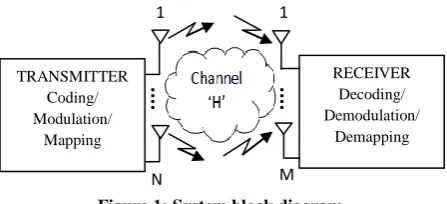
[image:1.595.318.542.372.474.2]The system of multiple antennas consists of three main elements that are transmitter (Tx), channel (H) and receiver (Rx). The block diagram of system model is shown below,
Figure 1: System block diagram
At the transmitter there are 1,2,3...N transmitting antennas and at the receiver there are 1,2,3...M receiving antennas. Before transmission of signal from N transmitter they are encoded using principle of orthogonality ,after that are modulated using any of BPSK, QPSK, QAM or any other else modulation technique due to the reason of high transmission rate .These signals are then mapped on the basis of their signal constellations based on employed modulation scheme. At the receiver side the same process reverses and the signal is received by M receiver are demapped, demodulated and decoded and finally required signal is obtained. The channel ‘H’ is wireless medium through which signal transmit from transmitters and reach to receivers. The channel matrix can be represented as, H
(1)
Where represents path gain from transmit antenna to receive antenna . The path gains are considered to be independent complex Gausian random variables with variance 0.5. The channel (H) is to be considered as a quasi-static Rayleigh fading .it means path gain will be constant within a
25 frame and vary from frame to frame of length ‘’.The overall
MIMO signal model is described as ,
(2)
Where,
= received signal at receiver antenna at time slot .
= path gain from transmit antenna to receive antenna .
= signal transmitted from transmit antenna at time slot . noise at receive antenna at time slot .
Every noise is modeled as independent identically distributed AWGN random variable with variance N/ (2 SNR). The average energy of the symbols transmitted from each transmitting antenna is one. The maximum likelihood detector at receiver computes the decision metric,
(3)
Over all code words is,
The ML detector makes a decision in favor of code word that minimizes above sum (2).
3.
SPACE-TIME BLOCK CODING
3.1
Encoding
In a space time block coding scheme the signal are encoded in a transmission matrix . The matrix will be of order x N where is 1, 2, 3... time slot and N is the number of
transmitting antennas. The matrix constitutes linear
combinations of signals variables x1, x2, x3...xk and their
conjugates. Considering for two transmitting antennas, the transmission matrix for [16] is represented as,
(4)
Where, rows represents time slot ‘ ’ and columns represents transmitting antennas. Signal transmission employs signals constellation with 2b elements, where b is number of bits for employed modulation scheme.
In Alamouti’s et al, uses two transmit antennas regardless of the number of receive antennas. The transmission matrix is
represented as,
(5)
Where, and are signals and and are respective conjugate of and .
In this the row represents transmission of signal at different time slot and columns represents transmission of signal through different antennas .These orthogonality of signal allows a simple decoding scheme. In matrix , time slots are used to transmit symbols.
Symbol Rate of any block code is given by the formula:
Symbol Rate ( ) = where , – number of transmitting symbols and - number of time slots
For the rate = 2/2, so rate of is 1.
For four transmitting antennas is a transmission matrix and is represented as,
(6)
The code rate of , = ½.
3.2
Decoding
Decoding is performed at the receiver side. For linear processing of signals maximum likelihood decoding is employed in space time block code. In case of space time block code , if there are 2b signals in the constellation ,then at time slot one 2b bits arrive at the encoder and select two complex symbols and . The symbols and are simultaneously transmitted from antenna one and two respectively.
The maximum likelihood detector minimizes the decision metric [16] over all possible values of signals and .
(7)
The minimized value of and at receiver is the estimates of and . After expanding and deleting the independent terms of the codewords of the above eq. (6) the minimization will be equivalent to [16],
(8) The above equation decomposes in two parts one of which is a function of as [16],
(9)
(10)
Then for detecting above equation is equivalent to minimizing the decision metric to,
(11)
and for detecting above equation is equivalent to
minimizing the decision metric to,
(12)
Similarly, the decoders for can be obtained.
4.
SIMULATION
RESULTS
AND
ANALYSIS
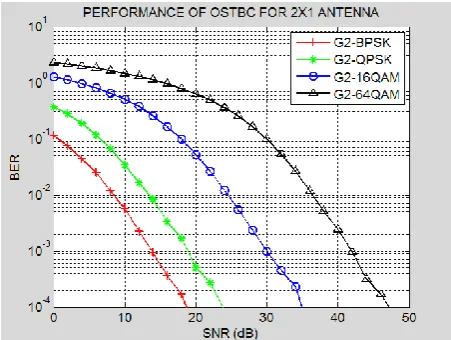
Simulations are done in MATLAB [17] using Rayleigh fading channel. From the below figure 2 and 3 using matrix for 1 and 2 receive antennas , it is observed that as number of receiving antenna increases at particular BER the SNR value decreases ,that is power of signal transmission requirement is less.
In both figure 2 and 3 BPSK has gain over QPSK, 16-QAM
and 64-QAM. At BER 10-4 BPSK have 5dB, 16dB and 28dB
gain over QPSK, 16QAM and 64QAM.
[image:3.595.317.543.70.241.2]In figure 4,5,6 and 7 simulation are done using four transmitting antennas and 1,2,3 and 4 receiving antennas respectively using as encoding matrix. It is observed that as number of receiving antennas increases at particular BER the SNR value decreases. In all figure 4, 5, 6 and 7 BPSK has gain over QPSK, 16QAM and 64QAM.
[image:3.595.317.544.272.447.2]Figure 2: Two transmit and one receive antenna
[image:3.595.317.544.476.651.2]Figure 3: Two transmit and two receive antenna
Figure 4: Four transmit and one receive antenna
[image:3.595.55.281.570.740.2]27 Figure 6: Four transmit and three receive antenna
Figure 7: Four transmit and four receive antenna
[image:4.595.56.282.73.243.2]The below figure 8 shows bar chart of SNR requirement for each modulation technique for various diversity order of the system at BER 10-4.
Figure 8: Performance of OSTBC at BER 10-4
[image:4.595.55.281.262.435.2]The below figure 9 shows bar chart of SNR requirement for each modulation technique for various diversity order of the system at BER 10-3.
Figure 9: Performance of OSTBC at BER 10-3
The below table 1 shows the total transmission rate for each system of antennas on the basis of code rate of and for each modulation technique.
Table 1. Total transmission rate for various antennas at transmitter and receiver
Antennas (Nt x Nr)
Code rate
Total transmission rate (bits/sec/Hz) Modulation
BPSK QPSK 16 -
QAM 64 - QAM
2X1 1 1 2 4 6
2X2 1 1 2 4 6
4X1 1/2 0.5 1 2 3
4X2 1/2 0.5 1 2 3
4X3 1/2 0.5 1 2 3
4X4 1/2 0.5 1 2 3
5.
CONCLUSION
This paper provides the basic overview of the MIMO systems. The space-time block coding is provided for 2 and 4 transmitting antennas. Various modulation technique are employed to each configuration of number of transmit and receive antennas. It is observed that as diversity increases the performance of OSTBC (Orthogonal Space-Time Block Code) increases and requirement of power of signal for transmission is less. Also higher transmission rate can be achieved by employing higher order modulation technique.
6.
REFERENCES
[1] Hamid Jafarkhani “Space-time coding theory and
practice” Cambridge University Press 2005.
[2] David Gesbert, Mansoor Shafi,. From theory to practice: an overview of MIMO space-time coded wireless systems[J]. IEEE J. Select. Area.Commun., 2003, 21(3): 281-302R. Nicole, “Title of paper with only first word capitalized,” J. Name Stand. Abbrev., in press.
[3] G. Foschini and M. Gans, “On limits of wireless communications in a fading environment when using multiple antennas,” Wireless personal communications, vol. 6, no. 3, pp. 311–335, 1998.
[4] Michael Joham, Linear Transmit Processing in MIMO Communications Systems [J]. IEEE Transactions on SignalProcessing, 2005, 53(8): 2700-2712.
[5] A. Molisch, Wireless Communications. Wiley-IEEE
[image:4.595.56.284.500.647.2][6] S.M.Alamouti. A simple transmit diversity scheme for wireless communication[J]. IEEE J. Select.Area. Commun. , Oct 1998, 16(8): 1451-1458.
[7] J. Winters, J. Salz, and R. D. Gitlin, “The impact of antenna diversity on the capacity of wireless communication systems,” IEEE Trans.Commun., vol. 42. no. 2/3/4, pp. 1740–1751, Feb./Mar./Apr. 1994.
[8] H. Niu and Ngo, “Diversity and Multiplexing Switching
in 802.11 n MIMO Systems,” in Signals, Systems and Computers, 2006. ACSSC’06. Fortieth Asilomar Conference on, 2006, pp. 1644–1648.
[9] V.Tarokh, H.Jafarkhani and A.R.Calderbank. Space-time
block codes from orthogonal designs[J]. IEEE Trans. On IT., July 1999, 45(5): 1456-1467.
[10]Tarokh V, Seshadri N, Calderbank A R. Space-time codes for high data rate wireless communication: performance criterion and code construction[J]. IEEE Trans.on I.T., 1998, 44(2):744-765.
[11]A.F.Naguib, R.Calderbank. Space-time cods for high data rate wireless communications[J]. IEEE Signal Processing Magazine, 17(3): 76-92.
[12]V.Tarokh, H.Jafarkhani and A.R.Calderbank, The
application of orthogonal designs to wireless
communication,” in Proc. IEEE Information Theory Workshop, Killarney, Ireland, June 1998, pp. 46–47. [13]Zhang Zhen-chuan, Li Ying Research on OSTBC Over
Rayleigh Fading Channels and Its Performance Simulation IEEE Conf, 978-1-4244-3709-2/10.
[14]J. Winters, “On the capacity of radio communication systems with diversity in a Rayleigh fading environment, ” IEEE Journal on Selected Areas in Communications, vol. 5, no. 5, pp. 871–878, 1987.
[15]J.-C. Guey, M. P. Fitz, M. R. Bell, and W.-Y. Kuo, “Signal design for transmitter diversity wireless communication systems over Rayleigh fading channels,” in Proc. IEEE VTC’96, Apr. 1996, pp. 136–140.
[16]Tarokh V,Jafarkhani H,Calderbank A R. Space-time
block coding for wireless communications: performance
results[J]. IEEE Journalon selected areas in
communications, 1999, 17(3): 451-460.