Georgia State University Georgia State University
ScholarWorks @ Georgia State University
ScholarWorks @ Georgia State University
Educational Policy Studies Dissertations Department of Educational Policy Studies
Fall 12-18-2014
Beyond Your Perception: An Exploratory Study of Black
Beyond Your Perception: An Exploratory Study of Black
Parent-Daughter Relationships and Hip Hop Influences on Adolescent
Daughter Relationships and Hip Hop Influences on Adolescent
Girls
Girls
Sherell A. McArthur
Follow this and additional works at: https://scholarworks.gsu.edu/eps_diss
Recommended Citation Recommended Citation
McArthur, Sherell A., "Beyond Your Perception: An Exploratory Study of Black Parent-Daughter
Relationships and Hip Hop Influences on Adolescent Girls." Dissertation, Georgia State University, 2014. https://scholarworks.gsu.edu/eps_diss/116
BEYOND YOUR PERCEPTION: AN EXPLORATORY STUDY OF BLACK
PARENT-DAUGHTER RELATIONSHIPS AND HIP HOP INFLUENCES ON
ADOLESCENT GIRLS
by
Sherell A. McArthur
A Dissertation
Presented in Partial Fulfillment of Requirements for the
Degree of
Doctor of Philosophy
in
Social Foundations
in
the Department of Educational Policy Studies
in
the College of Education
Georgia State University
Atlanta, GA
ACCEPTANCE
This dissertation, BEYOND YOUR PERCEPTION: AN EXPLORATORY STUDY OF BLACK PARENT-DAUGHTER RELATIONSHIPS AND HIP HOP INFLUENCES ON ADOLESCENT GIRLS, by SHERELL A. McARTHUR, was prepared under the
direction of the candidate’s Dissertation Advisory Committee. It is accepted by the committee members in partial fulfillment of the requirement for the degree Doctor of Philosophy in the College of Education, Georgia State University.
The Dissertation Advisory Committee and the student’s Department Chair, as representatives of the faculty, certify that this dissertation has met all standards of excellence and scholarship as determined by the faculty. The Dean of the College of Education concurs.
_____________________________ ______________________________ Joyce E. King, Ph.D. Janice Fournillier, Ph.D. Committee Chair Committee Member
_____________________________ ______________________________ Kristen L. Buras, Ph.D. Layli Maparyan, Ph.D.
Committee Member Committee Member
_____________________________ Date
_____________________________________ William L. Curlette, Ph.D.
Chair, Department of Educational Policy Studies
______________________________________ Paul A. Alberto, Ph.D.
Dean
AUTHOR’S STATEMENT
By presenting this dissertation as a partial fulfillment of the requirements for the
advanced degree from Georgia State University, I agree that the library of Georgia State University shall make it available for inspection and circulation in accordance with its regulations governing materials of this type. I agree that permission to quote, to copy from, or to publish this dissertation may be granted by the professor under whose direction it was written, by the College of Education’s director of graduate studies and research, or by me. Such quoting, copying, or publishing must be solely for scholarly purposes and will not involve potential financial gain. It is understood that any copying from or publication of this dissertation which involves potential financial gain will not be allowed without my written permission.
NOTICE TO BORROWERS
All dissertations deposited in the Georgia State University library must be used in
accordance with the stipulations prescribed by the author in the preceding statement. The author of this dissertation is:
Sherell A. McArthur
Department of Educational Policy Studies College of Education
Georgia State University Atlanta, GA 30302-3977
The director of this dissertation is:
Dr. Joyce E. King
Department of Educational Policy Studies College of Education
CURRICULUM VITAE
Sherell Anjel McArthur
ADDRESS: 5243 Rockborough Trail
Stone Mountain, GA 30083
EDUCATION:
Ph.D. 2014 Georgia State University
Educational Policy Studies, Social Foundations
M.A. 2006 University of Maryland-College Park
Educational Policy Studies
B.A. 2004 Psychology
PROFESSIONAL EXPERIENCE:
2009-2013 Graduate Research Assistant
Alonzo A. Crim Center for Urban Educational Excellence
Georgia State University
2012-2014 Graduate Teaching Assistant
Educational Policy Studies
Georgia State University
2007-2010 Elementary School Teacher
Fulton County Board of Education, Atlanta, GA
2006-2007 Elementary School Teacher
Clayton County Board of Education, Jonesboro, GA
PROFESSIONAL ORGANIZATIONS:
American Educational Research Association
American Educational Studies Association National Association for Multicultural Educators Georgia Educational Research Association
PUBLICATIONS:
King, J. E., Goss, A. C., and McArthur, S. (2014). Recovering history and the “Parent Piece” for cultural well-being and belonging. In J. E. King & E. Swartz (Eds.), Re-Membering History in Student and Teacher Learning: An Afrocentric Culturally-Informed-
Praxis. New York: Routledge.
PRESENTATIONS:
Muhammad, G. and McArthur, S. (2014, March). Adolescent girls’ interpretation of Black girlhood in the media. Paper presented at the Southeastern
McArthur, S. and Edwards, E. (2013, November). Hip-Hop: Bridging the gap between teachers and African American girls. Paper accepted at the National Association for Multicultural Education Conference, Oakland, California.
Edwards, E. and McArthur, S. (2013, November). Using a hip hop pedagogy to bridge the gap between teachers and Black girls. Paper presented at the American Educational Studies Association Conference, Baltimore, Maryland.
McArthur, S. (2013, November). Black girls, hip hop and parents. Paper presented at the American Educational Studies Association Conference, Baltimore, Maryland.
King, J.E., Goss, A. and McArthur, S. (2012, April). Engaging parents in culturally authentic assessment of heritage knowledge and contextualized teaching for Black middle school parents. Panel presentation at the American Educational Research Association Conference, Vancouver, British Columbia.
McArthur, S. (2011, October). Teacher, “If you don’t go, who will?” Paper presented at the Southeast Philosophical Education Society Conference, Atlanta, Georgia.
McArthur, S. (2011, April). The value of lifelong learning. Paper presented at the Sources Conference, Atlanta, Georgia.
ABSTRACT
BEYOND YOUR PERCEPTION: AN EXPLORATORY STUDY OF BLACK PARENT-DAUGHTER RELATIONSHIPS AND HIP HOP INFLUENCES ON
ADOLESCENT GIRLS by
Sherell A. McArthur
This study is situated at the nexus of three bodies of literature and research and sought to
contribute to all three: the socialization of Black girls, hip hop as a pedagogical tool and
critical media literacy. My research explored how might the Black parent-daughter
relationship serve as a vehicle by which the girls come to understand, submit to, and/or
resist the stereotypical images prevalent in the hip-hop culture? I co-created a critical
media literacy collective with high school, African American girls where we explored
personal identity development in relationship to representations of African-American
women in the media. It was through my interactions with the girls in this collective,
named Beyond Your Perception (BYP). Through this collective, the primary data
sources were qualitative interviews, focus groups, and documents. A thematic analysis
revealed Black girls represent the dominant narratives within the cultural movement of
hip hop by ascribing to cultural mores like fashion trends, hairstyles and language. They
also consciously choose to resist the stereotypical imagery (e.g., loud, angry, sexually
loose, etc.) and are able to compose powerful counter-narratives to the monolithic
depictions of Black women in the media. By examining the data it was evident that
parents engage with hip hop media by listening to the music and watching television
shows and music videos, however the ways in which they engage their daughters in
dialogue pertaining to the messages within hip hop media is sporadic and suggests the
need for the creation of collaborative and emancipatory spaces for Black girls, media
BEYOND YOUR PERCEPTION: AN EXPLORATORY STUDY OF BLACK
PARENT-DAUGHTER RELATIONSHIPS AND HIP HOP INFLUENCES ON
ADOLESCENT GIRLS
by
Sherell A. McArthur
A Dissertation
Presented in Partial Fulfillment of Requirements for the Degree of Doctor of Philosophy
in
Educational Policy Studies in
the Department of Educational Policy Studies in
the College of Education Georgia State University
Copyright by Sherell A. McArthur
ii
ACKNOWLEDGMENTS
This dissertation has truly taken a whole village of mentors, family, and friends
in order to come to fruition. Much thanks to the department of Educational Policy Studies at
Georgia State University for allowing me to serve as a GTA. HUGE thanks to the Alonzo A.
Crim Center of Urban Educational Excellence for five years of support as a graduate student!
BYP, know that when it comes to sisterhood I am serious about my commitment to you. Without
your transparency this dissertation could, and would not, be what it is. I have learned from you
and hopefully all who read this study will learn from you too. I will always be your big sister! To
my mentors: Dr. Joyce King. WHEW! This dissertation is quite an effort, from beginning to end.
My beginning with curriculum and instruction, through many changes and ending up back where
I started. Thank you for all of your support throughout this entire doctorate process. Your
wisdom, advice, and incredible editing skills are immeasurable! I love you and thank you
immensely. Drs. Janice Fournillier, Kristen Buras, and Layli Maparyan, I thank you for all of
your wisdom, support and encouragement. Dr. F, often I had to repeat your wisdom: Drop by
drop bucket ah fill up. You all are an incredible dissertation committee! Dr. Duhon, I met you at
Grambling State University over 14 years ago, and it was you who told me that I would continue
on to get a Ph.D. one day. I followed your advice and your mentorship and am so grateful to
have you as a big sister.
To my family: Mommy and Pop, there are not words enough to explain how much your
support, in each and every way, enabled me to continue to see this doctorate dream come to
fruition. I could not begin to thank you enough! PARKER, you are the reason I continued to
fight. You kept me focused. You are fun. You are my friend. You are my first real and true,
iii
blessing! Grandma Davis and J.R., I hope you know just how much your spirit energy fueled me
through this, especially at the end. I knew you were with me. I know you are with me. This Ph.D.
is in your honor.
To my friends: Latasha, LaTeka, Tashuan, and Gholdy, you four are my besties! You
have allowed me to be who I am, unapologetically, and there is no way to thank you enough for
that. I don’t call you friend, I call you sister! Drs. Adrienne Goss and Angela Bullock…man! I
made it! I owe you so much. Thank you for being open about your processes to help me
maneuver through mine. Erica, you’re my homie for life! Nuff said. To my linesisters: I thank
you for encouraging me throughout this process. Thank you for allowing me to cry and vent.
Big, big thanks to all of my friends for picking up the check when I did not have the funds. When
v
TABLE OF CONTENTS
LIST OF TABLES………..……….vii
LIST OFFIGURES……….viii
1INTRODUCTION………..…...1
Problem………...………..……...1
Research Questions……...………..……...5
Statement of Purpose………...6
Significance………...7
Key Terms………...9
Assumptions and Limitations……….………...11
Back Story………...12
Overview………...16
2 REVIEW OF THE LITERATURE………...18
Socialization………..……...18
Critical Media Literacy……….…...36
Hip Hop………. ………...38
Hip Hop Pedagogy and Critical Media Literacy……….…...52
Summary……….…...58
3 METHODOLOGY………..………...59
Epistemology……….…...59
Collective Case Study……….…...60
Theoretical Perspectives……….…...62
Method……….…...68
Procedure……….…...72
Implementation: Beyond Your Perception……….…...78
Data Management……….…...84
Data Analysis……….…...84
Role of the Researcher & Representation……….…...87
Summary……….…...89
4FINDINGS………..……...91
Black Girls Experience, Embody, and or Resist Hip Hop Media Hegemony………...95
Theme 1: Black Girls Representin’&Resistin’……….…….…...98
Parents’ Role in Mediating Hip Hop Media Influences….……...122
Theme 2: “Parents’” Media Literacy………….……….…...123
Implications for Pedagogical Intervention………..…...145
Theme 3: Media Literate Teachers..………..……...148
vi
5 DISCUSSION ………...……...160
Introduction………..…………...160
Womanist-Ecological Perspective………...……...161
Discussion………..………...167
Implications for Practice……..………...174
Significance for Education Policy and Research………….………...…...177
Future Research………...186
Conclusion.………...187
References…….………...191
vii
LIST OF TABLES
TABLE PAGE
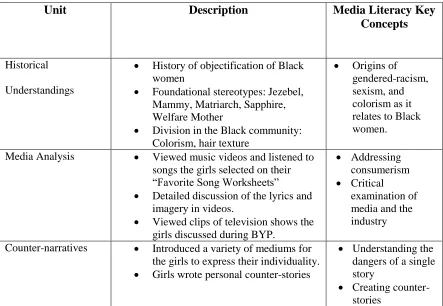
1: Beyond Your Perception Curriculum Overview 79
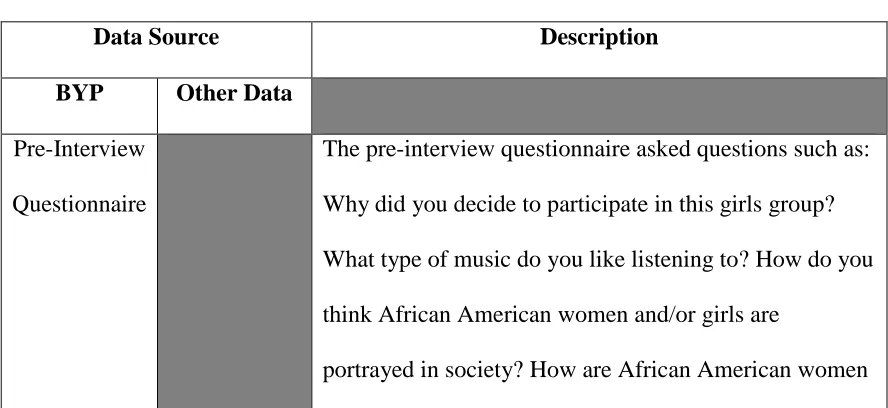
2: Data Sources 80
3: Themes Developed from the Research Study 93
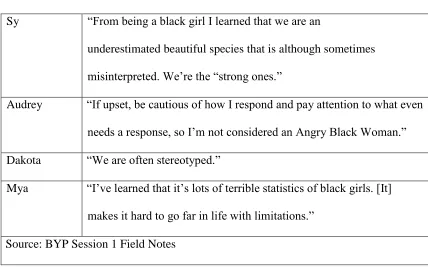
4: Day One Ice-Breaker “What I’ve Learned about Being a Black Girl” 96
5: BYP Ice-Breaker, Session 1: Personal Slogans 114
6: BYP Activity, Session 10: Counter-story for Stereotypes 119
7: BYP Activity, Session 24: Personal Counter-stories 139
viii
LIST OF FIGURES
FIGURE PAGE
1: Focus Group 2 Conversation Black Girls’ Representin’ and Resistin’ 99
2: Aaliyah’s Profile How Aaliyah Experiences Hegemony in Hip Hop Media 100
3: Kai’s Profile Kai and the Angry Black Woman Trope 103
4: Audrey’s Profile: Audrey and Female Rappers Reifying Patriarchal Views 105
5: Devon’s Profile: Devon and Accountability 108
6: Mya’s Profile: Mya and Fashion Trends 111
7: Sy’s Profile: Sy and Intergenerational Engagement in Hip Hop 112
8: Dakota’s Profile: Dakota Resists 115
9: Milan’s Profile: Milan Resists by Faith 120
10: Parents Find Hip Hop Media “Entertaining” 124
11: Mrs. Johnson’s Profile: Mrs. Johnson and Disciplined TV Viewing 125
12: Mrs. Carter’s Profile: Mommy-Daughter Time 128
13: Jamarcus’ Profile: Big Brother Talks 132
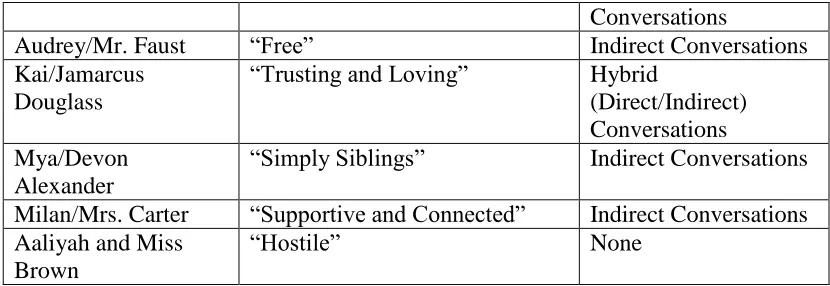
14: Miss Ballard’s Profile: A Contentious Relationship 140
15: Miss Brown’s Profile: Two Ships Passing in the Night 143
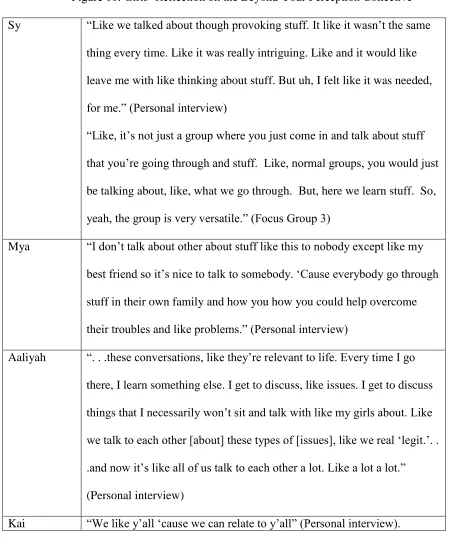
16: Girls’ Reflection on the Beyond Your Perception Collective 148
1 CHAPTER 1
INTRODUCTION
Now imagine there’s a shorty, maybe five maybe four. Ridin’ ‘round with his mama listening to the radio. And a song comes on and a not far off from being born, doesn’t know the difference between right and wrong. Now I ain’t trying to make it too complex, but let’s just say shorty has an undeveloped context about the perception of women these days. His mama sings along and this what she says, “Niggas, I’m a bad bitch, and I’m bad bitch. Something that’s far above average” and maybe other rhyming words like cabbage and savage and baby carriage and other things that match it. Couple of things are happenin’ here, first he’s relatin’ the word “bitch” with his mama-comma, and because she’s relatin’ to herself, his most important source of help and mental health, he may skew respect for dishonor.
–Lupe Fiasco “Bitch Bad” 20121
Problem
This description of the problem addresses the socialization messages African
American female adolescents receive, the hip hop cultural movement as an educative site,
and the role of parents and educators in countering the dominant scripts and facilitating
media literacy among African American adolescent females. Those born between 1965
and 1984, the first hip hop generation, have entered adulthood and middle age and now
have children impacted by the same musical content and imagery that also influenced
them (Kitwana, 2002). Further, while young people all over the world today identify
with and use popular culture to define themselves, this is so for hip hop’s second
generation of African American youth as well as their the parents.
1 Waco, J., Jordan, D., Giannos,J. and Boyd, J. (2012). “Bitch Bad”. [Recorded by Lupe Fiasco]. On Food
2
Hip hop is now intergenerational. For many of the millennial generation their
parents, and possibly their grandparents, listen to the music. Further, these parents engage
with hip hop media through viewing television shows and films. Hip hop is becoming
more pervasive. Attention must be called to the ways in which our youth create authentic
selves, especially since the cultural movement of hip hop has been appropriated and
endorses monolithic representations of Black women and men. Research must examine
how Black women and girls move beyond the limited imagery of them presented in the
media. It also needs to explore how young Black women, involved in the cultural
movement of hip hop, create and sustain positive self-identity while consuming
monolithic and misogynistic messages in hip hop media. Examples of these monolithic
messages include: sexually immoral, overly aggressive, angry, loud, and on welfare.
Brown (1993) states that socialization messages African American female
adolescents receive is “of critical importance because African American girls are
bombarded early with negative messages about their worth, intelligence, and beauty” (p.
301). Research shows the impact parental involvement has on socializing children
(Updegraff, Delgado, & Wheeler, 2009; Elmore & Gaylord-Harden, 2013; McHale,
Crouter, & Whiteman, 2003), so what is the role of parents in mediating the impact of
objectifying lyrics and imagery that can be found within hip hop media? “Youth’s
examination of rap music is not without contradictions and confusion because the
messages that rap music transmits are monolithic images of the Black experience”
(Bynoe, 2004, p.34). Therefore, the role of parents and educators is vital in mediating the
messages, facilitating the understanding of critical consumption, and aiding the
3
educators, community leaders, parents and policy makers,” according to Love (2012),
“are going to counter the corporate-manipulated space of Black popular culture, we must
teach our youth how to be media literate…Media literacy and Hip Hop pedagogy have to
become a part of Black girls’ lives as well as the lives of all youth” (p. 108).
Since media culture provides material by which many youth construct their sense
of self there is a greater risk that they will live out the messages they consume (Emerson,
2002; Stephens & Few, 2007; Stephens & Phillips, 2005; Ward, 2004; Ward, Hansbrough
& Walker, 2005). Youth’s consumption of rap music is problematic, especially when
they lack pedagogy that is critical of popular culture. Research indicates some of the
ways that parents are an influential socializing agent and thereby should be able to serve
to aid their children in becoming more media literate (Boykin & Ellison, 1995; Bennett,
2006; Thomas & King, 2007). According to Love (2012):
“Young girls need a space where they feel comfortable resisting demeaning notions of womanhood. They also need teachers who expose popular culture for its contrived messages built on stereotypes but do not demoralize youth choices to consume Hip Hop or any form of popular culture; this is hard pedagogical
technique but is needed, according to the experiences of girls.” (p. 95)
Consistent with Love, Dimitriadis (2001) asserts that educators dismiss or ignore the idea
that Black youth come to understand “notions of self and community outside of school”
(p. x). Much of how Black youth construct identity is forged through their engagement
with popular culture, specifically hip hop.
Hip hop media serves as a critical educational site because it informs Black youth
and becomes their “common culture” (Willis, 1990, p. 30). Educators must find ways to
forge meaningful relationships with students while also, according to Morrell and
4
needed to become critical citizens in a multicultural democracy” (p. 88). Hip hop media,
which includes rap music, acts as an influential bridge between teacher and student.
Willis (1990) wrote that the “common culture” youth created stems from “the
omnipresent cultural media of the electronic age,” which “provide a wide range of
symbolic resources for, and are a powerful stimulant of, the symbolic
work and creativity of young people” (p. 30). By creating their own forms of
entertainment, youth have subsequently invented and negotiated identities. Students’
sense of self, how they relate to others and the world around them is critical to the site of
education.
While I initially conceptualized this study around the consumption of music, I
decided later to open the study to include television, influenced by hip hop media, as
well. Love (2008) states “rap music has become boundless and transcends race, class, and
gender” (p. 8). A revolution in youth culture was launched through the evolution of hip
hop and effects youth’s multiple identities. Television, another form of popular culture,
has nudged its way into this space as well. Aisha Durham (2010) refers to the music in
hip hop and its imagery as hip hop media. There are several television shows, on a variety
of networks, in which hip-hop is the basis. Vh1’s “Love & Hip Hop-New York,” with
spin-off, “Chrissy & Mr. Jones,” as well as “Love & Hip Hop-Atlanta,” with a spin-off in
the making based on a controversial couple, Stevie J and Joseline Hernandez.
Additionally, several hip-hop artists have created television shows: rap mogul Sean
“Diddy” Combs’ “Making the Band” and “Who Wants to Work for Diddy,” William
“Flavor Flav” Drayton’s “Flavor of Love” and subsequent spin-off shows “I Love New
5
“Run’s House,” rapper Clifford “T.I.” Harris’ “Family Hustle,” rapper Jayceon “The
Game” Taylor’s “Marrying the Game” and Bravo channel’s “The Real Housewives of
Atlanta”. Hip-hop continues its reach into film. Three films, “8 Mile,” “Hustle and
Flow,” and “Get Rich or Die Tryin’,” all received academy award nominations. “8
Mile,” starring White rapper Eminem, received the Academy Award for Best Original
Song for “Lose Yourself” from the movie soundtrack. The song was also nominated for
a Golden Globe Award for Best Original Song. “Hustle and Flow” won an Academy
Award for Best Original Song for “It’s Hard Out Here for a Pimp” by rap group Three 6
Mafia. Additionally, rapper 50 Cent’s “Get Rich or Die Tryin’,” based on his life, earned
him a Best New Artist nomination at the Grammy Awards. The cultural movement of hip
hop has expanded to include not only music, but television and film as well. Therefore,
while the contention could be made that parents are not listening to hip hop music the
overall assertion that parents are not consuming hip hop media is problematic.
Research Questions
My overarching research question is how may the Black parent-daughter relationship
serve as a vehicle by which the girls come to know, submit to, and/or resist the
stereotypical images prevalent in hip hop media? The following additional questions
guide my research:
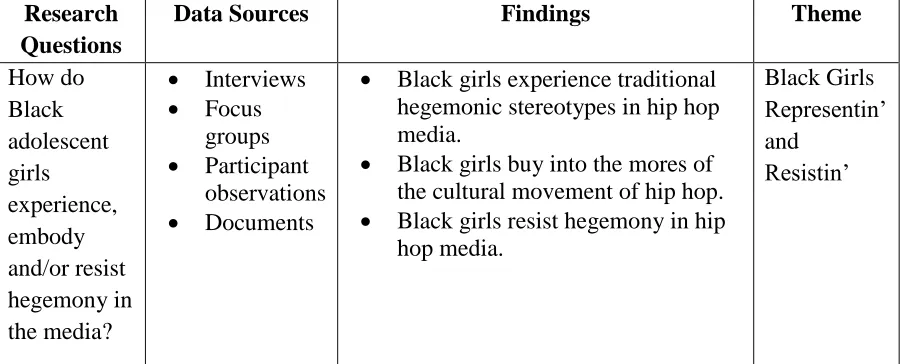
1. How do Black adolescent girls experience, embody and/or resist hegemony in the
media?
2. What is the role of parents in mediating the socialization influences of media on
6
3. What implications might the racialized-gender identities the girls represent have
for pedagogical intervention?
Statement of Purpose
The purpose of this qualitative research study is to understand to what extent and,
if they do, how African American adolescent girls construct their racialized-gender
identity through hip hop. This study further seeks to explore the role of parents as
mediating influences as insiders within the cultural movement of hip hop. Adolescence is
a period when youth construct their identity, but is usually more complex for African
American girls as they must also develop an understanding of the meaning of both their
gendered and racialized selves (Lindsay-Dennis, 2010).
Research shows the impact parental involvement has on socializing children and
Black parents’ roles has also been documented (Updegraff, Delgado, & Wheeler, 2009;
Elmore & Gaylord-Harden, 2013; McHale, Crouter, & Whiteman, 2003). However, there
is little research that specifically focuses on parents’ gender socialization, though Black
parents, concerned about the safety of Black boys have ways to prepare them. This
research asks: What is the role of parents (or other family members) in mediating the
impact of objectifying lyrics and imagery on Black adolescent girls that can be found
within the cultural movement of hip hop? In order to explore this topic, I situate this case
study in Womanism (Phillips, 2006; Maparyan, 2012), while also using ecological
systems theory (Bronfenbrenner, 1979). Both allow the study to explore the multiple
7 Significance
Yeah, now imagine a group of little girls nine through twelve. On the internet watchin’ videos listenin’ to songs by themselves. It doesn’t really matter if they have parental clearance. They understand the internet better than their parents. Now being the internet, the content’s probably uncensored. They’re young, so they’re malleable and probably unmentored. A complicated combination, with no relevance, until that intelligence meets their favorite singer’s preference. ‘Bad bitches, bad bitches, bad bitches. That’s all I want all I like in life is bad bitches, bad bitches’. Now let’s say that they less concerned with him and more concerned with the video girl acquiescent to his whims. Ah, the plot thickens. High heels, long hair, fat booty, slim. Reality check, I’m not trippin’, they don’t see a paid actress, just what makes a bad bitch.
–Lupe Fiasco “Bitch bad” 2012
The significance of this study is its effort to provide empirical data that can
support the use of hip hop—its music and imagery (or what Aisha Durham (2010) refers
to as “hip hop media”)—as a pedagogical tool. Researchers must consider the social
context in which African American youth, specifically girls, are socialized and educated.
When parents and schools condemn hip hop as a cultural movement, these two
socializing agents fail to equip students with the knowledge that they can, and should, be
critical consumers. "Teaching through a Hip Hop-inspired pedagogical and media literacy
approach is culturally responsive pedagogy with possibilities for social action in that
teaching through a culturally relevant framework is restructuring classroom politics”
(Love, 2012, p. 103).
The schooling experience of Black pupils focuses almost exclusively on the
disproportionate number of Black males excluded from school. While the academic needs
of boys of color is a valid concern, examination of government data indicates that they
ought to also extend to Black girls, who are approximately twice as likely to be
8
white female peers (Rollock, 2007). The problem is a structural one. Since much
emphasis has been placed on Black boys in schools, because of their trouble-maker
status, Black girls are frequently left out of the black educational narrative. A review of
the literature shows that when examining gender in schools, researchers usually study
white females. Thus, Black girls are also left out of the discourse on the schooling of
girls. So in the investigation of studies conducted on youth, illuminating their race or
gender, Black girls are most normally excluded. Being excluded from research and the
Black educational narrative also leaves these young women on the outside of initiatives
to help them develop positive gender-racial identity.
Hip hop as a pedagogical tool offers the opportunity to bridge the gap between
teacher and student especially for youth who engage with the culture. Love (2008) states:
“Perhaps, there is no other sound that resonates with our youth like rap music (Ginwright, 2004). Alridge (2005) contended that ‘For many youth, Hip Hop reflects the social, economic, political, and cultural realities and conditions of their lives; speaking to them in a language and manner they understand’. Alridge implied that Hip Hop is a powerful force in shaping the lives of youth, for Hip Hop not only reflects youth reality, it helps create it.” (p. 180)
Raps crossover appeal then impacts television. This broad commercialization of Black
popular culture in the form of hip hop has then affected all that traditionally matters to
youth including, their music, slang, and fashion sense.
Kellner (1995) has suggested that “the ways in which urban youth engage with
Black popular culture is important to education because youth learn about themselves and
others through Black popular culture” (p. 10). Students’ ability to learn does not start
when they enter school; they are engaged outside of the classroom walls by many factors
9
limited to students, family, friends, and popular culture, which is of primary concern
regarding the significance of this study (Giroux & Simon, 1988; Newman, 2006). A
review of the literature shows that African American parents deliver gendered racial
socialization messages primarily to African American boys (Fiese & Skillman, 2000;
Hill, 2001; Varner & Mandara, 2013). Little research has examined gender socialization
specifically for girls in African American families (Hill 2001; 2002; Lewis, 1975).
Research has not explored gender socialization delivered by African American parents
through, within, and in light of the influence of hip hop media.
Key Terms
It is necessary to define key terms that will be used throughout the dissertation. It
is first important to note that over the course of this study, I will use the word "Black"
interchangeably with the word "African American." During data collection, I will use the
term(s) utilized by the participants.
Since this study is explores the influence of popular culture, specifically Black
popular culture and hip hop media, I define those terms next. Popular culture is defined
like Storey (1998), who suggests that popular culture is a site of education that is filled
with “contradictory meanings” (p. 1) about our multiple identities including race, class,
gender, body image, and sexual orientation. I additionally use Alverman’s (2012)
definition of popular culture which “connects a group of people to each other in particular
times and places” (p. 1)/ Many define themselves through the mores of popular culture
allowing the power of popular culture to make representations, authentic or defamatory,
about groups of people. The repetition of these images from “music, literature, art forms,
10
lifestyles” (Alvermann, 2012, p. 1) seeps into society’s psyche and can create conflict in
the ways we are perceived by others or in how we represent ourselves. This is especially
controversial in cases by which the dominant culture is unaware of—or has limited
contact with—marginalized groups and their perception of them from popular culture
mediates how they will treat others. An example of this can be found in the 2012 case of
Trayvon Martin, a young, Black male who was walking home from the store in a hoodie
and was followed and gunned down by a neighborhood watchman. It is quite possible
that the watchman’s idea about Black, male youth was shaped—or rather misshaped—by
popular culture. Black popular culture is derived from Stuart Hall (1983) in his classic
piece, “What is this “Black” in Black Popular Culture.” Hall (1983) defines Black
popular culture as:
“Popular culture, commodified and stereotyped as it often is, is not at all, as we sometimes think of it, the arena where we find who we really are, the truth of our experiences…It is where we discover and play with the identifications of ourselves, where we are imagined, where we are represented, not only to the audiences out there who do not get the message, but to ourselves for the first time.” (p. 28)
It is important that a discussion on the commodification of Black popular culture is
incorporated in the curriculum so that teachers are able to instruct students about these
dynamics in order to explore the politics of power and, in the case of hip hop, the
contrived representations of Black and Brown bodies.
Another significant term is hip hop, and its differentiation from rap. Hip hop is
defined as cultural self-expression that includes graffiti art, DJing, MCing and break
dancing. In this study, however, when “hip hop” is used, it refers to rap music and
media—which includes television inspired by hip hop, music videos, and social media—
11
situated within the space of popular culture, and more specifically, Black popular culture
known as hip hop. Rap music has become a place where Black youth search for their
identities, which is due in large part to Black popular culture representations of Black
youth as the most accessible cultural representation of the Black youth everyday life. A
brief history of rap and its current state will be explored within the review of the
literature.
While this study will explore the impact of hip hop media on adolescent females,
which includes radio, music videos, rap press, television, and social media. Additionally,
while not often stated explicitly, the implication of scripts on the adolescents is inferred.
A script, according to Stephens and Phillips (2003), is a “schema used to…create norms
regarding behavior that are expressed and maintained through their usage (p. 143). It is
important to recognize the representations in hip hop media as more than merely
providing a mental picture. Hip hop media influences public opinion about Black women
and also influences the way Black women and girls view themselves.
Lastly, critical media literacy is defined by Alvermann (2000) as “engaging
students in the analysis of textual images (both print and nonprint), the study of
audiences, and the mapping of subject positions such that differences become cause for
celebration rather than distrust” (p. 194).
Assumptions & Limitations
This study makes some assumptions about urban, Black girls, presuming that they
engage in or with hip hop and that their parents engage in or with hip hop. Additionally,
I assume that the participants’ parents have some ability to decode meanings and
12
are also some important limitations to this study. First, I focus primarily on high school
aged girls and do not explore the experiences adolescent, or young adult women, have
with hip hop music and their parental influence. Second, I will not be able to consider the
impact of hip hop on Black female youth as a whole, but solely on its influence on the
urban, Black high school aged girls in this study. Further, I specifically explore the
relationship between parent and daughter so the perspective on how urban Black males
(sons) interact with hip hop will not be included.
Additionally, girls participating in this study are a part of a program for high
school students to earn college credit before entering a university. That the girls will be
in a setting which has the potential for them to feel uncomfortable, that these discussions
are not being conducted in their own element, is a limitation of this study. Moreover how
one engages with hip hop media can, and, or will vary depending on the girl. The
participants will not be a representative sample of the population. I do, however, want
my study to get at how parents and daughters interact to help craft possible answers to
questions on the influence of popular culture and family socialization on youth.
Back Story
Sure enough, in this little world the little boy meets one of those little girls. And he thinks she a bad bitch and she thinks she a bad bitch. He thinks disrespectfully, she thinks of
that sexually. She got the wrong idea, he don’t wanna fuck her. He think she’s bad at bein’ a bitch, like his mother; Momma never dressed like that, come out the house hot mess like that. Ass, titties, dressed like that, all out to impress like that. Just like that, you
see the fruit of confusion? He caught in a reality, she caught in an illusion. Bad mean good to her, she really nice and smart. But bad mean bad to him, bitch don’t play a part.
But bitch still bad to her if you say it the wrong way. But she think she a bitch, what a double entendre.
–Lupe Fiasco “Bitch bad” 2012
One day I was sitting with a colleague discussing media representations of Black
13
of the multidimensionality of Black women I began ruminating on myself and I realized
that my attitude and actions is outside of the prescriptive boxes that have been labelled
for Black women. In essence, I am beyond your perception. And there in the name of this
collective was born. I needed these girls to understand that who they are is not created by
anyone else and can be beyond the perception of others. The inscription of stereotypes
from the media onto the bodies of Black girls can obstruct them from developing
authentic selves, so who they are has the potential to be beyond their own perception if
they are stuck posturing what Black womanhood looks like based on the representations
available. I needed these young ladies to know that they have the right to decide for
themselves who it is that they were and wanted to be. They could ascribe to the dominant
narrative of Black womanhood or they could create a counter-narrative. Who they are is
a decision they can consciously make. It is negligent in the face of the inundation of hip
hop media to ignore these forms of socialization and education. Hip hop, according to
Baszile (2009), has “not only found its way across various urban landscapes” but it has
also found its way “into the homes of white suburban youth and across the borders of the
U.S. with multiple manifestations in Africa, Asia, and Europe” (p.7). Therefore, to
ignore the vast range of influence these media have on youth is irresponsible.
In 2012, I was invited by my academic advisor to participate in a middle school
program that she and other graduate students created. The “Songhoy Club” was an
after-school program that provided middle-after-school students with an Afrocentric curriculum. I
chose to teach the youth on the historical treatment of Black women from “Hottentot to
Hip Hop.” Months later, my advisor wanted to conduct parent workshops. She invited the
14
about Afrocentric curriculum and pedagogy” (King, Goss & McArthur, 2014, p. 3). I
conducted a similar lesson with the parents as I did with their children in order to explore
the standards and values parents instill within their homes and how that is reinforced or
undermined by the messages in hip hop media. It is my experiences with the parents
during these parent workshops that prompted me to want to explore the role of parents as
mediators of hip hop media influences on youth because these parents were up-to-date on
rap music, artists, and hip hop gossip. These parents were critical of hip hop media,
although they engaged with the cultural movement, and reported having analytical
dialogue with their children about their collective engagement with hip hop media.
According to Kitwana (2002) “as many among the so-called hip hop generation
(those born between 1965 and 1984) enter early adulthood and middle age, hip hop is no
longer solely a youth culture” (p. 23). Hip hop, Dimitriadis (2009) continues, “has all but
defined our contemporary cultural landscape in the United States and around the world”
(p. xi). Rap music is more than just a musical genre in which youth engage, it is also a
form of persuasive, influential rhetoric that has the ability to educate, inspire, or
dehumanize youth in countless different directions.
The song lyrics throughout this introduction represent the ways that youth can
misconstrue the messages that are received both within the lyrical content of rap music,
the imagery in its videos, and the way their parents model their “acceptance” of the
messages. As the song’s beginning, Lupe Fiasco talks about how the word “bitch” can
have different meanings and can, therefore, be interpreted differently based on the
listener or viewer. In one instance, as example, he illuminates how a young woman may
15
has acquired, while a young man may be referring to the woman as a “bitch” based on the
way that she acts. Also, while the young man develops and hears his mother call herself
a “bad bitch” he then relates the term “bitch” to all women. The refrain of this song,
“Bitch bad,” which I have used throughout this introductory chapter, is sung “Bitch bad,
woman good, lady better, they misunderstood” where “bitch bad” portrays the
problematic nature of utilizing the term “bitch” to refer to oneself or others, while
“woman good” speaks to one’s ability to show self-respect and respect for others through
their regard of them. “Lady better,” to use this song as a metaphor, would be the goal of
my work; to influence and re-invite the relationship between Black parents and their
daughters to become stronger, as well as, to aid Black girls in constructing, or
maintaining, positive self-identity. Sections of this introduction have opened with a verse
of Lupe Fiasco’s song to better illustrate the argument that youth are socialized by both
media and parental influences simultaneously.
Young people today are using popular culture to define themselves and to chart their
daily lives. Hip hop has created a global youth culture that began in the United States
and has been mass produced by the media. Hip hop is “as pervasive today, it seems, as
the air we breathe” (Dimitriadis, 2009, p. xi). Hip hop media can superimpose
stereotypical scripts on those a part of the culture, especially African American women
and girls. Scripts have been designed to control Black women, and while Black women
are not the only people who are objectified by scripts, the personification of these women
is conducted in very specific ways that attack Black womanhood. In the culture at large,
including popular culture, white women do not have the ongoing historical constructions
16
Inimical labelling has been the burden of Black women since slavery and hip hop music
is imbued with these stereotypical depictions of Black girls and women.
As a participant in hip hop myself (I enjoy listening to and I purchase the music, I go
to see the artists live, etc.), in no way is it my belief, nor am I implying, that all of the
messages—as defined by lyrical content, video imagery, and artist behavior—within hip
hop are negative. However, according to Durham (2010), “Hip hop media can [also]
recall dominant relations of power by reproducing racist stereotypes about Black female
hypersexuality and by reproducing the logic of capitalism through its familiar trope of the
pimp and ho” (p. 125-126). This “logic of capitalism” is evident when record labels
encourage artists to create music that will receive the most radio airplay, and in the
southern region of the United States, where this study takes place, a Strip Club subculture
of music has now been established. Many rap artists test out new music in strip clubs.
Based on how enthusiastic the dancers are to perform to their music enables the artists to
determine if they have a song which will be widely accepted by their fans. The essence of
hip hop has, in many ways, been bought out through capitalistic notions of success, and
this study will investigate the extent to which this corporate controlled version of hip hop
can instill derogatory and dehumanizing impressions on its listeners.
Overview
This dissertation is composed of five chapters, including this introductory chapter. In
Chapter 2, I present of a review of literature on the socialization of Black girls, critical
media literacy, and hip hop to provide a context for framing Black girls’ experiences with
hip hop media and parents’ role in mediating the influence of hip hop media. In Chapter
17
research findings are presented in Chapter 4, and my final chapter includes a discussion
of the major findings of the research study, and implications for education policy and
future research.
To this end, this study serves to fill the gap in the literature on the impacts of hip
hop media. The purpose of my dissertation is to understand to what extent, and if they
do, how Black girls construct their racialized-gender identity through hip hop media and
18 CHAPTER 2
LITERATURE REVIEW
In order to explore how the Black parent-daughter relationship may serve as a
vehicle by which the girls experience, embody and or resist the stereotypical imagery in
hip hop media, three bodies of literature must be examined: the socialization of Black
girls, critical media literacy, and hip hop. I conclude with a discussion on the necessity of
employing hip hop pedagogy that utilizes critical media literacy in an effort to broaden
discussion and connections with Black girls.
Socialization
Researchers have given considerable attention to how race and class-based
constraints limit the educational pathways of African American adolescents from
low-income backgrounds (O’Connor, 1999). For African American girls, gender also
contributes to unique social and academic risks, which can pose significant threats to
academic achievement (Sanders & Bradley, 2005). Lindsay-Dennis (2009) explains,
“African American adolescent girls are considered to be “at risk” due to racial and gender
discrimination, exposure to pejorative one-dimensional images of Black womanhood,
poverty, early sexual encounters, teenage pregnancy, juvenile delinquency, increased
adult responsibilities, and other forms of victimization” (p 53). Despite these risks, many
African American adolescent girls are academically resilient while others succumb to
environmental stressors. African American girls’ educative experiences must not be
framed as isolated events. These experiences must be assessed in relation to the world
around them. In order to discuss the socialization of Black girls, I provide an overview of
19
that Black women’s racialized-gender include. I follow that synopsis with a review of the
literature of family socialization on Black girls. I conclude this section on socialization
with an overview of media socialization on youth, specifically Black girls.
Stereotypical Scripts of Black Women
Intersecting oppressions of race, class, gender, and sexuality could not
continue without powerful ideological justifications for their existence (Collins,
2000). Since this study explores hip hop media influences on Black girls, I
highlight the four dominant stereotypical images (Jezebel, Mammy, Matriarch,
and Welfare Mother) and how those images have developed into contemporary
controlling images. Stereotypical images throughout history have set African
American women up to be sexually victimized over time. Therefore, she is always
defending her name and her honor. According to hooks (1984) ideas about race
have placed African American females in a complex dual relationship to both
Black culture and the dominant culture. That means that Black women have to
negotiate their racialized-gender in their daily interactions. The double-jeopardy
of being both Black and female in society has continued to create, and reinforce,
an American culture sated with derogatory representations of Black women.
The United States system of slavery was a dehumanizing institution which
left assaults on the bodies and minds of the enslaved. Not only were female
slaves used to toil as assiduously as male slaves, they were also used as breeders.
Williams (1991) stated that “under such a system in which the control of property
is fundamental, enslaved African women were valuable commodities” (p. 51).
20
bodies into an economic good as units of capital. Additionally, as mothers, Black
women’s fertility produced the children who increased their owner’s property and
labor force (Davis, 1981). Slave owners wanted enslaved Africans to breed
because each slave child represented a “valuable unit of property, another unit of
labor, and, if female, the prospects of more slaves” (Collins, 2000, p.78). The
image of breeder claimed that Black women were able to produce children as
easily as animals. An example of the pervasiveness of breeding is found in the
fictional novel, “NightJohn,” which portrays American slavery in the 1850s
through the eyes of the enslaved on a Georgia plantation. Its narrator is Sarny, a
twelve-year-old girl, who relates events that follow the arrival of Nightjohn, an
enslaved adult male, at the plantation of Clel Waller. In this story, Sarny, though
young, is aware of her impending role as that of a breeder. She describes how
“breeding” comes after the enslaved girls’ “time for the troubles,” or their
menstrual cycle (Paulsen, 1995, p. 6). The portrayal of enslaved African women
as breeders provided justification for the governance of enslaved Africans’
reproductive behavior. White (1985) wrote “slave masters wanted adolescent girls
to have children, and to this end they practiced a passive, though insidious kind of
breeding” (p. 101). Black women were a commodity as breeders, and in order to
justify this system she was deemed by White slave owners to be oversexed and
sexually promiscuous. However, slave owners treated the breeding of African
men and women as no different from breeding animals, as enslaved Africans were
treated inhumanely. For example, Sally Heming’s was owned by former President
21
property. So whether African American women’s sexual exploitation took the
form of coercion, rape, or consent, the power slave owners, such as Jefferson,
possessed allowed White men access to Black women’s body. The United States
system of slavery was dehumanizing and disparaging, and was also used as a tool
for sexual gratification by White men.
Enslaved men and women were both assigned field jobs—toiling the soil,
picking cotton, cutting cane, and harvesting tobacco—so in some sense, Davis
(1981) argues, “the oppression of women was identical to the oppression of men”
(p. 6). Davis (1981) continues, “but women suffered in different ways as well, for
they were victims of sexual abuse and other barbarous mistreatment that could
only be inflected on women” (p. 6). Within the institution of slavery, the rape and
sexual exploitation of powerless Black women by powerful White men was the
corollary to dominant controlling images of Black women; as a justification for
the heinous actions carried out against them. Further, the sexual assaults Black
women experienced during slavery and as domestic workers brought justifying
image created by White men in an effort to rationalize their unscrupulous actions.
The following synopsis of the four foundational stereotypes—Jezebel, Mammy,
Matriarch, Welfare mother—will include examples of their contemporary
manifestations.
Jezebel. While historically White women have been portrayed as models
of self-respect, self-control, and even sexual purity Black women have been
portrayed as innately promiscuous, even predatory. This depiction of Black
22
animalistic precedes the institution of slavery in America to when European
explorers traveled to Africa and found natives in tribal attire which the travelers
misinterpreted as carnal, lewd, and erotic. White Europeans, locked into the racial
ethnocentrism of the 17th century, saw tribal attire, dances, and other aspects of
African culture as proof of the African's uncontrolled sexual lust and were thereby
fascinated by African sexuality. The Jezebel stereotype was used as a
rationalization for sexual relations between White men and Black women,
especially during sexual unions involving slavers and slaves. The Jezebel was
depicted as a Black woman with an insatiable appetite for sex, which excused the
slave owners’ assault on her. An example of the stereotype of Jezebel can be
found in the story of Saartje, or Sarah, Baartman. While on display, she was
referred to as the “Hottentot Venus.” Many dehumanizing stereotypes of the
Black female body can be traced back to the “Hottentot Venus” as her body was
seen as “animal like” and “primitive” in the early eighteenth-century while on
display in Europe (Gilman, 1985).
In 1810, Giddings (1995) reports that Saartje Baartman left her tribal
home with European William Dunlop. Researchers are not clear if she was forced,
coerced or persuaded but she, nonetheless, was an exhibit of fascination for
Europeans, excited by the “tales of the exotic, animalistic body of African
women” (p. x). While on exhibit she was presented with a skin colored loincloth
as her only coverage (Gould, 1985) and for an additional fee, viewers could touch
her body. Baartman’s body was one of the first representations to become the
23
and White body (Hall, 1997, p. 265). Cuvier, a French scientist, made
interpretations of Baartman’s anatomy which became the basis of sexual scripts
for women of African descent—primitive, wild, sexually uninhibited, and exotic
(Fausto-Sterling, 1995). Not only did control over her body not belong to her, her
named was changed from Saartjie to Sarah. Renaming was also a power play of
White plantation owners in the United States, to minimize familiarity with their
culture. Our names are a narrative as they are the first introduction we give to the
world. Our names have meaning and a story behind them. Today, much media
renames Black women as “bitch,” “hoe,” “angry,” and “violent.” In order to
redefine, dehumanize and control a people, oppressors first usually attack how
those people have named themselves.
The dehumanization of Black women’s bodies has not stopped with
Baartman, in more contemporary times, various researchers have argued that
present-day examples of the Black female body in popular culture, like hip hop
videos, encourages viewers to focus on the buttocks of Black women, like
Baartman, which suggests that White patriarchy of the Black female body is still
accessible. A modern day example of Baartman is Buffie “the Body” Carruth.
Buffie the Body became a video “model” in 2005 accompanying rap artist Tony
Yayo in his video “So Seductive.” She earned her moniker from the size of her
buttocks. Also new female rap artist Nikki Minaj has much public discussion
surrounding her buttocks as well, and how “unreal” they look. So the awe over
the buttocks and the Black female anatomy that may have begun with Saartje
24
Mammy. The labor niche for Black women of domestic worker, during
and post-slavery, spawned the mammy image. She is viewed as asexual,
nurturing, and willing to put the White family’s needs above the needs of her own
family. One caricature of mammy is Aunt Jemima, “overweight,
dark-skinned…with typical African features” (Stephens and Phillips, 2003, p. 8).
According to Stephens and Phillips (2003) “the Mammy image preserved the
convenient script of the happy, docile, Black female servant during a period when
Black women were transitioning from unpaid house slaves to paid domestic
workers” (p. 9). Post-slavery, a typical Southern tradition for Black girls was to
train for domestic work by doing chores and taking care of younger siblings.
Collins (2000) describes this type of work as “alienated labor,” saying that this
type of work can be “economically exploitative, physically demanding, and
intellectually deadening” (p. 48). Rollins (1985) argues that what made domestic
work more “profoundly exploitative than other comparable occupations” is the
aspect of the personal relationship between employer and employee. The
treatment afforded U.S. Black women domestic workers exemplifies the many
forms that objectification can take; minimally paid, sexually assaulted, demeaned
by being referred to as ‘girl.’ According to Collins (2000), “…calling Black
domestic workers ‘girls’ enable[d] employers to treat their employees like
children, as less capable human beings” (p. 71), an extension of the treatment they
were regarded as slaves. While Black women might have been emancipated as
slaves, their labor as domestic servants still entailed sexual harassment by the man
25
male homeowner to engage in sexual acts, if not raped. A precarious situation:
working to support her family while having to avoid the male homeowner
furtively.
For not engaging in sexual acts, exposing his attempts to his wife or law
enforcement, and a slew of other circumstances beyond her control, African
American domestic workers were often fired without notice and without a
reference to seek employment. With no financial resources, minimal options and
no education, domestic work became Black women’s labor niche. According to
Collins (2000):
“Black women wanted to withdraw from the labor force, not to mimic middle-class White women’s domesticity but, rather, to strengthen the political and economic position of their families. Their actions can be seen as a sustained effort to remove themselves from the exploited labor force in order to return the value of their labor to their families and to find relief from the sexual harassment they endured in domestic service. While many women tried to leave the paid labor force, the limited opportunities available to African American men made it virtually impossible for the majority of Black families to survive on Black male wages alone.” (p.54)
Some domestic workers were able to thwart their employers’ attempts while many
more were not. The sexual exploitation of black domestic workers, especially
live-in maids was commonplace. They were violated against their will routinely
as almost a condition of employment. Similarly, with limited acting and modeling
opportunities for Black women, some try to gain access to that industry by first
becoming “video models.” Many of these positions like domestic work, employs
sexual coercion and assault as a typical condition of employment.
Matriarch. This image of the Black woman is seen as overly aggressive
26
(1965) notes that the Black matriarchy theory argued that “African American
women who failed to fulfill their traditional womanly duties at home contributed
to social problems in Black civil society” (p. 76). Spending too much time away
from home inevitably led to unsupervised children who became failures in school
and a burden on society. Assuming that Black poverty in the United States is
passed on intergenerationally via the values of the home environment and parental
structure, Collins (2000) further notes that “dominant ideology suggests that
Black children lack the attention and care allegedly lavished on White,
middle-class children” (p.76). Additionally, Collins (2000) contends, “portraying African
American women as matriarchs allows White men and women to blame Black
women for their children’s failures in school and with the law, as well as Black
children’s subsequent poverty” (p.76). Further, as “overly aggressive women,”
Black matriarchs allegedly emasculate their lovers and husbands, and these men,
thereby, either desert their partners or refuse to marry the mother(s) of their
children. Sadly, Black men have bought into this stereotype of the matriarch. The
matriarch, or overly strong Black woman, has also been used to influence “Black
men’s understandings of Black masculinity” (Collins, 2000, p. 76). Claiming that
Black women are less desirable than White women due to their assertive nature.
Years of single Black women raising sons and daughters for less pay than their
White female and male counterparts are never considered in their assertiveness.
The image of the matriarch persists and often finds many Black women feeling as
27
The matriarch image allows White men and women to blame Black
women for their children’s mistakes in schools and society, the continuation of
Black poverty and economic disadvantages having spawned from the lack of
attention Black mothers placed on their children’s care and education. The
Moynihan Report (1965) contends that slavery destroyed Black families by
creating reversed roles for men and women. Black family structures are seen as
being deviant because they challenge the patriarchal assumptions underpinning
the traditional family ideal. Moreover, the absence of Black patriarchy is used as
evidence for Black cultural inferiority (Collins, 2000). Therefore, the image of the
matriarch also supports racial oppression.
Welfare mother. Governmental assistance in the form of welfare benefits
was created for White women whose husbands had gone off to war and who
needed financial supplements. As long as poor Black women were denied social
welfare benefits, there was no need for the stereotype of the welfare mother,
however, when U.S. Black women demanded and gained equity to access state
services, the need for this controlling image arose. This image has been
developed for Black women who use welfare benefits. However, while Black
women are not the only people who utilize this form of governmental assistance,
they are the only ones degraded for using benefits they are entitled to by law.
The welfare mother has transmuted to the welfare queen. The term
“welfare queen” was coined during the Reagan era in an effort to paint a portrait
of Black women fraudulently collecting excessive benefits, so that these benefits
28
generally used to describe Black women utilizing governmental assistance which
still posits that she does not need the services and is somehow abusing the system.
Contemporary scripts. Many scholars propose that White and African
American females have different gender socialization experiences and develop
clashing ideals about femininity (Collins, 2000; Davenport & Yurich, 1991; King,
1982). Many White females are socialized to adhere to the cult of true
womanhood in which “true” women possess four cardinal virtues: piety, purity,
submissiveness, and domesticity (Collins, 2000; Taylor, Gilligan & Sullivan,
1995). Conversely, according to Lindsay-Dennis (2009) “African American
female family members and friends who serve as African American girls’ primary
socialization agents often do not adhere to the cult of true womanhood” (p. 24).
For these reasons the socialization experiences of Black females and some White
female teachers can be starkly varying and create an incongruent learning
environment. According to Irvine (1990), cultural congruency can only occur
when educators recognize that their lived experiences and gender expectations
may differ from those of their students their students. Teachers must also learn to
view cultural differences between themselves and their students as strengths
rather than primarily as problems to be solved.
In addition to understanding the socialization and history of objectification
of Black women over history, it is critical to this study to explore family
socialization. The socialization messages from parents and siblings are significant
to this study because “parent” in this study refers to anyone who maintains the
29 Family Socialization
In the literature on African American adolescent’s psychosocial functioning,
research focuses on racial and ethnic socialization over gender (Bennett, 2006; Brown,
Tanner-Smith, Lesane-Brown, & Ezell, 2007; Hughes, Smith, Stevenson, Rodriquez,
Johnson, & Spicer, 2006). Updegraff, Delgado, and Wheeler (2009) explicitly state,
“Lack of descriptive information about gender dynamics and family socialization process
in ethnic minority and. . .families” (p. 559). Although researchers acknowledge that
racial, ethnic, gender, and class socialization processes shape African American youth’s
racial and ethnic identity black girls’ gender and racial socialization has received less
attention in social science research (Bennett, 2006; Brown et al., 2007; Hughes et al.,
2006). The literature which indicates gender socialization is found within research on
racial and ethnic socialization (Bowman & Howard, 1985; Jones & Shorter-Gooden,
2003; Thomas & Speight, 1999; Thomas & King, 2007). There must be more research
on the racialized-gender socialization of African American females. A review of
socialization literature shows that African American girls receive socialization messages
about strength, nurturance, racial pride, self-defined ideal of beauty, and education (Jones
& Shorter,-Goodson, 2003; Thomas & King, 2007). Socialization involves passing on the
roles, behavior patterns, values, norms, and beliefs of adulthood. Socialization in African
American families also includes preparing youth to fit in broader adult society and their
racial and ethnic communities (Boykin & Ellison, 1995).
Systematic oppressions such as slavery, racism, sexism, and other forms of
societal injustices have created a need for culturally situated survival skills that often