Public Health Theses School of Public Health
Spring 5-15-2015
Surgical Site Infections Following Total Joint
Arthroplasty: An Examination of Microbial Isolates,
Predisposing Patient Factors, and Diagnostic Delay
Brooke BeaulieuFollow this and additional works at:https://scholarworks.gsu.edu/iph_theses
This Thesis is brought to you for free and open access by the School of Public Health at ScholarWorks @ Georgia State University. It has been accepted for inclusion in Public Health Theses by an authorized administrator of ScholarWorks @ Georgia State University. For more information, please contact [email protected].
Recommended Citation
Beaulieu, Brooke, "Surgical Site Infections Following Total Joint Arthroplasty: An Examination of Microbial Isolates, Predisposing Patient Factors, and Diagnostic Delay." Thesis, Georgia State University, 2015.
Surgical Site Infection Following Total Joint Arthroplasty : An Examination of Microbial Isolates, Predisposing Patient Factors, and Diagnostic Delay.
by
Brooke A. Beaulieu
B.S., Georgia Institute of Technology
A Thesis Submitted to the Graduate Faculty of Georgia State University in Partial Fulfillment
of the
Requirements for the Degree
MASTER OF PUBLIC HEALTH
ABSTRACT
Background: Although device-associated total joint arthroplasty (TJA) has the potential to greatly improve recipient quality of life, the occurrence of surgical site infection (SSI) thereafter can render drastically debilitating and costly consequences.
Methods: A retrospective cohort design was used to analyze hospital discharge data from the State Inpatient Database (State of California, years 2009-2011). Descriptive statistics were conducted to establish microbial prevalence and multivariate logistic regression was conducted to examine associations between various patient-centric risk factors and the development of SSI. Interaction terms were evaluated for model inclusion. Finally, elapsed time from TJA operation to infection diagnosis was assessed according to site of TJA, pathogen virulence, and pre-existing comorbidities.
Results: During retrospective review, 1769 infections were detected. The incident rate of infection was 2.70 infections per 100,000 person-days. Staphylococci species were the most prevalent microorganisms (79%), including methicillin-resistant S. aureus (MRSA 24%) and methicillin-susceptible S. aureus
TABLE OF CONTENTS
Approval page ……….5
Acknowledgements ……….…6
Author’s statement ………..7
Notice to borrowers ………...8
CHAPTER 1: INTRODUCTION 1.1 Background ………..…...9
1.2 Purpose ………...9
CHAPTER 2: REVIEW OF THE LITERATURE 2.1 A portrait of total joint arthroplasty in the United States ………..………….10
2.2 Aetiology of TJA surgical site infections.………...………10
2.2.1 SSI classification criteria……….………….11
2.2.2. Causative pathogenic agents………...12
2.2.3 Treatment protocol…………14
2.3 Identified risk factors in the extant literature………...16
CHAPTER 3: ORIGINAL RESEARCH MANUSCRIPT 3.1 Structured abstract ……….….21
3.2 Introduction ……….22
3.3 Methods ………...25
3.4 Results ……….28
3.5 Discussion ………...32
3.6 Conclusions ……….36
3.7 References ………...37
APPROVAL
Surgical Site Infection Following Total Joint Arthroplasty (TJA): An Examination of Microbial Isolates, Predisposing Patient Factors, and Diagnostic Delay.
by
Brooke A. Beaulieu
Approved:
__________________________________________ Committee Chair
__________________________________________
Committee Member
__________________________________________
ACKNOWLEDGEMENTS
AUTHOR’S STATEMENT
In presenting this thesis as a partial fulfillment of the requirements for an advanced degree from Georgia State University, I agree that the Library of the University shall make it available for inspection and circulation in accordance with its regulations governing materials of this type. I agree that permission to quote from, to copy from, or to publish this thesis may be granted by the author or, in his/her absence, by the professor under whose direction it was written, or in his/her absence, by the Associate Dean, School of Public Health. Such quoting, copying, or publishing must be solely for scholarly purposes and will not involve potential financial gain. It is understood that any copying from or publication of this dissertation which involves potential financial gain will not be allowed without written permission of the author.
NOTICE TO BORROWERS
All theses deposited in the Georgia State University Library must be used in accordance with the stipulations prescribed by the author in the preceding statement.
The author of this thesis is: Brooke A. Beaulieu
800 Peachtree St. NE, #8309 Atlanta, GA 30308
The Chair of the committee for this thesis is:
Richard Rothenberg, MD, MPH
Division of Epidemiology and Biostatistics School of Public Health
Georgia State University Atlanta, Georgia 30302-‐3995
Users of this thesis who not regularly enrolled as students at Georgia State University are required to attest acceptance of the preceding stipulation by signing below. Libraries borrowing this thesis for the use of their patrons are required to see that each user records here the information requested.
CHAPTER I: Brief Introduction
1.1 Background
Modern surgical procedures provide avenues to considerably improve recipient quality of life. However, though benefits of surgery abound, there are inherent risks associated with all surgical procedures. One of the most common, and devastating, complications of surgery is the occurrence of surgical site infection (SSI). Encompassed under the broader categorization of healthcare-associated infections (HAI), SSI comprise almost one third of all infections associated with seeking healthcare and inflict significant burden unto both the patient and the healthcare system. Risk factors for contracting SSI vary according to patient attributes, hospital characteristics, and type of surgical procedure. Additionally, resulting morbidity and the severity thereof can fluctuate with the causative pathogenic agent, time at which the infection was detected, and the rectifying treatment. As such, an epidemiologic understanding of how various risk factors and interventions contribute to the overall risk of infection remains an imperative pursuit in the mitigation and reduction of postoperative infections.
1.2 Purpose of the study
CHAPTER II: Review of the Literature
2.1 A portrait of total joint arthroplasty in the United States.
Total joint arthroplasty (TJA) is an orthopedic operation that aims to increase mobility and relieve pain by reconstructing deteriorated joints in the musculoskeletal system. The vast majority of TJA operations comprise total hip arthroplasty (THA) and total knee arthroplasty (TKA). In the past decade, the cumulative number of TJA operations performed in the United States exceeded two million1. Further, due to the growth of both the aging and obese populations, the anticipated number of TJA operations is projected to skyrocket1,2. Therefore, the economic and personal burdens associated with complications resulting from TJA should be given considerable attention.
2.2 Aetiology of TJA surgical site infections.
2.2.1 Classification of SSI
Standardized definitions of surgical site infection are crucial to HAI surveillance efforts; such definitions heavily guide how infections are identified, and sequentially, how incident rates of SSI are determined. For TJA and other implant- or device-associated surgeries, an infection is defined as SSI if: it occurs within one year of surgery, it appears to be related to the initial arthroplasty operation, there is purulent drainage from the surgical site, and there is evidence of infection in either the deep soft tissue or organ/space5. Specific criteria for the diagnosis of SSI can be found in Figure 1.
Figure 1. Definition criteria for surgical site infection following implant-related operations.
Deep Incisional SSI Organ/Space SSI
If within one year of surgery for implantation AND
Infection appears to be related to the operation AND
Infection involves deep soft tissues of the incisions and at least one of the following:
1. Purulent drainage from the deep incision but not from the organ/space component of the surgical site.
2. A deep incision spontaneously dehisces or is deliberately opened by a surgeon when the patient has at least one of the following signs or symptoms: fever (>38°C), localized pain, or tenderness, unless site is culture-negative.
3. An abscess or other evidence of infection involving the deep incision is found on direct examination, during reoperation, or
by histopathologic or radiologic
examination.
4. Diagnosis of a deep incisional SSI by a surgeon or attending physician.
If within one year of surgery for implantation AND
Infection appears to be related to the operation AND
Infection involves any part of the anatomy (e.g., organs or spaces) other than the incision which was open or manipulated during an operation and at least one of the following:
1. Purulent drainage from a drain that is placed through a stab wound‡ into the organ/space.
2. Organisms isolated from an aseptically obtained culture of fluid or tissue in the organ/space.
3. An abscess or other evidence of infection involving the organ/space that is found on direct examination, during reoperation, or
by histopathologic or radiologic
examination.
4. Diagnosis of an organ/space SSI by a surgeon or attending physician.
2.2.2. Causative pathogenic agents
i. Staphylococcal species
The vast majority (60-80%) of infections following TJA operations are caused by gram-positive Staphylococci species, including methicillin-sensitive Staphylococcus aureus (MSSA) and methicillin-resistant Staphylococcus aureus (MRSA)6. MRSA is typically associated with poorer health outcomes, compared to MSSA. Infections due to S. aureus are predominately endogenous in origin, meaning that infection emanates from the patient’s own microbial flora. Anatomically, S. aureus colonizes in the nostrils and on the skin; bacterial colonization is the considered the most important predictor of subsequent infection. For example, TJA recipients with pre-surgical nasal colonization have markedly increased odds of developing postoperative infection7. There are other various risk factors that can increase the odds of colonization, including diabetic status, the receipt of hemodialysis, and a suppressed immune state8.
induces blood clotting in a way that forms a protective barrier around the microorganism; therefore macrophages and other responding immune cells cannot engulf it10. Certain strains of S. aureus known as coagulase-negative S. aureus (CoNS) lack the ability to synthesize coagulase; CoNS bacteria are generally categorized as less virulent that MRSA and MSSA. S. aureus also evades neutrophils by secreting proteins that can block neutrophil recognition of antigenic sequences, allowing the foreign invader to remain undetected while it continues to spread. For S. aureus, the adaptive immune response usually occurs within 7-10 days and will manifest as swelling, tenderness, neat, and pain near the prosthetic implant10.
ii. Gram-negative enteric bacilli
Although gram-positive species predominate as the causative pathogens in infections following TJA, there has been an observed increase in the number of infections due to gram-negative bacilli (GNB)11. GNB comprise several species of bacteria, including Escherichia coli, Pseudomonas aeruginosa,
Acinetobacter baumannii, and various enterococci species12. Many of these microorganisms exhibit some form of antimicrobial resistance, and are thus categorically considered quite virulent relative to other pathogens. Early and appropriate treatment of GNB infection results in reduced mortality and morbidity; however, within the context of TJA in which diagnosis often delayed, infections caused by GNB can be extensively detrimental. Therefore, though GNB are most frequently associated with other categories of HAI, such as respiratory tract infections, catheter-associated urinary tract infections, and bloodstream bacteremia12, recent evidence suggests that GNB may soon play a larger pathogenic role in
2.2.3 Treatment protocol.
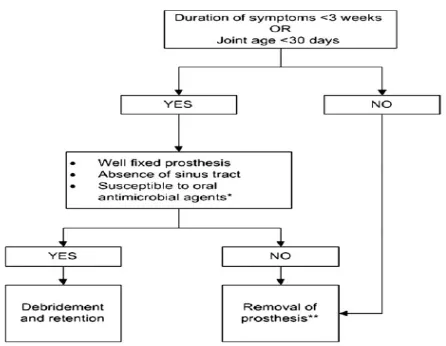
[image:15.612.96.319.510.683.2]Upon official diagnosis SSI, the process of infection management and remediation may begin. The time at which the infection is diagnosed heavily guides the course of treatment. For patients with a diagnostic delay less than 30 days from index surgery, or an estimation of less than 3 weeks from symptom onset, debridement of the infected bone/tissue and retention of the implant is an acceptable treatment option13. It should be noted that retention of the original implant may contribute to a higher risk of infection relapse, and should therefore only be considered for patients in which infection was detected early and for whom additional surgery is exceptionally risky. For patients that present with infection greater than 30 days after surgery, a more intensive course of action is required. As with earlier diagnoses, the tissue and bone surrounding the joint is sufficiently debrided and scourged of biofilm13,14. However, in delayed cases, effective infection control paradigm mandates the subsequent removal of the prosthetic implant and replacement with an antibiotic-laden cement spacer that acts a temporary placeholder. Though rare, in extensively severe cases infection the best course of action may in fact be amputation of afflicted limbs. Figure 2 details the decision process of determining if implant retention a possibility.
Figure 2. Decision diagram in determining the proper course of treatment following infection diagnosis13.
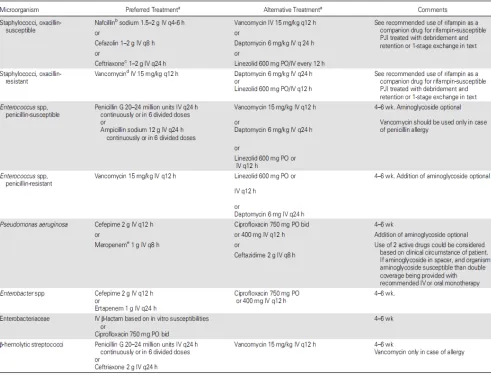
Following surgical remediation, six to eight weeks of appropriate antibiotics are intravenously administered to clear any remaining infection. Current recommendations for clinicians regarding antibiotic delivery and duration can be found in Figure 3. Finally, once the patient has been declared free of infection, the process may begin anew with a revision TJA procedure, with hopes of a better outcome than the initial attempt. Though the degrees of infection severity may vary, the treatment protocol for each is inarguably tedious, additionally invasive, and usually a source of great frustration for the patient and provider alike.
2.3 Identified risk factors in the extant literature.
References.
1. Iorio, R., Robb, W., Healy, W., Berry, D., Hozack, W., Kyle, R., & ... Parsley, B. (2008). Orthopaedic surgeon workforce and volume assessment for total hip and knee replacement in the United States: preparing for an epidemic. Journal Of Bone & Joint Surgery, American Volume, 90A(7), 1598-1605.
2. Kurtz SM, Ong KL, Schmier J, Mowat F, Saleh K, Dybvik E, et al. Future Clinical and Economic Impact of Revision Total Hip and Knee Arthroplasty. Journal of Bone & Joint Surgery, American Volume. 2007; 89-A:144.
3. Magill SS, Edwards JR, Bamberg W, et al. Multistate Point-Prevalence Survey of Health Care– Associated Infections. N Engl J Med 2014;370:1198-208.
4. Whitehouse JD, Friedman ND, Kirkland KB, Richardson WJ, Sexton DJ. The impact of surgical-site infections following orthopedic surgery at a community hospital and a university hospital: adverse quality of life, excess length of stay, and extra cost. Infection Control & Hospital Epidemiology. 2002; 23:183-9.
5. Mangram, A. J., Horan, T. C., Pearson, M. L., Silver, L. C., & Jarvis, W. R. (1999). Guideline for Prevention of Surgical Site Infection, 1999. Infection Control and Hospital Epidemiology, (4). 250.
6. Norton T, Skeete F, Dubrovskaya Y, Phillips M, Bosco J, Mehta S. Orthopedic surgical site infections: analysis of causative bacteria and implications for antibiotic stewardship. American Journal Of Orthopedics.
nasal contamination. A systematic literature review and meta-analysis. Orthopaedics & Traumatology: Surgery & Research.
8. Everhart J, Altneu E, Calhoun J. Medical Comorbidities Are Independent Preoperative Risk Factors for Surgical Infection After Total Joint Arthroplasty. Clinical Orthopaedics And Related Research.
9. Bernthal N, Stavrakis A, Miller L, et al. A Mouse Model of Post-Arthroplasty Staphylococcus
aureus Joint Infection to Evaluate In Vivo the Efficacy of Antimicrobial Implant Coatings. Plos
ONE [serial online]. September 2010;5(9):1-11.
10.Brown A, Leech J, Rogers T, McLoughlin R. Staphylococcus aureus colonization: modulation of
host immune response and impact on human vaccine design. Frontiers In Immunology [serial
online]. January 2014;4:1-20.
11.Benito N, Franco M, Coll P, Gálvez ML, Jordán M, López-Contreras J, et al. Etiology of surgical site infections after primary total joint arthroplasties. Journal of Orthopaedic Research. 2014; 32:633-7.
12.Lockhart, S. R., Abramson, M. A., Beekmann, S. E., Gallagher, G., Riedel, S., Diekema, D. J., … Doern, G. V. (2007). Antimicrobial Resistance among Gram-Negative Bacilli Causing Infections in Intensive Care Unit Patients in the United States between 1993 and 2004 . Journal of Clinical Microbiology, 45(10), 3352–3359. doi:10.1128/JCM.01284-07
13.Osmon, D. R., et al. (2013). "Diagnosis and Management of Prosthetic Joint Infection: Clinical Practice Guidelines by the Infectious Diseases Society of America." Clinical Infectious Diseases
56(1): e1-e25.
15.Jain R, Shukla R, Singh P, Kumar R. Epidemiology and risk factors for surgical site infections in patients requiring orthopedic surgery. European Journal of Orthopaedic Surgery & Traumatology. 2015; 25:251-4.
16.González-Vélez AE, Díaz-Agero Pérez C, Robustillo-Rodela A, Monge-Jodrá V. Incidence and associated factors of surgical site infections after hip arthroplasty. 2011; 55:270-6.
17.Namba RS, Inacio MCS, Paxton EW. Risk factors associated with deep surgical site infections after primary total knee arthroplasty: an analysis of 56,216 knees. Journal of Bone and Joint Surgery, American volume. 2013; 95:775-82.
18.Li G-q, Guo F-f, Ou Y, Dong G-w, Zhou W. Major article: Epidemiology and outcomes of surgical site infections following orthopedic surgery. AJIC: American Journal of Infection Control. 2013; 41:1268-71.
19.Durand F, Berthelot P, Cazorla C, Farizon F, Lucht F. Smoking is a risk factor of organ/space surgical site infection in orthopaedic surgery with implant materials. International Orthopaedics. 2013; 37:723-7.
20.Pedersen AB, Svendsson JE, Johnsen SP, Riis A, Overgaard S. Risk factors for revision due to infection after primary total hip arthroplasty. Acta Orthopaedica. 2010; 81:542-7.
21.Everhart JS, Altneu E, Calhoun JH. Medical Comorbidities Are Independent Preoperative Risk Factors for Surgical Infection After Total Joint Arthroplasty. Clinical Orthopaedics and Related Research. 2013; 471:3112-9.
CHAPTER III: Original Research Manuscript
Surgical Site Infection Following Total Joint Arthroplasty: An Examination of Microbial Isolates, Predisposing Patient Factors, and Diagnostic Delay.
ABSTRACT.
Background: Although device-associated total joint arthroplasty (TJA) has the potential to greatly improve recipient quality of life, the occurrence of surgical site infection (SSI) thereafter can render drastically debilitating and costly consequences.
Methods: A retrospective cohort design was used to analyze hospital discharge data from the State Inpatient Database (State of California, years 2009-2011). Descriptive statistics were conducted to establish microbial prevalence and multivariate logistic regression was conducted to examine associations between various patient-centric risk factors and the development of SSI. Interaction terms were evaluated for model inclusion. Finally, elapsed time from TJA operation to infection diagnosis was assessed according to site of TJA, pathogen virulence, and pre-existing comorbidities.
Results: During retrospective review, 1769 infections were detected. The incident rate of infection was 2.70 infections per 100,000 person-days. Staphylococci species were the most prevalent microorganisms (79%), including methicillin-resistant S. aureus (MRSA 24%) and methicillin-susceptible S. aureus
1.19 – 1.87). Diagnostic delay differed significantly according to pathogen virulence, but not with comorbid status and site of TJA.
Conclusions: Staphylococci species were the most prevalent microbes identified in infected patients. Anatomical site of TJA, male sex, length of hospitalization, and existing comorbidities were significantly associated with increased odds of surgical site infection following operative TJA. Surveillance networks continue to be fundamental for understanding and reducing the burden of SSI as a subset of healthcare-associated infections.
KEYWORDS: healthcare-associated infections, total joint arthroplasty, surveillance
Introduction.
It is estimated that SSI account for approximately 20-30% of all health-care associated infections4. Currently, the incident rate of SSI for TJA procedures ranges from 0.72 to 2.71 infections per 100 arthroplasties performed5-8; however, these rates almost certainly underestimate the true population incidence as the majority of SSI occur after hospital discharge, with some cases remaining undocumented. The magnitude of this incident rate is associated with several previously identified risk factors, both patient-related and healthcare-associated in nature. Patient-related factors include increased age, male sex, smoking status, higher American Society of Anesthesiologist (ASA) score, previous operation history, and existing comorbidities such as diabetes mellitus, obesity, and rheumatoid arthritis6-14. Identified healthcare-associated factors include hospital case volume, length of operation, length of hospitalization, and the administration of antibiotic prophylaxis6, 8, 9, 11. While some of these factors are non-modifiable (e.g., age, sex), many are to some degree malleable. Therefore, efforts to reduce SSI following TJA operations may be most effectively pursued by targeting preventive measures towards these select modifiable sources of risk.
Sequentially, it is directly pertinent to the surveillance of healthcare-associated infections to identify which microorganisms are most commonly responsible for SSI development. Currently, the vast majority (60-80%) of infections following TJA are caused by gram-positive Staphylococci species, including methicillin-sensitive Staphylococcus aureus (MSSA), methicillin-resistant Staphylococcus aureus (MRSA), methicillin-resistant Staphylococcus epidermis (MRSE), and coagulase-negative staphylococci (CoNS)5, 15. However, while staphylococcal species predominate as the causative
Although most infections are monomicrobial (i.e, only one species present), trends from the past decade indicate an increase in the number of polymicrobial infections (i.e., multiple species of microbes) following TJA operations16. Patients with polymicrobial infections generally have poorer health outcomes, as compared to monomicrobial infections17. This temporal shift in pathogenic prevalence and diversity, particularly with regard to resistant species, may have important implications for antibiotics prescribed both prophylactically and for infection management and remediation.
Though a growing body of infection control literature exists examining the risk factors for the absolute occurrence of SSI, less is known about how these implicated risk factors are associated with the
The aims of the current epidemiologic study were 1) to determine the prevalence of microorganisms identified in cases of infection, 2) to examine the associations between various patient characteristics and the outcome of SSI in TJA recipients, and 3) to investigate the associations between procedure type, pathogen virulence, and existing comorbidities and the diagnostic delay from surgery to SSI detection.
Methods.
This retrospective cohort study utilized hospital discharge data from the State Inpatient Database (SID) aggregated by the Healthcare Utilization Project (HCUP). Participating hospitals report inpatient discharge data on a yearly basis; all discharge data is reported, regardless of payment source or insurance affiliation. In this way, a surveillance system is created that yields a fairly representative sample of all inpatient services, including patient characteristics, diagnoses and procedures, and details about hospitalization. For the current study, data from the State of California (years 2009-2011) were analyzed. Particularly, the California SID was selected because of its thoroughness and inclusion of revisit linkage variables, which enabled the identification of patient readmission across multiple years and hospitals. The appropriate Institutional Review Board approval for this study was obtained prior to data management and analysis.
Study Sample.
Outcome Assessment.
The primary outcome of interest was the development of surgical site infection. The medical records of TJA patients were prospectively monitored for a period of 12 months. Previous research has indicated that one year is an appropriate surveillance time for identifying postoperative infections, corroborated by infection classification criteria for implant-associated operations. Infections were defined as patients who underwent TJA and were subsequently readmitted with a surgical site infection code within 12 months of index surgery. Non-infections were defined as TJA recipients that did not readmit for surgical site infection within 12 months of index surgery. ICD-9 codes were used to determine if the principal diagnosis was infection or inflammation resulting from prosthetic implant, and for identification of the causal microorganism (see Appendix A). All diagnoses on record were evaluated in order to determine the principal diagnosis. Individuals that underwent TJA in the terminal year of the study timeframe (2011) that did not develop SSI prior to the end of the year were excluded from risk factor analysis, as their records could not be prospectively monitored for an entire 12 months.
Patient Characteristics.
Statistical Analyses.
Descriptive statistics were conducted to determine frequencies of patient characteristics and the incident rate of SSI. Incident rate (IR) was calculated as:
𝐼𝑅= 𝑛𝑒𝑤 𝑐𝑎𝑠𝑒𝑠 𝑜𝑓 𝑆𝑆𝐼
𝑡𝑜𝑡𝑎𝑙 𝑛𝑢𝑚𝑏𝑒𝑟 𝑜𝑓 𝑝𝑒𝑟𝑠𝑜𝑛𝑑𝑎𝑦𝑠 𝑎𝑡 𝑟𝑖𝑠𝑘
This IR is calculated from a preliminary sample (n = 222,078) including TJA recipients that were eventually excluded from the analyses for microbial prevalence, patient risk factors, and diagnostic delay.
Microbial Prevalence.
Descriptive statistics were used to determine the prevalence of microorganisms indicated on patient records for the inpatient stay at the time of SSI discovery. All additional diagnoses on the patient chart were evaluated for microbial identification by their corresponding ICD-9 codes. Polymicrobial aetiology was flagged as the presence of more than one pathogen on the patient record. Fisher’s exact test was conducted to compare the distribution of microbial prevalence by anatomical site of TJA (hip vs. knee).
Patient Risk Factors.
multivariate logistic regression model in order to calculate adjusted odds ratios. Interaction terms were also assessed. Akaike Information Criterion (AIC) and Hosmer-Lemeshow goodness-of-fit statistics were given consideration for determining best-fit model selection.
Diagnostic Delay.
Among patients that developed SSI, Wilcoxon rank sum non-parametric t-test for independent samples was used to compare median diagnostic delay across anatomical site of TJA (hip vs. knee), pathogen virulence (less virulent vs. more virulent), and comorbid status (no comorbidities vs. one or more comorbidities). Diagnostic delay was defined as the difference from the time of initial TJA operation to time of infection diagnosis.
Results.
For this sample, 1769 surgical site infections were diagnosed. The incident rate of infection for this sample was 2.70 infections per 100,000 person-days at risk.
Microbial Prevalence.
Microbial isolates were identified in 46% of infections. Staphylococci species were implicated in the vast majority (78.9%) of infections, including 39.6% methicillin-susceptible Staphylococcus aureus
(MSSA) and 24.3% methicillin-resistant Staphylococcus aureus (MRSA). Approximately 10.5% of infections were caused by gram-negative bacilli (GNB), comprised of Eschrichia coli (1.3%),
Patient Risk Factors.
Univariate analysis revealed that all risk factors were significantly associated with the outcome of SSI (Table 2). Although many variables were significantly associated with both the outcome and additional patient characteristics, none were deemed to be sources of confounding. Forward selection identified 4 statistically significant interaction terms. Models containing all possible combinations of these interaction terms were evaluated. The final model that yielded minimum the AIC value and p > 0.05 for the Hosmer-Lemeshow χ2 goodness-of-fit test contained 3 interaction terms: obesity x TJA site,
After logistic regression in the multivariate model, all variables but hypertension and race remained significantly associated with the outcome of SSI (Table 3). Increased odds of infection were found for knee vs. hip operations (OR = 1.50; 95% CI = 1.41 – 1.60), for male sex (OR = 1.70; 95% CI = 1.60 – 1.80), for increasing length of hospitalization (OR = 1.10; 95% CI = 1.09 – 1.11), and for comorbidities including obesity (OR = 3.99; 95% CI = 3.16 – 5.04), diabetes (OR = 1.45; 95% CI = 1.29 – 1.63), and rheumatoid arthritis (OR = 1.49; 95% CI = 1.19 – 1.87). Increasing age was determined to be very slightly protective against SSI (OR= 0.99; 95% CI = 0.98 – 0.99).
Diagnostic Delay.
(p < 0.0001). Diagnostic delay did not differ with comorbid status (no comorbidities vs. one or more comorbidities) or anatomical site of TJA operation (hip vs. knee).
Discussion.
For the majority of recipients, TJA is a highly beneficial operation that improves range of motion, mobility, and quality of life generally. However, for the small subset of patients who go on to develop subsequent surgical site infection, the operative experience becomes tainted by further pain and debilitation, frustration, and augmented healthcare costs. And while advances in infection prevention and control continue to emerge, this epidemiological study and others demonstrate that SSI remains a notable occurrence following total joint arthroplasty operations.
Microbial Prevalence.
investigate which patient characteristics are associated with the susceptibility to specific microbes; that is, could patient attributes potentially predict the causative microorganism in cases of infection?
Patient Risk Factors.
The patient characteristics investigated in this study were age, sex, race, anatomical site of TJA, length of hospital stay associated with the TJA operation, and patient comorbidities existing at the time of surgery. Patients who received joint replacement at the knee had 1.5 times the odds of developing surgical site infection as compared to those who underwent joint replacement at the hip (95% CI = 1.41 – 1.60). Length of inpatient stay surrounding the initial arthroplasty operation was also statistically significant (OR = 1.10; 95% CI = 1.09 – 1.11). Though the magnitude of this association was relatively small compared to the contributions from other risk factors, it aligns with previous findings. A longer hospitalization may result from complications during or immediately after surgery, as well as patient vulnerabilities that may necessitate a longer period of observation post-operation. It would not be imprudent to infer that such complications and vulnerabilities might supplement the odds of developing infection.
often necessitates TJA may add to or exacerbate patient obesity, healthcare providers should suggest that patients take safe measures to reduce BMI to a non-obese status, when possible.
Interestingly, increasing age was found to very slightly protective against infection (OR = 0.99, 95% CI 0.98 – 0.99). This finding contradicts associations elucidated in other studies, in which older age
increases the odds of SSI or is not significantly associated at all. However, the odds ratio obtained for this sample, though significant, is substantially close to and tightly clustered around OR = 1. Therefore, from a clinically practical perspective, it would be unwise to advocate that increased age is a protective factor. More research is needed to determine a more concrete and universal understanding of the relationship between age and development of SSI after TJA, as well as what other factors may confound this relationship.
Diagnostic Delay.
others throughout the literature, use the time of infection diagnosis as a proxy for the time of event occurrence. In reality, symptom onset and clinically detectable levels of infection most likely occur days to weeks prior to diagnosis. Therefore, though time and resource intensive, prospective cohort studies in which biological samples are regularly extracted and examined may illuminate more precisely the exact timing and natural history of surgical site infection following TJA operations, and sequentially, how patient and pathogen characteristics affect this timing.
Strengths and Limitations.
This investigation exhibits many strengths. Firstly, the dataset from which the sample was drawn is deemed to be fairly representative of inpatient visits nationally. Additionally, due to the size and inclusiveness of the data, the sample size of the population of interest (TJA recipients) was relatively large (n = 146,692). Given the small rate of infection that is generally expected for SSI following arthroplasty operations, a large population sample is favorable. Finally, the retrospective study design used for this examination is preferable for investigating comparatively rare disease outcomes.
patient had a TJA operation in-state, and then moved out of state and subsequently developed SSI, that infection would not be included in the current calculated rate. Therefore, this incident rate calculated for this study most likely underestimates the true population rate. Integration of data across all states would greatly strengthen future epidemiological investigations. Finally, the use of forward selection in model determination may have excluded biologically, though not statistically, important interactions.
Conclusions.
References.
1. Whitehouse JD, Friedman ND, Kirkland KB, Richardson WJ, Sexton DJ. The impact of surgical-site infections following orthopedic surgery at a community hospital and a university hospital: adverse quality of life, excess length of stay, and extra cost. Infection Control & Hospital Epidemiology. 2002; 23:183-9.
2. Cooper RA. Surgical site infections: epidemiology and microbiological aspects in trauma and orthopaedic surgery. International Wound Journal. 2013; 10:3-8.
3. Kurtz SM, Ong KL, Schmier J, Mowat F, Saleh K, Dybvik E, et al. Future Clinical and Economic Impact of Revision Total Hip and Knee Arthroplasty. Journal of Bone & Joint Surgery, American Volume. 2007; 89-A:144.
4. Nelson KE, Williams CM. Infectious disease epidemiology : theory and practice / edited by Kenrad E. Nelson, Carolyn Masters Williams: Burlington, Mass. : Jones & Bartlett Learning, c2014.
3rd ed.; 2014.
5. Norton TD, Skeete F, Dubrovskaya Y, Phillips MS, Bosco JD, 3rd, Mehta SA. Orthopedic surgical site infections: analysis of causative bacteria and implications for antibiotic stewardship. American Journal Of Orthopedics (Belle Mead, NJ). 2014; 43:E89-E92.
6. Jain R, Shukla R, Singh P, Kumar R. Epidemiology and risk factors for surgical site infections in patients requiring orthopedic surgery. European Journal of Orthopaedic Surgery & Traumatology. 2015; 25:251-4.
8. Namba RS, Inacio MCS, Paxton EW. Risk factors associated with deep surgical site infections after primary total knee arthroplasty: an analysis of 56,216 knees. Journal of Bone and Joint Surgery, American volume. 2013; 95:775-82.
9. Li G-q, Guo F-f, Ou Y, Dong G-w, Zhou W. Major article: Epidemiology and outcomes of surgical site infections following orthopedic surgery. AJIC: American Journal of Infection Control. 2013; 41:1268-71.
10. Durand F, Berthelot P, Cazorla C, Farizon F, Lucht F. Smoking is a risk factor of organ/space surgical site infection in orthopaedic surgery with implant materials. International Orthopaedics. 2013; 37:723-7.
11. Pedersen AB, Svendsson JE, Johnsen SP, Riis A, Overgaard S. Risk factors for revision due to infection after primary total hip arthroplasty. Acta Orthopaedica. 2010; 81:542-7.
12. Everhart JS, Altneu E, Calhoun JH. Medical Comorbidities Are Independent Preoperative Risk Factors for Surgical Infection After Total Joint Arthroplasty. Clinical Orthopaedics and Related Research. 2013; 471:3112-9.
13. Yuan K, Chen H-L. Obesity and surgical site infections risk in orthopedics: A meta-analysis. International Journal of Surgery. 2013; 11:383-8.
14. Pugely AJ, Callaghan JJ, Martin CT, Cram P, Gao Y. Incidence of and Risk Factors for 30-Day Readmission Following Elective Primary Total Joint Arthroplasty: Analysis From the ACS-NSQIP. The Journal of Arthroplasty. 2013; 28:1499-504.
15. Montanaro L, Speziale P, Campoccia D, Ravaioli S, Cangini I, Pietrocola G, et al. Scenery of Staphylococcus implant infections in orthopedics. Future microbiology. 2011; 6:1329-49.16.
17. Park SY, Park K-H, Bang KM, Chong YP, Kim S-H, Lee S-O, et al. Clinical significance and outcome of polymicrobial Staphylococcus aureus bacteremia. Journal of Infection. 2012; 65:119-27. 18. Zimmerli W. 2: Prosthetic-joint-associated infections. Best Practice & Research Clinical Rheumatology. 2006; 20:1045-63.
19. Dicks KV, Lewis SS, Durkin MJ, Baker AW, Moehring RW, Chen LF, et al. Surveying the Surveillance: Surgical Site Infections Excluded by the January 2013 Updated Surveillance Definitions. Infection Control & Hospital Epidemiology. 2014; 35:570-3.
20. Lewis SS, Dicks KV, Chen LF, Bolognesi MP, Anderson DJ, Sexton DJ, et al. Delay in Diagnosis of Invasive Surgical Site Infections Following Knee Arthroplasty Versus Hip Arthroplasty. Clinical Infectious Diseases: An Official Publication Of The Infectious Diseases Society Of America. 2014.
21. Osmon DR, Berbari EF, Berendt AR, Lew D, Zimmerli W, Steckelberg JM, et al. Diagnosis and Management of Prosthetic Joint Infection: Clinical Practice Guidelines by the Infectious Diseases Society of America. Clinical Infectious Diseases. 2013; 56:e1-e25.