Communication Dissertations Department of Communication
Winter 12-7-2012
The Critical Eye: Re-Viewing 1970s Television
The Critical Eye: Re-Viewing 1970s Television
Karen C. Petruska PhD Georgia State University
Follow this and additional works at: https://scholarworks.gsu.edu/communication_diss
Recommended Citation Recommended Citation
Petruska, Karen C. PhD, "The Critical Eye: Re-Viewing 1970s Television." Dissertation, Georgia State University, 2012.
https://scholarworks.gsu.edu/communication_diss/38
This Dissertation is brought to you for free and open access by the Department of Communication at ScholarWorks @ Georgia State University. It has been accepted for inclusion in Communication Dissertations by an authorized administrator of ScholarWorks @ Georgia State University. For more information, please contact
by
KAREN PETRUSKA
Under the Direction of Dr. Alisa Perren
ABSTRACT
In my dissertation entitled “The Critical Eye: Re-Viewing 1970s Television,” I
argue that TV scholars would benefit greatly by engaging in a more nuanced
consideration of the television critic’s industrial position as a key figure of negotiation.
As such, critical discourse has often been taken for granted in scholarship without
attention to how this discourse may obscure contradictions implicit within the TV
industry and the critic’s own identity as both an insider and an outsider to the television
business. My dissertation brings the critic to the fore, employing the critic as a lens
through which I view television aesthetics, media policy, and technology. This study is
grounded in the disciplines of television studies, media industries studies, new media
studies, and cultural studies. Yet because the critic’s writing reflects the totality of
upon American culture.
This project offers a history of the television critic during the 1970s, a decade in
which the field of criticism professionalized and expanded dramatically.
Methodologically, I am incorporating three approaches, including historical research of
the 1970s television industry, textual analysis of critical writing, and interviews with
critics working during that decade. I’ve identified the 1970s for a variety of reasons,
including its parallels with today’s significant technological and industrial
transformations. My central texts will be the industry trade publications, Variety and
Broadcasting, and national daily newspapers including the New York Times, Los Angeles
Times, Washington Post, and Chicago Tribune. Viewing TV criticism as a profession, a
historical source, and a site of scholarly analysis, this project offers a series of
interventions, including a consideration of how critical writing may serve as a primary
source for historians and how television studies has overlooked the significance of the
critic as an object of analysis in his/her own right.
by
KAREN PETRUSKA
A Dissertation Submitted in Partial Fulfillment of the Requirements for the Degree of
Doctor of Philosophy
in the College of Arts and Sciences
Georgia State University
Copyright by Karen Christine Petruska
by
KAREN PETRUSKA
Committee Chair: Alisa Perren
Committee: Ted Friedman
Kathryn Fuller-Seeley
Greg Smith
Horace Newcomb
Electronic Version Approved:
Office of Graduate Studies
College of Arts and Sciences
Georgia State University
DEDICATION
For my father, who has been waiting a long time for me to become the next Dr. Petruska.
ACKNOWLEDGEMENTS
Coming to Georgia State was among the best decisions of my life. The program’s rigor
challenged me, the support of the faculty encouraged me, and the friendship of my cohort
sustained me. Among the faculty who helped shape this project and my identity as a scholar are
Kathy Fuller-Seeley, Ted Friedman, Greg Smith, Angelo Restivo, Jennifer Barker, Mary
Stuckey, and Alessandra Raengo. To them, I say thank you for having your door always open.
Special thanks also to Horace Newcomb, who shared with me his vast experience, his contacts,
and his conversation. Thanks also to Nedda Ahmed, world’s most helpful and fun librarian. My
mentor, Alisa Perren, gave endlessly of her time and knowledge. She read everything I ever
wrote while at Georgia State, and I always knew that her advice would make my work better.
Without Alisa, I would not have identified the deep passion of my intellectual life—the study of
television—and for that I am deeply grateful. Years from now, when fellow scholars read my
work and spot evidence of my training under her, I’ll be proud to be known as “one of Alisa’s.”
A number of critics and reporters writing in the 1970s or early 1980s were kind enough to
talk with me, and their contributions to how I have conceived of the critic as an industrial figure
have been immeasurable. Thanks to Howard Rosenberg, Tom Shales, Erik Mink, David
Bianculli, Joe Flint, Lee Margulies, and Noel Holston. You were all incredibly generous with
your time and with your memories. I hope I have reflected your work fairly—I’ve enjoyed
seeing television through your eyes. My committee, Kathy, Greg, Ted, and Horace Newcomb
worked with me throughout this process, helping me to refine my vision and to find the most
important questions about how TV criticism matters to television scholarship. I am very grateful
Countless friends have followed my progress through this project. Amanda spent hours
discussing academia with me, and having her as a companion beyond our Master’s program has
enriched my life. The Viz girls have been a reassuring cheering section, and my Big D
understood like few others the struggle of finishing. Darcey was my grad school girlfriend—I
will miss our nights with Grey’s Anatomy and Thai food (and wine). Christine Becker provided
an invaluable research aid, without which this project would have been MUCH harder. Steve,
Kris, and Drew were the best cohort I could imagine—always pacing me, always willing to talk
shop, always happy to hang out. For my coffee shop buddies, Kris and Alessandra, you made
work fun. Thanks for the hours you spent chatting over the tops of our macs.
My path to an academic career has led me through St. Louis, Louisville, Chicago, Italy,
Atlanta, and (soon) Boston. My parents have stood by me through all that change, all those
moves including an adventure through the West Virginia mountains with a queen-sized bed
(almost but not quite) falling off a minivan. They never stopped trusting that I knew what I was
doing—even when I did not know myself what was next. I’ve lived an incredible life of
education, art, and culture, and none of it would have been possible without them. Thanks to
Mary for being my best friend, to Paul for being my kindred spirit, and to Brian for being my
hero. I’m very lucky that you are my family. My new family, the Ayers, have welcomed me
with open arms—my visits to Iowa have become a highlight of the summer and winter, and I
look forward to the many visits to come. Macie and Cora, you give me joy—thanks for being my
cuddle buddies. And to Drew, my partner in life, love, and learning, thank you for making
dinner when I was working, for doing the routine when I was traveling, for formatting this
dissertation when I needed to revise, and for introducing me to Hell’s Kitchen, the best
TABLE OF CONTENTS
ACKNOWLEDGEMENTS ... v
LIST OF TABLES ... ix
LIST OF FIGURES ... x
1 INTRODUCTION: THE PASSING OF THE BATON: TELEVISION CRITICISM IN THE 1970S ... 1
1.1 TV Criticism as a Profession ... 4
1.2 TV Criticism as a (Historical) Source ... 14
1.3 Critics in Context: Debates and a Cast of Characters ... 19
1.4 TV Criticism as a Site ... 33
1.5 Chapter Descriptions ... 41
2 THE CRITIC’S PURVIEW: PROGRAM EVALUATION AND THE POPULAR ... 45
2.1 A Program Saved by Critics: The Authenticity of The Waltons ... 53
2.2 Happy Days: The Program that Jumped the Shark and Built a Network ... 70
2.3 Holocaust: Selling Products and Tragedy ... 84
2.4 Conclusion ... 103
3 THE PRIME TIME ACCESS RULE: MEDIA POLICY, FAILURE, AND THE HOPE FOR BETTER TELEVISION ... 108
3.1 A Revisionist History of the Prime Time Access Rule ... 113
3.2 The Prime Time Access Rule & Pre-emptive Failure ... 117
3.3 The Macro-View of the PTAR: Discursive Naturalization Through Repetition .... 122
3.4 The Micro-View of the PTAR: Program Reviews as Historical Trace ... 127
3.6 The PTAR and Regulatory Ideology ... 143
3.7 Conclusion ... 146
4 TV CRITICS AND THE ‘SUPER’ STATION: TECHNOLOGICAL REVOLUTION AND THE STATUS QUO ... 148
4.1 A Brief History of Domestic Satellite Television Distribution in the United States ... 155
4.2 The Superstation as Hybrid: WTCG-TV, Ted Turner, and the Limits of Metaphor ... 158
4.3 Bringing the Superstation Back to Earth: Programs and the Unique Contributions of Critics to Technological Discourse ... 170
4.4 The Superstation and Localism ... 181
4.5 Conclusion ... 188
5 CONCLUSION ... 192
5.1 Critics on Criticism: A Conversation with Second-Generation Television Critics 197 5.2 Contemporary Criticism: A Parallel Moment of Change ... 209
5.3 The Legacy of the TV Critic ... 229
WORKS CITED ... 232
APPENDICES ... 255
Appendix A: Tables ... 255
LIST OF TABLES
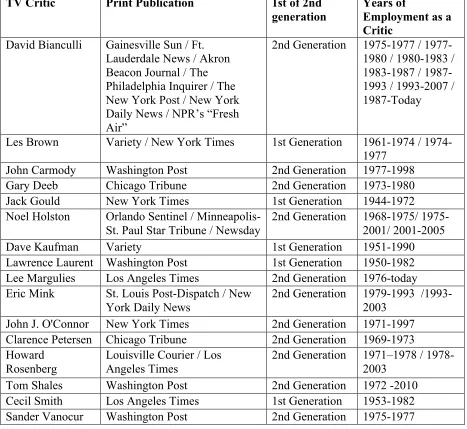
Table 1: TV Critics Referenced and Interviewed: Professional Affiliations ... 255
LIST OF FIGURES
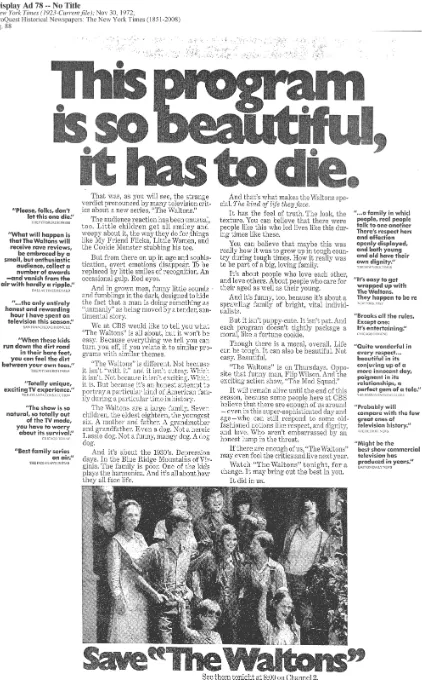
Figure 1: The Waltons Ad ... 257
Figure 2: Three views of Michael Learned ... 257
Figure 3: Fonzie Jumps Over a Shark ... 258
Figure 4: Los Angeles Times 'Holocaust' Feature ... 258
Figure 5: Map of WTCG National Reach ... 259
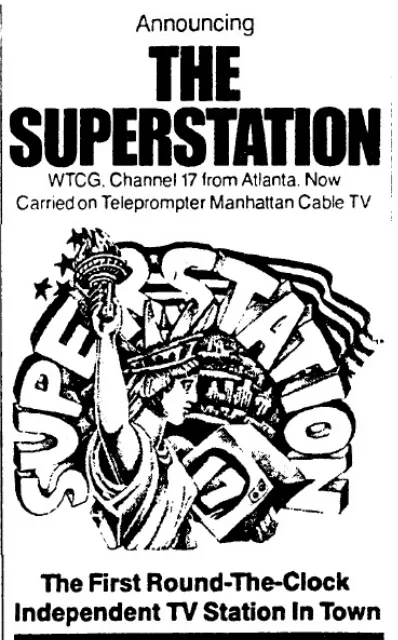
Figure 6: Teleprompter WTCG Ad ... 259
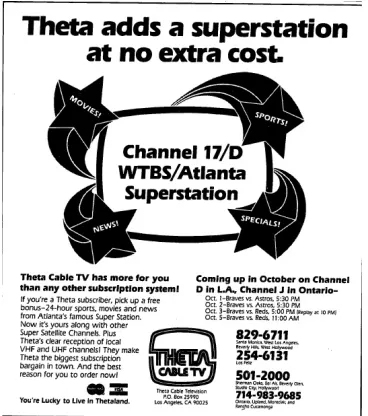
Figure 7: Theta WTCG Ad #1 ... 260
Figure 8: Theta WTCG Ad #2 ... 260
1 INTRODUCTION: THE PASSING OF THE BATON: TELEVISION CRITICISM IN
THE 1970S
“When I was a little kid at my family breakfast table, my father would read the sports
section and hand me the Entertainment section of the Miami Herald, and I would read the
local TV critic—you know, Jack Anderson, and I would read TV Guide with Cleveland
Amory, and since television meant a lot to me while I was very young, so did those guys.
I really wanted to be a critic. It’s an odd thing…” ~David Bianculli, Television Critic1
If you had asked David Bianculli as a young man what he wanted to be when he grew up,
he would have responded “TV critic.” Having read other critics in his daily newspaper and TV
Guide, Bianculli developed a lifelong fascination with television. He was so committed to
becoming a critic that when he entered college and found no established curriculum for his
desired field, he consciously constructed a course progression that would prepare him for a
career as a TV critic, taking such classes as statistics, creative writing, and critical analysis.2
That Bianculli knew he wanted to become a TV critic was more than “odd,” the phrase he used
in the quote above—it was genuinely novel when he was growing up in the 1960s. For the first
generation of TV critics, those who wrote about television during the 1950s and 1960s, television
criticism was less a vocation than an accident of circumstance.3 As explained by Chicago’s
American critic Janet Kern, there was no training to be a critic in 1959: “When I get letters
asking for my qualifications as a television critic, I have a standing answer. I tell them I have the
1 David Bianculli, Phone Interview (2012).
2 To this day, criticism tends to be a sub-field, a particular path someone who studies journalism or media
studies might follow.
four necessary qualifications for the job: a television set, a typewriter, a dictionary, and a job on
a newspaper."4 Bianculli represents the second generation of television critics, those for whom
television had always existed and who followed in the footsteps of critics who had already been
writing about television for twenty years. Bianculli’s childhood decision to become a TV critic
may be read as symbolic of television’s maturity as a medium of increasing legitimacy—by the
1970s, it was possible that children would dream of growing up to be a TV critic.
At major newspapers across the U.S., the first generation of critics passed the baton to the
next generation just starting their careers in the 1970s [See Table 1].5 Bianculli secured his first
job as a TV critic in the mid-1970s, and he was only one of many “young turks” entering the
business of journalistic TV criticism at that time. For example, first-generation critic at the Los
Angeles Times Cecil Smith, who had worked as the television critic for the Times since 1953,
was joined by second-generation critic Howard Rosenberg in 1978, and the two worked side by
side for the Times until Smith’s retirement in 1982. At the New York Times, first-generation critic
Jack Gould had written about broadcasting since 1944. Before retiring in 1972, he, too,
overlapped with his successor, second-generation critic John J. O’Connor, for one year.
Meanwhile, as the medium of television and profession of TV criticism both reached maturity in
the 1970s, smaller papers began to hire full-time TV critics for the first time.6 This moment of
transition—from the first to the second generation of critics—has been scarcely remarked upon
in television scholarship. This dissertation re-views the writings of critics in the 1970s to
understand better not only how the critic has reported and evaluated television, but also how
4 Charles Steinberg, "The Compleat Television Critic," Television Quarterly 11, no. 2 (1974): 8-9. 5 Having reached 87 percent national penetration in 1960, TV became a common appliance in houses
throughout America. Michele Hilmes, Only Connect: A Cultural History of Broadcasting in the United
States, 2nd ed. (Belmont: Thompson Wadsworth, 2007). 177.
6 Some papers had employed critics who wrote about various media, but television became a beat for one
scholars may better employ this figure in our research. The fundamental research question that
drives this project inquires, “If we stop taking the critic for granted, what can this figure teach us
about television’s history and how scholars write that history?”
To answer that question, I analyze television criticism from three perspectives. First, I
consider criticism as a profession, a field defined by seemingly paradoxical responsibilities. For
example, critics were employed by print publications, but they wrote about the television
industry. They generally considered themselves journalists, but they also expressed subjective
opinions in their role as evaluators of television. Their work therefore often offered unique
insights into their personal stakes as commentators about such topics as media policy,
technology, and business structure and operation. Second, I consider the critic as a source,
employing the critic as a lens through which to understand the 1970s differently. This is a
revisionist history, rethinking not only how scholars have described the key programs and
challenges facing the television industry in the 1970s but also the methods applied by scholars to
re-view the past. While scholars have frequently cited critical discourse as a secondary source,
their use of the critic has overlooked the deeper complexity featured in critical work. Finally, I
consider the critic as a site, examining the value of critical discourse for television studies. In
their efforts to account for television as an entertainment medium, a regulated industry, a
technology, and a cultural form, critical discourse shares particular preoccupations with TV
scholarship. Television studies, as an academic discipline, developed in the 1970s, alongside
critics’ efforts to professionalize their own field through the establishment of the Television
Critics Association [TCA]. This decade, therefore, serves a particularly resonant moment
through which to analyze the parallels and divergences between critical and scholarly writing, to
1.1 TV Criticism as a Profession
Television criticism, like the medium itself, arose from the days of radio broadcasting.
Yet interest in television criticism grew dramatically during the early years of its emergence; a
1955 study, for example, revealed that space allotted for television coverage in newspapers
increased five hundred percent between 1953 and 1955.7 When the TV quiz show scandal
erupted at the same time, exposing the corruption within the industry, this crisis reinforced the
need for critics to engage in a productive critique of television.8 For most critics living outside
New York and Los Angeles, the early history of broadcasting criticism in the 1950s and 1960s
primarily featured critics watching television in real time along with audiences and reviewing
programs after they aired.9 Closed-circuit and taped television offered occasional opportunities
for critics to view programs in advance of their airing, but it was not until 1969 that the CBS
network issued a policy of consistent previewing for their major primetime program premieres.10
Following CBS’s decision, NBC nevertheless refused to offer previews for years, so the adoption
of previewing was gradual and uneven. Critics also disagreed about the value of pre-reviews,
7 Frank Henry Frakes, Jr., "A Study of Standards Imposed by Four Leading Television Critics with
Respect to Live Television Drama" (Doctoral Dissertation, Ohio State University, 1960). Frakes offers a brief history of broadcasting criticism, beginning in the 1920s. Lichty develops another early history of broadcasting to frame his content analysis of the writing of Jack Gould, Lawrence L. Lichty, "What Does a Television Critic Write About?," Journal of Broadcasting 7(1962-1963). See also Patrick D. Hazard, "TV Criticism - A Prehistory," Television Quarterly 2, no. 4 (1963).
8 The quiz show scandal actually helped critics fight back against a series of articles that documented
antagonism within the television industry towards critics, as when Time observed that despite their negativity, critical work lacked practical use, having failed to unearth the corruption at the heart of TV operations. "Critics Be Damned," Sponsor, November 1957; Eric Sevareid, "Harsh Words for TV
Critics," The Reporter, July 10 1958; Bob Stahl, "What Good are Television Critics?," TV Guide, January 24 1959; Jack Gould, "Where TV Critics Strike Out," New York Times, May 19 1957; Jack Gould, "TV Under Assault," New York Times, June 22 1958.
9 This explains the famous joke by Jackie Gleason that critics reported traffic accidents to eye witnesses. 10 As the number one station, CBS perhaps felt intimidated by the possibility of negative reviews, but an
article by Jack Gould surmised that CBS knew previewing could function as an appeasement of
concerned they would undermine the importance of live TV and make it more difficult for critics
to account for the long-form of the television narrative.11 There was little consistency about
which programs were available for pre-review and critics’ access to advanced copies of
programs varied across the nation’s papers. Nevertheless, previewing, in essence, transformed
critics into privileged viewers of television, able to influence audience-viewing practices. CBS’s
announcement in 1969 therefore forced critics to revisit key questions about their relationship
with the television networks and with their audience. Fundamentally, the ability to preview a
program altered the critic’s relationship with the audience because they no longer watched TV
with their readers but instead enjoyed privileged access to programs that distinguished critics
from their readers in new ways.
The 1970s also marked a moment of professionalization and legitimation for TV critics.
The first Pulitzer Prize for Criticism was awarded in 1970, and Ron Powers from the Chicago
Sun-Times received the first award for a television critic in 1973.12 Also, a group of critics
formed the Television Critics Association [TCA] in 1977, driven in part by a desire to replace
the network-sponsored junkets with a less industry-driven form of interaction between critics and
program executives. The new organization limited membership to “professional journalists in
the print media who specialize in or whose responsibilities include the regular coverage of
11 The critics at the New York Times wrote repeatedly about their conflicted thoughts about previewing.
Jack Gould, "CBS-TV Plans to Allow Reviews Before Screening," New York Times, March 28 1969; John J. O’Connor, "Opening Week of New Season," New York Times, September 14 1971. Variety also reported in 1973 the statement from an NBC executive explaining the networks’ continued refusal to follow the lead of CBS and ABC, who offered pre-review opportunities for critics. M.S. (Bud) Rukeyser, "Why NBC Won't Allow Pre-Reviews," Variety, June 6 1973. In 1974, NBC offered a preview for an original movie, and Rukeyser implied his stance towards previews was softening. "NBC Pre-Screens 'Slovik;' Dubelman Bids for Credit," Variety, March 13 1974.
12 Ron Powers’ work is not featured in this dissertation. Even in this digital age, access to some historical
television.”13 A clause in the founding document excluded from membership network-employed
publicity executives, an acknowledgement of the organization’s anxiety about the appearance of
too close a relationship with the television industry. Critics were aware, then, that while they
provided a promotional function for the networks, they did not want to be defined by that
association.
The TCA may be read as a sort of critics’ declaration of independence, freeing
themselves from the influence of network-sponsored junkets to increase the legitimacy of their
work. The TCA provided critics with an organization that hosted twice-yearly press tours
featuring industry presentations and previews of the upcoming season of programming. These
gatherings shifted the economic burden of supporting critics’ travel from the networks to the
individual newspapers that sponsored a critic’s attendance.14 The TCA’s collective expression of
how television critics defined their profession was largely influenced by the enthusiasm and
idealism of the young critics who had recently entered the industry. The 1970s, therefore,
introduced a renewed attention to defining TV criticism as a profession, and therefore serves as
an ideal moment during which to consider the profession.
Just as television may be defined as entertainment, art, commerce, and technology,
critics, too, may wear several hats in their responsibilities to their employers. In the narrowest
sense, “critic” will be defined here as journalists employed full-time to write about television for
print publications in the 1970s. Working the “TV beat,” the critic’s responsibilities included
anything writing basic industry news reportage, trend pieces, actor profile features, and
13 "TV Reporters Band Together in New Assn," Variety, June 29 1977.
14 David Bianculli, interviewed for this project, is a founding member of the TCA. I should note that not
individual program reviews. Most distinctively, though, critics were empowered to offer
subjective opinions, and this extended beyond their writing as program evaluators. The
subjective nature of critical writing not only distinguished critics from journalists, but it also
provided a deeper context for their work, with their own biases and priorities clearly elucidated.
There is no one definition of the TV critic to account for the variety of approaches to this
profession, just as there is no one definition for what is television. Virtually ever critic I spoke
with considered himself a journalist, yet they also acknowledged the unique nature of the TV
beat because they enjoyed freedom to define their writing style, objects of discussion, and the
parameters of their responsibilities. In that way, the complexity of studying TV criticism
parallels the central challenge of TV scholarship. This, in essence, is the fundamental
intervention offered in this project. Scholarly inquiry about TV criticism should approach the
critic with the same broad set of questions that we apply to the medium itself.
Because my interest in criticism extends beyond programming to consider television
industry and technology, a consideration of the diverse types of writing appearing in print
publications is essential for this project. By providing a holistic overview of the types of TV
writing that appeared in print publications in the 1970s, I not only offer a more nuanced
definition of what qualifies as critical television discourse but also develop a broader critique of
TV studies projects that do not identify these important distinctions. Most of the voices
represented here were employed under the title of “TV critic,” yet the distinction between critics
and non-critics was not simple. For example, the journalists who specialized in reporting
television news for Variety also wrote program reviews. Some newspapers employed both a
critic and a television reporter, so the former could focus on program reviews and trend pieces
they approached their beat differently.
I have included the voices of both types of television specialists, though I pay special
attention to note the distinctions between critics and television reporters. Examples of such
non-critics whom I will describe as television reporters are Les Brown, who worked at Variety and
the New York Times, Lee Margulies, who worked at the Los Angeles Times, and John Carmody,
who worked at the Washington Post. The fundamental distinction between the two figures—
critics and television reporters—was that the latter ascribed more closely to the code of objective
journalism.15 Neither type of commentary is necessarily more valuable but this project
distinguishes itself by accounting for the differences among critics in terms of job description,
intent, depth of knowledge, personal and professional stakes, and imagined audiences. Less
frequently, I have also incorporated the voices of staff reporters, those who wrote about a variety
of topics, including occasionally something related to one of my case studies. In these instances,
I have marked these individuals as outsiders to TV beat. That these three categories—TV critics,
TV reporters, and staff reporters—exist testifies not only to the broader definitional challenges of
criticism as profession, but also to the fact that television is a medium that touches so many
elements of culture—from entertainment to business to sports to marketing—and print
publications required a team of journalists to cover its largesse.
I conducted a series of interviews with critics working during the 1970s or early in the
1980s in order to account for the similarities and differences among TV critics. These interviews
included the Los Angeles Times’ Howard Rosenberg, the Washington Post’sTom Shales, the St.
15 Morris Janowitz accounts for two ideologically driven models of journalism that influence how
Louis Post-Dispatch’s Eric Mink, and two other critics—Noel Holston and David Bianculli—
who worked at several newspapers. I also spoke with Lee Margulies, who worked as a television
reporter alongside critic Howard Rosenberg at the Los Angeles Times. Margulies occasionally
wrote television reviews, but he did not self-identify as a critic. Across the interviews, the critics
agreed about many professional matters—for example, they all insisted upon their autonomy in
the face of industry pressure. Yet, there were enough variances that I have approached this study
as an examination of multiplicity, difference, and at times, tension. The majority of critics I
spoke with were second generation, so the personal reflections offered here derived from critics
who grew up with television, not from the first-generation critics who pioneered the field.16
In these interviews, I talked with critics better to understand how they conceived of their
role and their writing, how they defined their beat and their audience, and what they hoped was
their legacy. One key question I asked every critic, “Do you consider yourself a journalist,”
helped me navigate the tricky definitional challenges of this project. Indeed, every critic defined
himself as a journalist, yet each also oriented his relationship to the values and practices of
journalism differently. The TV beat was distinctive to them because a TV critic must become
somewhat expert on everything from entertainment to news to history to film to children’s
television to advertising. The most valuable contribution these critics made to this project was a
deeper portrait of the true complexity of their work.
Without a requirement for particular training, the critic’s expertise derived more from
his/her official sanctioning by a publication than from research, education, or experience. In their
professional role, critics operated at the intersection of several industries, including print
journalism, television production, and network promotions, marketing, and distribution.
16 One challenge of this historical work is that many of the critics discussed here, including John J.
Employed by print publications, critics served the commercial needs of their employers to reach
a wide audience and to satisfy advertiser interests.17 They also provided a promotional service
for the television industry, increasing awareness of programming and drawing attention to
particular networks. To encourage the critic’s promotional role, network publicity departments
often sent critics marketing materials, gifts, and opportunities to view programming in advance;
the critic therefore was at once dependent on the TV industry about which they reported while
also serving the needs of their print employers.18 Yet they also wrote for an audience of readers
who sought an “expert” opinion. Each critic negotiated this ethical terrain differently.
Importantly, the critic was not a neutral cultural arbiter.19 Because the critic played
different roles, as program evaluator, as industry reporter, and even, at times, as gadfly, s/he may
have experienced resistance from the industry or negative reactions to particular pieces.
Moreover, critical discourse did not feature unanimous or univocal opinions. As Howard
Rosenberg explained, a fundamental requirement of the job of the critic was feeling comfortable
delivering a personal perspective: “You have your opinion and that’s it. And it is [about]
17 This project does not account for critics employed by weekly magazines beyond the industry trade
publications Variety and Broadcasting. Critics working for magazines not only wrote without a byline but they also tended to discuss broad trends more than individual programs due to their weekly publication schedule. Their work, therefore, demanded a unique accounting for the differences of their professional responsibilities, and space did not allow me to provide that sort of accounting.
18 How critics responded to gifts sent by the industry depended on the critic. Noel Holston of the
Minneapolis Star, among other publications, insisted that he sent back any large gifts, citing a winter
parka as an example of a “large” gift. In terms of preview copies of programs, critics accessed these in a variety of ways. Some critics, like Eric Mink at the St. Louis Post-Dispatch, watched advance copies at the local network affiliate station. Other critics, like Howard Rosenberg, were able to watch programs at their newspaper’s office through special video players compatible with the format file sent by the networks.
19 That cultural meaning develops through conflict is a common theme within cultural studies. For more,
subjectivity.”20 Critics therefore were uniquely empowered to express opinions about television
programs, industry operations, and broader television transformations, and many did so largely
based more on the strength of their opinion, elegance of their writing and the status of their
employer than on their education or personal knowledge of TV practices.
The critic also policed, to some extent, the boundaries of good taste. A few critics with
whom I spoke described their work explicitly as “uplift.” For example, Noel Holston noted that
his view of television’s capacity for good work derived from his childhood watching programs
like Studio One with his parents. Holston, having been exposed to the golden age of live
theatrical television programming, “knew that TV could be more challenging… I was lobbying
in a way for television to reclaim that mantle of serious, thought-provoking drama, as well as live
stuff.”21 Holston spoke here in abstract terms—he did not identify particular industry forces, like
producers or network executives, contributing to the elevation or denigration of the medium. Yet
his sense that the role of the critic was to identify the best of what television has been and could
be again infused all of his writing with an evangelical enthusiasm. The significance of taste,
however, extends beyond a critic’s desire to improve the medium.
In his writing about fandom, John Fiske expands Pierre Bourdieu’s conceptualization of
the different economic and cultural capital possessed by the dominant and proletariat classes, or
between producers and fans.22 Towards the conclusion of the essay, Fiske describes how fan
desire to participate in the production and circulation of popular texts may conflict with the
cultural industries’ efforts to erect barriers between the fan and the work. These barriers may be
physical (a fence dividing the audience from live performers) or intellectual (as when the ad
20 Howard Rosenberg, Personal Interview (Los Angeles 2012). 21 Noel Holston, Personal Interview (Athens, GA 2010).
22 John Fiske, "The Cultural Economy of Fandom," in The Adoring Audience: Fan Culture and Popular
campaign conveys a particular reading of the media object).23 The journalistic critic, too,
functions as a barrier, positioned between the industry and the viewer, with a privileged position
as the first evaluator, hence an influential voice of interpretation. Beyond the critic’s industrial
position, however, the critic’s education, cultural priorities, and cultural capital are all factors
that may divide the critic from the audience. This is particularly important as the critic’s
reception is a trace archived in a way ephemeral audience reception is not. Moreover, the critic
may attempt to evaluate programming as a non-culturally embedded figure, denying his or her
own status and distinction from the audience. An individual critic’s success at this effort is
inherently fraught. For example, Howard Rosenberg pursued objectivity as a critic, which
meant, “I tried to separate me from what I’m writing about…I rarely in a critical piece every
use[d] ‘I’ because it comes between you and the piece…I try to draw attention away from the
writer.” Rosenberg’s intentions were admirable, but they also potentially occluded his privilege.
For a variety of reasons, Rosenberg was an unusual television viewer—his education, journalistic
experience, position at a newspaper, life of intellectual exploration, and the implicit power he
embodied through his column all distinguished him from his audience and rendered his
relationship with them problematic.
Attention to the critic’s cultural power remains essential for any analysis of the critic,
acknowledging the ways their own power circulates, constraining the possibilities for the
interpretative work of consuming media texts. By considering the critic abstractly as a figure,
this dissertation complicates the critic’s relationship not only with the industry but also with the
audience of newspaper readers and television viewers to whom they seemingly addressed their
work. I analyze the critic’s identity as “audience,” attempting to position the critic in relation to
an audience of readers and the wider mass audience targeted by television. Most prominently,
identify the critic’s “class” position through privilege—in terms of access and in terms of the
critic’s distribution outlet—to distinguish the critic from the audience to whom s/he writes.
Emphasize the various ways critical writing exposed a fissure between the critic and the
audience, I examine the stakes of this relationship and the critic’s broader role in the construction
of televisual meaning as a site of privileged reception.
Within my study, another work by Bourdieu provides the conceptualization of the
cultural intermediary, a formulation that is productive both for its attention to the stakes of the
project of aesthetic legitimation and for its depiction of the critic as mediator.24 The “new
cultural intermediary” includes the print publication critics “[who] have invented a whole series
of genres half-way between legitimate culture and mass production.”25 Critics produce new texts,
forms of distinction, and appropriations of dominant, legitimated culture to negotiate their
half-way position between industry and audience.26 The critic therefore performs an enunciative
production, since his/her work theoretically addresses a community of likeminded readers yet
lacks an immediate engagement in two-way conversation. Bourdieu’s definition of the cultural
intermediary attests to the negotiations performed by the critic, performing “partial revolutions in
the hierarchies,” and falling victim to allodoxia, or misapprehension. The critic’s own
24 It is important to note that David Hesmondhalgh avoids the term “cultural intermediary” because he
argues it has been misinterpreted, defined too broadly. Instead, he employs the term “creative managers,” defining those in this role as positioned between executives and producers. But “creative manager” does not account for the connection between the critic and the audience, so it is less useful here. David Hesmondhalgh, The Cultural Industries (London: Thousand Oaks, 2002).
25 Pierre Bourdieu, Distinction: A Social Critique of the Judgement of Taste, trans. Richard Nice
(Cambridge: Harvard University Press, 1984). 326.
26 Max Dawson, "Home Video and the ‘TV Problem’: Cultural Critics and Technological Change,"
Technology and Culture 48, no. 3 (2007). Recently, media scholar and cultural historian Max Dawson has
misapprehension frequently extends beyond programming to a misrecognition of his or her
audience. Even while the critic’s role as evaluator acts as a sort of cover for the upwardly
mobile aesthetic pretensions of the petit bourgeoisie, who “have no need to be alarmed: they can
recognize the ‘guarantees of quality’ offered by their moderately revolutionary taste-makers,”
their guarantees of quality are nevertheless contested terrain, often made most visible by the
critic’s anxiety about the status of television and its mass audience.27 The central questions of
media industry studies, an approach that combines a series of methodological frameworks in one
comprehensive examination of the production, distribution, exhibition, and reception of media
texts, will provide the means to analyze the critic in his relation to his employer, the television
industry, and the audience.28 Within each chapter of this project, I will account for power
dynamics, industrial imperatives and struggles over cultural meaning through a media industries
perspective.
1.2 TV Criticism as a (Historical) Source
This dissertation argues that the 1970s were in fact a time of great expansion and
increased significance for television critics. During this decade, the Watergate scandal provided
yet another opportunity for critics to articulate the significance of television and their role as
commentators and critics. TV critic Noel Holston described the mood in which critics like him
worked in the 1970s:
27 Bourdieu, Distinction: A Social Critique of the Judgement of Taste: 326.
28 For more about media industry studies, see also Jennifer Holt and Alisa Perren, eds., Media Industries:
History, Theory & Method (Malden: Wiley-Blackwell, 2009). I should note that my use of the phrase
When I came on the TV beat in the early 70s, we had just had Watergate, and there was a
real flowering of criticism and journalism in that period, and there was also I think, born
by Bernstein and Woodward, a sense of mission and crusade. You knew that journalists
could matter, and so there was a period starting around 1971 or ‘72 that lasted well into
the 1980s where a lot of really, really good people wrote about television and took it
seriously, and you know, at least attempted to hold television news responsible for its
abuses of journalistic tradition.29
Critics during this era articulated a new significance for television beyond its programming—
inspired by the work of fellow journalists, they responded to the medium’s increased relevance
with an expansion of their own field’s professional visibility.
The 1970s is a relatively overlooked era of history within TV studies scholarship.30 This
project examines television in the 1970s through the lens of the TV critic, an application of critic
as primary source that reveals both gaps in the traditional academic understanding of television
history and opens new paths for analysis. Reading history primarily through critical accounts in
print publications alters history, a description of the past that is, after all, always partial, always
subjective, and always shifting based on available evidence. Critics offer media historians
opportunities to understand the past anew, so I let the critics’ writing influence my selection of
case studies by identifying peak moments of conversation for them. Within each chapter, by
29 Holston, Personal Interview.
30 There are a few prominent histories of the 1970s television, including Elana Levine’s Wallowing in Sex
and Jane Feuer, Paul Kerr, and Tise Vahimagi’s MTM: Quality TV. Levine’s book explores the depiction of sex and culture on American television, arguing that even while representations of female sexuality became more visible within programs of that era, these representations continued to reinforce patriarchal notions of gender. Perhaps due to Levine’s focus on programs and ideology, she de-emphasizes industry and policy in her book, conflating the ways networks and advertisers shaped content, for example. My own work will therefore draw a fuller portrait of the multiple stakeholders within the following
discussions of television programming, policy, and technology. Elana Levine, Wallowing in Sex: The New
shifting the focus of traditional historiographies, I highlight those topics or programs that
appeared repeatedly in critical discourse but have not earned a prominent position in traditional
television histories.31
For example, Jane Feuer, Paul Kerr & Tise Vahimagi’s MTM: ‘Quality Television’
examined in depth one production company, MTM Enterprises, Inc., and its aesthetic priorities.32
The authors’ tight emphasis on MTM delivers a nuanced portrait of how industry structure
shaped programming, and their work has become a touch point for 1970s scholarship for its
novel consideration of the production company as brand. Because of the prominence of their
book, along with Todd Gitlin’s discussion of Hill Street Blues in Inside Prime Time and Kirsten
Marthe Lentz’s comparison of quality and relevant TV, TV scholars have come to take for
granted MTM as a defining television company for the 1970s.33 Thus, critical and scholarly
discourse has cumulatively come to canonize MTM as the privileged example of 1970s
programming.34 In my reading of critical discourse year by year, however, The Mary Tyler
Moore Show did not attract an unusual amount of attention from critics. Critics’ opinions of
MTM evolved over time and intensified after 1980. The collective works of MTM, their obvious
value notwithstanding, have obscured the broader range of programs that achieved success in the
1970s. My work complicates scholarly privileging of MTM’s achievements. I will examine
instead a range of less edgy programs, creating a fuller portrait of programming between the
31 Any process of selection requires privileging some texts while obscuring others, yet by concentrating
upon relatively understudied programs, I hope to expand the avenues for analysis without suggesting that these case study programs should be canonized or positioned above others unexamined here.
32 Jane Feuer, Paul Kerr, and Tise Vahimagi, eds., MTM: 'Quality Television' (London: BFI, 1984). 33 Todd Gitlin, Inside Prime Time (Berkeley: University of California Press, 1983); Kirsten Marthe
Lentz, "Quality versus Relevance: Feminism, Race, and the Politics of the Sign in 1970s Television,"
Camera Obscura 43, no. 15 (2000).
34 Throughout the 1970s, Norman Lear generated more attention in print publications than MTM, and his
trash and quality formulations of Levine and Feuer. Critics are a particularly valuable lens
through which to reconsider overshadowed programs because critics necessarily reviewed a
variety of shows that ranged from the sublime to the banal. In chapter 2, I assess the middle
range of 1970s programming, including case studies of The Waltons, Happy Days, and
Holocaust.
From an industrial perspective, the seventies foreshadowed the end of the classic network
era, and television critics were at the forefront of the evolving discourses about these changes.
The Big Three – ABC, NBC, and CBS – faced new rivals in the form of a maturing public
broadcasting system, the ascendancy of independent stations, and the emerging cable television
industry. Even among the Big Three, shock waves erupted in 1977 when ABC supplanted CBS
as the number one network, removing CBS’s crown for the first time in twenty years.35
Programming trends ranged from the rise of the “relevant” sitcom in the early 1970s to the peak
of the Hollywood film craze to the growing popularity of the original TV miniseries.36 The 1970s
therefore featured the last stand of the three broadcast networks, with the gradual erosion of their
domination raising questions about how the TV industry operated. Further challenging the status
quo, cable and satellite technologies, long in their infancy, were adopted as complimentary
distribution strategies, built on a subscription business model. This shift in business model began
to be widely diffused in the 1970s. Other new technologies such as the home video recorder,
video game console, and two-way cable also hit the media market in the 1970s, extending the
35 Bob Knight, "ABC's Record Ratings Win the Season," Variety, April 20 1977.
36 The “relevant” sitcom was a relatively failed experiment in timely series, addressing such things as the
new liberated woman, young professional idealism, and other cultural touchstones of the early 1970s, because many relevant series failed during their first season. In another programming trend, Hollywood movies became a significant type of programming on television in 1961, and it was during the 1970s that
Gone with the Wind and The Godfather earned the highest license fees of any film aired during the
ways critics defined television.37 The regulatory actions of this decade also altered the future
path of the industry in fundamental ways. As I discuss in chapter three, it was during the 1970s
that the U.S. government shifted from a regulatory to a deregulatory philosophy.38 My focus on
the dying breaths of the Federal Communication Commission’s regulatory efforts underscores
the long-term implications of this shift, discussed in more detail in Jennifer Holt’s Empire of
Entertainment: Media Industries and the Politics of Deregulation, 1980-1996.39Beyond the
broad shifts in policy momentum, television also underwent profound technological change in
the 1970s.
Spotlighting the years between the idealism of the 1960s and the rise of the neoliberal
1980s, this project identifies the 1970s as a moment of transition for television.40 Through a
consideration of media programming, policy, and technology, this project analyzes multiple case
studies of moments of transition. For these reasons, the 1970s serves as a unique decade in
television’s history, a bridge between the past and future of TV.41 For both the critics retiring and
the critics just entering the industry of criticism, accounting for all these changes in the industry
of TV reached a particular urgency during this decade. Critics were on the front lines of this
37 David Bianculli commented in our interview that during the early 1980s he thought that reviews of
video games would become part of his responsibilities as a TV critic. This did not come to pass during the 1970s, however, with the critics surveyed here writing about video games only rarely.
38 This shift reached its climax with a policy effort initiated during the 1970s, the passage of the
Communications Act of 1996.
39 Jennifer Holt, Empires of Entertainment: Media Industries and the Politics of Deregulation, 1980-1996
(Piscataway: Rutgers University Press, 2011).
40 A number of media histories have focused on the 1950s or the decades prior. See also Erik Barnouw,
Tube of Plenty: The Evolution of American Television (New York: Oxford University Press, 1975);
Michele Hilmes, Hollywood & Broadcasting: From Radio to Cable (Urbana: University of Illinois Press, 1990); William Boddy, Fifties Television (Chicago: University of Illinois Press, 1990); Chris Anderson,
Hollywood TV: The Studio System in the Fifties (Austin: University of Austin Press, 1994).
41 I conclude my study in the early 1980s largely for industrial reasons. In the late 1980s, large-scale
change, documenting and commenting upon the impact of programming shifts, policy changes,
and technological transformations impacting the transition from the classical network era to the
multichannel era.
1.3 Critics in Context: Debates and a Cast of Characters
The following brief history of television criticism is not a comprehensive review of the
industrial developments within criticism but rather offers a road map marking the key issues
facing television critics as they defined their profession in the 1970s. At an International Radio
and Television Society meeting in 1974, for example, Charles Steinberg, a former CBS public
information executive who held a Ph.D. in mass media, identified a commonly cited weakness
attributed to television critics by their detractors: “As powerful and all-pervasive as television is,
it simply is not amenable to aesthetic analysis, as films, plays and books are.”42 Steinberg
strongly rejected this formulation of television, noting that the medium had produced examples
of “superior.” From the point of view of the 1970s, critics were developing deeper methods of
analysis as the television medium was itself maturing. The achievements of televisual aesthetics
became a more frequent topic of conversation within critical discourse as television developed its
unique contributions as a medium.
Critics also formulated a broader conceptualization of television during this decade,
defining their own purview beyond program evaluations. Two critics issued prominent polemics
in the 1960s and 1970s that addressed television criticism’s lack of depth, breadth, and scrutiny.
In 1965, syndicated columnist Ernie Kreiling was invited to publish his “Kreiling Thesis” in The
Bulletin of the American Society of Newspaper Editors. At the beginning of his article, Kreiling
established the stakes for TV criticism, an industry deserving of higher standards: “a legend
persists that criticism of television in the daily press is penetrating and persistent. This is an
illusion. It stems from the firmly lodged habit of regarding TV program reviewing as criticism.
Reviews are a part, but only a small and fading part, of the broad range of television commentary
which is required.”43 Kreiling described a better form of TV criticism that accounted for industry
operations and considered the medium’s broader cultural impact. He also envisioned the critic as
a figure who inspired the public to demand better programming.
The second major polemic came from Gary Deeb of the Chicago Tribune. In a 1973
issue of Variety, Deeb published a harsh critique of the work of his fellow critics. Framing his
objections to the writing of many critics as “anti-journalistic,” his insults ranged from calling
critics “fuzzyheaded boobs” to “outright prostitutes.”44 He ire was inspired, in part, by the
Washington Post and New York Daily News reporting that NBC has claimed the #1 spot for the
1973 season’s ratings, without accounting for the fact that NBC’s numbers were based on an
October 1 start date for the season, instead of the traditional September start. Pointing out this
error, Deeb argued that critics performed a watchdog function, investigating and fact checking
the information they received from network publicists. Disparaging the soft tone of many
critics’ columns, Deeb accused newspaper editors of hiring poor reporters as critics to appease
the television industry and to lend the TV column a “frothy, showbiz-y manner.” Deeb identified
several types of writing common in criticism that he deemed uncritical, including “news”
updates that reprinted press release content, gushing actor profiles, and letters from viewers
made up by the critic himself. In simple terms, Deeb wanted TV criticism to be investigative
journalism, and he felt many papers preferred the TV column to be gossipy entertainment.
43 Ernie Kreiling, "The Kreiling Thesis," The Bulletin of the American Society of Newspaper Editors
489(1965).
Despite its disparaging tone, his column ended with a hint of hope that the future would bring a
more rigorous and nuanced criticism: “Television — as entertainment, as a business, as a social
force — isn’t lacking in issues of consequence. What is missing is a solid corps of dedicated,
no-nonsense newspaper journalists to write about them.”45 Deeb’s piece provided an example of an
active public conversation among critics about their profession, their responsibilities, and their
relationship with the media industries.46 My own interest in expanding the purview of the critic
beyond program reviews therefore is consistent with contemporary conversations among critics
at that time, documenting an increased attention within critical writing not only to the improving
aesthetics of television but also to its wider cultural significance.
Reading Gary Deeb’s critique of television criticism, an innocent reader may develop a
specific portrait of Deeb as a man of integrity, deep commitment, and (presumably) a dedicated
critic. What this innocent reader will not glean from his work is a deeper understanding of the
context in which Deeb worked.47 A number of factors may have influenced Deeb’s desire to
publicly criticize his peers. First, he had newly arrived at the Chicago Tribune after working in
relative obscurity in Buffalo, NY. His piece in Variety could be read as self-promotion, an
introduction by Deeb to his peers of his desired reputation as a rebel with a cause. Second, Deeb
worked in the Midwest, far from New York and Los Angeles, the major centers of television
industry and production. His ambition, therefore, may have motivated Deeb to write the piece as
an implicit acknowledgement that he would not be content to work in relative isolation in
Chicago. The local Chicago market for TV criticism was also extremely competitive, with three
45 Ibid., 108.
46 Both Kreiling and Deeb granted the superiority of the work of critics at national publications like the
New York Times and Los Angeles Times, noting that regional critics were more likely to abdicate the
responsibilities of their position.
47 Deeb’s reputation among other critics was not the best—many thought him disingenuous, failing to live
critics dominating the beat.48 Their columns were popular, too, standing as the third most
widely read of newspaper editorial columns in the early 1970s.49 Deeb may have been quite
conscious that his work would distinguish him among already distinguished peers, particularly
his colleague Ron Powers, who had already won his Pulitzer for criticism by the time Deeb
arrived in Chicago. Knowing more about Deeb does not alter the content of his Variety article,
but it does nuance and frame it, allowing the piece to resonate as a collective statement about
criticism while also serving as a personal statement about Deeb’s own professed brand of activist
criticism.
Because this project argues for a more engaged and contextualized consideration of the
critic as a historical source, I will provide a brief explanation for why I’ve chosen the
publications featured here, along with a short description of the significant critics who composed
the bulk of my research. In part, this “cast of characters” reflects my own role as historian,
shaping the narrative I provide here through my interpretive work. Hayden White argues, for
instance, that the most objective of scientific approaches to historical study will nevertheless
contain an element of art in the construction of narrative: “a historical narrative is thus
necessarily a mixture of adequately and inadequately explained events, a congeries [sic] of
established and inferred facts, at once a representation that is an interpretation and an
interpretation that passes for an explanation of the whole process mirrored in the narrative.”50 I
will approach critical discourse at once as individual and collective, filling in the gaps to identify
broader moments of consensus. At times, what critics write—and why they write it—will be my
48 A Variety article about Deeb in 1975 acknowledged the relative isolation of the critics in Chicago: “The
power of Deeb, Ron Powers at the Chicago Sun-Times, and Norman Mark at the Daily News is little understood outside the Chi market.”
49 "Chicago Tribune Cools Hot Copy Of Free-wheeling TV Critic Deeb," Variety, February 19 1975, 47. 50 Hayden White, Tropics of Discourse: Essays in Cultural Criticism (Baltimore: Johns Hopkins
focus, functioning as markers along the road, documenting moments in time and conceptual
framings persistent in journalistic discourses (and beyond). At other times, however, I’ll refer to
the “voice” of critics as a collective, one set of stakeholders sharing a similar industrial position,
engaging in a larger conversation about the meaning of television. Throughout I will attempt to
balance the tension between the individual and the profession, while always keeping in focus the
broader contributions scholars may gain from the unique perspectives offered by TV critics.
I weighed a variety of factors—including location, audience, and prominence—in
selecting the six publications cited in the case studies that follow, including Broadcasting,
Variety, the New York Times, Los Angeles Times, Washington Post, and Chicago Tribune. These
publications represent a variety of geographic regions across the U.S. The four general
newspapers featured the transition from first o second-generation criticism that I described at the
beginning of this chapter. Two employed Pulitzer-Prize winning critics. Most could reasonably
claim that television executives read their work with some regularity. The critics working at
these publications therefore enjoyed a particular eminence among their peers. In chapter four
alone, I bring in one other publication to account for the locally-inflected reporting of the Atlanta
superstation, WTCG. Other local papers would perhaps add nuance to this study, but the six
publications above shared enough in common to allow broader generalizations about the critics
working for them.
Variety and Broadcasting serve as examples of industry trades, publications that
addressed an audience of industry figures, regulators and other empowered or aspiring
stakeholders within the TV industry. Often the first to report the news, Variety had long boasted
prominence as the trade of record for a variety of media, but as its scope included film, TV,
![Table 2: Prime Time Access Rule [PTAR] Timeline](https://thumb-us.123doks.com/thumbv2/123dok_us/9219970.990021/269.612.68.516.130.714/table-prime-time-access-rule-ptar-timeline.webp)