Political Science Theses Department of Political Science
12-25-2012
Defeating Authoritarian State Structures in Semi-Democratic
Defeating Authoritarian State Structures in Semi-Democratic
Countries: Lessons from Turkey’s Justice and Development Party
Countries: Lessons from Turkey’s Justice and Development Party
Gulcan Saglam
Follow this and additional works at: https://scholarworks.gsu.edu/political_science_theses
Recommended Citation Recommended Citation
Saglam, Gulcan, "Defeating Authoritarian State Structures in Semi-Democratic Countries: Lessons from Turkey’s Justice and Development Party." Thesis, Georgia State University, 2012.
https://scholarworks.gsu.edu/political_science_theses/62
This Thesis is brought to you for free and open access by the Department of Political Science at ScholarWorks @ Georgia State University. It has been accepted for inclusion in Political Science Theses by an authorized
COUNTRIES: LESSONS FROM TURKEY’S JUSTICE AND DEVELOPMENT PARTY
by
GULCAN SAGLAM
Under the Direction of Dr. Michael F. Herb
ABSTRACT
Political success in semi-democratic countries has two aspects: shifting the balance of power in
one’s favor and maintaining it. This thesis seeks to examine how the AKP has succeeded in
shifting the balance of power in its favor while its predecessor the Welfare Party did not.
Focusing on electoral success, existing research primarily lists center-periphery conflict,
moderation, class struggle, party organization, and failures of others as the main determinants.
Yet the significance of reining in the power of the Kemalist state structure has been mostly
disregarded. Therefore, with a comparison of the AKP (2002-2007) and the Welfare Party
(1996-1997) governments, this study tests one assertion using most-similar systems research design that
in semi-democratic political settings with strong authoritarian actors, political parties that build
broad coalitions via group specific policy promises will be more likely to shift the balance of
power in favor of themselves than actors that lack such connections.
DEFEATING AUTHORITARIAN STATE STRUCTURES IN SEMI-DEMOCRATIC
COUNTRIES: LESSONS FROM TURKEY’S JUSTICE AND DEVELOPMENT PARTY
by
GULCAN SAGLAM
A Thesis Submitted in Partial Fulfillment of the Requirements for the Degree of
Master of Arts
in the College of Arts and Sciences
Georgia State University
Copyright by Gulcan Saglam
DEFEATING AUTHORITARIAN STATE STRUCTURES IN SEMI-DEMOCRATIC
COUNTRIES: LESSONS FROM TURKEY’S JUSTICE AND DEVELOPMENT PARTY
by
GULCAN SAGLAM
Committee Chair: Dr. Michael F. Herb
Committee: Dr. Carrie Manning
Dr. Charles Hankla
Electronic Version Approved:
Office of Graduate Studies
College of Arts and Sciences
Georgia State University
TABLE OF CONTENTS
1. INTRODUCTION ... 1
2. ALTERNATIVE EXPLANATIONS ... 8
2.1. CENTER – PERIPHERY CONFLICT ... 8
2.2. POLITICAL LEARNING / MODERATION ... 11
2.3. CLASS STRUGGLE ... 14
2.4. PARTY ORGANIZATION / MOBILIZATION ... 16
2.5. FAILURES OF OTHERS ... 17
3. GROUP SPECIFIC POLICIES ... 20
4.1. PARTICULARISTIC POLITICS IN THE “STATE OF NATURE” ... 24
4. RESEARCH DESIGN ... 37
4.1. KEMALIST/NATIONALIST STATE STRUCTURE ... 39
4.1.1. THE MILITARY ... 39
4.1.2. THE CONSTITUTIONAL COURT ... 40
4.1.3. THE PRESIDENT ... 41
4.1.4. THE REPUBLICAN PEOPLE’S PARTY (CHP) AND KEMALIST INTELLECTUALS ... 42
4.2. COALITION BUILDING PHASE ... 43
4.2.1. IV: GROUP SPECIFIC POLICY PROMISES AS A COALITION BUILDING STRATEGY 44 4.2.2. DV: SHIFTING THE BALANCE OF POWER ... 45
5.1. KURDS ... 45
5.1.1. THE WELFARE’S RELATION WITH KURDS: ... 47
5.1.2. THE AKP’S RELATION WITH KURDS: ... 53
5.2. TUSIAD ... 60
5.2.1. THE WELFARE’S RELATION WITH TUSIAD: ... 62
5.2.2. THE AKP’S RELATION WITH TUSIAD: ... 63
5.3. MUSIAD ... 66
5.3.1. THE WELFARE’S RELATION WITH MUSIAD: ... 68
5.3.2. THE AKP’S RELATION WITH MUSIAD: ... 69
5.4. CONSERVATIVES ... 71
5.4.1. THE WELFARE’S RELATION WITH CONSERVATIVES: ... 74
5.4.2. THE AKP’S RELATION WITH CONSERVATIVES: ... 75
5.5. LIBERALS ... 78
5.5.1. THE WELFARE’S RELATION WITH LIBERALS: ... 79
5.5.2. THE AKP’S RELATION WITH LIBERALS: ... 80
6. DEPENDENT VARIABLE: THE STRUGGLE ... 82
6.1. THE WELFARE PARTY AND THE FEBRUARY 28 PROCESS ... 82
6.2. THE AKP AND THE 27 APRIL MILITARY MEMORANDUM ... 91
7. CONCLUSION ... 103
LIST OF FIGURES
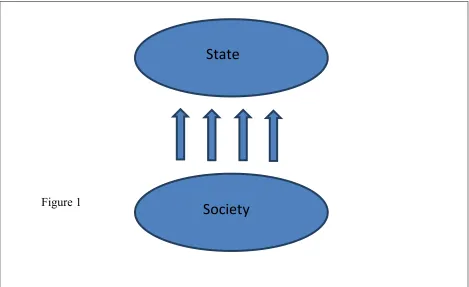
Figure 1: Weberian State ... 27
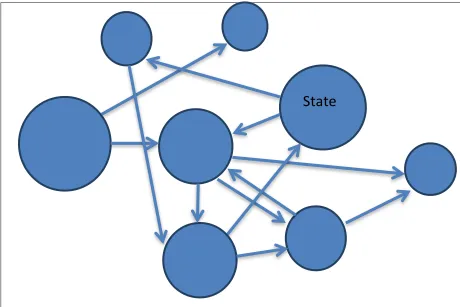
Figure 2: Migdal's State ... 28
Figure 3: Vertical, bilateral ties ... 34
1. INTRODUCTION
“The others are all collaborators,” decried Necmettin Erbakan in his 1994 local election
speech, “They are all imitators of the West, the Zionists. Vote for Refah (Welfare Party), and let
us spoil their game!” Just Order, which was based on a pragmatic mixture of capitalism,
Communism, and Islam, was presented as the only solution to the chronic problems of Turkey.
The ongoing economic crisis, reported as the most damaging one in the history of the
Republic, was on top of that obstinate list. “In the first quarter of 1994, the Turkish Lira (TL)
was devalued more than 50% against the US dollar, the Central Bank lost half of its reserves,
interest rates skyrocketed (with 400%), and the inflation rate reached three-digit levels.1” A
stabilization program, later supported by an IMF Stand-By was launched on April 5th, 1994, but
the structural adjustment measures only deepened the crisis. First, real wages fell sharply:
“average nominal wage increases of 65 percent were about 20 percent below the rate of
consumer price inflation2”. Later, due to rapid privatization of public enterprises, the slowdown
in government spending, and a sharp loss in business confidence, almost half a million people
lost their jobs3.
Nevertheless, it is possible to speculate that the economic hardship might have been
overlooked –or at least tolerated more quietly-, had not the monetary scandals of high-rank state
officials –and even Prime Minister Tansu Ciller herself- broke out one after another during the
same time period. It was quite obvious that the burden of the economic crisis, and the structural
adjustment program was not shared by every segment of the society. And, as a result, the popular
1 http://www.econturk.org/Turkisheconomy/kriz.pdf
frustration ascended day by day as a reaction to the corruption, mismanagement of the crisis, and
incompetence of the government.
Even worse, every path for channeling that frustration peacefully was either completely
blocked or limited by an imperious military authority. The ongoing fighting in the east of the
country between separatist Kurdish guerrillas and Turkish army was getting more intense every
day, and since half of the country was being ruled under the state of emergency, the political
space for the men in the uniform was expanding day by day. As the country was going through
“those days that unity and solidarity of the nation were needed, above all”, “whining” about
democracy or economic situation was intolerable. As a result, torture, death under custody,
disappearance (mostly under custody), murders whose perpetrators were unknown became the
norm due to the security-centric state ideology.
Sauced with a heavy Islamist rhetoric, Just Order was perceived as the light at the end of
the tunnel in this atmosphere. The Party promised that there would be neither the oppressor nor
the oppressed in the new system. The Kurdish problem, the privatization problem, the economic
problems, the corruption problem, and even the traffic problem could be solved via Islamist way
of governing. This call found a broad audience from the frustrated and oppressed lower classes
as much as conservative middle class, and the Welfare Party increased its vote share from 9.8%
(1989) to 19.10% (1994 local elections) in 5 years. At its peak, Welfare Party got 21.37% in the
1995 general elections, and for the first time in the history of Turkey, political Islam became the
partner of a ruling coalition.
Despite its electoral success and popular support, the ruling of the Welfare Party lasted
only for a year. The Party was first forced out of power by the military, and then shut down
marginalization of the Welfare Party, a strict de-Islamization process swept the society. Known
as 28 February process -regarding 28 February 1995 National Security Council decisions that are
considered to be the basis of a post-modern coup d’etat- this upgraded Turkish McCarthyism
turned into a total witch hunt against practicing Muslims in the public sphere.
Therefore, the landslide victory of the Adalet ve Kalkinma Partisi (AKP) in 2002 general
elections shocked the country not only because the Party “had been established merely 15
months before the elections and [its] president had been in jail some time ago for publicly
reciting a poem” (Isik & Pinarcioglu, 2010, p.161), but also because its cadre mostly consisted of
former Welfare Party members.
This victory quickly revived a huge scholarly and intellectual debate on the determinants
of election victory of the AKP, and the resurgence of the political Islam in Turkey. Not
surprisingly, the memoirs of the Welfare government revisited, and the AKP’s survival
possibility as a ruling party – and as a political party in general- became the subject of
conversation all over the country.
Contrary to the expectations of some and fears of others, the AKP has not only been able
to survive three general and two local elections, but also to increase its vote shares in each and
every election[4]. In a country accustomed to military and/or judiciary interferences to
government, the AKP was not exempt from assaults of the Kemalist state structure. During its
ten year rule, AKP fought against the very same state structure that had dismissed the Welfare
Party and many other governments while trying to convince the domestic and international
forces that the Party was not a threat to secularism per se. When the tension reached its peak with
an online military memorandum on April 27, 2007, the AKP was unexpectedly able to repulse
shortly after the memorandum. This was a historic moment for Turkish politics since it was the
first time that a government resisted the ultimatum of the military, and managed to hold on to
power in spite of it.
Why did not AKP share the same destiny with the Welfare Party although high-rank
generals were implying such an end? How has the AKP managed to appease the Kemalist state
structure and shift the balance of power in favor of itself while its predecessor the Welfare Party
did not?
This puzzle is of more than passing historical interest of Turkish politics. Defeating
authoritarian regimes -transition to democracy- has long been debated among scholars of
democratization.
The sharp -yet smooth- balance of power change in Turkish politics in recent years might
shed light on the path for other illiberal democracies that have a powerful authoritarian actor
besides democratic institutions, or those that have a limited democratic setting. In a region with
burgeoning electoral success of Islamist parties with the fall of authoritarian leaders one after
another, the AKP experience could also be used as a reference point by the optimists to show that
the political agenda of the Islamist parties could be shaped, contained, and transformed by the
broad social coalition they depend on to survive, which eventually helps them weaken the
authoritarian structures that are strongly rooted in these countries.
Hence, it is no surprise that the case of the AKP has attracted a vast scholarly interest
from political science, sociology, and history for over a decade. Overwhelmed by the sensational
election victories of the AKP, the literature has unfortunately focused its attention solely on this
1. Center-periphery conflict: Top-down modernization –especially secularization-
promoted the polarization of the Turkish society, and spurred a struggle between the center –the
Kemalist elites- and the periphery –the Muslim population. As the periphery got stronger
economically and ideologically after the acceptance of neo-liberalism in 1980s, its political
influence began to ascend as well. The AKP’s success, therefore, was just a reflection of this
resurgence of the periphery that changed the balance of power between the Kemalist elites and
the Islamic masses.
2. Political Learning/moderation: The political learning process that the leaders of the
Party have been through has played a significant role in moderation of its political agenda and
rhetoric. And as a result of this moderation, the Party managed to appeal to a broader
constituency.
3. Class struggle: The point of convergence for the scholars of political economy has
largely been the emergence of a new conservative bourgeoisie as a product of the economic and
political liberalization of 1980s and 1990s. In consonance with this view, scholars have
contended that there is a class struggle between the traditional upper-middle class and the new
middle classes in Turkey since 1980s, and the AKP owes its success very much to this conflict.
4. Party organization/mobilization: According to these scholars, the AKP’s
unparalleled focus on grassroots voter mobilization, it systematical operation, and autonomy
have cleared the path for election victories, and given rise to the Party.
5. Failures of others: A group of scholars offered a new perspective, and tried to find
an answer to the question of why others failed instead of why the AKP succeeded. They
contended that it was not necessarily the success of the AKP, but mostly the failures of center
surprisingly, they argued that economic parameters were determinant for the voting behavior of
the Turkish constituency.
6. Group Specific Policy Promises: What has been mostly overlooked by the literature
is the fact that electoral success in-and-of itself may not be sufficient for explaining the survival
of the AKP vis-à-vis the Kemalist state structure, since the predecessor of the AKP –the Welfare
Party- was dismissed by the very same structure in spite of its 1994 and 1995 election victories.
Therefore, I believe that this puzzle cannot be analyzed properly without changing our
perspective on what we understand as “success”. My perspective suggests that success,
especially in semi-democratic contexts, refers to first reining in the power of the authoritarian
actor(s) and shifting the balance of power in the political sphere in favor of oneself, and then
maintaining/consolidating the new power balance. In other words, “success”, as it is used in this
study, encapsulates both the political survival and the actual dominance of the party.
First of all, such a perspective offers a more demanding standard than sole electoral
success, since in limited democratic settings elections can be used for a variety of reasons other
than determining the actual ruler of the country. In fact, scholars argue that authoritarian actors
use elections for systematic practical reasons such as gaining legitimacy in international arena
(Schwedler & Chomiak, 2006) or appeasing the challengers from both within the ruling elite
(Gandhi & Lust-Okar, 2009; Gandhi&Przeworski, 2007), and the society (Gandhi&Prezeworski,
2007; Lust-Okar, 2004; Schwedler, 1998; Brumberg, 2002). Moderating radical opposition
groups have also considered to be another motive for holding elections in authoritarian regimes
(Schwedler, 1998; Brumberg, 2002; Gandhi&Przeworski, 2007; Berman, 2008).
However, it is important to note that these semi-democratic political settings strongly
electoral, the legislature, the media and the judicial,” and therefore elections are not used merely
for window dressing. Elections provide a front for challenging the existing balance of power, but
one needs to take into account other fronts as well in order to win the battle.
Second, this new perspective takes into account the existence of various power centers in
the Turkish society, and builds on their struggle over social control while analyzing the shift of
power balance in the political sphere. This conflict, based on each groups’ value sets, preferences
or interests, played an underappreciated role in changing the balance of power that dominates the
Turkish society.
I argue that in this environment of struggle, the broad coalition of democracy seeking
groups –each for its own sake- has managed to weaken the authoritarian state structure
comprised of military, judiciary and bureaucracy. However, this coalition was not an ipso facto
aggregation of different groups for a “greater good.” Rather, it was the product of a deliberate
AKP strategy that aimed to attain the political power essential for the appeasement of the
Kemalist state structure, and the establishment of its own domination. That strategy, I believe,
was winning over different power centers in the society via particularistic policy promises.
In sum, deriving explanations from a larger literature on group-specific politics, and the
seminal study of Joel Migdal’s state-in-society approach, this study suggest that AKP’s strategy
of providing group-specific policy promises can be one of the underappreciated aspects that may
have promoted the success of the Party –not only in terms of winning elections per se, but also in
terms of shifting the balance of power in the political sphere in favor of itself.
After presenting the literature on the rise of the AKP/Islamist in Turkish politics, we offer
particularistic politics as an alternative explanation, and draw the boundaries of the term as it is
universalistic politics in Chapter 2. Later, I contend that Joel Migdal’s state-in-society approach,
which delineates the state as a web of multiple power loci struggling for social domination,
presents a proper context for the viability and acceptability of such an explanation. I argue that in
a context in which multiple power centers struggle with one another for social control, actors
using group-specific policy promises will be more likely to successfully change the balance of
power than actors that lack such connections. Relating this general hypothesis to my research
question, I assert that that the AKP has been successful in appeasing the Kemalist state structure
and shifting the balance of power in favor of itself; because it was able to build a broad coalition
consisting of various power centers in the society via providing group-specific policy promises
to each, whereas the Welfare Party lacked such connections.
In Chapter 3, I clarify the contents of the Kemalist state structure, and reveal my research
design for analyzing the correlation –if any- between the AKP’s group-specific policy promises
(IV) and its success in shifting the balance of power in favor of itself (DV). Chapter 4 tests my
hypothesis with a most-similar research design with the AKP and the Welfare Party at its focus.
2. ALTERNATIVE EXPLANATIONS
2.1.CENTER –PERIPHERY CONFLICT
Most scholars studying Turkish politics believe that the primary factor that has shaped
Turkish society and politics for decades is the modernization process, which dates back to
Tanzimat reforms (1839) of Ottoman Empire, and takes a more radical and transformative stance
with the founding of the Turkish Republic (Onis, 1997; Ozbudun, 1981; Kalaycioglu, 1994; Isik
& Pinarcioglu, 2010). More than any other scholar, Serif Mardin, in his 1973 book Center and
center and a periphery. According to Mardin, Ottomans used Islam –the majority religion of the
era- as a communication tool that tied these otherwise very loosely related worlds together
(Mardin, 1973). Modernization, on the other hand, cut that connection between the central elites
and peripheral forces and created “the most important social cleavage underlying Turkish
politics” (Mardin, 1973, p.170).
Modernization process had such traumatic effects for state-society relations because
bureaucratic elites were convinced that Islam was an obstacle to development and modernization
of the state, and therefore it had to be wiped out of the society through a top-down reform
process. As a result, “the Republican elite bodied in the Republican People’s Party –the single
party through which Republican policies were channeled- was unable to establish contact with
the rural masses.” (Mardin, 1973, p.183). Modeling the French system, the strict secularization
process in Turkey was more about subordinating religion to the political realm than separating it
from the state. Combined with harsh punishments, the authoritarian secularism further
“promoted the polarization of Islam and the struggle between Kemalists and Muslims for control
of the state,” (Yavuz, 1997, p.64) – a struggle usually resulted in the triumph of the Kemalist
elites due to their monopoly of political, economic, and military power.
Contrary to earlier literature, Ramin Ahmadow (2008) argues that the social and political
structure of Turkey, namely this center-periphery tension between Kemalists and Islamists has
dramatically changed after 1980s (Ahmadov, 2008). The role of the 1980 military in this
transformation was decisive, since “the leaders of the military coup, ironically, depended on
Islamic institutions and symbols for legitimization; fusing Islamic ideas with national goals, they
hoped to create a more homogenous and less political Islamic community,” (Yavuz, 1997, p.67).
preserved and the center and periphery continued to co-exist, the power balance between the two
has changed,” (Ahmadov, 2008, p.18). As a result, “the periphery recovered, produced its own
world with its own market and financial networks, grew its elite, and re-defined its worldview
with respect to its central beliefs and traditions,” (Ahmadov, 2008, p.18) - a transformation
which left Turkish center no option but to defend the status quo at any cost, even if it meant
supporting military coups. Islamists, on the other hand, demanded more and more liberalism in
order to extend the sphere of influence of the peripheral masses they are representing. In final
analysis, “these developments set the stage for a paradoxical switching of roles: progressive
Islamists versus reactionary Kemalists,” (Gunter & Yavuz, 2007, p.290)
In addition to the change in the balance of power between center and periphery, the 1980s
contributed to the addition of new battlefields that new wars could be fought. Isik and
Pinarcioglu (2010) claim that with the introduction of the neoliberal policies and increasing
urbanization, the center-periphery tension transferred to urban areas, and transformed into a new
tension between the well-educated rich and the less-educated poor. Taking over the heritage of
the once powerful center-right, Islamist parties have become the spokesperson for these newly
established peripheral areas.
Either the secular and West-oriented center vs. the religious and traditional periphery or
the modern urban vs. rural conflicts, the tension between two opposing worlds is still “the most
salient axis of political divisions in Turkey.” (Isik & Pinarcioglu, 2010, p.178). That’s why the
election victory of AKP –the last representative of the periphery- was correctly labeled as the
“Anatolian4 revolution5” initiating the “Second Republic6” by the mainstream media organs.
4 Aside from its geographical meaning, “Anatolia” represents the periphery in Turkish society. 5 http://arsiv.sabah.com.tr/2002/11/04/ 04/17/2012
Even if we accept that this dichotomy presents useful insights for explaining the electoral
success of the Islamist parties in Turkish politics, it is hardly that helpful in addressing the
distinction between the Welfare Party and the AKP with regards to the origins of their strengths
and weaknesses as well as their political agenda. The center-periphery arguments fail to answer
why the Welfare Party used a heavy Islamic rhetoric while AKP refrained from it and
emphasized the importance of democratization.
In addition to that, the center-periphery dichotomy overlooks the disparate between the
ruling experiences of these two peripheral parties vis-à-vis the center –or namely the Kemalist
state structure. Contrary to the “representative of the same periphery” thesis, the characteristic
and the life span of the Islamist governments entirely differed from one another. While the
Welfare Party was forced out of power with a post-modern military coup –aka 28 February
process, AKP has been able to stay in power with an increasing strength albeit the efforts of the
Kemalist state structure, surviving the 27 April Military Memorandum. Why would that be the
case if the same constituency against the same enemy supported both?
2.2.POLITICAL LEARNING /MODERATION
Another group of scholars emphasized the apparent difference between the party
programs, policy goals, rhetoric, and constituency support of the parties in explaining the AKP’s
success and the Welfare’s failure vis-à-vis Kemalists. In fact, they argued, AKP has been
successful because the Party refrained from making references to religion – a sharp contrast with
the previous Islamist parties (Cavdar, 2006). Thereby, “despite the Party’s Islamist heritage,
AKP targeted a broad constituency, cutting cross-class, gender, and ethnic lines, and gained the
support of those who previously had voted for central right and Islamist parties,” (Cavdar, 2006,
This moderation was not a sudden invention of the AKP, but rather was the result of a
“political learning” process, which was deeply rooted in the experiences of its cadres in the
Islamist movement, and the lessons they derived from the unpleasant end of the Welfare Party.
Scholars define political learning as “a process through which people modify their
political beliefs and tactics as a result of severe crises, frustrations, and dramatic changes in
environment” which is usually forced by structural constraints (Bermeo, 1992, p.274). Carrot and
stick policies as well as regime accommodations such as democratic openings have been
essential for moderation of the radical opposition leaders in order to exploit the opportunity of
inclusion to the system (Bermeo, 1992; Wickham, 2004; Yilmaz, 2008, Somer, 2007).
Hammered by the previous experiences of Islamist movement vis-à-vis these structural
constraints –namely the authoritarian Kemalist state structure and the unique position of
European Union regarding democratization-, “the top [AK] Party leadership came to
acknowledge that any attempt to increase the influence of Islam in Turkish politics, let alone any
radical changes in domestic or foreign policy, were bound to be blocked” (Cavdar, 2006, p.481).
Therefore, a radical transformation of the state was impossible in Turkish context. Instead, “what
was desirable and feasible, they believed, was to seek greater religious freedoms within the
parameters of a secular and democratic political system,” (Cavdar, 2006, p.481). Moreover,
moderation would also help them broaden their constituency support as they became aware that
the Turkish society was against the obstinate confrontation with the secular state structure
(Cavdar, 2007). In short, following the Welfare legacy was a political suicide in every means.
Such a shift from Islamism to post-Islamism7- and even to non-Islamism8- has put
moderation at the heart of the AKP’s political posture and practices: respect to Ataturk and
7 Post-Islamism: “A form of instrumentalization of Islam by individuals, groups and organizations that pursue
secularism was consistently emphasized by Party members, female candidates were chosen from
among those who did not wear headscarves, the EU membership was listed as one of the
priorities, headscarf, and IHL9 problems, the core demands of the conservative electoral base10,
were postponed to an indefinite future. And consequently, this unprecedented de-Islamization of
the Party –a virtue the Welfare Party apparently lacked- promoted its success vis-à-vis the
secular state structure. After all, “for Kemalists, radical Islam [has been] easier to vilify and to
justify restricting within democracy” as “moderate Islam’s zeal to embrace modern lifestyles and
its rejection of revolutionary methods make it harder to justify restricting it within a democratic
system,” (Somer, 2007, p.1277).
Nevertheless, even if we overlook the similarities of the AKP and the Welfare Party on
gender, and foreign policy practices, and accept that moderation argument does account for their
divergent destinies, the failure of other moderate Islamist parties that were not nearly as
successful as the AKP still begs an explanation.
After the Welfare Party ousted from power, the reformers that were going to found AKP
in upcoming years were not the only fraction to realize that avoiding open confrontation with the
Kemalist state structure was the only way to succeed (Yilmaz, 2008). The Virtue Party, which
was founded by traditionalist Welfare cadres after they realized that the closure of the Welfare
Party became imminent, also refrained from using religious rhetoric to an extent that its
foundations for which rests on reappropriated, reinvented concepts borrowed from the Islamic tradition,” (Denoeux, 2002, p.61) cited in (Yilmaz, 2008, p.45).
8 “From the beginning, the AKP claimed that their party is not Islamist; they even rejected the use of the label
“Muslim democrats” as an analogy to the Christian democrats in Western Europe. In rejecting the label “Muslim democrat”, Erdogan stated that: ‘These attributions are not correct, not because we are not Muslims or democrats; but because these two [identities] should be considered on different planes’. Rather, the AKP based its policies on the “conservative democracy” program. Instead of emphasizing their Muslim identity, they preferred to ground their moral and religious values within the confines of ‘conservatism’.” (Ayata & Tutuncu, 2008, p. 367).
9 Imam Hatip Schools – Vocational schools that pursue an Islamic curriculum in addition to the national one
containing arts and sciences.
10 Hayrettin Karaman, Iktidarin Uc Mesele ile Imtihani Yeni Safak Newspaper
discourse became very similar to that of a center-right economically liberal and socially
conservative party, (Yilmaz, 2008). The Virtue Party also “advocated pluralism and the
democratization of everyday values in order to democratize politics, abandoning the nationalist
and state-oriented model of economy preached by Erbakan for decades, in favor of free-market
economy with an emphasis on social justice. The VP also renounced anti-Westernism and
embraced European Union membership, previously thought to be a Jewish conspiracy by the
Welfare Party and its Islamist predecessors (Yildiz, 2003).
In short, even though the Virtue Party went through the same political learning process
as the AKP, this moderation did not carry it to power, nor did it prevent the Constitutional Court
from banning it in 2001 due to its violation of the Kemalist articles of the Constitution.
2.3.CLASS STRUGGLE
Deviating from the analysis based on traditional “center-periphery” conflict, some
scholars contend that class struggle lies at the heart of the ideological and cultural tensions in
Turkey in general, and the rise of the AKP in particular. According to these scholars, what is
disguised as an Islamist-Kemalist conflict is nothing more than a struggle between Anatolian
bourgeoisie (embodied in Independent Industrialists and Businessmen's Association – MUSIAD)
and Istanbul’s large businesses (embodied in Turkish Industry and Business Association –
TUSIAD) to get larger shares from the expanding economic pie (Onis, 1997; Meyer, 1999;
Gulalp, 1999; Cavdar, 2006; Alam, 2009; Baskan, 2010; Sen, 2010). Consequently, each class
supports the political parties that could be a perfect spokesperson for their economic interests.
After all, the scholars argue, ideology matters only to an extent in an environment in
which there are alternative players that could represent the same ideology. Therefore, the
ideological proximity. Endowed with genuine entrepreneurial spirit as much as religious and
national values, MUSIAD members believed that they were “excluded from the economic life
controlled by big business groups supported by Kemalist state, [which] allocated investment
funds and other privileges largely to Kemalists and Westernized big business groups –the
Istanbul bourgeoisie- [that are] state-protected, monopolistic, and rent-seeking,” (Sen, 2010,
p.74). Accordingly, what gave rise to the AKP was the marriage between neoliberalism and
Turkish Islamism that promised benefits to the new business elite.
This explanation is problematic in several aspects. First, the AKP was not the first
Islamist party to enjoy this support. During the 1980’s, the Welfare Party as well voiced the
interests of burgeoning Anatolian bourgeoisie who wished to receive state support and protection
like their Istanbul counterparts (Gulalp, 2001; Meyer, 1999; Baskan, 2010). “The rise of the
Welfare Party reflects,” argued Ziya Onis, “the growing aspirations of the rising Islamic
bourgeoisie to consolidate their position in society, to achieve elite status also and, in purely
economic terms, to obtain a greater share of public resources, both at the central and local levels,
in competition with other segments of private business in Turkey,” (Onis, p.760). Nevertheless,
the support of the Anatolian bourgeoisie did not prevent the fall of the Welfare Party. Quite the
contrary, the conservative entrepreneurs themselves got harmed by being labeled as
“unfavorable” and “reactionary” during 28 February process (Yavuz, 1997).
Second, TUSIAD, the very same organization that is claimed to be clashing with
MUSIAD- and consequentially the AKP, has been one of the most enthusiastic supporters of the
AKP. In this regard, Mehmet Ugur and Dilek Yankaya observe that “[the] awareness of the
significance of credible commitments to reform and the explicit linkage between the reform
Development Party,” (2008, p. 590). In fact, “TUSIAD [itself] tended to describe the AKP
government as an opportunity for economic and political stability and for economic and social
transformation that the country had been longing for,” (Ugur & Yankaya, 2008, p.593).
2.4.PARTY ORGANIZATION /MOBILIZATION
Studies addressing the links between electorate mobilization and the AKP’s success have
primarily placed stress on party organization. Some scholars argue that forming grassroots
organizations that build direct bridges with the large segments of society –especially those
adversely affected by the outcomes of the globalization- is the main reason behind the Party’s
landslide victory (Tugal, 2009). Others emphasize the role of “the party’s character as an
organization, its internal power structure, its electoral roots, strategy, and leadership in the
context of [the Party’s] organizational environment –including its constitution, major veto
players as well as international actors,” in determining not only the electoral success but also the
survival possibility of the AKP (Boyraz, 2010, p.287; Kumbaracibasi, 2009).
After all, parties do not act in a vacuum, the argument follows, the interaction between
internal life of a party (being systematic) and its organizational environment (its autonomy) is of
significant importance (Kumbaracibasi, 2009). Accordingly, “the survival [of the AKP] as a
major political force” will depend on “balancing the AKP’s roots in Islamic parties and
movements against its claims to be a moderate party far from radicalism and fundamentalism,”
(Kumbaracibasi, 2009, p.4).
However, such explanations overlook the fact that the Welfare Party’s rapid ascent in
1990’s was also considered to be due to “its populist platforms and aggressive recruitment
campaign [as well as] the Party’s unique internal discipline and impressive organizational
unprecedented cohesion, unity, and a well developed administrative organization (Yavuz, 1997).
And yet, its organizational capabilities and mobilization success did not translate into the ability
to govern when confronted by the secularist state structure.
2.5.FAILURES OF OTHERS
In spite of the vast literature studying the dynamics behind the AKP’s landslide victory, a
number of scholars posit that it is not the success of the AKP per se but the failures of the major
parties of the center-right and center-left that could explain “the first stage of a structural
transformation in center politics” (Cosar & Ozman, 2004, p.57, Carkoglu, 2002).
Integrating nationalist, conservative, liberal and social democratic tendencies, the AKP
leadership aims to transcend the ideological borders and appeal to the broader center-right
constituency (Cosar &Ozman, 2004; Taskin, 2008; Alam, 2009). In this vein, the AKP’s
self-identification itself of “conservative democrat” and distancing itself from the Islamist legacy in
Turkey, as well as its distinctive efforts for EU membership, are not natural consequences of
political learning. Rather they are “a part of a deliberate strategy of filling the void on the
center-right…. in responding to the ontological crisis deepened by the destabilizing effects of
globalization, civil war, and unregulated urbanization,” (Taskin, 2008, p.53-54).
But how did center-right politics, which represented no less than 50%11 of the Turkish
electorates during 1990’s, fail in Turkey? Taskin (2008) argues that the answer lies in the
systematic corruption combined with the failure of two center-right parties (the Motherland and
the True Path Party) to integrate the rising Muslim counter-elites into conservative
modernization process, which promises economic development without moral decay. In addition,
increased cooperation with the military and the secular establishment further distanced these two
parties from their populist claim of authentic representation of the masses (Cosar & Ozman,
2004; Alam, 2009).
On the other hand, economic factors also have significant implication for party politics in
explaining the decline of the center-right politics in Turkey. For example, Kalaycioglu observes
that since “there is more than one political party that occupies a particular ideological position of
the left-right spectrum, the voter needs to make a further choice between ideological similarity of
identical parties,” (Kalaycioglu, 2010, p.31). Similarly, Baslevent et. al (2005), provides
evidence in support of economic voting hypothesis[2], which basically argues that incumbent
parties will be in a disadvantaged position at this point, since voters hold the incumbent party
responsible for economic indicators such as inflation, unemployment and GNP per capita –real
or perceived-, and punish the government in elections. Likewise, Lewis-Beck and Stegmaier
contend that “Among the issues on the typical voter’s agenda, none is more consistently present,
nor generally has a stronger impact, than the economy. Citizen dissatisfaction with economic
performance substantially increases the probability of a vote against the incumbent.,”
(Lewis-Beck & Stegmaier, 2000, p.211).
Thus, the fall of a government seems to be more likely to come from economic
accountability than the shifts in ideological or political attachments (Lewis-Beck & Stegmaier,
2000). Even though, this effect has been considered asymmetrical, with mostly punishment and
little reward (Radcliff, 1994), Kalaycioglu (2010) finds out that “partisan affiliations followed by
the voter satisfaction with the performance of the economy played the biggest role in
determining the voter preferences in Turkey in 2007 elections,” (p.29).
Either symmetrical or asymmetrical, there is a consensus in the literature that the
The dimension and the nature of the impact, on the other hand, are quite controversial.
Nevertheless, what is not controversial is “incumbents pay the price for short-term economic
setbacks, but deeper crises may be translated into broader political shifts,” especially in
developing countries (Remmer, 1991). Accordingly, some scholars argue that these “broader
political shifts” mean the breakdowns of democratic or semi-democratic regimes (O’Donnell,
1973; Linz, 1978; Collier, 1979; Gasirowski, 1995), while others contend that economic setbacks
have a catalyst effect in triggering transitions to democracy (O’Donnell, Schmitter, &
Whitehead, 1986; Bermeo, 1990; Przeworski, 1986).
Either way, it can be derived from the literature that the worse the economy fails, the
more radical the political change will be. By weakening the old actors and/or giving rise to new
ones, economic crises create a chaotic atmosphere in the system. Thus, the argument indicates
that economic parameters that hindered the power of the incumbent parties enabled the electoral
victory of the AKP.
What might be an interesting research question for future research is whether we could
attribute the consecutive electoral victories of the AKP to the miracle developments in Turkish
economy under the AKP government. Is it possible that the political success of the Party is just a
reflection of its economic success?
Putting aside the debates on the symmetrical and asymmetrical effects of the economic
parameters on voting behavior, and the uneven distribution of wealth under the AKP rule, it
should be kept in mind that governments do not necessarily come and –especially- go with
elections in semi-democratic political settings such as Turkey. Therefore, the economic success
might not tell us much about the containment of Kemalist elites, which consistently intervenes
never addressed the poor economic performance of governments as a legitimizing factor for its
interruptions.
3. GROUP SPECIFIC POLICIES
Despite the valuable contributions they make to the literature on the rise of the AKP,
existing explanations suffer from two major weaknesses. First, most scholars take election
victory as the ultimate indicator of success. Even though it might be a useful proxy in fully
democratic political settings, where the elected government becomes the actual ruler of the
country, elections do not necessarily determine who dominates the society in semi-democratic
settings such as Turkey. Deeply rooted in the state structure, strong authoritarian actors in these
political settings do not refrain from interfering with democratic institutions whenever they feel
the need for the reproduction of their authority. Therefore, elections become an insufficient
platform for the challenger that wishes to dominate the society according to its political agenda
for establishing its rule prerequisites changing the status quo first.
But if not for determining the actual ruler of the country, what is the purpose of
elections in these limited democratic settings? Scholars argue that authoritarian actors use
elections for systematic practical reasons that can be summarized in two categories: external and
internal factors:
External factors: To be recognized as a respectful member of the international
community, the virtues of equality, the rule of law, human rights and freedoms as well as the
liberal economy are supposed to be internalized by states. The countries that have problems in at
least one of these are imposed, encouraged and even forced to reconsider their attitude
the European Union, responding to foreign pressure and gaining legitimacy in the international
arena has become crucial for the autocracies. if they manage to reflect this international
pressure on to domestic opposition, they have a chance of pressuring the further moderation of
the opposition (Schwedler & Chomiak, 2006; Berman, 2008).
Internal factors: The internal reasons to have electoral institutions are as important as the
external ones. Since the strength of an autocrat is not limitless, even the cruelest one cannot
repress or kill every single opponent to his power. Thus, autocratic regimes should compromise
one way or another to the challengers from both within the ruling elite and the society.
The solution to the challenges coming from other ruling elites or noble family members
could be conciliated by redistribution of the state patronage. The most efficient way for an
autocrat to decide who should be spoiled more by such patronage is holding elections to see who
is more popular (Gandhi & Lust-Okar, 2009; Gandhi&Przeworski, 2007).
Challenge also comes to the authoritarian regimes from the opposition groups in the
society. When autocrats need to neutralize these threats and “solicit the cooperation of
outsiders”, they usually use democratic institutions such as elections (Gandhi&Prezeworski,
2007, p. 1279). Since they can set the rules for competition, decide inclusiveness and
exclusiveness of the system (Lust-Okar, 2004), and influence electoral outcomes with direct and
indirect ways (Schwedler, 1998); autocrats rely on democratic institutions to maintain their
interests. It is a fact that “divide and rule” is a historically valid method in politics, and
autocracies use it very often to maximize their room for maneuver (Brumberg, 2002).
Moderating radical opposition could be another motive to hold elections in authoritarian
regimes. It is possible to make opposition condemn violence, act openly and respect the
radicals will have to compromise from some ideological extremism and become more moderate.
In return, they will be allowed to pursue their political agendas on low politic issues (Schwedler,
1998; Brumberg, 2002; Gandhi&Przeworski, 2007).
Clearly then, “political success” in semi-democratic settings have a different meaning
than topping elections. I argue that it is the ability of the elected governments to govern the
society without any interference. As Huntington (1968) contends “the most important political
distinction among countries concerns not their form of government but their degree of
government,” (p.1). Similarly, Francis Fukuyama notes that an essential feature of many
developing countries is the gap between the formal claims of the state authority, and its actual
capacity to govern (Fukuyama, 2004). This capacity has two aspects to it: first reining in the
power of the existing authoritarian actor, which will lead to a shift in the balance of power, and
then maintaining/consolidating the new balance of power, favoring one’s own political agenda.
Thus, I argue that the real success of the AKP lies not in the Party’s landslide electoral
victories, since they were not unprecedented, but in its ability to appease the Kemalist state
structure, and shift the balance of political power in favor of itself. I believe that this is why the
literature focusing solely on electoral success of the AKP fails to explain the demise of the
Welfare Party after its sensational election victories.
The second weakness of the literature is its attempt to analyze Turkish society in
superficial dichotomies such as “center vs. periphery”, “state vs. society” or “Kemalists vs.
Islamists.” In fact, revolving around a Weberian type of state definition, the literature fails to
account for the various power centers in Turkish society that cut across class, religious, or
pursuing the same political agenda. Within and across the categories, there are multiple power
centers, big and small, competing with each for the fulfillment of their political agendas.
Joel Migdal addresses this patched characteristic of the society with a new definition of
state in his state-in-society approach. He contends “the society is a web or mélange, rather than a
pyramidal structure with the state’s rule-making mechanisms at the apex,” (2001, p.36). This
web, according to Migdal, consists of “multiple rule-making loci, and the hidden and open
conflict among these multiple centers seeking to exercise domination,” (Migdal, 2001, p.36).
These power centers do not necessarily represent a single class, religion, or an ethnic group.
Rather, they are comprised of individuals who share similar value sets and compete for the
domination of their values.
I believe that this depiction of the state is a much closer fit to the Turkish case. Due to its
historical, ideological and political realities various power centers are all in a constant struggle
with each other for domination of their sets of values and beliefs in Turkish society. Some of
these power loci are the military, the Constitutional Court, the President, the Parliament, the
Kurds, Alewits, Sunnis, and the Kemalists elites. Putting the state-in-society approach at the
center of its analysis, this study aims to evaluate the determinants of the AKP’s success in
appeasing the power of the Kemalist state structure, which was a threat to the rule of the Party,
and shifting the balance of power in favor of itself – a virtue I contend is what differentiates the
Party from its predecessors.
The central question this study aims to answer is “How has the AKP managed to appease
the Kemalist state structure and shift the balance of power in favor of itself, while its predecessor
the Welfare Party did not?” I argue that the use of particularistic policy promises as a
be useful for winning elections. But I believe the diversity of the coalition members will provide
the Party with the necessary means for changing the balance of power at different levels in
different arenas such as the media, the judiciary, the discourse of the political sphere etc. For
example, a coalition partner that has a TV channel, a radio station or newspaper will enable the
Party to confront the Kemalist state structure in the media as well. Or a partner with strong
foreign connections will provide international support that can be vital and determinant in these
countries. In short, the diversity of coalition members opens new fronts that can be used to either
target the status quo seekers or defend oneself vis-à-vis them.
4.1.PARTICULARISTIC POLITICS IN THE “STATE OF NATURE”
Different historical and institutional circumstances may make different strategies
politically more or less viable and socially more or less acceptable. Therefore, before examining
how group-specific policy promises can be used as a coalition-building strategy for political
survival and domination, I will provide a brief summary of Joel Migdal’s state-in-society
approach as a fertile context for particularistic politics.
“Many of the existing approaches to understanding social and political change in the
Third World either have downplayed conflict altogether (e.g., much of “modernization” theory),
or have missed these particular sorts of conflicts, which only on occasion are class based (e.g.,
much of the Marxist literature), or have skipped the important dynamics within domestic society
altogether (e.g., dependency and world-system theories),” observes Joel Migdal (2001, p.65).
This incompetency, according to Migdal, derives from a misunderstanding of Weber’s classical
state definition (see Figure 1). Weber defines state as “a human community that (successfully)
2001, p.13). Migdal argues that that this “omnipotent given” image of the state is one of its two
components:
1-An image, a perception of the state as “the chief and appropriate rule maker within its
territorial boundaries”, which is “fairly autonomous, unified and centralized,” (Migdal, 2001,
p.16).
2- The actual practices of multiple parts of the state, which may bolster the image of the
[image:33.612.72.541.264.551.2]state, or batter it.
Figure 1
What other scholars overlook, he continues, is the second component; the actual practices
of multiple parts of the state, which may bolster the image of the state, or batter it. Therefore,
according to Migdal, in order to understand the political change one should look at the
accommodations between multiple parts of thesociety, which is “a web or mélange, rather than a
State
Society
pyramidal structure with the state’s rule-making mechanism at the apex,” (Migdal, 2001, p.16).
In other words, moving away from a perspective that simply puts state against society, Migdal
offers a state which is a player among multiple power centers in the society that are constantly at
hidden and open conflict over social control (Migdal, 2001) (See Figure II).
Moreover, he delineates the state as neither a unified nor a coherent actor in its struggle
with societal forces as its image suggests. On the contrary, Migdal contends that the parts of the
state are also at conflict with one another. They and do not refrain from building coalitions with
other formal or informal organizations to develop practices contradicting the official laws and
[image:34.612.98.558.330.637.2]regulations of the state (Migdal, 2001).
Figure 2: Migdal's State
He further notes that the struggles for domination take place in multiple arenas, and is not
limited to the question of who controls the top leadership position of the state (Migdal, 2001). As
aforementioned earlier, pseudo governments do not tell us much about the actual ruler of the
society. Whose laws prevail? Who controls the society? We cannot answer these questions by
just looking at the top leadership position of a country unless we know the “degree” of
government, whether it is autonomous from any influence or whether it actually controls the
society. Hence, we cannot limit the scope of the power struggle to a single arena. There are
various arenas that can be used for confrontation or accommodation by multiple power loci such
as the media, the judiciary, the legislature, the discourse of the society, and elections are but one
of them.
If this social struggle is not simply for controlling the top leadership position of the state,
then what is it for? “Social control is the currency for which social organizations compete,”
answers Migdal (Migdal, 2001, p.51) for the supremacy of a group’s rules or value system
requires social control. In addition, it is necessary for the enhancement of the strength and
autonomy of the ruler, and reflected by compliance, participation, and legitimacy (Migdal,
2001).
According to Migdal, there are two paths for sustaining social control. The first one is
political mobilization of masses, which entails “conveying to people that the routines, symbols,
and ways of behaving represented [by that power center] are essential to their well-being. And
involves providing them with channels to express their support,” (Migdal, 2001, p. 71). The
second one is the strategies of survival, which becomes a necessity due to the lack of broad
political support. While broad political mobilization solves the problem of social control by
especially in the face of any other significant concentration of power in the society, which
ultimately might be used against them,” (Migdal, 2001, p.71). Therefore, such narrower bases of
popular support necessitate the application of survival strategies that aim to “weakening any
group in society that seems to be building extensive mobilization strength, even the agencies of
the state itself,” (Migdal, 2001, p.72).
Migdal goes into detail explaining the strategies of survival while he pays little attention
to strategies of social mobilization other than stating that it demands much more than
exhortations, charisma, or ideology of state leaders. In addition, he suggests that it would be
better “for state leaders to undermine those other organizations and the efficacy of their rules by
supplying to people a mix of rewards, sanctions, and symbols” that constitutes a more attractive
value set than the other organizations offer (Migdal, 2001, p.66). However, he does not expound
the “rewards, sanctions, and symbols” that would convince people to trail behind.
What conveys to people that the routines, symbols, and ways of behaving represented by
that power center are essential to their wellbeing? How do these people come to believe that their
fate/future lies in with that actor? At this point, I offer group-specific policy promises made by
political parties or governments as one of the mobilization strategies that could have such an
effect on people from different power centers.
Joel Migdal mentions the importance of building coalitions and a domestic balance of
power as a strategy of survival. However, in his argument, this coalition building is limited to
“those agencies and organization whose services and products are of direct benefit to a regime
that cannot bring them under central control,” –namely “state-owned enterprises, local capital,
multinational firms, and other important state agencies (including the military),” (Migdal, 2001,
On the other hand, I believe that this coalition building strategy could be applied on the
societal level. On the demand side, power centers yearn for a powerful ally that could help them
fulfill their political agendas. On the supply side, political parties have the means necessary to
channel the demands of its allies by taking advantage of the democratic openings the system
offers – how small they might be.
The Demand Side (The Society): As already discussed, society consists of multiple
power centers, and each power center has its own value set, beliefs, and policy preferences. In
addition, these power centers are at a constant conflict with one another for the fulfillment of
their interests and political agendas. In this “state of nature”, obviously some actors are powerful
while others are not, some are more influential while others are peripheral, and some benefit
from the reproduction of the existing balance of power while others and seek an opportunity to
change the status quo. Democratic institutions in a fully democratic political setting, especially
elections, may present such an opportunity. Whereas, in countries where election victories do not
necessarily change the existing balance of power, these democratic institutions lose their
efficiency as the channels of voice for the unsatisfied actors in the system. Authoritarian actors in
semi-democratic states do not refrain from interfering, interrupting, and even suspending
democratic processes, which might be upsetting the existing balance of power reproducing the
authoritarian domination. Therefore, the challengers need to acquire, aggrandize, and maintain
political power to challenge this rule and set a new balance of power favoring their utility
functions – be it a political agenda, belief system or an economic interest.
However, not every one of these challengers has the strength, opportunity or capability to
control and dominate the society on its own. They need to increase their influence by aligning
their utility functions. In other words, in a rational choice exchange model, power centers
exchange their resources and get into a coalition for political influence in an effort to maximize
their utility. In return, they provide compliance, participation and legitimacy to their partners
through different channels.
The Supply Side (The Political Party): Being one of the power centers in the society, a
political party also represents a certain way of thinking, ideology, and utility function. And just
like any other power center that is not happy with the status quo, some of them want to change
the existing balance of power. Their advantage is that these parties have an actual potential to
change the status quo and have social control over society, if they could sustain political
mobilization of the masses or apply strategies of survival, according to Migdal.
Since it is a semi-democratic political setting, there are channels that are open to every
power center in the society. Even though authoritarian actors abuse them from time to time, they
exist. Elections, media, NGOs, referendums, demonstrations of support or opposition, strikes,
universities, economic forums, the courts, the Parliament etc, all can be used -to a lesser or a
greater degree- as channels for expressing political support, compliance, legitimacy or there lack
of.
However, in order to take advantage of all this support channeled through various
platforms, the party needs to appeal to people from different power centers on different grounds.
Moreover, the party should respond to the demands and longings of a particular power center to
an extent that the people in that power center would believe that the routines, symbols, and ways
of behaving represented by the party are essential to their own well-being. The strength of the
bond between a power center and the party will depend on the sense of urgency among members
society, in which there are multiple power centers with their own utility functions, one of the
strategies for creating this kind of attachment is through particularistic politics.
First of all, it gives the political party the flexibility to determine the partners of this
relationship via including or excluding any power center of its choice according to the value of
the resources or the degree of support provided by that power center. Such flexibility gives a
dynamic characteristic to the coalition, meaning that the party or a coalition member may prefer
to defect at any time during the process of challenging the status quo for any reason. Likewise,
the party may create new symbiotic relations with new power centers on the course of the
struggle. In sum, particularistic politics provides the party with the necessary means to regulate
the size and the composite of the coalition.
What is the ideal size for such coalitions? Riker (1962) argues that where coalitions are
engaged in a zero-sum competition with other coalitions over a limited source, and where
coalition leaders can offer side payments (bribes, money, promises or other things of value) to
induce outsiders to join them, rational coalition leaders will aim to attract only the smallest
number of members into their coalition that they need in order to win the competition –size
principle (p.33). In short, where additional members tend to raise the costs without adding
benefits to the coalition, the coalition leader will be inclined to create a minimum winning
coalition, the smallest possible coalition that will be enough for winning the majority of votes
(Riker, 1962; Koehler, 1972; Shepsle, 1974; Uslaner, 1975; Koford, 1982; Denzau and Munger,
1986; Baron and Ferejohn, 1989).
As rational as it may sound in theory, political scientist have found that Riker’s minimum
winning coalition does not hold empirically, and oversized coalitions are more common in