Religious Studies Theses Department of Religious Studies
4-9-2010
The Brain on Ritual: How Tantric Puja Shapes the Mind
The Brain on Ritual: How Tantric Puja Shapes the Mind
Sherry Lynn MortonGeorgia State University
Follow this and additional works at: https://scholarworks.gsu.edu/rs_theses
Part of the Religion Commons
Recommended Citation Recommended Citation
Morton, Sherry Lynn, "The Brain on Ritual: How Tantric Puja Shapes the Mind." Thesis, Georgia State University, 2010.
https://scholarworks.gsu.edu/rs_theses/24
This Thesis is brought to you for free and open access by the Department of Religious Studies at ScholarWorks @ Georgia State University. It has been accepted for inclusion in Religious Studies Theses by an authorized
THE BRAIN ON RITUAL: HOW TANTRIC PŪJĀ SHAPES THE MIND
By
SHERRY L. MORTON
Under the Direction of Dr. Kathryn McClymond
ABSTRACT
Traditional ritual studies approaches to the body are effective for illuminating
how the body functions as an entity that absorbs and expresses a variety of social, and
political dynamics; however, they are less productive for understanding the body as a
physical organism. This interdisciplinary thesis applies theoretical models from cognitive
science, social psychology and ritual studies to the Śrī Cakra Pūjā in order to develop a
more complete understanding of the ritual body as a physical body. Using Lawrence
Barsalou’s theory of embodied cognition, which focuses on the impact of human
experiences on the creation and integration of neural pathways, this essay, argues that
Śrī Cakra Pūjā affects the mind by shaping the neural architecture of the brain. This
cognitive perspective on religious ritual practice is compared with the more traditional
understanding of the religious ritual body, brain and mind.
THE BRAIN ON RITUAL: HOW TANTRIC PŪJĀ SHAPES THE MIND
By
SHERRY L. MORTON
A Thesis Submitted in Partial Fulfillment of the Requirements for the Degree of
Master of Arts
in the College of Arts and Sciences
Georgia State University
Copyright by
THE BRAIN ON RITUAL: HOW TANTRIC PŪJĀ SHAPES THE MIND
By
SHERRY L. MORTON
Committee Chair: Dr. Kathryn McClymond
Committee: Dr. Jonathan R. Herman
Dr. David M. Bell
Dr. Jeffrey S. Lidke
Electronic Version Approved:
Office of Graduate Studies
College of Arts and Sciences
Georgia State University
DEDICATION
This thesis has been powered by the love and patience of my family and friends.
Thank you all for pep talks and countless dinners. Most of all thank you for surviving the
ACKNOWLEDGEMENTS
This work required the creativity and support of a large community of scholars, and
I am fortunate to be writing in a city populated with many wonderful thinkers. Laurie
Patton set me on this path when she suggested I read Lakoff and Johnson and I have
never recovered from my initial encounter with The Body in the Mind. Brendan Ozawa-de
Silva introduced me to Larry Barsalou’s work and continues to serve as my social guide in
the world of embodied logics. David Bell’s introductory class on the psychology of religion
was an invaluable immersion course in the conversation on science and religion. Jeffrey
Lidke, Robert McCauley, and Larry Barsalou freely gave me their expertise and time. Jon
Herman’s insistence on knowing ―what’s at stake,‖ has kept this project far more focused
than it might otherwise have been and occasionally kept me awake at night. Sandy
Dwyer’s support made it possible to juggle the responsibilities of teaching critical thinking
to freshman while working to master the skill for myself. Thank you all; I hope to repay
your generosity.
Those who have undertaken the bloody hard work of thesis writing know that
having a mentor is a wonderful thing. Kathryn McClymond has been the best guide and
task master I could have imagined. She has a masterful instinct for pushing and pulling at
the right moments and helped me exceed my own expectations. Finally, Tim Renick’s
work has made this thesis and all others in the department of Religious Studies possible.
Without Tim’s vision and perseverance it is possible that there never would have been a
program in religious studies at Georgia State. Tim is a living example of the power that
Thank you all I have benefitted in ways beyond my imagining from your insight and
TABLE OF CONTENTS
ACKNOWLEDGEMENTS……….v
LIST OF FIGURES……….………viii
INTRODUCTION ... 1
Tantric Pūjā ... 1
Networks of the Mind ... 2
Ritual Bodies ... 3
Embodied Theories of Cognition ... 5
SECTION ONE: RITUAL ... 6
Śrī Cakra Pūjā: Theology and Context ... 6
Ritual Performance ... 111
Catherine Bell’s Ritual Studies Approach ... 14
Habitus and Schemes of Religious Ritual ... 166
Ritual Mastery ... 18
Ritualization ... 20
Misrecognition ... 21
SECTION TWO: A COGNITIVE REVOLUTION ... 23
Mithen: The Evolution of the Brain and Mind ... 26
Boyer: An Evolutionary Account of Religion and Ritual ... 28
Connecting Point ... 31
Barsalou: A Psychological Theory of Embodied Cognition ... 322
Barsalou: Feature Maps and Reenactments ... 333
Simulators and Simulations ... 34
Entrenchment, Pattern Completion and Reenactments ... 366
Social Psychology Research: The Mind in the Body ... 378
Posture ... 378
Hand Gestures and Arm Movements ... 39
Connecting Ritual to Cognitive Models of the Mind ... 40
SECTION THREE: THE RITUAL MIND ... 42
What Does Social Action Reveal About Ritual Action? ... 44
Body Posture ... 45
Hand Gestures ... 49
Arm Movements ... 52
Closing Reflections on Ritual Studies and Cognitive ScienceError! Bookmark
not defined.
A Cognitive View of Ritualization ... 622
REFERENCES…….……….……….66
LIST OF FIGURES
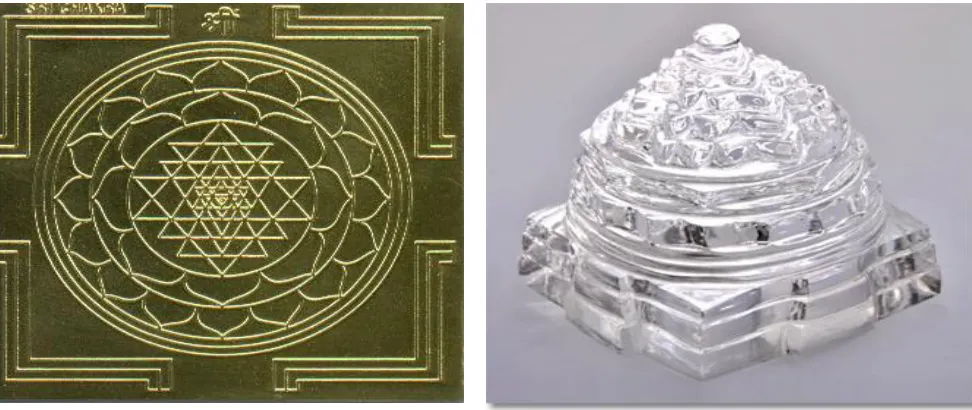
Figure 1 Two Dimensional Śrī Cakra Metal Etching, Three Dimensional Crystal ... 7
Figure 2 Śrī Ganapati Sachchidanada performing ŚCP using a body posture with extended
spine ... 456
Figure 3 Hand mudrā ... 50
Figure 4 Śrī Ganapati Sachchidanada performing ŚCP using circular arm movements… 53
Figure 5 Levels of neural networking in the brain created by ŚCP Error! Bookmark not
INTRODUCTION
Tantric Pūjā
Minutes outside of Mysore, India in a state-of–the-art open air amphitheatre,
Swami Ganapati Sachchidananda performs the Śrī Cakra Pūjā in front of hundreds of
onlookers. A large silver statue of the Goddess Lalitā Tipurasundarī, heavily draped in
orange, yellow and white garlands, sits behind a wooden platform holding a tray that
contains a small mountain-shaped crystal. In the background a group of priests
continuously chant verses from Sanskrit texts. Swami Sachchidananda sits cross-legged
on the platform reciting sacred mantras and making ritual gestures with his hands. At
intervals he tosses handfuls of flowers onto the statue and the crystal; he places herbs
in a silver bowl mixing them with water or milk and pours the mixture over the small
crystal. Maintaining intense focus on the ritual at hand he offers incense, a lighted
lamp, food, flowers and oil to the statue of Lalitā and then to the mountain-shaped
crystal.
This ritual worship of the Goddess Lalitā is a process by which the practitioner
transforms his body and mind into the mind and body of the Goddess. The tradition
teaches that when the ritual is complete the human body has been subtly transformed
into the body of the Goddess.1 Once transformed in this way the practitioner has full
access to the creative power of the Goddess, the source of all cosmic and material
Networks of the Mind
Psychologist Lawrence Barsalou argues that the mind is a physical component of
the body, and the way humans think is directly related to what the body experiences.
The mind is the process of information exchange that occurs in the networks of neurons
that populate the brain. These neural networks are continuously being developed and
refined in response to the body’s experiences. When the body has experiences of
seeing, touching, moving, feeling or of any other type, it causes the brain to process
and store information in different areas of the brain and develops neural networks to
connect these stored bits of information. There are areas that store information for the
visual appearance of things, sounds, texture, movement and feelings to name only a
few. When an individual has an experience the brain records the details in the proper
area of the brain and then neurons are generated to connect the areas, creating a map
of the entire experience that can be accessed in the future. To form the mental concept
of a friend’s face requires that different systems generate information regarding the
shape of her lips, distance between her eyes, the sound of her voice, her expressions
and a host of other details. These systems of information then network together to
form a neurological map of the friend’s face. Barsalou argues that stimulation of any
one of the particular systems in a network can result in the activation of the entire
network. This mechanism explains why a stranger can make a facial expression that
brings a friend to mind or why a glimpse of a rope coiled in a corner can illicit the same
reaction (fear and flight) that occurs at the sight of a snake.3 From the perspective of
embodied or grounded in the physical body’s experiences. This is a radical departure
from earlier concepts of cognition that understood the brain as a large data base or
encyclopedia of ideal types used by a disembodied mind to generate thoughts in
reaction to experiences.
Ritual Bodies
This essay draws material from two different disciplines, the humanities and the
sciences. It will use research from cognitive and social psychology to increase
understanding of the effect of engagement in religious ritual on the human brain (the
physical organ inside the skull) and the mind (the information processing system of
neural networks in the brain). In the last half of the twentieth century scholars in
disciplines as varied as philosophy, linguistics, neurobiology, psychology, computer
science, and anthropology have been rethinking the long held Western belief that the
mind and the body are separate entities. This objectivist view is often classified as
mind/body dualism and the earliest modern exposition of mind/body dualism is credited
to Descartes. The basic tenet of mind/body dualism is that the mind and body exist in a
hierarchical relationship where the immaterial mind uses the brain to control the actions
of the body. The body is a subordinate conglomeration of cellular systems that lacks
consciousness of its own and is dominated completely by the mind. Since the time of
Descartes mind/body dualism has dominated Western philosophical thinking regarding
human cognition.4 More recently the field of cognitive science has advanced models of
human cognition that counter the assumptions of mind/body dualism. These models
that affects actions and future experience. Termed ―embodied‖ or ―grounded
cognition,‖ these models assert that the experiences of the body have causal effects in
the brain and that cognition is the result of a dynamic exchange between the brain,
mind and the rest of the body.5 This essay integrates theories from psychology and
ritual studies using data from a contemporary example of the public performance of Śrī
Cakra Pūjā. Choosing to use a ritual currently in practice allowed me to video tape ritual
performances and increased my ability to focus on the actions of the body engaged in
ritual. The goal of this thesis is to understand the effects of ritual action on the brain
and mind. However, nothing written here intends to suggest that religion or religious
ritual can be reduced to a series of bodily states. Religion is a complex physical, social,
political and metaphysical entity as is science, and neither is advanced by attempts to
reduce one into another. What is offered here is another perspective on religious ritual,
one that has a great deal to contribute to understanding the ways ritual affects the
human mind, brain and body. As Barsalou states, ―To the extent that religious
knowledge is like non-religious knowledge, embodiment is likely to play central roles,
including many not entertained here.‖6
Both cognitive science and ritual studies recognize that human experiences affect
the brain and mind. For almost three decades the human body has been an important
category in ritual studies. Inspired by the work of Pierre Bourdieu and others,
Catherine Bell argues religious ritual is a means of transforming the body. For Bell, this
transformation produces a ritualized body, one that has been socially constructed in a
the participant a contextually specific social logic without engaging in conscious
discourse, thus creating ritualized social agents who perpetuate the religious and social
logic acquired during ritual practice. Bell understands the creation of ritualized social
agents as the real aim of ritual.
For Bell the ritualization process is unique because it changes participants in
ways they do not recognize; in her words they are ―blind‖ to or ―misrecognize‖ the
change that is the genuine outcome of ritual participation.7 Misrecognition is a key
component in the production of ritualized social agents for Bell. The ritualization process
instills ritual participants with religious and social dynamics that affect their behavior in
wider social contexts. Ritualization does this without engaging the ritual participant’s
conscious awareness, and as a result the ritualized social agent does not see that she
has been changed in ways that will cause her to perpetuate the religious and social
dynamics acquired during ritual practice. This lack of awareness is what allows the
ritualized social agent to transfer ritually acquired dynamics into other social contexts.
The ritualized social agent does not see that she has been redefined according to the
religious and social dynamics that inform the ritual or that she perpetuates those
dynamics in other social environments.
Embodied Theories of Cognition
For more than half a century cognitive science has been seriously engaged in
understanding the physical mechanisms of cognition. The development of computer
focused on understanding the way humans think and act. Barsalou’s model is one
scientific well suited for analysis of the ritual body because it focuses on the relationship
between the brain and mind to the rest of the body. Section one of this essay will
include a thorough description of the Śrī Cakra Pūjā and review of Bell’s discourse on
the ritual body and ritualization. This will be followed by a brief overview of the
discourse on religion from within cognitive science. Section three will focus specifically
on cognitive psychology and Barsalou’s theory of neurological patterning in the brain
and embodied cognition. This thesis will close with a reflection on the Śrī Cakra Pūjā
using Barsalou’s theory to determine how the ritual uses the body to shape the brain
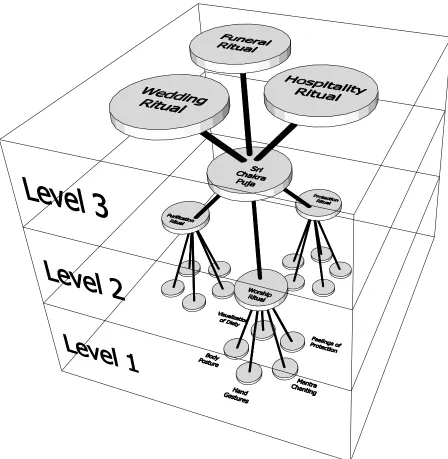
and mind. I argue that ritual practice creates a multi level neural architecture in the
brain. Thus, Tantric Pūjā shapes the mind by creating specific neural networks that
contain information for the sensory motor and conceptual experience acquired during
ritual action.
SECTION ONE: RITUAL
Śrī Cakra Pūjā: Theology and Context
The śrī cakra is one of the most famous geometric images in Hindu Tantrism.
The image represents the process that the creative principle undergoes as it separates
into the binary of masculine and feminine principles. According to the tradition this
process continues and results in the creation of all levels of cosmic and material
creation.8 The śrī cakra is a balanced and precise mathematical construction that can
(bindu) surrounded by nine interlocking triangles. This central dot represents the unity
of feminine and masculine principles out of which material reality emerges. The
triangles are commonly arranged with four pointing up, representing the feminine
principle, and five pointing down, representing the masculine principle. The triangles
are encircled by two rings of lotus petals inside and arrangement of outer circles and
[image:20.612.72.558.282.487.2]lines.9
Figure 1 Two Dimensional Śrī Cakra Metal Etching Three Dimensional Crystal (Images courtesy of Gyrony Consultive)
The nine triangles create an inner geometry of 43 smaller triangles, which are the
abodes or seats for the Goddesses’ attendants who reside in the śrī cakra. This inner
structure is encircled by an eight and then a sixteen petal lotus that is enclosed in three
concentric circles and then a square arrangement of straight lines with four openings.10
structure and the index of the reality that forms this structure.11 During the śrī cakra
the practitioner traces the process of all creation back to its original point of
undifferentiated creative potential through visualization, mantra recitation and ritual
action. The ritual process begins by focusing on the outer straight lines and working in
towards the central point or bindu. The tradition teaches that the triangles of the śrī
cakra are abodes for many different Goddesses, śaktis (female powers) and yoginīs
(female yoga adepts). Each being is individually worshipped through visualization and
mantra recitation. This is a process through which the power of the deity is ultimately
instilled in the body of the practitioner.12 The transformation of the body that unites the
worshiper with the presiding deity of the śrī cakra, Lalitā Tripurasundarī, is described by
Sanjukta Gupta as the result of self-conscious effort:
―He [the practitioner] visualizes the deity, his main mantra (iṣta-or mūla mantra) and his guru as all being identical. This resplendent divine personage then enters his heart as his essential self. While thus mentally busy, he thrice utters the formula declaring that his own self is identical with the absolute, divine self.‖13
It should be noted that the envisaged identification is not effected in one step. There
are in fact a series of identifications. 14 The transformation of the mundane self into a
divine self is accomplished by surrendering ordinary ego awareness and expanding
awareness of the divine creative power within.
There are important distinctions between Tantric theology and those of orthodox
Hinduism. Tantric theology sees Vedic ideas regarding caste, purity and dharma as a
form of ignorance. These social limits were seen as the product of the confusion that is
concerned with defining or maintaining a permanent social reality; they felt that by
returning to the primordial plentitude restrictions of caste and purity were eliminated
along with any sense of the social ego.15 Unlike the orthodox Hindu body, the Tantric
body is ideally beyond the social and purity concerns of dharma.16 The Śrī Cakra Pūjā
(ŚCP) is a process for transforming the mundane social body into a cosmicized body,
and as a result during ŚCP the Śrī Vidyā practitioner is more concerned with codes that
support the body’s ability to channel cosmic energy than with adherence to social
codes.
The particular performance of ŚCP discussed in this essay was observed at the
Śri Ganapati Sachchidanada Ashram in Mysore where the ritual is performed publically.
Śri Ganapati Sachchidanada is a widely recognized Tantric ritual expert and his public
performances are representative of other public performances of ŚCP that occur
throughout India.17 The Śrī Vidyā community of Sri Ganapati Sachchidananda in Mysore
outwardly appears to be strongly Vaishnava; there is a large temple for the God
Venkateśvara (a form of Viṣṇu), and they revere Dattātreya (also related to Viṣṇu).
However, during their śrī cakra worship reverence is given to the Goddess Lalitā
Tripurasundarī. This is an indicator that philosophically this community practices a form
of Vedic Śākta Tantra known as Śrī Vidyā. This philosophy asserts that the Vedic
tradition is the authoritative foundation of all that is commonly understood as Hindu,
and that Tantric practice is the esoteric discipline of Vedic Hinduism. As is common
among Tantrics, this Śrī Vidyā community conceals the heart of its practice (Tantric)
been sharply criticized by orthodox Hindus for providing religious initiation to women
and persons outside the brahmin caste. Smārta brahmins make up a significant portion
of this community. The smārta are self appointed guardians and authorities on Vedic
culture and ritual practice, and they are responsible for the creation and perpetuation of
Śrī Vidyā.19 The Śrī Vidyā community, dominated by these self-appointed ritual
authorities of Hindu culture, is committed to precise ritual practice.
[E]very part of the ritual has to be performed without a mistake, because only faultless performance brings the desired result. A complete pūjā is regarded as as an organic whole, and faulty performance in any part of it is a defect
disfiguring the whole pūjā.20
According to the tradition, it is the practitioner’s ability to focus flawlessly on the steps
to the goal that assures the achievement of the most powerful states of complete unity
in the Goddess. In Śrī Vidyā this is a body that is fully absorbed in the divine creative
force and a sense of self that has been subsumed into the divine self-awareness.
Bell’s work provides a means to explore the relationship between the Śrī Vidyā
tradition and South Asian society. Viewing ŚCP from the perspective of ritualization
illuminates the complexity of the relationship between the Tantric practitioner and
society. Bell’s theory reveals the ways in which ŚCP may express social conventions
regarding submission to religious authority and the proper treatment of guests.
However, it is also the case that ŚCP challenges and defies other social conventions
with regard to caste and gender. Examining ŚCP using Bell’s theory reveals that ritual
practice can be a tool for the social construction of the individual and that it can also be
Ritual Performance
The ŚCP is the ritual worship or adoration of the Goddess Lalitā Tripurasundarī
(Lalitā) in the form of the wheel (cakra) of prosperity (śrī). Cakras are often referred
to as mandalas (circles) because of their visual similarities; however there are tradition
specific technical differences between the two. The mundane cakra is transformed
through ritual into a sacred location for the Goddess’s creative power and is an aniconic
form of the Goddess.21 Once ritually prepared the śrī cakra is transformed into the
material embodiment of the power and process that creates all material and cosmic
existence. The pūjā is the practical procedure for enlivening the śrī cakra and reading
the map of creation that it embodies. In order to read this map the practitioner must
be an initiate in the esoteric teachings of Śrī Vidyā and its practices.22 During pūjā the
practitioner, the ritual location and the cakra are gradually moved through a series of
purification, protection and transformative rituals using mantra recitation, visualization
and the application of gestures. In Tantric practice, mantra recitation is highly
nuanced, including increasingly complex visualizations of deities.23 Mudrās (ritual hand
gestures) are used along with mantras to create shifts in energy of the cakra and the
practitioner. Worship includes offerings of flowers, food, incense, herbs, spices,
fragrant oils, water, and milk, all of which have multiple layers of symbolic meaning.
Gupta describes all pūjās as having three stages: purification rites, precautionary rites
for protection and the removal of obstacles, and the offering of gifts to and worship of
The initial stages of the ritual involve the purification of the practitioner’s body.
Bodily purification is achieved by symbolically dissolving the physical elements of the
body with mantra recitation and the performance of mudrās. In order to facilitate the
movement of energy in the body the practitioner assumes a cross legged seat, with an
erect spine during this and other rituals of purification and transformation. The energy
of the body is then elevated using the same techniques. Mantra recitation as a means
for the internal toning of sacred sounds, coupled with visualization and hand gestures,
creates changes in the body that increase the ability of the practitioner to harness and
transmit higher levels of energy. These energies are then used to mentally ascend
toward the source of creative power that is the apex (bindu) of the śrī cakra.25 All ritual
instruments and ingredients are purified as are the location for the ritual and the
practitioner’s seat and that of the śrī cakra. While Tantrics may not be concerned with
Vedic social purity, they are keenly aware of the purity of ritual elements. Along with
the rites of purification, salutations and propitiations are made to deities such as
Mahālakṣmī, Sarasvatī, Gaṇeśa, Kṣetrapāla, Gaṇga, and Yamunā. Malevolent spirits are
banished with glowering glances and mantras. The ritual space and the seat of the
practitioner are consecrated with sacralized water, rice, mantras and the drawing of
sacred diagrams. Salutations are offered to the ancestors, one’s gurus and the Sun.26
These actions comprise the first two stages as outlined by Gupta; however, elements of
purification and continued vigilance against malevolent forces and obstacles are
The third stage begins with the installation of the divine personality of the cosmic
śrī cakra into the purified mundane śrī cakra. The practitioner begins by envisioning the
abode of the Supreme Goddess and her attendants. The divinized śrī cakra is visualized
as sitting on the throne of the Goddess. Now the practitioner envisions the divine self
in his own heart, and fully identifies himself as the divine self. The process of
identification with the Goddess continues with the performance of several types of
nyāsa, the placing the divine power and qualities into the body of the practitioner. This
is achieved with the careful control of the breath (prāṇayāma), mantras, visualization
and the performance of specific gestures. This phase of the pūjā is most intense. After
a brief meditation on the Goddess the practitioner performs a kuṇḍalinī yoga technique
for experiencing the Goddess as a flash of pure knowledge that illuminates his spine
from the base up through and above the crown of the head.27 The teachings of the
tradition assert that in proper ritual performance the practitioner must fully become the
deity he worships.28 Once the body has been transformed into the divine body the
actual acts of worship can be performed. The list of gifts offered to the deity varies by
tradition but most include food, flowers, herbs, incense, fragrant oil, water, milk and
light. These items are symbolic in that they represent the five elements of creation:
fire, earth, air, water and space. They also represent the senses of the practitioner,
which are offered as sacrifice to the Goddess in order to make it possible for them to be
replaced by divine qualities. Also, included are acts that provide for the comfort of the
deity such as offering water for bathing, a comfortable seat, and an umbrella for shade.
and mantra recitation. This is followed by an internal form of fire sacrifice, which fully
ignites the practitioner’s internal power.29 At this stage the practitioner’s body has
become fully cosmicized, all awareness of the mundane self has been removed and only
the divine personality remains. The pūjā takes the practitioner beyond the realm of the
mind to a state of absolute pure consciousness, where existence is experienced as a
state of bliss.30 According to the tradition the practitioner is now in full command of the
creative power of the Goddess Lalitā.31 At the close of the worship apologies are made
to the Goddess for any offense that may have been made during the ritual and the
power of the deity that has been bound in the śrī cakra is released. What remains is
the divine illumination of the practitioner.
This ritual contains many physical movements, verbal utterances and
visualizations. These ritual actions are a significant part of a process that is intended to
change the awareness of the practitioner, and as will be discussed in section four may
create specific changes in the brain and mind. This section will close with a review of
key elements from Bell’s theory of ritual practice. Bell’s theory is representative a ritual
studies approach that is rooted in sociology.
Catherine Bell’s Ritual Studies Approach
Ritual theorist Catherine Bell traces the early anthropological and sociological
roots of ritual discourse on the body to scholars such as Mauss, Durkheim, and Douglas.
This early scholarship focused on understanding of the symbolism associated with the
the body covers many varieties of domestic, social and religious rituals, and provides a
logical point of intersection for study of the body among a number of disciplines
including the study of religion. In her 1990 book Ritual Theory Ritual Practice, Bell
outlines a theory of ritual practice and ritualization based on work from anthropology,
feminist studies and the practice theory of sociologist Pierre Bourdieu. Bell is not
concerned with providing a theoretical revision of the category of ritual but with the
production of a theory for understanding how ritual transforms its participants. She
locates ritual activity as a subset of the much broader category of human social
activities. Bell’s situation of ritual activity in this way allows for ritual practice to be
more readily examined in comparison to social practices.33 Her choice to situate ritual
activity in this way helps to create a theoretical point of intersection that I will argue is
compatible with the Barsalou’s notion of the relation between religious knowledge and
non-religious knowledge.
For Bell, when ritual activity/knowledge is located within a broader category of
activity/knowledge then the theoretical tools from other members of the category can
be applied to religious activity. Focusing on religious ritual in this way allows Bell to
engage the work of sociologist Pierre Bourdieu in the development of her theory of
ritual practice. Bell uses many of Bourdieu’s ideas and adapts them in nuanced ways to
religious ritual, which enables her to discuss the relationship between religious and
social rituals. In the following paragraphs I will unpack Bell’s use of the terms habitus,
for this work’s closing discussion of Bell’s theory in from the perspective of cognitive
science.
Habitus and Schemes of Religious Ritual
Bell adopts Bourdieu’s concept of habitus, the habit of acting in ways that both
structure and manage an environment to reflect social hierarchies and power dynamics,
and applies it to religious rituals.35 Bell stresses that to fully understand the effects of
ritual action it must be considered in its religious, social and historical context. For
example, many of the actions in pūjā are the same as those that one would offer to any
honored guest, thus an understanding of the social nuances of guest relations is
required in order to understand the actions of the ritual. This understanding is in
opposition to approaches to ritual that treat it as an object or an inner subjectivity to be
mined for esoteric knowledge.36 She states,
Confronting the ritual act itself, and therein eschewing ritual as some object to be analyzed or some subjectivity to be fathomed would involve asking how ritual activities, in their doing, generate distinctions between what is or is not
acceptable ritual. From this perspective one could not seek to construct a theory or model of ritual practice. Rather one could attempt to describe the strategies of the ritualized act by deconstructing some of the intricacies of its social logic. 37
Internal mental states and external social constructions are aspects of ritual, but in
order to understand ritual the focus must be on the activities and social strategies of
the body that expresses them. For both Bell and Bourdieu, habitus does not simply
refer to the repetition of ritual actions, but also includes the strategies and social logic
The strategies and social logic that motivate ritual action are what Bell calls
schemes of ritual. Strategies are the ways that ritual agents structure environments
and social logic is the systems of social and religious oppositions that provide the
context in which ritual functions and to which it reacts. Awareness of the schemes of
religious ritual, which are at work in habitus, helps to explain how it is possible for
members of a society to improvise rituals such as birthday parties, weddings and
funerals. Learning to celebrate weddings includes activities such as deference to a
host, gift exchange, and sharing a communal meal. Experiencing these ritual activities
teaches broad ritual schemes that can be mapped onto other religious and social rituals.
Bell notes that this learning occurs through action and not through mental reflection or
explicit discussion; this point is central to the process of ritualization according to Bell
and will be the final subject discussed in this section. Habitus is the set of actions that
expresses the schemes (strategies and social logic) of ritual. Repetition habituates an
individual to the schemes of ritual and causes them to be internalized. Once the
schemes of ritual are internalized they can be transferred from one setting to another in
a manner that appears to be unconscious or automatic. Habitus achieves this transfer
through a circular process. First, the habituated individual organizes an environment
according to ritual schemes. Then, the ritually ordered environment is managed with
actions learned during ritual practice, actions motivated by the same ritual schemes
used to structure the environment. Habitus is a necessary first step toward the
Ritual Mastery
For Bell ritual mastery is the adaptation of Bourdieu’s practical mastery
specifically for religious contexts, and the distinctions between the two are minimal. 38
Like practical mastery, ritual mastery is the projection of ritual action as the appropriate
action for a given circumstance. Commenting on Bourdieu’s practical mastery Bell
notes, ―They [the strategies and social logic of practical mastery] come to be embedded
in the very perceptions and dispositions of the body and hence are known only in
practice as the way things are done.‖39 Ritual mastery has two characteristics in
addition to those it shares with practical mastery. First, it exists only as a moment
within the larger cycle of ritualization. Secondly, it intimates the real ―work‖ of the
ritualization process, shaping individuals who have internalized schemes of religious
ritual, and who will transfer these schemes into wider religious and social
environments.40
The schemes of religious ritual center on the establishment of systems of
oppositions organized hierarchically. Inherent in these systems is a tension where
some schemes qualify, appropriate, and dominate others.41 The Catholic eucharistic
meal, with its distinctions between higher (sacred) and lower (profane), as well as inner
(sacred) and outer (profane), is an illustration of the schemes of ritualization. In the
course of the ritual meal, via the positioning of the individual below the altar, through
standing and kneeling, the opposition of higher- lower is highlighted. The most sacred
objects and the priest, who represents religious authority, are placed at the highest
higher-lower opposition is also demonstrated through the physical movements of
kneeling and standing. Congregants stand less and kneel more during the ritual than
the priests do. Thus by locating objects and persons in different levels of higher and
lower space the opposition of higher and lower is embodied, as is a hierarchy between
the sacred and the profane.42 Later in the ritual the higher-lower opposition is
subordinated by and inner-outer opposition. The inner-outer opposition is embodied via
the ingestion of the ritual meal. The final ritual act is the ingestion of the ritual meal;
this reflects an idea prevalent in much of Western theology that internal religious
experience is more sacred than external experience. Due to the positioning of the
inner-outer opposition as the final ritual act it comes to dominate the higher-lower
opposition.43 Ritual mastery establishes and manages these oppositions, making them
appear as if these ritual priorities are the proper or natural order of things. Habituation
leads to ritual mastery, which is the internalization of religious ritual priorities that
allows for the seemingly unconscious transfer of these priorities into wider religious and
social contexts. The religious ritual priorities are experienced as the way things are
done. As will be discussed next, ritualization is the process that shapes an individual
into a ritualized social agent who can transfer these priorities into wider religious and
social contexts.
Ritualization
Bell understands religious ritualization as ultimately a process for the production
of ritualized persons. Through habitus and the development of ritual mastery,
according to the schemes (strategies and social logic) of ritual. Ritualization focuses on
the production of individuals who will perpetuate the process of ritualization. Bell offers
this functional definition of ritualization:
[W]hat ritualization does is actually quite simple: it temporarily structures a space-time environment through a series of physical movements (using schemes described earlier), thereby producing an arena which, by its molding of the actors, both validates and extends the schemes they are internalizing.44
As discussed earlier the schemes of religious ritual are focused on maintaining a
hierarchy among religiously important oppositions.45 Again the Catholic eucharistic
meal provides an example in the form of its opposition with an ordinary meal. Bell
notes that multiple strategies are employed to distinguish the ritual meal from the
ordinary meal and these distinctions serve to symbolically demonstrate that the ritual
meal exists at a level that is dominant over the level that an ordinary meal inhabits.
The ritual meal will be conducted at times not associated with eating and includes an
amount of food that is too small to provide nourishment. The ritual meal is constructed
to stand out as not serving the same functions as an ordinary meal; it is an important
variation in the category of meals.46 Bell notes that; ―Ritualization appreciates how
sacred and profane activities are differentiated in the performing of them, and thus how
ritualization gives rise to (or creates) the sacred by differentiating it from the
profane.‖47 By focusing on the differences between what is sacred and what is profane
ritualization identifies (or determines) what is sacred. It also structures environments
environment more coherent for the ritual participants and is thus better able to mold
their perceptions.
According to Bell the true purpose of ritualization is the molding of the
perceptions of the ritual participants. Ritualization’s real aim is to produce bodies that
through practice have the schemes of ritualization in them, ―ritualized social agents.‖48
These agents then have the ability to transfer schemes of ritualization (focused on the
perpetuation and management of religiously defined oppositions) into other ritual
contexts as well as into wider social contexts.49 Ritualization is not only the process that
animates the schemes of ritualization, but is more importantly the process that
produces ritualized social agents who perpetuate these schemes.50 According to Bell
the production of ritualized social agents is the actual goal of ritualization. One of the
most important aspects of the ritualization process according to Bell is that the
ritualized individual does not recognize that ritual participation changes the way she
acts outside the ritual arena. The ritual participant is unaware that she is being
ritualized because ritual practice does not include open dialogue about the schemes and
priorities that inform the practice or that the individual is internalizing. Misrecognition is
one of the most significant elements of ritualization and it is the final point of Bell’s
discussed here.
Misrecognition
Misrecognition is a type of ―blindness‖ that occurs because of a lack of open
dialogue about the schemes of religious ritual being worked through in ritualization, and
ritualization is that ritual participants are not consciously aware of the changes in their
social behavior that result from ritual practice. Ritual participants do not recognize that
they are internalizing the schemes of ritual and that they will transfer these schemes
into other religious and social contexts. According to Bell, the ritualization process ―is
designed to do what it does without bringing what it is doing across the threshold of
explicit discourse or systematic thinking.‖51 Because the schemes of ritualization are
grounded in and expressed by the body, it is not necessary (or even preferred) that
they engage in conscious discourse. The absence of conscious verbal and analytical
processing renders the tension between purpose and meaning of ritual invisible. This
blindness prevents the ritualized social agent from recognizing the effects of ritual
participation on their behavior.
Bell’s focus on the power of misrecognition indicates one of the limits of ritual
theories that focus on the body as a text that reveals details about social strategies and
priorities. The traditional approach to the ―ritual body‖ as a socially constructed entity
provides some insight into the problems and complexity of the discourse on the ritual
body. These theories focus on particular aspects of the social meaning of the ritual
body’s actions and not the ritual body’s physiology As a result, ritual studies theories
have largely ignored two of the most crucial body parts, the brain and the mind.
Moving forward, I will use the phrase ―ritual body‖ specifically to refer to the physical
body engaged in the ritual actions of ŚCP. While limitations in the observational
techniques of sociology, anthropology and religious studies do not lend themselves to
insight into the inner workings of the brain and mind. The following section will use the
work of cognitive anthropology, psychology and research from social psychology to
explore the relationship between the brain and the rest of the human body. This next
step towards understanding the ritual mind requires a brief overview of the evolutionary
development of the brain and its impact on the development religion and religious
rituals, and this is where section two will begin. Following this introduction the work of
cognitive psychologist Lawrence Barsalou will be employed to unpack the concept of
embodied cognition and the working mechanisms of the mind. Section two will close
with a review of some of the research from social psychology that demonstrates the
types of effects that actions and experiences of the physical body have on the brain and
mind.
SECTION TWO: A COGNITIVE REVOLUTION
Introduction to Cognitive Models of Religion and Ritual
This section reviews the work of scholars in cognitive anthropology and
psychology who specifically address topics of religion and ritual. Evolutionary
anthropology provides a foundation for much of the current theoretical thinking that
concerns cognitive science and religion. Key questions in this section concern: the
evolution of the human brain and mind; the nature of cognition and its relationship to
culture; the relation between religion, religious ritual and the brain; and the role of
human experience on cognition and behavior. This evolutionary foundation will provide
a point of focus for the exploration of a cognitive psychology theory of grounded
body via the brain, and seek to understand the impact of experiences on these
processes.52 Toward this end the final portion of this section will focus on research from
within social psychology that demonstrates the influence of the body on the mind.
Research on grounded cognition is a product of a cognitive revolution that began in the
late 1950’s, and is partly a response to efforts to produce computers and machines that
think and function the way that humans do.
The cognitive revolution has engaged in serious critique of theories of mind/body
dualism. This dualism claims the mind exists outside the physical body over which it
maintains top down control. The relationship between the mind and the body in
dualistic models is much like that between an individual with a remote control (mind)
and the airplane (body) she operates. The plane has no volition of its own and
mechanically does the bidding of its operator. If the operator causes the plane to crash
and burn she along with her remote control remains intact. To the contrary theories of
grounded cognition locate or ground the mind in the human brain. Theories of
grounded cognition are a radical departure from the dualistic theories that have
dominated Western philosophy since the time of Descartes.53 Catherine Bell, in her
work on the ritual body, identifies the reaction to the tradition of Cartesian mind/body
dualism as one of the key influences on scholarship of religious ritual.
To provide a foundation for understanding the shift from dualist models of
cognition to models grounded in the body it is necessary to review scholarship on the
evolutionary origins of the brain and the mind. The following sections focus on two of
Steven Mithen and Pascal Boyer, both of whom devote considerable attention to the
topic of religion. This section will close with a review of cognitive psychologist
Lawrence Barsalou’s work on embodied cognition and research from social psychology
that support some of his claims. Barsalou argues that experiences (such as seeing a
face) create networks of neural activity and information in the brain that are used to
drive cognition. A neural network can be reactivated and drive human behavior long
after the original experience is over. In closing I conclude that Barsalou’s work offers
tools that can help to explain the process of ritualization that Bell describes. Barsalou’s
work can help illuminate the cognitive mechanisms that allow religious ritual activity to
be transferred into non-ritual environments. It is appropriate at this point to reiterate a
claim stated earlier that at no time does this work intend to suggest that religious
phenomena can be reduced to scientific or material explanations. One of the chief
criticisms of Barsalou’s work focuses on theoretical aspects of psychology. Barsalou is
currently engaging in research to test his theories. What is intended is a careful
dialogue between science and religion in order to determine how science might
contribute to a more rich understanding of religious ritual and its impact on human
culture. In applying the work of cognitive science to the study of religious ritual this
work intends to increase the number of theoretical tools available for understanding
religious ritual.
A number of technical terms will be used in the following discussion, thus it is
important to begin with a few working definitions. First, the ―brain‖ refers to the
of perception and cognition that occur in the brain. An important tenet of embodied
cognition is that the body includes the brain and its processes (the mind); the mind is
not a disembodied central controller for the body but part of the body. In theories of
embodied cognition the brain, mind and body are understood as functioning in a
process of dynamic information exchange. Thus, the mind is embodied as are its
cognitive processes, and both of them are affected by the experiences of the body.
Mithen: The Evolution of the Brain and Mind
Evolutionary anthropologist Steven Mithen’s work is representative of the main-
stream view that the modern brain and mind emerged during the transition between
the Middle and Upper Paleolithic Periods 60,000 to 30,000 years ago.54 He argues that
factors such as bipedalism, meat consumption and social interaction all contributed to
an increase in brain size, which resulted in improved brain function.55 According to
Mithen brain development progressed through three phases. To quote:
Phase 1. Minds dominated by a domain of general intelligence – a suite of general-purpose learning and decision – making rules.
Phase 2. Minds in which general intelligence has been supplemented by multiple specialized intelligences [technical, linguistic, social and natural history], each devoted to a specific domain of behavior, and each working in isolation from the others.
Phase 3. Minds in which the multiple specialized intelligences appear to be working together, with a flow of knowledge and ideas between behavioral domains.56
The defining property of the modern mind for Mithen is the flow of knowledge between
various domains in the brain that results in the ability to form generalizations, a
property he refers to as cognitive fluidity. An architectural example will help to explain
the medical profession develops, buildings dedicated to specialized areas of medicine,
such as oncology, mental health and women’s health are constructed. Later, these
separate care facilities are connected via a network of tunnels and skyways that allow
patients and healthcare providers to move between buildings in order to maximize
patient care. Phase one of brain/mind evolution began as a single ―hospital building‖
where all forms of general intelligence were housed. No complex conceptual patterns
were possible in phase one, and cognition was a process of stimulus and response. In
phase two separate buildings were constructed for each of what Mithen describes as
the four basic specialized intelligences: technical, linguistic, social and natural history.
At this phase knowledge expanded rapidly within each intelligence domain, but there
was no exchange among the domains. In the final phase, the separate specialized
domains were connected by a series of tunnels and skyways that allowed the
specialized forms of intelligence housed in the individual domains to be shared among
them. This is the phase where cognitive fluidity began and the human mind became
able to make generalizations using its specialized intelligences.57 This is the most
significant stage of mind evolution for Mithen:
[We] can be confident that religious ideologies as complex as those of modern hunter-gathers came into existence at the time of the Middle/Upper Paleolithic transition and have remained with us ever since. This appears to be another consequence of the cognitive fluidity that arose in the human mind, which resulted in art, new technology and a transformation in the exploitation of the natural world and the means of social interaction.58
After the development of cognitive fluidity and the ability to make generalizations, the
growth of culture in the forms of science, art and religion was rapid. For Mithen the
between specialized and general forms of intelligence was important for the production
of complex phenomena such as religion. As will be seen in the following section Boyer
asserts that the key to social behaviors such as religion and religious ritual are the
result of the brain’s organization around basic categories.
Boyer: An Evolutionary Account of Religion and Ritual
In contrast to Mithen’s notion of generalized knowledge that results from
cognitive fluidity, Pascal Boyer sees intelligence as a process of decision making based
on basic ontological categories such as animate/inanimate. For Boyer the mind is
organized in ―inference systems‖ focused on specific categories of knowledge necessary
for survival.59 He likens this system to the large country estate of Pemberley in Jane
Austin’s Pride and Prejudice. The elegant life of the manor appears to flow smoothly
from one elaborate event to another; what is not apparent is the hurried hard work of
the staff of specialists in the basement of the house whose efforts make the life upstairs
appear elegant and effortless. For Boyer inference systems are the hurried workers in
the human brain:
The most banal scenes of everyday life are replete with facts that seem obvious or simple only because we have a veritable Pemberley in the head, a huge mental basement filled with extremely efficient servants, whose activities are not available for detailed conscious inspection. Each of these specialized systems only handles a limited aspect of the information available about our surroundings but produces very smart inferences about that aspect. This is why all these systems in the brain are called inference systems.60
Inference systems are constructed around categories of knowledge important to
directed motion, understanding physical properties and the identification of causative
agents. Inference systems are not available for conscious examination, and are
activated and deactivated based on the type of objects and actions that need to be
interpreted. This concept of inference systems counters the long held notion that the
brain and mind are enormous encyclopedias that carefully catalogue the exhausting
amount of data that is accumulated through human experience. The human mind as a
series of inference systems allows for multiple bits of data to be processed in a variety
of ways, and this makes the mind fast and flexible enough to respond to diverse human
experiences. The flexibility of these systems allows for categories of knowledge to be
integrated into each other in ways that produce social phenomena such as art, science
and religion. As will be discussed below, Boyer sees inference systems as key for the
production of religion and religious ritual.
For Boyer religion and ritual are successful phenomena because of the
knowledge made possible by the processing that occurs in inference systems.
Information exchange in and among inference systems allows for the blending of
ontological categories, which creates novel concepts, and novelty is attention grabbing.
Religious phenomena are particularly novel and attention grabbing according to Boyer.
For example, blending categories makes phenomena such as trees that talk and
mountains that eat, intelligible to the human mind. The mountain that eats stands
outside the general category of mountains and grabs the mind’s attention because it
blends categories (animate and inanimate).61 Category blending is an effective means
detect anomalies in order to promote survival.62 Boyer argues that religious rituals have
been successfully transmitted throughout history, because they employ several means
for capturing mental attention such as entities that look human, but never need sleep
or food, and are all knowing.
According to Boyer the more important attention grabbing gadgets include
supernatural agents (gods, ancestors, and other spirits). As a result of their attention
grabbing power they have helped to insure the success and survival of religious ritual.63
The agent detection is one of the most important inference systems, Boyer states:
What matters to rituals and makes them relevant is that one construes the social effects as the result of the actions prescribed. This inevitably creates a causal gap. Because of the massive salience of agency in our mental systems, most humans fill in the gap with concepts of agents; but an abstraction like ―our tradition‖ or ―society‖ can play much the same role as gods or ancestors.64
Because of our survival needs, Boyer and Mithen agree that humans are hyperaware of
agency. What caused the bush to move? Is it something that may eat me or that I
might want to eat? What causes the kin relation of two unrelated people to be changed
to a familial relationship? Religion and religious rituals are successful according to
Boyer primarily because they provide answers to these questions, especially when no
causative agent in visible. By including a supernatural agent in a ritual event, the event
becomes more attention grabbing and it fills the explanatory gaps in human experience.
This heightened state of awareness makes rituals seem important and results in their
This brief discussion of just two views from evolutionary anthropology and
sociology highlights some of the more influential ideas on the development and
transmission of religion and ritual. These evolutionary views are rooted in the
assumption that human behavior (including religion and religious ritual) reflects the
basic evolutionary development of the brain and mind. As Boyer states, ―Evolution does
not create specific behaviors; it creates mental organization that makes people behave
in particular ways.‖65 In different ways and at different levels theses arguments are
materialist. For Mithen and Boyer religion and religious rituals are developed and
perpetuated because of the types of brains and minds humans are equipped with.
It is important to remember that these theories only explain a proclivity for
certain behaviors.66 These scholars are realistic about the limitations of their claims and
yet their work is the foundation that supports much of the cognitive perspective on
religion and ritual. They argue that religion and religious ritual are prominent
components of human culture because these types of behavior are agreeable to the
human brain.
Connecting Point
This final section focuses on the work of Lawrence Barsalou and his theory of
embodied cognition. Barsalou offers a description of the way human experiences may
affect the brain and mind. His work, coupled with research from social psychology,
provides support for the argument that mental processes (mind) are firmly grounded in
the brain, and are directly affected by the activities of the entire body. I argue that
the mind by creating networks of information in the brain. The following section begins
by outlining Barsalou’s theory that cognition is the process of networking among the
various areas where information is stored and processed in the brain. This will be
followed by a review of a number of studies from social psychology that demonstrate
the types of effects that physical actions have on human cognition and behavior.
Barsalou: A Psychological Theory of Embodied Cognition
Lawrence Barsalou’s work in cognitive psychology provides a discrete description
of the way the brain transforms experiences into neural networks that it then uses for
cognition. Like many other theorists of embodied cognition, Barsalou understands the
brain to contain systems or areas dedicated to specific categories of information. For
Barsalou the mind is the process of information sharing among the various systems in
the brain. Different systems of the brain are associated with categories of information
such as sensory motor, visual, aural, emotional, linguistic, and spatial orientation. The
general view is that the brain records information in the various systems, and that the
process that produces cognition is the result of information sharing among these
systems. There is considerable debate regardign the way in which the information
sharing process occurs, and Barsalou’s feature maps do not lend themselves to the type
of incremental research that has dominated neuroscience in the last two decades.67
This section will focus on five key aspects of Barsalou’s theory: feature maps,
Barsalou: Feature Maps and Reenactments
Barsalou describes cognition as the product of the creation of mental maps of
the body’s experiences. Within individual areas of the brain feature maps of the various
low level features associated with vision, audition, taste and the like are created. For
example, a visual feature map would include color, shape, orientation, simple
directional motions, etc. Individual feature maps join together and form a larger neural
structure that represents the various dimension of an entire experience.68 Barsalou is in
line with a growing list of scholars working on embodied theories of cognition who
argue that human cognition is the product of information exchange among a variety of
neural networks in the brain. From this perspective the mind is the neural architecture
and the information exchange that occurs through it. Facial recognition provides a
good example of the way feature mapping occurs, and of its role in larger neurological
structures. The face activates areas of the brain that record the shape, size and
proportion of facial features, color and texture of the skin, these are the low level
feature that make up the feature map of the face. As will be discussed in the following
section, this pattern connects with other areas of the brain associated with facial
expressions, the sound of the voice, responses to feelings about the face such as
like/dislike, comparisons with other faces and so forth. The mental concept of a face is
not simply a linguistic description of the face, but is a multidimensional representation
of the actual experience of a face. This multidimensional representation consists of the
feature map for a particular face connected to other associated neural structures that
The stimulation of a feature map in the brain results in the reenactment in the
brain of the experience of an encounter with a face. The concept of reenactment
distinguishes Barsalou’s theory from others that focus on cognition as a process of
cataloging information for future recall. Barsalou describes the reactivation of feature
maps as follows: ―[O]nce a set of conjunctive neurons captures a feature map pattern;
the set can later activate the pattern in the absence of bottom up stimulation.‖69 In
other words feature maps can be reactivated in the absence of the actual experience
that created them, in a process Barsalou refers to as part-to-whole inference.
Stimulation of any portion of a feature map can start a chain reaction that causes
reactivation of other parts of the feature map and of the larger associated structure of
neurons it connects with. For example a friend’s smile is an important feature in her
individual feature map. An encounter with a smile that looks like a friend’s smile can
result in the reactivation of the memory of the friend’s smile and literally bring her to
mind when she is nowhere in sight.
Simulators and Simulations
The network of a feature map in conjunction with other associated neural
networks results in larger networks of information that Barsalou calls a simulator.
Simulators are the neural networks used for the conceptualization of broader categories
of knowledge, such as the category of human face. A simulator for the category human
face would include general characteristics for faces including appearance, the sound of
human voices, the feelings they elicit and the proper way to respond and interact with
Simulators represent the broad knowledge base out of which cognition arises.
The activation of a simulator results in the simulation of previous experiences and
simulations are how human minds create categories and concepts. Human cognition is
a process of mental simulation of previous experiences. It is important to note that the
simulation process is dynamic, as Barsalou states:
Simulations can go considerably beyond the information stored originally―they are not mere reenactments of previously experienced events. Information stored on different occasions in a simulator may merge together at retrieval, thereby producing reconstructive and averaging effects…Furthermore, intentional attempts to combine simulations from different simulators productively can produce infinite simulations never experienced.71
Thus, during reactivation the pattern may be distorted in some way that causes it not to
be an exact reenactment of the original experience but a variation on it. This process of
consolidation, averaging and distortion allows for the development of many variations
on the concept of face. For example: red face, dog face, game face.72 As Boyer
pointed out, religion and religious rituals employ a great deal of novelty in an effort to
capture attention. The ability of ritual to affect behavior in consistent yet novel ways,
and to do so without engaging ordinary consciousness are also important aspects of
Bell’s notion of ritualization. Ritual’s apparent ability to bypass conscious awareness is
related to the speed with which the brain processes information. The next section will
explore entrenchment and pattern completion as they provide insight into cognitive
Entrenchment, Pattern Completion and Reenactments
Entrenchment occurs when a particular neural process is stimulated repeatedly.
The more frequently an action is repeated, the faster the reaction time within the
feature map, and the faster the feature map interacts with other associated networks
through out a simulator.73 Entrenchment explains the speed with which the mind can
integrate the experiences of the body, according to Barsalou:
Eventually the situated conceptualization [embodied concept] becomes so well established that it comes to mind automatically and immediately as a unit when the situation arises. After a parent frequently experiences an angry child, for example, the situated conceptualization for this situation becomes entrenched in memory, with minimal cuing bringing it all to mind on subsequent occasions.74
Action and experience create feature maps and simulators in the brain and repetition
makes the connections within the networks and to other associated networks become
stronger and faster. As a result stimulation of any one of the well entrenched features
in a feature map or a simulator can produce a response so quickly that the response
appears to be automatic, and that which is automatic may appear to be unconscious.75
Thus, when the habitually angry child has a frustrating or challenging experience their
―automatic‖ reaction can be to become angry.
For Barsalou the entrenchment of embodied concepts gives humans a
proclivity for pattern completion that can lead to automaticity in reactions to stimuli.76
He describes the role of pattern completion as follows: