R E S E A R C H A R T I C L E
Open Access
Green tea polyphenols supplementation and Tai
Chi exercise for postmenopausal osteopenic
women: safety and quality of life report
Chwan-Li Shen
1,2,3*, Ming-Chien Chyu
1,4,5,6, Barbara C Pence
1, James K Yeh
7, Yan Zhang
2,8, Carol K Felton
9,
Susan Doctolero
10, Jia-Sheng Wang
11Abstract
Background:Evidence suggests that both green tea polyphenols (GTP) and Tai Chi (TC) exercise may benefit bone health in osteopenic women. However, their safety in this population has never been systematically investigated. In particular, there have been hepatotoxicity concerns related to green tea extract. This study was to evaluate the safety of 24 weeks of GTP supplementation combined with TC exercise in postmenopausal osteopenic women, along with effects on quality of life in this population.
Methods:171 postmenopausal women with osteopenia were randomly assigned to 4 treatment arms for 24 weeks: (1) Placebo (500 mg starch/day), (2) GTP (500 mg GTP/day), (3) Placebo + TC (placebo plus TC training at 60 min/session, 3 sessions/week), and (4) GTP + TC (GTP plus TC training). Safety was examined by assessing liver enzymes (aspartate aminotransferase, alanine aminotransferase), alkaline phosphatase, and total bilirubin at baseline and every 4 weeks. Kidney function (urea nitrogen and creatinine), calcium, and inorganic phosphorus were also assessed at the same times. Qualify of life using SF-36 questionnaire was evaluated at baseline, 12, and 24 weeks. A mixed model of repeated measures ANOVA was applied for analysis.
Results:150 subjects completed the study (12% attrition rate). The compliance rates for study agents and TC exercise were 89% and 83%, respectively. Neither GTP supplementation nor TC exercise affected liver or kidney function parameters throughout the study. No adverse event due to study treatment was reported by the participants. TC exercise significantly improved the scores for role-emotional and mental health of subjects, while no effect on quality of life was observed due to GTP supplementation.
Conclusions:GTP at a dose of 500 mg/day and/or TC exercise at 3 hr/week for 24 weeks appear to be safe in postmenopausal osteopenic women, particularly in terms of liver and kidney functions. TC exercise for 24 weeks (3 hr/wk) significantly improved quality of life in terms of role-emotional and mental health in these subjects. ClinicalTrials.gov identifier: NCT00625391.
Background
In a recent comprehensive review [1], we suggest that tea and its bioactive components might reduce bone fracture risk by benefiting bone mineral density (BMD) and supporting osteoblastic activities while suppressing osteoclaistic activities, possibly due to their antioxidant and/or anti-inflammatory functions. Among different
types of tea, green tea polyphenols (GTP, extract of green tea) has shown its osteo-protective effects by decreasing oxidative stress [2,3], increasing activity of antioxidant enzymes [2], and decreasing expression of proinflammatory mediators in rodent models [3]. How-ever, limited information is available on the protective effect of consumption of tea or its bioactive components (e.g., GTP) on bone health in postmenopausal women. On the other hand, Tai Chi (TC), a form of mind-body, moderate-intensity, aerobic and muscular fitness exer-cise, has also shown to potentially benefit bone health * Correspondence: [email protected]
1
Department of Pathology, Texas Tech University Health Sciences Center, Lubbock, Texas, USA
Full list of author information is available at the end of the article
[4-7]. However, there is limited information based on systematic study of TC’s effect on bone health in post-menopausal women with low bone mass. Therefore, the long-term goal of the study is to investigate the effect of GTP and TC exercise on bone health in the targeted population. This paper focuses on the safety and impact on quality of life associated with this combined inter-vention. Results of bone, inflammation and oxidative stress parameters will be reported in a separate paper.
Legislation in use of complementary and alternative medicine (i.e., herbal/dietary supplement) is not uni-form, even lacking in many countries. In the US, green tea extract is labeled as a dietary supplement which does not seem to require pre-clinical tests, and its tradi-tional use proves not to be harmful in the specified con-dition of use [8]. Although green tea has been a popular beverage for centuries, a systemic review by the recent United States Pharmacopeia (USP) of 216 case reports on green tea products revealed 34 reports concerning liver damage [9]. Among them, 27 reports were categor-ized as possible causality and 7 reports as probable caus-ality. Based on this review, the USP Dietary Supplement Information Expert Committee determined that when dietary supplement products containing green tea extract are used and formulated appropriately, the Com-mittee is unaware of significant safety issues that would prohibit monograph development. A caution statement needs to be included in the labeling section [9].
On the other hand, based on published hepatotoxicity episodes, Mazzanti et al. [10] concluded that there can be no longer a reasonable doubt that ingestion of con-centrated extracts of green tea and infusions of green tea itself poses a real and growing risk to liver health. The hepatotoxicity is probably due to (-)-epigallo-cate-chin gallate or its metabolites which, under particular conditions related to the patient’s metabolism, can induce oxidative stress in the liver. In a few cases, toxi-city related to concomitant medications could also be involved [10].
The above evidence suggests that it is important to assess safety issues in conducting a long-term clinical study involving green tea extract as a treatment. How-ever, most of the published green tea clinical studies were either short-term (≤ 12 weeks) [11-13], with a longer study period but little or limited information on safety data related to liver function [14,15], or relatively small sample sizes [11-15]. The detailed safety informa-tion is important because for all of the interest in clini-cal studies using green tea as study agents, lacking such information hinders the research development. The pre-sent work is the first GTP safety report on liver and kid-ney functions based on a larger sample size in a 24-week placebo-controlled and randomized clinical trial.
Tai Chi has been investigated in many clinical studies, and is generally considered a safe intervention/treatment in population with various health issues [16]. However, no study evaluated the effect of TC in conjunction with GTP supplementation on liver and kidney function in any study population. It is not clear if Tai Chi exercise would interact with GTP to attenuate green tea related toxicity in our study subjects. Such safety data are important to future clinical studies using GTP and/or Tai Chi as study treatment.
Therefore, the objective of this paper is to evaluate the safety of 24 weeks of GTP supplementation combined with TC exercise in postmenopausal osteopenic women. In addition to safety, the effects of treatment arms on quality of life (as assessed by SF-36 questionnaires) are also reported.
Methods Study participants
Postmenopausal women were recruited primarily through flyers, local TV, radios, newspaper, municipal community centers and clinics to participate in this study. The complete study protocol has been reported in detail previously [17] and only a brief description is provided here.
Inclusion criteria were (i) postmenopausal women (at least 2 years after menopause) with osteopenia (mean lumbar spine and/or hip bone mineral density (BMD) T-score between 1 and 2.5 standard deviation (SD) below the young normal sex-matched areal BMD of the reference database) [12], (ii) normal function of thyroid (thyroid-stimulating hormone (TSH) > 0.3 and < 5.0 mU/L), liver (bilirubin ≤ 2.0 mg/dL, aspartate aminotransferase (AST)/alanine aminotransferase (ALT) < 3 × upper limit of normal), and kidney (serum creatinine (Crt)≤ 2.0 mg/dL, blood urea nitro-gen (BUN) < 1.5 times), (iii) serum alkaline phospha-tase (ALP) (33 - 130 U/L), calcium (Ca) (8.6 - 10.2 mg/dL), and inorganic phosphorus (Pi) (2.5 - 4.5 mg/ dL) were within normal ranges, (iv) and serum 25-hydroxy vitamin D (25(OH)D) ≥20 ng/mL.
Study design and intervention
This was a 24-week, placebo-controlled, randomized intervention trial to investigate the effects of GTP and TC on bone parameters. Participants were randomly assigned to one of the four treatment groups:
▪Placebo group: medicinal starch 500 mg daily
▪GTP group: GTP 500 mg daily
▪ Placebo + TC group: medicinal starch 500 mg daily and 24-move simplified Yang-style TC training (60 minutes per session, 3 sessions per week)
▪GTP + TC group: GTP 500 mg daily and 24-move simplified Yang-style TC training (60 minutes per session, 3 sessions per week)
Medicinal starch and GTP study agents were supplied by Zhejiang Yuxin Pharmaceutical Co., Ltd., China (US FDA IND number 77,470). The main GTP components were 99.25% pure, with 46.5% of epigallocatechin-3-gal-late (EGCG), 21.25% of epigallocatechin (ECG), 10% of epicatechin (EC), 7.5% of epicatechin-3-gallate (EGC), 9.5% of gallocatechin gallate (GCG), and 4.5% of cate-chin. The daily dose of GTP or placebo material was divided into two capsules (250 mg each). During the 24-week intervention, all participants were provided with 500 mg elemental calcium and 200 IU vitamin D (as cholecalciferol) daily.
Randomization and blinding
To ensure comparable distribution across treatment arms, eligible participants were stratified before rando-mization by a fixed randomized scheme based on age (≥ 65 or < 65 years old), history of green tea consumption, and history of mind-body exercise. Both the study parti-cipants and investigators responsible for the day-to-day operation and data analyses were blinded to the GTP/ placebo group status.
Measurements
Medical history, physical activity level, depression (mood), and cognitive impairment assessment were col-lected at the time of enrollment. The depression (mood) assessment was measured by the Yesavage self-rated Geriatric Depression Score [18]. BMD was determined at baseline for the screening purpose by dual energy X-ray absorptiometry (DEXA) (Norland Excel X-Ray Bone Densitometer). Also at baseline for screening purposes only, overnight fasting blood and urine samples were collected for the measurement of concentrations of serum 25(OH)D and TSH by a certified diagnostic laboratory (Quest Diagnostics, Dallas, TX).
Laboratory blood chemistry parameters, including ALP, BUN, bilirubin (Bil), AST, ALT, Ca, Pi, and Crt were assessed in overnight fasting blood samples taken
at baseline and every 4 weeks throughout the study per-iod. All samples were processed and analyzed in a certi-fied diagnostic laboratory (Quest Diagnostic Laboratory, Dallas, TX).
General health status was measured with the Medical Outcomes Study 36-item short form Health Survey (SF-36, version 2) at baseline, 12 and 24 weeks of study. SF-36 has been reported to have good validity, internal consistency, and reliability in the assessment of physical and mental health status of subjects and their progression [19,20]. The SF-36 consists of eight dimensions of health (physical function, bodily pain, general health, vitality, mental health, social function, and role of physical and emotional health) in the conduct of daily activity [21].
Adverse event monitoring
In the course of the 24-week clinical trial, adverse events associated with study agents were self-reported by the participants, and by monitoring liver enzyme activities, AST and ALT in particular, through blood analysis. Par-ticipants in the TC exercise groups (placebo + TC and the GTP + TC groups) were also queried about any adverse events due to TC during TC training sessions. They were also encouraged to self-report any adverse events by telephone. All observed and self-reported adverse events, regardless of suspected causal relation-ship to the study treatments, were recorded on the adverse event form throughout the study.
Compliance
Adherence/compliance of GTP or placebo study agents was determined as the percentage of all capsules of GTP or placebo capsules ingested throughout the study per-iod. Compliance of TC classes was assessed by TC class attendance record for each TC session.
Statistical analysis
Results Participants
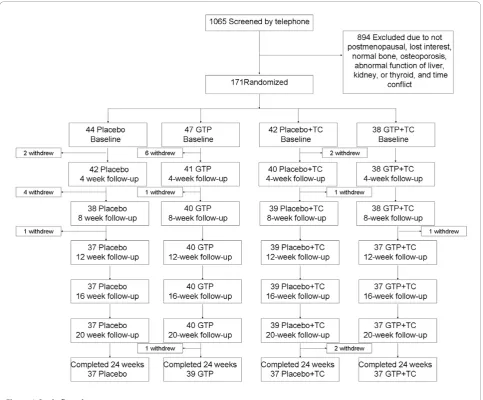
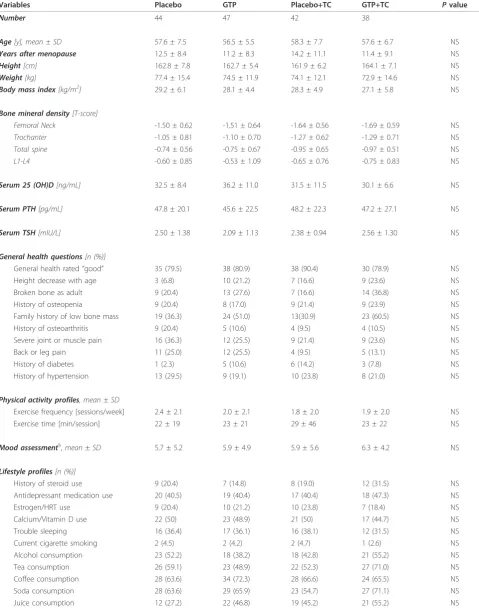
A total of 1065 patients were prescreened. Among them, 171 were qualified and randomized, and 150 completed the 24-week study (Figure 1). Seven (16%) participants in the Placebo arm, 8 (17%) in the GTP arm, 5 (12%) in the Placebo + TC arm, and 1 (3%) in the GTP + TC arm withdrew before the end of the study, due to accidental fall (1 subject), relocation (2 subjects), time conflicts (6 subjects), lost to follow-up (5 subjects), and lost interest (7 subjects). Baseline characteristics were similar among different treatment groups (Table 1). No statistically sig-nificant differences between the subjects who withdrew from the study and those who completed the study were observed in any parameter listed in Table 1. All subjects were instructed to maintain their pre-existing physical activity, dietary habits, and medications, if any, through-out the study. Based on the results of pill count, the
compliance rate was 89% for both GTP and placebo capsules. The compliance rate for TC classes was 83%.
Safety
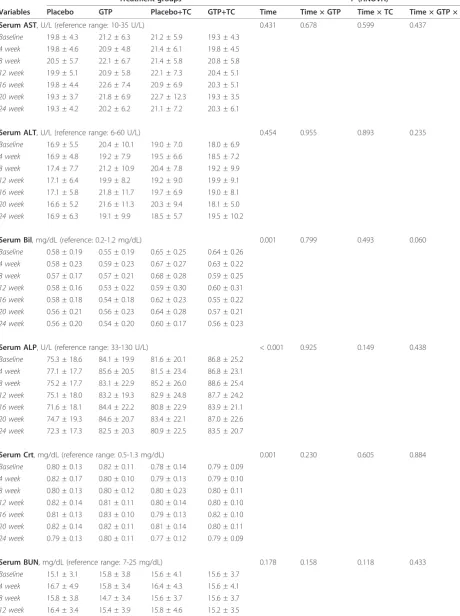
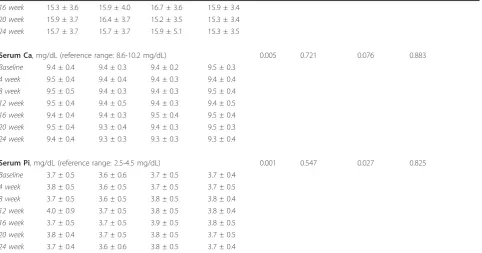
[image:4.595.57.541.88.488.2]At the baseline, there was no significant difference in any of the blood chemistry parameters among all treat-ment groups (Table 2). Based on the results of ANOVA, the levels of serum AST and ALT (indicators of liver functions) were not affected by either GTP or TC inter-vention during the 24-week study period (Table 2). Similarly, neither GTP supplementation nor TC exercise influenced serum BUN in subjects (Table 2). On the other hand, throughout the course of the 24-week inter-vention, there were significant decreasing trends in levels of serum Bil, ALP, Crt, Ca, and Pi over time with different magnitude in each treatment arm. However, in analyzing interaction between the time factor and the two treatment factors (GTP and TC), these parameters
Table 1 Baseline demographic characteristics of study population
Variables Placebo GTP Placebo+TC GTP+TC Pvalue
Number 44 47 42 38
Age[y], mean ± SD 57.6 ± 7.5 56.5 ± 5.5 58.3 ± 7.7 57.6 ± 6.7 NS
Years after menopause 12.5 ± 8.4 11.2 ± 8.3 14.2 ± 11.1 11.4 ± 9.1 NS
Height[cm] 162.8 ± 7.8 162.7 ± 5.4 161.9 ± 6.2 164.1 ± 7.1 NS
Weight[kg] 77.4 ± 15.4 74.5 ± 11.9 74.1 ± 12.1 72.9 ± 14.6 NS
Body mass index[kg/m2] 29.2 ± 6.1 28.1 ± 4.4 28.3 ± 4.9 27.1 ± 5.8 NS
Bone mineral density[T-score]
Femoral Neck -1.50 ± 0.62 -1.51 ± 0.64 -1.64 ± 0.56 -1.69 ± 0.59 NS
Trochanter -1.05 ± 0.81 -1.10 ± 0.70 -1.27 ± 0.62 -1.29 ± 0.71 NS
Total spine -0.74 ± 0.56 -0.75 ± 0.67 -0.95 ± 0.65 -0.97 ± 0.51 NS
L1-L4 -0.60 ± 0.85 -0.53 ± 1.09 -0.65 ± 0.76 -0.75 ± 0.83 NS
Serum 25 (OH)D[ng/mL] 32.5 ± 8.4 36.2 ± 11.0 31.5 ± 11.5 30.1 ± 6.6 NS
Serum PTH[pg/mL] 47.8 ± 20.1 45.6 ± 22.5 48.2 ± 22.3 47.2 ± 27.1 NS
Serum TSH[mIU/L] 2.50 ± 1.38 2.09 ± 1.13 2.38 ± 0.94 2.56 ± 1.30 NS
General health questions[n (%)]
General health rated“good” 35 (79.5) 38 (80.9) 38 (90.4) 30 (78.9) NS
Height decrease with age 3 (6.8) 10 (21.2) 7 (16.6) 9 (23.6) NS
Broken bone as adult 9 (20.4) 13 (27.6) 7 (16.6) 14 (36.8) NS
History of osteopenia 9 (20.4) 8 (17.0) 9 (21.4) 9 (23.9) NS
Family history of low bone mass 19 (36.3) 24 (51.0) 13(30.9) 23 (60.5) NS
History of osteoarthritis 9 (20.4) 5 (10.6) 4 (9.5) 4 (10.5) NS
Severe joint or muscle pain 16 (36.3) 12 (25.5) 9 (21.4) 9 (23.6) NS
Back or leg pain 11 (25.0) 12 (25.5) 4 (9.5) 5 (13.1) NS
History of diabetes 1 (2.3) 5 (10.6) 6 (14.2) 3 (7.8) NS
History of hypertension 13 (29.5) 9 (19.1) 10 (23.8) 8 (21.0) NS
Physical activity profiles, mean±SD
Exercise frequency [sessions/week] 2.4 ± 2.1 2.0 ± 2.1 1.8 ± 2.0 1.9 ± 2.0 NS
Exercise time [min/session] 22 ± 19 23 ± 21 29 ± 46 23 ± 22 NS
Mood assessment§,mean±SD 5.7 ± 5.2 5.9 ± 4.9 5.9 ± 5.6 6.3 ± 4.2 NS
Lifestyle profiles[n (%)]
History of steroid use 9 (20.4) 7 (14.8) 8 (19.0) 12 (31.5) NS
Antidepressant medication use 20 (40.5) 19 (40.4) 17 (40.4) 18 (47.3) NS
Estrogen/HRT use 9 (20.4) 10 (21.2) 10 (23.8) 7 (18.4) NS
Calcium/Vitamin D use 22 (50) 23 (48.9) 21 (50) 17 (44.7) NS
Trouble sleeping 16 (36.4) 17 (36.1) 16 (38.1) 12 (31.5) NS
Current cigarette smoking 2 (4.5) 2 (4.2) 2 (4.7) 1 (2.6) NS
Alcohol consumption 23 (52.2) 18 (38.2) 18 (42.8) 21 (55.2) NS
Tea consumption 26 (59.1) 23 (48.9) 22 (52.3) 27 (71.0) NS
Coffee consumption 28 (63.6) 34 (72.3) 28 (66.6) 24 (65.5) NS
Soda consumption 28 (63.6) 29 (65.9) 23 (54.7) 27 (71.1) NS
Juice consumption 12 (27.2) 22 (46.8) 19 (45.2) 21 (55.2) NS
GTP, green tea polyphenols; TC, Tai Chi; 25(OH)D, 25-hydroxy-vitamin D; SD, standard deviation; PTH, parathyroid hormone; TSH, thyroid stimulating hormone; HRT, hormone replacement treatment; NS, not significant (P > 0.005).
§
Table 2 Effect of green tea polyphenols supplementation and Tai Chi exercise on blood chemistry in postmenopausal osteopenic women
Treatment groups P(ANOVA)
Variables Placebo GTP Placebo+TC GTP+TC Time Time × GTP Time × TC Time × GTP × TC
Serum AST, U/L (reference range: 10-35 U/L) 0.431 0.678 0.599 0.437
Baseline 19.8 ± 4.3 21.2 ± 6.3 21.2 ± 5.9 19.3 ± 4.3
4 week 19.8 ± 4.6 20.9 ± 4.8 21.4 ± 6.1 19.8 ± 4.5
8 week 20.5 ± 5.7 22.1 ± 6.7 21.4 ± 5.8 20.8 ± 5.8
12 week 19.9 ± 5.1 20.9 ± 5.8 22.1 ± 7.3 20.4 ± 5.1
16 week 19.8 ± 4.4 22.6 ± 7.4 20.9 ± 6.9 20.3 ± 5.1
20 week 19.3 ± 3.7 21.8 ± 6.9 22.7 ± 12.3 19.3 ± 3.5
24 week 19.3 ± 4.2 20.2 ± 6.2 21.1 ± 7.2 20.3 ± 6.1
Serum ALT, U/L (reference range: 6-60 U/L) 0.454 0.955 0.893 0.235
Baseline 16.9 ± 5.5 20.4 ± 10.1 19.0 ± 7.0 18.0 ± 6.9
4 week 16.9 ± 4.8 19.2 ± 7.9 19.5 ± 6.6 18.5 ± 7.2
8 week 17.4 ± 7.7 21.2 ± 10.9 20.4 ± 7.8 19.2 ± 9.9
12 week 17.1 ± 6.4 19.9 ± 8.2 19.2 ± 9.0 19.9 ± 9.1
16 week 17.1 ± 5.8 21.8 ± 11.7 19.7 ± 6.9 19.0 ± 8.1
20 week 16.6 ± 5.2 21.6 ± 11.3 20.3 ± 9.4 18.1 ± 5.0
24 week 16.9 ± 6.3 19.1 ± 9.9 18.5 ± 5.7 19.5 ± 10.2
Serum Bil, mg/dL (reference: 0.2-1.2 mg/dL) 0.001 0.799 0.493 0.060
Baseline 0.58 ± 0.19 0.55 ± 0.19 0.65 ± 0.25 0.64 ± 0.26
4 week 0.58 ± 0.23 0.59 ± 0.23 0.67 ± 0.27 0.63 ± 0.22
8 week 0.57 ± 0.17 0.57 ± 0.21 0.68 ± 0.28 0.59 ± 0.25
12 week 0.58 ± 0.16 0.53 ± 0.22 0.59 ± 0.30 0.60 ± 0.31
16 week 0.58 ± 0.18 0.54 ± 0.18 0.62 ± 0.23 0.55 ± 0.22
20 week 0.56 ± 0.21 0.56 ± 0.23 0.64 ± 0.28 0.57 ± 0.21
24 week 0.56 ± 0.20 0.54 ± 0.20 0.60 ± 0.17 0.56 ± 0.23
Serum ALP, U/L (reference range: 33-130 U/L) < 0.001 0.925 0.149 0.438
Baseline 75.3 ± 18.6 84.1 ± 19.9 81.6 ± 20.1 86.8 ± 25.2
4 week 77.1 ± 17.7 85.6 ± 20.5 81.5 ± 23.4 86.8 ± 23.1
8 week 75.2 ± 17.7 83.1 ± 22.9 85.2 ± 26.0 88.6 ± 25.4
12 week 75.1 ± 18.0 83.2 ± 19.3 82.9 ± 24.8 87.7 ± 24.2
16 week 71.6 ± 18.1 84.4 ± 22.2 80.8 ± 22.9 83.9 ± 21.1
20 week 74.7 ± 19.3 84.6 ± 20.7 83.4 ± 22.1 87.0 ± 22.6
24 week 72.3 ± 17.3 82.5 ± 20.3 80.9 ± 22.5 83.5 ± 20.7
Serum Crt, mg/dL (reference range: 0.5-1.3 mg/dL) 0.001 0.230 0.605 0.884
Baseline 0.80 ± 0.13 0.82 ± 0.11 0.78 ± 0.14 0.79 ± 0.09
4 week 0.82 ± 0.17 0.80 ± 0.10 0.79 ± 0.13 0.79 ± 0.10
8 week 0.80 ± 0.13 0.80 ± 0.12 0.80 ± 0.23 0.80 ± 0.11
12 week 0.82 ± 0.14 0.81 ± 0.11 0.80 ± 0.14 0.80 ± 0.10
16 week 0.81 ± 0.13 0.83 ± 0.10 0.79 ± 0.13 0.82 ± 0.10
20 week 0.82 ± 0.14 0.82 ± 0.11 0.81 ± 0.14 0.80 ± 0.11
24 week 0.79 ± 0.13 0.80 ± 0.11 0.77 ± 0.12 0.79 ± 0.09
Serum BUN, mg/dL (reference range: 7-25 mg/dL) 0.178 0.158 0.118 0.433
Baseline 15.1 ± 3.1 15.8 ± 3.8 15.6 ± 4.1 15.6 ± 3.7
4 week 16.7 ± 4.9 15.8 ± 3.4 16.4 ± 4.3 15.6 ± 4.1
8 week 15.8 ± 3.8 14.7 ± 3.4 15.6 ± 3.7 15.6 ± 3.7
in the subjects were not statistically different over time across all the treatment arms (Table 2).
Four participants reported side/adverse effects during the study. One subject in the Placebo arm experienced nausea and diarrhea several times. One subject in the GTP arm had elevated AST and ALT levels, possibly due to concomitant medications for cold symptoms (Ibuprofen 400 mg daily for 9 days), lowering cholesterol (Lipitor 20 mg daily) and hypertension (Metoprolol 25 mg daily). After discontinuation of the medication for cold symptoms, this patient’s serum AST and ALT fell back to the normal range. One subject in the Placebo + TC arm reported having retinal bleeding on a non-exer-cise day, probably due to her uncontrolled high blood pressure and blood glucose, along with a family history of retinal bleeding. Another subject in the Placebo + TC arm reported having a broken wrist on a non-exercise day, due to an accidental fall. These four reports, as judged by the safety monitoring team, were unlikely related to the study protocol.
No adverse event due to TC was observed or reported in this study. There were only sporadic complaints about muscle soreness during the first two weeks.
Quality of life
Data demonstrating the effects of GTP and TC on quality of life, including all 8 domains, in postmenopausal
osteopenic women are presented in Table 3. At baseline, there was no significant difference in any domain of qual-ity of life among all 4 treatment groups. Throughout the course of the 24-week intervention, there was no statisti-cally significant change in any domain with time in all treatment groups, except that scores for physical function decreased with time (P< 0.001). However, when taking into account the interaction between time and the two treatment factors (GTP and TC), scores for physical function were not statistically different. Compared to those in the non-TC (Placebo and GTP) groups, subjects in the TC (Placebo + TC and GTP + TC) groups showed significant improvement in their scores for role-emo-tional (P= 0.036) and mental health (P= 0.003) after the 24-week intervention (Table 3). There was no significant difference in other domains of quality of life, including role-physical, bodily pain, general health, vitality, and social function (P> 0.05) (Table 3).
Discussion
[image:7.595.58.541.113.366.2]There is generally very little clinical information on the safety of long-term consumption of green tea extract supplements. The limited number of published studies were either short-term or with a small sample size, and most of them were not randomized controlled trials. This is the first placebo-controlled randomized study to evaluate the safety of long-term ingestion of green tea Table 2 Effect of green tea polyphenols supplementation and Tai Chi exercise on blood chemistry in postmenopausal osteopenic women(Continued)
16 week 15.3 ± 3.6 15.9 ± 4.0 16.7 ± 3.6 15.9 ± 3.4
20 week 15.9 ± 3.7 16.4 ± 3.7 15.2 ± 3.5 15.3 ± 3.4
24 week 15.7 ± 3.7 15.7 ± 3.7 15.9 ± 5.1 15.3 ± 3.5
Serum Ca, mg/dL (reference range: 8.6-10.2 mg/dL) 0.005 0.721 0.076 0.883
Baseline 9.4 ± 0.4 9.4 ± 0.3 9.4 ± 0.2 9.5 ± 0.3
4 week 9.5 ± 0.4 9.4 ± 0.4 9.4 ± 0.3 9.4 ± 0.4
8 week 9.5 ± 0.5 9.4 ± 0.3 9.4 ± 0.3 9.5 ± 0.4
12 week 9.5 ± 0.4 9.4 ± 0.5 9.4 ± 0.3 9.4 ± 0.5
16 week 9.4 ± 0.4 9.4 ± 0.3 9.5 ± 0.4 9.5 ± 0.4
20 week 9.5 ± 0.4 9.3 ± 0.4 9.4 ± 0.3 9.5 ± 0.3
24 week 9.4 ± 0.4 9.3 ± 0.3 9.3 ± 0.3 9.3 ± 0.4
Serum Pi, mg/dL (reference range: 2.5-4.5 mg/dL) 0.001 0.547 0.027 0.825
Baseline 3.7 ± 0.5 3.6 ± 0.6 3.7 ± 0.5 3.7 ± 0.4
4 week 3.8 ± 0.5 3.6 ± 0.5 3.7 ± 0.5 3.7 ± 0.5
8 week 3.7 ± 0.5 3.6 ± 0.5 3.8 ± 0.5 3.8 ± 0.4
12 week 4.0 ± 0.9 3.7 ± 0.5 3.8 ± 0.5 3.8 ± 0.4
16 week 3.7 ± 0.5 3.7 ± 0.5 3.9 ± 0.5 3.8 ± 0.5
20 week 3.8 ± 0.4 3.7 ± 0.5 3.8 ± 0.5 3.7 ± 0.5
24 week 3.7 ± 0.4 3.6 ± 0.6 3.8 ± 0.5 3.7 ± 0.4
extract in postmenopausal women. This study demon-strated that supplementation of 500-mg GTP daily for 24 weeks did not cause any safety concern (Table 2) with regard to liver function (in terms of AST, ALT, Bil, and ALP levels) as well as kidney function (in terms of Crt and BUN levels).
Considering a typical commercial decaffeinated green tea bag that contains approximately 80-100 mg green
[image:8.595.60.537.110.608.2]tea flavanols per serving [22], the GTP daily dose (500 mg with 99.25% purity) used in this study was approxi-mately equivalent to beverage prepared by 5-6 commer-cial decaffeinated tea bags. On the other hand, our previous animal study showed that GTP supplementa-tion through 0.5% GTP in drinking water benefited bone remodeling in ovariectomized middle-aged rats [2]. This dose of GTP consumption by rats in that study Table 3 Effect of green tea polyphenols supplementation and Tai Chi exercise on quality of life in postmenopausal osteopenic women
Treatment groups P(ANOVA)
Domain Placebo GTP Placebo+TC GTP+TC Time Time ± GTP Time ± TC Time ± GTP TC
Physical function < 0.001 0.214 0.414 0.453
Baseline 77.7 ± 21.4 77.6 ± 21.7 78.4 ± 16.3 80.4 ± 19.1
12 week 72.9 ± 28.8 81.8 ± 21.2 80.9 ± 15.7 84.1 ± 15.6
24 week 65.9 ± 20.6 68.4 ± 20.4 68.1 ± 16.3 69.4 ± 16.4
Role-physical 0.136 0.477 0.578 0.466
Baseline 80.0 ± 34.7 78.4 ± 30.1 81.8 ± 33.2 84.6 ± 28.2
12 week 85.7 ± 28.6 83.8 ± 30.7 80.4 ± 36.4 86.8 ± 26.3
24 week 80.7 ± 31.6 89.2 ± 23.9 85.1 ± 28.5 89.7 ± 24.7
Bodily pain 0.703 0.679 0.947 0.791
Baseline 73.8 ± 19.2 73.2 ± 17.5 74.5 ± 17.3 76.6 ± 15.3
12 week 73.4 ± 19.3 74.2 ± 18.1 74.9 ± 16.5 76.2 ± 14.9
24 week 74.5 ± 18.4 73.9 ± 17.0 77.3 ± 16.4 76.1 ± 17.2
General health 0.168 0.676 0.917 0.114
Baseline 76.6 ± 16.5 72.9 ± 19.7 75.4 ± 16.2 76.4 ± 18.2
12 week 77.8 ± 13.6 75.1 ± 21.4 77.1 ± 16.4 77.3 ± 16.9
24 week 75.2 ± 16.0 76.0 ± 20.1 77.5 ± 16.2 76.5 ± 17.1
Vitality 0.064 0.305 0.576 0.160
Baseline 63.0 ± 20.7 58.0 ± 24.1 60.8 ± 23.0 64.7 ± 18.9
12 week 62.3 ± 22.4 59.5 ± 23.5 63.1 ± 21.7 67.9 ± 17.5
24 week 60.6 ± 19.7 64.2 ± 22.7 65.4 ± 22.7 68.7 ± 19.1
Social function 0.250 0.731 0.338 0.986
Baseline 89.3 ± 20.8 86.8 ± 20.2 85.1 ± 22.4 86.8 ± 16.6
12 week 88.6 ± 20.2 88.2 ± 20.8 87.5 ± 22.8 91.9 ± 14.7
24 week 85.7 ± 22.7 85.1 ± 22.4 86.1 ± 24.1 89.3 ± 18.2
Role-emotional 0.464 0.918 0.036 0.815
Baseline 87.6 ± 29.2 88.3 ± 25.1 77.5 ± 36.9 81.4 ± 30.9
12 week 89.5 ± 27.7 85.6 ± 31.0 81.1 ± 35.6 87.3 ± 30.7
24 week 85.7 ± 32.6 82.9 ± 33.0 88.3 ± 26.3 91.2 ± 20.6
Mental health 0.629 0.931 0.003 0.232
Baseline 80.2 ± 12.6 81.5 ± 11.5 77.4 ± 14.9 76.9 ± 15.7
12 week 80.8 ± 14.4 78.7 ± 14.3 78.3 ± 16.9 82.0 ± 10.8
24 week 78.6 ± 13.9 77.3 ± 17.1 81.3 ± 12.4 82.6 ± 10.0
was comparable to the dosage employed in the present study. GTP dosages similar to our study have been adopted in study populations with different health issues. However, the study periods were generally short (up to 12 weeks) in most studies with the following two exceptions. Matsuyama et al. [14] reported that 24 weeks of beverage ingestion containing catechin (576 mg daily) ameliorated serious obesity and cardiovascular disease risk factors without raising any safety concerns in obese Japanese children (aged 6-16 years). Janjua et al. [15] reported that GTP supplementation (500 mg with 70% catechin daily) for two years did not demon-strate a significant benefit superior to placebo in improving clinical or histological photoaging parameters of women’s skin (aged 25 to 75 years). However, none of these studies investigated GTP’s safety in terms of possible liver and kidney damages through monthly blood tests. Further, the sample sizes of these published studies were small.
In this study, we observed decreasing trends in the levels of serum Bil, ALP, Crt, Ca, and Pi over the study period (Table 2). However, such trends disappeared when analyzing interaction between the time factor and the two treatment factors (GTP and TC), suggesting possible body’s adaptation to intervention stimuli over time.
In the present study, the four adverse events observed in different treatment arms were judged as unlikely related to the study protocol. Previous studies reporting adverse events with green tea extract supplementation, including acute liver failure in a few isolated case reports [23-26], in controlled human intervention trials [27,28], and in epidemiological studies suggested that possible medication contamination and other unknown factors may have contributed to hepatotoxicity [29]. Hepatotoxicity might also possibly be due to unusual dosing protocols, such as fasting, or a genetic variation (single nucleotide polymorphisms) in phase I and phase II enzymes in some affected individuals [30,31].
No adverse event attributed to TC was observed or reported in this study. This is in agreement with pre-vious studies reported by us and others [16]. TC, featur-ing gentle, slow and flowfeatur-ing movements, has been considered a safe exercise with very low risk of injury. As expected, TC did not influence any parameters related to liver and kidney function, except for a decreasing trend of serum Pi with time, which became not significant considering interaction between time and TC (Table 2). In addition, there was no interaction between GTP supplementation and TC exercise on liver and kidney function in the present study.
The present results show that 24 weeks of TC exercise confers beneficial effects on postmenopausal women in terms of improving their role-emotional and mental
health (Table 3). The favorable profiles of TC on mental health in the present study are consistent with those reported by Ko et al. [32] in healthy women, and by Abbott et al. [33] in patients with tension headaches. The positive impact of TC on the role-emotional domain also agrees with findings by Abbott et al. [33]. On the other hand, after involving GTP treatment, the interaction among time, GTP and TC was not signifi-cant (P > 0.05) in the domain of either role-emotional or mental health. Although time × TC did reach statisti-cal significance, but time × GTP did not reach statististatisti-cal significance, therefore, resulting in no significance in the results of time × GTP × TC.
This is the first study investigating the effect of GTP supplementation on quality of life, and the result showed no effect. There was also no evidence support-ing that selenium supplementation benefited quality of life in apparently healthy elderly (aged 60-74) in a dou-ble-blind, placebo-controlled intervention [34]. Another study found that vitamin E intake did not change quality of life in patients with amyotrophic lateral sclerosis [35]. Although all these supplements (GTP, selenium, vitamin E) are considered to be functional in protecting cells from oxidative stress, these published studies along with the present study seem to suggest no benefit of these supplements in quality of life.
Conclusion
Supplementation of 500-mg GTP daily to postmenopau-sal osteopenic women for 24 weeks did not cause any adverse effects on liver and kidney function, as deter-mined by blood test parameters, and had no influence on quality of life (as assessed by SF-36 questionnaires). TC exercise for 24 weeks (3 hr/wk) significantly improved quality of life in terms of role-emotional and mental health in these subjects. Based on our findings, GTP at a dose of 500 mg per day and/or TC exercise at 3 hr/week for 24 weeks appear to be safe in postmeno-pausal osteopenic women.
Acknowledgements
We gratefully acknowledge the study participants; without them this study would not have been possible. We thank for the assistance of Mary J. Flores, Raul Y. Dagda, and Marisela Dagda for data collection. This study was supported by the National Center for Complementary and Alternative Medicine (NCCAM) of the National Institutes of Health, under grant 1R21AT003735. The contents of this manuscript are solely the responsibility of the authors and do not necessarily represent the official views of the NCCAM or the National Institutes of Health.
Author details
1Department of Pathology, Texas Tech University Health Sciences Center,
Lubbock, Texas, USA.2Laura W. Bush Institute for Women’s Health, Texas
Tech University Health Sciences Center, Lubbock, Texas, USA.3Department
of Laboratory Science and Primary Care, Texas Tech University Health Sciences Center, Lubbock, Texas, USA.4Department of Mechanical
Health, Exercise, and Sport Sciences, Texas Tech University, Lubbock, Texas, USA.6Graduate Healthcare Engineering Option, Texas Tech University,
Lubbock, Texas, USA.7Applied Bench Core Laboratory, Winthrop-University Hospital, Mineola, New York, USA.8Department of Family and Community
Medicine, Texas Tech University Health Sciences Center, Lubbock, Texas, USA.9Department of Obstetrics and Gynecology, Texas Tech University
Health Sciences Center, Lubbock, Texas, USA.10Clinical Research Center, Texas Tech University Health Sciences Center, Lubbock, Texas, USA.
11
Department of Environmental Health Science, University of Georgia, Athens, Georgia, USA.
Authors’contributions
CLS received the research funding, led the entire study, and drafted the manuscript. MCC participated in the design of this study protocol and recruitment, implemented the exercise program, and drafted the manuscript. BCP, JKY, and JSW contributed to the design of this study protocol. CKF participated in the study design and oversaw participants’medical affairs. YZ participated in the design of the study and performed the statistical analysis. SD coordinated the study including blood/urine sample collection. All authors read and approved the final manuscript.
Competing interests
The authors declare that they have no competing interests.
Received: 5 October 2010 Accepted: 9 December 2010 Published: 9 December 2010
References
1. Shen CL, Yeh JK, Cao JJ, Wang J-S:Green tea and bone metabolism (review).Nutr Res2009,29(7):437-456, Review.
2. Shen CL, Wang P, Guerrieri J, Yeh J, Wang J-S:Protective effect of green tea polyphenols on bone loss in middle-aged female rats.Osteoporosis Int2008,19(7):979-990.
3. Shen CL, Yeh JK, Cao JJ, Tatum OL, Dagda RY, Wang J-S:Green tea polyphenols mitigate bone loss of female rats in a chronic inflammation-induced bone loss model.J Nutr Biochem2009. 4. Qin L, Au S, Choy W, Leung P,et al:Regular Tai Chi Chuan exercise may
retard bone loss in postmenopausal women: a case-control study.Arch Phys Med Rehabil2002,83(10):1355-1359.
5. Wang C, Collet JP, Lau J:The effect of Tai Chi on health outcomes in patients with chronic conditions.Arch Intern Med2004,164:493-501. 6. Qin L, Choy W, Leung K,et al:Beneficial effects of regular Tai Chi exercise
on musculoskeletal system.J Bone Miner Metab2005,23(2):186-190. 7. Chan K, Qin L, Lau M,et al:A randomized, prospective study of the
effects of Tai Chi Chuan exercise on bone mineral density in postmenopausal women.Arch Phys Med Rehabil2004,85:717-722. 8. Stickel F, Patsenker E, Schuppan D:Herbal hepatotoxicity.J Hepatol2005,
43:901-910.
9. Sarma DN, Barrett ML, Chavez ML,et al:Safety of green tea extracts: a systematic review by the US Pharmacopeia.Drug Saf2008,31(6):469-484. 10. Mazzanti G, Menniti-Ippolito F, Moro PA,et al:Hepatotoxicity from green
tea: a review of the literature and two unpublished cases.Eur J Clin Pharmacol2009,65(4):331-341, Review.
11. Nagao T, Komine Y, Soga S,et al:Ingestion of a tea rich in catechins leads to a reduction in body fat and malondialdehyde-modified LDL in men.Am J Clin Nutr2005,81(1):122-129.
12. Hsu CH, Tsai TH, Kao YH,et al:Effect of green tea extract on obese women: a randomized, double-blind, placebo-controlled clinical trial.Clin Nutr2008,27(3):363-370.
13. Hsu SP, Wu MS, Yang CC,et al:Chronic green tea extract supplementation reduces hemodialysis-enhanced production of hydrogen peroxide and hypochlorous acid, atherosclerotic factors, and proinflammatory cytokines.Am J Clin Nutr2007,86(5):1539-1547. 14. Matsuyama T, Tanaka Y, Kamimaki I,et al:Catechin safely improved higher
levels of fatness, blood pressure, and cholesterol in children.Obesity (Silver Spring)2008,16(6):1338-1348.
15. Janjua R, Munoz C, Gorell E,et al:A two-year, double-blind, randomized placebo-controlled trial of oral green tea polyphenols on the long-term clinical and histologic appearance of photoaging skin.Dermatol Surg
2009,35(7):1057-1065.
16. Jahnke R, Larkey L, Rogers C,et al:A comprehensive review of health benefits of qigong and tai chi.Am J Health Promot2010,24(6):e1-e25. 17. Shen CL, Chyu MC, Yeh JK,et al:Green tea polyphenols and Tai Chi for
bone health: designing a placebo-controlled randomized trial.BMC Musculoskeletal Disorders2009,10:110.
18. Yesavage JA, Brink TL, Rose TL,et al:Development and validation of a geriatric depression scale: a preliminary report.J Psychiatr Res1982, 17:37-49.
19. Ware J Jr, Kosinski M, Keller SD:A 12-Item Short-Form Health Survey: construction of scales and preliminary tests of reliability and validity.
Med Care1996,34(3):220-233.
20. Pickard AS, Jeffrey AJ, Penn A,et al:Replicability of SF-36 Summary Scores by the SF-12 in Stroke Patients.Stroke1999,30:1213-1217.
21. Ware J, Snow KK, Kosinski M,et al:SF-36 health survey manual and interpretation guide.Boston, MA: Health Institute, New England Medical Center Hospital; 1993.
22. Hennig SM, Fajardo-Lira C, Lee HW,et al:Catechin content of 18 teas and a green tea extract supplement correlates with the antioxidant capacity.
Nutr Cancer2003,45:226-235.
23. Federico A, Tiso A, Loguercio C:A case of hepatotoxicity caused by green tea.Free Radic Biol Med2007,43(3):474.
24. Jimenez-Saenz M, Martinez-Sanchez Mdel C:Acute hepatitis associated with the use of green tea infusions.J Hepatol2006,44(3):616-617. 25. Gloro R, Hourmand-Ollivier I, Mosquet B,et al:Fulminant hepatitis during
self-medication with hydroalcoholic extract of green tea.Eur J Gastroenterol Hepatol2005,17(10):1135-1137.
26. Molinari M, Watt KD, Kruszyna T,et al:Acute liver failure induced by green tea extracts: case report and review of the literature.Liver Transpl2006, 12(12):1892-1895.
27. Hsu SP, Wu MS, Yang CC,et al:Chronic green tea extract supplementation reduces hemodialysis-enhanced production of hydrogen peroxide and hypochlorous acid, atherosclerotic factors, and proinflammatory cytokines.Am J Clin Nutr2007,86(5):1539-1547. 28. Nagao T, Hase T, Tokimitsu I:A green tea extract high in catechins
reduces body fat and cardiovascular risks in humans.Obesity (Silver Spring)2007,15(6):1473-1483.
29. Imai K, Nakachi K:Cross sectional study of effects of drinking green tea on cardiovascular and liver disease.BMJ1995,310:693-696.
30. Tanaka K, Tokunaga S, Kono S,et al:Coffee consumption and decreased serum gamma-glutamyltransferase and aminotransferase activities among male alcohol drinkers.Int J Epidemiol1998,27(3):438-443. 31. Ingelman-Sundberg M, Oscarson M, McLellan RA:Polymorphic human
cytochrome P450 enzymes: an opportunity for individualized drug treatment.Trends Pharmacol Sci1999,20(8):342-349, Review. 32. Ko GT, Tsang PC, Chan HC:A 10-week Tai-Chi program improved the
blood pressure, lipid profile and SF-36 scores in Hong Kong Chinese women.Med Sci Monit2006,12(5):CR196-CR199.
33. Abbott RB, Hui KK, Hays RD, Li MD, Pan T:A Randomized Controlled Trial of Tai Chi for Tension Headaches.Evid Based Complement Alternat Med
2007,4(1):107-113.
34. Rayman M, Thompson A, Warren-Perry M, Galassini R, Catterick J, Hall E, Lawrence D, Bliss J:Impact of selenium on mood and quality of life: a randomized, controlled trial.Biol Psychiatry2006,59(2):147-154. 35. Galbussera A, Tremolizzo L, Brighina L, Testa D, Lovati R, Ferrarese C,
Cavaletti G, Filippini G:Vitamin E intake and quality of life in amyotrophic lateral sclerosis patients: a follow-up case series study.Neurol Sci2006, 27(3):190-193.
Pre-publication history
The pre-publication history for this paper can be accessed here: http://www.biomedcentral.com/1472-6882/10/76/prepub
doi:10.1186/1472-6882-10-76