A Framework to Recognise Daily Life Activities with
Wireless Proximity and Object Usage Data
1
M. A. Azam,
1J. Loo,
2U. Naeem,
1S. K. A. Khan,
1A. Lasebae,
1O. Gemikonakli
1School of Engineering and Information Sciences, Middlesex University, London, UK 2School of Architecture, Computing and Engineering, University of East London, UK
{m.azam, j.loo, ska.khan,a.lasebae,o.gemikonakli}@mdx.ac.uk; [email protected]
Abstract— Human behaviours are complex and challenging task to learn from daily life activities. To recognise daily life activities, smart environments are becoming very popular as platforms that can be used to obtain the context sensitive information for human activity and behaviour recognition. The motivation here is to investigate a mechanism that can recognise both indoor and outdoor tasks and activities of low entropy people such as elderly people and dementia patients, by using wireless proximity data and objects usage data. Wireless proximity data is used to recognise the outdoor tasks and activities, whereas, object usage data is generated by objects that are used when performing every day activities inside the home/building and is collected through Radio Frequency Identification (RFID) sensors. The approach is divided into two levels, i.e. lower tier and higher tier. The lower tier is responsible for the recognition of tasks from the raw sensor data in the form of a list of tasks. This list of tasks is further utilized by higher tier to recognise the high level activities performed by the target users. Number of different scenarios and experiments are performed to test the functionality of the said approach in different circumstances.
Keywords-Tiered Approach; Human Behaviour; daily Life Activities; Low Entropy; Elderly care
I. INTRODUCTION
Modelling human behaviours such as individual routines and activities by using sensor data gathered from the daily life activity patterns, is an important realm in ubiquitous computing [1][2][3] and has a large application area including context aware human computer interaction [4][5], health care systems [6][7] and identifying changes in human behaviour [8]. This ability of monitoring daily life activities in a smart environment can be seen as an important approach for tracking functional decline among elderly people and patients such as early stages of dementia patients. Continuous care and monitoring is required for dementia patients to live a healthy life, as it generally becomes difficult for the people who suffer from this progressive disease to live an independent life.
The work in this paper is based on activity and behaviour recognition using proximity information from contextual data and object usage information from non-intrusive sensors. This work is targeted towards the group of low entropy people including the elderly people who are between mild and moderate stages of Alzheimer’s disease. Low entropy means, people who follow somewhat regular daily life routines and exhibit less change in their behaviours, such
as a working person who follows a regular work routine or an elderly person with limited activities.
In addition to providing valuable information about the activities being conducted, it is also possible for the activity and behaviour recognition system to predict the next task or activity that is most likely to be performed by the target user or even provide possible alternatives. It is intended that this system will also be able to distinguish between the categories of activities, for example an activity can be a conventional ADL [24]or an Instrumental Activity of Daily Life (IADL) [25].
The objective of work presented in this paper is to develop a system of activity and behaviour recognition that not only recognise the long term activities performed outdoor but also detect the short term indoor activities, such as, ‘Cooking’, ‘Washing’, ‘Watching TV’, ‘Reading Newspaper’ and ‘Making Tea’. This will help to achieve twenty-four hour care and monitoring of elderly people and patients. An evaluation of this capability is provided within this paper. Outdoor activities are detected by using the wireless proximity data that is obtained by simulating different scenarios in the ONE simulator [22]. The ONE is a discrete event simulation engine that models the wireless environment and allows the integrated scenario builder to generate different movement profiles. While a smart environment with non-intrusive sensors is used for indoor activities data collection.
II. STATE OF THE ART
RFID to collect the data of indoor activities from everyday objects usage favours the dense sensing approach as it is cheap and feasible solution to setup a smart environment inside the home.
Researchers have also used wearable sensors around the body for feature detection [13]. These wearable sensors can be accelerometers that detect the motion of the body, microphones that record the sound or GPS that gives information about the user’s location. Researchers have determined different type of activities such as working in the home, climbing the stairs or walking by using wearable sensors [14][15][16][17][18]. Most of the research work conducted so far considered only short range and indoor activities for recognition. Recognising both short range or indoor activities and long range or outdoor activities is a challenging task because it requires different type of data to be used and different techniques to integrate with each other. For models of activity recognition, a favoured approach is Markov Models that have been used very often for probabilistic state transition models. Wilson et al. [19] has presented one such approach in his research work. He used Hidden Markov Models (HMM) and Viterbi algorithm for task recognition process. The drawback of this and the similar approaches is that they cannot recognise the tasks properly when tasks are carried out in random order which is a natural way in normal daily life activities.
III. LEVELS OF MODELLING
The nature of indoor and outdoor activities is basically different from each other in a sense that indoor activities such as ‘Making Tea’ are relatively short term as compared to outdoor activities such as ‘Working in the Office’ that may comprise of hours. The nature of the data used in this paper to recognise indoor activities (object usage data) is also different from the data used to recognise outdoor activities (wireless proximity data). These daily life activities can be simple tasks such as ‘Switch on the Burner’, ‘Going to the Bus Stop’ or they can be more complex activities such as ‘Make Breakfast’, ‘Shopping in the Market’.
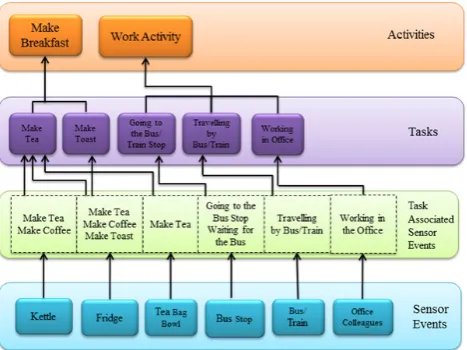
In this paper, activities are modelled into daily life activity plans using a planning language Asbru [20]. Asbru is a process representation language, which has similarities to workflow modelling, but has been designed to provide more flexibility than the workflows. Asbru was developed by the Asgaard project [23]. In Asbru, plans can consist of further sub-plans. A plan or a sub-plan that cannot be further subdivided is known as a ‘Task’. What should be considered a task depends on the context the plans are used for. A task is recognised, not necessarily reliably, with sensor data. In order to recognize the activities and behaviour of an individual, it is very important that the atomic tasks (activities that cannot be further subdivided) are identified as tasks that are potentially identifiable from the sensor data as completed tasks (see Figure 1), as the higher level activity plans are constructed from these tasks. For indoor activities, task generates sensor events based on the objects that have been used to perform the activity whereas for outdoor activities, a range of sensors that can be used is augmented to include wireless proximity data and user’s location
coordinates. The proximity data is detected by the mobile device and the coordinates can be obtained either by GPS or by triangulation mechanisms such as are directly accessible in Android and other mobile platforms. Therefore, task recognition is based on analysing the sensor data. The sensor data used in this work for indoor activities is collected using ‘Dense Sensing’ approach by Naeem et al. [21], whereas the sensor data for outdoor activities is simulated in the ‘ONE’ simulator [22] for a number of different scenarios [11]. A. Hierarchical Activities of Daily Life
Daily life activities as mentioned earlier have a hierarchical or tiered structure. Activities can contain other activities and tasks within them and different activities can occur in parallel as well. Figure 1 shows an example of tasks and activities. Two different activities are divided into tasks and subtasks. The activity ‘Make Breakfast’ is made up of task sequence: ‘Make Tea’ and ‘Make Toast’. Both of these tasks can be performed in any order or in parallel with each other. Whereas the activity ‘Work Activity’ is made up of task sequence: ‘Going to the Bus/Train Stop’, ‘Travelling by Bus/Train’ and ‘Working in Office’.
[image:2.595.308.542.483.658.2]The lowest level of the hierarchy is the sequence of the sensor events that have been detected and labelled as associated objects and contextual information (location and proximate devices) in the figure. These low level sensor events are then associated with different tasks that relate with the sensor events, e.g. detecting ‘Office Colleagues’ sensor event can be associated with ‘Working in the Office’ task, ‘Kettle’ sensor event can be associated with ‘Make Coffee’ or ‘Make Tea’ task. Each sensor event is then divided into suitable segments, where each segment is then mapped to a specific task. As a result, a list of tasks is created from these sensor events, which are then used for activity and behaviour recognition in higher levels.
Figure 1. An Example of Tiered Structure of Tasks and Activities
and outdoor activities. As mentioned earlier, the data set used for indoor activities is object usage data obtained through RFID tags. The approach used for the recognition of tasks from this stream of object usage data is known as Generating Alternative Tasks Sequences (GATS) and is explained in [21]. It generates a set of different task sequences based on the conjunction of the disjunction of task possibilities for each sensor event. For outdoor activities, streams of wireless proximity data (contextual information) are obtained from the sensor events through simulation of different scenarios in the ONE simulator. The approach used to separate different tasks from this stream of wireless proximity data is Task Separator (TASE) algorithm, which is explained in detail in [11].
The work in this paper will describe how GATS and TASE algorithms are used to recognise the indoor and outdoor tasks from two different datasets and then merged with the high tier activity recognition. While the lower tier is used to recognise the tasks from object usage and wireless proximity data and provide task sequences, the higher tier activity recognition modules recognise the high level daily life activities given the task sequences.
[image:3.595.100.271.390.553.2]IV. ACTIVITY AND BEHAVIOUR ANALYSER FRAMEWORK
[image:3.595.358.502.457.577.2]Figure 2 below shows the block diagram of Activity and Behaviour Analyser Framework (ABAF).
Figure 2. Activity and Behaviour Analyser Framework (ABAF)
A. Data Analyser
The first component of ABAF is ‘Data Analyser’. It analyses the sensor data. Two different types of data is analysed in this component. One is wireless proximity data that is obtained for outdoor activities through simulating different daily life scenarios using the ONE simulator and second is objects usage data that is obtained for indoor activities from the data set collected by Naeem et al. [21]. Wireless proximity data and object usage data is then fed into the ‘Task Analyser’ that uses ‘Task Separator’ and ‘Task Associated Sensor Events’ approaches to classify the tasks associated with different sensor events from the raw data.
B. Task Analyser
Raw sensor data (both wireless proximity and object usage data) is analysed by the ‘Task Analyser’ phase that segments the data into different tasks associated with the sensor events. As task recognition is carried out by segmenting the sensor events into different segments that correspond to a particular task. A limitation with this approach is that there is always likelihood that the sensor event segments being generated are not accurate and may have no similarity with the actual task that is being carried out. To mitigate this affect, for each task (a) and sensor event (b), a prior probability P [b | a] is assigned which is possible to determine from the tiered approach adopted in this work given the activity that has been recognised in the higher tier.
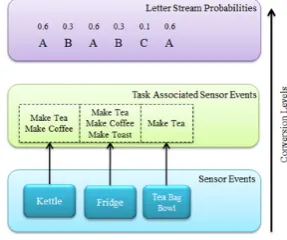
As mentioned earlier, different approaches have been used for both indoor and outdoor activities. For indoor activities, ‘Task Associated Sensor Events’ approach mentioned by [21] is adopted. In this approach, each sensor event which is obtained from the object usage data of RFID tags is converted into Task associated Sensor Events disjunction. For example, the ‘Milk Bottle’ sensor event can be associated with the tasks, ‘Make Cereal’, ‘Make Coffee’, or ‘Make Tea’. Each task is then represented by a letter, for example; ‘Make Cereal’ = A, ‘Make Coffee’ = B, and ‘Make Tea’ = C. The sensor event ‘Milk Bottle’ is then replaced by the disjunction, Make Cereal | Make Coffee | Make Tea = A + B + C, where ‘+’ denotes the disjunction. Figure 3 shows hierarchy of different levels from lowest sensor events to task associated sensor events to the stream of letters. Each letter is further assigned a probability value depending upon the number of associations each task has with the total number of sensor events.
Figure 3. Conversion Levels of Sensor Events [21]
C. Task Recogniser
The objective of the ‘Task Recogniser’ is to output an ordered list of task sequences given an input set of events. Two different approaches are combined into this section. For indoor activities, ‘GATS’[21] approach is applied; whereas for outdoor activities an approach based on the relative frequencies of the detected wireless proximate devices is applied.
‘GATS’ generates a list of alternative task sequences given input set of events obtained from the object usage data. Each task sequence has an associated cost. Most likely task sequence is the task sequence with the lowest cost as the cost function is intended to reflect the compliance of the task sequence with the event sequence and the relative frequencies of the activities. Task sequences can have different lengths depending upon the number of events in consideration. When a new event arrives, the task recogniser computes a new set of task sequences, depending upon the cost of the new event.
After generating different task sequences from the sensor events, sets of activities are generated that contains all probable activities given the set of task sequences. Each of these sets of activities has a utility value that depends upon the cost of each task sequence. This gives an exact task sequence to the higher tier activity recogniser as an input. The ‘Utility Function’ itself is based on the ‘Matching Degree’ between the modelled activities and the set of activities generated.
For outdoor activities, raw sensor events data is first analysed by the ‘Task Separator’ algorithm and is divided into different segments associated with different tasks. One month of data is simulated that gives 30 samples of each outdoor task. A library of sets of devices associated with tasks is created that contains the detected sets of devices for each task. Each set contains all the detected devices in the thirty samples of each task, except those devices whose ‘Relative Frequency’ value is less than 0.2.
The process of matching the experiment data with the set of devices in the library to recognise the task is given below.
∑
∑ (1)
where ‘M’ is Matching Coefficient, Nj = (A∩B) =
{1,2,……… i}, Mn = (AUB) = {1,2, ………K}, ‘A’ is a set of
the devices obtained from the experiment data using the TASE algorithm as explained in the previous sections and ‘B’ is the set of the devices in the library. P(Nj) and P(Mn)
are the relative frequencies of the devices obtained in the (A∩B) and (AUB) respectively. As we know, the library here contains different sets of the devices. Each set of the devices is for the separate task. So, ‘A’ will be matched with all the sets in the library one by one, to find the highest match between the two sets. The task with the highest match will be the active task.
D. Activity Recogniser
While the objective of the lower tier is to recognise the tasks and provide task sequences from the sensor events
(wireless proximity and object usage data), the higher tier activity recogniser components recognise the actual high level activities from the task sequences obtain from the lower tier. As the whole daily life routine is scheduled in different timeframes, the higher tier also gives an overview of all the possible activities that could occur in the given timeframe. This makes it possible for ‘Activity Recogniser’ to recognise the activity even when a task at lower tier has not been recognised properly.
V. EXPERIMENTS/SCENARIOS
This section explains the design of the experiments that are conducted in this research work. The key objectives of these experiments are the recognition rates for activity and task recognition. As there are two different types of tasks and activities considered in this work, i.e. indoor and outdoor activities, different types of experiments are conducted to collect the data for both indoor and outdoor activities. A. Outdoor Activities Experiments
For outdoor activities, a number of different experiments are designed and simulated in the ‘ONE’ simulator. Daily life routines of three different users are simulated as scenarios. These scenarios represent the typical daily life outdoor activities of low entropy elderly person, a school child and a working person. These users perform different tasks and activities in the simulation, such as, ‘Going to the Bus Stop’, ‘Travelling in the Bus’ and ‘Doing Evening Activity’. While performing these activities, all the proximate devices and people in the vicinity of the target user get detected that are further utilised to recognise the tasks and activities being performed by the target user. The scenarios simulated in the ONE simulator explained in detail in [11].
The purpose of the experiments performed for the outdoor tasks and activities is to generate varying wireless proximity data with different levels of entropy/noise added in the data. The experiments are designed using a factorial model with two factors ‘k’. Each factor has three different levels ‘L’. The total experiments are Lk => 32 = 9.
B. Indoor Activities Experiments
dish washer. RFID reader was worn by the subjects on their fingers that detect the objects used by the users.
TABLE I. INDOOR TASKS/ACTIVITIES EXPERIMENTS
VI. RESULTS
Table II shows the outdoor tasks recognition results. These results show that ‘Task Separator’ algorithm and RF based approach used for the recognition of outdoor tasks given the wireless proximity data performed well for experiment 1 and recognised the tasks 100%. The reason why this approach gave 100% result for all the tasks in experiment 1 is that unlike other recognition approaches such as Hidden Markov Models (HMM), the ordering of the detected wireless devices does not affect the recognition process and also the entropy of the tasks was low in the first experiment. However, the results for experiment 2 to 9 show a decrease in the average recognition rate from 100% to 73.3% respectively. The reason for this decrease in recognition rate is that as we move from experiment 1 to 9, ‘Wireless Range’ and the ‘Random Movement’ of the background population is increasing due to which more random and irrelevant devices get detected that ultimately increases the entropy of individual tasks. This increase in the entropy causes decline in the recognition rate of the outdoor tasks.
TABLE II. OUTDOOR TASKS RECOGNITION RESULTS
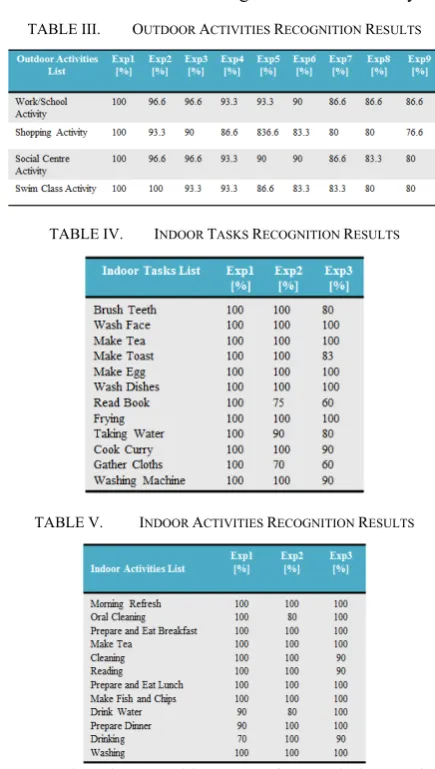
Even though the task recognition rates have fallen from experiment 2 to 9, this did not affect too much to the average recognition rate of high level activities (Table III) that drops from 100% to 76.6% respectively.
Table IV and V show the recognition results for indoor tasks and activities. GATS approach effectively recognised the single tasks (Table IV) that were conducted with objects without any order. The reason behind this effective recognition is also not being influenced by the order of the objects. However, those tasks such as ‘Gather Cloths’ and ‘Serve Warm Meal’ who did not have objects exclusive to these tasks causes decline in the average recognition rate. Also these tasks are generally performed with fewer objects
that other tasks and if any segment of the data is missing then it becomes more difficult to recognise the task correctly.
TABLE III. OUTDOOR ACTIVITIES RECOGNITION RESULTS
TABLE IV. INDOOR TASKS RECOGNITION RESULTS
TABLE V. INDOOR ACTIVITIES RECOGNITION RESULTS
Even though recognition rate of some indoor tasks in experiment 2 and 3 is low but this did not affect too much to the high level activity recognition rate. The average recognition rate of the high level activities is still above 90% (Table V). The reason why this approach is able to detect the activities without their distinct features is the planning capability of the Asbru that is used in the modelling of high level activities. All activities are mapped as the plans, which make it possible to recognise the activities that are active. The high level activity plans are also able to deal with the missing tasks, as long as few tasks that are associated with the activity are detected, otherwise it will be difficult to recognise the activity.
[image:5.595.54.288.142.275.2]VII. CONCLUSION
In this paper a tiered approach is described to recognise the daily life activities of low entropy people with wireless proximity and object usage data. Both indoor and outdoor activities are considered and number of different scenarios and experiments are performed. Wireless proximity data is used for outdoor activities whereas object usage data obtained through non-obtrusive sensors is used for the indoor activities. The experiments indicate the considerable potential of the technique for recognizing tasks and activities.
The approach is divided into two levels of abstraction, i.e. lower tier and higher tier. Lower tier deals with the recognition of tasks from the raw sensor data (wireless proximity and object usage data), whereas, higher tier modeled the high level activities in Asbru plans and recognise these activities given the list of tasks recognised in the lower tier. The next step is to enhance the higher level recognition capability in order to improve the recognition rate of the lower tier tasks through more feedback. Concept of learning and storage of information between both levels can be introduced that will help overall system to keep track of active tasks even when they get interweaved.
REFERENCES
[1] K. Farrahi and D. Gatica-Perez, (2008). (2008). “Daily Routine
Classification from Mobile Phone Data”. In Popescu-Belis, A., Stiefelhagen, R. (eds.) MLMI 2008. LNCS, Volume 5237, Page(s): 173–184. Springer, Heidelberg (2008).
[2] K. Farrahi and D. Gatica-Perez, (2008). “What did you do today?
Discovering daily routines from Large-Scale Mobile Data”. In MM 2008: Proceeding of the 16th ACM international conference on Multimedia, Page(s): 849–852. ACM, New York (2008).
[3] N. Eagle, A. Pentland, (2006). “Reality mining: sensing complex
social systems”. Personal and Ubiquitous Computing 2006 – Springer, Volume 10, Issue 4, Page(s): 255-268, 2006.
[4] B. Schilit, N. Adams, and R. Want. (1994). “Context-aware
computing applications”. IEEE Workshop on Mobile Computing Systems and Applications (WMCSA'94), Santa Cruz, CA, US. Page(s): 89-101.
[5] S. Agarwal, A. Joshi, T. Finin, Y. Yesha, T. Ganous, (2007). “A
Pervasive Computing System for the Operating Room of the Future ”. Mobile Networks and Applications, Volume 12, Issue 2-3, Page(s): 215-228, 2007.
[6] T. Broens, A. Halteren, M. Sinderen, K. Wac, (2007). “Towards an
application framework for context-aware m-health applications”. International Journal of Internet Protocol Technology, Volume 2, Issue 2, Page(s): 109-116.
[7] O. Gama, C. Figueiredo, P. Carvalho, P.M. Mendes (2007). “Towards
a Reconfigurable Wireless Sensor Network for Biomedical Applications”. Proceedings of the 2007 International Conference on Sensor Technologies and Applications, (SensorComm), Valencia (Spain), 2007.
[8] H. Yamahara, H. Takada, H. Shimakawa, (2007). “Behaviour
Detection Based on Touched Objects with Dynamic threshold Determination Model”. Proceedings of Second European Conference on Smart Sensing and Context, Page(s): 142-158, Kendal, England, 2007.
[9] M. Philipose, K.P. Fishkin, M. Perkowitz, D.J. Patterson, H. Kautz,
D. Hahnel, Inferring Activities from Interactions with Objects. IEEE Pervasive Computing Magazine, vol. 3, no. 4, 50-57, 2004.
[10] M. Phillipose, J.R. Smith, B. Jiang, A. Mamishev, S. Roy, K.
Sundara-Rajan, Battery-Free Wireless Identification and Sensing.
Pervasive Computing IEEE Journal. Volume 4, Issue 1, January –
March 2005. pp.37-45, 2005.
[11] M. A. Azam, J. Loo, S. K. A. Khan, W. Ejaz, “Tiered Approach to
infer the Behaviour of Low Entropy Mobile People”, In 2012 IEEE Wireless Communication and Networking Conference (WCNC’12), April 1-4, 2012, Paris, France.
[12] M. A. Azam, J. Loo, S. K. A. Khan, W. Ejaz, “Recognising the
Activities of Low Entropy Mobile People Using Wireless Proximity Data”, In 9th International Conference on Information Technology: New Generations (iTNG’12), April 16-18, Las Vegas, Nevada, USA.
[13] N. Kern, B. Schiele, A. Schmidt, Multi-sensor Activity Context
Detection for Wearable Computing, in: Proceedings of EUSAI, LNCS. Volume 2875, Eindhoven, Netherlands, pp.220-232, 2003.
[14] P. Lukowicz, J.A. Ward, H. Junker, M. Stager, G. Troster, A. Atrash,
T. Starner, Recognizing Workshop Activity Using Body Worn Microphones and Accelerometers, in: Proceedings of the 22nd International Conference on Pervasive Computing, 21 -23 April, Vienna, Austria, Volume 3001, pp.18-32, 2004.
[15] N. Ravi, N. Dandekar, P. Mysore, M.L. Littman, Activity
Recognition from Accelerometer Data, in: Proceedings of the 20th National Conference on Artificial Intelligence, pp.1541-1546, 2005.
[16] U. Naeem, J. Bigham, J. Wang, (2008). “Recognising Activities of
Daily Life using Hierarchical Plans”. In Springer-Verlag Berlin Heilelberg, EuroSSC 2007, Page(s): 175-189, 2007.
[17] U. Naeem, J. Bigham, (2008). “Activity Recognition using a
Hierarchical Framework”. Ambient Technologies for Diagnosing and Monitoring Chronic Patients Workshop, Tampere, Finland, 29th of January, 2008.
[18] Y. J. Hong, I. J. Kim, S. C. Ahn, H. G. Kim, (2008). “ Activity
Recognition Using Wearable Sensors for Elder Care”, in Second International Conference on Future Generation Communication and Networking (FGCN 2008), Hainan Island, 13-15 December 2008, Page(s): 302-305, 2008.
[19] D.H. Wilson, D. Wyaat, M. Philipose, Using Context History for
Data Collection in the Home, in: Gellersen, H.-W., Want, R., Schmidt, A. (eds.) Pervasive 2005. LNCS, vol. 3468, 2005.
[20] C. Fuchsberger, J. Hunter, P. McCue, (2005). “Testing Asbru
Guidelines and Protocols for Neonatal Intensive Care”. Proceedings of the 10th Conference on Artificial Intelligence in Medicine, 23-27 July 2005, Aberdeen, UK, Volume: 3581, Page(s):101-110, 2005.
[21] U. Naeem, J. Bigham, “Activity Recognition in the Home using a
Hierarchal Framework with Object Usage Data” in Journal of Ambient Intelligence and Smart Environments, IOS Press, 2009
[22] A. Keranen, J. Ott, T. Karkkainen, (2009). “The ONE Simulator for
DTN Protocol Evaluation”. SIMUTools '09: Proceedings of the 2nd International Conference on Simulation Tools and Techniques, Rome, March 2-6, 2009.
[23] R. Kosara, S. Miksch, (2001). “Metaphors of Movement: A
Visualization and User Interface for Time-Oriented, Skeletal Plans”. Artificial Intelligence in Medicine, Special Issue: Information Visualization in Medicine, Volume 22, Issue 2, Page(s): 111-131, 2001.
[24] S. Katz, A.B. Ford, R.W. Moskowitz, B.A. Jackson, M.W. Jaffe
(1963). “Studies of illness in the aged: The index of ADL: A standardized measure of biological and psychosocial functions ”, JAMA, 185(12), 914-919
[25] S. Katz, (1983). “Assessing self-maintenance: Activities of daily