Running head: Face specific capacity limits
Perceptual Load Effects on Processing Distractor Faces Indicate Face-Specific Capacity Limits
Volker Thoma
School of Psychology, University of East London, UK
Nilli Lavie
Institute of Cognitive Neuroscience, University College London, UK
Address correspondence to:
Volker Thoma
School of Psychology, University of East London, Water Lane, London, E15 4LZ, UK.
Abstract
The claim that face perception is mediated by a specialized ‘face module’ that proceeds automatically, independently of attention (e.g., Kanwisher, 2000) can be reconciled with load theory claims that visual perception has limited capacity (e.g., Lavie, 1995) by hypothesizing that face perception has face-specific capacity limits. We tested this hypothesis by comparing the effects of face and non-face perceptual load on distractor face processing. Participants searched a central array of either faces or letter-strings for a pop star versus politician’s face or name and made speeded classification responses. Perceptual load was varied through the relevant search set size. Response competition effects from a category-congruent or
incongruent peripheral distractor face were eliminated with more than two faces in the face-search task but were unaffected by perceptual load in the name face-search task. These results support the hypothesis that face perception has face-specific capacity limits and resolve apparent discrepancies in previous research.
Perceptual Load Effects on Processing Distractor Faces Indicate Face-Specific Capacity Limits
The ability to recognize faces is an important visual system function of high sociobiological value. Indeed, this ability is often claimed to be mediated by a specialized ‘face module’ (Fodor, 1983; 2000; Kanwisher, 2000) that operates in an automatic and mandatory fashion, processing any face input, independently of attention or voluntary will. In the present study we use the load theory framework (Lavie, 1995, 2005) to address this claim. Load theory proposes that visual perceptual processing has limited capacity but proceeds in a mandatory, involuntary fashion on all input within its capacity. The effect of level of load on perceptual processing plays therefore a critical role: in tasks of low perceptual load, people perceive additional task-irrelevant input even if this causes distraction, due to the mandatory nature of perceptual processing. In contrast, in tasks of high perceptual load, perceptual capacity is consumed by processing task-relevant information and thus any irrelevant distractors are simply not perceived.
present study we set out to test this claim. The literature we review below provides provisional support for this rationale.
Perceptual load research
Load theory received much support in studies showing that increases in perceptual load (e.g. tasks with a greater number of items, or with a more demanding perceptual discrimination) cause reduced processing of any task-irrelevant items (see Lavie, 2005, 2010). These effects of perceptual load have been shown across the range of perceptual processing from low level visual processing such as detecting stimulus presence (Carmel, Saker, Rees, & Lavie, 2007; Cartwright-Finch & Lavie, 2007; Macdonald & Lavie, 2008; Schwartz et al., 2005; Simons & Chabris, 1999), or motion (Rees, Frith, & Lavie, 1997) to higher levels, involving letter discrimination (Lavie, 1995; Lavie & Cox, 1997; Lavie & Fox, 2000) and recognition of meaningful distractor images of objects (Forster & Lavie, 2008; Jenkins, Lavie, & Driver, 2005; Lavie, Lin, Zokaei, & Thoma, 2009; Pinsk, Doniger, & Kastner, 2004) and places (Yi, Woodman, Widders, Marois, & Chun, 2004).
effects on response times (RT) irrespective of the level of perceptual load in the task. Moreover, these results were unique to distractor faces, because when perceptual load was manipulated in a similar name search task, but now concerning musical instruments, distractor images of the musical instruments only produced response competition effects in the low load search task but not in the high load conditions.
faces during a letter search task, and this effect holds irrespective of the level of perceptual load in the search (Jenkins, Burton, & Ellis, 2002).
All these previous studies used a non-face task to load attention. Thus it remains possible that face perception is modular, in the sense that it is insensitive to the level of load involved in the perception of non-face objects. Nevertheless such a face module may have its own face-specific capacity limits restricted to the demand on face processing. A few studies provide preliminary evidence in support of this claim. However, as none of these studies have manipulated the level of perceptual load in the face processing task, it is impossible to draw any clear conclusions about perceptual capacity from their results (i.e. it is not clear that face processing capacity was challenged without a manipulation that increases the demand on processing capacity). Bindemann, Burton, and Jenkins (2005) found that famous distractor faces (pop stars or politicians, of US or UK nationality) only produced response competition effects on responses to target names (of either UK or US politicians) or national flags (of either UK or US) but produced no response competition effects on responses to famous target faces. Using the same stimuli, Bindemann, Burton, and Jenkins (2007) replicated the same pattern of results with a measure of identity-based repetition priming effects. Famous distractor faces only produced identity-based priming effects when presented with a target flag but not a target face. Although these findings certainly point to a form of face-specific interference it is not clear that this interference reflects a particularly restricted face
capacity for non-face objects (e.g., Lavie & Cox, 1997; Pylyshyn, 1994; Treisman, Kahneman, & Burkell, 1983).
Palermo and Rhodes (2002) demonstrated that the advantage in detection of a face part (e.g., the mouth) when it is presented within a face (indicating holistic face processing) can be found when people pay full attention to the target face, while ignoring two flanker faces, but such advantage is eliminated when the participants have to pay attention to the two flanking faces as well. Moreover, paying attention to scrambled or inverted flanker faces did not affect target face processing, suggesting that the modulation was specific to upright faces. The effect of reduced target face processing when people have to pay attention to two other faces is in line with our suggestion of face-specific capacity limits, but once again since the level of load was not manipulated a firm conclusion regarding processing capacity is not warranted. We therefore set out to test the hypothesis that face perception has face-specific capacity limits by manipulating the level of perceptual load for either face (Experiment 1) or non-face (Experiment 2) target stimuli and testing the effects on the processing face
distractors.
Experiment 1
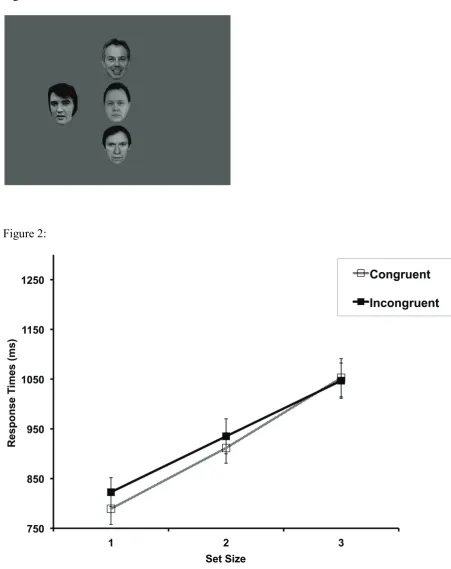
In Experiment 1 we used a search plus classification task similar to that used in Lavie et al’s (2003) study but replaced the names of famous people (used in their study as targets in a search task containing nonsense strings) with faces. Participants were asked to search for a famous face presented in one of three display positions (at the central fixation point, above or below it) and classify it into a pop star’s or a politician’s face, while ignoring a famous distractor face presented in the periphery (Figure 1). The level of perceptual load in this face search task was varied through the relevant search set size. The famous face target was either presented alone (relevant set size ‘one’) or among one (relevant set size ‘two’) or two
from the distractor face were assessed as a function of face-search load. If distractor face processing depends on face-specific capacity limits it should be modulated by the increase in the number of faces in the search task.
Method
Participants. Sixteen paid UCL students (six male, mean age 29 years) participated. All reported normal or corrected-to-normal vision. Before the experiment participants were asked to name photographs of the famous faces used in the experiment. Only one person (out of seventeen asked) could not name all politicians and pop stars and was therefore excluded from the experiment.
anonymous male faces was used as non-targets. The face images were greyscale with a standardized vertical size of 3 cm (2.86 degrees of visual angle) for targets and nontargets and 3.4 cm (3.24 degrees) for distractors. Target identity and positions were counterbalanced with respect to distractor identity and position. Each participant ran through a practice block of 72 trials followed by 10 experimental blocks of 72 trials each. Within each block, all conditions were randomly intermixed. Displays remained visible until the participant
responded or 3 seconds elapsed. The average stimulus luminance of the faces was 65 cd/m2. ---
Figure 1 about here --- Results
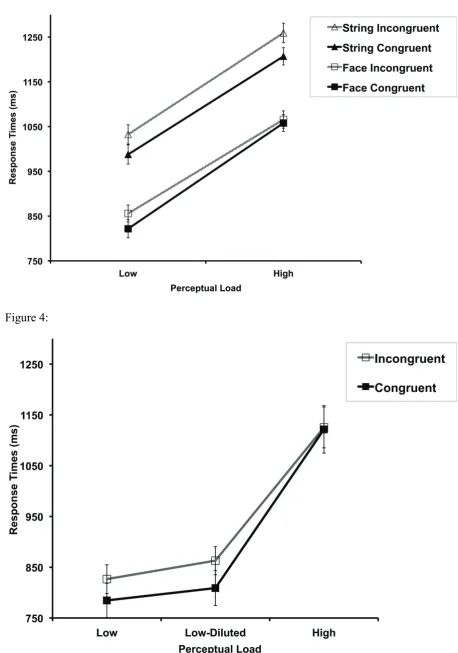
Incorrect responses (and those with RT shorter than 200 ms, 1% of all trials) were excluded from the RT analyses. Figure 2 presents the mean correct RTs as a function of the experimental conditions. A within-subject ANOVA with the factors of set size and
congruency revealed a main effect of set size, F(2, 30) = 241.79, p < .001, MSE = 1969.23,
eta2 = 0.94. RT was significantly increased by each increase in the search set size (p < .001 in all comparisons) with an average search slope of 122 ms. This finding confirms that search load was manipulated effectively with the increase in the face search set size. There was also a main effect of congruency, F(1,15) = 13.83, p < .01, MSE = 500, eta2 = 0.48. However, the congruency effect was qualified by an interaction with set size, F(2, 30) = 5.80, p < .01, MSE
= 574, eta2 = 0.28, reflecting significant distractor congruency effects at set size one, F(1,15) = 20.93, p < .001, and set size two, F(1,15) = 9.44, p < .01 (with no difference between these effects, F < 1) but no distractor congruency effects at set size three, F < 1.
---
Mean error rates were around 3% for all conditions except for that of a congruent distractor in set size 2 (M= 3.6%) and their ANOVA revealed no main effect of congruency (F < 1) or load (F < 1), and no significant interaction between these factors, F(1, 30) = 1.72, MSE = .001, p = .19, eta2 = .10. Thus, the results provide preliminary support for our hypothesis that face processing is subject to face-specific capacity limits.
--- Figure 2 about here ---
Experiment 2
to this task involving lower level of load. As a result of this pilot the name-search task involved three letter strings (a target name and two meaningless letter strings) in the low load condition and six letter strings (a target name and five non-target meaningless letter strings, as in Lavie et al., 2003) in the high load conditions.
Method
Participants. 58 paid students from University College London and the University of East London (19 male, mean age 29 years) participated for pay or course credit. All the participants reported normal or corrected-to-normal vision and were randomly assigned to one of two groups A or B (n = 29 each). One participant in group B had a load effect that was 2.5 standard deviations below the mean load effect (218 ms) and also uniquely responded more slowly in a low load than in a high load condition but with higher error rates in the latter, suggesting a possible speed-accuracy tradeoff. This participant was therefore excluded from the analyses. Before the experiment participants were asked to name photographs of the famous faces used in the experiment. All participants could name the faces correctly.
Stimuli and Procedure. The face stimuli were the same as in Experiment 1 except that the face set now comprised of four faces in each category (see Appendix). Participants were randomly assigned to the group with faces as targets and non-targets (group A) or with letter strings (a target name and meaningless letter strings as non-targets) (group B). Note that following on Lavie et al’s. (2003) method, meaningless letter strings were used in the name search task instead of other common names, so that the effects of set size increase perceptual load rather than load on higher-level semantic processing. There were only two levels of load for both groups. For group A, a relevant set size of one face was used in the low load
set size of six letter strings was used was used in the high load condition. Pilot testing showed that these set sizes produced a similar load effect on latencies as found in Experiment 1. The trial procedure in both groups was similar to Experiment 1, except that for group B the target and non-target faces were replaced with letter strings: targets consisted of the names of the famous individuals (one name was selected in random on each trial from the set of four famous names for each category) and the non-target stimuli were meaningless or ‘nonsense’ letter strings but with first name and surname structure kept, e.g. ‘Rydre Tsueer’. Participants were instructed to find the real name of a famous person among the two (low load) or five (high load) nonsense letter strings and to indicate per key press whether it was a politician or pop star.
As in Experiment 1 the relevant search display was presented in a vertical column placed in the center of the display. The face stimuli were of the same dimensions and positions as those used in Experiment 1. The letters were shown in Arial 12 (bold), and the horizontal expanse of the letter strings was between 3.5 (3.34 degrees) and 4.9 cm (4.68 degrees). The vertical expanse from the top edge to the bottom edge for the set of target plus non-target strings was 3 cm (2.86 degrees) in the low load displays (the same as that used in the low load displays in group A) and 6 cm (5.73 degrees) in the high load condition (the same as the vertical distance between the upper and lower face center points in high load displays of group A).
The position of target and non-target stimuli was counterbalanced within a block. In both groups participants started with a practice block followed by four experimental blocks of 96 trials each. Displays remained visible until the participant responded or 2 seconds elapsed. As in Experiment 1, participants heard a beep sound when they made an error or took too long. There was a short break between blocks.
Figure 3 about here ---
Results
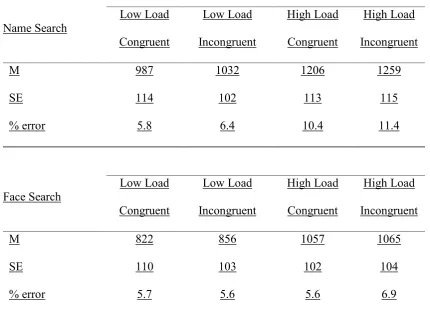
Incorrect responses (and those with RT shorter than 200 ms, 2% of all trials) were excluded from all RT analyses. Figure 3 presents the mean correct RTs as a function of the experimental conditions. Mixed model ANOVAs were performed on RTs and error rates with the within factors of load (high vs. low) and congruency (congruent vs. incongruent) and the between factor of group (name search vs. face search). The RT ANOVA revealed main effects for congruency, F(1, 55) = 69.62, p < .001, MSE = 989, eta2 = 0.56, load, F(1, 55) = 1834, p < .001; MSE = 1544; eta2 = 0.97, and group, F(1, 55) = 38.82, p < .001; MSE = 10769; eta2 = 0.41. Response times were higher for incongruent compared to congruent conditions, increased from low load to high load, and were slower for the group performing name search than the group performing face search.
There was a significant interaction between congruency and group, F(1, 55) = 10.93, p < .01; MSE = 989; eta2 = .16. Congruency effects were smaller in the face search group than in the name search group. This is explained by the significant 3-way interaction, F(1, 55) = 4.08, p < .05; MSE = 993; eta2 = .069. Whereas load reduced the congruency effects in the face search group, F(1, 28) = 6.63, p < .05, MSE = 746; eta2 = .19, as in Experiment 1, load had no effect on congruency in the name search group, F(1, 27) = 0.23, p = .57 (see Figure 3). Indeed the congruency effects did not significantly differ between the face (M = 31 ms;
There were no other significant interactions (all Fs < 1.23). Notice in particular that the load effect on RT was equivalent between the face-search group (M = 223 ms) and the name-search group (M = 218 ms, F < 1 for the interaction of group and load).
--- Table 2 about here
---
The ANOVA on error rates also showed main effects for congruency, F(1, 55) = 8.50,
p = .005, MSE = .001, eta2 = 0.13, and load, F(1, 55) = 28.99, p < .001, MSE = .029, eta2 = 0.34: error rates were higher for incongruent compared to congruent conditions, and
increased from low load to high load (see Table 2) in line with the RT effects. There was no main effect for group, F(1, 55) = 3.01, p = .088, MSE = .003, eta2 = .05, but a trend of higher error rates in the name-search group was consistent with the RT results. There was a
significant interaction between load and group, F(1, 55) = 17.85, p < .001, MSE = .001, eta2 = .05, indicating that error rates increased more from low load to high load conditions in the name-search group compared to the face-search group. There was no interaction between load and congruency, F(1, 55) = 2.78, p = .101, nor any other interaction (all F’s < 1.11).
Thus Experiment 2 results showed that a manipulation of perceptual load that
appeared to be similarly effective in both the name and face search tasks (or perhaps to some extent somewhat stronger for the names search as revealed by the greater effect of load on errors) had no effect on distractor face processing. Only high load in the face search task eliminated distractor face processing.
Experiment 3
a manipulation of load within face processing only is exactly as predicted on the basis of our a-priori hypothesis (see also Lavie et al., 2003). However, the results of Experiments 1-2 in themselves remain open to an alternative interpretation which attributes the contrasting results pattern to a difference in efficiency of the perceptual load manipulation for the face search compared to the name search. Indeed, although the load manipulation led to a greater increase in the error rates for the name search than the face search, while the effect of load on RT was equivalent between the two tasks, the name search task did have longer RT overall and hence a smaller proportional increase in the RT (20%) compared to the face search task (24%) with higher load. Thus, one could question whether the load manipulation was somewhat less effective for the name search than for the face search (Note 2). This interpretation is somewhat unlikely given a previous demonstration that a similar
manipulation of perceptual load in name search was effective in reducing the processing of non-face distractor objects (Lavie et al., 2003). Nevertheless, to further test our face-specific capacity hypothesis we sought to examine whether our manipulation of load in the name search task can be effective in reducing the processing of distractor names rather than faces. The task in Experiment 3 was thus very similar to that used for group B (name search with different set size) in Experiment 2 except that the distractor faces were now replaced with distractor names of politicians or pop stars.
Method
Participants. Sixteen students (six male, mean age 25 years) from the University of East London took part in exchange for course credit.
consisted of names rather than face stimuli. The distractor names were either the same (congruent condition) as the target name or the name of a famous person from the opposite category. The distractor name was shown with the first name centred above the surname of the politician or pop star (0.8cm; 0.07 degrees) and the center 4 cm (3.82 degrees) to the left or right of fixation. Whereas the target and non-target strings were shown in ARIAL 10 font, the font for the distractor was GEORGIA 18 (bold) to allow better legibility in the periphery. The same person identities were used as in Experiment 2, with the exception that “John Major” was replaced with “Gordon Brown” (since the former could not be usually remembered as an active politician by most of our participants).
Results and Discussion
Incorrect responses (and those with RT shorter than 200 ms, 1.5% of all trials) were excluded from the RT analysis. Table 3 presents the mean correct RTs and error rates for the different experimental conditions. A within-subject ANOVA of the RT with the factors of load and congruency revealed no main effect of RT for congruency, F(1, 15) < 1, MSE = 2249; eta2 = .06, but a significant main effect of load, F(1, 15) = 546.99, p < .001; MSE = 2311; eta2 = 0.99, and a significant interaction of load and congruency, F(1, 15) = 5.38, p < .05; MSE = 7197; eta2 = .26. As can be seen in Table 3 this interaction reflected the reduction in the distractor congruency effect which was found the low load condition, F(1,15) = 5.08, p
< .05, but not in the high load condition, F(1,15) < 1. Error rates did not vary between the conditions (M= 6.2% in each condition, see Table 3).
--- Table 3 about here
These results demonstrate that our manipulation of perceptual load in the name search task is effective in reducing the processing of name distractors.
The contrast in the effects of perceptual load in the name search on distractor name versus distractor face processing was further confirmed in the three-way interaction, F(1, 42) = 4.97, p =.031; MSE = 1280, eta2 = .11, between load congruency and Experiment that was found in a mixed-model ANOVA of the RT in Experiment 3 and in group B in Experiment 2. The contrast between the reduced distractor name processing in Experiment 3 and the lack of effect on face-specific effect of load observed in Experiments 1 and 2 is further supportive of our hypothesis that faces have face-specific capacity limits.
Experiment 4
condition was of low load because it allowed for a target pop out, however it involved dilution because the display set size was the same as in the high load condition, and also contained the same amount of visual features, (see method for more detail) as those in the high load condition. If the effects of load are due to a form of visual interference for example visual feature crosstalk, as per the dilution account, then this condition should also reduce distractor interference. If the effects are due to a draw specifically on face processing capacity as we hypothesized then they should only be found in the high load condition.
Method
Participants. Ten UCL students (four male, mean age 24 years) participated. All reported normal or corrected-to-normal vision.
of each of the scrambled faces was slightly cropped around the chin to provide the same outline as the original version of the corresponding intact face.
The conditions of low load (set size one) and high load (set size three with intact nontarget faces) were the same as those used in Experiment 1. The distance between the target and nontargets was kept the same as in Experiment 1 so that the faces above or below fixation were now placed with their center 2.9 cm (2.77 degrees) away from fixation. Distractor faces were presented at the same size and position as in Experiment 1.
Results and Discussion
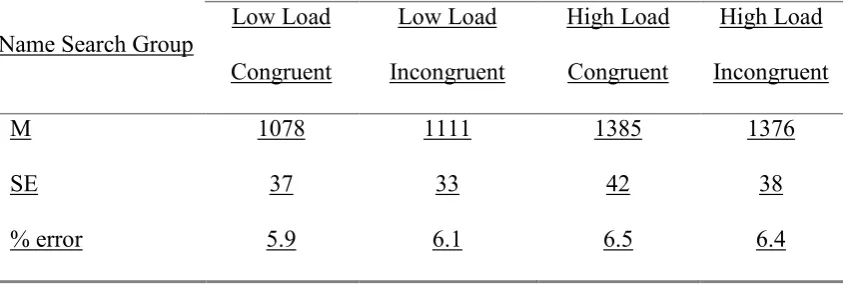
Incorrect responses (and those with RT shorter than 200 ms, 1.2 % of all trials) were excluded from the RT analysis. Figure 4 presents the mean RTs as a function of the
experimental conditions. A within-subject ANOVA of the RT as a function of condition (low load, high load, low load/dilution) and congruency (incongruent, congruent) revealed a significant main effect for condition, F(2, 18) = 135.21, p < .001, MSE = 4550, eta2 = 0.94. Planned contrasts indicated that the mean RT of the high load condition was significantly longer than the mean RT of the low load condition, F(1, 9) = 175.50, p < .001, and the low load/dilution condition, F = 159.44, p < .001, while the small increase in RTs (by 30 ms) from the low load to the low load/dilution condition was not significant, F(1, 9) = 3.34, p = .09. There was also a main effect of congruency, F(1, 9) = 13.80, p < .01, MSE = 1206., eta2 = 0.61, and more importantly, an interaction of load and congruency, F(2, 18) = 7.91, p < .01,
These results provided further support of our face-specific capacity limits account, while ruling out an alternative account in terms of a form of visual interference, feature crosstalk, or “dilution”. The lack of dilution effects in the present study cannot be explained by reduced visual salience of the scrambled faces, as conceived in computational models of visual salience (e.g. Itti, Koch, & Niebur, 2008). In such models visual salience is registered as a location that stands out on feature maps for colours, intensity and orientation and so forth. All these types of information (as well as overall shape orientation) were retained in the phase-shifted scrambled faces we used, and thus any local salience signal on these feature maps should have been retained as well. Reduced similarity between the scrambled and intact faces cannot explain the lack of dilution effects either, since dilution is known to be found for dissimilar items. For example a row of X’s, brackets, or even “equal” signs have been shown to dilute interference from a distractor word (Kahneman & Chajczyk, 1983; Brown, Roos-Gilbert, & Carr, 1995).
--- Figure 4 about here
---
General Discussion
The present findings demonstrate that the processing of face distractors critically depends on the level of perceptual load specifically involved in face processing. Irrelevant face
distractors were perceived under all conditions of load in a name search task, including conditions of high perceptual load (that were previously shown to reduce processing of non-face distractor objects), as well as under conditions of low perceptual load in a non-face search task (including those involving the so called “dilution” effect, Experiment 4). In contrast, the name search task was shown to be effective in reducing processing of names (Experiment 3), and face distractor processing was reduced with high perceptual load when a face-search task involved three faces.
The striking contrast between the effects of perceptual load in face versus non-face processing was found despite both load manipulations being clearly effective in reducing the search task efficiency (as shown in Experiment 2) and despite the name search task being effective in reducing the processing of distractor names (and in a previous study also shown to be effective in reducing the processing of meaningful distractor objects, Lavie et al., 2003). This dissociation thus strongly suggests that face processing depends only on the level of load involved specifically in face perception, while being immune to perceptual load in other object domains. In this respect distractor faces are an exception to all other types of
et al. (2009) have shown that perceptual load in search task modulated the processing of a wide range of meaningful distractor objects whether the load manipulation involved search for objects or for letters. Many other studies have reported similar effects on distractor processing for manipulations of load in another domain (e.g. letter strings, words, Forster & Lavie, 2008; Lavie et al., 2003; Pinsk et al., 2004; Rees et al., 1997; to name but a few). The conclusion that unlike meaningful non-face distractor objects, distractor faces seem to only have face-specific capacity limits converges with evidence from functional imaging and neuropsychology on the suggestion that faces are processed by a dedicated, perhaps even encapsulated (in the sense that it is immune to effects of non-face load) face module .
This conclusion also provides firm support for our hypothesis that load theory applies to face perception as well, as long as the specialized (perhaps even modular) nature of
capacity limits for face perception is taken into account. Our proposal of a face module with face-specific capacity limits can account for the previous demonstrations that face processing is unaffected by the level of load in processing non-face objects (e.g., Fodor, 1983; 2000; Lavie et al., 2003; Neumann & Schweinberger, 2008; Neumann et al., 2011) but can be disrupted by attending to other faces (e.g., Bindemann et al., 2005; 2007; Jenkins et al., 2003; Nagy, Greenlee & Kovacs, 2011; Palermo & Rhodes, 2002) especially when the attention task becomes more demanding (e.g., Jacques & Rossion, 2007; Neumann & Schweinberger, 2009). A module approach stipulates that the face module would just be engaged in the perception of faces, while being unaffected by the processing of non-face objects (‘encapsulated’ processing, see Fodor, 1983).
involved unless the demand on this (face perception) resource is quantitatively varied. It is therefore possible that other factors, or other face-specific interactions can account, at least in part, for the modulations previously reported. For instance, stimulus competition for neural representations (e.g., in face selective areas such as the fusiform face area, or as indicated by ERP amplitude of the N170 component of face processing) is more sensitive to the presence of another face than non-face stimuli (e.g., Jacques & Rossion, 2004, 2007; Nagy, Greenlee, & Kovács, 2011). Other factors such as the relative visual salience of a target and distractor, which are known to determine base-line level of distractor effects may also play a role. It is for example possible that a contribution of factors such as reduced salience and stimulus competition may explain why processing of a distractor face was already reduced by the presence of one target face in Bindemann et al.’s (2005; 2007) studies. As we discuss earlier (in the General Introduction) Bindemann’s et al.’s suggestion that face processing has a particularly restricted capacity allowing only one face to be perceived at a time, in a bottle neck fashion, is somewhat unlikely given the higher estimates of perceptual capacity for all other types of non-face objects as well as demonstrations that the capacity for face
representations in visual short term memory (as estimated with Cowan’s K) is similar to (e.g., Wong, Peterson, & Thompson, 2008) or in some cases better than (Curby & Gauthier, 2007; Scolari, Vogel, & Awh, 2008) other objects of similar level of complexity. It is also
independently contributed to reduced amplitude of the N170 related to a lateralized face (Jaques & Rossion, 2006). In further support of this explanation, the task requirement in Bindeman et al.’s studies appeared to be more demanding than in the present task. Cleary recognizing a famous politician as a politician of a particular nationality (as required in Bindemann et al.’s 2005; 2007 studies) is more demanding than the present task requirement to just recognize a famous politician as a politician. Neumann and Schweinberger (2009) have shown that distractor face processing (as indexed by N250 repetition priming effects) continued in the presence of a face target as long as the task demand was low (color judgment) but not when the task demand was high (young vs. old judgments).
Thus the apparent discrepancy between our suggestion that face processing capacity limits are not approached until four faces are presented, and Bindemann’s findings of reduced face processing with just one target face can be reconciled by suggesting that their task requirement involved higher load, and that both stimulus competition and the relative salience of the distractor face in their study acted to reduce distractor face processing in the presence of another face more than in the presence of a flag. However, without directly varying the level of load involved in face processing it is impossible to reach a clear cut conclusion with respect to the contribution of capacity limits in the effects found.
loading perceptual capacity instead. Note, however, that our findings do not imply a fixed number of faces as the limit. Rather, as shown in the Neumann and Schweinberger (2009) study, the task demands may lead to a higher or lower load for the same number of faces (see also for example, Carmel, Thorne, Rees, & Lavie, 2011; Cartwright-Finch & Lavie, 2007; and Lavie, 1995, Experiments 2-3; as examples of different levels of load for the same number of non-face objects).
expertise) can lead to category-selective processing for the objects of expertise that has similar characteristic to face processing. Future studies may wish to explore the possibility that other stimuli of expertise (for example birds for bird watchers, Gauthier et al., 2000; musical instruments for musicians, e.g., Ro, Friggel, & Lavie, 2009) may also have their own domain-specific capacity limits. Indeed Ro et al. (2009) have shown that musicians were susceptible to interference by distractor images of musical instruments presented in a response competition task (requiring participants to classify names of musical instruments) irrespective of the level of perceptual load in the task, whereas non-musicians were only interfered by the same distractor images under low, but not high, load. An interesting test of the hypothesis that expertise leads to domain-specific capacity limits would be to investigate whether musicians’ processing of instruments as distractors will be affected by the level of domain-specific perceptual load (e.g. as varied by the number of musical instruments presented in their relevant task).
Finally, we note that while perception of faces may only be subject to face-specific capacity limits, explicit memory recognition for faces does depend on general non-face specific capacity. Jenkins, Lavie and Driver (2005) manipulated perceptual load in a letter search task and found that explicit recognition memory for the distractor faces was
substantially reduced under high load. These findings can be reconciled with our suggestion that whereas face perception has face-specific capacity limits (as presently revealed by online measures), recognition memory for faces has general capacity limits. Such a suggestion accords in principle with Fodor’s (1983) claims that modules are encapsulated input-processing systems, but their output to central processes - such as memory - can be shared.
address whether this is a consequence of extensive expertise or whether faces are a unique category for attention and perception.
References
Benoni, H., & Tsal, Y. (2010). Where have we gone wrong? Perceptual load does not affect selective attention. Vision Research. doi:10.1016/j.visres.2010.04.018
Benoni, H., & Tsal, Y. (2012). Controlling for dilution while manipulating load: perceptual and sensory limitations are just two aspects of task difficulty. Psychonomic bulletin & review, 19(4), 631–638. doi:10.3758/s13423-012-0244-8
Bindemann, M., Burton, A. M., & Jenkins, R. (2005). Capacity limits for face processing.
Cognition, 98(2), 177–197. doi:10.1016/j.cognition.2004.11.004
Bindemann, M., Jenkins, R., & Burton, A. M. (2007). A Bottleneck in Face Identification.
Experimental Psychology (formerly “Zeitschrift für Experimentelle Psychologie”),
54(3), 192–201. doi:10.1027/1618-3169.54.3.192
Brown, T. L., Roos-Gilbert, L., & Carr, T. H. (1995). Automaticity and word perception: Evidence from Stroop and Stroop dilution effects. Journal of Experimental Psychology: Learning, Memory, and Cognition, 21, 1395–1411.
Carmel, D., Saker, P., Rees, G., & Lavie, N. (2007). Perceptual load modulates conscious flicker perception. Journal of vision, 7(14), 14.1–13. doi:10.1167/7.14.14
Carmel, D., Thorne, J. D., Rees, G., & Lavie, N. (2011). Perceptual load alters visual excitability. Journal of experimental psychology. Human perception and performance, 37(5), 1350–1360. doi:10.1037/a0024320
Curby, K. M., & Gauthier, I. (2007). A visual short-term memory advantage for faces.
Psychonomic bulletin & review, 14(4), 620–628.
Desimone, R., & Duncan, J. (1995). Neural Mechanism of Selective Visual Attention. Annual Review of Neuroscience, 18, 193-222.
Fodor, J. (1983). Modularity of Mind: An Essay on Faculty Psychology. Cambridge, Mass: MIT Press.
Fodor, J. A. (2000). The mind doesn’t work that way: the scope and limits of computational psychology. Cambridge, Mass.: MIT Press.
Forster, S., & Lavie, N. (2008). Attentional capture by entirely irrelevant distractors. Visual Cognition, 16(2), 200–214. doi:10.1080/13506280701465049
Gauthier, I., Tarr, M. J., Moylan, J., Skudlarski, P., Gore, J. C., & Anderson, A. W. (2000). The fusiform “face area” is part of a network that processes faces at the individual level. Journal of cognitive neuroscience, 12(3), 495–504.
Itti, L., Koch, C., & Niebur, E. (1998). A model of saliency-based visual attention
for rapid scene analysis. IEEE Transactions on Pattern Analysis and Machine Intelligence, 20 (11), 1254-1259,
Jacques, C., & Rossion, B. (2004). Concurrent processing reveals competition between visual representations of faces. Neuroreport, 15(15), 2417–2421.
Jacques, C., & Rossion, B. (2006). The speed of individual face categorization. Psychological science, 17(6), 485–492. doi:10.1111/j.1467-9280.2006.01733.x
Jacques, C., & Rossion, B. (2007). Electrophysiological evidence for temporal dissociation between spatial attention and sensory competition during human face processing.
Jenkins, R., Burton, A. M., & Ellis, A. W. (2002). Long-term effects of covert face recognition. Cognition, 86(2), B43–B52. doi:10.1016/S0010-0277(02)00172-5
Jenkins R., Lavie N., & Driver J. (2003). Ignoring famous faces: category-specific dilution of distractor interference. Perception & Psychophysics, 65(2), 298–309.
Jenkins, R., Lavie, N., & Driver, J. (2005). Recognition memory for distractor faces depends on attentional load at exposure. Psychonomic Bulletin & Review, 12(2), 314–320. Kahneman, D., & Chajczyk, D. (1983). Tests of the automaticity of reading: dilution of
Stroop effects by color-irrelevant stimuli. Journal of experimental psychology. Human perception and performance, 9(4), 497–509.
Kanwisher, N. (2000). Domain specificity in face perception. Nature neuroscience, 3(8), 759–763. doi:10.1038/77664
Kyllingsbæk, S., Sy, J. L., & Giesbrecht, B. (2011). Understanding the allocation of
attention when faced with varying perceptual load in partial report: A
computational approach. Neuropsychologia, 49(6), 1487–1497.
doi:10.1016/j.neuropsychologia.2010.11.039
Lavie, N, & Cox, S. (1997). On the efficiency of attentional selection: Efficient visual search results in inefficient rejection of distraction. Psychological Science, 8, 395–398. Lavie, N., & Fox, E. (2000). The role of perceptual load in negative priming. Journal of Experimental Psychology. Human Perception and Performance, 26, 1038–1052. Lavie, N. (2010). Attention, Distraction, and Cognitive Control Under Load. Current
Directions in Psychological Science, 19(3), 143–148. doi:10.1177/0963721410370295
Lavie, N. (1994).Perceptual load and physical distinctiveness as determinants of the locus of attentional selection. Unpublished Doctoral Thesis, Tel Aviv University.
Lavie, N. (2005). Distracted and confused?: selective attention under load. Trends in Cognitive Sciences, 9(2), 75–82. doi:10.1016/j.tics.2004.12.004
Lavie, N., Lin, Z., Zokaei, N., & Thoma, V. (2009). The role of perceptual load in object recognition. Journal of Experimental Psychology: Human Perception and
Performance, 35(5), 1346–1358. doi:10.1037/a0016454
Lavie, N., Ro, T., & Russell, C. (2003). The role of perceptual load in processing distractor faces. Psychological Science, 14(5), 510–515.
Lavie, N., & Torralbo, A. (2010). Dilution: A theoretical burden or just load? A reply to Tsal and Benoni (2010). Journal of experimental psychology. Human perception and performance, 36(6), 1657–1664; discussion 1665–1668. doi:10.1037/a0020733 Macdonald, J. S. P., & Lavie, N. (2008). Load induced blindness. Journal of experimental
psychology. Human perception and performance, 34(5), 1078–1091. doi:10.1037/0096-1523.34.5.1078
McCarthy, G., Puce, A., Gore, C., & Allison, T. (1997). Facespecific processing in the human fusiform gyrus. Journal of cognitive neuroscience, 9, 605–610.
Nagy, K., Greenlee, M. W., & Kovács, G. (2011). Sensory competition in the face processing areas of the human brain. PloS one, 6(9), e24450. doi:10.1371/journal.pone.0024450 Neumann, M. F., Mohamed, T. N., & Schweinberger, S. R. (2011). Face and object encoding
under perceptual load: ERP evidence. NeuroImage, 54(4), 3021–3027. doi:10.1016/j.neuroimage.2010.10.075
Neumann, M., & Schweinberger, S. (2008). N250r and N400 ERP correlates of immediate famous face repetition are independent of perceptual load. Brain Research, 1239, 181–190. doi:10.1016/j.brainres.2008.08.039
Palermo, R., & Rhodes, G. (2002). The influence of divided attention on holistic face perception. Cognition, 82(3), 225–257.
Pinsk, M. A., Doniger, G. M., & Kastner, S. (2004). Push-pull mechanism of selective attention in human extrastriate cortex. Journal of neurophysiology, 92(1), 622–629. doi:10.1152/jn.00974.2003
Pylyshyn, Z. (1994). Some primitive mechanisms of spatial attention. Cognition, 50(1-3), 363–384.
Reddy, L., Wilken, P., & Koch, C. (2004). Face-gender discrimination is possible in the near-absence of attention. Journal of Vision, 4(2), 4–4. doi:10.1167/4.2.4
Rees, G., Frith, C. D., & Lavie, N. (1997). Modulating irrelevant motion perception by varying attentional load in an unrelated task. Science (New York, N.Y.), 278(5343), 1616–1619.
Ro, T., Friggel, A., & Lavie, N. (2009). Musical expertise modulates the effects of visual perceptual load. Attention, perception & psychophysics, 71(4), 671–674.
doi:10.3758/APP.71.4.671
Santee, J. L., & Egeth, H. E. (1982). Do reaction time and accuracy measure the same aspects of letter recognition? Journal of experimental psychology. Human perception and performance, 8(4), 489–501.
field. Cerebral cortex (New York, N.Y.: 1991), 15(6), 770–786. doi:10.1093/cercor/bhh178
Scolari, M., Vogel, E. K., & Awh, E. (2008). Perceptual expertise enhances the resolution but not the number of representations in working memory. Psychonomic bulletin & review, 15(1), 215–222.
Simons, D. J., & Chabris, C. F. (1999). Gorillas in our midst: sustained inattentional blindness for dynamic events. Perception, 28(9), 1059–1074.
Treisman, A., Kahneman, D., & Burkell, J. (1983). Perceptual objects and the cost of filtering. Perception & psychophysics, 33(6), 527–532.
Tsal, Y., & Benoni, H. (2010). Diluting the burden of load: perceptual load effects are simply dilution effects. Journal of experimental psychology. Human perception and
performance, 36(6), 1645–1656. doi:10.1037/a0018172
Wilson, D. E., Muroi, M., & MacLeod, C. M. (2011). Dilution, not load, affects distractor processing. Journal of experimental psychology. Human perception and performance,
37(2), 319–335. doi:10.1037/a0021433
Wong, J. H., Peterson, M. S., & Thompson, J. C. (2008). Visual working memory capacity for objects from different categories: a face-specific maintenance effect. Cognition,
108(3), 719–731. doi:10.1016/j.cognition.2008.06.006
Yeh, Y.-Y., & Lin, S.-H. (2013). Two mechanisms of distractor dilution: Visual selection in a continuous flow. Journal of experimental psychology. Human perception and
performance, 39(3), 872–892. doi:10.1037/a0030486
Footnotes.
Note 1. Set size three was chosen as a maximum because pilot data showed that this was sufficient to load face perception with a greater set size inducing “data limits” (likely to be due to the reduced acuity in the periphery) as reflected in a substantial increase in the error rates.
Author Note.
Figure Captions.
Figure 1. Example of a display in the incongruent condition with a relevant set size three in Experiment 1. Note: The versions of the faces shown here differ from the images used in the actual experiments due to copyright limitations (see Appendix for lists of famous faces used in this study).
Figure 2: Mean response times for congruent and incongruent conditions as a function of set size in Experiment 1.
Figure 3: Mean response times for congruent and incongruent conditions as a function of set size in Experiment 2.
Appendix:
Experiment 1:
Famous politicians: Tony Blair, Bill Clinton, George W Bush, John F Kennedy, Michael Portillo, John Major
Famous pop stars: David Bowie, Elton John, Elvis Presley, Mick Jagger, Sting, Paul McCartney
Experiment 2:
Figure 1:
[image:38.595.73.301.114.281.2]Figure 3:
Table 1
Experiment 1: Mean RT (ms), SE and Percentage Errors as a function of distractor condition and face-search set size
Set Size 1 Congruent
Setsize 1 Incongruent
Set Size 2 Congruent
Set size 2 Incongruent
Set size 3 Congruent
Set size 3 Incongruent
M 789 822 911 934 1052 1047
SE 31 29 30 35 38 35
Table 2
Experiment 2: Mean RT (ms), SE and Percentage Errors as a function of distractor condition and search set size
Name Search Low Load Congruent
Low Load Incongruent
High Load Congruent
High Load Incongruent
M 987 1032 1206 1259
SE 114 102 113 115
% error 5.8 6.4 10.4 11.4
Face Search Low Load
Congruent
Low Load Incongruent
High Load Congruent
High Load Incongruent
M 822 856 1057 1065
SE 110 103 102 104
Table 3
Experiment 3: Mean RT(ms), SEs and Percentage Errors as a function of distractor condition and name-search set size
Name Search Group Low Load Congruent
Low Load Incongruent
High Load Congruent
High Load Incongruent
M 1078 1111 1385 1376
SE 37 33 42 38