COMPACT-CALIBRES OF REGULAR AND MONOTONICALLY
NORMAL SPACES
DAVID W. MCINTYRE
Received 10 January 2001 and in revised form 10 May 2001
A topological space has calibreω1(resp., calibre(ω1,ω)) if every point-countable (resp., point-finite) collection of nonempty open sets is countable. It has compact-calibre ω1 (resp., compact-calibre(ω1,ω)) if, for every family of uncountably many nonempty open sets, there is some compact set which meets uncountably many (resp., infinitely many) of them. It has CCC (resp., DCCC) if every disjoint (resp., discrete) collection of nonempty open sets is countable. The relative strengths of these six conditions are determined for Moore spaces, regular first countable spaces, linearly-ordered spaces, and arbitrary regular spaces. It is shown that the relative strengths for spaces with point-countable bases are the same as those for Moore spaces, and the relative strengths for linearly-ordered spaces are the same as those for arbitrary monotonically normal spaces.
2000 Mathematics Subject Classification: 54A25.
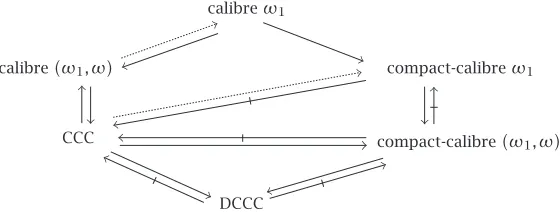
1. Introduction and basic results. LetXbe a topological space. If every uncount-able collection of nonempty open sets is point-countuncount-able (resp., point-finite) thenXis said to have calibreω1(resp., calibre(ω1,ω)). If for every uncountable collection of nonempty open sets there is a compact subset ofXmeeting uncountably many (resp., infinitely many) of the open sets then X is said to have compact-calibreω1(resp., compact-calibre (ω1,ω)). If every disjoint (resp., discrete) collection of nonempty open sets is countable, then X is said to have the countable chain condition (CCC) (resp., the discrete countable chain condition (DCCC)). Clearly, calibreω1implies cal-ibre(ω1,ω), calibre(ω1,ω)implies CCC, and CCC implies DCCC. Also, calibreω1 implies compact-calibreω1, and either compact-calibreω1or calibre(ω1,ω)implies compact-calibre(ω1,ω).
Proposition1.1. Every space with compact-calibre(ω1,ω)has DCCC.
Proof. Let(X,᐀)be a space which has a discrete family{Uα:α∈ω1}of nonempty open sets. SupposeK⊆X meetsUα for infinitely manyα∈ω1. PutΛ= {α∈ω1: K∩Uα≠∅}. Then{K∩Uα:α∈Λ}is an infinite discrete collection of closed subsets
ofK, soKis not compact.
These simple relations are summarized inFigure 1.1.
calibreω1
calibreω1,ω
compact-calibreω1
CCC compact-calibreω1,ω
DCCC
Figure1.1. Relative strengths of the conditions for arbitrary spaces.
Hypothesis (SH) holds then any CCC linearly-ordered space is separable and so CCC implies each of the other conditions under that assumption. We will discuss what happens when we weaken metrizability, and what happens when SH fails.
The classic weakening of metrizability is to Moore spaces. In the next section, we will see that for Moore spaces calibreω1, calibre(ω1,ω), CCC, and DCCC are distinct, while compact-calibreω1is equivalent to calibreω1and compact-calibre(ω1,ω)is equivalent to DCCC. For normal Moore spaces, DCCC is equivalent to CCC, which may or may not be equivalent to calibreω1.
InSection 3, we will see that for linearly-ordered spaces calibreω1, compact-calibre ω1, compact-calibre(ω1,ω), and DCCC are distinct, while calibre(ω1,ω)and CCC are equivalent. Depending on whether or not SH holds, CCC is either equivalent to calibreω1 or does not even imply compact-calibreω1. As so often occurs, we can replace “linearly ordered” by “monotonically normal” in these statements.
InSection 4, we will show that for arbitrary regular spaces, no implications, other than those inFigure 1.1, hold between the conditions.
2. Moore spaces. First we will show that, for Moore spaces, compact-calibreω1is equivalent to calibreω1, and DCCC is equivalent to compact-calibre(ω1,ω).
Proposition2.1. Any Moore space with compact-calibreω1has calibreω1.
Proof. Let(X,᐀)be a Moore space with compact-calibreω1, and let{Uα:α∈ω1} be a collection of nonempty open subsets ofX. LetKbe a compact subset ofXand Γ an uncountable subset of ω1such that, for every α∈Γ, K∩Uα ≠∅. ThenK is
a compact Moore space, and hence separable and metrizable. Moreover, the family
{Uα∩K:α∈Γ}is an uncountable family of nonempty open subsets ofK, and hence
not point-countable. Thus, the original family is not point-countable.
Proposition2.2. Let(X,᐀)be a regular first countable space with DCCC. Then
infinitely manyα∈ω1. Let{Bn(x):n∈ω}be a local basis atxsuch that, for every
n∈ω,Bn+1(x)⊆Bn(x). We define sequences(αn)n∈ωinω1and (xn)n∈ω inX as
follows: pickα0∈ω1 such thatB0(x)∩Uα0 ≠∅, and pickx0∈B0(x)∩Uα0. Now letn∈ω, and suppose that we have already chosenαm∈ω1andxm∈Xfor every
m < n. Chooseαn such that, for everym < n,αn≠αm, andBn(x)∩Uαn ≠∅, and
choosexn∈Bn(x)∩Uαn. PutK= {x}∪{xn:n∈ω}. ThenKis a compact subset ofX
which meetsUαfor infinitely manyα∈ω1. Thus,(X,᐀)has compact-calibre(ω1,ω).
The hypothesis thatXis first countable is needed inProposition 2.2, as is shown by Example 4.1. On the other hand, the hypothesis of regularity is only needed in order to invoke Wiscamb’s result that DCCC spaces have what might be termed the “locally finite countable chain condition” or LFCCC: every locally finite collection of nonempty open sets is countable. As far as the author is aware, no other results have been published on this property. The most natural question to ask is the following.
Question2.3. For which classes of spaces does DCCC imply LFCCC?
The author knows of aT1space with DCCC but not LFCCC, but no Hausdorff exam-ple.
Let (X,᐀) be a regular first countable space. For each x ∈ X, fix a local basis
{B(x,n): n∈ω}at x such that, for each n∈ω, B(x,n+1)⊆B(x,n). Let M = X×<ωω, and forp= x,f ∈Mandn∈ωdefine
Gn(p)= {p}∪y,fg:(g≠∅)∧g(0)≥n∧y∈Bx,n+g(0), (2.1)
wherefgdenotes the concatenation of the functionsf andg. Then{G
n(p):p∈
M, n∈ω}forms a basis for a topologyonM. The space(M,)is a Moore space, called theReed spaceoverX. A number of chain conditions are preserved between
(X,᐀)and(M,), including DCCC, CCC, calibre(ω1,ω), calibreω1, and separability (see Reed [11] and McIntyre [5]). The construction was introduced in the case where
X is ω1, with its order topology, in order to construct a Moore space with DCCC but without CCC (see Reed [10]). A variation of this construction was used in [12] to construct a Moore space with calibre(ω1,ω)but without calibreω1. The set of finite subsets ofR, with the Pixley-Roy topology, is a Moore space with CCC but without calibre(ω1,ω)[5]. Thus the relationships between the six conditions are as shown in Figure 2.1.
calibreω1 compact-calibreω1
calibreω1,ω
CCC
DCCC compact-calibreω1,ω
Figure2.1. Relative strengths of the conditions for Moore spaces and for spaces with point-countable bases.
versus CCC for spaces with a point-countable base. Shakhmatov has shown that there exist pseudocompact (and hence DCCC) zero-dimensional spaces with point-countable bases containing closed discrete subsets of arbitrary cardinality [13]. In particular, there is a pseudocompact space with a point-countable base with cardinality greater than 2ω, whereas any CCC first-countable space has cardinality at most 2ω. Thus, the relative strengths of the conditions for spaces with a point-countable base are the same as the strengths for Moore spaces.
Metrizability can be thought of as having two factors, developability and separation. What happens when we add some extra separation? In normal Moore spaces, DCCC and CCC are equivalent. This follows from results in [10], where Reed shows that a Moore space has CCC if and only if it has DCCC and iswd-normal(in other words, if for every open setU there is a sequence(Dn)n∈ω of open sets such that for each
n∈ω,Dn⊆UandU⊆n∈ωDn). Since normal Moore spaces are perfectly normal,
they are wd-normal.
We do not require the full strength of developability for normal DCCC spaces to have CCC. Recall that aσ-space is a space with aσ-discrete network, and that Moore spaces are σ-spaces (see [1, Section 4]). Suppose that a normalσ-space X has an uncountable disjoint collection of nonempty open sets. By theσ-space property, these can be shrunk to aσ-discrete collection of closed nonempty sets which are separated by the original open sets. Since in a normal space any discrete family of closed sets, which can be separated by disjoint open sets, can be separated by a discrete family of open sets, we can find an uncountable discrete family of open sets inX. Thus, ifX
is a normalσ-space with DCCC, thenXhas CCC. In particular, stratifiable DCCC spaces have CCC.
The author is unaware of any (consistent) example of a normal Moore space with calibre(ω1,ω)but without calibreω1.
3. Linearly-ordered spaces and monotonically normal spaces. We have seen that in Moore spaces, DCCC and the calibres are all distinct, whereas the compact-calibres are all equivalent to one of those conditions. We will see that in linearly-ordered spaces the situation is reversed: the calibres collapse together while the compact-calibres become distinct.
Example 3.1. A linearly-ordered space with DCCC but without compact-calibre
(ω1,ω).
LetX=(ω1×(0,1))∪{ω1,0}, ordered lexicographically, that is, by defining
α,x<β,y ⇐⇒(α < β)∨(α=β)∧(x < y). (3.1)
Suppose{Uα:α∈ω1}is a discrete collection of nonempty open sets. For eachα∈ ω1, pick some βα ∈ω1 and some xα ∈(0,1) such thatβα,yα ∈Uα (note that
we can do this, becauseω1,0is not an isolated point ofX). By discreteness, there is a neighbourhood ofω1,0containing at most oneβα,yα, so{βα:α∈ω1}is bounded. But then, there is someγ such thatβα=γ for uncountably manyα∈ω1, so by separability of{γ}×(0,1)the collection is not disjoint and hence is not discrete. Thus,Xhas DCCC.
On the other hand, for eachα∈ω1, putVα= {α} ×(0,1). Then eachVα is open
inX. LetKbe a subset ofX, and letΓ= {α∈ω1:K∩Vα≠∅}. IfΓ is infinite, then
letΛbe a countably infinite subset ofΓ. For each α∈Λ, pickxα∈(0,1)such that
α,xα ∈K. Then {α,xα:α∈Λ}is an infinite closed discrete subset of K, soK
cannot be compact. Thus,Xdoes not have compact-calibre(ω1,ω).
A linearly-ordered space with CCC is hereditarily Lindelöf [4], and hence has cal-ibre (ω1,ω)[5]. If Souslin’s hypothesis holds, then it is also separable, and hence has calibreω1. However, the square of any Souslin space (i.e., any linearly-ordered CCC nonseparable space) does not have CCC [3], whereas calibreω1is preserved by products [14]. Thus, no Souslin space has calibreω1.
Example3.2. If Souslin’s hypothesis fails, then there is a linearly-ordered space
with CCC but without compact-calibreω1.
If there is a Souslin space, then there is one in which the interval between any two of its elements is nonseparable. One can easily adapt the proofs of the corresponding theorems about the real line to show that such a spaceS has exactly 2ω many open sets, and each closed uncountable set has cardinality 2ω, and to deduce that there exist disjoint subsetsXandYofSsuch that, ifKis an uncountable subset ofS, then
Thus,Zdoes not have any uncountable compact sets, and it does not have calibreω1, so it does not have compact-calibreω1.
Example3.3. A first countable linearly-ordered space with compact-calibreω1but without CCC.
LetX=[0,1]×[0,1], ordered lexicographically. This space is compact (and hence has compact-calibreω1), and is first countable, but does not have CCC (see Steen and Seebach [16]).
It is a standard observation that most results about linearly-ordered spaces are “really” results about monotonically normal spaces. The observation applies in this case, as the results we have just stated for linearly-ordered spaces all hold for monotonically normal spaces. Monotonically normal spaces with CCC are hereditarily Lindelöf [8], Souslin’s hypothesis is equivalent to the assertion that every CCC mono-tonically normal space is separable [18], and the square of any CCC nonseparable monotonically normal space does not have CCC (seeProposition 3.4).
We take the following definition of monotone normality: aT1space(X,᐀)is mono-tonically normal, provided that there is a functionV:X×᐀→᐀satisfying the follow-ing conditions:
(1) ifx∈U⊆UwithU,U∈᐀thenx∈V (x,U)⊆V (x,U)⊆U; and (2) ifx,y∈Xwithx≠ythenV (x,X {y})∩V (y,X {x})= ∅.
Such a functionVis called anMN operator. All linearly-ordered spaces are monoton-ically normal [2].
Proposition3.4. LetXbe a CCC nonseparable monotonically normal space. Then
X2does not have CCC.
Proof. LetV be an MN operator onX. LetW be the set of isolated points ofX.
SinceX has CCC,W is countable. We now define, forα∈ω1, pointsaα,bα, andcα
as follows. Supposeα∈ω1, andaβ,bβ, andcβ have been chosen for allβ < α. Let
Sα=W∪{aβ:β < α}∪{bβ:β < α}. SinceSαis countable, it is not dense, so there is
some pointcα∈X Sα. Choose distinct pointsaα,bα∈V (cα,X Sα), and define
Pα=Vcα,X Sα,
Uα=Vaα,Vaα,Pαbα,
Vα=Vbα,Vbα,Pαaα,
Wα=Uα×Vα.
(3.2)
Notice that, for any open setU,x∈Uandz∈X, ifV (z,X {x})∩V (x,U)≠∅then
z∈U. Thus ifβ < αandPα∩Uβ≠∅thencα∈V (aβ,Pβ{bβ}), and ifPα∩Vβ≠∅
thencα∈V (bβ,Pβ{aβ}). SinceV (aβ,Pβ{bβ})andV (bβ,Pβ{aβ})are disjoint,Pα
can meet at most one ofUβandVβ. Hence, sinceUα,Vα⊆Pα, eitherUα∩Uβ= ∅or
Vα∩Vβ= ∅(or both). In either case,Wα∩Wβ= ∅, so{Wα:α∈ω1}is an uncount-able disjoint collection of nonempty open subsets ofX2. HenceX2does not have CCC.
compact-calibreω1,ω
DCCC CCC
Figure3.1. Relative strengths of the conditions for linearly-ordered and for monotonically normal spaces.
4. Other classes of spaces. The results above determine all the relations between the six conditions for linearly-ordered spaces, monotonically normal spaces, and Moore spaces. What about arbitrary regular spaces? Of course, all the implications in Figure 1.1hold. If we consider all the other possible implications, we have mentioned a counterexample, either in the class of linearly-ordered spaces or in the class of Moore spaces, for every implication except that from CCC to compact-calibre(ω1,ω). This implication holds for first countable regular spaces, but does not hold for arbitrary regular spaces, as shown byExample 4.1below. Thus, the implications inFigure 1.1 are the only ones that hold for arbitrary regular spaces.
Example4.1. A CCC regular space without compact-calibre(ω1,ω).
Let ˜R denote the set of real numbers with the topology whose base consists of all sets of the formU C, whereUis an open interval andC consists of the points of a nontrivial convergent sequence (without its limit). LetXdenote the set of finite subsets of ˜R, with the Pixley-Roy topology. ThenX has CCC but does not have any infinite compact subsets. Since X does not have calibre (ω1,ω), it does not have compact-calibre(ω1,ω). See [6] for details.
If regularity alone is not enough to make any of these conditions equivalent, then what more is needed? First-countability is enough to make DCCC equivalent to com-pact-calibre (ω1,ω), but it is not enough to make DCCC equivalent to CCC nor to make compact-calibreω1equivalent to calibreω1, even if we strengthen regularity to monotone normality. The first of these is shown byω1with the order topology, the second byExample 3.3. The examples inSection 2show that CCC, calibre(ω1,ω), and calibreω1are distinct for first-countable regular spaces.
Acknowledgements. I would like to thank Paul Gartside and Mike Reed for a
number of helpful comments and suggestions.
References
[1] G. Gruenhage,Generalized metric spaces, Handbook of Set-Theoretic Topology, North-Holland, Amsterdam, 1984, pp. 423–501.
[image:7.498.123.403.87.194.2][3] G. Kurepa,La condition de Souslin et une propriété caractéristique des nombres réels, C. R. Acad. Sci. Paris231(1950), 1113–1114 (French).
[4] D. J. Lutzer and H. R. Bennett,Separability, the countable chain condition and the Lindelöf property in linearly orderable spaces, Proc. Amer. Math. Soc.23(1969), 664–667. [5] D. W. McIntyre,Chain conditions and calibres in Moore spaces, Topology Proc.15(1990),
121–127.
[6] ,A regular countable chain condition space without compact-caliber(ω1,ω), Pa-pers on General Topology and Applications (Madison, WI, 1991), New York Acad-emy of Sciences, New York, 1993, pp. 269–272.
[7] A. Mishchenko,Spaces with a point-countable base, Soviet Math. Dokl.3(1962), 855–858. [8] A. J. Ostaszewski,Monotone normality andGδ-diagonals in the class of inductively gener-ated spaces, Topology, Vol. II (Proc. Fourth Colloq., Budapest, 1978), Colloq. Math. Soc. Janos Bolyai, vol. 23, North-Holland, Amsterdam, 1980, pp. 905–930. [9] T. C. Przymusi`nski and F. D. Tall,The undecidability of the existence of a non-separable
normal Moore space satisfying the countable chain condition, Fundam. Math.85 (1974), 291–297.
[10] G. M. Reed,On chain conditions in Moore spaces, General Topology Appl.4(1974), 255– 267.
[11] ,On continuous images of Moore spaces, Canad. J. Math.26(1974), 1475–1479. [12] G. M. Reed and D. W. McIntyre,A Moore space with calibre(ω1,ω)but without calibre
ω1, Topology Appl.44(1992), no. 1-3, 325–329.
[13] D. B. Shakhmatov,On pseudocompact spaces with point-countable base, Soviet Math. Dokl. 30(1984), 747–751.
[14] N. A. Shanin,On intersection of open subsets in the product of topological spaces, C. R. (Doklady) Acad. Sci. URSS (N.S.)53(1946), 499–501.
[15] B. Shapirovskij,On separability and metrizability of spaces with Souslin’s condition, Soviet Math. Dokl.13(1972), 1633–1638.
[16] L. A. Steen and J. A. Seebach Jr.,Counterexamples in Topology, Holt, New York, 1970. [17] F. D. Tall,Normality versus collectionwise normality, Handbook of Set-Theoretic Topology,
North-Holland, Amsterdam, 1984, pp. 685–732.
[18] S. W. Williams and H. X. Zhou,Strong versions of normality, General Topology and Appli-cations (Staten Island, NY, 1989), Lecture Notes in Pure and Appl. Math., vol. 134, Dekker, New York, 1991, pp. 379–389.
[19] M. R. Wiscamb,The discrete countable chain condition, Proc. Amer. Math. Soc.23(1969), 608–612.
David W. Mcintyre: Department of Mathematics, University of Auckland, Private
Bag92019, Auckland, New Zealand