© Associated Asia Research Foundation (AARF)
A Monthly Double-Blind Peer Reviewed Refereed Open Access International e-Journal - Included in the International Serial Directories.
Page | 58
A STUDY ON CUSTOMER PREFERENCE AND LEVEL OF
SATISFACTION IN SME BANKING SERVICES WITH SPECIAL
REFERENCE TO COIMBATORE CITY
Mr. J. Gnanadevan Assistant Professor Department of Commerce Rathinam College of Arts and Science
ABSTRACT
The Small and Medium enterprises (SMEs) have been accepted as the engine of
Economic growth and for promoting equitable development in all over the world. Let there
be any category of countries (Developed, Developing and Under Developed), the existence of
SME is inevitable. The major advantage of the sector is its pivotal role through its
contribution in Industrial output, Exports, and majorly in Employment generation at low
capital cost. The labour intensity of the SME sector is much higher than that of the large
enterprises.
INTRODUCTION
The SMEs constitute over 90% of total enterprises in most of the economies and are
credited with generating the highest rates of employment growth and account for a major
share of industrial production and exports. In India, the SMEs contribution is highly
remarkable in the overall industrial economy of the country. In recent years the SME sector
has consistently registered higher growth rate compared to the overall industrial sector. With
its agility and dynamism, the sector has shown admirable innovativeness and adaptability to
survive the recent economic downturn and recession. In Indian market, SMEs rapid growth
could be seen as Indian entrepreneurs are making remarkable progress in various Industries
like Manufacturing, Precision Engineering Design, Food Processing, Pharmaceutical, Textile
& Garments, Retail, IT and ITES, Agro and Service sector. The sector not only serves for
urban market but also helps in industrialization of rural and backward areas, reducing International Research Journal of Management and Commerce
ISSN: (2348-9766) Impact Factor- 5.564, Volume 5, Issue 4, April 2018
Website- www.aarf.asia, Email : [email protected] , [email protected]
© Associated Asia Research Foundation (AARF)
A Monthly Double-Blind Peer Reviewed Refereed Open Access International e-Journal - Included in the International Serial Directories.
Page | 59 regional Imbalances and assuring more equitable distribution of national income and wealth.
MSMEs complement large industries as ancillary units and contribute enormously to the
socioeconomic development of the country. SMEs account for 45% of India’s manufacturing output, about 40% of India’s total exports; employ about 73 people in more than 31 units
spread across the country, manufacture more than 6,000 products ranging from traditional to
high tech items (SME report 2011). The report also projects the total production coming from
the SME sector at 10,957.6 in FY11, an increase of more than 11% over the previous year
contribution. Though, SMEs contribution is phenomenal in the growth of Indian economy,
Simultaneously, SMEs are facing intense pressure and constraints to sustain their
competitiveness in globalized world. Some other issues such as recession, low demand,
finance, heavy competition from MNCs etc. are becoming conspicuous dilemma to SMEs in
India. In this competitive world, SMEs need to be able to confront the increasing competition
from developed and emerging economies and to plug into the new market opportunities,
provided by these countries. There is a direct link between internationalization and increased
SMEs performance. International activities reinforce growth, enhance competitiveness and
support the long term sustainability of companies. Yet Indian SMEs still depend largely on
their domestic markets despite the opportunities brought by the enlarged single market and by
globalization at large. De-reservation of items which were earlier reserved for SMEs,
increasing competition by liberalizing the policies and allowing foreign companies to operate
in Indian market are some of the emerging challenges before SMEs. Internationalization
strategy is studied in this research as one of the important strategies for countering global
challenges for SMEs. This term basically is not new; it has been studied by various authors in
different-different ways. Internationalization does not only mean exporting but it compasses
trade across the border, cross-border collaboration, alliances, cross-cultural diversity and the
different business environment beyond the home country environment. So to counter the
global competition and to access the global market, internationalization strategy is become
the need of the hour for SMEs to use all the opportunities created due to globalization. A
natural way of internationalization would be to first get involved in inward and outward
activities which are nothing but imports and exports. Relationships and knowledge gathered
from import activities could thus be used when the firm engages in export activities (Welch
and Luostarinen, 1993; Korhonen, Luostarinen and Welch, 1996). Recent research (Fletcher,
R.,2001) into internationalization has found that a majority of firms engage in both outward
(e.g.sales/export) and inward (e.g. import or access to knowledge) activities in the
© Associated Asia Research Foundation (AARF)
A Monthly Double-Blind Peer Reviewed Refereed Open Access International e-Journal - Included in the International Serial Directories.
Page | 60 phase to become international firm. There are also many enterprises which are inclined to
born global concept, however this emerging concept requires more capital investment at the
initial phase of the enterprises. Wherein the internationalization strategy goes through the
steps and the SMEs could make their presence globally at low capital cost.
This research study is specifically done to the actual process of internationalization
and for SMEs right from preliminary work, market research, and market entry to actually
operating along with the challenges in the process. On the completion of this study the best
Strategies and suggestions will be provided to SMEs for expanding their business
internationally. For the purpose of this study the primary and secondary both kind of data is
been used so that the proper analysis could be done to justify the problem statement of the
study.
STATEMENT OF THE PROBLEM
SME is an industrial undertaking with fixed investment up to 20 million excluding the
cost of land. Statement of the problem with micro (tiny) businesses traditionally known as
village and cottage industries as their counter to make a statement of the problem in
investigatory projects, come up with a detailed paragraph outlining the essential issue.
OBJECTIVES OF THE STUDY
1. To study the socio economic profile of the respondents
2. To study the preference of banking service by SME respondents
3. To study the level of satisfaction among the SME respondents in banking service
METHODOLOGY
The Present study is descriptive research study. In this study the researcher used convenient
sampling method for selecting the sample from the total population. Sample size for the
present study is 500. The researcher used primary and secondary data in this study. The study
area is restricted to Coimbatore city.
LIMITATIONS OF THE STUDY
The study is restricted with Coimbatore alone.
The time constrains had restricted the researcher from an in-depth study.
© Associated Asia Research Foundation (AARF)
A Monthly Double-Blind Peer Reviewed Refereed Open Access International e-Journal - Included in the International Serial Directories.
Page | 61 REVIEW OF LITERATURE
Sarosh Bana (2000)1 states that, Small Industries Development Bank of India (SIDBI) SSI
accounts for as much as 96 per cent of India’s industrial units, 40 per cent of the output in the
manufacturing sector and 35 per cent of the exporters apart from employing over 17 million
people. Importantly, this sector has also spurred a new generation of entrepreneurs and
opened up new lines of production besides providing vital ancillary inputs for the organized
sector. He also points out that SIDBI believes that their service for MSMEs go much beyond
than just lending money.
Basheer Ahmed (2000)2 states that one of the functions of DIC (District Industrial Centre) is
to help the entrepreneurs in providing greater financial assistance to SSI units. In providing
financial assistance to the units, DICs are supported to liaise with public sector banks and
other government department and agencies. It is found that a few members approached the
DIC to get financial assistance.
Sridhar Krishna (2001)3 states one of the main functions of the DIC is to give provisional and
permanent registration to industrial units not only as legal requirements but also for keeping
structural development which enables the entrepreneurs to avail themselves of the various
incentives, concession and other benefits from public sector banks related to the development
of SSI.
Obamuy (2010)4 examines how banks lending affects firm’s performance by taking a sample
of 260 SMEs from the ten local governments in Onto State, Nigeria. The study reveals that
firm were reluctant to obtain loans from the banks because of high interest rate and stringent
lending policies. The banks were also constrained due to the poor creditworthiness of the
firms. The government should formulate policies that will compel banks to relax their
stringent regulations, which discourage borrowings. The findings further suggest that the
firms that received bank loans performed better that those without loans.
1.
Sarosh Bana (2000) “India Small Scale Sector”, in the Business India, No. 596, p.32. 2.
Basheer Ahmed, (2000), “Sickness of SSI”, in Southern Economist, Vol.38 (18), p.19. 3.
Sridhar Krishna (2001) “Impact of Small Scale Industries”, in the Economic and Political Weekly, Vol.XXXVI, (27), pp. 25-45.
4.
© Associated Asia Research Foundation (AARF)
A Monthly Double-Blind Peer Reviewed Refereed Open Access International e-Journal - Included in the International Serial Directories.
Page | 62 ANALYSIS AND INTERPRETATION OF THE STUDY
[image:5.595.96.514.167.740.2]2.1 SOCIO – ECONOMIC PROFILE OF THE CUSTOMER TOWARDS ELECTRIC SCOOTER
TABLE 2.1
SOCIO – ECONOMIC PROFILE OF THE CUSTOMER TOWARDS ELECTRIC SCOOTER
Sl. No. Socio –Economic Factor Number of Respondents Percentage Gender
1.
Male 376 75.0
Female 124 25.0
Total 500 100.00
Age Group
2.
Below-20 71 14.0
21-35 126 25.0
36-45 203 41.0
Above-50 100 20.0
Total 500 100.00
Marital Status
3.
Married 298 59.6
Unmarried 202 40.4
Total 500 100.00
Nativity
4.
Rural 170 34
Urban 70 14
Semi Urban 260 52
Total 500 100.00
Educational Qualification
5.
Upto10 180 36
HSC 120 24
UG 158 32
PG 42 8
Total 500 100.00
Monthly Income
7.
Upto Rs.10,000 180 36.00
Rs.10,000-Rs.20,000 217 43.40
Rs.20,000-Rs.30,000 83 16.60
Rs.30,000-Rs.40,000 13 2.60
Above Rs.40,000 7 1.40
Total 500 100.00
Type of Family
8.
Single 80 16.00
Nuclear 326 65.20
Joint Family 94 18.80
Total 500 100.00
Total Family Income
9.
Upto 25000 70 14.00
Rs.25,000-35,000 112 22.40
Rs.35,000-Rs.45,000 88 17.60
© Associated Asia Research Foundation (AARF)
A Monthly Double-Blind Peer Reviewed Refereed Open Access International e-Journal - Included in the International Serial Directories.
Page | 63
Above Rs.55,000 167 33.40
Total 500 100.00
Source: Primary Data
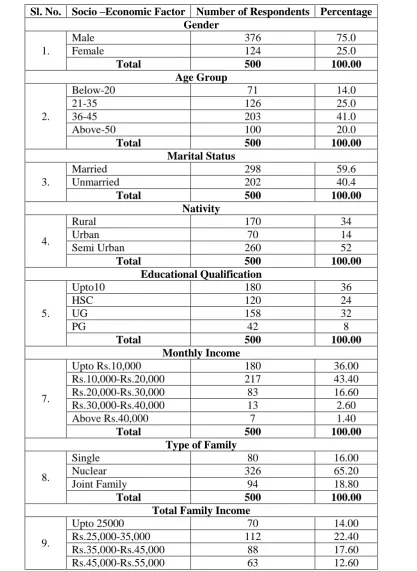
From the above table it is clearly stated that 75.2% of the respondents are male and
25.8% of the respondents are female.
From the above table, it is clearly stated that 14% of the respondents are below the age group of 20, 25.0 % of the respondents are between 21-35 years of age, 41.0% of the respondents are between the age group of 36-45, 20.0% of the respondents are above the age group of 50. the result inferred that majority 41.0% of the respondents are between 36-45 years of age.
From the above table, it is clearly stated that 59.6% of the respondents are single and 40.4% of the respondents are married. The result inferred that majority 59.6% of the respondents are married.
From the above table it is clear that 34% of the respondents are from rural area, 14% of the respondents are from semi urban area and 52% of the respondents are from urban area. the result inferred that majority 52% of the respondents are from urban side.
From the above information 36% of the respondents are Upto - 10 in the level of education, 24% of the respondents are having HSC level of education, 32% of the
respondents are UG and 8% of the respondents are PG level of education. the result inferred that majority 36% of the respondents are having Upto -10 in the level of
education.
The results show that 43.40 per cent of respondents belong to the monthly salary group of Rs.10,000 – Rs.20,000, 36.00 per cent of respondents belong to the monthly salary group of Upto Rs.10,000, 16.6 per cent of respondents belong to the monthly salary group of Rs.20,000 – Rs.30,000, 2.6 per cent of respondents belong to the monthly salary group of Rs.30,000 – Rs.40,000 and 1.4 per cent of respondents belong to the monthly salary group of above Rs.40,000.
It is clear that 65.20 per cent of respondents belong to the nuclear family, 18.80 per cent of respondents belong to the joint family and rest of the 16.00 percent of respondents belong to the single category.
© Associated Asia Research Foundation (AARF)
A Monthly Double-Blind Peer Reviewed Refereed Open Access International e-Journal - Included in the International Serial Directories.
[image:7.595.105.492.84.223.2]Page | 64 TABLE 2.2
BANK IN WHICH THE RESPONDENTS HAVING ACCOUNT
S.No Bank Name Number of Respondents Percentage
1 Canara 141 28.2
2 IOB 207 41.4
3 SBI 71 14.2
4 Others 81 16.2
5 Total 500 100
Source: Primary Data
From the above table it is clearly stated that 28.2% of the respondents are having account in Canara Bank, 41.4% of the respondents are having account in IOB Bank, 14.2% of the respondents are having account in SBI Bank, and 16.2% of the respondents are having account in Other Bank. The result inferred that majority 41.4% of the respondents are having account in IOB Bank.
TABLE 2.3
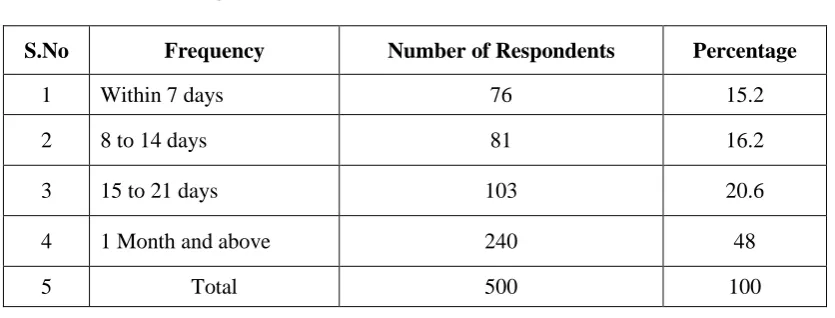
FREQUENCY TOWARDS BANKING SERVICE
S.No Frequency Number of Respondents Percentage
1 Within 7 days 76 15.2
2 8 to 14 days 81 16.2
3 15 to 21 days 103 20.6
4 1 Month and above 240 48
5 Total 500 100
Source: Primary Data
[image:7.595.90.508.381.540.2]© Associated Asia Research Foundation (AARF)
A Monthly Double-Blind Peer Reviewed Refereed Open Access International e-Journal - Included in the International Serial Directories.
Page | 65 TABLE 2.4
GENDER AND SME SERVICE PROVIDED BY BANKS
Sl. No Gender
Number of Respondents SME Service Provided By Banks Credit Facility Insurance
Policy
Money Transfer
Financial
Advisory Totals 1. Male 106 (106.03) 151 (151.15) 57 (56.40) 62 (62.42) 376 2. Female 35 (34.97) 50 (49.85) 18 (18.60) 21 (20.58) 124
Total 141 201 75 83 500
Source: Primary Data
[image:8.595.68.555.86.216.2]The chi-square statistic is 0.0376. The p-value is 0.998085. The result is not significant at p < .05.
TABLE 2.5
AGE GROUP AND LEVEL OF SATISFACTION IN SME BANKING SERVICE
Sl. No Age Group
Number of Respondents
Level of Satisfaction in SME Banking Service Credit Facility Insurance
Policy
Money Transfer
Financial
Advisory Totals 1. Below-20 39 (39.19) 22 (22.15) 5 (4.54) 5 (5.11) 71 2. 21-35 70 (69.55) 39 (39.31) 8 (8.06) 9 (9.07) 126 3. 36-45 112 (112.06) 63 (63.34) 13 (12.99) 15 (14.62) 203
4. Above-50 55 (55.20) 32 (31.20) 6 (6.40) 7 (7.20) 100
Total 276 156 32 36 500
Source: Primary Data
The chi-square statistic is 0.1203. The p-value is 1. The result is not significant at p < .05.
FINDINGS OF THE STUDY
1. Majority 75.2% of the respondents are Male.
2. Majority 41.0% of the respondents are between 36-45 years of Age.
3. Majority 59.6% of the respondents are Married.
4. Majority 52% of the respondents are from Urban side.
5. Majority 36% of the respondents are having Upto 10 in the level of education.
6. 43.40 per cent of respondents belong to the monthly salary group of Rs.10,000 – Rs.20,000.
© Associated Asia Research Foundation (AARF)
A Monthly Double-Blind Peer Reviewed Refereed Open Access International e-Journal - Included in the International Serial Directories.
Page | 66 8. 33.40 per cent of respondents have their total family income group above as Rs.55,000.
CONCLUSIONS
SME banking is the banking services of small and medium-sized enterprises, and
represents a major function of the general business finance market – in which capital for
different types of firms are supplied, acquired, and cost. Capital is supplied through the
business finance market in the form of credit facility such as bank loans and overdrafts,
leasing and hire-purchase arrangements, equity issues, venture capital and asset-based
finance. However, overall services given by SME banking is satisfied by customers still some
of the services to be improved like charges levied in the current account may be
rationalization to satisfy the customers, providing investment advices to the investors etc.,
Interest rates may bring down so that the entire customer can satisfied.
REFERENCES
Nambiar,P,C,D (1997) “Financing of Priority Sector”, SBI monthly Review, Vol.XVI(12),
December 1977, pp. 447-453.
Murthy (1980) “Financing of SSI in Rayalaseema”, in Ph.D. thesis, Sri.Venteshwara
University, Anantapur.
Agarwal, M.S (1987) “Bank Financing of Small- Scale Industries in India”, Ph.D. thesis,
Kerala University.
Jain, L, C (1990) “Assistance of Small Industry”, in the Eastern Economist, Vol.80 (12),
p.203
James Manalel (1994) “Role of Incentives in the Development of SSI Units in Kerala, in
Ph.D. thesis, Cochin University, Cochin.
Venkateswara Rao (1995) T. “Development of SSI”, Anmol Publications Private Ltd, p. 31.
Prasad (1995) “Financing Small Scale Industries: Some Recent Changes”, in the Yojana,
pp.8-10.
Nirmal , K, Gupta (1995), “Small Industry”, in the Anmol Publications, p. 56.
Sarosh Bana (2000) “India‟s Small Scale Sector”, in the Business India, No. 596, p.32.
Basheer Ahmed, (2000), “Sickness of SSI”, in Southern Economist, Vol.38 (18), p.19.
Sridhar Krishna (2001) “Impact of Small Scale Industries”, in the Economic and Political
© Associated Asia Research Foundation (AARF)
A Monthly Double-Blind Peer Reviewed Refereed Open Access International e-Journal - Included in the International Serial Directories.
Page | 67 Obamuyi, T, M (2010) “Firms Performance and Lending Constraints in Nigeria”, in The
Journal of Entrepreneurship, Vol.19 (2), pp. 179-190.
Ramachandra, K, S (2001) “Reviving Sick Units”, in the Financial Express” p. 5.
Nalsamma Antony (2002) “The Prospects and Growth of Small Scale Industries in India - An Overview”, in the Southern Economist, vol.14 (1), p. 96.
Raju, B, Y (2002) “Small Scale Industries in the Liberalized Era Beg for Attention, in the
Global Business Review, Vol. 3(2), pp. 351-367.
Jaya Sing (2003) “SSIs, Small Industries, Big Scope”, in the Kisan World, Vol. 30(6),