Citation:
Fraser, M and Orange, G and Kor, A (2009) The creation, operation and future of HE in FE partner-ships. In: HELP CETL conference: HE in FE culture and experience: a partnership perspective, 30th - 31st March 2009, University of Warwick.
Link to Leeds Beckett Repository record: http://eprints.leedsbeckett.ac.uk/738/
Document Version:
Conference or Workshop Item
The aim of the Leeds Beckett Repository is to provide open access to our research, as required by funder policies and permitted by publishers and copyright law.
The Leeds Beckett repository holds a wide range of publications, each of which has been checked for copyright and the relevant embargo period has been applied by the Research Services team.
We operate on a standard take-down policy. If you are the author or publisher of an output and you would like it removed from the repository, please contact us and we will investigate on a case-by-case basis.
The creation, operation and future of HE in FE partnerships
Michelle Fraser, Graham Orange, Ah-Lian Kor [Innovation North Faculty of Information and Technology, Leeds Metropolitan University] & Mark Stone [Higher Education Learning Partnerships Centre for
Excellence in Teaching and Learning, University of Plymouth Colleges]
Introduction
The 20 year vision outlined in the Dearing Report (NCIHE, 1997) was to create a learning society in the UK. In order to realise this vision, one of its recommendations was to establish active partnerships between Further Education Colleges (FECs) and Higher Education Institutions (HEIs) for the purpose of sharing expertise and resources (HEFCE, 2008). The Higher Education Funding Council for England (HEFCE) stresses that HE and FE partnerships ought to focus on the needs of local or regional communities and provision is expected to be generally dynamic, flexible, ‘short-cycle’ (two years or fewer of full-time study), and delivered in a variety of modes (e.g. within the work-place) (HEFCE, 2006a). However, such links will not only help cultivate an HE environment in the former (HEFCE, 2003b1) but also provide local access to HE for students with deprived as well as diverse backgrounds so that they will experience less of a culture gap in a local FEC than in a University (AimHigher Southwest, 2001). Thus HE in FE is not only viewed as particularly important locally-based provision, (DIUS & DCSF, 2008) but a crucial means for widening participation and meeting the expanding needs of a learning society through delivering higher level vocational skills. This provision also creates hubs for regional or local access to HE (HEFCE, 2006a). There is wide variety in the forms and nature of the English HE in FE partnerships that have developed in and helped shape this landscape.2
This paper focuses on HE in FE partnerships in England and deals with the following organisational concerns along with their inherent challenges:
1. HE in FE partnership and government programmes or initiatives 2. HE in FE partnership models
3. operation of HE in FE partnerships 4. the future of HE in FE partnerships
1. HE in FE partnerships and government programmes or initiatives
HE in FE sits centre stage within so many Government plans because it is an area of interface between the key stake holder groups and also offers a flexible and responsive environment for realising strategic plans. For example, within the White Paper entitled ‘The Future of Higher Education’ (DfES, 2003 and 2005), partnerships were prioritised and facilitated through the HEFCE Partnerships for Progression (P4P) Initiative which aimed to stimulate demand for HE (HEFCE and LSC, 2002). This initiative was rolled out under the broader AimHigher Programme (AimHigher et al, 2008; Smith, 2007) which is one of the key components of the UK Government widening participation policy and which aims to increase under represented groups’ opportunities for HE. Through this programme (2003-2011), partnerships between higher education institutions, schools, colleges, and work-based learning provides, would be built on and extended (HEFCE, 2008).
Concerning the skills and employer engagement agenda, COVEs (Centres of Vocational Excellence) have worked to deliver high quality vocational skills up to level 3 that will meet the industry needs (Smith, 2007). This work is also supported by employer-led initiatives through the National Skills Academies’ aim to shape the supply of vocational education and training at every level (NSA, 2008). Train to Gain and the Higher Level Skills Pathfinder projects (HEFCE, 2009a) also aim to engage employers and employees in higher level skills development. The Leitch Review of Skills (Leitch, 2006) set a target of 40% of the adult working age population having qualifications at level 4 and above by 2020.
1 A new version of the Good Practice Guides (HEFCE 03/15 & 16) is in print (2009). Some sections have been updated, while others have been completely rewritten as so much in the HE in FE arena has changed since 2003.
These government initiatives come thick and fast, some with short lead time and others signalled ahead of time. For example, HEFCE have indicated their intention to further recognise and support the
development of HE in FE through their stated aim to create the Centre of HE in FE Excellence (HEFCE 2006a). The aim is to further develop employer-led work-based learning programmes; strengthen partnerships between HEIs and FECs and foster regional-level collaboration and dissemination of good practice. DfES (2006) proposed that such centres of HE in FE excellence focus on the themes of
employability and widening participation. However, funds to support these centres are not yet in place and may not be within the current economic cycle.
What is clear is that those managing, delivering and supporting HE in FE need to be adept at: aligning organisational structures and practices to national agendas
responding to national initiatives and funding streams to meet local needs.
2. HE and FE Partnerships Models
Partnerships between HEIs and FECs are viewed as essential for the benefits of the learners such as providing opportunities for progression through the vocational routes, and local access to HE (DFES, 2003 & 2005). However, there is no single widely replicated model of HE in FE partnership. What follows are five possible ways in which the current diversity of practice can be categorised:
Course Type
Course Delivery
Funding, Award
Student
Networks
Course Type Model
The Course Type Model relates to the sources of funding for the HE provision3:
Prescribed - HEFCE is empowered to fund any course at an HEI but only ‘Prescribed’ HE courses in FECs (HEFCE, 2006a).
Non-prescribed - Both HEFCE and LSC can fund ‘Non-prescribed’ HE courses but the former can only fund them through an HEI (HEFCE, 2006a). Non-prescribed HE encompasses courses which lead to a range of qualifications awarded by professional bodies (HEFCE, 2003a).
HEFCE suggests that FECs focus on the development of higher level vocational skills through close employer engagement (HEFCE, 2006a).
Course Delivery Models
Rowney et al (2003) cite three types of partnerships based on course delivery patterns developed by the Regional University Partnership (RUP) at Anglia Ruskin:
1. Integrated: here the HEI determines and directs the course design, provides lecturers, module content, and assessment. Working in this way requires agreement on funding.
2. Collaborative: This involves collaboration in course design, validation and delivery. Working in this way requires agreement on funding, quality assurance, responsibility for course materials and assessment.
3. Dispersed: Courses are distributed physically within different FECs and are locally designed. The commonality that exists is the award design principles or the existing module catalogue. Shared delivery requires an agreement on costing, course regulations, module content, delivery, and assessment.
Anglia Ruskin, an indirectly funded (franchise) partnership, chose to operate three course delivery models in parallel as a response to the size, density and geographical spread of its partnership. For example, a distributed model works best where there is significant distance between partnership
colleges and between colleges and the HEI. Integrated and collaborative models are more suited to tighter clusters of colleges located close to an HEI. Furthermore, a variety of approaches may also co-exist where there is a mix of settings e.g. urban and rural localities.
Funding Model
HEFCE (2006a) has provided three types of funding relationships for HE in FE (outlined below), however in practice, colleges can have a hybrid model (HEFCE, 2003b; HEFCE, 2007) where they are directly funded by HEFCE and at the same time, have some indirectly funded provision with one or more local HEI partners.
Indirect Funding (or Franchise Partnership): 44% of HE in FE was indirectly funded through an HEI (HEFCE, 2006a). Here the HEI owns, and is responsible for, the student numbers (franchised to the FEC), students’ experience, curriculum and the quality of its provision. Such a franchise relationship is viewed by some as hierarchical. HEFCE suggested operation of these partnerships be based on the principles outlined in the code of practice for indirectly funded partnerships (HEFCE 2000)4. These partnership agreements entail strategic commitment on the part of both the College and the HEI.
Direct Funding: the FEC has a direct contract with HEFCE, owns and is responsible for the student numbers, students’ experience, fees, and provision. However, its curriculum has to be validated by an awarding body (an HEI or Edexcel) so the standards of the award is their responsibility. HEFCE is empowered by law to fund only full HE qualifications in certain subjects so colleges cannot be directly funded for modules of chunks of learning.
Consortium Funding (or Consortium Partnership): The term ‘consortium’ is used to describe ‘more or less formal groups of institutions with a common purpose’ (HEFCE, 2003a). A member (usually but not always an HEI) of the consortium manages the contract with HEFCE on behalf of the others and the nature of the partnership is within the constraints of a consortium agreement which clarifies funding procedures, student number allocation, staffing, resources, and quality issues. Student numbers are shared and can be moved among the members. However the quality of student experience is the responsibility of each member and each partner retains ownership of their HE programmes. HEFCE funding is similar to direct funding. Consortia usually have a flat structure, with a partnership of equals. Decisions pertaining to the allocation of resources lie with a consortium committee and not the individual institution. Curriculum is jointly planned and collaboratively delivered. HEFCE suggest the partnership principles be based on the code of practice for consortia (HEFCE 2000)4. There were 13 of these HEFCE-funded consortia (HEFCE, 2003b), however there now are only nine; despite HEFCE being a keen supporter of this model of working. The 2006 HEFCE consultation on Higher Education in Further Education College focused on many of the features of these consortia as examples of best practice (HEFCE 2007). Even those consortia that remain have evolved hybrid operations e.g. the University of Staffordshire has evolved non-Staffordshire University Regional Federation (SURF) niche partnerships. These partnerships employ the principles, approaches and systems developed within SURF. Therefore it is the features and operational practices of these consortia that have been most significant in informing sector wide practice e.g. in the effective handling of Higher Education Statistical Agency data returns for HE delivered in FE.
The term ‘Mixed Economy Institution’ (MEI) is linked to the type of funding and funding source and covers HE provision in FECs and FE provision in HEIs (HEFCE, 2004):
FEC
o With indirect funding from a single or multiple HE partners o With direct funding for its HE provision from HEFCE o With funding through a HEFCE-recognised consortium o With a mixture of direct and indirect funding
HEI
o With FE provision funded by LSC.
Award Model
The Award Model involves a wide range of partnership arrangements. According to HEFCE (2006a), the arrangements could be placed on a spectrum where one end is a bilateral partnership and the other a multiple collaborative one.
Bilateral partnership: this is a franchise relationship between an HEI and a FEC. The FEC is contracted to deliver a specific award or part of an award. The HEI is responsible for the design, mode of delivery, quality assurance and validation of the provision.
Multiple bilateral partnerships: where an HEI or FEC has a bilateral arrangement with multiple partners.
Multiple collaborative partnerships: while some franchises may involve multiple collaborations, these are generally consortium relationships involving a network of institutions and a wide range of programmes (normally within a region).
Long term bilateral relationships can allow a close understanding between partners to build up. Moving from a bilateral partnership to multiple partnerships allows FECs to offer a wider range of HE opportunities to new and existing students / employers. However, there are constraints to multiple partnerships HEFCE (2004); for example some FECs cannot afford the necessary infrastructure (e.g. time and human resources) to support multiple partnerships. This is especially true where FECs are required to work with diverse quality assurance practices and demands of different HEIs. Therefore the additional benefit of a taking on another HEI or HE in FE partnership relationship needs to be balanced against costs; many of which are recurring for example increased travel.
Student Model
According to Aimhigher Southwest (2001), existing partnerships have different categories of HE students in FECs:
FEC Student: the student pursues a university qualification at an FEC. The HEI assumes the responsibilities for course accreditation, assessment, and validation but is not directly responsible for its delivery.
HEI Student: the student pursues a university qualification at an FEC and the HEI is directly responsible for them as with any of their on-campus students.
However there is no one clear or consistent model in operation across HE in FE partnerships. Within University of Plymouth Colleges partnership, students of the FEC study on HEI awards. Fortunately students are less interested in structures than with the quality of their programmes and associated support structures.
Networks
FE partnerships is to manage the number of concurrent and sometimes overlapping networks they (or their members) belong to or are associated with.
Choices
The diversity of organisational model choices that HE in FE partnerships have made, have often been based on an historical situation, evolution of practice and local politics. What is called for now is a clear articulation of what models are used in what contexts, including the value and pitfalls of these choices. Only then will there be a clearer choice for new or evolving HE in FE partnerships in how they may organise themselves for what is always a changing context.
3. Operation of HE/FE partnerships
Effective Partnerships
The revised HE in FE HEFCE Good Practice Guide (2009b) emphasises that building and sustaining productive and beneficial partnerships is both time consuming and labour intensive. Outlined below is a list of the features that the Guide highlights as contributing to effective partnerships:
Pre-requisites:
clarity of purpose – a clear, shared understanding of why the partnership should exist and what it is seeking to achieve
a commitment to collaborative working at all levels, including senior management and the board or corporation
real benefits for all partners
informed awareness of the costs of working in partnership, especially in terms of time clear roles and responsibilities
clear communication structures clear financial and service agreements.
Ethos:
collaborative arrangements that recognise the equality of all partners openness and transparency
shared resources and responsibilities willingness to compromise
partners who are alert to potential areas of conflict of interest and competition.
Structure:
building on existing or prior networks
some central co-ordination for partnerships in both the college and the HEI appropriate administrative support
the involvement, in some capacity, of all categories of staff
creation of sub-groups and working parties, bringing together FE and HE staff around topics of mutual interest to build effective relationships.
Process:
focus on a limited number of key issues
initial concentration on practical issues should not result in the loss of a more strategic perspective flexibility to respond creatively to changing external circumstances is an important characteristic of
successful partnerships
Role and Contribution of HE and FE Partnership Stakeholders
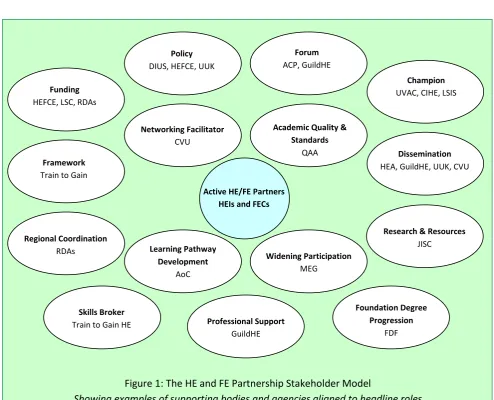
As discussed under Networks above, HEI and FEC partnerships do not operate in isolation. The model in Figure 1. shows HEI and FEC partnerships surrounded by a wide range of stakeholders. The inner core consists of HEIs and FECs that are the prime active partners while the outer ring consists of organisations, groups and initiatives designed to offer support to HE in FE. While these organisations, groups and initiatives each offer a range of support, within this model they are allocated to one of fifteen broad headline categories of support to illustrate the range and diversity of HE in FE peripheral stakeholder interest and focus.
Headline categories HE in FE peripheral stakeholder interest and focus: 5
1. policy and strategy 2. funding
3. forum
4. championing the HE and FE sector
5. facilitating networking 6. ensuring academic quality and
standards in the HE provision
7. dissemination of good practice 8. providing a framework to guide
FECs for provision of high level vocational skills
9. skill brokerage among the stakeholders
10. coordinating initiatives and programmes
11. champions in the sector 12. development of pathways 13. supporting widening
participation
14. supporting research and scholarly activity
15. providing a repository of HE in FE resources
5 A companion resource further detailing the nature of this peripheral support is available at www.help-cetl.ac.uk
Active HE/FE Partners HEIs and FECs Policy
DIUS, HEFCE, UUK
Forum
ACP, GuildHE
Funding
HEFCE, LSC, RDAs
Foundation Degree Progression
FDF
Dissemination
HEA, GuildHE, UUK, CVU
Research & Resources
JISC Widening Participation MEG Professional Support GuildHE Learning Pathway Development AoC Skills Broker
Train to Gain HE
Champion
UVAC, CIHE, LSIS
Regional Coordination
RDAs
Framework
Train to Gain
Networking Facilitator
CVU
Academic Quality & Standards
[image:7.595.66.561.299.699.2]QAA
Figure 1: The HE and FE Partnership Stakeholder Model
All of these stakeholder organisations, initiatives and fora are broadly supportive of the sector and bring the value of a wider regional, national or specialist view. However, their agenda, drivers and targets are likely to only have a partial fit with any one HE in FE partnership. Also the nature of the services provided changes over time e.g. FDF has recently withdrawn its National Validation Service. Therefore their contribution is not neutral and collaboration is not cost free, involving at the very least staff time and travel to keep abreast of the latest development and opportunities. The additional benefits these stakeholders might provide may seem a vital resource, however their involvement can be distracting to HEIs and FECs. Those managing, delivering and supporting HE in FE need to be selective and strategic in their choice of stakeholder partners and discriminating as to the extent to which their agenda overlaps with the local partnership context. It may be a sensible strategy to work with only a limited number of stakeholders at any one time.
4. Future of HE and FE Partnerships
The establishment of the Department for Innovation, Universities & Skills (DIUS) aimed to provide an integrated voice across Government for promoting effective investment in skills, breaking down barriers between universities, colleges and employers and promoting sustained engagement among them for the purpose of training, skill development and innovation (DIUS, 2007). This will inevitably effect a culture change within HE, FE and for HE/FE/Employers partnerships. Part of this vision is for more partnership working between FECs, HEIs, Sector Skills Councils, Regional Development Agencies and employers in priority regional economic sectors to design and deliver employer-employee led flexible workplace focused skills provision (DFES, 2006)6.
As has already been discussed, the HE in FE arena is far from static. To illustrate the pace, scope and breadth of the current change agenda, a number of current challenges and opportunities for HE in FE partnerships are outlined below:
The development of HE Centres through the HEFCE Strategic Development fund and the New University Challenge is changing the way some HE in FE looks and feels.
The Credit Framework7 developed by DIUS, the Burgess Group and Universities UK to create a common accreditation approach for HE in England so as to facilitate FE to HE progression (DIUS & DCSF, 2007).
The HEFCE drive for the development of HE strategies and a widening participation strategic assessment by FECs will necessitate partnerships to be ever more clear about their division of responsibility and partner expectations.
IQER is the first FEC focused QAA review method to involve the management of all HE in FE provision, however funded; but still includes an emphasis on awarding bodies and partnerships. Considering, or being successful in gaining Foundation Degree Awarding Powers, may strain or
radically change relations between colleges and their partners.
The current lack of ASNs and a general reduction in available funding may require HE in FE partnerships and their members to make some tough choices.
Partnerships are organic; dealing with any of these challenges can either strengthen or weaken partnership ties. What they will all do is add to the ever changing operating practice of HE in FE partnerships.
Concluding thoughts and future challenges
HE in FE in England plays a pivotal role in widening access to, and participation in, HE provision. In order to support this role, partnerships between HEIs and FECs have to be created, nurtured and extended so
6 Further developments of this vision are likely now that the Commission for Employment and Skills which oversees all Sector Skills Councils has superseded Skills for Business.
that there exists a strong as well as sustainable HE and FE partnership system, which not only involves the active and participating HEIs and FECs, but a very broad group of stakeholders. These stakeholders will need to provide peripheral support in terms of policy enhancement, sustainable streams of funding, etc and opportunities for continuous improvement. Senior managers involved in HE in FE need to understand the strategic implications of current policy development and be appropriately equipped with entrepreneurial, global management as well as change management skills so that the boundaries of the system could extend beyond the UK. This is in line with the Leeds Metropolitan University (2003) vision of a ‘Great North University and a World Class University’.
References
Aimhigher Southwest (2001) Aimhigher Southwest Good Practice in Student Retention. Bristol: AimHigher. Available at: http://www.aimhighersw.ac.uk/activities0002/retention.pdf [Accessed 27 February 2009].
Aimhigher, Department for Innovation, Universities and Skills, Learning and Skills Council, Higher Education Funding Council for England (2008) Guidance for Aimhigher partnerships: Updated for the 2008-2011 Programme. Bristol: HEFCE. Available at: http://www.hefce.ac.uk/pubs/hefce/2008/08_05 /08_05.doc [Accessed: 8 September 2008].
National Committee of Inquiry into Higher Education (NCIHE) (1997) Higher Education in the Learning Society Dearing - summary report (The Dearing Report). London: NCIHE.
DfES (2003) The Future of Higher Education. Norwich: The Stationery Office.
DfES (2004) Department For Education And Skills: Five Year Strategy For Children And Learners Putting People At The Heart Of Public Services. Norwich: The Stationery Office.
DfES (2005) Realising the Potential: A Review of the Future Role of Further Education Colleges. Annesley Nottinghamshire: DfES Publications.
DfES (2006) Further Education: Raising Skills, Improving Life Chances. Norwich: The Stationery Office.
DIUS (2007) World Class Skills: Implementing the Leitch Review of Skills in England. Norwich: The Stationery Office.
DUIS & Department for Children, Schools and Families (2007) Further Education: Raising Skills, Improving Life Chances, Update: July, 2007. Runcorn: DIUS and Department for Children, Schools and Families.
DIUS & Department for Children, Schools and Families (2008) Raising Expectations: Enabling the System to Deliver. Norwich: The Stationery Office.
HEFCE (2000) Higher education in further education colleges: Indirectly funded partnerships: codes of practice for franchise and consortia arrangements [00/54]. Bristol: HEFCE. Available at:
http://www.hefce.ac.uk/ pubs/hefce/2000/00_54.htm [Accessed: 30 November 2008].
HEFCE (2003a) Supporting higher education in further education colleges: A guide for tutors and lecturers (Good Practice Guide) [2003/15]. Bristol: HEFCE.
HEFCE (2003b) Supporting higher education in further education colleges: Policy, practice and prospects (Good Practice Guide Issues for Senior Managers) [2003/16]. Bristol: HEFCE.
HEFCE (2006a) Higher Education in Further Education Colleges: Consultation on HEFCE Policy. Bristol: HEFCE. Available at: http://www.hefce.ac.uk/pubs/hefce/2006/06_48/ [Accessed: 16 June 2008].
HEFCE (2006b) Lifelong Learning Networks. Bristol: HEFCE. Available at: http://www.hefce.ac.uk/widen/lln/ [Accessed: 30 November 2008].
HEFCE (2007) Higher Education in Further Education Colleges: Outcomes of the Consultation. Bristol: HEFCE. Available at: http://www.hefce.ac.uk/pubs/RDreports/2007/rd17_07/outcomes.doc [Accessed: 12 June 2008].
HEFCE (2008) HEFCE Strategic Plan 2006-11 - Updated May 2008. Bristol: HEFCE. Available at: http://www.hefce.ac.uk/pubs/hefce/2008/08_15/08_15.doc [Accessed: 12 February, 2008].
HEFCE (2009a) Higher Level Skills Pathfinders. Bristol: HEFCE. Available at:
http://www.hefce.ac.uk/econsoc/employer/path/ [Accessed: 13 February 2009].
HEFCE (2009) Supporting higher education in further education colleges: Policy, practice and prospects, Bristol, HEFCE.
HEFCE and LSC. (2002). Partnerships For Progression: Call For Strategic Plans To Release Funding. Bristol: HEFCE. Available at: http://www.hefce.ac.uk/pubs/hefce/2002/02_49/02_49.doc [Accessed: 8
September 2008].
Leeds Metropolitan University (2003) Leeds Metropolitan University: Vision and Character. Leeds Metropolitan University. Available at: http://www.leedsmet.ac.uk/the_news/docs/
visionandcharacter08.pdf [Accessed: 13 February 2009].
Leitch, S. (2006) Leitch Review of Skills, Prosperity for all in the global economy - world class skills (Final Report). Norwich: HMSO.
National Skills Academy (NSA) (2008) Introducing the National Skills Academy Network. Available at: http://www.nationalskillsacademy.co.uk/downloads/NSA_brochure.pdf [Accessed: 27 February 2009]
QAA (2004) Code of Practice for the Assurance of Academic Quality and Standards in Higher Education: Section 2: Collaborative Provision and Flexible and Distributed Learning (including e-learning). Mansfield: QAA for HE.
Rowney, S., Aves, A., Bullard, P., Fynn, P. and Graves-Morris, R. (2003) HEFCE Restructuring and Collaboration Project. City College Norwich: Research Centre. Available at:
http://www.theresearchcentre.co.uk/files/docs/publications/rs0203.pdf [Accessed: 27 February 2009].
Smith, D. (2007) Higher Level Skills and Education in North East England Regional Context Statement. Available at: