GE-International Journal of Engineering Research
Vol. 4, Issue 5, May 2016 IF- 4.721 ISSN: (2321-1717)
© Associated Asia Research Foundation (AARF) Publication
Website: www.aarf.asia Email : [email protected] , [email protected]
STUDY AND DEVELOPMENT OF AUSTEMPERED DUCTILE IRON
WITH ADDITION OF CU
Anil Kumar M M1, Theertha D P2 and Dr. Suresh R3
1. Assistant Prof., Department of Mechanical Engineering, Maharaja Institute of Technology (MIT), Mysore.
2. Junior Research Fellow, FMBTC Department, CFTRI, Mysore. 3. Professor, Department of Mechanical Engineering, SIT- Tumkur.
ABSTRACT
Materials which are used in almost every application are ferrous materials. Ductile iron is the ferrous metal which is used in railways, machine tools, machine members, etc. The researchers attracted towards this material, because it has properties of both steel and cast iron, but they found difficulties in using the ductile iron due to lack of formability. Development of Austempered Ductile Iron (ADI) is not a new process but it is challenging, since lot of parameters are involved in this process and obtaining the required property is difficult where machinability of the ADI is a critical problem. Investigations are made on the development of ADI by varying the few parameters which helps in getting the ADI with different properties and incorporate it in different applications. The attempt has been
N/mm2 and 1523.6 N/mm2 before & after heat treatment respectively. The hardness gradually increased (234 to 266 BHN) before heat treatment with addition of Cu (0.5wt%, 1wt%, 2wt%) and after heat treatment addition of 0.5wt% Cu shown better hardnes(443 BHN).
Keywords: Austempering, Austenization, Austempered Ductile Iron, Tensile Strength, Hardness.
INTRODUCTION
The increasing interest in energy saving has led to the development of lightweight materials to reduce the weight of existing materials without compromising their properties. For example, in the automotive industries, attempts have been made to replace cast iron and steel components with aluminum and austempered ductile iron. Austempered ductile iron (ADI) is a ductile iron that has undergone a special isothermal heat treatment called austempering. Unlike conventional “as-cast” irons, its properties are achieved by specific heat treatment. Therefore, the only prerequisite for good ADI is a good quality ductile iron [1].
ADI offers superior combination of properties because it can be cast, like any other member of the ductile iron family. It offers all production advantages of conventional ductile iron castings. The unique features of ADI are low cost, design flexibility, high strength to weight ratio, good toughness, wear and fatigue resistance
alloying elements that control the mechanical properties are important [5-7]. In the present work, the effect of Copper with austempering heat treatment on the mechanical properties and hardness of ductile iron were studied. Austenization time, Austempering time (60 minutes) and temperature (900°C- Austenization,
Austempering-300°C) are kept constant. Metallographic studies on DI and ADI are also conducted.
EXPERIMENT
Materials Selected: CRC scrap, Burnt Coconut shell for carbon, Ferro silicon Magnesium, Ferro silicon and pure copper (99%), engine oil as quenching medium. Equipments used: Resistance furnace, electric oven, miscellaneous equipments like quenching tube made of mild steel,
graphite crucible etc.
Experimental Procedure: Experiment was conducted in a normal foundry located in Bangalore for the preparation of ADI. Melting of scrap was done in a induction furnace. Detail steps are explained below. Material Selection: Cold rolled Coil (CRC) scrap is used as the raw material for the preparation ductile iron. Carbon is added in the form of burnt coconut shell. Magnesium and silicon is added in the form of Ferro silicon magnesium and Ferro silicon as
inoculants and graphite promoter respectively.
Melting: Melting was done in a induction furnace of capacity of 250kg and 130 kW power. After melting the melt was transferred into the ladle for alloying purpose.
a. Melted material was poured into the prepared sand mold and it is allowed for solidification.
b. The specimens for tensile test were machined from the test bar casted and then specimens were subjected to austempering heat treatment.
c. Two sets of specimens were prepared for each composition for the purpose of comparing the properties between the DI before and after heat treatment.
Heat Treatment:
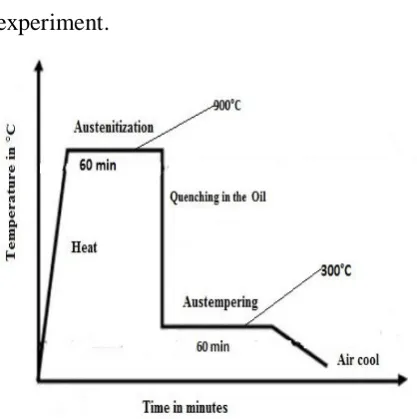
media selected for austempering was engine oil (Servo Max 4T grade). Figure 1 show the heat treatment cycle used in this experiment.
FIGURE 1. Typical Heat Treatment
Equipments used for Heat Treatment:
The following are the equipments used for heat treatment cycle:
i. Resistance furnace: for Austenization at 900°C.
ii. Electric oven: for Austempering at 300°C.
After heat treatment specimens were tested for tensile property, hardness, and microstructural study using optical microscopy.
RESULTS AND DISCUSSION
Microstructure of DI and ADI
Without heat treatment With heat treatment
0% Cu 0% Cu
0.5% Cu 0.5% Cu
2.0% Cu 2.0% Cu FIGURE 2. Microstructure of DI before
and after heattreatment
From all the groups microstructural examination specimens were prepared. The photographs taken from these specimens are given at the Figures 2. The specimens are examined both before and after the heat treatment. At the microstructural examination before the heat treatment the percent of spherodisation is controlled. To determine the success of austempering microstructures are checked after heat treatment.
The microstructure of ductile iron in as cast condition is mostly pearlitic. After different heat treatments there is a change in matrix/phase structure, number of nodules and their spheroidicity. These cause changes in the mechanical properties of ductile iron. The microstructures after different types of treatments of two different grades are shown.
Bainitic matrix structure can be seen at photographs. The amount of stabilized austenite increases with the increasing
temperature. In addition to this by the decrease of the transformation temperature a decrease at the grain size is observed. This is possibly a cause of increase in hardness values and tensile strength.
Effect of Copper on the Tensile Strength
of Ductile Iron
To find out effect of copper, four samples were made with 0.0 wt. %, 0.5 wt %, 1.0 wt. % and 2.0 wt. %. The tensile samples were machined from the castings. The samples were austenitized in a Resistance furnace at a temperature of 900°C for one hour and austempered in a Resistance oven at 300ºC for one hour. Then the tensile test was performed. The results are tabulated in Table 1.
TABLE 1. Effect of Copper on Tensile Strength of DI
Copper
Ultimate Tensile Strength ( N/mm2)
0
wt%
0.5
wt%
1.0
wt%
2.0
wt%
Without
heat
treatment
561.5 696.1 734.3 762.2
With heat
FIGURE 3. Comparision of Tensile Strength
before and after heattreatment of DI
From the Table 1 and Figure 3 it can be
shows that
addition of Cu in the Ductile Iron increases the strength of the Ductile Iron. This is because of the grain refinement takes place after the addition of Cu. When it is subjected to austempering process the presence of retained austenite matrix-ferrite matrix around the graphite nodules increases the tensile strength very high. But it is limited up to 1% of Cu, because after 1% there is decrease in the amount of retained austenite phase. But compare to Ductile Iron before heat treatment, tensile strength of ductile iron after heat treatment is very high.
TABLE 2. Effect of Copper on Hardness of Ductile Iron
Copper
Brinell Hardness Number ( BHN )
0
wt
%
0.5
wt%
1.0
wt%
2.0
wt%
Without
heat
treatment
184 234 249 266
With heat
treatment 371 443 432 400
[image:6.595.179.525.51.536.2]
CONCLUSIONS
Based on the experiment carried out and results obtained the following conclusions were made.
1. Servo engine oil used for the austempering process helps in obtaining the ADI with good strength and ductility with compare to that of salt bath quenching from previous literature.
2. The tensile strength of the DI before heat treatment was increased gradually with the addition of Cu (0.5, 1 and 2 in wt %) without decrease. Therefore the addition of Cu helps in improving the tensile strength of the material. The maximum tensile strength obtained was 762 N/mm2 at 2 wt%.
3. The tensile strength of the DI after heat treatment was increased up to the 1wt% of the Cu addition, after it tends to decrease. The austempering helps in improvement of tensile strength compare to specimens of without heat treatment. The maximum tensile strength obtained was 1523.6 N/mm2 at 1 wt%.
4. Hardness of the DI with the addition of Cu before the heat treatment was found to be increased as increase in the
composition of Cu. The maximum hardness obtained was 266 BHN at 2 wt% Cu.
5. Hardness of the DI with the addition of Cu after the heat treatment was found to be decreased as increase in the composition of Cu. The maximum hardness obtained was 443 BHN at 0.5
wt% Cu.
But the austempering process helps in the improvement of hardness than that of specimen without heat treatment.
By seeing the experimental results it can be concluded that austempering process helps in increasing the tensile property, hardness than that of without heat treatment.
REFERENCES
1. Olivera Eri. et al., (2005), “An austempering study of ductile iron alloyed with copper”, J. Serb. Chem. Soc. 70 (7), pp 1015–1022.
2. Najmeddin Arab, (2011), “Investigation to Production Machinable Austempered Ductile Iron (MADI)”, Journal of American Science, 7(9).
4. Hasan Avdusinovic and Almaida Gigović-Gekić, (2009), “Heat Treatment of Nodular Cast Iron”, “Trends in the Development of Machinery and Associated Technology” TMT, Hammamet, Tunisia, 16-21 October 2009.
5. A.A. Nofal, L. Jekova, (2009) “Novel Processing Techniques And Applications Of Austempered Ductile Iron (Review)”, Journal of the University of Chemical Technology and Metallurgy,44, 3, pp 213-228.
6. H.R. Erfanian-Naziftoosi, N. Haghdadi, and A.R. Kiani-Rashid, “The Effect of Isothermal Heat Treatment Time on the Microstructure and Properties of 2.11% Al Austempered Ductile Iron”, ASM International, DOI: 10.1007/s 11665-011-0086.
7. Anita Bisht, (June 2009) “Effect of Heat Treatment Prodedures on Microstructure And Mechanical Properties of Nodular Iron”, National Institute of Technology, Rourkela..