Development of a Gustatory Function Test
for Clinical Application in Korean Subjects
Chi Sang Hwang
1*, Jin Won Kim
1*, Salma Saud Al Sharhan
2, Jin Woong Kim
2,
Hyung-Ju Cho
1,3,4, Joo-Heon Yoon
1,3,4, and Chang-Hoon Kim
1,3,4,51Department of Otorhinolaryngology, Yonsei University College of Medicine, Seoul, Korea;
2Department of Otorhinolaryngology, Imam Abdulrahman Bin Faisal University and King Fahd Hospital, Al-Khobar, Saudi Arabia; 3The Airway Mucus Institute, Yonsei University College of Medicine, Seoul;
4Korea Mouse Sensory Phenotyping Center, Seoul;
5Medical Research Center, Yonsei University College of Medicine, Seoul, Korea.
Purpose: To obtain validated clinical values suitable for developing a gustatory function test, including umami taste, in a Korean population.
Materials and Methods: The investigation involved 297 participants with self-reported normal sense of taste and smell. Liquid solutions were used for the assessment of gustatory function. The test consisted of 30 taste solutions [six concentrations of five tastants (sweet, bitter, salty, sour, and umami)]. For evaluation of overall gustatory function, the number of detected or correctly recognized taste thresholds was combined to form a “taste score.”
Results: Mean values of each detection and recognition threshold for the five tastes in men were consistently lower than those of women. The 10th percentile of taste score for recognition was used as the cut-off value for distinguishing normogeusia from hy-pogeusia. In subgroup analysis, total taste score from recognition thresholds revealed a significant negative correlation with age, indicating lower scores for increasing age. Taste score for non-smokers was significantly higher than that of smokers, in terms of detection and recognition of taste sensitivities.
Conclusion: This gustatory function test was easy to perform, affordable, and time-saving, with the capacity to self-produce and obtain reliable data. Gustatory function was more sensitive in young people, women, and non-smokers.
Key Words: Taste, gustation, validated clinical value, umami
INTRODUCTION
Gustatory system mediates in sense of taste human. It is a fun-damental sensory system that is essential for various factors such as nutrition and food selection, pleasurable and sensual
aspect of food, efficiency of metabolism, and even a good quality of life. In Japan, approximately 240000 people visit health professionals annually to evaluate their changes in taste.1 As elderly people account for the fastest growing
seg-ment of the population, a significant number of them will en-counter age-related sensory disorders.2 In addition, since
sen-sory deterioration is known as an early marker in neurodege-nerative diseases,3,4 evaluation of gustatory function can be an
ef-fective part of early diagnostic strategy for the older age group. Although a significant number of olfactory function tests have been described, only a few valid gustatory function tests have been published.5-7 So far, no clinical protocol for testing
gustatory function has been validated or adapted for a Korean population. The insights of aging, underlying diseases, and drugs on olfactory function are relatively well understood; how-ever, there has been no similar understanding in the field of taste.
Received: August 1, 2017 Revised: November 15, 2017
Accepted: December 15, 2017
Corresponding author: Prof. Chang-Hoon Kim, Department of Otorhinolaryngol-ogy, Yonsei University College of Medicine, 50-1 Yonsei-ro, Seodaemun-gu, Seoul 03722, Korea.
Tel: 82-2-2228-3627, Fax: 82-2-393-0580, E-mail: [email protected] *Chi Sang Hwang and Jin Won Kim contributed equally to this work.
•The authors have no financial conflicts of interest.
© Copyright: Yonsei University College of Medicine 2018
This is an Open Access article distributed under the terms of the Creative Com-mons Attribution Non-Commercial License (http://creativecomCom-mons.org/licenses/ by-nc/4.0) which permits unrestricted non-commercial use, distribution, and repro-duction in any medium, provided the original work is properly cited.
pISSN: 0513-5796 · eISSN: 1976-2437
Umami, one of the five basic tastes, is considered to be on a different molecular basis compared to the other tastes: sweet, bitter, salty, and sour.8,9 Umami taste was first described a
cen-tury ago by Ikeda,10 and is commonly added to some foods in
the form of monosodium glutamate. Previous studies have shown significantly positive correlation between umami taste function and physical health condition, especially in elderly people.11 However, a reliable taste test of umami for Koreans has
not yet been established. Therefore, we do not have detailed information about the taste of umami.
In most patients, self-reported gustatory function is not reli-ably correlated with psychophysical test results.12 Evaluation
of patients with taste complaints is difficult without standard-ized quantitative methods of assessment. We, therefore, aimed to provide validated clinical scales, including those for umami taste, to develop and standardize methods and protocols for measuring the sense of taste in a Korean population, as well as to understand the impact of gustatory function and dysfunc-tion on public health. Furthermore, we developed the test to identify modifiable risk factors and develop treatment strate-gies for clinically significant dysfunction.
MATERIALS AND METHODS
Subjects
Participants were selected upon reviewing the medical re-cords of patients who had undergone septoplasty and/or rhi-noplasty at Severance Hospital in Seoul, Korea, from January to August 2016. This study was approved by the Institutional Review Board (No. 4-2016-0706) of Yonsei University College of Medicine in Seoul, Korea. Informed consent was obtained from all participants. From 2015 onwards, patients who un-derwent planned nasal surgery at our institution were routinely examined by taste and smell tests (Korean Version of Sniffin’ Stick, KVSS II13) preoperatively.
Eligibility criteria for this study were patient aged between 8 and 90 years, with normal self-rated taste and smell functions, and within the normal range of KVSS II. Patients with inflam-mation of the middle ear and paranasal sinuses, head and neck malignancies, history of previous middle ear and/or nasal sur-gery, as well as those taking drugs that might significantly af-fect the taste sensitivity14 were excluded from the study.
Finally, 297 patients (190 males and 107 females, mean age 44.96±19.73 years; age range 9–89 years) who had undergone evaluation at our institution were enrolled in this study. Sub-jects were instructed to refrain from drinking, eating, or brush-ing their teeth for at least one hour before the test.
Preparation of taste solutions
For assessment of gustatory function, liquid solutions were used. The test consisted of 30 taste solutions [six concentrations of five tastants; sweet (sucrose), bitter (quinine hydrochlo-ride), salty (sodium chlohydrochlo-ride), sour (citric acid), and umami (monosodium glutamate)]. Solution with the highest concen-tration of each tastant was scored 1, and solution with the low-est was scored 6 (Table 1). Distilled water was used as the sol-vent. Successive stimuli concentrations were based on previous reports and a repetitive preliminary experiment for finding the appropriate range.15-17 All solutions were administered from
30-mL medicine droppers of similar shape and color. Due to the light sensitivity of quinine hydrochloride, sample droppers were protected from light. Taste solutions were replaced every two months.
Determination of taste detection threshold
The test was performed by filling in a questionnaire, and then measuring taste detection and taste recognition threshold in each patient. After the mouth was rinsed with tap water, one of the tastant solutions was administered as single drop (ap-proximately 40 μL) and placed on the middle part of the ante-rior one-third of the tongue. Between the drops, patients were educated to rinse their mouths with tap water. Administration of taste solution was performed in random order of tastants, starting with the lowest concentration until the respective tas-tant was detected twice in a row. We then re-examined con-centrations that were one level lower and higher, in order to confirm the exact threshold level. Detection threshold was defined as the lowest concentration of test solution that can be consistently perceived by patients as any taste, while deter-mining the recognition threshold required to discriminate each taste. If patients did not perceive concentration score of 1, they received a score of 0.
Determination of taste recognition threshold
[image:2.595.43.540.637.717.2]Taste recognition threshold was determined according to the
Table 1. Concentrations of Taste Stimuli Used in g/mL (Solvent: Distilled Water), Separately for the Five Tastants: Sweet, Bitter, Salty, Sour, and Umami
Taste Material/Score 6 5 4 3 2 1*
Sweet Sucrose 0.0048 0.0097 0.0195 0.039 0.0781 0.1563 Bitter Quinine 0.00005 0.0001 0.0002 0.0004 0.0008 0.0016 Salty Sodium chloride 0.0006 0.0012 0.0024 0.0048 0.0096 0.0192 Sour Citric acid 0.0002425 0.000485 0.00097 0.00195 0.00391 0.00781 Umami Monosodium glutamate 0.002 0.004 0.008 0.016 0.032 0.064 6, lower concentration; 1, higher concentration.
same method used to determine taste detection threshold. However, the patients were asked to choose one of the six ver-bal descriptors to describe what kind of taste was contained in the tastant solution (“sweet,” “bitter,” “salty,” “sour,” “umami,” or “no taste”). Ultimately, we obtained the overall gustatory func-tion using the number of detected and correctly recognized taste thresholds, which were summed up as the ‘taste score’ of each detection and recognition, with a range of 0–30. The com-plete taste test for the five tastants required approximately 20 min.
Test reliability
To calculate the test-retest reproducibility, taste test was repeat-ed in 33 healthy subjects (24 men and 9 women, mean age of 34.12±11.54 years with range of 20−63 years) at two different time points (with approximately 2-week interval).
Statistical analyses
SPSS 20.0 (IBM Corp., Armonk, NY, USA) was used for statisti-cal analyses. Descriptive statistics are expressed as mean± standard error of the mean. Statistical significance of the dif-ferences between subgroup scores was assessed using Stu-dent’s t-test or analysis of variance where appropriate. Pear-son statistic was used for correlational analysis. Reproducibility and internal consistency were assessed by intraclass correla-tion coefficient and Cronbach’s alpha coefficient. Alpha level was set at 0.05.
RESULTS
Normative values are listed in Tables 2 and 3. Mean values of
each detection and recognition threshold for the five tastes in men were consistently lower than in women, while only bitter (p<0.001) and sour (p=0.03) detection threshold and bitter (p<0.001) recognition threshold in men were significantly higher than those in women. Based on the definition of hy-posmia in previous studies that used a standardized meth-od,18,19 taste score at the 10th percentile recognition threshold
was used to differentiate normogeusia and hypogeusia. In our study, therefore, subjects with recognition taste scores <12 were regarded as hypogeusia (Table 4).
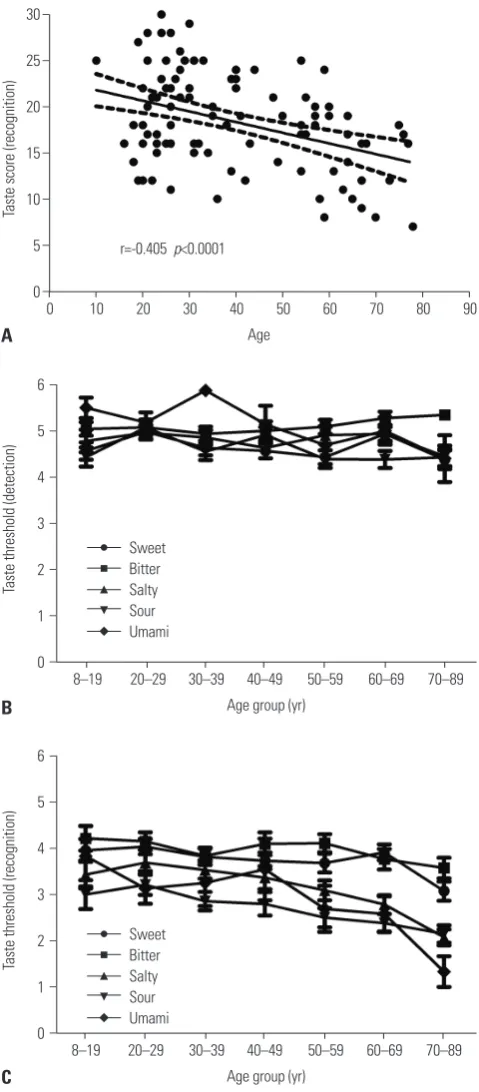
In subgroup analysis, total taste scores from recognition threshold revealed significant negative correlation with age, indicating lower scores for increasing age (r=-0.405, p<0.001) (Fig. 1A). However, the effect of age was not seen on the taste score from detection threshold. In regards to each of the five tastant groups investigated, none demonstrated a statistically significant relationship with age in detection thresholds (Fig. 1B). Interestingly, as shown in Fig. 1C, comparison of recogni-tion threshold obtained for each age group (8−19 years of age, n=23; 20−29 years of age, n=64; 30−39 years of age, n=49; 40−49 years of age, n=30; 50−59 years of age, n=44; 60−69 years of age, n=47; 70−89 years of age, n=40) revealed significant dif-ferences with scores being lower with increased age (p<0.05).
[image:3.595.57.556.483.550.2]Furthermore, the difference in taste function between smoking (n=48, mean age of 45.02±19.02 years, and range 19 to 81 years) and non-smoking (n=235, mean age of 46.67±19.89 years, and range 19 to 89 years) groups was analyzed. Average taste score for non-smokers was significantly higher than for smokers in the detection and recognition taste sensitivity (de-tection taste sensitivity: 26.16±3.54 vs. 22.58±4.19, p=0.002; recognition taste sensitivity: 19.46±4.57 vs. 11.33±2.54, p<0.001).
Table 2. Taste Detection Threshold in 297 Korean Individuals
Sweet Bitter Salty Sour Umami Taste Score
Male (n=190) 4.62±1.10 4.96±1.09 4.77±1.20 4.51±1.19 5.16±1.28 25.28±4.10 Female (n=107) 4.83±1.00 5.43±0.74 4.93±1.26 4.82±1.10 5.32±0.99 26.50±3.07
p value 0.09 <0.001 0.26 0.03 0.51 0.09
[image:3.595.55.564.572.638.2]Total (n=297) 4.69±1.07 5.13±1.00 4.83±1.22 4.62±1.17 5.22±1.17 25.74±3.78
Table 3. Taste Recognition Threshold in 297 Korean Individuals
Sweet Bitter Salty Sour Umami Taste Score
Male (n=190) 3.77±1.28 3.73±1.41 3.16±1.41 2.65±1.44 2.94±1.87 18.36±5.12 Female (n=107) 3.82±1.28 4.47±1.15 3.21±1.48 2.93±1.46 3.13±1.95 18.74±5.12
p value 0.72 <0.001 0.77 0.11 0.62 0.72
Total (n=297) 3.79±1.26 3.99±1.37 3.18±1.43 2.75±1.45 3.01±1.89 18.50±5.10
Table 4. Normative Taste Score from Recognition Threshold Using Solution-Based Gustatory Function Test
Percentile Sweet Bitter Salty Sour Umami Taste score*
10th 2.0 2.0 1.0 1.3 1.5 12.0†
25th 3.0 3.0 2.0 1.0 1.0 16.0
50th 4.0 4.0 3.0 3.5 3.0 18.0
90th 5.5 5.0 5.0 5.0 6.0 25.0
[image:3.595.55.556.664.727.2]In the patient study, patients with current and past smoking habits were significantly more likely to be male (44 men and 4 women with current/past smoking habits vs. 137 men and 98 women without such a history, χ2 test, p<0.001). However,
al-30
25
20
15
10
5
0
6
5
4
3
2
1
0
6
5
4
3
2
1
0 −
−
−
−
−
−
−
−
−
−
−
−
−
−
−
−
−
−
−
−
−
Taste score (recognition)
Taste threshold (detection)
Taste threshold (recognition)
0 10 20 30 40 50 60 70
8–19 20–29 30–39 40–49 50–59 60–69 70–89
8–19 20–29 30–39 40–49 50–59 60–69 70–89
80 90
Age
Age group (yr)
Age group (yr)
A
B
C
[image:4.595.42.282.140.687.2]r=-0.405 p<0.0001
Fig. 1. (A) Linear regression analysis between recognition taste score and age of subjects. The lines indicate the mean with 95% confidence interval. (B) Comparison for detection threshold obtained for each age group. (C) Comparison for recognition threshold obtained for each age group.
Sweet Bitter Salty Sour Umami
Sweet Bitter Salty Sour Umami
cohol consumption, denture use, serologic tests, body mass index, and baseline blood pressure revealed no relationship with all taste sensitivities.
The present study showed relatively high reliability, and in-traclass correlation coefficients between test and retest were 0.61 (0.31−0.80, p<0.001) and Cronbach’s alpha was 0.79.
DISCUSSION
Any disturbance in taste function can hamper the quality of life by affecting their appetite, body weight, and psychological well-being.20 Taste disorders have been diagnosed by different
modalities of gustatory function tests, and there is no consen-sus for diagnosis or treatment strategies. Although heteroge-neous gustatory function tests have been developed over the past few decades, they mainly applied four basic tastes (sweet, bitter, salty, and sour), and not umami. These methods include whole-mouth method,21 filter paper disk method,6,22
three-stimulus drop technique,23 and taste strip method.7,24,25 Filter
paper disk or taste strip methods use filter paper disk or taste strips that are impregnated with a known concentration of each taste quality. Filter paper disk or taste strip is placed on a spe-cific part of the tongue or palate of the participant, and thresh-old of distinct area that is innervated by specific taste nerve can be measured. However, filter paper disk and taste strip methods may either lead to inaccurate assessment or cause subjective discomfort, especially for elderly patients with dry mouths.
We designed our gustatory function test as a whole-mouth method that was easy to perform, affordable, and time-saving, with the capacity to self-produce and obtain reliable data. Taste solutions are readily available at any pharmacy at very low cost, and can even be considered to enable a more physi-ological taste test by better representing real edible stimuli. Although this method is convenient and versatile to use, it cannot assess local damage in the mouth. Since test substance becomes immediately diluted in saliva, values acquired with this method might represent sensation of the oral cavity as a whole. Since the aim of this study was to provide validated clinical data for subjects’ gustatory function, regional taste test was not necessary. The taste test presented herein exhibited a good test-retest reliability of 0.79, and correlation coefficient was comparable with other extant taste tests.24,26
When comparing recognition threshold values for the five tastants to those from other studies, our concentration was much lower than those obtained by filter paper disk meth-od6,22 and taste strip method.7,24,25 Recognition threshold from
filter paper disc or taste strip method can only assess a small area; therefore, higher concentrations of each tastant should be presented in the saliva to reach the taste buds. This may be a small advantage of our study in that it offers a safer taste test.
in all tastes, whereas its recognition score was lower compared to sweet, bitter, and salty tastes (Tables 2 and 3). For each age group investigated, umami taste seemed to follow a similar pattern in subjects under age of 50 years (Fig. 1B and C). It was not surprising to observe higher total score in the retest session, as psychophysical tests usually tend to improve test results through training. Interestingly, this effect was most noticeable in the umami taste. Consequently, we can assume that uma-mi taste is unfauma-miliar to younger subjects, as it is difficult to understand the exact concept of “umami.” Nevertheless, taste function of umami could be of great interest in regards to gus-tatory dysfunction or as a possible nutrition advice.27-29
De-creased sensitivity to umami taste may induce loss of both ap-petite and weight, which can lead to poor overall health, es-pecially in older age group.22
Our present results provide validated clinical scales for rou-tine clinical screening test of the gustatory function. In our subjects, recognition taste score at the 10th percentile was 12. Such data can be used as cutoff value for estimating individual gustatory ability. However, the 10th percentile does not define the border between normogeusia and hypogeusia in all age groups. For example, an 80-year-old individual scoring 11 may be in the 20th percentile, thus being considered “normogeusia” relative to his age group. Nevertheless, as description of abso-lute gustatory sensitivity should be based on the performance of all age groups, the term “hypogeusia” should be applied to all subjects with recognition taste scores <12.19
Like olfactory function, taste perception becomes some-what impaired with normal aging. We noted lower score re-sults with increasing age. Interestingly, this effect was most pronounced for recognition threshold. Detection thresholds remained relatively steady with increasing age. The reason for this age-related change is not clear. Furthermore, we observed increased taste score results in nonsmokers compared to smokers, as well as in females compared to male subjects. An-atomical data were consistent with gender differences, as fe-males had more fungiform papillae and taste buds than males.30 Although the cause of such anatomical difference
re-mains uncertain, it may be related to a hormonal factor as well as other dietary habits, smoking behaviors, and alcohol con-sumption.31 Accordingly, unpredictable bias could be involved
in this study.
In light of the different eating habits among different ethnic groups that lead to differences in sensitivity of gustatory func-tion, cross-cultural validation of a taste test is justified. Ribeiro, et al.32 found that a Portuguese population demonstrated lower
taste scores than those previously observed in a German pop-ulation, while Yang, et al.33 showed that a Chinese population
did not demonstrate any variation with age or gender. The cur-rent study is the first to use a gustatory function test, including umami taste, in a Korean population, and the results may al-low improvements in diagnosis, treatment, and folal-low-up of taste disorders.
One of the limitations of this study was its investigation of gustatory function using a clinical population. For additional information, inclusion of community-based subjects would be required to reach a more meaningful conclusion.
Many clinically encountered taste disorders occur due to factors such as surgery, tumors, inflammatory diseases, trau-ma, or radiation treatment; therefore, a gustatory function test is diagnostically valuable and facilitates interpretation of taste scores in routine clinical practice. Further studies using more normative data for a gustatory function test are in pregress, and their results will be presented in the near future.
ACKNOWLEDGEMENTS
C.H. Kim received funding from Basic Science Research Pro-gram through National Research Foundation of Korea (NRF), funded by Ministry of Education (2015R1D1A1A02062228) and Bio & Medical Technology Development Program of NRF, funded by Ministry of Science, ICT & Future Planning (2016M3A9D5A01952414). C.H. Kim was also supported by NRF Grant funded by the Korean Government (MSIP) (2016R1A5A2008630), Yonsei University Future-leading Re-search Initiative of 2015 (2015-22-0114).
ORCID
Chi Sang Hwang https://orcid.org/0000-0001-7161-7276 Jin Won Kim https://orcid.org/0000-0002-0085-0326 Chang-Hoon Kim https://orcid.org/0000-0003-1238-6396
REFERENCES
1. Ikeda M, Aiba T, Ikui A, Inokuchi A, Kurono Y, Sakagami M, et al. Taste disorders: a survey of the examination methods and treat-ments used in Japan. Acta Otolaryngol 2005;125:1203-10. 2. Boesveldt S, Lindau ST, McClintock MK, Hummel T, Lundstrom
JN. Gustatory and olfactory dysfunction in older adults: a national probability study. Rhinology 2011;49:324-30.
3. Boesveldt S, Verbaan D, Knol DL, Visser M, van Rooden SM, van Hilten JJ, et al. A comparative study of odor identification and odor discrimination deficits in Parkinson’s disease. Mov Disord 2008;23:1984-90.
4. Naudin M, Mondon K, El-Hage W, Perriot E, Boudjarane M, Des-midt T, et al. Taste identification used as a potential discrimina-tive test among depression and Alzheimer’s disease in elderly: a pilot study. Psychiatry Res 2015;228:228-32.
5. Henkin RI, Schecter PJ, Friedewald WT, Demets DL, Raff M. A double blind study of the effects of zinc sulfate on taste and smell dysfunction. Am J Med Sci 1976;272:285-99.
6. Tomita H, Ikeda M, Okuda Y. Basis and practice of clinical taste examinations. Auris Nasus Larynx 1986;13 Suppl 1:S1-15. 7. Landis BN, Welge-Luessen A, Brämerson A, Bende M, Mueller
CA, Nordin S, et al. “Taste Strips” - a rapid, lateralized, gustatory bedside identification test based on impregnated filter papers. J Neurol 2009;256:242-8.
9. Chaudhari N, Landin AM, Roper SD. A metabotropic glutamate receptor variant functions as a taste receptor. Nat Neurosci 2000; 3:113-9.
10. Ikeda K. New seasonings. Chem Senses 2002;27:847-9.
11. Schiffman SS, Graham BG. Taste and smell perception affect ap-petite and immunity in the elderly. Eur J Clin Nutr 2000;54 Suppl 3:S54-63.
12. Soter A, Kim J, Jackman A, Tourbier I, Kaul A, Doty RL. Accuracy of self-report in detecting taste dysfunction. Laryngoscope 2008; 118:611-7.
13. Cho JH, Jeong YS, Lee YJ, Hong SC, Yoon JH, Kim JK. The Korean version of the Sniffin’ stick (KVSS) test and its validity in compari-son with the cross-cultural smell identification test (CC-SIT). Auris Nasus Larynx 2009;36:280-6.
14. Syed Q, Hendler KT, Koncilja K. The impact of aging and medical status on dysgeusia. Am J Med 2016;129:753.e1-6.
15. Lee JW, Son HJ, Shin SH, Rhyu MR, Kim JY, Ye MK. Differences in taste thresholds according to sex and age groups in Korean. Kore-an J Otorhinolaryngol-Head Neck Surg 2014;57:692-697.
16. Stinton N, Atif MA, Barkat N, Doty RL. Influence of smell loss on taste function. Behav Neurosci 2010;124:256-64.
17. Yamauchi Y, Endo S, Sakai F, Yoshimura I. A new whole-mouth gustatory test procedure. 1. Thresholds and principal compo-nents analysis in healthy men and women. Acta Otolaryngol Sup-pl 2002;122:39-48.
18. Doty RL, Shaman P, Dann M. Development of the University of Pennsylvania Smell Identification Test: a standardized microen-capsulated test of olfactory function. Physiol Behav 1984;32:489-502.
19. Kobal G, Klimek L, Wolfensberger M, Gudziol H, Temmel A, Owen CM, et al. Multicenter investigation of 1,036 subjects using a standardized method for the assessment of olfactory function combining tests of odor identification, odor discrimination, and olfactory thresholds. Eur Arch Otorhinolaryngol 2000;257:205-11. 20. Nagraj SK, Naresh S, Srinivas K, Renjith George P, Shrestha A,
Levenson D, et al. Interventions for the management of taste dis-turbances. Cochrane Database Syst Rev 2014 Nov 26 [Epup]. https://doi.org/10.1002/14651858.CD010470.pub2.
21. Schiffman SS, Warwick ZS. Effect of flavor enhancement of foods for the elderly on nutritional status: food intake, biochemical
indi-ces, and anthropometric measures. Physiol Behav 1993;53:395-402. 22. Satoh-Kuriwada S, Kawai M, Iikubo M, Sekine-Hayakawa Y, Shoji
N, Uneyama H, et al. Development of an umami taste sensitivity test and its clinical use. PLoS One 2014;9:e95177.
23. Gudziol H, Hummel T. Normative values for the assessment of gustatory function using liquid tastants. Acta Otolaryngol 2007; 127:658-61.
24. Mueller C, Kallert S, Renner B, Stiassny K, Temmel AF, Hummel T, et al. Quantitative assessment of gustatory function in a clinical context using impregnated “taste strips”. Rhinology 2003;41:2-6. 25. Wolf A, Illini O, Uy D, Renner B, Mueller CA. A new extension to
the Taste Strips test. Rhinology 2016;54:45-50.
26. Pingel J, Ostwald J, Pau HW, Hummel T, Just T. Normative data for a solution-based taste test. Eur Arch Otorhinolaryngol 2010;267: 1911-7.
27. Sasano T, Satoh-Kuriwada S, Shoji N, Sekine-Hayakawa Y, Kawai M, Uneyama H. Application of umami taste stimulation to remedy hypogeusia based on reflex salivation. Biol Pharm Bull 2010;33: 1791-5.
28. Mueller CA, Pintscher K, Renner B. Clinical test of gustatory func-tion including umami taste. Ann Otol Rhinol Laryngol 2011;120: 358-62.
29. Tsutsumi R, Goda M, Fujimoto C, Kanno K, Nobe M, Kitamura Y, et al. Effects of chemotherapy on gene expression of lingual taste receptors in patients with head and neck cancer. Laryngoscope 2016;126:E103-9.
30. Prutkin J, Fisher EM, Etter L, Fast K, Gardner E, Lucchina LA, et al. Genetic variation and inferences about perceived taste inten-sity in mice and men. Physiol Behav 2000;69:161-73.
31. Hong JH, Chung JW, Kim YK, Chung SC, Lee SW, Kho HS. The re-lationship between PTC taster status and taste thresholds in young adults. Oral Surg Oral Med Oral Pathol Oral Radiol Endod 2005; 99:711-5.
32. Ribeiro JC, Chaves M, Chaves C, Lemos L, Silva ED, Paiva A, et al. Cross-cultural validation of a taste test with paper strips. Eur Arch Otorhinolaryngol 2016;273:3407-11.