Retrospective Assessment of the Validity of Robotic Surgery
in Comparison to Open Surgery for Pediatric Choledochal Cyst
Na Young Kim,
1Eun Young Chang,
2Young Ju Hong,
2Simin Park,
2Ha Yan Kim,
3Sun-Joon Bai,
1and Seok Joo Han
21Department of Anesthesiology and Pain Medicine, Anesthesia and Pain Research Institute, Yonsei University College of Medicine, Seoul;
2Department of Pediatric Surgery, Severance Children’s Hospital, Department of Surgery, Yonsei University College of Medicine, Seoul;
3Biostatistics Collaboration Unit, Yonsei University College of Medicine, Seoul, Korea.
Received: May 26, 2014 Revised: July 22, 2014 Accepted: August 11, 2014
Co-corresponding authors: Dr. Seok Joo Han, Department of Pediatric Surgery,
Severance Children’s Hospital, Department of Surgery,
Yonsei University College of Medicine, 50-1 Yonsei-ro, Seodaemun-gu, Seoul 120-752, Korea.
Tel: 82-2-2228-2130, Fax: 82-2-2227-7897 E-mail: [email protected] and
Dr. Sun-Joon Bai,
Department of Anesthesiology and Pain Medicine, Anesthesia and Pain Research Institute,
Yonsei University College of Medicine, 50-1 Yonsei-ro, Seodaemun-gu, Seoul 120-752, Korea.
Tel: 82-2-2228-4438, Fax: 82-2-2227-7897 E-mail: [email protected]
∙ The authors have no financial conflicts of interest.
© Copyright:
Yonsei University College of Medicine 2015
This is an Open Access article distributed under the terms of the Creative Commons Attribution Non-Commercial License (http://creativecommons.org/ licenses/by-nc/3.0) which permits unrestricted non-commercial use, distribution, and reproduction in any medium, provided the original work is properly cited.
Purpose: We evaluated the validity of robotic surgery (RS) for pediatric
chole-dochal cyst (CC) in comparison to open surgery (OS). Materials and Methods:
From January 2009 to April 2013, clinical data from 79 consecutive pediatric pa-tients with CC, who underwent RS (n=36) or OS (n=43) performed by a single pe-diatric surgeon, were analyzed retrospectively. Results: In the RS group, the age of the patients was significantly older, compared to the OS group. Operation and an-esthesia times were significantly longer in the RS group than the OS group. Fluid input rates to maintain the same urine output were significantly smaller in the RS group than the OS group. The American Society of Anesthesiologists (ASA) physi-cal status, length of postoperative hospital stay, and the incidence of surgiphysi-cal com-plications did not differ significantly between the two groups. Conclusion: Al-though early complications could not be avoided during the development of robotic surgical techniques, RS for pediatric CC showed results comparable to those for OS. We believe that RS may be a valid and alternative surgery for pediatric CC. After further development of robotic surgical systems and advancement of surgical techniques therewith, future prospective studies may reveal more positive results.
Key Words: Choledochal cyst, robotic surgery, children
INTRODUCTION
Choledochal cyst (CC) is a congenital condition that develops when cystic dilation occurs in all or a portion of the bile ducts. Although CC is an unusual disease in Western countries, it has a relatively high prevalence in East Asian countries, such as Korea, China, and Japan.1 Usually, it is diagnosed in the first few years of life,
although it can be discovered early during the antenatal period using prenatal so-nography or late during childhood or early adulthood. Approximately two-thirds of patients with this condition are found at a pediatric age. CC has a high likeli-hood of progressing to hepatobiliary malignancies, and therefore, prompt diagno-sis and treatment are essential.2
time to starting a liquid diet, length of postoperative hospi-tal stay, and postoperative complications. Postoperative hospital stay was defined as the duration between the day of the operation and the patient’s hospital discharge. We re-corded complications into two categories: immediate com-plications were defined as comcom-plications that developed during hospital stay; 30-day complications were defined as complications within 30 days after discharge.7,8
Postoperative pain was measured using the Faces, Legs, Activity, Cry, and Consolability (FLACC) Behavior Pain As-sessment Tool designed for infants and a verbal numerical rating scale for pain (vNRS, 0=no pain and 10=worst pain imaginable) for children every 6 hours for 36 hours post-op-eratively by randomized nurses from the admission unit.9
Operative procedures
Open surgery (OS)
After endotracheal intubation under general anesthesia, an ar-terial catheter and a peripheral intravenous catheter were addi-tionally established. A right extended subcostal incision was made with or without operative cholangiography. Complete excision of the CC with the creation of a retrocolic Roux-en-Y hepaticojejunostomy was performed in the usual manner.
Robotic surgery (RS)
After endotracheal intubation, an arterial catheter and a cen-tral venous catheter were inserted. A supraumbilical semicir-cular incision was made for insertion of a 12-mm camera port, and carbon dioxide pneumoperitoneum was estab-lished with a pressure of <12 mm Hg. Thereafter, 8-mm ro-botic working ports were placed in three different areas, in-cluding the left upper quadrant, right upper quadrant, and right lower quadrant. Additionally, in the left lower quad-rant, a 12-mm laparoscopic assist port was positioned. The RS procedures for pediatric CC consist of two stages (pre-docking and (pre-docking stage). In the pre-(pre-docking stage, after identifying the jejunum by the laparoscopic method, extra-corporeal jejunojejunostomy was performed and a remod-eled jejunum was placed back into the peritoneal space. Af-ter the robotic surgical system was docked, the CC was completely excised and intracorporeal Roux-en-Y hepatico-jejunostomy was performed. The RS procedures for pediat-ric CC have been described in detail in a previous report.6
Postoperative progress
Under evidence of return of bowl motility, an oral diet was current optimal treatment is considered to involve complete
excision of the cyst with reliable biliary reconstruction.3
Generally, open surgery (OS) for CC requires a wide inci-sion and leaves a visible abdominal scar, which may be a concern, particularly in women: CC is reportedly more
common in women than in men (female:male 4:1 to 3:1).3
Recently, a few articles regarding robotic surgery (RS) for CC have been published.4-6 However, there still is a lack of
data comparing OS with RS for this condition with which to justify performing RS for the pediatric CC. Therefore, we aimed to evaluate the perioperative outcomes of RS in pediatric CC in comparison to those for OS.
MATERIALS AND METHODS
Study population
The study was approved by the Institutional Review Board of Yonsei University Medical Center (4-2013-0596). We re-viewed the perioperative medical records from 79 consecu-tive pediatric CC patients who underwent RS (n=36) using the da VinciTM Robot System (Intuitive Surgical, Inc.,
Moun-tain View, CA, USA) or OS (n=43) performed by one pedi-atric surgeon from January 2009 to April 2013 at Yonsei University Medical Center in Korea. During this period, all consecutive patients were included, except for patients who received another concurrent surgical procedure. Parents or guardians were permitted to make the final decision regard-ing the operative method to be used on their children, after they received detailed information on RS and OS for CC, including previous surgical data, and an explanation of the advantages and disadvantages of each approach.
Data collection
Although the data were collected retrospectively from elec-tronic medical records, all variables were prospectively evaluated. Preoperative variables included the demograph-ics of the patient, such as age, sex, weight, height, and body mass index (BMI). Intraoperative variables included opera-tion time, anesthesia time, intraoperative fluid management, urine output, blood loss, and erythrocyte transfusion. The operation time was defined as the duration between the first skin incision and the end of the operation. Anesthesia time was defined as the duration from the moment the patient entered the operating room until the patient was transferred from the post-anesthesia care unit.
tained from elective medical records. One patient in the OS group who underwent combined urology surgery was ex-cluded. Finally, 36 patients who underwent RS and 42 pa-tients who underwent OS were examined, and their data were analyzed.
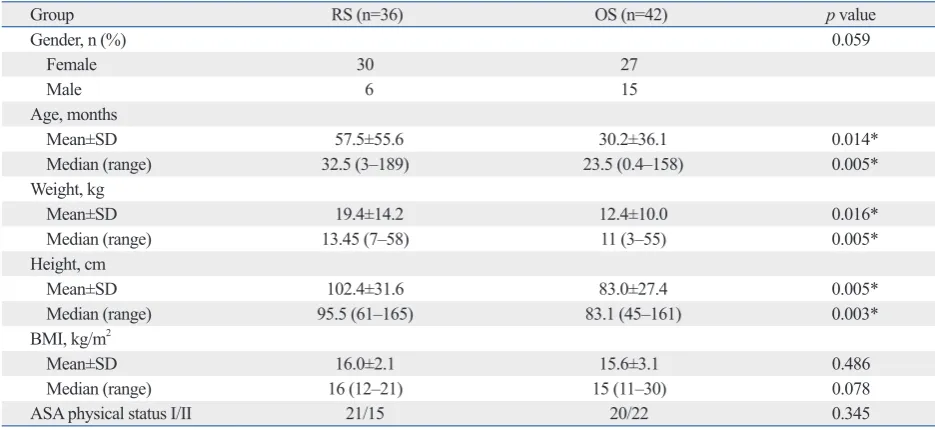
Patient characteristics are presented in Table 1. The age of the patients at the time of operation was significantly older in the RS group, compared to the OS group (p<0.05). Also, the weight and height of patients were greater in the RS group than those in the OS group (p<0.05). No significant difference in BMI and American Society of Anesthesiolo-gists (ASA) physical status was noted between two groups.
Intraoperative data are summarized in Table 2. The opera-tion and anesthesia times were significantly longer in the RS group than the OS group (p<0.001). The mean total operat-ing time and the mean console time in the RS group were 520 (range 400‒865) and 300 (range 185‒475) minutes, re-spectively. Total amounts of intraoperative fluid input were significantly larger in the RS group than the OS group. However, urine output rates were similar for both groups (0.03±0.02 mL-1kg-1hour in RS group, 0.03±0.03 mL-1kg-1
hour in OS group, p=0.177), while fluid input rates were significantly less in the RS group than the OS group (0.17± 0.05 mL-1kg-1hour in RS group, 0.2±0.05 mL-1kg-1hour in
OS group, p=0.004). The amount of intraoperative bleeding and the number of the patients who required red blood cell transfusion were higher in the RS group than in the OS started on the third day after operation in both groups. If the
patient did not have evidence of bowel motility until the third day, the oral diet was usually delayed. Water was given first, followed by a liquid and a soft diet. Patient discharge was considered after all diets could be consumed without any discomfort, abdominal pain, or other complications.
Statistical analyses
Statistical analysis was performed by using IBM SPSS Sta-tistics software, version 19.0 (SPSS Inc., Chicago, IL, USA) and R version 3.0.1. Patient characteristics (age, weight, height, and BMI), intraoperative patient data, length of post-operative hospital stay, and postpost-operative duration in the in-tensive care unit were analyzed using Student’s t-test. Inter-group differences in the time to taking sips of water, time to starting a clear liquid diet, and complications were com-pared by using the Mann-Whitney U test. Postoperative pain scores were presented using box plots. Continuous variables are presented as a mean±SD or median (range), and categori-cal variables are expressed as numbers (percentages). Statis-tical significance was defined as a p value of <0.05.
RESULTS
Data from 79 consecutive patients who underwent RS (n=36) or OS (n=43) from January 2009 to April 2013 were
ob-Table 1. Patient Characteristics According to Surgical Approach
Group RS (n=36) OS (n=42) p value
Gender, n (%) 0.059
Female 30 27
Male 6 15
Age, months
Mean±SD 57.5±55.6 30.2±36.1 0.014*
Median (range) 32.5 (3‒189) 23.5 (0.4‒158) 0.005*
Weight, kg
Mean±SD 19.4±14.2 12.4±10.0 0.016*
Median (range) 13.45 (7‒58) 11 (3‒55) 0.005*
Height, cm
Mean±SD 102.4±31.6 83.0±27.4 0.005*
Median (range) 95.5 (61‒165) 83.1 (45‒161) 0.003*
BMI, kg/m2
Mean±SD 16.0±2.1 15.6±3.1 0.486
Median (range) 16 (12‒21) 15 (11‒30) 0.078
ASA physical status I/II 21/15 20/22 0.345
RS, robotic surgery for pediatric choledochal cyst; OS, open surgery for pediatric choledochal cyst; BMI, body mass index; ASA, American Society of Anes-thesiologists.
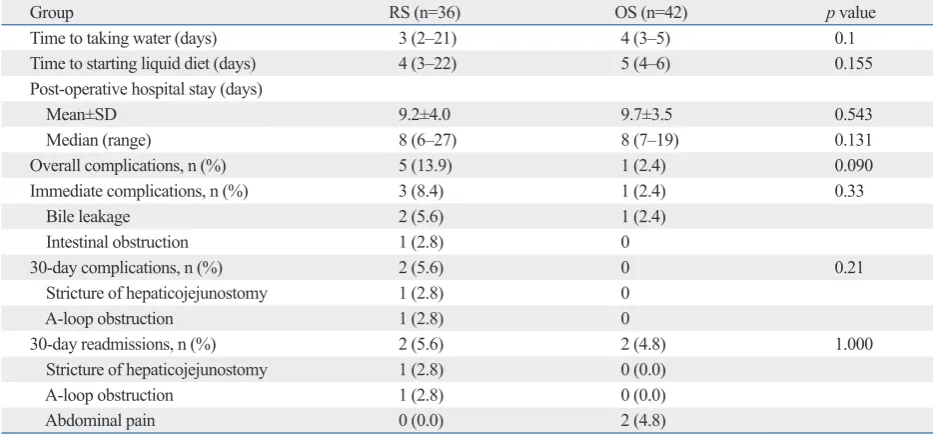
[image:3.595.70.538.473.688.2]similar between the two groups. The number of complica-tions was higher in the RS group (n=5) than the OS group (n=1) without significant difference. There were three im-mediate complications in the RS group, consisting of two group without any statistical difference.
[image:4.595.56.527.150.430.2]Postoperative outcomes and complications are shown in Table 3. The time to taking water, time to starting liquid diet, and the average length of postoperative hospital stay were
Table 2. Intraoperative Outcomes According to Surgical Approach
Group RS (n=36) OS (n=42) p value
Operation time (min)
Mean±SD 520±97 327±73 <0.001*
Median (range) 493 (400‒865) 313 (195‒516) <0.001*
Anesthesia time (min)
Mean±SD 578±76 383±80 <0.001*
Median (range) 563 (475‒805) 360 (225‒580) <0.001*
Console time (min)
Mean±SD 300±81
Median (range) 288 (185‒475)
Total fluid input (mL)
Mean±SD 1553±751 983±563 <0.001*
Median (range) 1235 (460‒3750) 665 (192‒3300) <0.001*
Fluid input rate (mL/kg/hr) 0.17±0.05 0.2±0.05 0.004*
Total Urine output (mL)
Mean±SD 246±154 159±171 0.023*
Median (range) 224 (42‒600) 114 (12‒765) 0.001*
Urine output rate (mL/kg/hr) 0.03±0.02 0.03±0.03 0.177
Intraoperative bleeding (mL)
Mean±SD 79±183 33±52 0.153
Median (range) 30 (0‒930) 17.5 (0‒300) 0.145
Transfusion rate, n (%) 2 (5.6) 0 (0)
RS, robotic surgery for pediatric choledochal cyst; OS, open surgery for pediatric choledochal cyst. Data are presented as means±standard deviation or numbers.
[image:4.595.56.523.492.710.2]*p<0.05.
Table 3. Postoperative Outcomes and Complications According to Surgical Approach
Group RS (n=36) OS (n=42) p value
Time to taking water (days) 3 (2‒21) 4 (3‒5) 0.1
Time to starting liquid diet (days) 4 (3‒22) 5 (4‒6) 0.155
Post-operative hospital stay (days)
Mean±SD 9.2±4.0 9.7±3.5 0.543
Median (range) 8 (6‒27) 8 (7‒19) 0.131
Overall complications, n (%) 5 (13.9) 1 (2.4) 0.090
Immediate complications, n (%) 3 (8.4) 1 (2.4) 0.33
Bile leakage 2 (5.6) 1 (2.4)
Intestinal obstruction 1 (2.8) 0
30-day complications, n (%) 2 (5.6) 0 0.21
Stricture of hepaticojejunostomy 1 (2.8) 0
A-loop obstruction 1 (2.8) 0
30-day readmissions, n (%) 2 (5.6) 2 (4.8) 1.000
Stricture of hepaticojejunostomy 1 (2.8) 0 (0.0)
A-loop obstruction 1 (2.8) 0 (0.0)
Abdominal pain 0 (0.0) 2 (4.8)
2009, RS for pediatric CC was able to be performed with-out any open conversions. All the cases included in the present study were performed after the completion of this training course.
In the present study, patients in the RS group were signif-icantly older than those in the OS group. We believe that this is the result of our strategy of not recommending RS in small patients with CC, because currently bulky robotic surgical systems and evolving techniques for CC would limit the application of RS in very young patients because of their small size. However, we believe that technical re-finement and further miniaturization of robotic systems in the future would reduce the limiting effect of patient size in pediatric CC surgery. In the current study, the ASA physical statuses of the two groups were the same. We think that this reflects the fact that RS has been applied regardless of the patient’s medical condition: we performed RS successfully regardless of whether the patient had bile peritonitis sec-ondary to the rupture of the choledochal cyst and cholangi-tis. Our only exclusion criterion for RS in pediatric CC was only the body size of the patient.
The duration of surgery was longer in the RS group than in the OS group, and the mean total operation time (520±97 min) for RS group appeared to be longer than that pub-lished in the literature. However, the robotic console time was 300±81 [range 288 (185‒475)] minutes and this was comparable to that reported in other studies.6,13 This
differ-ence may reflect a longer surgical duration in our early cas-es; this has gradually shortened with increasing experience. Another reason for the longer operation times in the RS minor bile leakages and one immediate postoperative
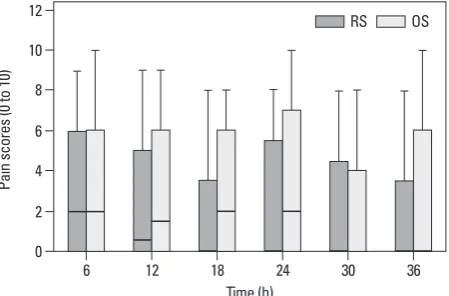
intes-tinal obstruction. In the OS group, there was one immediate complication of minor bile leakage. There were two 30-day complications in the RS group: one stricture of the hepati-cojejunostomy site and one A-loop obstruction. There were no 30-day complications in the OS group, even though two were admitted again due to abdominal pain without any definite cause. Finally, postoperative pain scores appeared to be lower in the RS group than the OS group, although no significant differences were noted (Fig. 1).
DISCUSSION
Minimal invasive surgery (MIS) in adults has been per-formed extensively for various conditions. Recently, it has been applied in pediatric patients as well. In 1995, bile duct surgery using a laparoscopic approach was first demonstrat-ed in pdemonstrat-ediatric patients.10 Several advances have been made
with regard to laparoscopic techniques for hepatobiliary surgery in children; however, this approach is still not pop-ular for many reasons: it is a highly skilled technique and much effort is required to connect a pediatric hepatic duct to the intestine with unarticulated laparoscopic instruments in a small peritoneal cavity.4,6,11 Recently, the number of
parents enquiring about safe minimal invasive surgery for complex procedures for their children has grown. Mean-while, robotic surgery has been proposed as another adjunct for pediatric minimal surgery for hepatobiliary diseases, in-cluding operations for CC.12 However, RS for pediatric CC
is currently in its nascent stage, and no studies have been conducted to validate its use. To the best of our knowledge, thus far, this study is the first to compare RS and OS in or-der to demonstrate the validity of RS for pediatric patients undergoing CC surgery.
[image:5.595.315.540.502.650.2]Laparoscopic choledochal cyst excision was the first minimally invasive surgery to be performed for pediatric choledochal cyst patients in our institution, prior to RS. However, despite the advantages of minimally invasive sur-gery, it has not been commonly performed due to complica-tions associated with the procedure, its technical complexi-ties, and difficulties with the rigid nature of the instruments and movement thereof within a limited space. Thereafter, in July 2008, RS was introduced in our institution for pediat-ric CC, which provided more technical advantages com-pared to standard laparoscopic instruments. After pediatric surgeons completed the robotic surgical training course in
Fig. 1. Pain scores during 36 hours after surgery. Pain scores were mea-sured using the Faces, Legs, Activity, Cry, and Consolability (FLACC, Score 0–2) Behavior Pain Assessment Tool designed for infants and a verbal nu-merical rating scale for pain (0=no pain and 10=worst pain imaginable) for children every 6 hours for 36 hours post-operatively. Box plot with median (solid line), interquartile range (box), and values within 1.5 times the inter-quartile range (whiskers). RS, robotic surgery for pediatric choledochal cyst; OS, open surgery for pediatric choledochal cyst.
Time (h) 0
2 4 6 8 10 12
Pain scores (0 to 10)
6 12 18 24 30 36
Research has shown that MIS in adults is associated with reduced postoperative pain.18 In pediatric patients, surgical
pain and postoperative stress are usually underestimated, which may contribute to the lack of development of MIS methods for pediatric patients. However, minimal pain after surgery is also important for pediatric patients. Although the difference in pain scores between the two groups was not significant in this retrospective study, postoperative pain scores appeared to be lower in the RS group than in the OS group, which is a unique benefit of MIS, including RS. In addition, we thought that the estimation methods of postop-erative pain scale score used in the present study may not provide accurate data, because the results of our data were recorded by many nurses using subjective FLACC and vNRS scales. There are certain limitations of this study. Most importantly, this is a retrospective, small, and single-center study. Also, we were unable to outline times to recov-ery of bowel movement in the RS group because of a lack of data thereon in medical records. As such, we perceive that the present study is mostly delineative and may present bias due to the nature of this study. Nevertheless, to date, this study is the largest to compare RS and OS and to dem-onstrate the validity and feasibility of RS in pediatric CC.
Despite long operation times and complications in the early stages of technical development, the results of RS for pediatric CC were comparable to open conventional gery. We believe that with current robotic systems and sur-gical techniques, RS is a valid alternative for surgery in pe-diatric patients with CC. Nevertheless, we recognize that further prospective studies are required. We now believe that after further development of robotic surgical systems and advancement of surgical techniques, future additional prospective, controlled, and multi-center studies would sup-port a consensus development framework for the use of RS for pediatric CC and yield more positive results.
REFERENCES
1. Lipsett PA, Pitt HA. Surgical treatment of choledochal cysts. J Hepatobiliary Pancreat Surg 2003;10:352-9.
2. de Vries JS, de Vries S, Aronson DC, Bosman DK, Rauws EA, Bosma A, et al. Choledochal cysts: age of presentation, symptoms, and late complications related to Todani’s classification. J Pediatr Surg 2002;37:1568-73.
3. Bhavsar MS, Vora HB, Giriyappa VH. Choledochal cysts: a re-view of literature. Saudi J Gastroenterol 2012;18:230-6.
4. Dawrant MJ, Najmaldin AS, Alizai NK. Robot-assisted resection of choledochal cysts and hepaticojejunostomy in children less than
group, compared to OS group, were related to technical as-pects of initial setup, docking time, and the time taken to exchange instruments during the procedure. Another reason of our long operation times in the RS group in comparison to other studies is related to the surgeon’s personal prefer-ence of applying only interrupted suturing for all hepatico-jejunostomies in order to reduce the risk of anastomotic stricture. Nevertheless, given the complexity of pediatric hepatobiliary surgeries, the longer operation time is not re-garded as a serious issue, as robotic surgical systems are es-sentially designed and utilized for precision and accuracy, not for speed.12,14,15 In addition, we think that it is also
natu-ral that the total amount of intraoperative fluid input in the RS group was larger than that in the OS group because of the longer operation time in the RS group. Meanwhile, how-ever, the input rate of fluid necessary to maintain the same urine output was significantly smaller in the RS group. This suggests that robotic procedures may be beneficial in pre-venting insensible water loss and in maintaining body tem-perature during surgery; almost all robotic procedures were performed in a closed peritoneal cavity.
With regard to complications, minor bile leakage devel-oped in both groups (one in the OS group and two in the RS group); however, such complications are known to oc-cur regardless of surgical method.16,17 All of our patients
with minor bile leakage were treated with short conserva-tive medical treatment without any problems. The other more serious surgical complications such as intestinal ob-struction, A-loop obob-struction, and stricture at the hepatico-jejunostomy site, which required additional surgical inter-vention, occurred during the developmental stage of the RS technique for pediatric CC.
Compared to previous studies13 that reported shorter
T, Aljazairi A, et al. Robot-assisted pediatric surgery: how far can we go? World J Surg 2010;34:975-8.
12. Meehan JJ, Elliott S, Sandler A. The robotic approach to complex hepatobiliary anomalies in children: preliminary report. J Pediatr Surg 2007;42:2110-4.
13. Alizai NK, Dawrant MJ, Najmaldin AS. Robot-assisted resection of choledochal cysts and hepaticojejunostomy in children. Pediatr Surg Int 2014;30:291-4.
14. van Haasteren G, Levine S, Hayes W. Pediatric robotic surgery: early assessment. Pediatrics 2009;124:1642-9.
15. Meehan JJ, Sandler A. Pediatric robotic surgery: a single-institu-tional review of the first 100 consecutive cases. Surg Endosc 2008;22:177-82.
16. Miyano T, Yamataka A, Kato Y, Segawa O, Lane G, Takamizawa S, et al. Hepaticoenterostomy after excision of choledochal cyst in children: a 30-year experience with 180 cases. J Pediatr Surg 1996;31:1417-21.
17. She WH, Chung HY, Lan LC, Wong KK, Saing H, Tam PK. Man-agement of choledochal cyst: 30 years of experience and results in a single center. J Pediatr Surg 2009;44:2307-11.
18. Darzi SA, Munz Y. The impact of minimally invasive surgical techniques. Annu Rev Med 2004;55:223-37.
10 kg. J Pediatr Surg 2010;45:2364-8.
5. Akaraviputh T, Trakarnsanga A, Suksamanapun N. Robot-assisted complete excision of choledochal cyst type I, hepaticojejunostomy and extracorporeal Roux-en-y anastomosis: a case report and re-view literature. World J Surg Oncol 2010;8:87.
6. Chang EY, Hong YJ, Chang HK, Oh JT, Han SJ. Lessons and tips from the experience of pediatric robotic choledochal cyst resec-tion. J Laparoendosc Adv Surg Tech A 2012;22:609-14.
7. Dangle PP, Kearns J, Anderson B, Gundeti MS. Outcomes of in-fants undergoing robot-assisted laparoscopic pyeloplasty com-pared to open repair. J Urol 2013;190:2221-6.
8. Bao PQ, Mazirka PO, Watkins KT. Retrospective comparison of robot-assisted minimally invasive versus open pancreaticoduode-nectomy for periampullary neoplasms. J Gastrointest Surg 2014;18:682-9.
9. Diao M, Li L, Cheng W. To drain or not to drain in Roux-en-Y hepatojejunostomy for children with choledochal cysts in the lapa-roscopic era: a prospective randomized study. J Pediatr Surg 2012;47:1485-9.
10. Farello GA, Cerofolini A, Rebonato M, Bergamaschi G, Ferrari C, Chiappetta A. Congenital choledochal cyst: video-guided laparo-scopic treatment. Surg Laparosc Endosc 1995;5:354-8.