Citation:
Nigam, S and Burke, BP and Davies, LH and Domarkas, J and Wallis, JF and Waddell, PG and
Waby, J and Benoit, DM and Seymour, AM and Cawthorne, C and Higham, LJ and Archibald,
SJ (2016) Structurally optimised BODIPY derivatives for imaging of mitochondrial dysfunction in
cancer and heart cells. Chemical Communications, 52. pp. 7114-7117. ISSN 1364-548X DOI:
https://doi.org/10.1039/c5cc08325g
Link to Leeds Beckett Repository record:
http://eprints.leedsbeckett.ac.uk/3252/
Document Version:
Article
Creative Commons: Attribution 3.0
The aim of the Leeds Beckett Repository is to provide open access to our research, as required by
funder policies and permitted by publishers and copyright law.
The Leeds Beckett repository holds a wide range of publications, each of which has been
checked for copyright and the relevant embargo period has been applied by the Research Services
team.
We operate on a standard take-down policy.
If you are the author or publisher of an output
and you would like it removed from the repository, please
contact us
and we will investigate on a
case-by-case basis.
Cite this:Chem. Commun.,2016,
52, 7114
and heart cells
†
Shubhanchi Nigam,abBenjamin P. Burke,abLaura H. Davies,cJuozas Domarkas,bd Jennifer F. Wallis,cPaul G. Waddell,cJennifer S. Waby,eDavid M. Benoit,a
Anne-Marie Seymour,deChristopher Cawthorne,beLee J. Higham*cand Stephen J. Archibald*ab
The structural features required for mitochondrial uptake of BODIPY-based optical imaging agents have been explored. The first derivatives of this class of dyes shown to have mitochondrial membrane potential-dependent uptake in both cancer and heart cells have been developed.
Mitochondrial membrane potential (MMP) plays a key role in cardiac failure and cancer.1The electron transport chain con-tained within the impermeable inner mitochondrial membrane gives rise to a negative membrane potential (ca. 150 mV to 170 mV) in healthy cells.2,3In cancerous and ischaemic heart cells, mitochondrial dysfunction can substantially disrupt the MMP4,5resulting in up to a tenfold increase in accumulation of MMP-dependent compounds.2,3During apoptotic or necrotic cell death, complete membrane depolarisation occurs and no uptake is observed.6,7Lipophilic cations carrying a positive charge can
pass through lipid bilayers in the mitochondria and accumulate proportionally to the change in membrane potential gradient.2
Optical agents have been developed for MMP-dependent imaging, with many derivatives based on rhodamine and tetramethylros-amine structures, with the highly effective Mitotrackers series now in common use.2,8
Boron-dipyrromethene (BODIPY) type structures are regu-larly used in optical biomedical imaging due to their tunable
wavelength emission, photostability, remarkable brightness and biological media compatibility.9–12 Recently, the use of BODIPYs
has been further extended by the incorporation of the positron emitting radioisotope, fluorine-18, resulting in multimodal positron emission tomography (PET)/optical imaging agents.13–15Formation of BODIPY based PET/optical multimodal imaging can be achieved viaB–F bond formation or modification of the structural backbone to incorporate the radiolabel.
To date, there have been no reports of BODIPY-based agents capable of imaging both cancer and heart cells in a MMP-dependent manner. Phosphonium-based lipophilic cations have been receiving interest, most notably in the development of PET imaging agents.16–21 Recently, Yuanet al.described a BODIPY triphenylphosphonium-based lipophilic cation designed for multimodal imaging which did not show MMP-dependent mito-chondrial uptake.20The development of MMP-dependent tracers
would offer the capability for detection of mitochondrial dys-function in cardiac disease and cancer together with the potential for monitoring of therapeutic responses.
Our approach in designing MMP dependent BODIPY deriva-tives is to form phosphonium cations directly on the lipophilic BODIPY backbone and study their chemical and biological characteristics. We have previously developed highly fluorescent, air-stable BODIPY-based phosphanes22carrying either dicyclohexyl and diphenyl substituents.23Methylation with methyl trifluoro-methanesulfonate gave phosphonium derivatives1and2(see Fig. 1 and ESI†).
Mitochondrial uptake studies of1and2were carried out using confocal microscopy in human breast cancer cells (MCF-7) and rat cardiomyocytes (H9c2). Mitotracker deep red (MDR) was used for dye co-localisation studies as its emission wavelength (665 nm) is suffici-ently different from that of1and2(532 nm) to allow independent detection. Confocal microscopy confirmed mitochondrial localisa-tion of both1and2(see Fig. 2 and ESI†for further details). Overlap coefficients identified that both tracers showed similarly high mitochondrial localisation in H9c2 cells, however the overlap coeffi-cient was 36% higher in MCF-7 cells for1, indicating that it has significantly greater potential as a specific imaging agent.
aDepartment of Chemistry, University of Hull, Cottingham Road, Hull, HU6 7RX,
UK. E-mail: [email protected]
bPositron Emission Tomography Research Centre, University of Hull,
Cottingham Road, Hull, HU6 7RX, UK
c
School of Chemistry, Newcastle University, Bedson Building, Newcastle upon Tyne, NE1 7RU, UK
d
Centre for Cardiovascular and Metabolic Research, University of Hull, Cottingham Road, Hull, HU6 7RX, UK
eSchool of Biological, Biomedical and Environmental Sciences, University of Hull,
Cottingham Road, HU6 7RX, UK
†Electronic supplementary information (ESI) available: Synthetic details, fluores-cence spectra, partition coefficient determination, confocal microscopy details, flow cytometry details and computational chemistry details. CCDC 1474862. For ESI and crystallographic data in CIF or other electronic format see DOI: 10.1039/ c5cc08325g
Received 6th October 2015, Accepted 25th April 2016
DOI: 10.1039/c5cc08325g
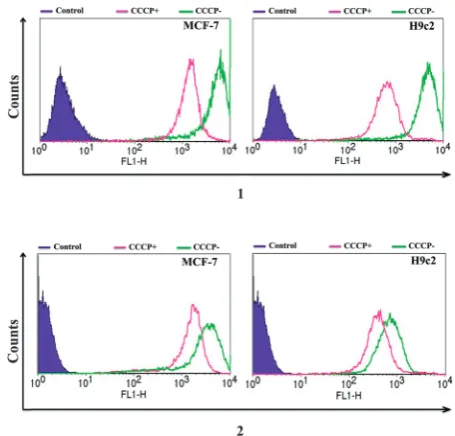
Imaging agents with MMP-dependent uptake offer an ideal tool to probe mitochondrial function. To establish the mito-chondrial membrane potential specific uptake of 1 and 2, a flow cytometry study was carried out in the presence of carbonyl cyanide m-chlorophenylhydrazone (CCCP), a protonophore which eliminates the mitochondrial membrane potential (see Fig. 3 and ESI†for further details).24,25Both tracers showed a
decrease in mean fluorescent intensity (MFI) upon CCCP induced MMP depolarisation in both cell lines. 1 showed a greater than 70% decrease in MCF-7 and H9c2 cell lines, whereas 2showed a smaller 38% and 58% decrease in MCF-7 and H9c2 cells respectively.
The vast majority of lipophilic cations used in molecular imaging are based on triphenylphosphonium ions.3,16,18,19In this study,
we have designed and synthesised a triphenylphosphonium BODIPY structure (2) along with a cyclohexyl derivative (1) to explore the structural features necessary for MMP-dependent uptake. Both the mitochondrial localisation determined by confocal microscopy and the flow cytometry MMP-dependent uptake studies demonstrate that the replacement of two phenyl groups for two cyclohexyl groups cause an increase in MMP dependent, mitochondrial specific uptake. DFT calculations were carried out on both structures to determine the degree of delocalisation of electron density. Our calculations show (see Fig. 4 and ESI†for further details) that the charge is localised on the phosphorus atom for the cyclohexyl derivative (1) while it is mainly delocalised on the aromatic ligands for the triphenyl-phosphonium structure (2). The effect of the degree of lipo-philicity on the uptake of lipophilic cations has been partially explored in previous studies, generally when describing selec-tivity between cancer and cardiac uptake.16 The lipophilicity (logP) values of1and2were determined to be 3.19 and 2.80 respectively, revealing a significant increase in lipophilicity for the cyclohexyl derivative.
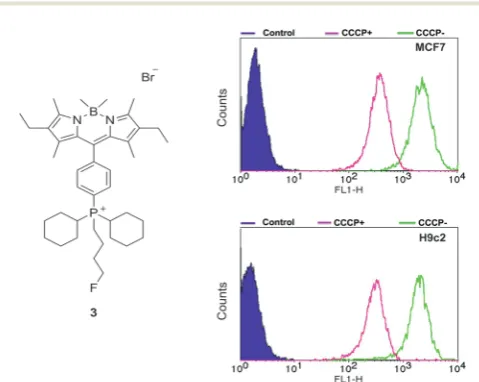
To validate the strategy and open opportunities for future PET/optical imaging agents, we have replaced methyl trifluoro-methanesulfonate in the final step methylation reaction of the dicyclohexyl derivative with 1-bromo-4-fluorobutane. The structure of the formed product,3, was confirmed by NMR and X-ray crystallography (see ESI†) and is the cold standard of a potential future radiolabelled product. The fluorine-18 analogue can be preparedviaconventional nucleophilic substitution in a one step procedure or directly from1in a 2-step radiolabelling protocol.26,27
Flow cytometry studies on3, carried out using an identical protocol to that used to analyse1and2, demonstrated that this fluoride substituted derivative behaves in an analogous fashion. Fig. 3 Flow cytometry studies of1and2in MCF-7 (left) and H9c2 (right) cells without (green) and with (pink) the presence of mitochondrial membrane depolarising agent (CCCP) to assess mitochondrial membrane potential uptake.
Fig. 1 Chemical structures of phosphonium BODIPY derivatives1and2.
Fig. 2 Confocal microscopy of1and2 (left) in MCF-7 and H9c2 cell lines with mitotracker deep red (MDR, centre), overlaid mitochondrial co-localisation (right).
Communication ChemComm
[image:3.595.313.541.47.265.2] [image:3.595.69.270.49.131.2] [image:3.595.52.286.158.494.2]Replacement of the methyl group in1with a fluorobutyl leads to an increase in MMP dependent uptake, with CCCP causing decreases in uptake of 84% and 83% in MCF-7 and H9c2 cells respectively (see Fig. 5), thus validating this approach for the design of multimodal optical/PET imaging agents.
In conclusion, we have developed novel BODIPY based agents for mitochondrial imaging. These agents, for the first time, have been shown to be taken up in mitochondria in a mitochondrial membrane potential-dependent manner in both cancer and heart cells. The new structural class, with the phosphonium grafted directly on the BODIPY backbone, offers the opportunity to reduce non-specific binding by optimising the lipophilicity of a dicyclo-hexyl derviative with shielded localised charge. This work validates the structural features required to develop MMP-dependent PET/ optical multimodal imagingviafluorine-18 radiolabelling. Studies are currently underway to develop these agents forin vivouse.
We gratefully acknowledge the Daisy Appeal Charity for funding (Grant: DAhul0211), the University of Hull for a fee reduction scholarship for SN, Newcastle University for a student-ship LHD, EPSRC and High Force Research Ltd for financial support of JFW and EPSRC for a LJH Fellowship (EP/G005206/1). We thank Dr Assem Allam for his generous donation and ongoing support to the PET Research Centre at the University of Hull. The authors wish to thank the EPSRC National Mass Spectrometry Service at Swansea.
Notes and references
1 S. Fulda, L. Galluzzi and G. Kroemer,Nat. Rev. Drug Discovery, 2010,
9, 447–464.
2 M. P. Murphy,Biochim. Biophys. Acta, 2008,1777, 1028–1031. 3 J. S. Modica-Napolitano and J. R. Aprille,Adv. Drug Delivery Rev.,
2001,49, 63–70.
4 J. S. Modica-Napolitano and J. R. Aprille,Cancer Res., 1987,47, 4361–4365. 5 B. Kadenbach, R. Ramzan, R. Moosdorf and S. Vogt,Mitochondrion,
2011,11, 700–706.
6 H. W. Strauss and H. Schoeder,J. Am. Coll. Cardiol. Img., 2012,5, 293–296.
7 V. Ganitkevich, S. Reil, B. Schwethelm, T. Schroeter and K. Benndorf, Circ. Res., 2006,99, 165–171.
8 M. Poot, Y. Z. Zhang, J. A. Kramer, K. S. Wells, L. Jones, D. K. Hanzel, A. G. Lugade, V. L. Singer and R. P. Haughland,J. Histochem. Cytochem., 1996,44, 1363–1372.
9 G. Ulrich, R. Ziessel and A. Harriman,Angew. Chem., Int. Ed., 2008,
47, 1184–1201.
10 N. Boens, V. Leen and W. Dehaen,Chem. Soc. Rev., 2012,41, 1130–1172. 11 J. Karolin, L. B. A. Johansson, L. Strandberg and T. Ny,J. Am. Chem.
Soc., 1994,116, 7801–7806.
12 L. H. Davies, B. B. Kasten, P. D. Benny, R. L. Arrowsmith, H. Ge, S. I. Pascu, S. W. Botchway, W. Clegg, R. W. Harrington and L. J. Higham, Chem. Commun., 2014,50, 15503–15505.
13 Z. Li, T. P. Lin, S. Liu, C. W. Huang, T. W. Hudnall, F. P. Gabbai and P. S. Conti,Chem. Commun., 2011,47, 9324–9326.
14 J. A. Hendricks, E. J. Keliher, D. Wan, S. A. Hilderbrand, R. Weissleder and R. Mazitschek,Angew. Chem., Int. Ed., 2012,51, 4603–4606. 15 B. P. Burke, G. S. Clemente and S. J. Archibald,Contrast Media Mol.
Imaging, 2015,10, 96–110.
16 Y. Zhou and S. Liu,Bioconjugate Chem., 2011,22, 1459–1472. 17 X. Yan, Y. Zhou and S. Liu,Theranostics, 2012,2, 988–998. 18 D.-Y. Kim, H.-S. Kim, L. Uyenchi Nguyen, S. N. Jiang, H.-J. Kim, K.-C. Lee,
S.-K. Woo, J. Chung, H.-S. Kim, H.-S. Bom, K.-H. Yu and J.-J. Min,J. Nucl. Med., 2012,53, 1779–1785.
Fig. 4 Charge distribution for structure (1) (A, left) and structure (2) (B, right) computed at the TPSS-D3/def2-TZVPP level of theory using their fully optimised geometries. The atomic charges are determined using the CHELPG method and represented using a colour scheme where red indicates a +1e
nominal charge and blue a 1enominal charge. Note the concentration of charge around phosphorus in (A) which is not seen in (B).
[image:4.595.73.532.50.221.2] [image:4.595.46.286.480.671.2]19 Z. Zhao, Q. Yu, T. Mou, C. Liu, W. Yang, W. Fang, C. Peng, J. Lu, Y. Liu and X. Zhang,Mol. Pharmaceutics, 2014,11, 3823–3831. 20 H. Yuan, H. Cho, H. H. Chen, M. Panagia, D. E. Sosnovik and
L. Josephson,Chem. Commun., 2013,49, 10361–10363.
21 B. P. Burke, P. Greenman, A. M. Smith and S. J. Archibald,Acta Crystallogr., Sect. E: Struct. Rep. Online, 2012,68, o3202.
22 L. H. Davies, B. Stewart, R. W. Harrington, W. Clegg and L. J. Higham, Angew. Chem., Int. Ed., 2012,51, 4921–4924.
23 L. H. Davies, R. W. Harrington, W. Clegg and L. J. Higham,Dalton Trans., 2014,43, 13485–13499.
24 H. Steen, J. G. Maring and D. K. F. Meijer,Biochem. Pharmacol., 1993,45, 809–818.
25 M. L. R. Lim, T. Minamikawa and P. Nagley,FEBS Lett., 2001,503, 69–74. 26 P. W. Miller, N. J. Long, R. Vilar and A. D. Gee,Angew. Chem., Int. Ed.,
2008,47, 8998–9033.
27 F. Buckingham and V. Gouverneur,Chem. Sci., 2016,7, 1645–1652.
Communication ChemComm