Distributed Processing Systems
Four-Phase Series 2000, 4000, 5000, and 6000
MANAGEMENT SUMMARY
With the announcement of the Series 6000, Four-Phase
joined the growing number of system vendors who are
becoming OEM's for Convergent Technologies. The CT
Miniframe and Megaframe, based on the Motorola
MC68000 family of CPUs and repackaged as the Series
6000, provide Four-Phase's entry into the 32-bit system
arena. The Series 6000 is geared toward dedicated word
processing and large-scale office automation applications.
Two models of the Series 6000 have been introduced to
date. The 6300 compact entry level system, based on
Convergent Technologies' Miniframe, can support one to
eight users. The processor boards, disk drives, and power
supply are housed in a single unit. Other features include a
main memory capacity of up to 2MB, removable media
storage, and fixed mass storage of up to 37MB. The 6600,
based on Convergent Technologies' Megaframe, has a
multiprocessor architecture that supports modular
expan-sion. The system can be configured to support up to 128
concurrent users, main memory is expandable to 4MB, and
up to 851MB of disk storage can be supported.
Each model of the Series 6000 has its own Unix V-based
operating system. Languages supported include C, Basic,
Cobol, Pascal, and Sibol. Communications facilities
in-clude 2780/3780 bisynchronous batch communications,
3270 bisynchronous interactive communications, and
3270 SNA. Applications provided include
Supercomp-Twenty, a spreadsheet-type decision-making tool, and the
Oracle data base management system.
t>
The 6000 Series is Four-Phase's new 32-bit office information system. Composed of the System 6300 and System 6600 (shown here). the Series 6000 run under a Unix-derived operating system that is based on and compatible with Unix System V. The Series 6000 provides support for up to 128 workstations.
Four-Phase is a traditional leader in the dis-tributed data processing system market. With the recent addition of the Series 6000, Four-Phase Systems has now entered the arena of 32-bit systems. Designed as a multiuser office information system, the Series 6000 complements the current members of the product line, including the Series 4000, the newly rereleased Series 5000, and the small Series 2000. Four-Phase has enhanced these existing systems by making a number of software packages available for them.
MODELS: Series 6000: 6600 and 6300; Series 5000: 700 and 800; Series 4000: IV/40, IV/50, IV/60, IV/65, IV/70, IV/80, IV/90, and IV/95; Series 2000: 220, 240, and 260.
CONFIGURATION: The Series 2000 pro-vides support for up to 8 workstations; the Series 4000 supports up to 32 worksta-tions. The Series 5000 can be configured with up to 64 workstations. The top-of-the-line Series 6000 provides support for up to 128 workstations. A variety of printers, mass storage devices, and magnetic tape units are also available for various systems. SOFTWARE: The Series 2000 systems pro-vide either the ISOS 1/ or a virtual memory version of Unix V as the operating system. The Series 4000 and 5000 feature the MFEIIV operating system. The Series 6000 operating systems are derivatives of Unix V. COMPETITION: The Series 2000, 4000, and 5000 compete with various DDP sys-tems, including the IBM 8100 and Wang VS. The Series 6000 competes with super-minicomputers like the Data General Eclipse MV 4000 and Prime 2250.
PRICE: A Series 5000 configuration includ-ing 16 workstations, 192K bytes of memory, 40M bytes of disk storage, a line printer, and a bisynchronous communications controller is priced at $69,203.
CHARACTERISTICS
MANUFACTURER: Four-Phase Systems, Inc., 10700 North De Anza Blvd., Cupertino, California 9S014. Tele-phone (408) 2SS-0900. In Canada: Motorola Information Systems Ltd., 944S Afrport Road, Brampton, Ontario L6S 4J3 Canada. Telephone (416) 793-S700.
DATE OF ANNOUNCEMENT: (Series 4000) IV/70-September 1970; IV 140-March 1973; IV ISO-June 1976; IV /90-June 1977; IV /60 and IV /6S-April 1979; IV /80 and IV /9S-February 1981; (Series 2000) 220 and 240- ~
Distributed Processing Systems
Four-Phase Series 2000, 4000, 5000, and 6000
t:>
The Series 2000 line of systems, based on Motorola's
MC68010 microprocessor, is designed primarily for
multiuser applications in communication with an IBM
host. Three models are offered in the Series 2000 family.
The Model 220 has a maximum main memory of 384KB
and can support up to four workstations; the Model 240
provides up to 768KB of main memory, and supports up to
eight workstations; and the Model 260 supports eight
work-stations, and main memory expandable to one megabyte.
The operating system for the Series 2000, called ISOS II,
like the Series 6000 operating system, is a derivative of
Unix V. A menu-oriented interface provides a user with
access to the system's many features, including virtual
memory support. Languages provided for the Series 2000
currently include Extended Basic, Cobol, and Mumps.
Applications supported include the Q-One word processing
system, the Dynacalc electronic spreadsheet, and the ASQ
Record Management System. Concurrent 3270 and
Con-current Batch communications are supported.
Four-Phase has also reintroduced the 5000 Series line of
clustered terminal processors. Intended to be the high end
of the Series 4000 line, the new 5000 Series has a redesigned
24-bit architecture, including such features as pipeline
pro-cessing to allow some simultaneous propro-cessing of
applica-tions. Two models currently make up the 5000 Series, the
Models 700 and 800. Both have a 1.5MB memory, can
provide up to 428MB of disk storage, and support up to 64
workstations. The 800 model also provides cache memory.
The System IV has been renamed and is now called the
Series 4000. The eight systems that comprise this series are
still called by their old names, retaining the IV prefix.
Support for up to 32 workstations is provided. The display /
keyboard units can be used to enter/generate data in batch
mode as well as interactive mode within the same system.
Character printers can be attached to each station to permit
the production of hard copy during data entry or word
processing operations. Line printers allow the production
of reports generated by on-line systems within the
Four-Phase network or by the remote host processor. Main
memory capacities in this series range from very small,
24KB as the minimum on the IV/40, to a 1536KB
maxi-mum on the IV /95. Maximaxi-mum disk storage ranges from
22.5MB on the IV/40, to 552MB on the IV/95.
The Multifunction Executive (MFE/IV) is a powerful
con-trol program which allows multiple software application
packages to run concurrently on a single Series 4000 or
5000 processor. Users can run Vision for 3270-style inquiry
and retrieval, source data entry, and batch
communica-tions, ForeWord for word processing, OMS/IV for office
automation functions, COMS/IV for distributed
informa-tion management throughout a corporate network,
OMS/IV for business graphics, Data IV for data entry,
Cobol for standalone processing, and utility programs on
up to 32 terminals on one system.
Four-Phase supplies bundled software programs needed to
operate the Series 4000 as a distributed data processor.
~~ June 1983; (Series 5000) 700 and 800-May 1984; (Series 6000) 6300 and 6600-March 1984.
DATE OF FIRST DELIVERY: (Series 4000) IV/70-February 1971; IV/4O-June 1973; IV/SO-I976; IV/90-July 1977; IV /60 and IV /6S-June 1979; IV /80-August 1981; IV/9S-June 1981; (Series 2000) 220 and 240-September 1983; (Series 5000) 700-June 1984; 800-October 1984; (Series 6000) 6300 and 6600-unspecified.
NUMBER DELIVERED TO DATE: Information not available.
SERVICED BY: Four-Phase Systems.
CONFIGURATION
The different families of systems in the Four-Phase line cover a wide range of capacity and configurability.
The top-of-the-Iine Model 6600 of the Series 6000 can support up to 128 workstations. In the Series 4000. family of systems, support for up to 32 workstations can be provided, Series SOOO systems can support up to 64 workstations. The Series 2000 can support up to eight workstations.
Configuration rules require one removable media and one fixed-media drive per system for the 6300, and one remov-able media and three fixed-media drives for the 6000. The Series 4000 and 5000 systems can support up to four disk drives. The Series 2000 supports up to four Intelligent Disk Controllers per configuration, and each controller can sup-port two drives, so a configuration can supsup-port at most eight drives.
The Series 4000 and 5000 systems can support up to four magnetic tape drives. The Series 5000 processors can sup-port up to 32 printers. The Series 2000 allows printers to be attached to the system or directly to a workstation.
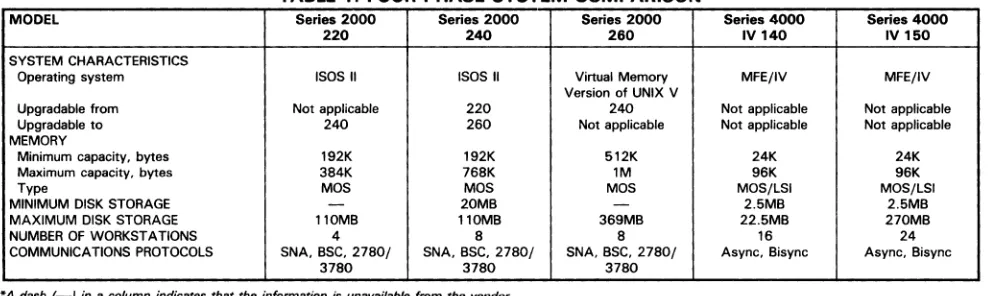
Table 1 details the systems that make up the Series 2000, 4000, 5000, and 6000.
TRANSMISSION SPECIFICATIONS
A number of communications control facilities are available for the Series 4000 and 5000. The 8411/4411 Asynchronous Data Set Controller provides a single-line interface for half-or full-duplex communications at 110, 150,301),600, 1200, 1800, or 2400 bps. Any 9- to 11-bit code can be accom-modated. The controller features automatic answer capa-bility and supports Bell System type 103A, 20lA, 20lB, 202C, and 202D modems or equivalents, or devices with an EIA RS-232-C interface.
The 8436/4436 Binary Synchronous Data Set Controller provides a single-line interface for half- or full-duplex Bell System 20lA, 201B, or equivalent EIA RS-232-C modems operating at up to 9600 bps. Any 7- or 8-bit code is accommodated.
The 8460 Multiline Asynchronous Controller is designed to
interface multiple nonstandard input/output devices with a Series 4000 or Series 5000 system capable of running MFE/IV. It contains a 16K-byte microprocessor and sup-ports devices utilizing an EIA RS-232-C interface of 60/20. ma Current Loop interface, and bit transfer rates up to 9600 bps in either half- or full-duplex.
The 8437 Intelligent Communications Controller is designed for use with the System IV /90, the controller contains a 16K-byte processor. The 8437 supports both the
Bisync and SDLe protocols. ~
© 1985 DATAPRO RESEARCH CORPORATION, DELRAN, NJ 08075 USA REPRODUCTION PROHIBITED
C21-435-103 Distributed Processing Systems
Four-Phase Series 2000, 4000, 5000, and 6000
TABLE 1. FOUR-PHASE SYSTEM COMPARISON
MODEL Series 2000 Series 2000 Series 2000 Series 4000 Series 4000
220 240 260 IV 140 IV 150
SYSTEM CHARACTERISTICS
Operating system ISOS II ISOS II Virtual Memory MFE/IV MFE/IV Version of UNIX V
Upgradable from Not applicable 220 240 Not applicable Not applicable Upgradable to 240 260 Not applicable Not applicable Not applicable MEMORY
Minimum capacity. bytes 192K 192K 512K 24K 24K
Maximum capacity. bytes 384K 768K 1M 96K 96K
Type MOS MOS MOS MOS/LSI MOS/LSI
MINIMUM DISK STORAGE
-
20MB-
2.5MB 2.5MBMAXIMUM DISK STORAGE 110MB 110MB 369MB 22.5MB 270MB
NUMBER OF WORKSTATIONS 4 8 8 16 24
COMMUNICATIONS PROTOCOLS SNA. BSC. 2780/ SNA. BSC. 2780/ SNA. BSC. 2780/ Async. Bisync Async. Bisync
3780 37BO 3780
*A dash (-) in a column indicates that the information is unavailable from the vendor.
TABLE 1. FOUR-PHASE SYSTEM COMPARISON (Continued)
MODEL Series 4000 Series 4000 Series 4000 Series 4000 Series 4000
IV 160 IV 165 IV 170 IV 180 IV 190
SYSTEM CHARACTERISTICS
Operating system MFE/IV MFE/IV MFE/IV MFE/IV MFE/IV
Upgradable from Not applicable Not applicable Not applicable Not applicable Not applicable Upgradable to Not applicable Not applicable Not applicable Not applicable Not applicable MEMORY
Minimum capacity. bytes 240K 288K 48K 2B8K 96K
Maximum capacity. bytes 720K 768K 96K 864K 480K
Type MOS/LSI MOS/LSI MOS/LSI MOS/LSI MOS/LSI
MINIMUM DISK STORAGE 5MB 5MB 2.5MB 2.5MB 2.5MB
MAXIMUM DISK STORAGE 80MB 80MB 2.70MB 80MB 552MB
NUMBER OF WORKSTATIONS 16 24 32 32 32
COMMUNICATIONS PROTOCOLS Async. Bisync. Async. Bisync. Async. Bisync Async. Bisync. Async. Bisync.
SDLC SDLC SDLC SDLC
TABLE 1. FOUR-PHASE SYSTEM COMPARISON (Continued)
MODEL Series 4000 Series 5000 Series 5000 Series 6000 Series 6000
IV 195 Model 700 Model BOO 6300 6600
SYSTEM CHARACTERISTICS
Operating system MFE/IV MFE/IV MFE/IV System 6300 System 6600 Operating System Operating System Upgradable from Not applicable Not applicable Not applicable Not applicable Not applicable Upgradable to Not applicable Not applicable Not applicable Not applicable Not applicable MEMORY
Minimum capacity. bytes 480K -
-
512K-Maximum capacity. bytes 1536K 1.5M 1.5M 2M 4M
Type MOS/LSI MOS/LSI MOS/LSI MOS MOS/LSI
MINIMUM DISK STORAGE 2.5MB 150MB 150MB
-
-MAXIMUM DISK STORAGE 552MB 2.2GB 2.2GB 37MB 851MB
NUMBER OF WORKSTATIONS 32 Up to 64 Up to 64 1-8 Up to 128 COMMUNICATIONS PROTOCOLS Async. Bisync. Async. Bisync. Async. Bisync. Bisync. SNA Bisync. SNA
SDLC SNA/SDLC *A dash (-) in a column indicates that the information is unavailable from the vendor.
~
Programs are provided to perform data entry, data editing,
on-line inquiry access, screen display formatting, word
processing, office automation, business graphics, printing,
file maintenance, communications line control, and
neces-sary utilities. An operating system, a multifunction
execu-tive, compilers, and assemblers are also offered.
The communications capabilities provided for the Series
4000 and 5000 include asynchronous and bisynchronous
communication, SNA/SDLC, HASP, and 2780/3780.
COMPETITIVE POSITIONThe wide range of products offered by Four-Phase compete
with a variety of different vendors' systems. For example,
1:>
SNA/SDLC
~ The Series 2000 Intelligent Communications Controller has an on-board Motorola MC6809E microprocessor with 64KB of RAM memory to service six serial ports. Four of these ports handle RS-232-C or RS-422 asynchronous inter-faces; the other two handle RS-232-C asynchronous or synchronous interfaces, using character or bit-level protocols.
Information on communications control for the Series 6000 is unavailable from Four-Phase.
SOFTWARE
OPERATING SYSTEMS: Each ofthe Series 6000 models has its own operating system. Both are derivatives of the popular Unix V operating system, under license from AT&T. Unix V is a layered design operating system, made up of a kernel, the shell. and user-level utilities to implement ~
[image:3.612.67.564.81.588.2] [image:3.612.67.563.86.234.2]1>
Distributed Processing Systems
Four-Phase Series 2000, 4000, 5000, and 6000
the Series 2000, designed for distributed processing with an
IBM host, competes with IBM's own 8100 Information
System, also geared toward IBM-host communication. The
Series 2000 competes specifically with the 8140 processor.
With a main memory expandable to 2MB, the 8150 is
larger than the Series 2000's 1MB maximum main memory
capacity. But the 8140 only supports up to 123MB of disk,
much less than the Series 2000's 369MB maximum disk
storage.
The Series 4000 and 5000 compete with the traditional
mid-size distributed processing systems. For example,
some of the models of the 16-bit Wang VS family of
systems offer memory capacity and configurability
com-parable to the Four-Phase systems. The VS 80, the oldest
model of the Wang VS family that is still current, offers
from 256KB to 512KB of main memory, up to 5.1GB of
disk storage, and supports up to 32 workstations. The
Series 4000 IV /80, by comparison, can also support 32
workstations and has a larger main memory, offering from
288KB to 864KB, but only provides a maximum of 80MB
of disk storage.
As a superminicomputer aimed at providing large-scale
office automation, the Series 6000 competes with such
products as Data General Corporation's Eclipse MV 4000
and Prime Computer's 2250. The DG MV/40oo, with a
maximum main memory capacity of 8MB and disk
sup-port of up to 5GB, outdistances the Series 6000 in those
categories, as the high-end 6600 can only support 4MB of
main memory and up to 851MB of disk storage. However,
the number of workstations that the 6600 can support is
128, double the 64 workstation support provided by the
MV/4000. Prime's 2250 has a similar main memory range,
from 512KB to 4MB, and supports significantly more disk
storage, 10GB compared to the 6600's 851MB. The 6600
can support more workstations, however-128 compared
to a 32-workstation maximum for the 2250.
ADVANTAGES AND RESTRICTIONS
The reintroduction of the Series 5000 has taken care of the
problem of limited storage capacity that the Four-Phase
product line had formerly faced. By marketing the Series
5000 as the high-end of the Series 4000, and redesigning the
architecture to ensure software and peripheral
compati-bility between the two systems, Four-Phase has designed a
migration path for users who find that the main memory
and disk storage that are available on the Series 4000 are no
longer enough for their needs. Even though the Series 4000
is not upgradable to the Series 5000, all software developed
on Series 4000 processors can
be
run on the Series 5000
without modification, according to Four-Phase.
the various commands. The kernel is a permanently resident program that provides the software environment for all other programs running on the system. The sheD provides the interface to the kernel, acting both as a command language interpreter, taking commands from the user level and send-ing them to the appropriate kernel process, and a low-level programming language.
Among the Unix V capabilities that both the System 6300 Operating System and the System 6600 Operating system provide are virtual memory with demand paging, a hier-archical, tree-structured file system, transparent file, device, and interprocess I/O, the ability to execute sequential, asynchronous, and background processes, the ability to invoke different command languages for each user, powerful text editors, a high degree of portability, Oexible document preparatioli and text management systems, access to the facilities of other host systems, support of many industry standard programming languages, compiler-compilers, desk calculator packages, a source code control system, network-communications facilities between Unix-based systems, and a system activity package for monitoring CPU and disk utilization.
In addition, the 6600 operating system provides distributed processing capability. This is accomplished by the inclusion of the Real-Time Operating System (RTOS). The capa-bilities provided by RTOS are transparent to the user; programming and all user interfaces are performed in the Unix environment. RTOS handles all file and I/O process-ing for the 6600 operatprocess-ing system.
Multifunction Executive (MFE/lV) enables multiple
Four-Phase software packages to operate concurrently and inde-pendently on a System IV /60, IV /65, IV /80, IV /90, or IV /95, and the Series 5000. These packages include Data IV, Vision, ForeWord, Cobol, OMS/IV, COMS/IV, and GMS/IV, making the following distributed processing functions available with a single processor: data entry, word processing, program development, on-line inquiry and re-trieval, batch communications, local processing, report generation, executive services, electronic mail document processing, and business graphics. A single station can switch from one function to another easily. MFE/IV sup-ports up to 32 of Four-Phase's 1920-character screens, 552M bytes of disk storage, and up to 768K bytes of memory.
NPOS (NP /80 Operating System) is a modular operating
system for the Series 4000 and 5000 which coordinates the services of the NP/80 peripheral processor. The primary function of NPOS is to service I/O requests for large mass storage devices as well as to enable the operation of mUltiple Series IV processors. Virtual disk capability and buffer pooling is also provided. A Multi-Key Access Method (MKAM) runs under control of NPOS.
lDOS is a disk-oriented operating system for the Series
4000 and 5000 oriented toward executing programs which IDOS provides for the cataloging and updating of source, relocatable, absolute files and command run parameter strings (job streams). The latter permits a single entry from the console to initiate sequential operation of a series of programs. The Code Assembler and Relocatable Loader, Cobol with DISAM, the Sort Package, and the System Relocatable Library are among the programs provided with IDOS. Two types of disk files are available under IDOS: contiguous (chained) and sequential (linked files).
ISOS II is a Unix-type operating system for the Series
2000, providing multitasking and multiprogramming
capa-Lack of upgradability is a problem within the Series 4000.
bilities. A menu-oriented interface enables the user to access any application on the system, or execute system commandsOnce you buy a Series 4000 system, you are tied to its size
and utilities. Hierarchical directories allow the user toorga-and configurability; there is no way to upgrade to a larger,
1>
nize files and programs by user, application, or type. ISOS . .Distributed Processing Systems
Four-Phase Series 2000, 4000, 5000, and 6000
J:>
more powerful model, short of buying a totally new system.
This remains a problem in the Series 5000 and 6000-there
is no way to upgrade, for example, from a 6300 to a 6600.
The Series 2000, however, provides the capability to field
upgrade to the next system in line.
Is Four-Phase's growing inclination toward Unix, as
evidenced by the operating systems provided for their new
systems, an advantage or a restriction? Many will argue
that the exploding popularity of Unix has made it an
industry standard, and that Unix capability on a system
opens the door to a plethora of off-the-shelf application
software. Others say that the major problem with Unix is
that there currently is no standard, and that many of the
currently available versions, such as Version Ill, Berkeley's
4.1 and 4.2 BSD versions, Xenix, and Venix, are not
compatable with one another. Running a version of Unix V
on a Series 2000 or 6000 system does not guarantee that a
user will be able to make use of all of the programs that
have been developed in a Unix environment.
USER REACTION
A total of 31 users of Series 4000 systems responded to the
1984 Datapro Users' Survey. (Survey results are given on
Page M07-100-401.) The average installed time for these
systems was 62.6 months. The majority of these users,
61.29 percent, leased their systems from Four-Phase. The
principle applications were accounting/billing (67.74
per-cent), health care/medical (41.94 perper-cent), order
process-ing/inventory control (25.81 percent), purchasing (12.9
percent), mathematics/statistics (9.68 percent), insurance
(6.45 percent), education-scheduling/administration (6.45
percent), manufacturing (6.45 percent),
construction/archi-tecture (3.23 percent), process control (3.23 percent), and
sales/distribution (3.23 percent). Most of the users
sur-veyed said that their primary source of application
pro-grams was in-house personnel (70.97 percent). Packaged
programs from the manufacturer were the second most
common source of application programs (38.71 percent),
followed by contract programmers (25.81 percent),
inde-pendent suppliers (25.81 percent), and manufacturer's
per-sonnel (3.23 percent). Ten percent of the users surveyed are
currently using a data base management system, and 13.33
percent are currently using a communications monitor.
More than half (55.17 percent) use integrated office
auto-mation functions, and some (6.9 percent) are planning to
do so within the year. Most (66.67 percent) have a disaster
recovery plan, and several (6.67 percent) are planning to
implement one this year.
In the next 12 months, the users surveyed plan the
follow-ing enhancements to their existfollow-ing systems: expansions to
present hardware (38.71 percent), expansions to data
com-munications facilities (29.03 percent), additional software
from the manufacturer (16.13), distributed processing
capabilities (12.9 percent), proprietary software from other
suppliers (9.68 percent), power conditioning systems (6.45
percent), and business graphics (3.23 percent).
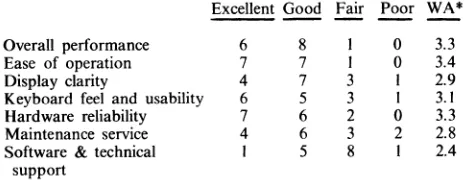
Results of the respondents' ratings of the Four-Phase
sys-tems are contained in the following chart.
1:>
II files are protected from unauthorized use by six file protection atributes, as they can be marked for public or private use with read, write, or execute attributes.
DATA BASE MANAGEMENT SYSTEM: The Series 6000 supports Oracle, a relational data base management system designed for ease of use. Oracle provides simple two-dimensional data presentation and English-like commands for data base access, as well as on-line help information. Oracle data bases can be accessed by C and Cobol pro-grams. The on-line query function allows a user to extract data from tables and display it on-screen. Then, multiple math functions are provided for use with the data obtained. Versatile formatting of queries is provided, and multiple queries can be linked together. The user is also provided with the capability to obtain hardcopy of a report.
LANGUAGES: On the Series 6000, a two-pass C compiler and execution environment are provided as part of the Unix-derived operating systems. Because of this, programs writ-ten in C can make optimal use of the operating system's features. Other features of the C programming environment include an extensive set of library functions, a large set of data structures, and a variety of debugging aids, including a preprocessor.
SMC Thoroughbred BtlSic, an enhanced version of Basic supported by the Series 6000, uses English-like statements to provide a programming language that can be learned quickly and is easy to use. Since Basic is interpreted rather than compiled, a program can be debugged, line by line, as it is being entered. The output from the interpreter is com-pressed pseudocode, optimized for very fast execution. Multiple users are supported, as well as the capability for multiple programs to run simultaneously. A library of utility routines provide the capability to renumber programs, com-pare programs, initialize the disk environment, transfer programs and files, perform a hexidecimal file dump, do string search and replacement, and display task memory allocation.
The Cobol system supported by the 6000 Series includes a mUltipass compiler, run-time interface, Oracle relational data base management system interface, and several pro-gram debugging aids. The run-time system, accessible directly via the command line or through Uniview menus, has been designed to support mUltiple users executing multiple programs simultaneously, a capability enhanced by demand-page virtual memory provided on both systems.
The 6000 Series supports an extended version of White-smiths PtlScal, an implementation of ISO Pascal. Provided are a single-pass compiler, access to the Unix-derived oper-ating system, Pascal run-time library, and program debug-ging aids. The compilation process actually begins when, transparent to the user, Pascal source code is translated into C, and this code is run through the C compiler. The resulting machine code is stored in small modules, which can be linked together at execution time to form an executable program. This makes it possible to assemble files from multiple sources so that common declarations and defini-tions can be included as needed. Debugging aids include a trace feature that will show which procedures have been accessed after a program has been run, helping the program-mer to pinpoint where potential problems can occur.
Sibol is a high-level language for commercial application programming available on the Series 6000. Using the same syntax as Digital Equipment Corporation's Dibol (DEC Business Oriented Language), Sibol is designed to make full use of the Unix environment. Unix commands and C lan-guage functions can be executed within a Sibol program. The Sibol system which consists of a single pass compiler, a run-time interpreter, a symbolic debugger, a linker, and a library
of external utilities. ~
~
Distributed Processing Systems
Four-Phase Series 2000, 4000, 5000, and 6000
Excellent Good Fair Poor WA*
----Ease of operation 8 21 1 1 3.23
Reliability of system 9 19 3 0 3.19
Reliability of peripherals 4 21 4 2 2.87 Maintenance service:
Responsiveness 11 17 3 0 3.26
Effectiveness 8 19 4 0 3.13
Technical support:
Troubleshooting 5 20 5 I 2.94
Education 3 19 8 1 2.77
Documentation 2 16 11 2 2.58
Manufacturers software:
Operating system 5 17 4 I 2.96
Compiler &. assemblers 3 16 4 1 2.88
Application programs 2 11 5 2 2.65
Ease of programming 6 14 I 2 3.09
Ease of conversion 1 10 9 2 2.45
Overall satisfaction 5 20 3 0 3.07
*Weighted Average on a scale of 4.0 for Excellent.
To further enhance our survey findings, Datapro contacted
two of the respondents by telephone. The results of these
telephone interviews follow the user ratings chart.
The survey responses from a manufacturing facility in
Michigan were very positive. The system in question is a
small Series 4000, supporting only five workstations and
less than 10MB disk storage. With the exception of the
vendor-supplied DOS operating system, all programs at
this particular facility are provided by in-house personnel.
Principal applications include accounting, billing, and
pay-roll. When asked to discuss the strengths and weaknesses of
the system, a representative from the facility said that the
maintenance service from Four-Phase is outstanding; they
report that "better than nine times out of 10," when
someone from the facility calls to report a problem, there is
someone dispatched to answer the call within 15 minutes.
The only problems the facility has encountered with the
system have involved the software developed in-house for
it, according to this representative.
A transportation company out west has also had a very
positive experience with its Four-Phase system. This
par-ticular Series 4000 installation has between 512KB and
1 MB of main memory, and between 100MB and 600MB of
total disk storage. There are currently between 16 and 30
terminals attached. Principle applications that the system
handles include accounting and payroll, as well as
construc-tion applicaconstruc-tions. The person we talked to from this
instal-lation also gave very high marks to the maintenance service
they had received from Four-Phase. Although no
extra-ordinary problems had been encountered, small ones had
been quickly and efficiently taken care of. Also on the
positive side was the capability offered at a single terminal,
including data entry, word processing, and 3270 emulation.
One major disadvantage of the system was noted; that is,
that both from a hardware and software standpoint, the
system offers very little in the way of compatibility with
other vendors. This user has been unable to find any
third-party software vendors who produce packages that can run
on the MFE operating system, or any independent
peripheral suppliers who manufacture or
mark~tFour-Phase compatible terminals. 0
~ For program development on the Series 4000 and 5000, Four-Phase offers three versions of Cobol. Cobol is offered in both ANSI Cobol '68 and Cobol '74 versions, with extensions provided for screen handling. Programmers can define screen formats in the Data Division and accept keyboard data in the Procedure Division. The screen areas can be manipulated like any working storage area; thus, the programmer can read and write data to operator displays without using I/O instructions. This allows for dynamic manipulation of screen displays without imposing overhead on the processor or the channel. Cobol and Assembly
lan-guage subroutines can be executed on-line and can be over-laid to conserve memory. Multitasking allows difl'erent activities to be supported at difl'erent displays simul-taneously. Data management facilities are provided for accessing of up to 270M bytes of local disk storage. Serial and direct files are processed using the Sequential Access and Random Access features of ANSI Cobol. A third access method, MKAM, provides multi-indexed files that may be
referenced by a primary key and up to 256 secondary keys. Files created or maintained in on-line operations can also be processed in batch mode using Cobol, RPG, sort/merge, and an extensive selection of utilities.
Cobol with 2780/3780 is a package which combines ANSI Cobol for local processing with concurrent batch communi-cations using IBM 2780/3780 protocol. Displays are sup-ported for entry, inquiry, processing, and printing. Data is transmitted and received using IBM 2780/3780 protocol in an attended or unattended mode. A Series IV CPU can communicate with any system using IBM 2780/3780 dis-cipline, including other Series IVs using RBS or Cobol with 2780/3780, and with IBM System/3s, 360s, and 370s. Cobol with HASP combines Cobol for local processing with a set of subroutines that can be called for the transmission of data to or from another computer using HASP multileaving batch transmission protocol. The other computer can be a 360/370, another Four-Phase processor, or any other sys-tem having a bisynchronous HASP multileaving interface. Communications can be over leased or dial-up facilities with either attended or unattended operation. Local transaction processing is accomplished with user routines written in either Assembler or Cobol.
The Series 2000 supports Extended Basic language system that includes an on-line text editor, mUltipass compiler, run-time interpreter, and interactive debugger. Data structures include atomic data types, arrays of up to three dimensions, and user-defined data types. The capability to optimize code is provided by a Pack statement. When the Pack statement is executed, a second compiler pass removes names, line numbers and comments, resulting in a smaller, faster program.
COMMUNICATIONS: The IBM 2260 Simulator for the Series 4000 and 5000 provides all functions of an IBM 2260/2848 Display System through software emulation. This package provides for operation in either local or remote environments, and supports all screen sizes. Features in-clude Supervisory Mode, in which a display unit, acting as a supervisory station, can communicate directly with other display units connected to the same Series 4000 or 5000 system, and Media Conversion, which supports data tran-scription operations such as card-to-tape, caro-to-printer, and tape-to-printer.
The IBM 3270 Simulator for the Series 4000 and 5000 provides all the functions of an IBM 3270 Information Display System through software emulation. This package provides for operation in either local or remote environ-ments, and supports 480, 960, and 1920 character display onits. The user may select either 3270 SDLC line protocol or Bisynchronous (BSC) line protocol, as weD as the. ability to use either ASCII or EBCDIC character sets. The Store- ~ © 1985 DATAPRO RESEARCH CORPORATION, DELRAN, NJ 08075 USA
REPRODUCTION PROHIBITED
Distributed Processing Systems
Four-Phase Series 2000, 4000, 5000, and 6000
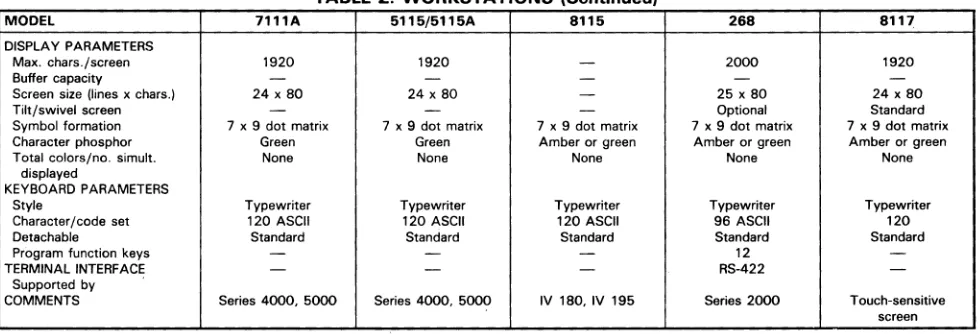
TABLE 2. WORKSTATIONS
MODEL TM30 FT40 FT50 7100A 7101A
DISPLA Y PARAMETERS
Max. chars./screen 2320 1920 1920 480 288, 576, or 1152
8uffer capacity - - -
-
-Screen size (lines x chars.) 29 x 80 24 x 80 24 x 80 12 x 40 6, 12, or 24 x 48
Tilt/swivel screen Standard Standard Standard
-
-Symbol formation 9 x 12 matrix 10 x 14 matrix 9 x 15 matrix 7 x 9 dot matrix 7 x 9 dot matrix
Character phosphor Green Green or amber Green or amber Green Green
Total colors/no. simult. None None None None None
displayed
KEYBOARD PARAMETERS
Style Typewriter Typewriter Typewriter Typewriter Typewriter
Character/code set ASCII Full ASCII Full ASCII 120 ASCII 120 ASCII
Detachable Yes Yes Yes Standard Standard
Program function keys - 13-27 13-27 -
-TERMINAL INTERFACE RS-233, R5-422 RS-423 RS-423, RS-232-C
-
-COMMENTS Series 6000 Series 5000 Series 5000 Series 4000, 5000 Series 4000, 5000
*A dash (-) in a column indicates that the information is unavailable from the vendor.
TABLE 2. WORKSTATIONS (Continued)
MODEL 7111A 5115/5115A
DISPLAY PARAMETERS
Max. chars.jscreen 1920 1920
Buffer capacity
-
-Screen size (lines x chars.) 24 x 80 24 x 80
Tilt/swivel screen -
-Symbol formation 7 x 9 dot matrix 7 x 9 dot matrix
Character phosphor Green Green
Total colors/no. simult. None None
displayed
KEYBOARD PARAMETERS
Style Typewriter Typewriter
Character/code set 120 ASCII 120 ASCII
Standard
Detachable Standard
Program function keys -
-TERMINAL INTERFACE -
-Supported by
COMMENTS Series 4000, 5000 Series 4000, 5000
"A dash (-..J. in a column indicates that the information is unavailable from the vendor.
and-Forward feature allows selected format images to be entered and recalled from disk, so that data entry may continue in the event host mainframe communications have been interrupted. When communications resume, the com-pleted formats may then be transmitted. The 3270 Simula-tor includes support for options such as Variable Intensity and Audible Alarm, and additional facility test features that can be used to pinpoint problems in the communications equipment, log line traffic, display format attribute types, write memory checkpoints to screen or disk, and accumulate error statistics. Local screen print capabilities are also available.
Programmable 3270 Simulator allows 3270 users to add local processing capabilities to an existing 3270 network. The package provides all the capabilities of the 3270 Simu-lator system plus Cobol programming. Editing and valida-tion capabilities, including range checks, algebraic relavalida-tion- relation-ships, interfield dependencies, conditional logic, and table comparison can be programmed into the system to enable local handling of data. Entries may be validated against local files, and filed data can be integrated with keyed data for transmission or with received data for displaying or printing. The Cobol-programmed routines to perform these functions can be added to the system without having to modify existing 3270 application programs, systems soft-ware, or network configuration. Cobol routines can be in-voked when data is transmitted or received, when the TAB or Program Function keys are pressed, or when entries in designated fields are completed. The subroutines can then access local disks, printers, and displays on the central CPU before returning control to the operator. Cobol processing is
8115 268 811~
-
2000 1920- -
-- 25 x 80 24 x 80
- Optional Standard
7 x 9 dot matrix 7 x 9 dot matrix 7 x 9 dot matrix
Amber or green Amber or green Amber or green
None None None
Typewriter Typewriter Typewriter
120 ASCII 96 ASCII 120
Standard Standard Standard
- 12
-- RS-422
-IV 180, -IV 195 Series 2000 Touch-sensitive
screen
performed in the background and can support multiple tasks at multiple displays with concurrent key entry and printing. All major Series 4000 and 5000 software packages provide the ability to transmit and receive data in a batch mode. The batch communication protocols in the various packages are: nata IV, Version 1 (2780/3780); Data IV, Version 2/3 (2780/3780/HASP/3770); Vision (2780/3780/HASP); (3770/3270 BISYNC, 3270 SDLC); ForeWord (2780/3780). In addition, two remote job entry packages are available.
RBS with 2780/3780 is a Remote Batch System that pro-vides a full complement of IBM 2780/3780 features for the Series 4000 and 5000, including point-to-point and multi-point operation as well as transparency, auto-answer, line turnaround, space compression, and spanned record trans-mission. Peripherals supported include 300- and 600-cpm card readers, printers from 300 to 1,000 lines per minute in speed, and a diskette or cartridge disk system for program loading. While jobs are running, the video control console displays system status, error messages, line performance statistics, and prompts. A disk spooling capability enables a job to be read in from a card reader, another job to be written out from disk to a printer, and a third job to be transmitted or received simultaneously. Reports can be transmitted to unattended RBS systems at night without concern for forms changing or device availability, and the spooled data can be printed the next day while other operations are being per-formed. During transmission, the host CPU creates separate disk files on the remote system for each job. Reports can be generated and local system files updated using
user-pro-grammed software. . .
[image:7.612.67.560.81.234.2] [image:7.612.70.559.262.429.2]Distributed Processing Systems
Four-Phase Series 2000, 4000, 5000, and 6000
TABLE 3. PRINTERS
MODEL PT30 PT35 PT31/32 PT34 PT36
Type Impact Impact pot matrix Pot matrix Band
Speed 32/35 cps 50/55 cps 150 cps 50 or 200 cps 600 Ipm Bidirectional printing Standard Standard Standard - No Paper size Up to 4-16" wida Up to 3"-12" wide 3"-16" wide
16.53" wide 10" wide
Character formation Solid Solid g x 7 dot matrix 200 cps: 7 x 9 Solid dot matrix
50 cps: 15 x 16 dot matrix
Horizontal character spacing 10. 12. or 15 10. 12. or 15 5.8.18. 10. 10.12.13.2. 10
(chars./inchl or 16.36 15. or 16.5
Vertical line spacing (Iines/inchl
-
- 6 3. 4. 6. 8. or 12 6 or 8 Character set 96 ASCII 96 ASCII 96 ASCII 96 ASCII 64 or 96 ASCII Controller/Interface RS-232-C Serial RS-232-C Serial RS-232-C Serial RS-232-C Serial CentronicsCentronics or Centronics or Centronics Parallel Parallel Parallel Parallel
No. of printers per controller/interface
-
-
--
-Printer dimensions. in. (h x w x dl 8.25 x 22.4 7.3 x 23.5 PT31:6x15x14 8.25 x 22.4 44.3 x 34.3 x 18.25 x 17.9 PT32: 7x21 x 15 x 18.25 x 29.7
Graphics capability No No No No No
Comments
*A dash (-) in a column indicates that the information is unavailable from the vendor.
TABLE 3. PRINTERS (Continued)
MODEL Series 2000 Series 2000
8122 8124 8125 300/600 Ipm 35 cps
Type Daisywheel - Serial Band Rotating wheel
Speed 45 cps 35 cps 40 cps 300/600 Ipm 35 cps
Bidirectional printing -
-
-
No StandardPaper size Up to 15" Up to 15" Up to 15" 3" to 16" wide Up to 16" wide
Character formation Solid -
-
Solid SolidHorizontal character spacing 10 10 10 10 10. 12. or 15 (chars./inchl
Vertical line spacing (lines/inchl
-
-
- 6 or 8-Character set 96 ASCII 96 ASCII 88 ASCII 64 ASCII 96 ASCII
Controller/Interface
-
- - RS-232 RS-232-CNo. of printers per controller/interface - -
-
1-Printer dimensions. in. (h x w x dl
-
-
- 15 x 30.3 9.79 x 24.34 x 25.2 x 18.45Graphics capability - -
-
No NoComments Integrated power
power *A dash (-) in a column indicates that the information is unavailable from the vendor.
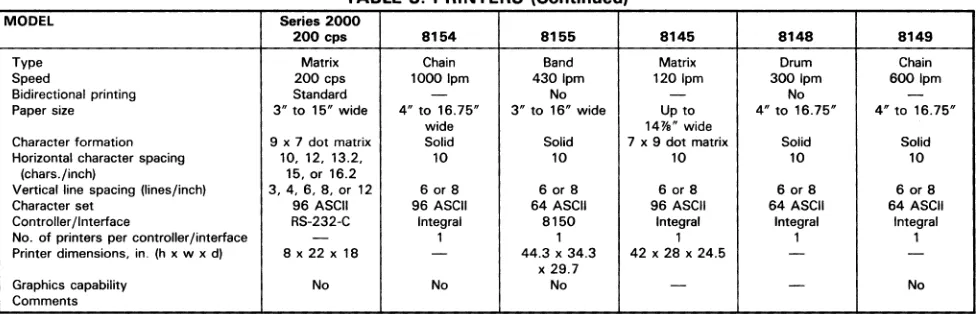
TABLE 3. PRINTERS (Continued)
MODEL Series 2000
200 cps 8154 8155 8145 8148
Type Matrix Chain Band Matrix Drum
Speed 200 cps 1000lpm 430lpm 120lpm 300 Ipm
Bidirectional printing Standard - No - No
Paper size 3" to 15" wide 4" to 16.75" 3" to 16" wide Up to 4" to 16.75"
wide 14%" wide
Character formation 9 x 7 dot matrix Solid Solid 7 x 9 dot matrix Solid Horizontal character spacing 10. 12. 13.2. 10 10 10 10
(chars./inchl 15. or 16.2
Vertical line spacing (lines/inchl 3.4.6.8. or 12 6 or 8 6 or 8 6 or 8 6 or 8 Character set 96 ASCII 96 ASCII 64 ASCII 96 ASCII 64 ASCII Controller/Interface R5-232-C Integral 8150 Integral Integral No. of printers per controller/interface - 1 1 1 1 Printer dimensions. in. (h x w x dl 8 x 22 x 18
-
44.3 x 34.3 42 x 28 x 24.5-x 29.7
Graphics capability No No No -
-Comments
*A dash (-) in a column indicates that the information is unavailable from the vendor.
© 1985 DATAPRO RESEARCH CORPORATION. DELRAN. NJ 08075 USA REPRODUCTION PROHIBITED
8159 Band 1350lpm
No 4"-18.75" wide
Solid
10 6 or 8 64 ASCII
8150 1 52 x 46 x 27
No
Series 2000 150 cps
Matrix 150 cps Standard 4.5"-15" wide 9 x 7 dot matrix
5.8.18.10. or 16.36
6 96 ASCII
-6x 15x 14(80coLI 7 x 21 No
8149 Chain 600 Ipm
-4" to 16.75"Solid 10 6 or 8 64 ASCII
Integral 1
-No
[image:8.612.47.541.79.276.2] [image:8.612.49.549.334.502.2] [image:8.612.52.541.559.716.2]Four-Phase Series 2000, 4000, 5000, and 6000
TABLE 4. MASS STORAGE
MOOEL 8230 8261 8270
Type Cartridge Removable Fixed
Controller model
-
Integral 8270Drives per subsystem/controller 4 4
-Formatted capacity per drive, 2.5 67.5 10
megabytes
Number of usable surfaces 2 10 8
Number of sectors or tracks per 200
-
200surface
Bytes per sector or track 768 768 768
Average seek time
-
-
65Average rotational/relay time 200 ms 30 ms
-Average access time
-
-
-Data transfer rate 184KB/sec. 250KB/sec. 195KB/sec.
Supported by system models Series 4000,5000 Series 4000, 5000 Series 4000, 5000 Comments
*A dash (-J in a column indicates that the information is unavailable from the vendor.
TABLE 4. MASS STORAGE (Continued)
C21-435-109 Oistributed Processing Systems
8291 Fixed Winchester
NP/80
-138
-20,480
-1.2MB/sec. Series 4000, 5000
MOOEL 000101 000201 000371/000372
Type Winchester Fixed
Controller model
-
-Drives per subsystem/controller
-
-Formatted capacity per drive, 10 20.97
megabytes
Number of usable surfaces
-
4Number of sectors or tracks per
-
-surface
Bytes per sector or track 512 512
Average seek time
-
-Average rotational/relay time
-
-Average access time
-
-Data transfer rate 5MB/sec.
-Supported by system models Series 6000 Series 6000 Comments
*A dash (-J in a column indicates that the information is unavailable from ·the vendor.
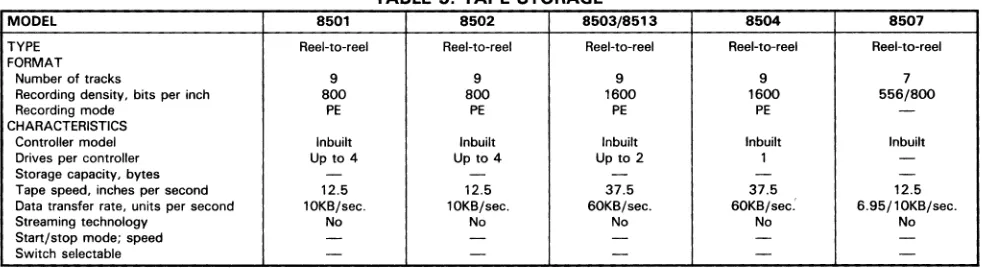
TABLE 5. TAPE STORAGE
MODEL 8501 8502 8503/8513 8504
TYPE Reel-to-reel Reel-to-reel Reel-to-reel Reel-to-reel
FORMAT
Number of tracks 9 9 9 9
Recording density, bits per inch 800 800 1600 1600
Recording mode PE PE PE PE
CHARACTERISTICS
Controller model Inbuilt Inbuilt Inbuilt Inbuilt
Drives per controller Up to 4 Up to 4 Up to 2 1
Storage capacity, bytes -
-
-
-Tape speed, inches per second 12.5 12.5 37.5 37.5
Data transfer rate, units per second 10KB/sec. 10KB/sec. 60KB/sec. 60KB/sec:
Streaming technology No No No No
Start/stop mode; speed
-
-
--Switch selectable
-
-
-
-*A dash (-J in a column indicates that the information is unavailable from the vendor.
FEBRUARY 1985 © 1985 OAT APRO RESEARCH CORPORATION, DELRAN, NJ 08075 USA REPRODUCTION PROHIBITED
-36.937
-512/sector
-5MB/sec. Series 6000
8507 Reel-to-reel
7 556/800
-Inbuilt
-12.5 6.95f10KB/sec.
[image:9.612.65.560.86.248.2] [image:9.612.67.556.307.464.2] [image:9.612.65.556.516.650.2]-Distributed Processing Systems
Four-Phase Series 2000. 4000, 5000, and 6000
RBS with HASP, available for the Series 4000 and 5000, is compatible with the IBM 360/30 HASP workstation used as a remote batch terminal. The package is offered with the System IV /40 and supports 300-to 60O-cpm card reader, multiple 300- to 1000-lpm printers, 1920-character video display and operator keyboard. The display and operator keyboard serve as an operator's console and display system status and communications status. The software provides the line discipline to simulate a multileaving HASP workstation.
The Series 2000 supports two communications systems. The
Series 2000 Concurrent 3270 Communications System runs as an application under the ISOS II operating system. On-line access to host information on an interactive basis is provided, concurrent with local data processing and office applications. Concurrent 3270 emulates both SNA and BSC 3270 protocols, operating at speeds up to 9600 bps. Up to eight Concurrent 3270 devices may be active at once in any combination of workstations and printers.
The Series 2000 Concurrent Batch CommuniCiltion System
runs as a batch communications facility in bisynchronous networks. Concurrent Batch allows a Series 2000 computer to communicate with a host CPU, an RJE 2780/3780 work-station or another Series 2000 computer in batch mode. The system can operate as a foreground task or, by use of a procedure file, a background task.
UTILmES: Uniview is a set of tools provided for the Series 6000 to make it Unix environment more user-friendly. Uniview provides menus and help screens, simplifying the user interface with the operating system.
Utilities for MFE/IV or IDOS are also provided and in-cludes a sort/merge, symbolic editor, relocatable loader, and various media conversion programs. The symbolic editor allows for insertion, deletion, replacement, and interrecord corrections of symbolic text. Media conversion programs include card-to-tape, tape-to-printer, and memory save/re-store on disk or magnetic tape.
OFFICE AUTOMATION: The Q-One Word Processing System is available for the Series 2000 and 6000. This menu-driven system provides spelling and automatic hyphenation facilities, a record processor for personalized correspondence, automatic index and table of contents generation, and an error recovery function to protect docu-ments from power failures and operational errors. In addi-tion, a calculator-type function allows calculations to be performed on numbers that are already in the document.
The Office Management System (OMS/IV) provides office automation capabilities in a distributed processing environ-ment for the Series 4000 and 5000. Composed of three functional units operating under the Multifunction Execu-tive (MFE/IV), OMS/IV integrates word processing, data processing and network communications. Functions which are data processing in structure are provided in Vision; those that require word processing use ForeWord. Communica-tions can be tailored to a customer's needs.
The Corporate Office Management System (COMS/IV) is a distributed information management system which oper-ates under the umbrella of MFE/IV-ForeWord-Vision-OMS/IV. COMS/IV includes all of the features available with OMS/IV, adds document tracking to the executive services function, and provides electronic mail, document management, document processing, remote system console, and IBM 3270 pass-through to any multifunction worksta-tion within the COMS/IV network. A processing request is entered via menu-driven interface. Internally, Vision verifies that the request is accurate and complete, and transmits it via 3270 mode to the System 311/312 node controll~r.
Accessible via the COMS/IV master menu, the Electronic Mail function allows any COMS/IV user to send "mail" electronically to any other user in the network. Mail can consist of a simple message, a document, or a package of documents, and can be addressed to a "mailbox," an in-dividual user, a group of users, or a predefiqetl distribution list. Recipients can scan, file, print, or hold their mail, delete mail after viewing, send a reply, or forward the mail to another recipient. A log is automatically maintained and updated for all mail sent by a particular user, allowing mail to be tracked for date and time of delivery. If any of the addressed are unknown, the sender is notified and given a choice of alternative actions: send to all others, correct the address and send, or cancel.
Since document and file access is possible from any worksta-tion in the network, Four-Phase has incorporated security features, based on access codes and document codes, at all levels in the system to permit access only by authorized users. Mailboxes and the central post office are accessed only through the electronic mail facility. Anyone may send mail to a mailbox or the central post office. Only the mailbox owner or those granted access permission can perform any other functions on the mail in the mailbox. Only those granted access to a particular piece of mail in the central post office may access that mail. The owner of a mailbox always has total access.
The Document Management feature of COMS/IV allows document filing and retrieval from multiple Series IV sys-tems. This is similar to ''filing'' a document in a filing cabinet. The electronic filing cabinet consists of two sections, the files and the file index. For each document filed, several index entries are created and stored in the file index.
The user interface to the Document Management feature is primarily menu-driven and is invoked by the master COMS/IV menu. Once the feature has been selected, the system will lead the operator through the various Document Management options. Document Management requires the Electronic Mail function since it uses the electronic commu-nications interface for the actual transmission of documents between the Series 4000 systems.
The Document Processing feature provides comprehensive text formatting and document construction functions which enable users to address a wide range of applications, includ-ing in-house publishinclud-ing of books, technical manuals, and other documents of complex format. Formats for documents such as correspondence, drafts, and manuscripts can be standardized and shared throughout a corporation, while specialized formats can be developed for individual needs. Text is simply typed without regard for its appearance on the CRT screen. The Document Processor performs all formatting tasks automatically, leaving the operator free to concentrate on content rather than form.
Supported functions include: multiple fonts, bold type, underscoring, revision bars, overstriking, super-/subscript-ing, string integrity, text alignment and justification, split text, headers and footers, footnotes, figures, lists, multiple columns, and variable line spacing.
ForeWord is a flexible shared-processor text editing system that allows text to be entered, stored, edited, and printed. The Series IV system can handle the editing and test manipulation functions of up to 24 video terminals. The system supports up to eight disk drives with removable disk packs providing an on-line storage capacity ranging from 400 to 50,000 pages of text. Removable disks provide un-limited archival storage. Up to 16 terminal printers are supported. Text is automatically written to the disk as entry progresses. Instant recall of text and rapid scrolling and cursor movement are provided by the editing and cursor . .
© 1985 DAT APRO RESEARCH CORPORATION, DELRAN, NJ 08075 USA REPRODUCTION PROHIBITED
C21-435-111 Distributed Processing Systems
Four-Phase Series 2000, 4000, 5000, and 6000
control keys conveniently located on the keyboard. Opera-tors can store frequently used words, phrases, or keystroke sequences within a special glossary and recall them with only two keystrokes. Automatic entering, discretionary hyphenation, and overstriking speed text entry. Updates and changes are easily done. Using the global search and replace command, the operator can type a correction once, no matter how often it appears in text. Blocks of text can be moved or copied without retyping. ForeWord provides rapid assembly of documents from libraries of stored paragraphs with an option to include fill-in information. When ready to print, the text can be formatted to add page headings and footings, page numbers, and automatic replacement of foot-notes. Margins, tabs, line spacing, page and paragraph numbering, and page headings all can be changed at will. ForeWord can also transmit and receive text from other computers with 2780/3780 line protocol.
APPLICATIONS: The Supercomp-Twenty package, offered for the Series 6000, provides an electronic spread-sheet-type decision-making tool. The worksheet organizes the information into cells that may also contain descriptive labels, formulas, or numbers. The cells are organized into a matrix, which can be as large as 1,000 rows by 1,000 columns. Information can then be manipulated, changed, erased, and rearranged, so that calculations can be per-formed to analyze how changes will effect the model.
DataManager is a toll designed to provide data collection capability for the Series 6000. The package is made up of four main functional models: DataDesigner, which handles data entry screens, DataCollector, which provides for entry of data in a fill-in-the-blank-type format, DataChanger, which allows a user to modify or reformat information, and DataHelper, which enables a user to custom design menus.
Vision and three versions of Data IV provide the software necessary to use the Series 4000 as a shared-processor data entry system (key/disk). They all provide for extensive data editing, and manipulation, for verifying previously entered records, and for searching for specific records. List process-ing selects data entered through Vision for output either as sorted information records, or for input into word processing documents.
Version 1 of Data IV provides up to six program formats per job. Multiple jobs can run at the same time, with formats shared among several jobs. Six balance accumulators are provided. Record lengths can be defined as up to 750 charac-ters. Conventional keypunch functions are provided along with a large number of other functions, including "generate" and numeric field relationships. The generate function allows a single key to be used to trigger the output of a stored constant field based on the character keyed. Arithmetic relationships such as equal, not equal, greater than, and less than can be used to check a group of fields having arithmetic relationships. A field can be defined as "must enter" or "must fill" to prevent a data entry operator from leaving the specified field blank.
Version 2 of Data IV provides all the features of Version 1 plus 24 balance accumulators, up to 15 program formats per job, audible error alarm, conditional field checking, multiple validation checks on the same field, extended table com-parisons, and support for mixed keypunch and typewriter-style keyboards. Provisions for conditioned logic are in-cluded to enable adaptive data validation during key entry. Conditional branches to different editing sequences and operator prompts can be inserted at any point in a format. Single and nested statements of the form IF ••• THEN ••. ELSE can reference previously entered fields, accumulator values, alphanumeric constants, value sets, and arithmetic and logical combinations of these.
Version 3 of Data IV provides all the features of Version 2 plus ISAM-like capabilities. Support for up to 32 video displays is provided for interactive accessing of up to 1,000 indexed sequential files, as well as storage capability for over 270M bytes. Source data can be entered and validated on fully formatted screens displaying up to 1,920 characters; data can be extracted from files for automatic entry; local files can be updated on-line; local reports can be produced; and batches of data can be exchanged with the host com-puter for updating of central files. Reports can also be received in an unattended mode for local file updating or printing.
Vision is a transaction-oriented distributed data processing system, combining in one package all computing capabilities needed at remote locations of widespread organizations: source data entry, on-line inquiry and retrieval, batch com-munications, asynchronous comcom-munications, and muItista-tion file processing. Source data entry is accomplished through the display of full records, operator prompts, and error messages on dual-intensity, 1920-character screens. The powerful editing capabilities of Data IV, including con-ditionallogic, are also avaimble with Vision. In addition, the file management capabilities of Data IV, Version 3, are provided. In on-line operation in 3270/mode, Vision sup-ports all IBM display commands and keyboard functions, enabling the full range of 3270 applications software to be used. Both 3270 BISYNC and 3270 SDLC are supported.
The Graphics Management System (GMS/IV) is an
inte-grated business graphics capability extended to the multi-function workstation user. Construction of graphs is opera-tor-controlled via a hierarchy of menus linked in a tree structure such that a user may step through each phase of graph creation by selecting from the options presented on the screen. There are no codes or commands to remember. All of the variables have default values so that the operator with little knowledge of graphics will be able to quickly generate clear and useful charts with minimal effort.
The Operations Control System/IV (OCS/IC) is an
auto-mated field service control system based on interactive workstations, a distributed information computer system, an on-line data base, and proprietary software. The system is designed to streamline field service operations to deliver increased productivity for field engineers, operations staff, and managers by allowing quick response to service problems. The OCS/IV allows users to see the status of operations on a moment-by-moment basis, easily review the trends which affect performance to plan accordingly, re-establish control over geographically dispersed locations, and provide better service to customers.
The Programmer Workstation (PWS/IV) is a
display-based remote job entry station that helps large programming shops develop and maintain programs for IBM 360s and 370s. The package handles distributed programming func-tions for as many as 16 display terminals. Each workstation may be used to create, edit, and store source programs locally and then send these programs to a host mainframe for compilation. Local files are maintained on a large 67M-byte disk. System status info)1l1ation is automatically logged on a low-speed character printer, and output from complete host jobs is printed on a high-speed printer.
Applications provided for the Series 2000 include Dynacalc,
an electronic spreadsheet. Dynacalc provides the capability for multiple users to share and merge spreadsheets. Other features of Dynacalc include the ability to generate bar graphs from numerical data, multiple window display capa-bility, a cell array of up to 256 rows by 256 columns, 16-digit arithmetic capability, and a help key that will step a user
through the development of the model. ~