S T U D Y P R O T O C O L
Open Access
Progressive mobility program and
technology to increase the level of physical
activity and its benefits in respiratory,
muscular system, and functionality of ICU
patients: study protocol for a randomized
controlled trial
Debora Stripari Schujmann
*, Adriana Claudia Lunardi and Carolina Fu
Abstract
Background:Enhanced mobility in the Intensive Care Unit (ICU) could minimize the negative effects of critical illness, such as declines in cognitive, muscular, respiratory, and functional capacity. We aim to compare the functional status at ICU discharge of patients who underwent a progressive mobilization protocol versus patients who received conventional physiotherapy. We also examine the level of physical activity in the ICU, the degree of pulmonary and muscle function, and the length of stay to analyze correlations between these variables.
Methods:This is a protocol for a randomized controlled trial with blind evaluation. Ninety-six ICU patients will be recruited from a single center and randomly assigned to a control group or an intervention group. To determine the level of protocol activity the patient will receive, the patients’ability to participate actively and their muscle strength will be considered. The protocol consists of five phases, ranging from passive therapies to walking and climbing stairs. The primary outcome will be the functional status at ICU discharge, measured with the Barthel Index and the ICU Mobility Scale (IMS). Measured secondary outcomes will include the level of physical activity, maximal inspiratory and expiratory pressures, forced expiratory volume in 1 second, maximum voluntary ventilation, handgrip strength, surface electromyography of the lower limb muscles, and results of the Timed Up and Go and 2-Minute Walk tests. Evaluations will be made within 2 days of ICU discharge except for the level of activity, which will be evaluated daily. Physiological variables and activity level will be analyzed by chi-square andttests, according to the intention-to-treat paradigm.
Discussion:Mobility and exercise in the ICU should be undertaken with intensity, quantity, duration, and frequency adjusted according to the patients’status. The results of this study may contribute to new knowledge of early mobility in the ICU, activity level, and varying benefits in critical patients, directing new approaches to physiotherapeutic interventions in these patients.
Trial registration:Recruitment will begin in February 2017, and the expected completion date is August 2018. Patients are already being recruited.
ClinicalTrials.gov, ID:NCT02889146. Registered on 3 March 2016.
Keywords:Early mobility, Rehabilitation, Critical care
* Correspondence:[email protected]
Department of Physical Therapy, Communication Sciences & Disorders, and Occupational Therapy, School of Medicine, University of São Paulo, Rua Cipotânea, 51, Cidade Universitária, Sao Paulo, SP, Brazil
Background
A large number of patients who survive hospitalization in the Intensive Care Unit (ICU) experience negative effects of critical illness, even after stabilization of the condition, presenting cognitive, psychological, and phys-ical changes as the main morbidities. In a prospective cohort study of 1075 patients 5 months after discharge, 48% of patients needed help in at least one activity of daily life [1]. Data show that 1 year after their stay in ICU, patients still reported muscle weakness, loss of muscle mass, and fatigue, and half of those patients had not yet returned to occupational tasks [2]. Even after 5 years, some of these changes persisted in most patients [3]. In another study, quality of life was evaluated at 1 year and 4 years after hospital discharge, with results in-dicating a decrease in quality of life in surviving patients due mainly to a decrease in physical function [4].
These medium and long-term consequences originate at the beginning of hospitalization and are related to changes that occurred during the stay in the ICU. In this period, patients may experience a period of inactivity and pro-longed rest resulting in immobility, related to changes in various systems of the body. In the respiratory system, the main consequences of this immobilization are atelectasis, mechanical ventilation (MV), and hospital-associated pneumonia as well as delayed removal of the MV due to muscle weakness, decreased vital capacity, and residual volume [5,6].
Studies of immobility in bed have shown a decrease in strength and muscle mass with variations similar to the losses experienced during ICU stays, with a decline of 1–1.5% per day and up to 50% of total muscle mass in 2 weeks [5]. In healthy people, immobilization has been shown to induce muscle atrophy, characterized by decreased protein content, fiber diameter, fatigue resis-tance, and strength [7]. Signs of cardiovascular dysfunc-tion are observable within 3 to 4 days of immobility in the bed [8]. These effects, seen in healthy, bed-restricted patients may be potentially relevant for ICU patients who also present with fluid loss, as evidenced by a decrease in plasma volume of 10–20%. This decrease contributes to postural hypotension and tachycardia as well as decreased systolic volume, ejection volume, cardiac output, and oxygen uptake [9,10].
In the ICU, in addition to immobility, muscular dysfunction is common due to multiple factors such as inflammation, the use of pharmacological agents (corticosteroids, muscle relaxants, or antibiotics) and the presence of neuromuscular syndromes associated with critical illnesses: critical illness myopathy and polyneuropathy [6, 8, 11–13]. Peripheral muscle weak-ness has been reported in 25–33% of patients under-going MV for 4 to 7 days and in 60% of patients with respiratory failure [14, 15].
In light of these facts, interventions that encourage greater mobility in and out of bed during hospitalization are necessary to avoid or minimize losses associated with immobility and inactivity. The European Respiratory So-ciety and the European SoSo-ciety of Intensive Care recom-mend starting these interventions as early as possible in critical patients, which can be done through both passive and active exercises [16]. Recent studies have indicated that early activity for ICU patients is safe and feasible, and results in a larger number of patients who leave the ICU functionally independent. Of all patients discharged from the ICU, those who underwent early mobilization left with fewer complications related to immobility and with improved functionality [17–19].
Among the benefits described in the academic literature on early mobility are increased days free of MV, reduced incidence of ventilator-associated pneumonia, reduced skin lesions, reduced days of hospital and ICU stay, decreased duration of delirium, and improved physical function at hospital discharge [5,17,19,20].
There is no clear consensus on the ideal prescription for patients in ICU; however, the American College of Sports Medicine proposes a basic program [21]. The program should include a prescription of intensity, vo-lume, and frequency for each patient to optimize the benefits from physical activity, even for ICU patients and those with respiratory insufficiency [7]. However, there are no guides or well-established practices for early and progressive mobility in the ICU. Determining the optimal initiation and progression of physical exercises can enhance beneficial effects of the protocol. Studies of current mobility protocols are still scarce in the academic literature of physical activity.
in order to hit targets, response inhibition, divide attention between tasks, sustain attention, follow visual and auditory cues, identify stimulus and decide quickly [23]. In the ICU, the use of these technologies, along with mobility programs, requires a thorough evaluation of the potential benefits and the safety, practicality, and efficacy.
Therefore, we created an early and progressive mobilization program based in four areas—muscle, cardio-vascular, respiratory, and cognitive activities—to promote ap-propriate functional capacity and performance. The program includes exercises to maintain or recover basic function and to integrate these systems, preserving or recovering patients’ functionality even during hospitalization in the ICU.
The study’s hypothesis is that a progressive mobilization protocol and the use of technology is superior to conven-tional physiotherapy in promoting activity levels in the ICU and provides greater functional capacity at ICU dis-charge. Given evidence that points to the benefits of early mobilization, we chose to use conventional physiotherapy with the control group.
Methods Aim
The primary goal of the study will be to compare the functional discharge status of ICU patients who undergo conventional physiotherapy with ICU patients who re-ceive the progressive mobilization protocol. A secondary goal will be to assess and compare levels of physical activity in the ICU, length of stay, and pulmonary and muscle changes in patients who receive conventional physiotherapy and those who undergo the progressive mobilization protocol.
Design
This study uses a protocol for a randomized and con-trolled trial with blind evaluation.
Setting
The study will be conducted in the general ICU of a ter-tiary level university hospital (Hospital das Clínicas at the University of São Paulo) in São Paulo, Brazil. The unit has a physiotherapist available at all times, and patients receive physical therapy twice a day. The patients receive respiratory care and mobilization from physical therapy professionals. There are no physiotherapy protocols in the unit; the protocol described in this article will be added to the physiotherapy routine for this research. The ICU is a general unit that receives patients with all kinds of illness as well as clinical and surgical patients. The average stay in the ICU is 12 days, and there are 14 beds.
Participants
Participants will be patients admitted to the ICU who are 18 years old or older with a Barthel Index equal to
100 points before hospitalization, who have not been transferred from another hospital, and who meet the criteria for inclusion in the progressive mobilization pro-gram will be enrolled in the study. The criteria for for initiation and continuity the progressive mobilization program follow the safety consensus described in the academic literature [19] and some points are as follows: respiratory rate (RR)≤35 breaths per min, absence of cardiac arrhythmias or acute ischemia, heart rate (HR) between 50 and 140 beats per min, without the use of vasoactive drugs or without dose increase, mean arterial pressure (MAP) between 60 and 120 mmHg, absence of active bleeding, and no prescription of bed rest. Patients with MV with inspired fraction of inspired oxygen (FiO2)≤60% and positive end-expiratory pressure
(PEEP)≤10 cmH2O are also eligible to participate.
Patients to be excluded include patients with neuro-logical diagnoses associated with motor alterations, who refuse to carry out the proposed exercises or ask to withdraw less than 3 days after beginning the protocol, with contraindications for movement, those with pre-existing amputations or who undergo amputation upon hospitalization, and those who die before the final evaluation will be excluded from the study.
After admission to the ICU, patients will be evaluated at all times of the day regarding the inclusion criteria in the program. Patients will be evaluated within 2 days of admission to the ICU to participate in the study. If they do not present the criteria for initiating a mobilization program in that period [19], they will not be randomized and will not be included in the study.
Details of the intervention and control
The study will consist of two groups: control and intervention. Patients will be randomized into groups using a computer program after evaluation of the inclusion criteria. Both groups will receive respiratory care according to the routine of the ICU and will receive physiotherapy twice daily. The ICU staffs a physiotherapist at all times. Patients in the interven-tion group will receive conveninterven-tional physiotherapy in the morning and perform the research protocol in the afternoon period, thus receiving physiotherapy twice a day. Patients in the control group will also receive physiotherapy twice a day, performing conventional physiotherapy in both the morning and afternoon.
Control group
mobilization as well as bed positioning, bedside and armchair transfers, orthostatism, and ambulation; how-ever, the type of therapy will not be defined in advance, but instead will be at the discretion of the attending physiotherapist and without a pre-established routine. No technological equipment will be used for this group, as these elements are not part of the normal service.
Intervention group
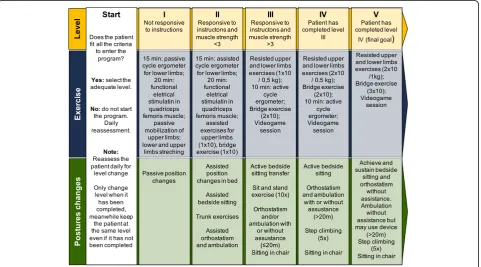
The intervention group will undergo a program of early and progressive mobilization (Fig. 1) created by the re-search team, based on data in the academic literature. As maintenance of functionality seems to depend primarily on the muscular and cardiorespiratory systems, the program is designed for rehabilitation focused on these systems. The protocol describes exercises, tech-niques, and apparatus for maintenance of muscle length, maintenance and gain of muscle strength, aerobic exercises, exercises aimed at reeducation of gait, and cognitive components.
The patients will undergo the prescribed program therapy at the appropriate level for each patient, chosen based on the physiotherapist’s evaluation and evolving within the protocol as described below. The program should be started within 48 h of ICU admission. The patient will be included in the program throughout their stay in the ICU and will be assisted by a specific physio-therapist to apply only the prescribed protocol.
According to the program description (Fig. 1), the patients in the intervention group will have equipment and technologies for the therapy. These devices are a functional electrical stimulator (Fesmed II, Carci®, São Paulo, Brazil), dumbbells, shin guards, a Motomed Letto® active and passive cycle ergometer (RECK Company, Bremen, Germany), a fixed walker, a LiteGait 300MX-30® ambulatory device (Mobility Research, Tempe, AZ, USA), and a Wii Fit® video game with sitting and stan-ding games (Nintendo®, Redmond, WA, USA).
If, during hospitalization, the patient evolves with criteria that indicate that any level of activity has been performed for more than 2 days, they will be excluded from the study.
The five levels of the early and progressive mobilization program (Fig.1) are described below.
Level I
Patient characteristics: not responsive to commands. Physical exercises: passive cycle ergometer for lower limbs (15-min duration) with 35 revolutions per min, passive upper limb mobilization with ten repetitions of flexion and abduction of shoulders and triple hip flexion, and tibialis ischial stretching and simultaneous functional electrical stimulation (FES) in the right and left quadriceps muscles. FES will be set with the follo-wing parameters: frequency (R) 60 Hz, pulse width (T) 250 ms, on time of 4 s and off time of 8 s, applied for 20 min.
[image:4.595.59.541.448.715.2]Postural changes: passive transfer of decubitus.
Level II
Patient characteristics: responsive to commands, muscle strength (MS) less than three for hip flexors and exten-sors according to the Medical Research Council (MRC) Scale [32].
Physical exercises: assisted exercises of upper limbs (one series of ten repetitions), cycle ergometer preferen-tially assisted in the lower limbs with a duration of 15 min, FES in the quadriceps muscles (15-min dur-ation), bridge exercise (one series of ten repetitions), video game session of 15-min duration.
Postural changes: active bed transfer, assisted bedside sitting, trunk control exercises, attempted orthostatism, and assisted walking with specific technologies.
Level III
Patient characteristics: responsive to commands, MS greater than or equal to three for hip flexors and knee extensors according to the MRC Scale.
Physical exercises: resistive exercise of shoulder abductor, elbow flexor, hip flexor, and knee extensor muscles (one series of ten repetitions with a load of 0. 5 kg), active cycle ergometer in lower limbs (15-min duration), bridge exercise (one set of ten repetitions), video game session lasting 5 min.
Postural changes: active transfer to a seated position at bedside, sit and lift training (ten repetitions), orthostatism and walking with or without assistance for a distance less than 20 m, sitting in an armchair.
Level IV
Patient characteristics: responsive to commands, MS greater than three according to the MRC Scale, comple-tion of level III of the program.
Physical exercises: continuation of resisted exercises (two sets of ten repetitions with a 0.5-kg load), bridge exercise (one set of ten repetitions), video game session for 5 min.
Postural changes: actively sitting at the bedside, orthostatism and walking with or without assistance for a distance greater than 20 m, training in going up and down steps, sitting in an armchair.
Level V
Patient characteristics: responsive to commands, MS greater than three according to the Medical Research Council (MRC) Scale, completion of level IV of the program.
Physical exercises: continuing resisted exercises of upper and lower limbs (one series of ten repetitions with a load of 1.0 kg), bridge exercise (one series of ten repe-titions), video game session lasting 5 min.
Postural changes: independent maintenance of bedside sitting, active orthostatism, and independent walking with or without aid for a distance greater than 20 m, climbing stairs, and sitting in an armchair.
Choice of activity level and criteria for progression in the mobilization program
The program consists of different levels of mobilization with progressive levels of activity, intensity, and types of exercise. To determine the appropriate level, the methods used to determine the appropriate level for each patient will be the patient’s ability to understand and their MS. The patient’s capacity to understand will be evaluated through requests to follow simple com-mands, such as“Put your hand on your head, bend your legs, open and close your eyes.” MS at the beginning of the program will be assessed using the MRC Strength Scale. A score of 3 points will be used as a cut-off to de-termine whether the patient can perform the movement alone and against the action of gravity. Patients capable of these movements will progress to the next level.
Thus, if a patient meets the criteria to enter the program, the next step will be to determine the activity level at which he or she will start the protocol. The first criterion is whether the patient can respond to commands; patients who are unresponsive will enter the program at level I. Patients who can follow commands will begin at levels II, III, IV, or V. To determine the spe-cific level of each patient, MS is measured, with a cut-off score of 3 on the force scale. Patients with MS less than 3 will begins the program at level II, patients with MS of 3 or greater will begin at level III. The difference between level I and the other levels is the ability to understand commands, and the differences between the other levels depend on MS. After completing a level, the patient can move to the next level.
Patients will be reassessed daily to determine whether they can advance to the next level. To progress from level I to level II, the patient should have improved consciousness and be able to respond to commands. If MS is less than 3, the patient will enter level II. If the patient’s MS is equal to or greater than 3, they can advance directly to level III.
From level II onwards, patients can advance by one level when they can perform all the exercises prescribed for that level. Therefore, at levels III, IV, and V in the early and progressive mobilization program, the patient must be able to perform all of the physical exercises and postural changes at their present level or they will remain at the same level for the following day. When patients can complete all of the activities, they advance to the next level on the following day.
and respiratory stability. Therapy will be discontinued if the RR is above 35 breaths/min, the MAP is below 60 mmHg or above 120 mmHg, the HR is below 60 bpm or above 140 bpm, or the patient experiences discomfort or unrelenting pain during the therapy.
Patient assessment procedures
At the time of admission to the ICU and up to 2 days after admission, the patient will be examined against the inclusion criteria. The patient’s functionality in the 2 weeks before admission will be evaluated with the Barthel Index, which will be assessed by directly questioning the patient or their caregiver if they are un-able to respond. Evaluation will include hemodynamic, respiratory, and cardiac stability for the safe practice of early mobility, and the absence of exclusion criteria will also be assessed. The patient will then be randomly placed in the control group or the intervention group.
After the patient is enrolled in the study, the initial variables will be collected, consisting of data related to the patient and their hospitalized and pre-hospitalization levels of functionality. At that time, an accelerometer will be placed on the patient to monitor their level of physical activity during the entire stay in the ICU.
Data on the patient’s hospitalization and the evolution of their condition, as well as the level of physical activity performed, will be collected during the entire stay in the hospital.
Upon discharge from the ICU or within 2 days of dis-charge, all patients will undergo a complete evaluation of their respiratory, muscular, and functional systems through methods already described in the academic literature and performed by a blind evaluator. The
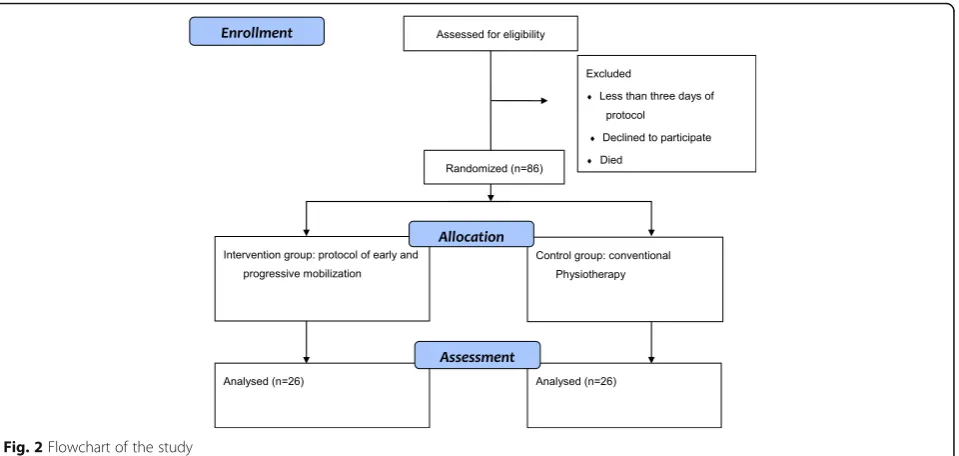
accelerometer will be removed, and the data will be ana-lyzed in a dedicated computer program. Figure 2 shows a flowchart presenting the methods used in the study.
Patients in both groups will use an Actigraph wGT3X-BT accelerometer (ActiGraph LLC®, Pensacola, FL, USA) throughout the length of their hospital stay, a tool which analyzes their position and level of activity. The acceler-ometer will be placed on the dominant lower limb using a bandage and will not be removed until discharge, allowing information on the patient’s physical activity to be col-lected objectively. The evaluation of the intensity of the exercises performed during ICU stay in both groups will be performed through the parameters evaluated by the accelerometer. This instrument is able to identify the intensity of the exercise performed, and for analysis we will divide it into mild, moderate and intense or absence of activity. Exercise intensity will also be monitored and evaluated by the Borg Scale at the end of each physical therapy session. At the end of the ICU stay, the equipment will provide data such as the exercise intensity and time spent lying down, sitting, and standing [24].
The following data concerning hospitalization will be collected: use of vasoactive drugs, use of corticoids or neuromuscular blockers, hypoglycemia, the presence of sepsis, surgery, hemodialysis, use of invasive and non-invasive MV, tracheostomy, and the number of days spent in the different therapies that were evaluated.
Evaluation of the respiratory system, muscular system, and functionality after ICU discharge will be performed by a blind evaluator using methods previously described in the academic literature. These data will be correlated with the physical activity data obtained from the accelerometer.
[image:6.595.61.541.499.727.2]The respiratory evaluation will be performed using the maximal inspiratory pressure test with the use of a man-ovacuometer (Wika Corporate®, Klingenberg, Germany), while evaluation of pulmonary function will be done through spirometry, assessing the forced expiratory volume in 1 second (FEV1) and maximum voluntary
ventilation [25] with a Datospir – Micro C digital spirometer (Sibelmed®, Barcelona, Spain).
The muscular evaluation will be performed by measuring MS with a handgrip dynamometer (Jamar Enterprises LDT®, Hoddesdon, United Kingdom) [26]. Muscle activity will be measured by electromyography of three muscles in the lower limbs—the anterior tibial, medial gastrocnemius, and vastus lateralis muscles—using a Miotool Miotec de-vice (Miotec Equipamentos Biomédicos Ltda®, Porto Alegre, Brazil). The patient will perform the voluntary contraction three times in each muscle, accompanied by an electrogoni-ometer (Miotec Equipamentos Biomédicos Ltda®, Porto Alegre, Brazil) [27,28].
Muscular function and mobility will be evaluated using the Timed Up and Go test [29] and the 2-Minute Walk test [30].
Functionality will be evaluated using the Barthel Index [31], measured by directly questioning the patient and by using the ICU Mobility Scale (IMS) [32].
The demographic data and initial evaluation of the pa-tient will be collected on a data sheet. The papa-tient’s physical activity data will be collected by the accelero-meter and stored in the equipment’s software, and will later be included in the general tabulation of patient data. The physical evaluation data (dynamometry, electromyography, respiratory MS, and spirometry) will be collected on the same data sheet.
Follow-up for outcome assessment
A longer-term follow-up will be performed for functional status by the Barthel Index. This scale will be reapplied at the time of hospital discharge, after 3 months and 1 year of hospital discharge. At these times the Barthel Index will be re-evaluated by phone contact.
Primary and secondary outcome measures and assessment points
The outcome variables of the study will be respiratory, muscular, and functional variables; the length of stay in the ICU; and analyzed variables of physical activity, measured by the accelerometer.
The primary outcome will be the functional status at discharge from the ICU. The functional status is the difference between baseline and final score on both the Barthel Index and the IMS. Therefore, at discharge from the ICU, the Barthel Index and IMS will be redone, and the quantitative final score on those scales will be considered as the primary endpoints of the study. The
secondary outcomes will be the respiratory and muscu-lar variables and the number of days of hospitalization in the ICU. Further secondary outcomes will be the vari-ables of physical activity performed during this period, which include an analysis of the intensity levels of the exercise to which the patient was submitted and the percentage of time spent sitting, lying, and standing.
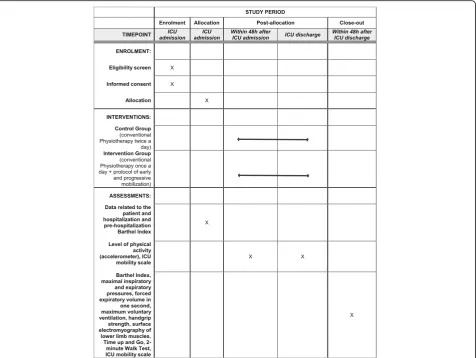
For both groups, the occurrence of any adverse events related to motor therapy, such as respiratory or hemodynamic instability, accidental removal of invasive devices, falls, or pain will be recorded. Figure3illustrates the schedule of enrollment, allocation, intervention, and assessment of the study.
Recruitment procedures
Patients will be recruited directly in the ICU at the time of admission to the unit. The criteria for inclusion in the study and the signing of informed consent for inclusion in the study will be analyzed. Data will be assessed only by the researchers and kept confidentially. Patients have been recruited since February 2017, and the expected completion date of the study is August 2018.
Randomization procedures
Patients will be allocated to each group through comput-erized randomization. It will be a study of superiority, conducted in a single center. The patient allocation will be concealed, and the randomization of the individual will be performed by a researcher who is not involved in enrolling the participants, assigning them to groups, or performing follow-up measurements. This researcher will keep the allocation hidden in sealed brown enve-lopes within a box, which will be opened individually only at admission to the ICU when the participant is enrolled in the study. Individuals will be distributed between two groups. Only the researcher responsible for conducting the protocol will know how the participants are distributed.
Masking/blinding
This is a blind evaluator study. The evaluator will not know the group to which the evaluated subject was assigned. Therefore, the patients will be instructed not to report their activity during hospitalization, and the equipment used in the protocol will be removed from the patient’s bed so that the evaluator cannot see the equipment that was used. The evaluator will also have no access to the tabulation of the split group data and will record the evaluation data on a separate worksheet.
Statistical analysis including sample size calculations
performed for all outcome variables. For the comparison of the physiological variables and the levels of activity be-tween the groups, a statistical test will be used to compare the two independent groups. For parametric data, thettest will be used.
To calculate the sample size for the primary outcome, we based the design on results found in Schweickert (2009) for a clinical trial. To an estimated expected dif-ference in means in the primary outcome (Barthel Index score) of 13 points and a standard deviation of 22 points. Considering a statistical power of 80% and an alpha error of 0.5, we found that the number of subjects should be 48 per group, totaling 96 patients in the study.
Discussion
The main objective of this protocol will be to compare the use of an early and progressive mobility program de-signed to increase the level of physical activity with a conventional therapy program and assess its benefits for the respiratory, muscular, and functional systems of pa-tients in the ICU. Objective descriptions of the intensity
of exercise performed in the ICU are scarce in the aca-demic literature.
Physiotherapy in clinical practice differs greatly in character between care services. Variation in the supply and types of treatments available within the ICU may be the main difficulty in achieving greater benefits, and standardization with early and progressive programs, with the patient being included at most appropriate level of the program (i.e., the maximum the patient can do at that moment), may be the key to better outcomes. Other procedures used in the ICU, such as weaning from MV, weaning from sedation and therapies for sepsis have pre-viously been addressed and are implemented using de-fined protocols [18].
A study conducted in ICUs in Australia showed that, although the vast majority of physiotherapists routinely prescribed exercises in the ICU, practices varied widely across the country, and it was also found that the results of the therapies were not measured. These results led to the conclusion that future research is necessary for ad-equate and improved exercise prescription in ICUs [33].
[image:8.595.62.539.88.446.2]As with other therapies, mobility and exercise in the ICU should be planned in terms of intensity, quantity, duration, and frequency. It is important that physiother-apy in the ICU also has directions and protocols for these characteristics [5]. Studies of current mobility protocols are still scarce, especially regarding physical activity characteristics, such as exercise intensity [13].
We hope that the early and progressive rehabilitation program will result in a higher level of physical activity during ICU admission and thus will also result in improved functional indexes and muscle and respiratory functions at ICU discharge. Also, we hope that our results will contrib-ute to scientific knowledge about the benefits of physical activity in the ICU and help to direct physiotherapeutic ac-tivity in this environment, bringing benefits to patients and the health care system (Additional file1).
Trial status
Trial registration:ClinicalTrials.gov
Registration number: NCT02889146. Registered on 3 March 2016.
The trial commencement was February 2017. It is cur-rently recruiting patients and anticipated completion date is July 2018.
Additional file
Additional file 1:SPIRIT 2013 Checklist: Recommended items to address
in a clinical trial protocol and related documents. (DOC 122 kb)
Abbreviations
FES:Functional electrical stimulation; FEV1: Forced expiratory volume in 1 second; FiO2: Fraction of inspired oxygen; HR: Heart rate; ICU: Intensive Care Unit (ICU); IMS: ICU Mobility Scale; MAP: Mean arterial pressure; MRC: Medical Research Council; MS: Muscle strength; MV: Mechanical ventilation; PEEP: Positive end-expiratory pressure; RR: Respiratory rate
Acknowledgements
The authors thank the Fundação de Amparo à Pesquisa do Estado de São Paulo (FAPESP) for financial support [grant numbers 2015/18768-8].
Funding
Funded by FAPESP Brazil 2015/18768-8
Availability of data and materials
The datasets generated and/or analyzed during the current study are available from the corresponding author on reasonable request.
Authors’contributions
DSS made substantial contributions to conception and design and acquisition of literature. She had been involved in drafting the manuscript and revising it critically for important intellectual content, major contribution. ACL made substantial contributions to conception and design and was involved in drafting the manuscript and revising it critically for important intellectual content. CF was substantial contributions to conception and design and was involved in drafting the manuscript and revising it critically for important intellectual content. All authors read and approved the final manuscript.
Ethics approval and consent to participate
The Hospital das Clinicas FMUSP Ethics Committee(s) approved this study. The researchers will assess all participants and give written informed consent before data collection begin.
Human Research Ethics Approval Committee
The Clinical Hospital, School of Medicine, University of Sao Paulo Ethics Committee approved this study.
Human research ethics approval number Approval number 033559/2016.
Competing interests
The authors declare that they have no competing interests.
Publisher’s Note
Springer Nature remains neutral with regard to jurisdictional claims in published maps and institutional affiliations.
Received: 19 December 2017 Accepted: 10 April 2018
References
1. Garland A, Dawson NV, Altmann I, et al. Outcomes up to 5 years after severe, acute respiratory failure. Chest. 2004;126:1897–9041.
2. Herridge MS, Cheung AM, Tansey CM, et al. One-year outcomes in survivors of the acute respiratory distress syndrome. N Engl J Med. 2003;34:683–93. 3. Herridge MS, Tansey CM, Matté A, et al. Functional disability 5 years after
acute respiratory distress syndrome. N Engl J Med. 2011;364:1293–304. 4. Dowdy DW, Eid MP, Dennison CR, et al. Quality of life after acute respiratory
distress syndrome: a meta-analysis. Intensive Care Med. 2006;32:1115–24. 5. Morris PE, Herridge MS. Early intensive care unit mobility: future directions.
Crit Care Clin. 2007;23(1):97–110.
6. Topp R, Ditmyer M, King K, Doherty K, Hornyak J. The effect of bed rest and potential of prehabilitation on patients in the intensive care unit. AACN Clin Issues. 2002;13:263–76.
7. Berry MJ, Morris PE. Early exercise rehabilitation of muscle weakness in acute respiratory failure patients. Exerc Sport Sci Rev. 2013;41:208–15. 8. Winkelman C. Inactivity and inflammation in the critically ill patient. Crit
Care Clin. 2007;23(1):21–34. Review
9. Convertino VA, Bloomfield SA, Greenleaf JE. An overview of the issues: physiological effects of bed rest and restricted physical activity. Med Sci Sports Exerc. 1997;29:87–90.
10. King L. Developing a progressive mobility activity protocol. Orthop Nurs. 2012;31:253–62.
11. Schweickert WD, Hall J. ICU-acquired weakness. Chest. 2007;131:1541–9. 12. Berg HE, Larsson L. Lower limb skeletal muscle function after 6 weeks of
bed rest. J Appl Physiol. 1997;82:182–8.
13. Hodgson CL, Tipping CJ. Physiotherapy management of intensive care unit-acquired weakness. J Physiother. 2017;63(1):4–10.
14. De Jonghe B, Sharshar T, Lefaucheur JP, et al. Paresis acquired in the intensive care unit: a prospective multicenter study. JAMA. 2002;288(22): 2859–67.
15. Bercker S, Weber-Carstens S, Deja M, et al. Critical illness polyneuropathy and myopathy in patients with acute respiratory distress syndrome. Crit Care Med. 2005;33(4):711–5.
16. Gosselink R, Bott J, Johnson M, et al. Physiotherapy for adult patients with critical illness: recommendations of the European Respiratory Society and European Society of Intensive Care Medicine Task Force on Physiotherapy for Critically Ill Patients. Intensive Care Med. 2008;34:1188–99.
17. Bailey P, Thomsen GE, Spuhler VJ, et al. Early activity is feasible and safe in respiratory failure patients. Crit Care Med. 2007;35:139–45.
18. Morris PE. Moving our critically ill patients: mobility barriers and benefits. Crit Care Clin. 2007;23(1):1–20.
19. Hodgson CL, Stiller K, Needham DM, Tipping CJ, et al. Expert consensus and recommendations on safety criteria for active mobilization of mechanically ventilated critically ill adults. Crit Care. 2014;18(6):658.
20. Schweickert WD, Pohlman MC, Pohlman AS, et al. Early physical and occupational therapy in mechanically ventilated, critically ill patients: a randomised controlled trial. Lancet. 2009;30:1874–82.
22. Garber CE, Blissmer B, Deschenes MR, et al. American College of Sports Medicine position stand. Quantity and quality of exercise for developing and maintaining cardiorespiratory, musculoskeletal, and neuromotor fitness in apparently healthy adults: guidance for prescribing exercise. Med Sci Sports Exerc. 2011;43(7):1334–59.
23. dos Santos Mendes FA, Pompeu JE, Modenesi Lobo A, Guedes da Silva K, Oliveira Tde P, et al. Motor learning, retention and transfer after virtual-reality-based training in Parkinson’s disease—effect of motor and cognitive demands of games: a longitudinal, controlled clinical study. Physiotherapy. 2012;98(3):217–23.
24. Troiano RP, McClain JJ, Brychta RJ, Chen KY. Evolution of accelerometer methods for physical activity research. Br J Sports Med. 2014;48(13):1019–23. 25. Crapo RO. Pulmonary-function testing. N Engl J Med. 1994;331:25. 26. Richards LG, Olson B, Pamiter-Thomas P. How forearms position affects grip
strength. Am J Occup Ther. 1996;50:133–8.
27. Burden AM, Trew M, Baltzopoulos V. Normalization of gait EMGs: a re-examination. J Electromyogr Kinesiol. 2003;13(6):519–32.
28. Merletti R, Hermens HJ. Detection and conditioning of the surface EMG signal, electromyography. Wiley Online Library; 2005. p. 107–31.
29. Rikli RE, Jones CJ. Development and validation of a functional fitness test for community residing older adults. Aging Phys Act. 1999;7:129–61.
30. Guedes MBOG, Lopes JK, Andrade AS, Guedes TSR, Rieiro JM, Cortez LCA. Validation of the two minute step test for diagnosis of the functional capacity of hypertensive elderly persons. Revista Brasileira de Geriatria e Gerontologia. 2015;18(4):921–6.
31. Mahoney FI, Barthel DW. Functional evaluation: Barthel Index. Md State Med J. 1965;14:61–5.
32. Kawaguchi YM, Nawa RK, Figueiredo TB, Martins L, Pires-Neto RC. J Bras Pneumol. 2016;42(6):429–34.