469
A REVIEW ON WIRELESS SENSOR NETWORKS ROUTING
PROTOCOL: CHALLENGES IN MULTIPATH TECHNIQUES
1ABDULALEEM ALI ALMAZROI, 2MA NGADI
1Department of Computer Science, Faculty of Computing, Universiti Technologi Malaysia 2Department of Computer Science, Faculty of Computing, Universiti Technologi Malaysia
E-mail: [email protected] , [email protected]
ABSTRACT
A sensor network basically comprises of low cost sensor nodes which gather data from the environment and transmit them to sink, where they will be afterward processed. Owing to the high density of sensor nodes and restricted communication range, packet forwarding in sensor networks is regularly achieved throughout the multi-hop data transmission. Consequently, routing in wireless sensor networks has been counted a significant field of research over the past decade. Thus, we present an inclusive review and present classification on the current routing sensor protocols, which are particularly designed for wireless sensor networks. We emphasize the main motivation behind the development of each routing protocol category and clarify the operation of different protocols in detail related to energy issues, with emphasis on their advantages and disadvantages. Moreover, the current multipath routing approach is broadly used in wireless sensor networks in order to improve network performance such as load balancing, reliability, fault tolerance, bandwidth aggregation and QoS Improvement. Therefore, in this paper we highlight the notion of the multipath routing approach and its essential challenges, additionally the basic motivations for utilizing this technique in wireless sensor networks. In addition, we contrast and review the state-of-the-art multipath routing protocols that based on energy aware method, fault tolerance and QoS multipath routing. At the end of this paper, a characterized comparison has been forwarded on these methods based on the analysis outcome.
Keywords: Wireless Sensor Networks, Routing Protocols, Energy Efficiency, Fault Tolerance, Qos,
Multipath Routing.
1. INTRODUCTION
The current progresses in wireless communication technologies and the manufacture of low-cost wireless devices have contributed to the introduction of low-power wireless sensor networks. Owing to their simplicity of deployment and the multi-functionality of the sensor nodes, wireless sensor networks have been exploiting for a diversity of applications such as environment monitoring, target tracking and healthcare [1].The major responsibility of the sensor nodes in every application is to sense the target area and broadcast their collected information toward the sink node for additional processing. Resource restrictions of the sensor nodes and unreliability of low-power wireless links [2],in addition with, diverse performance demands of different applications entail many challenges in designing efficient communication protocols for wireless sensor networks [3]. In the meantime, designing appropriate routing protocols to perform different
470 sensor networks have designed based on the single-path routing tactic without deeming the consequences of a variety of traffic load density. In this tactic, every source node chooses a single path that can assure performance requirements of the intended application for transmitting its traffic to the sink node. While route discovery throughout single-path routing tactic can be executed with minimum computational complexity and resource exploitation, the limited capacity of a single path highly decrease the achievable network throughput [6]. In addition, the low flexibility of this tactic besides node or link breakdown may extensively decrease the network performance in critical situations. For example, when the active path fails to convey data packets due to restricted power supply of the sensor nodes, high dynamics of wireless links and physical harms, discovering an alternative path to carry on data transmission process may cause further delay and overhead in data delivery. Thus, owing to resource restriction of sensor nodes and the unreliability of wireless links, the single-path routing tactics cannot be deemed effective techniques to meet the performance demands of various applications. In order to handle the restrictions of single-path routing techniques, another type of routing scheme, known as multipath routing approach has become as a promising technique in wireless sensor and ad hoc networks. Intense deployment of the sensor nodes permits a multipath routing approach to make several paths from individual sensor nodes to the target [7]. Finding paths can be exploiting concurrently to present sufficient network resources in rigorous traffic conditions. On the other hand, every source node can employ only one path for data transmission and change to another path when node or link failures. The multipath routing approach is primarily used for fault-tolerance purposes, and this is known as an alternative path routing [8]. Previously multipath routing approach have been broad been exploiting for diverse network management purposes such as improving energy efficiently, providing fault-tolerant routing, Quality of Service (QoS) [9] and congestion control support in traditional wired and wireless networks. On the other hand, the distinctive features of wireless sensor networks such as constrained power supply, low-memory capacity, higher rate of node deployment that are subjected to frequent breakdowns, QoS constraint and limited computational, as well as the characteristics of short-range radio communications namely, fading and interference Introduce new challenges that should be tackled during in the design of multipath
routing protocols [10, 11]. Therefore, the current multipath routing protocols which have proposed for traditional wireless networks such as ad hoc networks cannot be used directly in low-power sensor networks [12]. Over the past years, this problem has motivated the research community of wireless sensor networks to develop multipath routing protocols which are important for sensor networks. There are numerous research papers surveying proposed routing protocols for wireless sensor networks. These surveys illustrate and analyze the general routing tactics proposed for sensor networks. On the other hand, none of these literatures has presented a comprehensive classification on the presented multipath routing protocols for wireless sensor networks based on energy aware, fault tolerance and QoS based multipath routing. The authors in [4] have presented routing challenges and design issues in wireless sensor networks. They categorize all the presented routing tactics based on the network structure and protocol operation. In addition, the authors [13] have also presented a short overview on the existing fault-tolerant routing protocols in wireless sensor networks and grouped these protocols into retransmission-based and replication-based protocols. Furthermore, [14, 15] categorize the presented multipath routing protocols in ad hoc networks based on the main criterion used in their design. Moreover, [16] have surveyed multipath based Infrastructure, non-Infrastructure and coding multipath routing. Thus, the primary stimulus of accomplishing this research was the lack of a comprehensive survey on the proposed multipath routing protocols for wireless sensor networks based on energy aware, fault tolerance and QoS aware multipath routing. To the best of our knowledge, this paper is the first attempts to categorize and investigate the operation of routing sensor network and also it provides a comprehensive review of multipath routing protocols with highlighting on their advantages and disadvantages of the presented multipath routing protocols in sensor networks.
2. GENESIS OF WIRELESS SENSOR
NETWORK
471 Dust at DARPA (Defense Advanced Research Projects Agency of USA) defined WSN as: “A wireless sensor network is a deployment of huge numbers of small, low-cost, self- powered devices that can sense, compute, interact and communicate with other devices in order to gather local information to make global decisions about the physical environment” [18, 19]. The evolution of WSN development begun with the United States of America (USA) during the period of the Second World War with the then Soviet Union which is now Russia. The USA positioned acoustic sensor network at a tactical spot at the bottom of the sea floor with the intention of tracking Soviet Union submarines. The acoustic sensor network application at that time were known as Sound Surveillance System (SOSUS), and it was wired network instead of the current wireless sensor network so the challenges of energy and bandwidth limitations are less minimal [20]. Major research into innovative and advanced sensor networks was initiated by DARPA by USA with the introduction Distributed Sensor Networks (DSN) project in 1980. The acoustic sensor network comprises of transmission, processing schemes, algorithms, routing and distributed software systems. Modernization has also led to rapid advancement of sensor networks recently with the building of small and inexpensive micro-electro-mechanical systems (MEMS). Therefore, the project developed by DARPA contributed dynamic ad hoc network environments and wireless sensor networks in recent times.
3. MODEL OF WIRELESS SENSOR
NETWORK
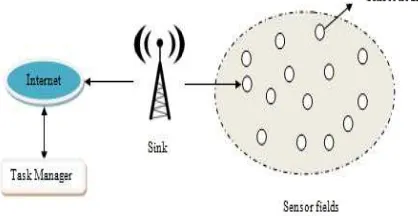
Wireless sensor network has known operational constraints such as resource limitations, node or link prone to failures, nodes densely deployed and the numbers of sensor nodes are so numerous when compared to ad hoc networks. The topology of sensor network has changed over the years, and new technology evolves. The following illustrate the key components of sensor networks: [19, 21] Sensor Field: A sensor field is vicinity where the nodes can be positioned.
Sensor Nodes: Sensors nodes are the heart of the network. It is the responsibility of the sensor nodes to gather information and transmit to the sink or base station; it is engineered for the network. Sink: Sink receives data from various nodes, and then process and stored all the data collected from the nodes. Message correspondences between nodes are diminished because of the sink thereby
[image:3.612.319.528.196.304.2]decreasing energy conditions of the entire network. Task Manager: The tasks Manger acts as a gateway to other networks. The base station also called the centralized control room for data extraction, spread information back and forth to the networks, data processing and storage center with user access controls. See the figure 1 below for a description; [17].
Figure 1: Wireless Sensor Networks Model And Architecture
Data is streamed to these workstations either via the internet, wireless channels, satellite etc. Sensor networks deployed in a specific geographical area does construct a wireless multi-hop network, and the sensor nodes apply wireless medium for transmission namely infrared, radio, Bluetooth during communication. The figure 1 above is the general view of sensor network made by task manager, internet, base station and sensor fields (geographical area deployed).
4. CLASSIFICATIONS OF SENSOR
NETWORKS COMMUNICATION
From the figure 1, the few categories of sensor networks derived are highlighted below;
4.1 Static and Mobile Network
self-472 governing road surfacing monitoring is a classic example of mobile sensor networks. Additionally static sensor networks are much easier to manage and applied, which is different from mobile sensor network because the mobility causes and frequent movements that lead to implementation difficulties.
4.2 Static Sink and Mobile Sink Network
The sink can either be static or mobile and positioned at various places in the wireless sensor network. While the static sink network is stationary having a constant point sit either inside or nearer to the sensing areas. The sensed data are transmitted to the sinks by the sensor nodes. The nodes positioned in the neighborhood of the sink drain their energy and die much quickly in comparison with nodes that are far off from the sink because of increasing packet relaying load contributing to network partition interruption of the network procedures. The mobile sink network involves the processes of the sink movements in the neighborhood sensing areas with the intention of gathering data from the sensor nodes used for equitable distribution of sensor nodes traffic load.
4.3 Single Sink and Multisink Network
There are two classifications of sinks in a sensor network namely single sink network and multiple sink networks. The single sink network is composed of a single sink positioned either inside or nearer of the sensing area. The sink is responsible for receiving the transmitted sensed data from every sensor node. In the case of multiple sink networks, many sinks are positioned at various areas which are either nearer or inside the sensing area. The tree-based routing joined together with multi-sink partitioning to create several routing trees founded at various sinks, and every sensor node is linked to a single sink only.
4.4 Single hop and Multi-hop network.
Single hope and Multi-hop sensor nodes are also one of the numerous components of wireless sensor network. In a single hop network whenever data are transferred to the next router, leading to hop appearance. The subsequent hop relays the packet between one hop the other, thereby single-hop defining as a means of which only one hop transmission takes place from the source to target destination. Wireless station can be linked to wireless access points (WAPs) that are connected to the router through wired network, for instance, wireless access points like Wi-Fi, WiMAX, cellular being connected to a bigger network, the Internet. On the other hand, multi-hop wireless sensor
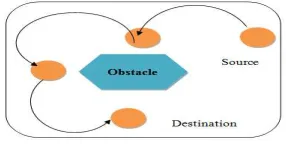
[image:4.612.346.486.366.442.2]networks applied more than two or more hops in transmitting data from source to destination. And this is achieved by the sensor nodes transmitting of the sensed data to the sink by means of wireless exchange of information through one or more intermediate nodes. Every intermediate node is supposed to perform routing before relaying the data through the multi-hop path. The two different applications that can be used for multi-hop communications are MANET and Multi-hop cellular [22]. In wireless sensor networks, single hop communication can be measured not always as distribution of node scattered between the selected areas. A single hop communication is a direct communication between the transceiver of the source node and sink node. The transceiver of the single node is limited by the limitation of distance by the covering signal, "as a result", some features restrict the implementation of single hop communication when the distance has obstacles in between the source and sink [19, 23]. In the figure 2 below shows simple type of single hop wireless sensor networks.
Figure 2: Single Hop Communication
Multi-hop communication has the ability to assist in overcoming the problem experience with a single hop communication. In multi-hop, relay techniques being used which transmit data packets from the source node toward the direction of the sink. Relay techniques are used nodes as a temporary medium to transmit the packet from one node to the others [24]. The nodes can be called as an intermediate node since the nodes located between the sources and destination. Figure 3 shows an example of multi-hop communication with an obstacle between source and sink.
[image:4.612.348.491.621.693.2]473 Although multi-hop can improve communication between source and sinks in wireless sensor networks, the guarantee of multi-hop routes existence is not permanent or that the route particular paths exist for a short period of time. While multi-hop can solve the problem in large communication area, it has the capacity to improve energy efficiency in sensor nodes because multi-hop techniques requires transmission on neighboring nodes which are very close with each other thus decreasing the transmitter functionality. As mentioned earlier, energy conservation is commonly issues in wireless sensor network environment where the sensor node energy needs to be preserved [19]. In comparison, single-hop network has easier network infrastructure and less trouble to manage because the coverage area for sensing data is not big, and nodes sparsely deployed unlike multi-hop that have bigger coverage and broad degree of application, so management is much difficult.
4.5 Self reconfigurable and Non self configurable network
Configurable networks are important in wireless sensor network because of their flexibility. In sensor networks, this can be self reconfigurable network or self configurable network. For non-self configurable, there is a limitation on the capability of the sensor nodes to effectively self-manage itself to become a network. They depend on centralized devices to manage every sensor node before extracting data from each of the nodes. A network of this nature is only applicable for operating in smaller network environments. A self reconfigurable network, on the other hand, is self-autonomous and self-governed can quickly auto-configured itself into becoming a network without the assistance of a remote connection control. The network can be implemented on a much broader levels and does carry out difficult sensing data schedules [25].
4.6 Homogeneous and Heterogeneous network.
Sensor nodes are either grouped into homogenous network or heterogeneous network. Homogeneous network is composed of computer network where all the sensor nodes used similar features such as same protocols, the same configuration and same devices. Their operations are harmonized so can share resources seamlessly. An example of a homogeneous network is a sensor network that uses Microsoft Windows over TCP/IP. In the case of heterogeneous network is a computer network that includes the sensor nodes that are made up different
and varying degree of devices, operating systems and computers. The computational power and data processing tend to be much higher because of combinations of different devices, so sensor nodes can perform complicated tasks to prolong the lifetime of the network and as well as efficient data transmission [26].
5. HARDWARE COMPONENTS OF SENSOR NODE
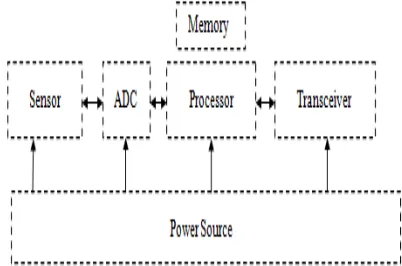
[image:5.612.326.527.401.534.2]In wireless sensor network every node can autonomously carry out processing and sensing schedules as well as communicate with each other and transferring of sense data to the central processing unit (CPU). Some of the commonly used sensor node platforms are Mica2 Mote. Sensor nodes are a small device that has a micro-sensor technology, low power signal processing, low power computation and a short-range communications capability. The hardware components for sensor node consist of Radio Transceiver, Embedded Processor, Memory, Power source and Sensor(s) [17, 27]. The sensor mainly comprises of four constituents and described in the figure 4 below:
Figure 4: Architecture Of Sensor Node
5.1 Embedded Processor
474 8051 microcontroller, and while Mote platform used ATMega128Lmicrocontroller.
5.2 Transceiver
The wireless communication of sensor nodes is the function of the transceiver, and some widely used names of transceivers are Radio Frequency (RF), Laser and Infrared. For wireless sensor applications, RF is the most suitable choice. The operational states of a transceiver are Transmit, Receive, Idle and Sleep. The radio transceiver in sensor node architecture operates at different levels namely; Transmit, Receive, Idle and Sleep.
Transmit: refers to the sending of data among
nodes and to the base station. Receive: collecting transmitted packets from various sections of the sensor networks. Idle: available to receive incoming packets, but not ready to start. Some techniques are used to switch off the functions of the hardware in order to diminish the consumption of energy to lesser levels. Sleep: the process entails switching off considerable sections of the transceiver so limiting its ability to receive any forms of data or information. It is essential to program recovery time and startup energy so as to awake from sleep state. Moreover, the transmissions are through electromagnet radio frequencies which enables the transceivers to broadcast in a bit or byte stream similar to the format of radio waves [17, 28, 29].
5.3 Memory
Sensor node has in-built memories that include chip flash memory, a RAM of a microcontroller and external flash memory. Different types of sensor application might require a unique set of memory requirements, in other words, there is an application dependent. These two types are mainly for storage; in-built memories such as RAM and chips for program storage and external for storing private data. Data can also be discovered by the program memory. For instance, the ATMega128L microcontroller running on Mica2 Mote has 128-Kbyte flash program memory and 4-128-Kbyte static RAM [28].
5.4 Power Source
The consumption of energy in sensor nodes is through sensing data, processing of data and communication. Power is more likely to be consumed by communication of data than when compared with data processing and also sensing data. Battery and capacitors act as storage facilities for power and then supply the power for the sensor nodes. For instance, Mica2 Mote can run on 2 AA
batteries [29]. The battery lifetime is very limited in WSN, so it is a bigger challenge; new ways of trying to improve power supply are by energy-harvesting methods that transform ambient energy such as solar, wind into electrical energy.
5.5 Sensors
Sensors are hardware which generates measurable reaction signal due to changes in environments like weather conditions, pressure, humidity and temperature. Analog signal sensed data are digitized by an analog-to-digital converter (ACD) and transferred to the embedded processor for additional processing. A sensor node can consist of numerous sensors integrated in or connected to the node. The primary objective for providing power supply for sensor nodes is to ensure that enough energy is made available to the nodes at the least cost, volume, weight, recharge time and longer lifespan. Recharging energy supplies might be or may not be an option depending on the environmental friendliness. For instance, primary battery for sensor such Lithium might have 2880Joule per cubic centimeter (J/cm3), whilst Alkaline battery is 1200Joule per cubic centimeter (J/cm3) [29]. The processor and the memory normally control the processes of the sensor node to ensure the node operations are accomplished while the transceiver link the sensor node in the network so becomes the means of communication for the node. The battery (AA size battery or quartz) supplies power not only to all the nodes and also determine the lifetime of the network [17]. To represent energy consumption, a typical sensor node burns up to around 4.8mA when receiving a message; 12mA is used to broadcast a packet and 5µA sleeping duration. Furthermore, the CPU disburses a typical 5.5mA during active mode.
6. WSN And Ad Hoc Networks
475 such as Mobile Ad hoc Network (MANET) and Vehicular Ad hoc Networks (VANETs) [17, 23]. The topology for these types of networks is dynamic and changes rapidly in order to meet environments and infrastructure needs. But the only distinctions identified for VANET that distinguish it from other ad hoc networks are links disconnection are regular, network topology are much higher; energy and storage are much sufficient and geographical area for communication.
6.1 Mobile Ad Hoc Network
Mobile Ad Hoc Network (MANET) belongs to ad hoc category of network that is more dynamic in nature and can quickly adjust to change environmental conditions, auto-configure, self-organized itself instantly without the assistance of centralized workstations. Because there are mobile, the mode of connections are wireless which is the standard Wi-Fi connection or cellular or satellite transmission or mobile nodes communicating with each other by means of Radio frequencies [30]. Due to its efficient characteristic of rapid deployment and self-organization, MANET can be used for several applications such as communication between soldiers and vehicles. The geographical area for local wireless devices is confined to a specific locality because of the wireless connection range, for instance, laptop computers, PDA group together at a certain area, and some might be connected through the internet. MANET is more prone to changes mainly due to node mobility and failures, though changes are lower when compared to other type ad hoc network like VANET; however, security is a bigger concern, so care must be taken when transmitting data over MANET [31].
6.2 Vehicular Ad hoc Network
Vehicular Ad hoc Network (VANET) is another classification of MANET, which features include dynamic network topology changes in a mobile vehicular setup. It is similar to MANET because the building of static network infrastructures is not required. However for communication to take place, wireless devices are placed at vantage locations along the highway as stagnant network nodes. Those devices placed along the roads are then used to connect to a broad range of Intelligent Transportation System (ITS) for vehicular networks. Distribution of messages is by operating within a specific environment or from geographical information, or the internet being the gateway. Compared to MANET, VANET speed controls
patterns are much higher because it comprises of rapid mobility nodes that are not constant and bigger physical limitation which can impede its performances, for instance, tall buildings along highway roads. The two states of affairs for speeding vehicles are; firstly, the vehicles can be discovered within the communication range when the vehicle is heading towards the same route, and secondly, if the vehicles are travelling towards the opposite path, network changes are very pronounced and is a difficult task when vehicles heading towards the opposite paths are so tough to manage the vehicular network [17, 19].
6.3 WSN Vs Ad hoc Networks
476 sensor nodes is important and significant since data collection is normally based on the location. Currently, it is not feasible to use Global Positioning System (GPS) hardware for this purpose [30]. Though WSN and MANET shared some common problems, however, there are primary variations among the two networks and such distinctions are essential because MANET are set up for a specific reason in order to assemble a rapidly emerging communication needs, unlike WSN. Below describes differences between WSN and MANET:
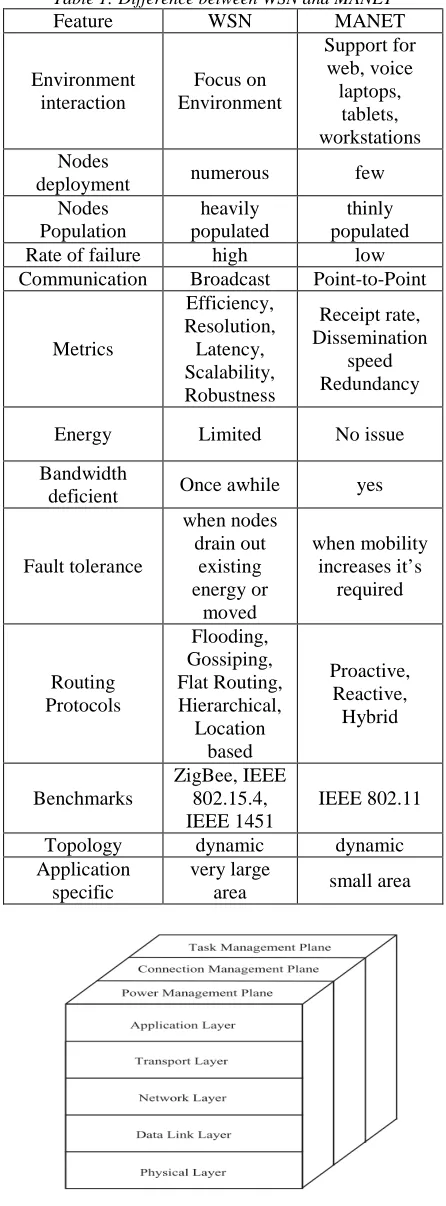
Tables 1 tabulate the differences between wireless sensor network and MANET. The differences as shows in the table can be seen in the area of the several mechanisms used to measure and evaluate each of them. They include environment through which each of them is to be deployed, deployment of nodes, node population, rate of failure, communication, that is, through broadcast or point to point, measurement metrics of each, such as efficiency, latency, scalability, speed, redundancy, robustness, rate of receiving. Another key issue is energy differentiation, while WSN is faced with a big challenge of limited energy constraints, MANET is not confronted by energy issue, bandwidth is a lesser problem in WSN when compared to MANET, identification of fault tolerance in WSN happens whenever nodes are move or existing ones runs out, for MANET it is only happens only when it is not stationed at one place. Both of them have dynamic topology networks can be quickly adjusted to meet changing trends, however, WSN can cover broader covered area, while MANET covered area is very small.
7. OSI OF WIRELESS SENSOR NETWORK
The standard structural design for WSN follows the OSI layer model which consists of five sub-sections namely the application, transport, network, data link and psychical layers. The following figure 5 describes the structure design OSI of WSN;
[image:8.612.306.529.109.712.2]Figure 5: OSI Layers of WSN [32] Table 1: Difference between WSN and MANET
Feature WSN MANET
Environment interaction
Focus on Environment
Support for web, voice
laptops, tablets, workstations Nodes
deployment numerous few
Nodes Population
heavily populated
thinly populated
Rate of failure high low
Communication Broadcast Point-to-Point
Metrics
Efficiency, Resolution, Latency, Scalability, Robustness
Receipt rate, Dissemination
speed Redundancy
Energy Limited No issue
Bandwidth
deficient Once awhile yes
Fault tolerance
when nodes drain out
existing energy or
moved
when mobility increases it’s
required
Routing Protocols
Flooding, Gossiping, Flat Routing, Hierarchical,
Location based
Proactive, Reactive, Hybrid
Benchmarks
ZigBee, IEEE 802.15.4, IEEE 1451
IEEE 802.11
Topology dynamic dynamic
Application specific
very large
477 The Application layer handles traffics and provides a platform for different kinds of applications to interpret the data into meaningful information or transmit further queries to obtain a specific data needed during a period of time. Sensor applications deployed in various areas in recent years such as environment, missions, medicals and, traffic. An additional layer call transport layer which ensures consistency and congestion avoidance, the protocols in this layer have been developed to be used for upstream -user to sink, for instance, ESRT, STCP and DSTN or downstream -sink to the user, for instance, PSFQ and GARUDA. The techniques apply various protocols to discover loss detection (ACK, NACK) and loss recovery [33]. Normally the transport layer protocol is partitioned into two sub-sections: Packet driven and Event driven. In Packet driven, the packet transmitted from the source should arrive at the target destination. In Event driven, any event which has taken place must be able to be detected and acknowledge as notification to reach the sink [19]. Furthermore, Network layer and the main function of this layer is for routing and the main resource constraints are energy supply, limited memory and buffers. The concept behind routing is to be able to discover reliable, efficient disused paths according to pre-determined techniques called metric, and it's quite unique from protocol to protocol [1, 5]. Some routing protocols for this layer are categorized into flat routing, for instance, direct diffusion, in addition other categorizes is hierarchal routing, for instance, LEACH. Finally, location routing such as GAF protocol. Data delivery models can be divided into time-continuous driven, query driven and event driven divisions.
The data link layer is accountable for multiplexing data streams, data frame detection, Medium Access Control (MAC), controlling of error, ensure consistency of packet delivery from the point to point or from point to multipoint. MAC for instance is essential for implementing channel access policies, scheduling, buffer management and controlling of errors and is important for the Sensor network because of its benefits of ensuring energy efficiency, consistency and delay reduction and throughput [32]. The physical layer allows the provision of an interface which is used to broadcast streams of bits across a physical medium. It also selects frequency, carrier frequency generation, signal detection, modulation and data encryption for transmission purposes. IEEE 802.15.4 is the recommended benchmark a lower geographical area for WSN because of its low cost, complexity, energy consumption, range of communication to
ensure maximization of power supply [34]. The OSI protocol is further categorized under management plans diagonally to all the layers including power, connection, and task management. Power Management Plane: The main goal for the power management plan is to take charge of managing the power supplies for all the different sections of the sensor such as sensing data, processing, broadcasting and responses that depend on a resourceful power management scheme at every phase of protocol layers. For instance, at the MAC layer, to conserve energy a sensor node might switch off the transceiver if there is not data to transmit and receive. At the network layer, a sensor node may select a neighbor node with the most residual energy as its next hop to the sink [32]. Connection Management Plane: The handling of configuration and re-configuration of the sensor nodes are through the connection management plan which ensure continuous connectivity and node maintenance of the network whenever changes to the topology due to break down of nodes, a mobile movement occurrence and node addition.
Task Management Plane: Allocation of tasks or schedule the sensing between the sensor nodes is the main duty of the task management plane. This procedure ensures energy efficiency improvement thereby network lifetime is increased. Deployment of sensor nodes is densely populated in the sensing sections so redundancy might occur since not every sensor node around the sensing area will the chance to perform similar sensing schedules. So that’s why management techniques are applied to perform sharing of schedules for several sensors nodes [17].
8. ROUTING PROTOCOL CHALLENGES
478
8.1 Energy Consumption
The main goal of the routing protocols is efficient delivery of information between sensor nodes and the sink. Thus, energy consumption is a major concern in the design of routing protocol in WSNs. Due to the limited energy resources of sensor nodes, data need to be delivered in the most energy-efficient approach without compromising the accuracy of the information content. Hence, many conventional routing metrics such as the shortest path algorithm may not be appropriate. Instead, the reasons for energy consumption should be carefully investigated, and new novel energy-efficient routing metrics developed for WSNs [23, 35]. The major reasons of energy consumption for routing in WSNs can be classified as Neighborhood discovery and Communication vs. Computation:
Neighborhood discovery: Many routing protocols involves every node in order to exchange information between its neighbors. The information to be exchanged can differ according to the routing methods. While most geographical routing protocols involve knowledge of the locations of the neighbor nodes, a data-centric protocol may require the information content of the observed values of each sensor in its surrounding. In each case, nodes consume energy in exchanging this information during the wireless medium, which increases the overhead of the protocol. In order to improve the energy efficiency of the routing protocols, local information exchange should be minimized without hindering the routing accuracy [19]. Communication vs. Computation: It is well known that computation is greatly cheaper than communication in terms of energy consumption. Moreover, in WSNs, the goal is to deliver information instead of individual packets. Consequently, in addition to the conventional packet switching techniques, computation should also be integrated with routing to improve energy consumption. An example, data from multiple nodes can be aggregated into a single packet to decrease the traffic capacity without hindering the information content. Similarly, computation at each relay node can be used to suppress redundant routing information [4, 23].
8.2 Robustness
WSNs rely on the nodes inside the network to deliver data in a multi-hop method. Hence, routing protocols operate on these sensor nodes instead of dedicated routers such as the Internet. The low- cost components used in sensor nodes, however, may result in unpredicted failures to such an extent that the sensor node may be non-operational. As a
result, routing protocols should provide robustness to node failures and prevent single point-of-failure situations, where the information is lost if a sensor dies [19]. Furthermore, the wireless channel results in packets being lost during communication. As well as robustness against node failures, the routing protocol should guarantee that the effectiveness of the protocol does not rely on a single packet that can be lost. Even under very harsh conditions with numerous channel errors, the routing protocol should provide efficient delivery between the sensor and the sink. Fault identification, node or link failures, limited power, physical damage and weather instability are the common occurrence in WSN routing so care must be taken to ensure that a failure should not necessarily have a negative impact on the entire operations of the sensor network. When numerous nodes break down, the MAC and the routing protocols must be dynamic enough to facilitate construction of new communication links, paths through to the data compilation base stations. To achieve this, necessitate amending the broadcasting powers and signaling volumes on the current links to decrease energy utilization or rerouting packets to sections of the network having lot of energy [13].
8.3 Data Aggregation
In most sensor network applications, sensor nodes are closely deployed in the region of interest and work together to achieve a common sensing task. As a result, the data sensed by multiple sensor nodes naturally have a certain level of redundancy or correlation. The key points for data redundancy are the increased toughness to route failures by the protocol, the recovery of data that is being lost and to rebuild the primary message and the same time eliminating too much delay normally associated with when retransmission of data. Aggregation entails the procedure of merging data from diverse sources using operational methods, for instance, average, duplicate suppression technique, maxima [34, 36].
8.4 Node Deployment
479 ad hoc network. In deploying the nodes, if the allocation is not standardized, optimal clustering is enforce in order to permit connection and for managing network operations and energy effectively. When communications between sensors are inside a shorter range transmission, the probable route will include various wireless multi-hops [34].
8.5 Scalability
Sensor node deployments in sensing regions are so huge, running into hundreds or even thousands upon thousands of nodes. So any designed routing protocol technique should have the capability to function with enormous amount of sensor nodes. And additional must be flexible or dynamic enough to rapidly adjust to and response to changing environmental conditions or amendment to other sections of the network. Most sensor nodes can be allowed to be in sleep mode until when needed re-awake again, with only a few supplying hard quality works [32].
8.6 Quality of Service
Applications sensors are time sensitive and so data must be transmitted within a specific time frame at the exact moment. The data have sensed with the longer elapse of time, data might become irrelevant leading to latency issues. But in most sensor applications, preservation of energy that impact the lifetime of the network is regarded more significant when compared with the quality of data being transmitted. When the energy begins to drain, network quality performance is decreased so as to conserve energy dissipation in the nodes and prolong entire lifetime of the network, so energy-aware protocols are essential to analyze and produce the energy conditions for the network [37].
9. ROUTING TECHNIQUES IN WIRELESS SENSOR NETWORKS
The process through which paths are discovered between source and destination for transmitting packets are known as routing. For most networks, routing of incoming packets is normally concentrated in the network layer. In multi-hop networks the source node does not communicate directly to the sink, sensor nodes does the relaying of packets, so the protocols features a routing table which enables the touting algorithm to assist in the creation and maintenance of packet source and destination. Some networks that routing can be done includes telephone network (that is, circuit switching), electronic data networks (Internet),
480
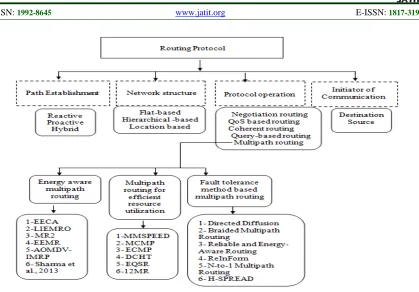
Figure 6: The classification of routing protocols
10. CATEGORIZATION BASED ON THE NETWORK STRUCTURE
The routing protocols designed for WSN can be classified based on path selection, as proactive; an approach where each router can build its own routing table based on the information that each router (or node) can learn by exchanging information among the network's routers reactive; routing is an approach where the routing process needs to discover a route whenever a packet arrives from a source and needs to be delivered to a destination and hybrid; which combine of proactive and reactive. Based on the network architecture, they can be further classified as Flat (flooding, data centric and forwarding) Hierarchical based routing and Geographical based routing.
10.1 Flat routing protocol
There are three types of flat routing schemes, namely, flooding, forwarding and data-centric based routing. Flooding is an old routing technique that can be used in sensor networks. In flooding, every node repeats the data once by broadcasting. It does not require costly topology maintenance and complex route discovery algorithms. Forwarding schemes utilize local information to forward messages. Unlike the traditional routing protocols, forwarding doesn’t maintain end-to-end routing
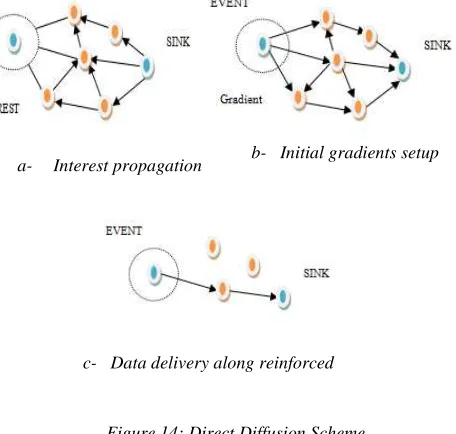
information. Instead, intermediate nodes maintain only neighbor information. One example is the gossiping protocol, a node only forwards data to one randomly chosen neighbor, so it doesn’t maintain any routing information or we can say it uses randomness to forward data. In data-centric based routing, an interest message is disseminated to assign the sensing tasks to the sensor nodes and data aggregation is used to solve the implosion and overlap problems. There are two types of data-centric based routing based on either the sink broadcasts the attribute for data, e.g. Directed Diffusion, or the sensor nodes broadcast an advertisement for the available data and wait for a request, e.g. Sensor Protocols for Information via Negotiation (SPIN). In a flat network routing every single node normally plays similar function and nodes work collectively by performing assigned sensing tasks. Sensor nodes are so numerous, and assigning of global IDs to every single node is almost impossible, so data centric routing was proposed as an alternative that involves the base stations (BS) broadcasting queries to specific sections and wait for response a data from the sensor nodes. Some example of this class of routing protocols is Sensor Protocols for Information via Negotiation (SPIN), Minimum Cost Forwarding (MCF), Directed Diffusion (DD), Rumor Routing, SER (Stream Enable Routing),
481 (Constrained Anisotropic Diffusion Routing),
COUGAR and ACQUIRE (Active Query
Forwarding in Sensor Networks) [5].
10.1.1 Flooding
[image:13.612.295.511.207.307.2]In flooding mechanism the source node broadcast all events to each node in the network. Therefore when a sensor receives a data message, it holds a copy of the message and sends the message to every one of its neighboring sensors and the cycle repeats as shown in the figure 7. The flooding is considered easy-to-implement routing scheme and it is appropriate for various network types, node distributions and environments. The reliability provided by flooding routing method is the major advantage. Due to the message will be transmitted to at least once to every node. However the huge broadcasting the packets in the flooding scheme will cause the broadcast storm [39]. The flooding routing protocol has three deficiencies as:
Figure 7: Flooding Routing
Implosion: as shown in figure 8 (a), the sensor nodes in flooding technique send data by broadcasting; hence similar data might attempt to reach similar sensor nodes through using different paths. When a sensor node receives a packet, it will not check the packet if it has received the packet before. Thus duplicated data are transmitted to similar locations. For instance Node A begins by flooding the packets to every area of its surrounding neighbors; D obtains double copies of the similar packets finally that is not needed. Overlap: as shown in figure 8 (b), the procedure ensures that if two sensor nodes discover similar event, the nodes both attempts to transmit the packets of this event through the sink. By carrying out the process it ensures that the duplicate data of
the event are transmitted to the sink. The boundaries of the region section (r) are enclosed by the two sensors and C receives similar copy of the packet from the two sensors.
Resource blindness: When a sensor node is not transmitting packets in flooding, it does not change their actives, even if the sensor nodes do not have much power to operation [4].
Figure 8: (A) The Implosion Problem, (B) The Overlap Problem
10.1.2 Gossiping
Gossiping is an enhanced version of flooding which avoids the problem of implosion. In gossiping [40], the sender node sends the data at random way to selected neighbor rather than broadcasting the packet blindly. Moreover every node that receives the packets randomly chooses a neighbour and sends the data to it. This procedure is repeated through all the nodes that receive the packets, until the data arrive at its destination. Since gossiping sends the data to only one neighbour, this is energy saving. However, the delay that a data experiences, on its way to the destination, may be too much due to the random nature of the protocol.
10.1.3 Sensor Protocols for Information via Negotiation
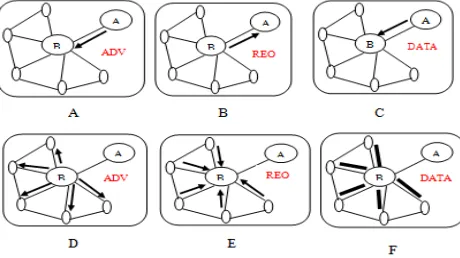
[image:13.612.124.245.379.504.2]482 sending request messages. A SPIN meta-data negotiation mechanism solves the problem of flooding like redundant information passing, overlapping of sensing areas and resource blindness. There are three messages defined in SPIN to exchange data between nodes. These are: ADV message to allow a sensor to advertise a particular meta-data, REQ message to request the specific data and DATA message that carry the actual data as shown in figure 9. The foremost important of SPIN indicates that of frequent topology changes because any changes are done undertaken locally, and every node will get to know about the changes at next neighboring single-hop. A broadcast technique from SPIN information does not ensure the possibility for data delivery. An example point to this, if the nodes that are interested in the data are far away from the source node and the nodes among source and destination are not interested in that data, such data will not be delivered to the destination at all. Therefore, making SPIN not suitable for application such as intrusion detection which requires the reliability of data delivery.
Figure 9: The process of SPIN Protocol
10.1.4 Rumor routing
Rumor routing comprises of two technique event flooding and query flooding [42]. The basic idea of rumor routing is to use agents to route the query to every section of the sensor nodes which are known to have connections to a specific event instead of attempting to flood the whole network to recover data about event currently happening. The agents in rumor routing are utilized as long-life packets to flood events throughout the network. Any event discovered by the sensor node, it adds that particular event to the routing table and produces an agent. The agents can travel through the network and spread messages about the neighboring events
and nodes which are distant. In any situation where a node produces a query for any event, the sensor nodes connected to the route act in response to the query through references from the generated event table, thereby evading the extra overheads involving in flooding the entire network. One key point which distinguishes Rumor routing from Directed Diffusion (DD) is that, it keeps not more than one route between the source and the destination, as DD entails the transmission by multiple routes at cheaper levels. Moreover rumor routing tends to function much better if the amount of events being generated is small. If the amounts of events are too big, the cost of sustaining the agents and event tables for every sensor node is uncontrollable when sensor nodes have not attached a high significance of the events from the base station. Also the cost link with rumor routing is managed by various conditions applied through the techniques like time-to-live (TTL) pertain to the query and agents generations.
10.1.5 Active Query Forwarding in Sensor Networks
Active Query Forwarding in Sensor Networks (ACQUIRE) [43] is a scheme to query sensor networks. The technique has some likeness with COUGAR, but ACQUIRE analysis entire network to be a distributed database to which complicated queries categorized by numerous small sections of queries. The functions of ACQUIRE are; the base station node transmits and forward the query to every node. During this, each node receiving the query tries to respond to the query partially by using its pre-cached information and then forwards it to another sensor node. If the pre-cached information is not up-to-date, the nodes gather information from their neighbors within a look-ahead of d hops. Once the query is resolved completely, it is sent back through either the reverse or shortest-path to the sink. Hence, ACQUIRE can deal with complex queries by allowing many nodes to send responses.
10.1.6 Energy Aware Routing (EAR) Protocol
483 are utilizing frequently, it will lead to depletion of the energy of the node along that particular route, rather multiple routes should be used by assigning a algorithm or forecasting technique to ensure balance and increase approach of the network life. By employing load balancing technique that is more resourceful, it limits the rapid depletion of the energy on every single route. This scheme extends the lifetime of the network because energy dissolve equitably between every sensor node. One of the disadvantages of EAR where it does not provide any mechanism to recover from a node or path failure when compared to Directed Diffusion.
10.2 Hierarchical routing protocol
Hierarchical or cluster-based routing traditionally was meant for wireless sensor network because of its scalability and resourceful communication, so the model of hierarchical routing is also leveraging upon to execute efficient energy routine. In Hierarchical routing protocol the top most energy nodes processes and transmits the data, and lower level energy nodes carry out the sensing of target proximity. They enable an environment for constructing clusters and allocating assigned schedules to cluster heads contribute immensely to overall system performance in terms of energy efficiency, lifetime and scalability and it is the most effective means of reducing energy consumption within the cluster through the activation of data aggregation and fusion, thereby lessen the amount of transmitted messages to the base station Examples of this category are weight-clustering algorithm (EWC), TEEN (Threshold sensitive Energy Efficient sensor Network protocol), Self-organizing Protocol (SOP), LEACH (Low energy Adaptive Cluster Hierarchy) routing protocol and PEGASIS (Power Efficient Gathering in Sensor Information System) routing protocol belongs to this grouping. Some types of hierarchical based routing are explained briefly below;
10.2.1 Low Energy Adaptive Clustering Hierarchy (LEACH)
Low Energy Adaptive Clustering Hierarchy (LEACH) [45] is one of cluster-based protocol in sensor network. The operations of LEACH are the random selections of some nodes to form cluster-heads and rotate every role of the cluster-cluster-heads in order to equitably share the load energy between the sensors in the network. The cluster-head nodes also compress data being transmitted from the nodes that is in the same group of that particular cluster, and send aggregated packets to the Base Station (BS) thereby decreasing the number of
information being sent to the BS. The operation of LEACH is separated into two phases, the setup phase and the steady state phase.
In the setup phase, the clusters are organized and CHs are selected. In the steady state phase, the actual data transfer to the base station takes place. The duration of the steady state phase is longer than the duration of the setup phase in order to minimize overhead. During the setup phase, a predetermined fraction of nodes, p, elect themselves as CHs as follows. A sensor node chooses a random number, r, between 0 and 1. If this random number is less than a threshold value, T (n), the node becomes a cluster-head for the current round. The threshold value is calculated based on an equation that incorporates the desired percentage to become a cluster-head, the current round, and the set of nodes that have not been selected as a cluster-head in the last (1/P) rounds, denoted by G. It is given by:
T (n) =
)
1
mod(
(
1
p
r
p
p
−
if n € G, (1)Where G is the set of nodes that are involved in the CH election. The application of TDMA/CDMA MAC being operated by LEACH normally leads to reduction in inter-cluster and intra-cluster collisions though the gathering of data is still operated at central locations and done once awhile. LEACH uses single-hop routing where each node can transmit directly to the cluster-head and the sink. Therefore, it is not applicable to networks deployed in large regions moreover, the notion of dynamic clustering brings extra overhead, e.g. head changes, advertisements etc., which may diminish the gain in energy consumption.
10.2.2 Power-Efficient Gathering in Sensor Information Systems
484 techniques, and secondly permit only local harmonization among the nodes that are nearer to each other, so bandwidth consumption during communications are reduced. Discovering of nearest neighbor nodes is through signal strength that each node applies to computing the distance of nodes closest to each other. PEGASIS introduces excessive delay for distant node on the chain. Hierarchical-PEGASIS is extended version of PEGASIS, with the only purpose of reducing the delays occurring for data whenever data is being transmitted to the base station. It also provides a scheme result for the packet collection constrains by taking notice by calculation energy x delay metric. Data reduction delays in PEGASIS can be achieved through concurrent data transmission of messages. For the issue of collision and interference coming from signaling between sensors, the two procedures have been recommended. The first technique allows for inclusion of signal coding, e.g. CDMA, while the second procedure entails spatially dividing nodes only are permitted to broadcast concurrently same time. In the second approach only spatially separated nodes are allowed to transmit at the equivalent times. CDMA, which is a chain-based routing protocol is made of reliable nodes, can build chains of nodes to form a tree structure hierarchy, where every chosen node a specific neighboring area send packets to the node that are at the top layer of the hierarchy. This technique enables parallel packets broadcasting thereby delays are immensely reduced. An advantage of PEGASIS is the prevention of clustering overhead usually associated with LEACH. One disadvantage of PEGASIS is the requirement for every single information inside the chain is combined as a single packet contributing to incorrect information transmitted to the sink.
10.2.3 Weight-clustering algorithm
Weight-clustering algorithm (EWC) [47] is energy efficient algorithm with the main reason being to join many special weight metrics such as residual energy, node degree and location, node degree, and the nodes with minimal combined weight become cluster heads which intend contributes to reduction of energy consumption through the improvement in cluster formation and selection processes. At selection phase for cluster head, various factors were taken notice because of the distribution of various weighted co-efficient to parameters like energy residual, location, scale of nodes, and also nodes which have added minimum weight are grouped together to become cluster heads. The
algorithms additional permits adjustments to the co-efficient founded on network criteria. The authors also set various kinds of parameters which have diverse weight structures pertaining to precise system specifications. In selecting the cluster heads, extreme care must be considered as cluster heads can have significant impact on the operations of the entire network. Node suitability is measured through numerous factors such as residual energy, distance between the cluster heads, nodes degree and node and base station before being selected to be cluster heads. These are four procedures the authors recommended for the selection of cluster head; approximating distance among sensor node and base station; determine the neighboring areas of every sensor node. Sensor nodes transmit neighbor discovery messages, that is made by node ID, energy level and distance to the base station; Computation of the degree of diversity and Weight exchange, this is where after every node compute its weight, there are exchange of weight information with neighboring nodes, and which intend maintain the information in their tables.
10.2.4 Threshold-Sensitive Energy Efficient Protocols
485 not generate any data from the network for the user to use.
Figure 10: Hierarchical Clustering in TEEN and APTEEN
The Adaptive Threshold sensitive Energy Efficient sensor Network protocol (APTEEN) [49] is upgraded version of TEEN, the main objectives are of two forms, first to take hold of periodic data compilation, and secondly respond to real-time event schedules. Its architecture is similar to TEEN, and the base station are founded on the clusters, and then the cluster top level heads transmits the properties, values of the threshold, and tasks of the broadcasting to every node. The operation of data aggregation is also done by the Cluster heads for preservation of energy. The APTEEN scheme can analyze three kinds of query such as historical, examination of past data values; one-time, quick and once overall view of the entire network; and persistent, observe schedules for specific time frame. Experiments conducted by the authors in TEEN and APTEEN which have proven that they perform much better when compared with LEACH. The APTEEN’s performance is somewhere among LEACH and TEEN in terms of energy consumption and network lifetime. TEEN gives the best performance because it decreases the number of transmissions. The main disadvantages of the two methods are the overhead and complexity related with forming clusters at multiple levels, the method of implementing threshold-based functions, and how to deal with attribute-based naming of queries.
10.3 Location based routing
In terms of location based routing the nodes are recognized through their locations. The distance between the neighboring nodes are calculated on the base of arriving signal strengths. Medium of exchanging data among neighbors are acquired
through relative coordinates of neighboring nodes. Moreover the discovery of sensor nodes is ascertained directly through communication satellite, applying Global Positioning System (GPS) when sensor nodes are fitted with a low power GPS receiver. Energy is saved by this routing scheme that allowed sleeping of the nodes when there is a lack of activity taken place [38]. Energy Aware Greedy Routing (EAGR), Geographic and Energy Aware Routing (GEAR), Geographical Adaptive Fidelity (GAF) are some examples which are discussed briefly below.
10.3.1 Geographic and Energy Aware Routing
486 recursive geographic forwarding or restricted flooding. In restricted flooding, it is useful if the deployment of the sensors is not heavy. Recursive geographic flooding is more suitable and resourceful for high density network node deployment. From that situation, the region is separated into four sub-regions and four duplicate copies of the data are generated. The procedure of splitting and forwarding carry on till all the regions have one node remaining. GEAR comparison with GPSR protocol which has the same non-energy aware characteristics and was one earliest protocols developed to handle geographic routing which applied planar graphs in resolving the constraints of holes. GEAR shows perform better than GPSR and the advantage of GEAR is the reduction of energy consumption in the path setup time and delivery of packets.
10.3.2 Geographical Adaptive Fidelity
Geographic Adaptive Fidelity (GAF) is also energy-aware routing techniques [51]. The conservation of energy by GAF is conducted through the switching off redundant nodes in the network. GAF conserves energy by turning off unnecessary nodes in the network which does not affect routing efficacy. All the sensor nodes use GPS-assisted geographical based to connect their selves with a section in the virtual grid. When the nodes relate to the same section on the grid, and then there are classified as equal in terms of packet cost routing. The equitability of maintaining nodes in grid sections ensures the area to be designated as sleeping state thereby conserving and saving energy. Thus, GAF can substantially increase the network lifetime as the number of nodes increases. Nodes change states from sleeping to active in turn so that the load is balanced. There are three states defined in GAF, these states are discovery for determining the neighbors in the grid, active which reflecting participation in routing and sleep when the radio is turned off.
10.3.3 Energy Aware Greedy Routing
Energy Aware Greedy Routing (EAGR) [52] is a location-based protocol for providing geographical information on the sensor nodes, and at the same time preserving energy level accessibility in sensor nodes, considering the fact that every node which is available on the shortest path loose energy very fast, leaving a gap the section resulting in packets dropping. EAGR provides all nodes with the identical energy levels where a threshold energy rank is set if the nodes have lesser energy than the original level. The nodes which have a lower
amount than the energy levels are measured as dead, allowing the algorithm to discover the positioning of every node. Every sensor node which have energy level higher than the threshold value obtains information about the neighboring nodes and build a table for the positions, and this positional table is used to compute the average distance of its neighboring nodes. In data relaying, the algorithm chooses the node which have distance equivalent to or lower to average distance value and at the same time having highest energy levels between its neighboring nodes. Through energy level indication, if needed, a fresh node is chosen, then each node depletion of energy is significantly reduced contributing to extended network lifetime. In EAGR, data dropped only if the target destination is not active or if there is lack of neighboring nodes which is alive to relay data. Research conducted by authors comparing the outcome of EAGR with shortest path greedy algorithm using OMNET++ simulator describes the immense difference between the two, with EAGR performing far superior in comparison with the simple greedy algorithm [53].
11. CATEGORIZATION BASED ON PROTOCOL OPERATION
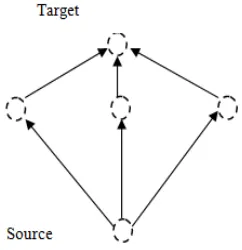
The Classifications based on protocol operations are grouped into Query based, QoS based, negotiation based, Coherent based routing and multipath based. The negotiation based protocols have the objective to eliminate the redundant data by include high level data descriptors in the message exchange. In query based protocols, the sink node initiates the communication by broadcasting a query for data over the network. The QoS based protocols allow sensor nodes to make a tradeoff between the energy consumption and some QoS metrics before delivering the data to the sink node. Finally, multipath routing protocols use multiple paths rather than a single path and it has demonstrated its efficiency to improve wireless sensor and ad hoc networks’ performance for load balancing, reliability, fault tolerance, bandwidth aggregation and QoS Improvement [54].
11.1 Negotiation-Based Routing