WRL
Research Report 2000/2
The Swift
Java Compiler:
Design and
Implementation
technical strategy of the Corporation and has the potential to open new business opportunities. Research at WRL ranges from Web search engines to tools to optimize binary codes, from hard-ware and softhard-ware mechanisms to support scalable shared memory paradigms to graphics VLSI ICs. As part of WRL tradition, we test our ideas by extensive software or hardware prototyping.
We publish the results of our work in a variety of journals, conferences, research reports and technical notes. This document is a research report. Research reports are normally accounts of completed research and may include material from earlier technical notes, conference papers, or magazine articles. We use technical notes for rapid distribution of technical material; usually this represents research in progress.
You can retrieve research reports and technical notes via the World Wide Web at:
http://www.research.compaq.com/wrl
You can request research reports and technical notes from us by mailing your order to:
Technical Report Distribution
Compaq Western Research Laboratory 250 University Avenue
Palo Alto, CA 94301 U.S.A.
You can also request reports and notes via e-mail. For detailed instructions, put the word “Help” in the subject line of your message, and mail it to:
Daniel J. Scales, Keith H. Randall, Sanjay Ghemawat, and Jeff Dean
Western Research Laboratory and System Research Center
Compaq Computer Corporation
Abstract
We have designed and implemented an optimizing Java com-piler called Swift for the Alpha architecture. Swift trans-lates Java bytecodes to optimized Alpha code, and uses static single assignment (SSA) form for its intermediate repres-entation (IR). The Swift IR is relatively simple, but allows for straightforward implementation of all the standard scalar optimizations. The Swift compiler also implements method resolution and inlining, interprocedural alias analysis, elim-ination of Java run-time checks, object inlining, stack alloca-tion of objects, and synchronizaalloca-tion removal. Swift is written completely in Java and installs its generated code into a high-performance JVM that provides all of the necessary run-time facilities.
In this paper, we describe the design and implementa-tion of the Swift compiler system. We describe the prop-erties of the intermediate representation, and then give de-tails on many of the useful optimization passes in Swift. We then provide some overall performance results of the Swift-generated code for the SpecJVM98 benchmarks, and analyze the performance gains from various optimizations. We find that the Swift design is quite effective in allowing efficient and general implementations of numerous interesting optim-izations. The use of SSA form, in particular, has been espe-cially beneficial, and we have found very few optimizations that are difficult to implement in SSA.
1
Introduction
Though originally used mainly in web applications, the Java programming language is becoming popular as a general-purpose programming language, because of its simple design and its properties that improve programmer productivity. Its object-oriented features promote modularity and simplify the coding of many kinds of applications. Its type-safe design detects or eliminates many programming bugs that can oc-cur in other languages. In addition, its automatic memory management takes care of a time-consuming aspect of de-veloping code for the application programmer.
We have developed a complete optimizing compiler for Java called Swift. Because we believe Java will be a popular general-purpose programming language, we are interested in developing an intermediate representation and a set of
ad-vanced optimizations that will enable us to generate highly efficient code for Java programs. Most existing commercial Java systems do just-in-time (JIT) compilation that can do only limited optimizations, but we are interested in studying more expensive optimizations that can improve the relative efficiency of code generated from Java, as compared to other languages, such as C.
Java presents many challenges for a compiler attempting to generate efficient code. The required run-time checks and heap allocation of all objects can introduce considerable overhead. Many routines in the standard Java library include synchronization operations, but these operations are unne-cessary if the associated object is only being accessed by a single thread. Virtual method invocation is quite expensive if it cannot be transformed to a direct procedural call. In addi-tion, if a virtual method call cannot be resolved, the unknown call can reduce the effectiveness of various interprocedural analyses. Many operations can cause exceptions because of run-time checks, and the possibility of these exceptions fur-ther constrains many optimizations.
On the other hand, the strong typing in Java simplifies much of the compiler analysis. In particular, Java semantics ensure that a local variable can only be modified by expli-cit assignment to the variable. In contrast, the creation of a pointer to a local variable in C allows a local variable to be modified at any time by any routine. Similarly, a field of a Java object can never be modified by an assignment to a dif-ferent field. Because of these properties that make most data dependences explicit in Java programs, we believe that static single assignment (SSA) form is highly appropriate as an in-termediate representation for Java. SSA graphs make most or all of the dependences in a method explicit, but provide great freedom in optimizing and scheduling the resulting code.
We have therefore adopted SSA form in Swift, and have used Swift to study the effectiveness of SSA form in ex-pressing various optimizations. Though Swift is a research platform, it is currently a complete Java compiler with all of the standard optimizations and numerous advanced op-timizations. Swift is written completely in Java and installs its generated code into a high-performance JVM [12] that provides all of the necessary run-time facilities.
dis-cuss some of its advantages. We next describe the structure of the compiler and the many interprocedural and intrapro-cedural optimizations in Swift. We then provide some over-all performance results of the Swift-generated code for the SpecJVM98 benchmarks, and analyze the performance gains from various optimizations. Finally, we discuss related work and conclude.
2
Swift Intermediate Representation
In this section, we describe the major features of the Swift intermediate representation (IR). A method is represented by a static single assignment (SSA) graph [3, 15] embedded in a control-flow graph (CFG). We first describe the structure of the SSA graph, the structure of the CFG, and the rela-tionship between the two. Next we describe the type system used to describe nodes in the SSA graph. We then describe our method of representing memory operations and ensuring the correct ordering among them. We also describe the rep-resentation of method calls. Finally, we discuss some of the advantages of the Swift IR.
2.1
Static Single Assignment Graph
As we mentioned above, the basic intermediate form used in Swift is the SSA graph. We consider the SSA form of a method to be a graph consisting of nodes, which we call values, that represent individual operations. Each value has several inputs, which are the result of previous operations, and has a single result, which can be used as the input for other values. Since a value has only a single result, we will frequently identify a value with the result that it produces.
In addition to its inputs, each value has an operation field and an auxiliary operation field. The operation field indic-ates the kind of operation that the value represents. For ex-ample, if the operation field is add, then the value represents an operation that adds the two incoming values to produce its result. The auxiliary operation field is used to specify any extra static information about the kind of operation. For ex-ample, if the operation field is new, then the value represents an operation that allocates a new object, and the auxiliary field specifies the class of the object to be allocated. If the operation field is constant, the value represents a numeric or string constant, and the auxiliary field specifies the actual constant.
The Swift IR contains about 55 basic operations, as sum-marized in Figure 1. These operations include the usual arithmetic, bitwise-logical, and comparison operators. They also include operations for controlling program flow, mer-ging values (phi nodes [15]), invoking methods, accessing the contents of arrays and objects, and allocating new ob-jects and arrays from the heap. Some object-oriented opera-tions include instanceof computaopera-tions, virtual method calls, and interface calls. There are also a few primitives that are
Numeric operations
• constant
• add, sub, mul, div, rem, negate • shl, shr, ushr
• and, or, xor, not • lt, leq, eq, neq, geq, gt • lcmp, fcmpl, fcmpg • convert
Control operations
• if, switch, throw • arg, return • phi
• invoke_virtual, invoke_special, invoke_static, invoke_interface
Memory operations
• get_field, put_field • get_static, put_static • arr_load, arr_store, arr_length
Run-time checks
• instanceof
• null_ck, bounds_ck, cast_ck • init_ck
Miscellaneous
• nop • select • new, new_array
• monitor_enter, monitor_exit
Figure 1: Summary of Swift IR operations
particularly Java-specific, such as operations modeling the
lcmporfcmplbytecodes.
As with most other Java compilers, the Swift IR breaks out the required run-time checks associated with various Java bytecodes into separate operations. The Swift IR therefore has individual operations representing null checks, bounds checks, and cast checks. These operations cause a run-time exception if their associated check fails. A value represent-ing a run-time check produces a result, which has no rep-resentation in the generated machine code. However, other values that depend on the run-time check take its result as an input, so as to ensure that these values are scheduled after the run-time check. Representing the run-time checks as distinct operations allows the Swift compiler to apply optimizations to the checks, such as using common subexpression elimin-ation on two null checks of the same array.
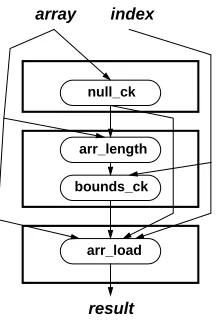
As an example, Figure 2 shows the expansion of a Java array load into Swift IR. The ovals are SSA values, and the boxes are blocks in the CFG. (The CFG will be discussed in the next section.) array and index are the values that are in-put to the array load operation. Java requires that a null check and a bounds check be done before an element is loaded from an array. The null ck value takes the array reference as input, and throws aNullPointerExceptionif the reference is null. The arr length value takes an array reference and the associated null ck value as input, and produces the length of the array. The bounds ck value takes an array length and an array index as inputs, and throws an ArrayIndexOutOf-BoundsExceptionif the index is not within the bounds of the array. Finally, the arr load value takes an array ref-erence, an index, and the associated null-check and bounds-check values, and returns the specified element of the array.
array index
null_ck
arr_length
bounds_ck
arr_load
[image:5.612.124.232.53.213.2]result
Figure 2: Expansion of Java array load to Swift IR
Swift will eliminate redundant initialization checks during optimization. In addition, our underlying JVM replaces an initialization check by a NOP after the first time that it is encountered.
The Swift IR also has about 100 machine-dependent oper-ations which represent or map very closely to specific Alpha machine instructions. As described below, one pass of the compiler converts many of the machine-independent opera-tions into one or more machine-dependent operaopera-tions. The conversion to machine-dependent values allows for optimiz-ation of the lower-level operoptimiz-ations, and allows the instruction scheduling, register allocation, and code generation passes to operate directly on the SSA graph.
Our SSA graph is essentially a factored representation of the use-def chains for all variables in a method, since each value explicitly specifies the values used in computing its result. We have found that many of our optimizations can make efficient use of def-use information as well. When Swift builds an SSA graph, it therefore also builds up def-use information and it updates the def-def-use chains whenever the graph is manipulated. Thus, an optimization can, at any stage, directly access all the users of a particular value.
2.2
Representing Control Flow
The Swift IR actually represents a method as an SSA graph embedded within a control-flow graph (CFG). Each value is located in a specific basic block of the CFG, although vari-ous optimizations may move values among blocks or even change the CFG. A block in a CFG has zero or more incom-ing edges and zero or more outgoincom-ing edges. Some of the out-going edges may represent the control-flow that results from the occurrence of an exception. These edges are labeled with the type of exception that causes flow along that edge.
Each method's CFG has a single entry block, a single nor-mal exit block, and a single exceptional exit. The entry block contains the values representing the input arguments of the method. The exit block contains the value representing the return operation of the method. The exceptional exit block
represents the exit of a method that results when an excep-tion is thrown that is not caught within the current method. Because many operations can cause run-time exceptions in Java and these exceptions are not usually caught, there are many blocks which have an exception edge to the exception exit.
We have chosen in the Swift IR to use the standard defini-tion of a basic block. All blocks end whenever an operadefini-tion is reached that has two or more control exits. An operation that causes an exception therefore always causes the end of a basic block. Because of the large number of operations in Java that can cause run-time exceptions, this design can res-ult in CFGs with large numbers of blocks. Some other Java compilers [8, 22] have used an intermediate form with exten-ded basic blocks, in which an exception-causing operation does not necessarily end a block in the CFG. The use of ex-tended basic blocks may reduce the amount of memory used to represent the CFG. However, we believe that many of the dataflow calculations and interesting optimizations will have to treat the extended basic blocks as separate blocks anyway in order to achieve the desired precision, and therefore will become more complex. In addition, the larger basic blocks are not as important for good scheduling, since Swift uses global code motion and trace scheduling.
Many types of values can affect the control flow of a pro-gram. An if node takes a boolean value as input and de-termines the control flow out of the current block based on that input. Similarly, a switch node determines control flow based on an integer input. Exception-causing operations in-clude method calls, run-time checks, and object or array al-location. In addition, the throw operation explicitly throws an exception.
Each block has a reference to a distinguished value, called the control value. For a block which has more than one out-going edge, the control value is the value that controls the program flow or that may cause an exception. The control value of the normal exit block is the return value. Simple blocks with a single outgoing edge have no control value. The control value field of a block provides easy access to the exception-causing or control-flow value of the block. In addition, the set of control values indicates the base set of values in a method that are “live”, because they are used in computing the return value and for controlling program flow. Other live values are determined recursively based on the in-puts of this base set. Swift uses this definition to do dead code elimination of values that are no longer needed.
All values which are the control value of a block cannot be moved from their block. We say that these values are pinned. Phi nodes are also pinned. Operations that write to the global heap (see Section 2.4) are also pinned. All other operations are not pinned, and may be moved freely among blocks, as long as their data dependences are respected.
du-plicating bytecodes. However, these subroutines complicate control-flow and data-flow representations. We have there-fore chosen to inline these subroutines in the Swift IR, as is done by most other Java compilers [22]. There is a possib-ility of exponential blowup in the size of the CFG if there are multiply nestedfinallyclauses, but in practice this situation is very unlikely.
2.3
Swift Type System
Every value in the SSA graph also has a program type. The type system of the Swift IR can represent all of the types present in a Java program. These types include base types, such as integer, short, or double, as well as array types and object types. We compute the type of each value of a graph as we build the SSA graph from the method's bytecode. As has been noted elsewhere [26], the bytecode for a method does not always contain enough information to recover the exact types of the original Java program. However, it is always possible to assign a consistent set of types to the values such that the effects of the method represented by the SSA graph are the same as the original method. Though Java bytecode does not make use of an explicit boolean type, we assign a type of boolean to a value when appropriate. The boolean type essentially indicates an integer value which can only be 0 and 1, and can enable certain optimizations that don't apply to integers in general.
For some operations, the value type actually further spe-cifies the operation and therefore will affect the specific ma-chine code generated. For example, the generic add opera-tion can specify an integer, long, or floating-point addiopera-tion, depending on its result type. Information about a value's type can also help optimize an operation that uses that value. For example, the compiler may be able to resolve the target of a virtual method call if it has more specific information about the type of the method call's receiver.
The Swift type system contains additional information that facilitates these kinds of optimizations. It allows spe-cification of the following additional properties about a value with a particular Java type T:
the value is known to be an object of exactly class T, not a subclass of T
the value is an array with a particular constant size the value is known to be non-null
By incorporating these properties into the type system, we can describe important properties of any value in the SSA graph by its type. In addition, we can easily indicate prop-erties for different levels of recursive types, such as arrays. One possible generalization of the type system is to allow union types. However, we have not found this extension to be very useful for the Java applications that we have examined.
2.4
Representing and Ordering Memory
Op-erations
Because of Java's strong typing and lack of pointers, the local variables of a method cannot be read or written by any other method in the same thread or another thread. There-fore, all program dependences on a local variable are explicit in the current method, and SSA form is ideal for represent-ing these dependences. All values in the SSA graph can be considered to be temporary variables stored in a large set of virtual registers. It is only near the end of the compil-ation process that the register allocator must choose which values are stored in actual registers and which are spilled to the stack.
On the other hand, reads and writes of global variables or locations allocated from the heap must be represented expli-citly as memory operations, since there may be many hid-den depenhid-dencies among these operations. In Java, these memory operations include getting and putting values into the field of a class object or instance object, and getting or putting a value into an array.
In general, the compiler must ensure that the original ordering among memory operations is maintained, even though the memory operations are not connected in the standard SSA graph. For example, a store operation may write into a field that is read by a later load operation. The store operation does not produce any value that is used by the later load operation, so there is no scheduling dependence between the two operations. However, in order to maintain the original program semantics, the compiler must ensure that the store is executed before the load.
The Swift IR solves this problem by actually having store operations produce a result, which is called a global store [10]. The global store represents the current contents of global memory. Since a store operation modifies the con-tents of memory, it takes the latest global store as an extra input and produces a new global store. Additionally, each load operation takes the latest global store as an extra input. With one exception, these connections now correctly repres-ent the data dependences between memory operations, and therefore allow many optimizations to immediately general-ize to memory operations. The exception is that the SSA graph does not include required dependences – known as anti-dependences – between load operations and following store operations. The Swift compiler enforces these depend-ences via explicit checks during scheduling. It simply adds extra constraints to ensure that a load operation which takes a global store S as input is not moved down past a store op-eration that modifies S (i.e. takes S as input). We chose not to include anti-dependences edges in the SSA graph mainly to reduce the number of edges in the graph. Note also that an anti-dependence between a load and a store operation does not indicate that the load is an input of the store, so repres-enting anti-dependences would require a new kind of edge in the SSA graph.
edges of a block, then a phi node must be inserted in that block to merge the two global stores into a new current store, just as with any other kind of value. The phi node ensures that any memory operations in that block or below do not incorrectly move up one side or the other of the control-flow merge. Similarly, the phi node of global stores at the top of a loop ensures that memory operations do not incorrectly move out of a loop if the loop has side effects. The need for phi nodes for global stores increases the number of nodes in the SSA graph. However, the extra number of phi nodes is not large, and the advantage is the simplicity that results when memory operations are treated like all other values in the SSA graph.
There are a number of necessary modifications to other types of values to handle stores correctly. Method bodies have a global store as an extra input argument. The return value at the end of a method takes two inputs, the actual re-turn value of the method (if there is one) and the latest global store. This adjustment ensures that all stores are correctly kept alive by our dead-code elimination passes. Similarly, a throw value takes a value to throw and a global store as input.1 As described in the next section, method calls take a global store as input and produce a new global store as an output, since any method call may modify global memory.
Java provides constructs for synchronizing on an object, which we model via monitor enter and monitor exit op-erations. The Java memory model essentially requires that memory operations cannot move above or below these syn-chronization operations. We easily enforce this requirement in this Swift IR by having both monitor enter and mon-itor exit take a global store as input and produce a new global store as output. Optimization around reads of volatile fields can be similarly limited by having such reads produce a new global store as output.2
One shortcut that we take with the current Swift IR is that operations that store into an object or an array (put field, put static, and arr store) are pinned to their original block. This pinning is not strictly required, since these operations do not cause exceptions. However, a write to memory has a control dependence on the immediately preceding control operation that determines whether it is executed. For ex-ample, a write to memory should not be moved up above a preceding IF operation. In the Swift IR, we decided not to represent these control dependences, and instead chose to pin store operations to their original block.
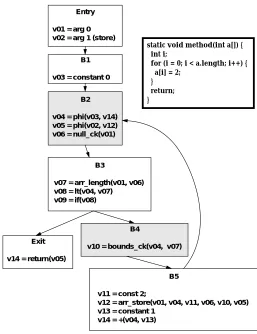
Figure 3 shows a full example of the Swift IR for a method
1The exception exit of a method should also contain a return value which takes an exception object and a global store as input. Such a return value would typically require phi nodes with many run-time exception objects and many global stores as inputs. For simplicity, we do not represent this excep-tion return object. This simplificaexcep-tion does not greatly affect the compiler, since most of the exception processing is done by the run-time system. The only effect is that we cannot easily do method inlining inside code with an explicit exception handler.
2For simplicity, we currently insert a special value before each read of a volatile field that modifies the global store (but generates no actual machine code), instead of creating special versions of the read operations.
Entry
v01 = arg 0 v02 = arg 1 (store)
B1
v03 = constant 0
B2
v04 = phi(v03, v14) v05 = phi(v02, v12) v06 = null_ck(v01)
B3
v07 = arr_length(v01, v06) v08 = lt(v04, v07) v09 = if(v08)
B4
v10 = bounds_ck(v04, v07)
B5
v11 = const 2;
v12 = arr_store(v01, v04, v11, v06, v10, v05) v13 = constant 1
v14 = +(v04, v13) Exit
v14 = return(v05)
static void method(int a[]) { int i;
for (i = 0; i < a.length; i++) { a[i] = 2;
[image:7.612.308.565.59.393.2]} return; }
Figure 3: Example of Swift IR for a Full Method
that does writes to global memory. In this figure, we use our typical method for representing the Swift IR. Because the SSA graph can have so many nodes and edges, we give names to all the values and specify the inputs to a value as named arguments, rather than via edges between those val-ues. We have indicated the CFG in the usual manner, with one additional shortcut. We have not shown the exception exit block, and instead indicate that a block has an outgoing edge to the exceptional exit block by shading the block. That is, a block is shaded if it may produce an uncaught exception.
2.5
Method Calls
The Swift IR has operations representing the various types of method invocation in Java, including class method calls, instance method calls (either virtual or direct), and interface calls. Class method calls are like normal non-object-oriented procedure calls, since there is no receiving object. Values representing method calls all take the method arguments as inputs, as well as the current global store. In addition, in-stance method calls take a null check of the receiver object as an extra input, because Java requires that a null check on a receiver object be done before an instance method invocation on that object is done.
Most method calls produce a program result, as well as producing a new global store. In order to follow the rule that each value in the SSA graph produces a single result, method calls produce a tuple, which consists of the method result and the new global store. The two components of the result are accessed by special SELECT values [10], which take a tuple as input and produce a specified component of the tuple as output. Values representing method calls are therefore typic-ally followed by one or two select values in the SSA graph.
If a method call can cause an exception that is caught in the current method, the call actually produces a distinct global store for each normal and exception successor edge, since the state of global memory may be different depending on how the method call completed. In the common case when no exception of the method call is caught, no extra store is required, since the exception exit will not access the global store.
In the representation of a method body, there are corres-ponding arguments in the entry block for the incoming global store and, if an instance method, the null check on the re-ceiver. In the case of an instance method, the receiver, which is the first argument, is known to be non-null, as indicated by the null-check argument to the method call. When build-ing an SSA graph, the compiler therefore automatically uses the null-check argument when a null check of the receiver is required in the method. The null-check argument does not produce any machine code, so the null checks on the receiver argument have been eliminated.
The above handling of the store and null-check arguments results an especially clean implementation of method inlin-ing. In order to do method inlining, the compiler builds the IR of the original method and the called method. The CFG and SSA graph of the called method are inserted into the CFG and SSA graph of the calling method at the point of the call, with the arguments to the method body of the inlined method replaced by the corresponding arguments to the method call, including the global store and the null check. This matching process establishes all the correct de-pendences (including those for memory operations and those based on the null check of the receiver object) so that all values that were within the inlined SSA graph can now be moved anywhere allowed by the usual dependence rules.
Note that a method that has no write operations returns
its original store argument in the return operation. If this method is inlined, then the operations that were below the call to this method will now be using the store from above the method call, and thus optimizations will automatically take advantage of the fact that the inlined method has no side effects.
2.6
Results of the Swift IR
We have found that the design of the Swift IR has worked out especially well, and has allowed us to do simple and general implementations of various optimizations. In this section, we summarize some of the advantages of the IR, as well as some other implications.
First, the rule for determining if values are equivalent, and therefore candidates for common subexpression elimination (CSE) is very simple, yet works for all operations. A general rule in the Swift IR is that values with identical operations (including the auxiliary operation) and equivalent inputs are equivalent. This rule follows because the global store inputs conservatively represent memory dependences, and all other true data dependences are explicit in the inputs to values.3 With this rule, global CSE can be applied to all values, in-cluding, for example, memory reads. Values that load the field of an object will be candidates for CSE only if they access the same field of the same object, and they have the same global store input. Because the rule about equivalent values is so simple, it is easy to apply in a limited fashion where useful in many other passes of the compiler. In partic-ular, the Swift compiler does a limited form of CSE while building the SSA graph in order to reduce the number of nodes initially created.
Another advantage of the Swift IR is that almost all data flow and ordering dependences are explicit in the SSA graph. As mentioned in Section 2.4, anti-dependences are not ex-plicitly represented and must be generated during schedul-ing passes. In addition, we have pinned various operations to their basic blocks so as not to have to represent vari-ous control dependences. However, all other values are eas-ily moved around, subject to the straightforward scheduling constraints. Like CSE, scheduling is still simple enough that several passes in Swift do limited forms of scheduling to de-termine if some other optimization would be useful.
As we explained in Section 2.5, method inlining is quite simple in the Swift IR. In addition, method inlining just pro-duces a slightly larger SSA graph that is like any other graph and only includes the required dependences between values in the inlined method and values in the calling method. All the standard optimizations, such as CSE, code motion, and dead-code elimination, apply after method inlining without any artificial restrictions.
Interprocedural analysis & opts
Machine-indep. optimizations Build IR for
method
Machine-dep. conversion & peephole optimization
Global CSE & code motion
Instruction scheduling, register allocation, and code generation
Alpha code Method
bytecode Profile information
Information on other methods and classes
[image:9.612.140.473.57.225.2]Information on target architecture
Figure 4: Organization of the Swift Compiler
One property of SSA that became clear to us only after using it in the Swift compiler is that SSA improves the ef-fectiveness of peephole optimizations. SSA form exposes all the users of a value, rather than having some limited window. The Swift compiler therefore applies pattern-based peephole optimizations, where the peephole is essentially the whole method, and values in the pattern can be arbitrarily far apart in the control flow of the method. For example, one peep-hole optimization says that a length operation applied to an array allocated in the method can be replaced by the size ar-gument to the allocation operation. This optimization can be applied no matter where the allocation and length opera-tions are in the method. In fact, it is frequently useful for the case when an array is allocated at the beginning of a method, and length operations, often generated because of required bounds checks, occur throughout the method.
We should note that the use of SSA form does put some constraints on the Swift compiler. First, and most im-portantly, the register allocator must be quite effective and general-purpose, since it must assign the numerous values of the SSA graph to registers and stack locations with minimal copies and spills. Otherwise, the optimization advantages of SSA may be outweighed by the cost of copying and spill-ing values. Similarly, the passes that do the final placement of values in blocks and scheduling within blocks are quite important. The use of SSA form provides much freedom in placing values into a final schedule, so the scheduling passes must make effective use of available information in comput-ing a good schedule.
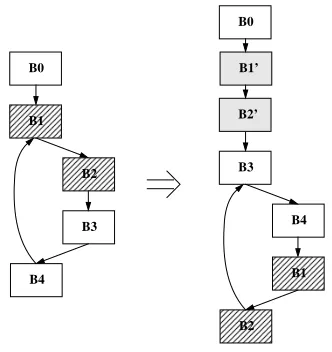
Finally, some groups [22] have noted that SSA form is dif-ficult to use for restructuring optimizations, since it may be difficult to add required phi nodes correctly as code is re-structured and new join points are created. We have not en-countered any difficulty with keeping an SSA graph correctly structured for almost all of our optimizations, including many that modify the CFG, such as branch removal, method inlining, method splitting, conditional constant propagation,
etc. The only optimization that we found difficult in SSA form was loop peeling (see Section 3.3.5). However, other restructuring optimizations, such as loop unrolling or loop interchange, might also be complex in SSA form.
3
The Organization of Swift and its
Optimizations
Interprocedural analyses
• alias analysis
• class hierarchy analysis • escape analysis • field analysis • type propagation
Interprocedural optimizations
• method resolution • method inlining • method splitting • object inlining • stack allocation
• synchronization removal
Intraprocedural optimizations
• bounds check removal • branch removal
• conditional constant propa-gation
• dead code elimination • global CSE
• global code motion • loop peeling • null check removal • peephole optimizations • strength reduction • type test elimination
Machine-dependent passes
• conversion to machine-dependent operations • peephole optimizations • sign-extension elimination • trace scheduling
• register allocation - live range splitting - biased graph coloring with
[image:10.612.115.505.65.209.2]rematerialization • block layout • code generation
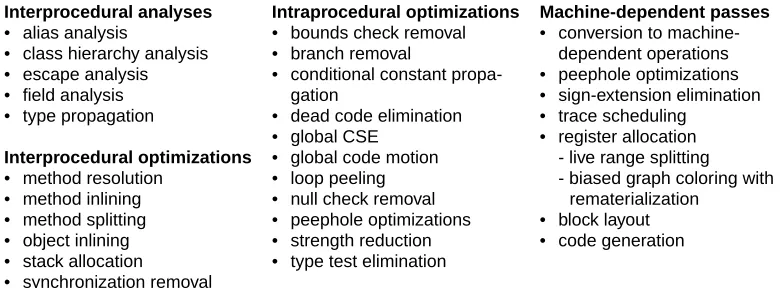
Figure 5: Analyses and Optimizations of Swift Compiler
3.1
Building the IR
Swift generates the IR from a method's bytecode in a manner similar to other Java compilers that use SSA form for their intermediate representation. First, the bytecode is scanned to determine the number of basic blocks and the edges between the basic blocks. Then, a phi node placement algorithm [30] is executed to determine which local variables of the JVM require phi nodes in the various basic blocks. Then the byte-codes of each of the basic blocks are executed via abstract interpretation, starting with the initial state of the local vari-ables on method entry. The abstract interpretation maintains an association between JVM local variables and SSA values, determines the appropriate inputs for new values, and builds the SSA graph.
Swift does numerous simple optimizations during creation of the SSA graph in order to reduce the number of nodes cre-ated. As described above, it can replace an arr length op-eration with the allocated size of an array, if the array was allocated in the current method. It can also eliminate bounds checks if the index and array length are constant. These optimizations are especially important in methods (such as class initialization methods) which initialize large constant-sized arrays.
Swift can also take advantage of profile information that was produced by previous runs. Based on the profile in-formation, Swift annotates the edges of the CFG indicating their relative execution frequency. This profile information is mainly used for decisions about code layout and the choos-ing of traces by the trace scheduler. If no profile information is available, Swift guesses reasonable execution frequencies based on the loop structure of the CFG.
Swift maintains the invariant that there are no critical edges in the CFG. A critical edge is an edge whose source is a block with multiple successors and whose destination is a block with multiple predecessors. Critical edges must be eliminated in order to facilitate the first phase of register al-location, which, as described in Section 3.4.3, places copy operations at the inputs of phi nodes. In addition, the
re-moval of critical edges ensures that global code motion (see Section 3.3.2) has the greatest freedom in placing values so as to minimize unnecessary computations in the final code. A critical edge can be eliminated by introducing an empty block between the source and destination of the edge. Swift eliminates all critical edges immediately after building the CFG, and later phases that modify the CFG are written to ensure that they do not create critical edges.
3.2
Interprocedural Analysis and
Optimiza-tions
The Swift compiler does extensive interprocedural analysis and numerous interprocedural optimizations, many of which can individually be turned on and off. The interproced-ural analyses include class hierarchy analysis (CHA), type propagation, type- and field-based alias analysis, escape ana-lysis, and a new form of analysis called field analysis [24]. Some of the associated optimizations include method resol-ution, method inlining, elimination of run-time checks, re-moval of unnecessary data dependence edges, stack alloca-tion, and synchronization removal.
Several interprocedural optimizations are combined into a single pass and are applied repeatedly, because each optimiz-ation can enable further optimizoptimiz-ations. These optimizoptimiz-ations include method resolution, method inlining, type propaga-tion, and determining types based on field analysis. For ex-ample, the inlining of one method can clarify the type of a re-ceiver of another method call, which may enable that method call to be resolved and possibly inlined as well.
In the following sections, we describe the various inter-procedural analyses done by Swift, and their use in various optimizations.
3.2.1 Class and Method Analysis
modules operate on demand and analyze classes and meth-ods only when requested because Swift encounters an oppor-tunity for a possible optimization.
The basic information maintained about classes is the class hierarchy, as determined by the subclassing relation-ship. By default, this hierarchy is built only as necessary to help resolve method calls. However, Swift can optionally use class-hierarchy analysis (CHA) in resolving method calls. CHA assumes that the set of classes is fixed at compile time, so the entire class hierarchy is known by the compiler [17]. With this assumption, many virtual method calls can be re-solved, because the compiler can determine that there is only one possible implementation of a specified method in a class or all of its known subclasses. If CHA is turned on, Swift loads information on all the known classes and builds a rep-resentation of the class hierarchy. It can then easily scan all the subclasses of any given class. If CHA is not being used, Swift only assumes that it knows all the subclasses of a class if it is markedfinal.
Swift also maintains a variety of information about meth-ods in a hash table. Simple examples include the size of the method's bytecode (for use in deciding whether to inline a call) and whether the method is reimplemented in a subclass (for use in resolving a method call). In addition, a method entry can store many other useful properties which can only be determined by examining the method bytecode. For ex-ample, Swift can determine, when useful for optimization, if a method is guaranteed to return a non-null result. These properties are typically determined on demand by building the Swift IR for the method and then examining the result-ing graphs. The use of SSA in the Swift IR naturally makes these properties somewhat flow-sensitive.
3.2.2 Type Propagation
Type propagation is useful for resolving some virtual method calls, especially when CHA is not being used. As we men-tioned above, Swift assigns types to all values based on avail-able information in the bytecode and SSA graph. Some vues have very specific types. For example, a value that al-locates a new object of a particular class C is known to have an exact type of class C, not any subclass of C, even though the static type in the original Java program indicates C or any subclass. Type propagation ensures that this exact informa-tion is recorded in the type field of applicable values. The use of SSA form makes the type propagation flow-sensitive, since types are merged correctly at control-flow joins. Given the type propagation, Swift can resolve a virtual method call directly if the receiver object of the call has an exact type.
Exact types can be determined in several ways. First, as mentioned above, exact types are known when an object or array is directly allocated. Second, one of the properties of methods that Swift can compute on demand is whether the method returns an object with an exact type. Third, Swift can use field analysis, as described in the next section, to determine if a load from a field of an object always returns
public class Plane { private Point[] points;
public Plane() {
points = new Point[3]; }
public void SetPoint(Point p, int i) { points[i] = p;
}
public Point GetPoint(int i) { return points[i];
[image:11.612.318.558.56.267.2]} }
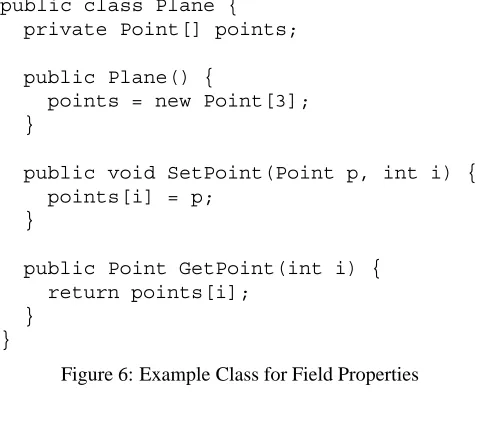
Figure 6: Example Class for Field Properties
an object with an exact type.
3.2.3 Field Analysis
Field analysis is an inexpensive kind of interprocedural ana-lysis that determines useful properties of a field of an object by scanning the code that could possibly access that field, as dictated by language access rules. For example, aprivate
field in Java can only be accessed by methods in the local class, while apackagefield can only be accessed by meth-ods in classes that are in the same package as the containing class.4 An example of a field property is more exact informa-tion on the type of a field. Field analysis can often show that a field, if non-null, only references objects of class C, and never objects of any of C's subclasses. Similarly, field ana-lysis can often prove that a field, if non-null, always contains an array of a particular constant size.
As an example, consider the code in Figure 6. Because the fieldpointsisprivate, the compiler only needs to scan the instance methods in class Planeto determine its properties. The compiler can prove thatpoints, when non-null, must reference an array with base-typePointand a fixed size of 3. In addition, the compiler knows thatpoints
is non-null anywhere outsidePlane's constructor.
As mentioned above, Swift uses exact type information from field analysis to help resolve method calls. Informa-tion about the size of fixed-sized arrays is used to simplify or eliminate bounds-check computations. Null checks can potentially be eliminated for fields that are known to be non-null. While Swift (like most Java systems) uses page protec-tion to implement null checks without any extra code, elim-inating the null check is still useful because it gives the com-piler more flexibility in code motion. As with the class and method analysis modules, a property of a field is computed on demand only if required for a potential optimization. For more details on field analysis, see [24].
Ray start end
Point
int x; int y;
int x; int y;
(a)
Ray start
end
int x; int y;
int x; int y;
[image:12.612.97.258.71.202.2](b)
Figure 7: Example of Object Inlining
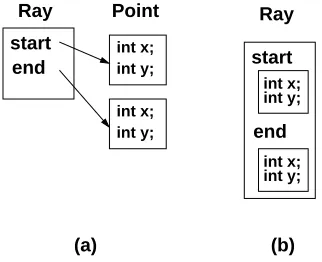
We have also used the field analysis approach to determ-ine fields that are candidates for object inlining. Object in-lining [21] is a method of reducing the overhead of accessing objects by allocating the storage of an object within its con-taining object. If object B is inlined in object A, the cost for accessing object B is reduced by a pointer dereference. Ob-jects A and B are likely to be frequently accessed together, so cache locality may be improved by inlining if A and B are now stored in the same cache line. As an example of object inlining, Figure 7(a) shows the storage layout for aRay ob-ject which references twoPointobjects. Figure 7(b) shows the storage layout when the twoPointobjects are inlined into theRayobject.
Our analysis is unique in that it finds both objects that can be inlined without a header for the inlined object, and objects that can be inlined, but require with an object header. The object header contains an indication of the type of the ob-ject and its method table, and is also typically used for syn-chronizing on the object. The header information is there-fore needed for many operations on the object, including vir-tual method invocations, synchronization, and type-inclusion checks. If an object is inlined with a header, then a reference to the object can be allowed to escape into the heap. We are not aware of any other implementations of object inlin-ing that allow references to inlined objects to be stored in the heap.
Our field analysis finds fields whose contents can always be inlined. The basic criteria is that a new object of partic-ular class must be allocated and assigned to the field in all constructors for the containing class, and the field must not be reassigned by any other method that can access the field. In addition, the inlined object must include its header, if an operation that might require the header may be executed or if a reference to the object might be stored into the heap.5 For more details on our analysis and implementation of object inlining, see [24].
5For the purposes of object inlining, we use very quick and simple tests to determine whether the object might be stored into the heap, in contrast to the more general escape analysis described in the next section.
3.2.4 Escape Analysis
Escape analysis is used to determine if a reference to an ob-ject escapes a thread (i.e. can be accessed by another thread) or a particular method call (i.e. can still be accessed by the current thread after the method call completes). Escape ana-lysis is a necessary component for determining if an object can be allocated on the stack, rather than the heap. If a ref-erence to an object does not escape a particular method call (along with a few other conditions), then the object can be allocated on the stack frame of that call. Escape analysis can also be used for eliminating or reducing the cost of unne-cessary synchronization. If a reference to an object does not escape a thread, then synchronization on the object is unne-cessary.6
Our basic escape analysis assumes that an object escapes if a reference to the object is ever stored into a global vari-able or a heap object (including arrays). We can then use a simple dataflow analysis [23] to determine if any value in an SSA graph escapes. To increase the precision, we make use of summary information about the effects of called meth-ods. Our method analysis module does an interprocedural dataflow analysis on demand to determine if a method may store or return its arguments, and if it definitely returns an unaliased object (i.e. a new object that has not already been stored). If a method call is not resolvable or analyzable, the conservative assumption is made that the method call returns and stores all parameters and does not return an unaliased object.
We have also extended the simple analysis to take advant-age of some information available from field analysis. The main idea is to discover fields which are encapsulated, in the sense that the field is initialized with a reference to a new object by methods in the object's class or package, can only be accessed by these methods, and and is never “leaked” by these methods. If we discover an object that does not escape, then the contents of any encapsulated fields of that object do not escape, and so on, recursively.
Given the above escape analysis, stack allocation and syn-chronization removal are implemented fairly easily. While compiling a method, Swift looks for candidate values, which are either objects that are allocated directly in the method, or are newly allocated, unaliased objects returned by method calls. Swift then reduces its list to the candidates which it can prove do not escape the current method. There are also additional restrictions for objects that will be stack allocated, such as that each object must have a known, exact type and arrays must have small, constant lengths. If an object can be stack allocated, then an operation to allocate the object on the stack is added to the current SSA graph, and the existing
class Example {
int A[] = new int[10]; int B[] = new int[10];
public void method() {
for (int i = 0; i < 10; i++) A[i] = 0;
B[i] = 1; }
}
Figure 8: Code with Data Dependences between Memory Operations
allocation operation is removed. If the object was allocated by a called method, then another version of that method is generated which initializes the object allocated on the stack, rather than creating its own object. If Swift determines that synchronization on an object can be removed, then it scans all uses of the object and removes any synchronization oper-ations. This process may also result in new, unsynchronized versions of called methods being created.
3.2.5 Alias Analysis
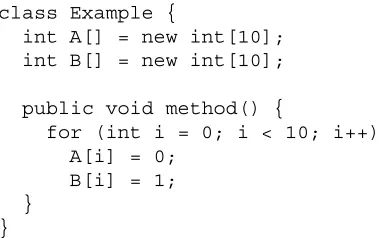
Swift includes a phase which does a form of alias analysis and attempts to relax some of the data dependences in the SSA graph so as to allow further optimizations. This phase tries to eliminate data dependences between two memory op-erations when it can prove that the accessed locations are not aliased, i.e. cannot be the same. As an example, consider the code in Figure 8. The loop contains two array store op-erations, so its representation in Swift IR requires a phi node at the top of the loop merging the initial global store entering the loop and the global store at the end of each loop iteration. The get field operations that load the values ofAandBtake the global stores produced inside the loop as inputs, and can-not move above the loop. The generated code will therefore reload the values ofAandBin each iteration of the loop.
Clearly, though, from Java's type rules, the values ofAand
Bcannot be modified by stores to integer arrays, so the loads ofAandBshould be moved out of the loop. In general, a memory operation that accesses a particular field or an array element of a particular type can only be affected by memory operations that access the same field or same type of array element. We would like a way to represent these reduced dependences among memory operations caused by Java se-mantics, while still enforcing other required dependences.
One possible way of representing dependences among memory operations with more precision is to have many dif-ferent types of “global stores”. For example, we could have a separate global store for each distinct field and each type of array element. A write to fieldfof an object would modify the “f” global store, but not any other global store. Simil-arly, a read of fieldgof an object would only take the “g” global store as input, and therefore would not be affected by
Store operation v of LocType L Method call v with known store effects on L1, L2, etc... Method call v with unknown effects Lock or unlock operation v Phi node v
update input mapping with (L, v) update mapping with (L1, v), (L2, v), etc...
change mapping to (L,v) for all L change mapping to (L, v) for all L for any L that maps to u on all inputs, use (L, u) else use (L, v)
[image:13.612.55.246.52.171.2]⇒ ⇒ ⇒ ⇒ ⇒
Figure 9: Transfer Function for Store Resolution
a preceding write to fieldf.
There are several problems with this approach. First, there would be many more edges and nodes in the SSA graph. Ex-tra phi nodes would now possibly be required for many dif-ferent kinds of global stores, and a method body would now require arg nodes for many kinds of global stores. If the ef-fects of a method call are unknown, then it would have to take every possible kind of global store as input, and pro-duce new versions as output. The same requirement would also apply for synchronization nodes. Also, method inlining would become much more complicated, and might require that new global store arg nodes for the caller method be cre-ated to represent the effects of the called method.
We have chosen to stay with the basic Swift IR, but to use a process which we call store resolution to relax memory dependences by changing the global store inputs of some memory operations. For example, in Figure 8, the desired effect can be achieved by changing the store inputs of the loads ofAandBto be the original store input of the method, rather than one of the global stores in the loop. The loads of
AandBcan then be moved out of the loop.
Store resolution first does a forward dataflow computation to build up information about memory operations, as follows. Let us call a value a “StoreOp” if it produces a new global store. StoreOps are either writes to memory, method calls, or phi nodes. The idea is to look at the subgraph of the SSA graph which consists of StoreOps. We want to compute in-formation at these nodes about sets of locations that are easy to classify. As we mentioned above, in Java we can easily distinguish stores to particular fields of various types, and also to array elements of particular types. Let us refer to these different sets of locations as LocTypes. Then, we wish to compute information at each node of the subgraph that indicates, for each LocType, the most recent StoreOp that might have modified locations of that type.
mod-ified in a loop.
Once we have obtained the state information for each node, store resolution then uses this information to update dependences based on this information. In particular, we ex-amine each load operation in the method. Each load opera-tion has a particular global store G as input. We use the state information at G to determine the actual global store H that the load operation may depend on, based on the LocType of the load. If G is different from H, than we change the load operation to use H as its input rather than G.7
By changing the store input, store resolution makes the relaxed dependence information available to all later passes. For example, if there are two identical load operations and store resolution changes the store input of one to be the same as the other, then a later CSE pass will naturally combine the loads into a single operation. Similarly, a load operation will automatically be scheduled earlier if possible, and may be moved out of a loop.
Our analysis is interprocedural, since it makes use of sum-maries of the effects of methods. As with other method prop-erties, the write effects of methods are computed on demand by the method analysis module. The summary is a flow-insensitive list of fields and array element types (LocTypes) that the method (and all methods that it might call) might modify. Unlike many other properties, the immediate effects of a method can be determined by examining the bytecode without building a CFG or SSA graph.
By categorizing locations into distinct field and array ele-ment types, we have used a type-based alias analysis scheme (where the field name of a location is also considered part of its type). However, store resolution can easily be used with a more sophisticated alias analysis technique which manages different kinds of LocTypes and produces more precision.
3.2.6 Method Resolution and Inlining
As described in the above sections, Swift resolves virtual method calls using information from various kinds of ana-lyses. If CHA is being used, then method information may indicate that there is only one possible implementation of that could be referenced by a virtual call, given the static type of the receiver. If CHA is not being used, Swift can still determine that there is only one implementation if cer-tain classes or methods are declared as final. Alternat-ively, type propagation (possibly with help from field ana-lysis) may indicate that the receiver must have a particular exact type and therefore can only invoke a specific method. Information on exact object types is also used to resolve in-terface calls.
We already described the basic implementation of method inlining in Section 2.5. If inlining is turned on, Swift inlines a method if the method call can be resolved and the size of the method is below a certain threshold. Together with the
7Swift maintains a record of the original store input G, so that the ap-propriate anti-dependences can be calculated in the scheduling phases, as described in Section 2.4.
other interprocedural optimizations, method inlining is ap-plied recursively a small number of times. Recursive inlining is especially important for eliminating the costs of calling su-perclass constructor methods, most of which may be empty. If Swift is being used in an environment where dynamic loading can occur, Swift can limit its use of CHA to simplify correctness issues. In general, if a method M is compiled with information that a particular class has no subclasses or a particular method has only a single implementation below a certain class, then M's code must be modified if the dynamic loading of code means that such information is no longer true. However, it can sometimes be difficult to modify ex-isting code. The problem is that the method M that we want to modify may actually be running or active (on the stack) at the time. In fact, M may be executing an infinite loop or a long-running computation (e.g. reading input from a large file). Therefore, we cannot simply ”wait” until M is no longer running to modify it.
If M has a virtual method call C that is resolved to a dir-ect call using CHA, but the call is not inlined, then it is easy to modify M to turn off the CHA optimization, even if M is running. The JVM can generate a stub that does the virtual call instead, and then atomically change the call C to jump to the stub. A more difficult problem is to reverse the effects of CHA when the virtual method call C has been resolved and inlined. However, as observed in [18], the resolved call C only becomes incorrect if its receiver can possibly contain a new object from the dynamically loaded class. If the re-ceiver of C is an argument of the containing method M, then the receiver existed before the current entry to M and cannot change. Therefore, the receiver cannot reference an object of the dynamically loaded class, so the resolution of C will be correct at least within the current invocation of M. So, M can be invalidated simply by creating a new version of M with the virtual call reinstated, and ensuring that any future calls to M use the new version. Alternatively, instead of generat-ing new compiled code, the JVM can just ensure that future calls to M revert to interpreting the bytecode directly or using less-optimized JIT code.
imple-mentations would require a modification of M, and, for each of these, whether a particular direct call can be modified or if M's code must be invalidated or recompiled.
3.2.7 Method Splitting
Object-oriented programs frequently have small methods that access an encapsulated field or array element in an ob-ject. Method inlining naturally reduces the overhead of these small methods, by eliminating the method call overhead and allowing further opportunities for optimizations. However, sometime these methods contain one or more quick tests for unusual cases before executing a small amount of code in the common case. In the unusual case, these methods may do much more computation or throw an exception. Important examples include methods in the standard Java library such as java.util.Vector.elementAt and
java.lang.String.charAt. A problem with these kinds of methods is that they will not be inlined, because of the code that handles the unusual cases. In addition, when they are compiled as a separate routine, there will likely be extra register saves and restores, because of the extra code.
Swift addresses this problem by checking if it would be beneficial to split up a method. In general, a method should be split if it has only a small amount of code that is com-monly executed, as defined by profile information or static estimates. Currently, Swift defines the “splittable” property much more conservatively, in order to simplify the imple-mentation of method splitting. A method is splittable only if it has a single path to the return statement that calls no other methods, as well multiple other paths that eventually throw exceptions. In such cases, the path to the normal exit is the common case.
The information about whether a method is splittable is another property that is computed and cached by the method analysis module. When Swift compiles a splittable method, it will create auxiliary methods that execute the code along the abnormal paths that throw exceptions. Swift then modi-fies the IR of the original method by replacing the abnormal paths with calls to the auxiliary methods. In addition, if a method calls a splittable method, then Swift only inlines the “split” version of the method with calls to the auxiliary meth-ods.
3.3
Intraprocedural Optimizations
Once all the interprocedural analysis and associated optimiz-ations have been done, Swift does all the standard intrapro-cedural optimizations on the existing IR, as well as a number of optimizations that are more Java-specific. In this section, we describe some of the interesting aspects of these optimiz-ations and their implementation in the Swift IR.
3.3.1 Global Common Subexpression Elimination
By default, Swift does global common-subexpression elim-ination (CSE) and global code motion, as described by Click [11]. That is, by default, Swift will apply CSE to any two values that are equivalent, no matter where they occur in the control-flow graph. In particular, Swift will replace one value by an equivalent value, even if neither value dominates the other. In this case, the resulting value does not neces-sarily dominate all its users. Global CSE must therefore be followed by a pass of global code motion, which places val-ues in blocks so that all valval-ues dominate all their users.
As described in Section 2.6, two values are equivalent if and only if they have identical operations (including the aux-iliary operation) and have equivalent inputs. During global CSE, Swift computes equivalent values via a partitioning al-gorithm [3, 11]. It splits all values into initial partitions based solely on their operation fields and puts the partitions on a work-list. Each time it takes a partition P off the work-list, it builds the set of valuesS
iwhich take one of the values in the
partition as thei th
input, asiranges over the possible input
numbers. If there is a partition Q which has some set of its values Q', but not all its values, inS
i, then Q is split up into
Q' andQ Q
0
, and the smaller of the two resulting parti-tions is added to the worklist. Eventually, this partitioning algorithm terminates, and all values in a partition are equi-valent.
We make one modification to the partitioning algorithm to deal with values that cause exceptions. Exception-causing values cannot be moved from their original block, so we can-not use code motion to ensure that these values dominate their uses after CSE is applied. So, if there are two identical exception-causing values, the first value can only replace the second if the first value's block dominates the second value's block. In addition, the second value is redundant only if the first value definitely did not throw an exception. So, Swift also requires that the second value's block is dominated by the non-exception successor of the first value's block.
To satisfy these conditions, we modify the CSE algorithm as follows. Our rule is to keep the dominating value of a par-tition of exception-causing values as the first element of the partition. Every time that the above partitioning algorithm reaches quiescence, we find the value V in each partition with exception-causing values that is at the highest level of the dominator tree. We make V be the first value of the par-tition and test that V dominates the rest, according to the above condition. If not, then we break up the partition into those dominated by V and those that are not. The smaller of the two partitions is added to the worklist, and we again run the partitioning to quiescence, and so on. Eventually, all partitions with exception-causing values will have their first value dominating the rest.
oth-ers in the case of exception-causing values. It then changes all users of a value in the partition to use the representative value. All of the other values in the partition are no longer used and are removed.
Global CSE is highly effective at removing many run-time checks. For example, many null checks of the same input argument or local variable will be eliminated automat-ically, as long as one of the null checks dominates the oth-ers. Whenever a run-time check is eliminated via CSE, Swift automatically removes the exception edge of the containing block and merges the block with the successor block. Thus, the elimination of redundant run-time checks greatly com-presses the CFG as well.
Note that CSE also applies to loads of fields or array ele-ments. When preceded by the store resolution phase that makes alias information available by relaxing memory de-pendences, global CSE automatically accomplishes the re-moval of redundant loads, which frequently requires a separ-ate pass in other intermedisepar-ate representations. [14].
Swift currently does global CSE (and global code mo-tion) once during the machine-independent processing, after all interprocedural optimizations. This CSE pass elimin-ates redundant expressions that are in the original method or that are exposed by interprocedural optimizations, and can greatly reduce the size of the SSA graph. Swift does an-other round of global CSE (and global code motion) after the conversion to machine-dependent IR, in order to elimin-ate common expressions revealed by the conversion to the lower-level form.
3.3.2 Global Code Motion
Swift currently uses Click's global code motion al-gorithm [11]. The exact choice of a code motion alal-gorithm is not very important, since Swift has a final scheduling pass which can move values over traces consisting of multiple ba-sic blocks. The main purpose of the code motion pass is to move loop-independent values outside of loops and to en-sure that all values are in blocks that dominate their users after global CSE.
Click's code motion algorithm proceeds via two passes over the SSA graph. The first pass finds the earliest pos-sible placement for all values by requiring only that a value be placed such that it is dominated by all its inputs. The second pass finds the latest possible placement for all values by requiring only that a value be placed in a position that dominates all its users (and also respects any necessary anti-dependences, as described in Section 2.4). For any particular value, the early placement will dominate the late value. After determining the latest placement for the value in the second pass, the algorithm scans the sequence of blocks from the early to the late placement of a value. It then places the value in the latest possible block (i.e. lowest in the dominator tree) which is at the lowest loop nesting. The result is that a value is moved out of loops as much as possible, and is otherwise put in the most control-dependent block.
public boolean equals(Object o) { if (this == o)
return true;
ValueVector vv = (ValueVector) o; if (ptr != vv.ptr)
return false;
for (int i=0; i< ptr; i++) if (!v[i].equals(vv.v[i]))
[image:16.612.324.539.51.182.2]return false; return true; }
Figure 10: Example of Elimination of Duplicate Inputs to Phi Nodes
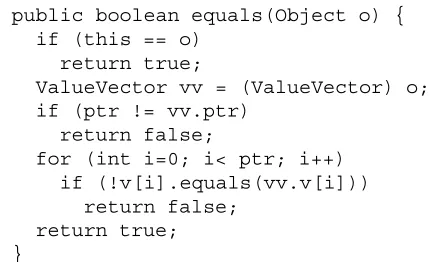
Immediately before code motion, Swift does a quick pass to try to eliminate duplicate inputs to phi nodes. The mo-tivation is for code such as the method from a SpecJVM98 benchmark shown in Figure 10. The SSA graph for the method has a phi node in the final block that merges all the possible return values. This phi node has two inputs which are the value 'true' (actually just 1) and two inputs which have the value 'false' (actually just 0). The generated code has two sequences that load zero and jump to the epilog, and two sequences that load 1 and jump to the epilog. (Even worse, the constant 1 is sometimes put in a different register and hoisted to the dominating block of the branches, result-ing in greater register pressure.)
To get rid of these duplicate code sequences, Swift scans blocks for phi nodes with duplicated inputs. If such a phi node is found, and the only other phi node in the block is for global stores, then the compiler eliminates the duplicate inputs by inserting an extra predecessor block that joins all the blocks corresponding to the duplicate inputs. (The new block may need to have a phi node to merge the store inputs for these blocks, but this doesn't not actually generate any code.) The result of the optimization is that the register cop-ies for the duplicated phi inputs will be merged into a single code sequence, and the duplicated value can now possibly move down into the new block.
So, in the example in Figure 10, there will be just one code sequence that loads one and returns, and one code sequence that loads zero and returns. This optimization occurs most frequently with return values, but is applied when appropri-ate for any phi nodes with duplicappropri-ated inputs.
3.3.3 Branch Removal